Why The Finance Minister Is the Most Important After the Prime Minister


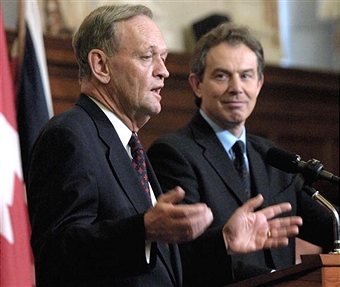
This photo captures Chretien’s wiliness and Blair’s mild amusement thereto.


Introduction

If you asked Canadians, Britons, or Australians which minister is the most important after the prime minister, you would almost invariably get the same answer: the Finance Minister — known as the Chancellor of the Exchequer in the United Kingdom and Treasurer in Australia, but they fulfill the same function. In contrast, if you asked Americans which of the President’s cabinet secretaries is most important, most would probably cite the Secretary of Defence, or possibly the Secretary of State. The Secretary of Homeland Security and the Attorney General would round out the top four. But, having lived in the United States for five years (2001-2006), I’m confident that none of them would mention the Secretary of the Treasury! Even those who generally pay attention to the news might not know who occupies that office at any given moment. I knew that Rumsfeld and Powell were the Secretaries of Defense and State in 2004, but I couldn’t have told you at the time who was the Secretary of the Treasury.

There is a very good reason for this, which I shall return to in the conclusion. But first, I shall discuss a very amusing example that illustrates the point.

Politicians’ Autobiographies

I generally enjoy reading the autobiographies of former heads of state and government; while they are, by definition, exercises in propaganda, they also offer interesting insights into how the executive branch of government works in practice and how successful politicians think and deal with both routine matters and crises. (I emphasize “successful” politicians, because the unsuccessful and mediocre, like Joe Clark or Kim Campbell, tend not to write memoirs in the first place. What would they even write? And who would bother to read them?) Thus far, I have Margaret Thatcher’s, Tony Blair’s, and Jean Chretien’s memoirs.

Tony Blair’s memoir, A Journey: My Political Life, contains a passage that Canadian politicos would very both interesting and amusing. He describes a meeting that he took with Gordon Brown on 15 March 2006, the day that the Cash-for-Access Scandal broke. The controversy involved a Labour Party fundraiser who had allegedly offered peerages in exchange for donations, under the guise of loans, to the Labour Party, given that new accountability laws only required that the names of donors be published, but allowed those who gave loans to remain anonymous. In any event, the Blair government had set up an Appointments Commission for life peerages in the House of Lords, which reduced the prime minister’s absolute authority to nominate new peers and made these patronage appointments more difficult. (Incidentally, Prime Minister Trudeau drew upon the House of Lords Appointment Commission, sponsored by the Cabinet Office, in devising a similar Independent Advisory Board for Senate Appointments).[1] This Cash-for-Access Scandal itself didn’t reach the levels of the Sponsorship Scandal, though the British Parliamentary Expenses Scandal of 2009-2010 bears a resemblance to the Senate Expenses Scandal.

When Gordon came in, he was in [a] venomous mood. I can truthfully say it was the ugliest meeting we ever had. To be fair to him, for some reason he thought this whole donations business had been a way of leaving him with some frightful scandal, a sort of ticking bomb that would then wreak his leadership in the same way, as he put it to me, Jean Chretien had done to Paul Martin in Canada (there had been a funding row in the Liberal Party that Paul Martin had inherited from the time Jean was prime minister). […]

Anyway, it [the meeting] was not pleasant and there were things said that should remain in the privacy of that room and our recollection. Suffice to say, he [Gordon Brown] felt I was ruining his inheritance and I felt he was ruining my legacy.[2]

The similarities between the strained dynamic between Tony Blair and Gordon Brown on the one hand and the overt bitter acrimony Jean Chretien and Paul Martin on the other are obvious and instructive – and the fact that both Blair and Brown were aware that their conflict mirrored that between Chretien and Martin makes the similarities more amusing. Australian Prime Minister John Howard and the Australian Treasurer Peter Costello also famously feuded with one another throughout the 1990s, and they each represented different wings of the Liberal Party of Australia.[3] Tony Blair’s chief of staff, Jonathan Powell, noted the similarities between these three cases in his memoir, The New Machiavelli, and he superimposes the Canadian example on his British experience and expresses sympathy with Chretien over Martin.[4]

Elsewhere in his autobiography, Blair speaks highly of Chretien and trusted his political instincts and followed his advice in May 2001 during the outbreak of Mad Cow Disease.[5] It isn’t much of a stretch to imagine that Blair sought Chretien’s advice on dealing with his troublesome Chancellor, Gordon Brown, based on his experience in dealing with Paul Martin.

Brown and Martin had another thing in common: they were also both unkempt and often wore frumpy suits.

Likewise, one could easily picture Gordon Brown and Paul Martin chatting at G7 Finance Ministers’ conferences and sharing their loathing for Blair and Chretien and exchanging notes on plotting against their respective prime ministers. In fact, Paul Martin confirms as much in his autobiography Hell or High Water as he describes his first meeting with Gordon Brown in Denver, Colorado in 1997. Martin practically gushes about Brown:

[…] we were well on our way to becoming fast friends. He was open. He was smart. And, to my surprise, he shared more of my fiscal philosophy than I expected from a Labour politician. As our friendship grew over the many encounters we had at finance ministers’ meetings in the coming years, it was not lost on either of us that our relationships to our respective prime ministers was very similar – although that was something that we rarely discussed.[6]

Martin deigns to acknowledge that he and Brown only “rarely discussed” their mutual predicament; he doesn’t even try to suggest that they never discussed it. I suspect that they discussed it more than Martin lets on! Martin also describes how he and Brown developed the G20 in 1998-1999,[7] and how they shared in a Social Gospel and advanced the policy of forgiving the debt and loans from developing countries after drawing inspiration from the Jubilee Debt described in Leviticus 25:25-55.[8] Their friendship endured even after Martin’s premiership.[9]

Blair and Brown shared a genuine friendship in the 1980s, but they friendship turned into rivalry in 1994 after making their infamous “Deal”, where Brown agreed to spare the Labour Party a fractious leadership election in exchange for supporting Blair and being poised to become the most autonomous Chancellor of the Exchequer that the United Kingdom had ever seen. In contrast, Chretien and Martin fought a bitter campaign for the Liberal leadership in 1990 and had always loathed and mistrusted one another — and neither had ever seriously tried to pretend otherwise. Blair led his “New Labour” to three parliamentary majorities, served as prime minister for 10 years, and became the most successful Labour prime minister in history. Chretien led the Liberals to three consecutive parliamentary majorities (the best since Sir Wilfrid Laurier’s four consecutive majorities) and served as prime minister for 10 years. Along with Bill Clinton, they both considered themselves “Third Way” center-left politicians whose governments balanced social justice and economic liberalism. And, of course, both Chretien and Blair had fraught relationships with their finance ministers.

Paul Martin succeeded Chretien under the cloud of the Sponsorship Scandal, and it is clear that Chretien made the decision to prorogue Parliament in November 2003 in order to prevent Auditor General Sheila Fraser from tabling her report on the subject until after Paul Martin had become prime minister and reconvened the next session of parliament.[10] He served as prime minister for only just over two years. Similarly, Gordon Brown succeeded Tony Blair but only served as prime minister for 3 years. Both earned rebukes as indecisive and weak leaders who paled to their predecessors, and both led their parties to humiliating electoral defeats and years in opposition. The Economist famously dubbed Paul Martin as “Mr. Dithers,” and the British press also attacked “Bottler Brown” for his disquieting indecisiveness over whether to call an early general election 2007 (since prime ministers could still do snap elections prior to 2011), and whether to participate in a Canadian-style televised leaders’ debate when the election finally arrived by necessity in 2010.[11]

Conclusion

Some Canadian media noted this same passage in Blair’s memoir when it was published in 2010, but they certainly did not delve more deeply into the matter.[12] And the Globe and Mail’s headline that “Blair’s memoir reveals how Chretien-Martin fuelled his split with Brown” is a gross misrepresentation of both Blair’s autobiography and Canada’s importance. Chretien eventually fired Martin and dismissed him from Cabinet in 2002, but Blair never dismissed Brown, though, according Jonathan Powell, he did consider doing so on several occasions.[13] The Toronto Star’s headline “Tony Blair’s memoirs cite Chretien-Martin Fight” is accurate because it simply states a fact and doesn’t exaggerate Canada’s importance. As amusing as they are, these similarities between political rivalries in the United Kingdom, Canada, and Australia reveal a fundamental characteristic of parliamentary systems of responsible government.

The Constitution Act, 1867 entrenches Responsible Government and this balance between the executive and legislature through sections 53 and 54.[14] Section 53 mandates that all money bills must originate in the House of Commons, from which the bulk of the Ministry is drawn; section 54 states that all money bills must receive the Royal Recommendation, which the Governor General grants on ministerial advice. In other words, only the people’s elected representatives can introduce bills that would levy tax or grant expenditures, and that bill can only proceed if the executive wishes to take responsibility for it. Lord Durham referred to this arrangement as “the real protection of the people.” Responsible Government does not “fuse” the legislature and executive, as many lazy and incurious late 20th- and early 21st-century political scientists say. Instead, Responsible Government maintains a narrow separation of powers and brings the executive and legislature into balance and “harmony,” as 19th-century scholars like Alpheus Todd said, and makes them act on the same wavelength. [15].

In contrast, the United States Constitution sets up a presidential-congressional system that relies on a rigid separation of powers and a republican equivalent of the 18-century British system. The Ineligibility Clause prevents the executive and legislature from operating on the same harmonic wavelength and expressly forbids the congressional representatives from serving simultaneously as cabinet secretaries. This is why Responsible Government could never have developed by convention in the United States. While the Origination Clause of United States Constitution also drew upon the British tradition and mandated that money bills must be introduced in the lower house, the House of Representations, the US Constitution contains no equivalent to the Royal Recommendation. The President introduces a budget to Congress, but Congress can amend or reject it and retains the absolute and ultimate power of the purse. Neither the President nor the Secretary of the Treasury are responsible for the budget that Congress passes. The President and cabinet secretaries remain in office pursuant to Article II of the US Constitution, not at all based on whether they command the confidence of Congress. That is why no American would suggest that the Secretary of the Treasury is the most important cabinet secretary.

The Minister of Finance in Canada, the Chancellor of the Exchequer in the United Kingdom, and the Treasurer in Australia are the most important cabinet ministers after their respective prime ministers because Responsible Government is all about the money: who proposes taxation and spending (the executive), who approves taxation and spending (the legislature), and who takes responsibility for taxation and spending (the executive). In contrast, the Secretary of the Treasury of the United States doesn’t matter because he cannot and does not take responsibility for taxation, spending, and the budget. The Finance Minister is the most important after the Prime Minister because he is responsible for fiscal policy and the budget.

Similar Posts:

Endnotes   

[1] Tony Blair, A Journey: My Political Life (Toronto: Alfred A. Knopf Canada,2010), 598-599.
[2] Blair 2010, 600.
[3] Peter Hartcher, “Fiscal Feud: The Conflict Between John Howard and Peter Costello Ran Much Deeper Than Mere Political Tensions,” Sydney Morning Herald, 25 April 2009; Peter Hartcher, “Howard Unleashes: Elitist Costello Blew His Chance At Power,Sydney Morning Herald, 22 October 2010; Paul Kelly, “Peter Costello Blew His Chance by Pushing Me, Declares John Howard,” 22 October 2010.
[4] Jonathan Powell, The New Machiavelli: How to Wield Power in the Modern World (London: Vintage Books, 2010), 106.
[5] Blair 2010, 308-309.
[6] Paul Martin, Hell or High Water: My Life In and Out of Politics (Toronto: McClelland and Stewart Ltd, 2008), 197.
[7] Martin 2008, 206-207.
[8] Ibid., 212-213.
[9] Ibid., 460-461.
[10] Martin 2008, 249-250; Jean Chretien, My Years as Prime Minister (Toronto: Alfred A. Knopf Canada, 2007), 400.
[11] CBC News, British Magazine Dubs Martin ‘Mr. Dithers,'” 17 February 2005; BBC News, “How Election Fever Developed,” 7 October 2007; The Guardian, Gordon Brown Accused of ‘Dithering’ Over TV Debate,” 29 September 2009.
[12] Doug Saunders, “Blair’s memoir reveals how Chrétien-Martin fuelled his split with Brown,” Globe and Mail, 1 September 2010; Bruce Campion-Smith, “Tony Blair’s Memoirs Cite Chretien-Martin Fight,” Toronto Star, 1 September 2010.
[13] Powell 2010, 127-129.
[14] Janet Ajzenstat, The Once and Future Canadian Democracy: An Essay in Political Thought (McGill-Queen’s University Press, 2003), 64, 66-67.
[15] Alpheus Todd, Parliamentary Government in the British Colonies, 2nd Edition (London: Longmans, Green, and Co., 1894), 26.

Posted in Commonwealth Realms, Comparative, Parliamentarism v Presidentialism, Responsible Government, Separation of Powers | 3 Comments

What Is It About Dissolution That Everyone Finds So Confusing?


I’m posing this question seriously, because I genuinely don’t know the answer to it. It truly baffles me.

But what I do know is that Canadian journalists and scholars don’t seem to understand the implications of our various federal and provincial fixed-date election laws, and, interestingly, British journalists don’t seem to understand the radical effects of the Fixed-Term Parliaments Act, 2011 either.

In brief, the Canadian fixed-term election laws do not prevent prime ministers and premiers from advising snap elections, precisely because they all deliberately preserve the authority of the Governor General and Lieutenant Governors to dissolve parliament and provincial legislatures. And both the principles of Responsible Government and the practice over the last 9 years necessarily mean and confirm that since the Governors’ authority is preserved, the first ministers’ authority to advise dissolution is also thereby preserved. Hence, snap elections are still possible, and they have happened on 5 occasions between 2008 and 2015 in jurisdictions with fixed-date election laws. The Canadian laws deliberately preserve the Crown’s authority over dissolution precisely because only a constitutional amendment under the Unanimity Formula of section 41(a) could eliminate it.

The only concrete effect of the Canadian fixed-date election laws has been to reduce the maximum life of the legislatures from five years to somewhere in between four and five years. This is because none of the Canadian laws say that an election shall occur four years after the return of writs for the previous election, but instead that the next election shall occur in x month in the fourth year after the return of writs for the previous election. This is why, for instance, the 41st general federal election took place in May 2011, while the 42nd general federal election took place in October 2015, and not May 2015.

In contrast, the Fixed-Term Parliaments Act, 2011 in the United Kingdom has done precisely the opposite. As long as this law is on the statute rolls, the Crown of the United Kingdom’s authority over dissolution is in abeyance. It is dead. It is no more. It has gone to meet its maker. Dissolution is an ex-authority of the British Crown! In other words, neither the British Prime Minister nor the Queen has any role whatsoever in dissolution. They have no discretion over dissolution. The Prime Minister no longer advises the Queen to dissolve Parliament. Instead, the dissolution of the Westminster Parliament now occurs automatically, by efflux of time, pursuant to the authority of the Fixed-Term Parliaments Act itself. As the Cameron-Clegg government stated in this press release acknowledging the most recently dissolution and general election in 2015, “Parliament has been prorogued and will automatically dissolve on 30 March under the Fixed-term Parliaments Act.[1]

While the Act does contain two exceptional procedures for two circumstances in which early dissolution can occur, the executive also plays no part and has no discretion in these mechanisms either. Section 2 of the Act outlines these procedures. In one case, parliament may be dissolved early if two-thirds of MPs pass a motion “That there shall be an early parliamentary general election.” In the other case, if the Commons votes non-confidence in Her Majesty’s Government by simple majority (“That this House has no confidence in Her Majesty’s Government”) but then fails to pass a confirmation vote for a new government (“That this House has confidence in Her Majesty’s Government”) within 14 days, then Parliament shall automatically dissolve in order to break the deadlock. The defeated government would remain in a caretaker capacity during the ensuing election and until the new Parliament meets and passes a confirmation vote in favour of a new government.

Philip Norton, a Professor of Government at the University of Hull and a Conservative life peer in the House of Lords, has written extensively about this issue from a British perspective, and I find that his blog posts and journal articles on the subject mirror almost exactly my work on this subject from a Canadian perspective. Just today, in fact, he had to publish yet another blog entry explaining  this aforementioned process. He has had to write that blog entry at least half a dozen times over the last few years, because no one listens. Similarly, I have had to explain until blue in the face that Canadian fixed-date election laws do not prevent snap elections.

Even though Canadian fixed-date election laws and the British Fixed-Term Parliaments Act have the exact opposite effects — ours preserves the existing order while the British statute has radically altered it — Canadian and British journalists and commentators both keep getting the facts wrong. What is it about dissolution that journalists on both sides of the Atlantic find so confusing? And why are these two contrary examples both so confusing?? That’s the part that really stumps me. That said, now that Stephen Harper is no longer Prime Minister, many Canadian journalists seem to have FINALLY come around to the facts of the matter.

Similar Posts: 

[1] United Kingdom, Prime Minister’s Office, 10 Downing Street, “Press Release: State Opening of Parliament to Take Place on 27 May 2015,” 26 March 2015 [accessed 20 August 2016].

Posted in Dissolution, Fixed-Date Elections | 5 Comments

Collective Parliamentary Privilege Includes The Expulsion of Members of Parliament


 Introduction

As winter’s last gasp of cold air descends on Ottawa, so, too, has speculation over the expulsion of Senator Don Meredith from the upper chamber over his misuse of Senate resources in carrying out an extra-marital affair, which brought the Senate of Canada into disrepute.

Some of my correspondents have informed me that the talk within the Senate of Canada’s administration is that a Senator could only be expelled for one of the reasons listed in section 31 of the Constitution Act, 1867. I believe that this is false.

The grounds for expulsion listed in section 31 as “Disqualifications of Senators” — failing to attend two consecutive sessions of a parliament, becoming a citizen of “a foreign power,” going bankrupt, being convicted of a felony (i.e., an indictable offence in today’s terms) or being attained of treason, or for failing to uphold the residency requirement — are obligatory, but they should not be regarded as an exhaustive list.

Parliamentary Privilege

The well-established principles of parliamentary privilege mean that any legislative body (i.e., a house of parliament) like the House of Commons or the Senate possesses the authority to discipline or even expel its members. This authority flows from section 18 of the Constitution Act, 1867, section 4 of the Parliament of Canada Act (which itself derives from section 18 of the Constitution Act, 1867), as well as centuries of recognition in the courts and parliamentary precedent and practice.

In the Vaid case, the Supreme Court of Canada defined parliamentary privilege as such: “Parliamentary privilege in the Canadian context is the sum of the privileges, immunities and powers enjoyed by the Senate, the House of Commons and provincial legislative assemblies, and by each member individually, without which they could not discharge their functions.”[1]

Parliamentary privilege applies both to a chamber collectively and to members individually.[2] Ultimately, the individual member’s privilege derives from, and is therefore subordinate to, the collective privilege of the chamber in which he sits.[3] Undoubtedly, one of a legislative body’s collective privileges is the discipline or expulsion of its members.[4]

The case for the expulsion of Senator Meredith could hinge upon his having committed a contempt of parliament rather than having breached a specified privilege, because “a contempt is any conduct which offends the authority or dignity” of the legislative body.[5]

Precedents and Procedure for Expulsion of Members

The Canadian House of Commons has exercised its collective privilege to expel members on four occasions:

  1. Louis Riel in 1874;
  2. Louis Riel in 1875;
  3. Thomas McGreevy in 1891; and,
  4. Fred Rose in 1947.[6]

The procedure for expulsion takes two forms.[7]

  1. The expulsion of a member would occur automatically pursuant to section 750(1) of the Criminal Code if a member has been convicted of a criminal offence; in the House of Commons, the chamber would adopt a motion calling for a writ of election for the affected riding. A by-election would then be held in accordance with the Canada Elections Act.

750 (1) Where a person is convicted of an indictable offence for which the person is sentenced to imprisonment for two years or more and holds, at the time that person is convicted, an office under the Crown or other public employment, the office or employment forthwith becomes vacant.

  1. Cases which would not result in automatic expulsion would follow a longer process. First, a members would vote on a motion to refer the allegations against the member to a committee, which would then examine the charge. If the committee’s report upholds the charge, then a member (usually a Minister of the Crown) would move a separate motion for the expulsion of the offending member. If that motion passes by simple majority, then it promulgates the expulsion of the offending member into force, and his seat is thereby vacated. A by-election would then be held in accordance with the Canada Elections Act.

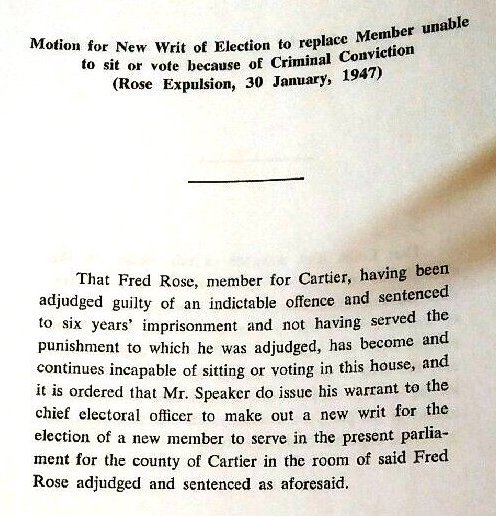
Louis Riel holds the singular distinction of having been expelled from the House of Commons twice. After his first expulsion, he ran in the by-election held in his riding, and the voters of Provencher, Manitoba re-elected him. The House of Commons then expelled him for the second and final time. Thomas McGreevy was expelled for having refused summons to the Commons. Fred Rose, a Communist who passed Canadian state secrets to the Soviet Union, was expelled after having been convicted of treason.

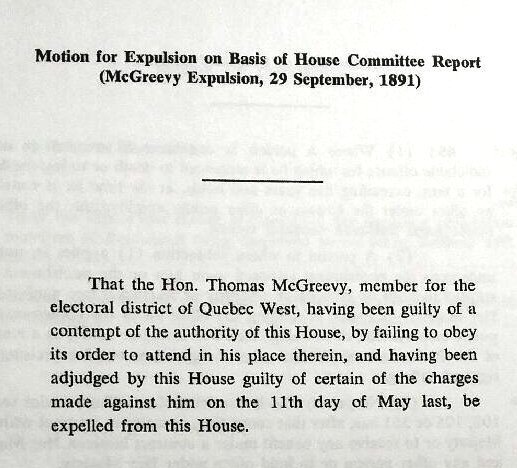
The Appendices of the Manual of Official Procedure of the Government of Canada provide the motions that promulgated the expulsions of Louis Riel, Thomas McGreevy, and Fred Rose.[8]

Since Senator Meredith has not even been charged with, let alone convicted of, a criminal offence, the first procedure relative to section 750(1) of the Criminal Code would not apply. The Senate would therefore have to follow the second procedure. Of the four precedents of expulsion from the Commons, the motion to expel Meredith would most resemble that for Thomas McGreevy’s “having been found guilty of a contempt of the authority of this House.” The Senate could substitute “dignity” for “authority” in its motion.

Conclusion

In principle and under under section 18 of the Constitution Act, 1867 and section 4 of the Parliament of Canada Act, the Senate as a legislative body possesses this same collective parliamentary privilege as does the House of Commons. Consequently, neither the House of Commons alone nor the Senate alone could expand their own privileges as legislative bodies; only the Parliament of Canada (i.e, Queen, Senate, Commons) could create new or expand existing privileges through statute, or through a Section 44 Constitutional Amendment, which Parliament can pass alone.[9] (For instance, Parliament could amend section 18 and strike out the bizarre proviso that parliamentary privilege in Canada only exists to the extent that parliamentary privilege existed in the United Kingdom at a certain date on the grounds that this provision is now inconsistent with Canada’s status post-1931 as an independent, sovereign state).

Quite simply, there is no impediment to putting that principle into practice. The Senate’s collective parliamentary privilege as a legislative body allows it to expel its members for reasons other than those listed in section 31 of the Constitution Act, 1867, provided that it follows the proper procedures in accordance with its Standing Orders. If the Senate expelled a member, then his seat would become vacant, and the Prime Minister could advise the Governor General to summon someone else to take his place, pursuant to sections 32 and 24 of the Constitution Act, 1867. 

As a constitutional matter, the Senate of Canada possesses the authority to expel Senator Meredith for reasons other than those listed in section 31. As a political matter, the Senate of Canada must now decide whether or not it should exercise its authority of expulsion.

Endnotes

[1] Canada (House of Commons) v. Vaid [2005] 1 SCR 667, at para 29(2).
[2] House of Commons, Privilege in the Modern Context (Ottawa: Table Research Branch, June 1990), 2.
[3] House of Commons, Privilege in the Modern Context (Ottawa: Table Research Branch, June 1990), 7.
[4] House of Commons, Privilege in the Modern Context (Ottawa: Table Research Branch, June 1990), 11; Joseph Maignot, Parliamentary Privilege in Canada, 2nd Edition (Ottawa: House of Commons, 1997), 180.
[5] House of Commons, Privilege in the Modern Context (Ottawa: Table Research Branch, June 1990), 6.
[6] Canada. Privy Council Office, Manual of Official Procedure of the Government of Canada, Henry F. Davis and André Millar. (Ottawa: Government of Canada, 1968): 239-242.
[7] Canada. Privy Council Office, Manual of Official Procedure of the Government of Canada, Henry F. Davis and André Millar. (Ottawa: Government of Canada, 1968): 239-242.
[8] Canada. Privy Council Office, Manual of Official Procedure of the Government of Canada: Appendices, Henry F. Davis and André Millar. (Ottawa: Government of Canada, 1968): 359, 360, 361. In 1968, it was section 654 of the Criminal Code that provided for the automatic expulsion of members convicted on treason. Today, section 750(1) of the Criminal Code provides the equivalent function, though it has expanded the grounds from expulsion so that they now cover any conviction for a criminal offence and not only treason.
[9] House of Commons, Privilege in the Modern Context (Ottawa: Table Research Branch, June 1990), 2, 4.

Posted in Expulsion of Members, Parliamentary Privilege | 15 Comments

Some Thoughts on National Parks in Canada and the United States


Kluane Lake National Park, Yukon. I took this photo in July 2006. Magnificent!

Kluane Lake itself. Absolutely spectacular! I took these on my old Canon Rebel X/S SLR.

I just overdosed on pseudo-profound American exceptionalism and Tocqueville-inspired democracy babble in this preview for Ken Burns’s PBS documentary on America’s national parks. I thoroughly enjoyed Burns’s documentaries on the US Civil War, Prohibition, and the Roosevelts, but based on this preview, I’m not sure if I could stomach watching his series on America’s national parks.

That said, Burns’s neo-transcendentalist New England idealism, combined with the general nostalgic mood I’ve been in for the last few weeks, did remind me of something interesting.

From what I remember of my five years in Alaska, and Perry Lewis’s classes for Hono(u)rs History 10 and AP US History in junior year, I would say that, for Americans, national parks represent the democratic egalitarianism of equal access to lands held in public trust in perpetuity, as opposed to the aristocratic tradition of setting aside land from an estate for preservation. National parks in the United States are inextricably linked to the broader Progressive Movement, particularly under President Theodore Roosevelt. They also served as an outlet for Americans’ Post-Frontier Anxiety at the end of the Gilded Age and at the cusp of America’s first forays into empire in 1898; since Americans had for centuries defined themselves by their struggle against the wilderness of the continent and the inevitability and pseudo-Protestant righteousness of their westward expansion, the so-called “Manifest Destiny,” they needed to preserve in national parks the last vestige of that pre-1890 Frontier and their sense of national identity. (For the census of 1890, the Census Bureau declared that, for the first time, there was no longer a definitive “frontier” line of longitude out west). In other words, the preservation of wilderness was about the preservation of American identity, and the Frontier Myth. But the creation or expansion of national parks in the United States often inspires great controversy, especially in the western states with respect to federal public lands versus state public lands.

Clever Canadians like Clifford Sifton, who served as Minister of Immigration in the Laurier government, appealed to this American frontier mythos. He tried to attract American farmers to settle in Saskatchewan and Alberta in the 1910s by dubbing them “The Last, Best West.” The Macdonald government saw that the Dominion Lands Act became law in the 1870s, based on the American Homestead Act, and used it as an instrument of western expansion in the preceding decades as well.

The Dominion of Canada used this advertisement to attract American settlers.

The West has played its part in Canadian mythology as well, but in a different way than in the United States. My history teacher, Perry Lewis, the Indefatigable Mainer (descended from Joshua Chamberlain in spirit!), mentioned as an off-hand comment one day in AP US that the Canadian Shield posed a huge barrier to Canada’s natural and gradual expansion west of the Great Lakes. To paraphrase Christopher Moore, western alienation began after Young Street in the 1850s and 1860s, and so, too, did the western frontier. For Canada, the trans-continental railways were necessary for expansion (and necessary to prevent America from realizing the more virulent form of Manifest Destiny and taking British North America for itself); while in the US, Americans could and did expand westward without government-funded infrastructure because of the favourable geography. Their trans-continentals and the Homestead Act certainly facilitated westward expansion after the Civil War, but they weren’t absolutely necessary. The fact that Americans could expand westward largely independent of established government infrastructure and uninterrupted by a vast expanse of 3 billion-year-old, barren granite and impenetrable coniferous forest contributes to their myths of the rugged individualism of westward expansion.

I believe that Canadians view national parks in far more practical and utilitarian terms: they serve as a reasonable and good method of preserving the natural beauty and wilderness of the country. And due to this country’s small population and large northerly landmass too cold and barren for permanent agricultural settlement, Canada’s wilderness was never in danger of being entirely settled like America’s was anyway. Vast swathes of this country are Crownland as well, whether administered by the Dominion or by the provinces. As such, the creation and expansion of Canadian national parks has rarely, if ever, been controversial. The Harper government tried to make great hay out establishing new national parks (Nááts’ihch’oh National Park Reserve, Qausuittuq National Park, Rouge National Urban Park) and increased funding for existing parks in 2015, and no one paid attention. Canadians certainly didn’t oppose the decision to protect more wilderness. To the contrary: precisely because everyone likes national parks, making a wedge political issue out of them by drawing attention to the policy did not work.

In conclusion, Canada took America’s best idea and improved upon it. Yellowstone predates Banff by 13 years, but the Dominion Parks Service established coherent management of Canada’s parks in 1911, five years earlier than the National Parks Service did in the US. Prior to 1916, American national parks were managed jointly and ineffectually by the Army and two or three civilian departments. What an apt metaphor for the two countries: the United States is more pioneering, but Canada is better managed.

Similar Posts:

Posted in Documentaries, History of British North America, Random Thoughts | Leave a comment

Who Updates Section 37 of the Constitution Act, 1867?


Does the executive, through the Department of Justice, write the indirect amendment of section 37 separate from any parliamentary action?

Does the executive, through the Department of Justice, write the indirect amendment of section 37 separate from any parliamentary action?

Whenever I re-read the Constitution Act, 1867 — the statute formerly known as the British North America Act, 1867 –, I always see something interesting which I hadn’t noticed before.

I’m currently drafting a response to Professor Pilon’s strawman summary of my arguments on electoral reform and the fact that the rules contained in section 51 of the Constitution Act, 1867, coupled with sections 14 and 15 of the Electoral Boundaries Readjustment Act (which refer back to the electoral quotient contained in section 51), necessarily mean that we elect MPs under a single-member plurality voting system. Pilon has pointed out, correctly, that this was not always the case. But this is because section 51 has been amended several times since Confederation, and because when Parliament first passed the Electoral Boundaries Readjustment Act in 1964, it thereby repealed section 40 of the British North America Act, including the provision for the dual-member constituency for Halifax. The Electoral Boundary Readjustment Act also precluded the possibility of any other dual- or multi-member constituencies. At any rate, the current rules under section 51, which Parliament passed through a Section 44 constitutional amendment in 2011, most certainly do require single-member constituencies.

In a way, I have to thank Pilon, because I have been able to demonstrate that my core arguments in “Time Has Run Out on Electoral Reform” still hold up, despite all his best efforts, and because if it were not for Pilon’s strawman, I probably would not have re-read the sections of the Constitution Act, 1867 that pertain to the electoral system and would therefore not have discovered the little gem that I’m about to share with you.

Section 37 of the Constitution Act, 1867 presents something of a curiosity. It defines the House of Commons as consisting of 308 seats instead of 338. Upon the election of the 42nd Parliament in 2015, it became out of date in practice, but its reference to 308 MPs had become obsolete in principle as early as December 2011 when the Fair Representation Act entered into force with a new electoral quotient and it became clear that the House of Commons would expand beyond its 308 seats. The Chief Electoral Officer’s most recent Representation Order, promulgated under the authority of the Electoral Boundary Readjustment Act on 27 September 2013, confirmed that the House of Commons would consist of 338 seats after the next general election. This Representation Order entered into force in 2014. The version of the Department of Justice’s consolidated Constitution Acts available online as a PDF dates from 1 January 2013, which only partially explains the anomaly.

The House of Commons shall, subject to the Provisions of this Act, consist of three hundred and eight members of whom one hundred and six shall be elected for Ontario, seventy-five for Quebec, eleven for Nova Scotia, ten for New Brunswick, fourteen for Manitoba, thirty-six for British Columbia, four for Prince Edward Island, twenty-eight for Alberta, fourteen for Saskatchewan, seven for Newfoundland, one for the Yukon Territory, one for the Northwest Territories and one for Nunavut. (20)

The accompanying footnote 20 presents even more of an enigma, since it does not explain precisely how or when or by what measures section 37 “has been altered from time to time.”

(20) The figures given here result from the application of section 51, as enacted by the Constitution Act, 1985 (Representation), S.C. 1986, c. 8, Part I, and amended by the Constitution Act, 1999 (Nunavut), S.C. 1998, c. 15, Part 2, and readjustments made pursuant to the Electoral Boundaries Readjustment Act, R.S.C. 1985, c. E-3. The original section (which was altered from time to time as the result of the addition of new provinces and changes in population) read as follows:
37. The House of Commons shall, subject to the Provisions of this Act, consist of one hundred and eighty-one members, of whom Eighty-two shall be elected for Ontario, Sixty-five for Quebec, Nineteen for Nova Scotia, and Fifteen for New Brunswick.

The footnote says that the “figures given here result from the application of section 51”, but this ambiguous phrasing does not explain how those rules are applied and when Parliament is supposed to update this section. More curiously still, the footnote cites the Constitution Act, 1985 (Representation), which the Fair Representation Act, 2011 repealed and replaced with the new set of rules in section 51. So the Department of Justice consolidated this PDF version of the Constitution Acts as of 1 January 2013, and therefore included the new section 51, which entered into force in 2011, but it did not update this footnote to explain why the current section 37 is out of date and why it refers to a repealed constitutional amendment from 1985 instead of to the new section 51 that it includes later on! The footnote also mentions the Constitution Act, 1999 (Nunavut), but the figure of 308 seats mentioned in section 37 dates from after 1999. In 1999, the House of Commons consisted of 301 seats. The first general federal election in which Canadians elected 308 MPs occurred in 2004. In that case, the House of Commons had gained an additional 7 seats based on the Decennial Census of 2001 and the section 51 formula from 1985.

Parliament last amended the rules under section 51 through the Section 44 Constitutional Amending Formula in December 2011 and An Act to Amend the Constitution Act, 1867, the Electoral Boundaries Readjustment Act, and the Canada Elections Act, better known by its short title, the Fair Representation Act. This act, which doubles as a constitutional amendment, altered section 51 of the Constitution Act, 1867 as well as section 14(1) of the Electoral Boundary Readjustment Act, which refers to the electoral quotient contained in section 51 of the Constitution Act. Section 51 of the Constitution Act, 1867 and key provisions of the Electoral Boundary Readjustment Act are therefore inexplicably linked and bound to one another. However, the Fair Representation Act only amended section 51 and did not provide for a means of amending section 37 of the Constitution Act, 1867, which states the total number of seats per province in the House of Commons. The Electoral Boundary Readjustment Act also lacks any provision for updating section 37 of the Constitution Act, 1867. Parliament would therefore presumably have to pass separate legislation, as a Section 44 Constitutional Amendment, in order to update this provision. But another clue suggests that it, rather extraordinarily, would not.

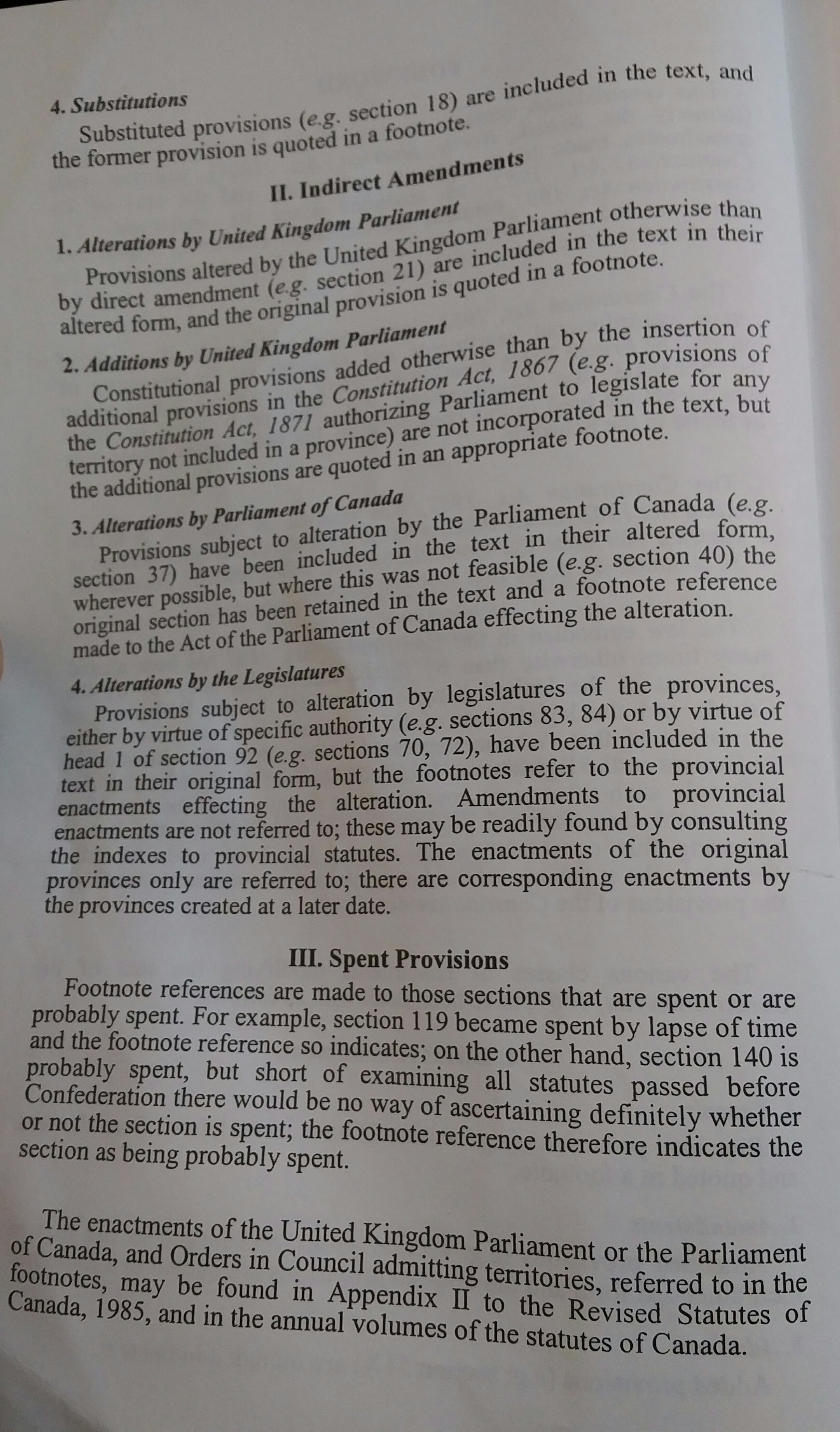
The introductory pages to the Department of Justice’s consolidation of The Constitution Acts, 1867-1982 mentions something called a “non-textual amendment,” some of which were enacted by the Westminster Parliament prior to 1982, and some of which have been enacted by the Parliament of Canada and by provincial legislatures.

Alterations by Parliament of Canada
Provisions subject to alteration by the Parliament of Canada (e.g. section 37) have been included in the text in their altered form, wherever possible, but where this was not feasible (e.g. section 40) the original section has been retained in the text and a footnote reference made to the Act of the Parliament of Canada effecting  the alteration.

The Department of Justice’s consolidation of The Constitution Acts, 1867-1982 from 1 January 2001 (I only have this as a paper copy) contains a slightly different introduction. It classifies alterations to section 37 under the heading “Indirect Amendments” instead of “Non-Textual Amendments”. Incidentally, “Indirect Amendment” seems more accurate than “Non-Textual Amendment,” given that section 37 is, by definition, part of the text of the Constituiton Acts.  This in turn raises a strange possibility: that the Parliament of Canada does not alter section 37 at all; instead, the Department of Justice itself alters section 37 as it releases updated consolidations of the Constitution Acts — which sounds unconstitutional and contradicts the very purpose of a legislative provision. How could the executive re-write a law unilaterally? Nevertheless, this would explain why I cannot find any record of Parliament having altered section 37 directly under the Section 44 constitutional amendment formula. (If I missed something, please do let me know in the comments). This notion would also explain the Department of Justice’s clever use of the passive voice in the aforementioned footnote 20, in the phrase “The original section (which was altered from time to time […]”, as well as the ambiguous construction in the phrase “The figures given here result from the application of section 51,” which, while not in the passive voice, still conceals the source of the alterations. How, precisely, do those numbers “result from” section 51? If anything, they “result from” section 51 of the Constitution Act, 1867, the Electoral Boundaries Readjustment Act, and the Chief Electoral Officer’s Representation Order, which is promulgated by order-in-council purusant to the Electoral Boundaries Readjustment Act.

The closest equivalent to an amendment to section 37 of the Constitution Act, 1867 can be found in the Representation Order of 2013, which the Harper government promulgated by order-in-council pursuant to the authority of section 24 of the Electoral Boundary Readjustment Act.

Section 24 (2) of the Electoral Boundaries Readjustment Act says:

(2) The draft representation order shall (a) specify the number of members of the House of Commons who shall be elected for each of the provinces as calculated by the Chief Electoral Officer under subsection 14(1); and
(b) divide each of the provinces into electoral districts, describe the boundaries of each such district and specify the population and name to be given thereto, in accordance with the recommendations contained in the reports referred to in subsection (1).

The Representation Order from 2013 says:

Prepared and transmitted to the Minister, pursuant to section 24 of the Electoral Boundaries Readjustment Act (chapter E-3 of the Revised Statutes of Canada, 1985), as amended

Seven members of the House of Commons shall be elected for the Province of Newfoundland and Labrador, four for the Province of Prince Edward Island, eleven for the Province of Nova Scotia, ten for the Province of New Brunswick, seventy-eight for the Province of Quebec, one hundred and twenty-one for the Province of Ontario, fourteen for the Province of Manitoba, fourteen for the Province of Saskatchewan, thirty-four for the Province of Alberta and forty-two for the Province of British Columbia.

The Representation Order therefore provides the closest approximation to section 37 of the Constitution Act, 1867. However, it does not list the provinces in the same order of precedence as does section 37, and it also excludes the territories — presumably because their ridings were never “redistributed”, since the entire Yukon Territory, the entire Northwest Territories, and Nunavut as a whole each form individual constituencies whose borders correspond precisely to the territories’ respective borders.

I first noticed something odd about section 37 earlier this week but couldn’t quite put my finger on it. The passive voice and ambiguous wording in footnote 20 piqued my curiosity and confirmed that I was onto something, rather like how Woodward and Bernstein knew for certain that they had stumbled onto something significant with the Watergate break-in when the White House Press Secretary, without prompting, dismissed it as a “third-rate burglary.”  From my decade in Ottawa, I have observed that both lawyers and civil servants love the passive voice because it conceals the subject of the sentence and therefore offers plausible deniability and allows the speaker to absolve himself of responsibility. Those in the Department of Justice who compiled this consolidation of the Constitution Acts are both lawyers and civil servants; they therefore must doubly approve of the passive voice.

Similar Posts: 


Posted in Amending Formulas, Constitution (Written), Indirect Amendment | 3 Comments