The Queen’s Annual Christmas Message


Introduction

I wish you all a very happy Christmas and hope that this blog entry finds you well.

Last year in “A Parliamentarist’s Christmas,” I explored the influences of ecclesiastical architecture on the neo-Gothic style of the Centre Bloc of the Parliament of Canada, the more fundamental medieval, and therefore Christian, origins of the parliamentarism itself, and the biblical basis of our national motto Ad mari usque ad mare.

This year, I would like to highlight Her Majesty Queen Elizabeth II’s annual Christmas message itself, and – if you can humour my scholarly pedantry during the holidays – some of the interesting constitutional aspects that the speech raises, namely, the Personal Union, succession, and the Crown as corporation sole.

Significance of the Christmas Message
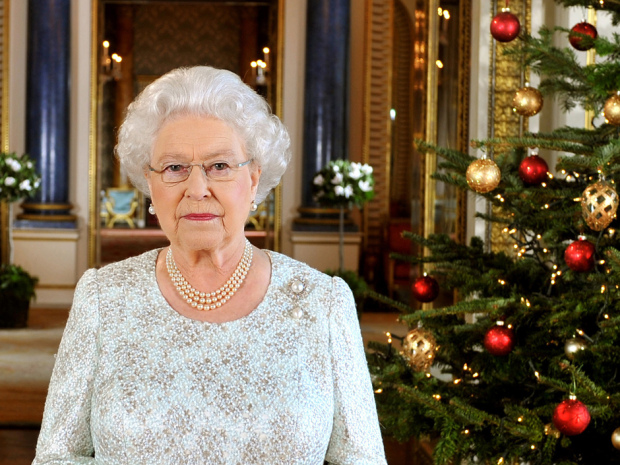
The Queen delivers Her annual Christmas Address

The Queen delivers Her annual Christmas Address

The Queen’s annual Christmas message stands out as one of the Sovereign’s non-constitutional or extra-constitutional functions; as such, the Queen and her staff develop these addresses independent of any ministerial advice. In this case, the Queen acts as representative of the nation and cultural leader, or what one scholar deems “the liturgical function”, rather than in her legal-constitutional capacity as head of state.[1] In the first half of her address, the Queen acknowledged the Diamond Jubilee celebrations that took place throughout the Commonwealth in her honour and highlighted the Personal Union, and thus her roles as Queen of the 16 Commonwealth Realms. In the second half, the Queen emphasized her role as Supreme Governor of the Church of England and her Command-in-Chief of the British Armed Forces. However, the Queen delivered a generic Christian commemoration of the Christ child rather than an explicitly Protestant rendition.

The Queen of the United Kingdom performs an unambiguous, sectarian liturgical function; the British Sovereign also acts as the Supreme Governor of the Church of England and must therefore be in communion with the same. However, neither the Queens nor the Governors General of Canada, Australia, and New Zealand take on an equivalent religious function because none of these countries maintain established churches (which, frankly, is a favourable development and an example of how the Realms have improved upon the British model). The natural person of Elizabeth Windsor is vested with 16 separate juristic persons and is therefore simultaneously but separately the Queen of the United Kingdom, Queen of Canada, Queen of Australia, and Queen of New Zealand and Queen of the 12 other Commonwealth Realms. These 16 juristic persons – these 16 Crowns – thus form the “Personal Union” because they are all vested by law in the same natural person. (They are also 16 separate corporations sole).

This difference flows naturally into changing the rules that govern succession to the throne, which I have discussed in previous blog entries and in a column that I co-authored with Professor Phil Lagassé. The Prime Ministers of the 16 Commonwealth Realms agreed in November 2011 that the common-law principle of male-preference cognatic primogeniture should be replaced with equal primogeniture and that the Act of Settlement’s penalty of marriage to a Catholic should be repealed. Each of the 16 Realms would have to enact its own legislation in order to change the rules of succession to its Crown.[2] In December 2012, the Cameron government tabled the Succession to the Crown Bill, which would eliminate the provision in the Act of Settlement that removes any person from the line of succession for marriage to a Catholic, but it retains the other statutory requirements that the Sovereign be a Protestant and be head of the Church of England.  Currently, any member of the Royal Family could marry a Jew, Muslim, Hindu, atheist, etc. and retain his or her place in the line of succession; only marriage to a Catholic would automatically remove him or her from the line of succession altogether, as prescribed by law. This provision induced a Canadian woman, Autumn Kelly, to convert to Anglicanism before marrying Peter Philips (son of Anne, the Princess Royal) in 2008. If the Succession to the Crown Bill, 2012 had been statute law in 2008, she would not have needed to convert to Anglicanism to prevent Peter Philips, and their issue, from losing their places in the line of succession.

Thanks to the feedback from one of my correspondents, I have amended this section and drew the proper distinction between two distinct factors. The British Succession to the Crown Bill, 2012 omits entirely two other separate components of succession: 1. that the Sovereign be a Protestant, and 2. that the Sovereign also be the Supreme Governor of the Church of England. The Bill of Rights, 1689 and the Act of Settlement, 1701 established the Protestant succession and affirmed the Sovereign’s role as Supreme Governor of the Church of England. (The Act of Supremacy, 1534 first established the latter). The first requirement that the Sovereign be a Protestant now extends to the Crowns of all 16 Realms. However, the second requirement that the British Sovereign be the Supreme Governor of the Church of England pertains only to the Crown of the United Kingdom because the other 15 Realms do not maintain established Churches.

As such, if the British Parliament wanted to eliminate the Sovereign’s role as the Supreme Governor of the Church of England and/or disestablish the Church of England, the British Government would not need to consult the Realms before repealing either or both because the Sovereign fulfills no formal religious function in any of the other 15 Realms. However, the British would again consult the other Realms before repealing the requirement that the Sovereign be a Protestant in order to keep the Personal Union intact. Each of the 16 Realms would then have to repeal, through legislation or constitutional amendment, the requirement that the Sovereign must be a Protestant.

Conclusion

Republicans sometimes assert, incorrectly, that there is no difference between the Queen of the United Kingdom and the Queen of Canada, but the formal and informal religious roles of the Queen of the United Kingdom versus the absence of any such role in Canada (among various other points) proves them wrong. While the Sovereigns of both Canada and the United Kingdom must be Protestants, neither the Queen of Canada nor her vice-regal representatives perform any official religious role as Supreme Governor of any church, because Canada does not maintain an established church.

In conclusion, I found Her Majesty’s portrayal of the Personal Union of 16 Crowns incomplete. The Queen acknowledged only the British athletes who competed in the Olympics, not the athletes from all 16 Realms of which she is head of state, and only the personnel in the British Armed Forces who are currently serving overseas. I suspect that the Palace hesitates to emphasize the Queen’s constitutional duties in the other Realms as the Governors General have gained more prominence as her representatives. In Canada, section 15 of the Constitution Act, 1867 vests the command in chief of the Canadian Armed Forces in the Queen, though the Letters Patent have since delegated (not “transferred”) that authority to the Governor General. Formally and constitutionally, the Queen retains the command-in-chief, but in practice the Governor General assumes this role as the Queen’s representative, both in Canada and abroad.[3] In fact, Governor General David Johnston has spent this Christmas abroad boasting the morale of Canadian troops serving overseas.[4]

Lord Philip Norton, Professor of Government at the University of Hull and a Conservative Life Peer, wrote of the Queen’s civic and liturgical duties to “set standards of citizenship and family life,” to command the “allegiance of the armed forces,” to “maintain the continuity of British traditions,” and to “preserve a Christian morality.”[5] The Queen of the United Kingdom exemplified all these duties in her Christmas Address. However, I can only conclude that while the Queen of the United Kingdom emphasizes the full civic-liturgical duty and legal-constitutional authority in the Christmas Address, the Queens of Canada, Australia, New Zealand, and the other 12 Realms do not figure prominently therein and appear only peripherally, or even as afterthoughts. Perhaps the Palace does not feel comfortable emphasizing the Crowns of the other Realms independent of the advice of the responsible ministers of those Realms. Sadly, these practices only reinforce republican assertions that the Queen of Canada is a “foreign monarch” and irrelevant to Canada and to Canadians.

Similar Posts:

Endnotes

[1] Paul Benoit, presentation to the Monarchist League on “The Three Threats to Canada’s Constitution,” 4 October 2012; Paul Benoit. “State Ceremonial: The Constitutional Monarch’s Liturgical Authority,” in The Evolving Canadian Crown, edited by Jennifer Smith and D. Michael Jackson, 119-137. (Kingston: Institute of Intergovernmental Relations, School of Policy Studies, Queen’s University, 2012).
[2] I will argue in an upcoming article that the British government obtained the “consent” of the Prime Ministers at CHoGM last year through a mere custom, rather than through a constitutional convention, and that none of the 16 Realms could veto the British decision or derogate from the authority of the British Parliament to legislate for the Crown of the United Kingdom. As such, one or more of the 16 Realms could – intentionally or unintentionally – break the Personal Union by refusing or failing to pass the necessary statutory or constitutional amendment.
[3] Phil Lagassé, forthcoming article on the Crown as Commander-in-Chief; Christopher McCreery, “Myth and Misunderstanding: The Origins and Meaning of the Letters Patent Constituting the Office of the Governor General, 1947,” in The Evolving Canadian Crown, edited by Jennifer Smith and D. Michael Jackson, 31-54. (Kingston: Institute of Intergovernmental Relations, School of Policy Studies, Queen’s University, 2012).
[4] Canada, Government House. “Governor General and Commander-in-Chief of Canada Visited Canadian Troops and Civilians Deployed Abroad for the Holidays,” (Ottawa: Crown Copyright, 25 December 2012). [accessed 25 December 2012].
[5] Philip Norton, “The Crown,” in Politics UK. 5th Ed., edited by Bill Jones et al., 362-387. (Essex, England: Pearson Education Ltd., 2004).
Posted in Corporation Sole, Crown (Powers and Office), Succession (Sovereign), The Personal Union | Tagged , , , , , , , , | 7 Comments

Succeeding to the Australian Throne


Succession in Australia

Anne Twomey, a Professor of Law at the University of Sydney, has written extensively on the Crown of Australia and other issues of government. I consider her the foremost expert on constitutionalism and Westminster parliamentarism in our sister Realm down under!

Most recently, Professor Twomey has written an op-ed to the Sydney Morning Herald which I regard as the direct Australian equivalent of the op-ed that Professor Lagassé and I just submitted to the Ottawa Citizen. In “Archaic and Sexist Law Overshadows Pending Arrival of New Royal,” Twomey explains why altering the laws of succession to the Crown of Australia also involves a constitutional amending procedure that requires the concurrence of the parliaments of the 6 Australian States and of federal Parliament of Australia:

In Australia, the issue is complicated by the federal system. It is most likely that the Federal Parliament does not have unilateral power to change the rules of succession. It has no specific power to do so and as the Queen is also a part of state constitutions and state parliaments, it is likely that any Commonwealth attempt to interfere with state constitutions would be invalid. The most appropriate approach is to use a section of the constitution that permits the states and the Commonwealth to co-operate to enact laws that only the Westminster Parliament could have enacted at the time of Federation. This would entail each state parliament passing a law that requests the Commonwealth to enact the changes to the Australian law of succession.

The Australian and Canadian Amending Formulas Compared

Under s. 51(xxxviii) of the Australian Constitution, the Commonwealth Parliament may legislate on behalf of the states after each state parliament has given its consent through enabling legislation. The Commonwealth Parliament would amend the rules that govern the line of succession to the Crown of Australia by an act of parliament, though it would probably be regarded as an organic statute of constitutional importance. As Twomey alluded in her column, s.51(xxxviii) of the Australian Constitution acts as the equivalent to s.4 of the Statute of Westminster, which Canada repealed in 1982 and which Australia repealed in 1986. Before its repeal, s.4 allowed the Westminster Parliament to legislate on behalf of the Dominions after obtaining their approval. Today, however, the Westminster Parliament may only legislature for the United Kingdom itself, which is why each of the 16 Realms must change its succession pursuant to its own laws or constitution.

s. 51 The Parliament shall, subject to this Constitution, have power* to make laws for the peace, order, and good government of the Commonwealth with respect to:

(xxxviii) The exercise within the Commonwealth, at the request or with the concurrence of the Parliaments of all the States directly concerned, of any power which can at the establishment of this Constitution be exercised only by the Parliament of the United Kingdom or by the Federal Council of Australasia

Under s. 41(a), the 10 provincial legislatures, the House of Commons, and the Senate would pass concurring resolutions (not bills), which the Governor General would then proclaim into force. (As with Royal Assent, the Governor General would promulgate the constitutional amendment by and with the advice and consent of the legislative assemblies, and not on and in accordance with the advice of the federal and provincial governments). This amendment to the Constitution of Canada would codify and amend the hitherto unwritten constitutional principles that govern succession. It would be the first amendment to codify an unwritten constitutional principle (UCP) and the first pursuant to s. 41.

s. 41. An amendment to the Constitution of Canada in relation to the following matters may be made by proclamation issued by the Governor General under the Great Seal of Canada only where authorized by resolutions of the Senate and House of Commons and of the legislative assembly of each province:
(a) the office of the Queen, the Governor General and the Lieutenant Governor of a province

Conclusion

Twomey’s comparative scholarship on succession in Australia and Canada has has highlighted the importance of federalism and written constitutions, and how federalism affects the Crown. Both countries have always benefited from Constitution Acts (which, however, only form part of a overall hybrid written-conventional constitution) that set up a division of powers between the federal and state/provincial levels. In both countries, the Crown also guarantees federalism, and both federal Realms have provided for mechanisms whereby the federal and state/provincial levels must act in concert in order to change their respective Crowns. These issues simply do not apply to unitary states like New Zealand, which is precisely why Australia and Canada should be set apart in this discussion and compared to one another.

In “Changing the Realms of Succession: The Problem of the Realms,” Twomey also argues that succession to the Crown of Canada falls under s.41(a). (You can download the video at that link). Succession in Australia helps show why succession in Canada must be subject to s.41(a).

Similar Posts:

Posted in Crown (Powers and Office), Succession (Sovereign), The Personal Union | Tagged , , , | 10 Comments

“Succeeding to the Canadian Throne”


Bowden & Lagassé

Bowden & Lagassé

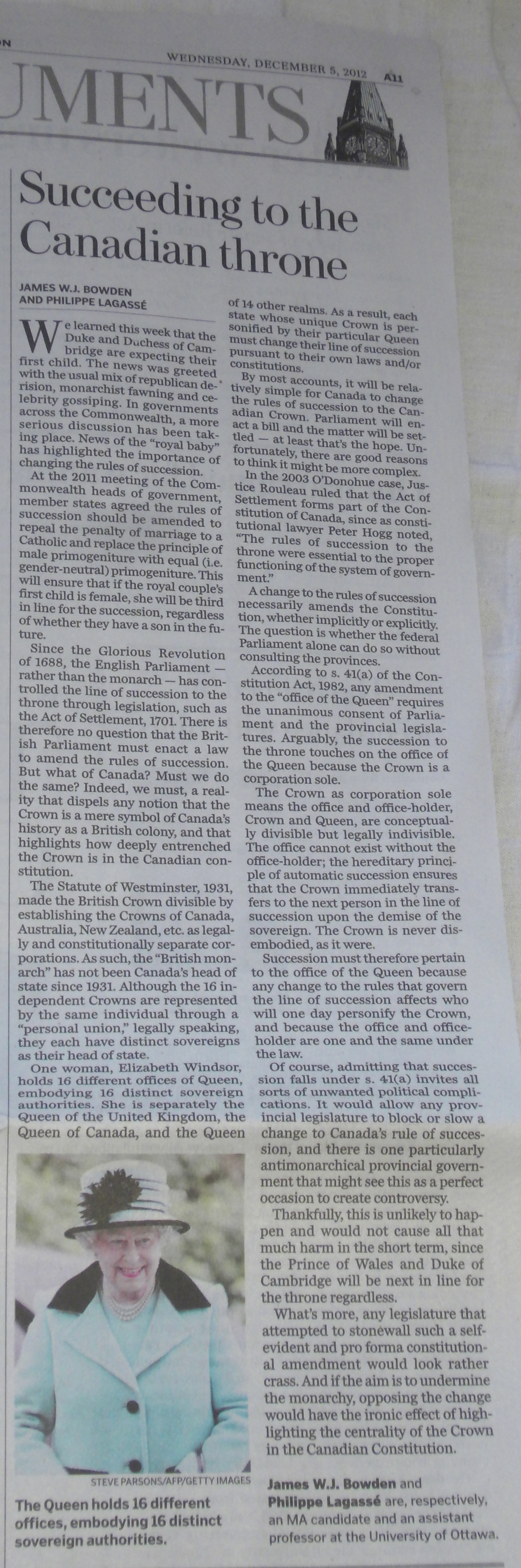
Professor Philippe Lagassé and I have co-authored “Succeeding to the Canadian Throne” for the Ottawa Citizen. In this column, we explain why the Crown of Canada is a hereditary corporation sole and why succession to the Crown falls under the “Office of Queen,” and therefore under the unanimity formula under s.41(a) of the Constitution Act, 1982.

Succeeding to the Canadian Throne

James W.J. Bowden and Philippe Lagassé

We learned this week that the Duke and Duchess of Cambridge are expecting their first child. The news was greeted with the usual mix of republican derision, monarchist fawning, and celebrity gossiping. In governments across the Commonwealth, a more serious discussion has been taking place. News of the ‘royal baby’ has highlighted the importance of changing the rules of succession.

At the 2011 meeting of the Commonwealth heads of government, member states agreed that the rules of succession should be amended to repeal the penalty of marriage to a Catholic and replace the principle of male primogeniture with equal (i.e. gender-neutral) primogeniture. This will ensure that that if royal couple’s first child is female, she will be third in line for the succession, regardless of whether they have a son in the future.

Since the Glorious Revolution of 1688, the English Parliament – rather than the monarch – has controlled the line of succession to the throne through legislation, such as the Act of Settlement, 1701. There is therefore no question that the British Parliament must enact a law to affect the rules of succession. But what of Canada? Must we do the same? Indeed, we must, a reality that dispels any notion that the Crown is a mere symbol of Canada’s history as a British colony, and that highlights how deeply entrenched the Crown is in the Canadian constitution.

The Statute of Westminster, 1931 made the British Crown divisible by establishing the Crowns of Canada, Australia, New Zealand, etc. as legally and constitutionally separate corporations. As such, the “British monarch” has not been Canada’s head of state since 1931. Although the 16 independent Crowns are represented by the same individual through a “personal union”, legally speaking they each have distinct Sovereigns as their head of state.

One woman, Elizabeth Windsor, holds sixteen different offices of Queen, embodying sixteen distinct sovereign authorities. She is separately the Queen of the United Kingdom, the Queen of Canada, and the Queen of fourteen other realms. As a result, each state whose unique Crown is personified by their particular Queen must change their line of succession pursuant to their own laws and/or constitutions.

By most accounts, it will be relatively simple for Canada to change the rules of succession to the Canadian Crown. Parliament will enact a bill and the matter will be settled – at least that’s the hope. Unfortunately, there are good reasons to think that it might be more complex.

In the 2003 O’Donohue case, Justice Rouleau ruled that the Act of Settlement forms part of the Constitution of Canada, since as Peter Hogg noted, “The rules of succession to the throne were essential to the proper functioning of the system of government.” A change to the rules of succession necessarily amends the constitution, whether implicitly or explicitly. The question is whether the federal Parliament alone can do so without consulting the provinces.

According to s.41(a) of the Constitution Act, 1982, any amendment to the “office of the Queen” requires the unanimous consent of Parliament and the provincial legislatures. Arguably, the succession to the throne touches on the office of the Queen because the Crown is a corporation sole.

The Crown as corporation sole means that the office and officer-holder, Crown and Queen, are conceptually divisible but legally indivisible. The office cannot exist without the office-holder; the hereditary principle of automatic succession ensures that the Crown immediately transfers to the next person in the line of succession upon the demise of the Sovereign. The Crown is never disembodied, as it were.

Succession must therefore pertain to the office of the Queen because any change to the rules that govern the line of succession affects who will one day personify the Crown, and because the office and office-holder are one and the same under the law.

Of course, admitting that succession falls under s.41(a) invites all sorts of unwanted political complications. It would allow any provincial legislature to block or slow a change to Canada’s rule of succession, and there is one particularly antimonarchical provincial government that might see this as a perfect occasion to create controversy.

Thankfully, this is unlikely to happen and would not cause all that much harm in the short term, since the Prince of Wales and Duke of Cambridge will be next in line for the throne regardless. What’s more, any legislature that attempted to stonewall such a self-evident and pro forma constitutional amendment would look rather crass. And if the aim is to undermine the monarchy, opposing the change would have the ironic effect of highlighting the centrality of the Crown in the Canadian constitution.

James W.J. Bowden and Philippe Lagassé are, respectively, an MA candidate and assistant professor at the University of Ottawa.

Similar Posts:

Posted in Corporation Sole, Crown (Powers and Office), Succession (Sovereign), The Personal Union | Tagged , | 17 Comments

Blogrolls *Are* Endorsements: Excellent and Interesting Blogs on the History and Practice of Westminster Parliamentarism


Retweets are not endorsements? #failwhale

Retweets are not endorsements? #failwhale

No practice in social media has made me bristle with indignation more than this ubiquitous and irritating phrase on Twitter, “Retweets are not endorsements.” You may also have seen the qualified, Mackenzie King-style version, “Retweets are not necessarily endorsements” (which means that some retweets are in fact endorsements, but not all of them are) or even the truncated litigiousness contained in “RTs ≠ endorsements.” (At least in the latter template, the user had the wit and creativity to include a proper mathematical symbol in this otherwise dull affair). Why would someone waste 29 characters on this litigious pretension? I barely managed to squeeze my brief bio into the straightjacket of Twitter’s conformist brevity. I attribute this horrid little trend to the disproportionate presence of journalists and politicians on Twitter, and their generally incestuous co-dependency, for having turned that medium into the latest front in the continuous “air war” for communications supremacy.

On Parliamentum, however, I do treat my blogroll as an endorsement, either to support the aspirations of other young emerging scholars or to showcase the important and most excellent contributions of established scholars and researchers throughout the core Commonwealth who also deal with the history and practice of Westminster parliamentarism. And “endorsement” does not mean “agree with”; it means that one finds something noteworthy, interesting, well-written, well-argued, relevant, or important. I could disagree with an author while still “endorsing” his well-written, relevant, important scholarship, for instance. I highlight the work of other scholars in order to fulfill my goal of making Parliamentum “a hub of research” on Westminster parliamentarism and to build informal networks of peer review.

At the risk of playing favourites and offending the other writers on my blogroll, I would recommend in particular the blog of Janet Ajzenstat, Professor emerita of Political Science at McMaster University, who has contributed so much to the Canadian scholarship on the classical liberal origins of Confederation and the great Whiggish tradition of Canadian political thought, which most Marxists academics have ignored and glossed over at the expense of this country’s true history. Lord Norton of Louth, Professor of Government at the University of Hull and Conservative Peer in the House of Lords, both practices and studies politics; recently, he has emerged as the leader of the “counter-reformation” of the House of Lords in order to preserve its essential character as a house of review and in order to preserve Responsible Government and the primacy of the Commons within the Crown-in-Parliament.

I only recently stumbled upon “The House Divided: Politics, Procedure, and Parliament” and appreciate this anonymous author’s attention to the esoteric but important issues like the prerogative powers of the Crown and his or her cogent historical analyses. (Incidentally, I also very much appreciate the quote by Benjamin Disraeli and might have to update my own by-line with a similar citation). Finally, I can always trust the writers of “On Procedure and Politics” to provide detailed technical briefings on the minutia of parliamentarism and excellent comparative analyses of various Westminster jurisdictions; the website recently won a well-deserved recognition from the Canadian Weblog Awards.

Several good sources on Westminster parliamentarism have managed to secure a niche market online, and I hope that they can hold onto it.         

Posted in Random Thoughts | Leave a comment

Only the Governors or Royals Should Confer Honours Upon Deserving Canadians


Prime Minister Stephen Harper has officially made a mockery of the Queen’s Diamond Jubilee Medal by awarding one to Justin Bieber, who in turn made the ceremony even more undignified by not having the courtesy to wear a suit. Harper sought only a nice photo-op that would garner him some positive media attention.

In general, only the Governors or members of the Royal Family should award honours and medals that recognize excellence and heroism (though of course, neither truly applies in this case) because they are non-partisan figures who can undertake ceremonies without entailing any partisan-political considerations. Any public ceremony, celebration, or commemoration that involves the Crown properly falls under the domain of the Governors or to the Royals; in contrast, Ministers of the Crown and parliamentarians take responsibility for the legal-constitutional aspects of the Crown-in-Council and Crown-in-Parliament.[1] When politicians intrude upon such ceremonies, one cannot help but ask oneself, “What political advantage does he derive from this situation?” and “what partisan calculations has he made in this case?” These questions of political calculation simply do not apply to our Governor General and the Lieutenant Governors, who represent the Sovereign.

That said, I must highlight the exception to my general argument in this particularly case: I suspect that the Prime Minister, rather than the Governor General, conferred this honour precisely because we all know that the young Justin Bieber, who only recently stumbled into adulthood, has done nothing to merit such an award. If the Governor General conferred such an undeserved honour, that contrived ceremony would have embarrassed the Crown.

Politicians are inherently partisan, and they should not attempt to augment their own legal-constitutional power, or their personal prestige or popularity, by cloaking themselves in the ceremonial, doling out honours like patronage, and turning the honours system into a political tool. In a constitutional monarchy such as ours, politicians may not seek the loyalty and love that only the non-partisan, non-executive Sovereign enjoys.[2] We do and should criticize and scrutinize elected politicians constantly; these self-aggrandizing careerists may not command the citizen’s loyalty, thereby  usurping the Sovereign. In a constitutional monarchy, we reserve our loyalty to the Sovereign, who personifies the Crown and thus all our liberal-democratic institutions and the country.

Similar Posts:


[1] Paul Benoit, presentation to the Monarchist League on “The Three Threats to Canada’s Constitution,” 4 October 2012.
[2] Peter Hitchens, The Abolition of Britain, interview by Brian Lamb, Booknotes, CSPAN, 20 October 2000. [accessed 1 June 2012]; Peter Hitchens, “MPs Shouldn’t Give Out Medals – That’s Why We Have a Monarch,” The Mail on Sunday, 8 September 2012.

Posted in Crown (Powers and Office), The Honours System | Tagged , , | 3 Comments