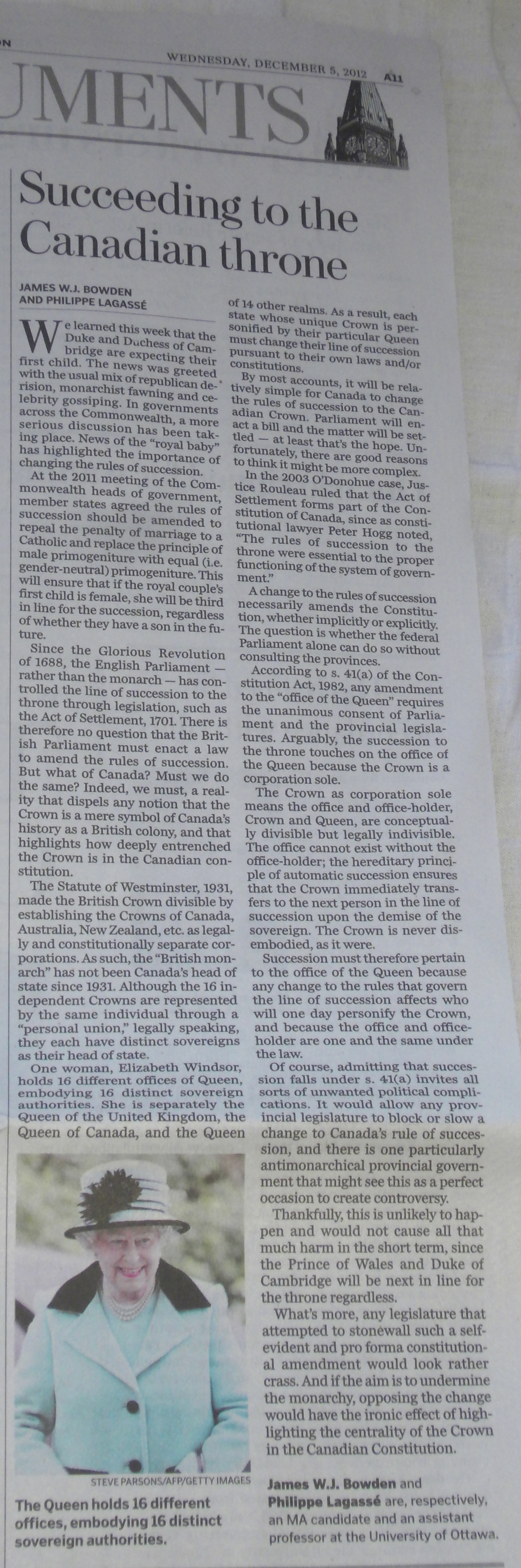
“Succeeding to the Canadian Throne”


Bowden & Lagassé

Bowden & Lagassé

Professor Philippe Lagassé and I have co-authored “Succeeding to the Canadian Throne” for the Ottawa Citizen. In this column, we explain why the Crown of Canada is a hereditary corporation sole and why succession to the Crown falls under the “Office of Queen,” and therefore under the unanimity formula under s.41(a) of the Constitution Act, 1982.

Succeeding to the Canadian Throne

James W.J. Bowden and Philippe Lagassé

We learned this week that the Duke and Duchess of Cambridge are expecting their first child. The news was greeted with the usual mix of republican derision, monarchist fawning, and celebrity gossiping. In governments across the Commonwealth, a more serious discussion has been taking place. News of the ‘royal baby’ has highlighted the importance of changing the rules of succession.

At the 2011 meeting of the Commonwealth heads of government, member states agreed that the rules of succession should be amended to repeal the penalty of marriage to a Catholic and replace the principle of male primogeniture with equal (i.e. gender-neutral) primogeniture. This will ensure that that if royal couple’s first child is female, she will be third in line for the succession, regardless of whether they have a son in the future.

Since the Glorious Revolution of 1688, the English Parliament – rather than the monarch – has controlled the line of succession to the throne through legislation, such as the Act of Settlement, 1701. There is therefore no question that the British Parliament must enact a law to affect the rules of succession. But what of Canada? Must we do the same? Indeed, we must, a reality that dispels any notion that the Crown is a mere symbol of Canada’s history as a British colony, and that highlights how deeply entrenched the Crown is in the Canadian constitution.

The Statute of Westminster, 1931 made the British Crown divisible by establishing the Crowns of Canada, Australia, New Zealand, etc. as legally and constitutionally separate corporations. As such, the “British monarch” has not been Canada’s head of state since 1931. Although the 16 independent Crowns are represented by the same individual through a “personal union”, legally speaking they each have distinct Sovereigns as their head of state.

One woman, Elizabeth Windsor, holds sixteen different offices of Queen, embodying sixteen distinct sovereign authorities. She is separately the Queen of the United Kingdom, the Queen of Canada, and the Queen of fourteen other realms. As a result, each state whose unique Crown is personified by their particular Queen must change their line of succession pursuant to their own laws and/or constitutions.

By most accounts, it will be relatively simple for Canada to change the rules of succession to the Canadian Crown. Parliament will enact a bill and the matter will be settled – at least that’s the hope. Unfortunately, there are good reasons to think that it might be more complex.

In the 2003 O’Donohue case, Justice Rouleau ruled that the Act of Settlement forms part of the Constitution of Canada, since as Peter Hogg noted, “The rules of succession to the throne were essential to the proper functioning of the system of government.” A change to the rules of succession necessarily amends the constitution, whether implicitly or explicitly. The question is whether the federal Parliament alone can do so without consulting the provinces.

According to s.41(a) of the Constitution Act, 1982, any amendment to the “office of the Queen” requires the unanimous consent of Parliament and the provincial legislatures. Arguably, the succession to the throne touches on the office of the Queen because the Crown is a corporation sole.

The Crown as corporation sole means that the office and officer-holder, Crown and Queen, are conceptually divisible but legally indivisible. The office cannot exist without the office-holder; the hereditary principle of automatic succession ensures that the Crown immediately transfers to the next person in the line of succession upon the demise of the Sovereign. The Crown is never disembodied, as it were.

Succession must therefore pertain to the office of the Queen because any change to the rules that govern the line of succession affects who will one day personify the Crown, and because the office and office-holder are one and the same under the law.

Of course, admitting that succession falls under s.41(a) invites all sorts of unwanted political complications. It would allow any provincial legislature to block or slow a change to Canada’s rule of succession, and there is one particularly antimonarchical provincial government that might see this as a perfect occasion to create controversy.

Thankfully, this is unlikely to happen and would not cause all that much harm in the short term, since the Prince of Wales and Duke of Cambridge will be next in line for the throne regardless. What’s more, any legislature that attempted to stonewall such a self-evident and pro forma constitutional amendment would look rather crass. And if the aim is to undermine the monarchy, opposing the change would have the ironic effect of highlighting the centrality of the Crown in the Canadian constitution.

James W.J. Bowden and Philippe Lagassé are, respectively, an MA candidate and assistant professor at the University of Ottawa.

Similar Posts:

Posted in Corporation Sole, Crown (Powers and Office), Succession (Sovereign), The Personal Union | Tagged , | 17 Comments

Blogrolls *Are* Endorsements: Excellent and Interesting Blogs on the History and Practice of Westminster Parliamentarism


Retweets are not endorsements? #failwhale

Retweets are not endorsements? #failwhale

No practice in social media has made me bristle with indignation more than this ubiquitous and irritating phrase on Twitter, “Retweets are not endorsements.” You may also have seen the qualified, Mackenzie King-style version, “Retweets are not necessarily endorsements” (which means that some retweets are in fact endorsements, but not all of them are) or even the truncated litigiousness contained in “RTs ≠ endorsements.” (At least in the latter template, the user had the wit and creativity to include a proper mathematical symbol in this otherwise dull affair). Why would someone waste 29 characters on this litigious pretension? I barely managed to squeeze my brief bio into the straightjacket of Twitter’s conformist brevity. I attribute this horrid little trend to the disproportionate presence of journalists and politicians on Twitter, and their generally incestuous co-dependency, for having turned that medium into the latest front in the continuous “air war” for communications supremacy.

On Parliamentum, however, I do treat my blogroll as an endorsement, either to support the aspirations of other young emerging scholars or to showcase the important and most excellent contributions of established scholars and researchers throughout the core Commonwealth who also deal with the history and practice of Westminster parliamentarism. And “endorsement” does not mean “agree with”; it means that one finds something noteworthy, interesting, well-written, well-argued, relevant, or important. I could disagree with an author while still “endorsing” his well-written, relevant, important scholarship, for instance. I highlight the work of other scholars in order to fulfill my goal of making Parliamentum “a hub of research” on Westminster parliamentarism and to build informal networks of peer review.

At the risk of playing favourites and offending the other writers on my blogroll, I would recommend in particular the blog of Janet Ajzenstat, Professor emerita of Political Science at McMaster University, who has contributed so much to the Canadian scholarship on the classical liberal origins of Confederation and the great Whiggish tradition of Canadian political thought, which most Marxists academics have ignored and glossed over at the expense of this country’s true history. Lord Norton of Louth, Professor of Government at the University of Hull and Conservative Peer in the House of Lords, both practices and studies politics; recently, he has emerged as the leader of the “counter-reformation” of the House of Lords in order to preserve its essential character as a house of review and in order to preserve Responsible Government and the primacy of the Commons within the Crown-in-Parliament.

I only recently stumbled upon “The House Divided: Politics, Procedure, and Parliament” and appreciate this anonymous author’s attention to the esoteric but important issues like the prerogative powers of the Crown and his or her cogent historical analyses. (Incidentally, I also very much appreciate the quote by Benjamin Disraeli and might have to update my own by-line with a similar citation). Finally, I can always trust the writers of “On Procedure and Politics” to provide detailed technical briefings on the minutia of parliamentarism and excellent comparative analyses of various Westminster jurisdictions; the website recently won a well-deserved recognition from the Canadian Weblog Awards.

Several good sources on Westminster parliamentarism have managed to secure a niche market online, and I hope that they can hold onto it.         

Posted in Random Thoughts | Leave a comment

Only the Governors or Royals Should Confer Honours Upon Deserving Canadians


Prime Minister Stephen Harper has officially made a mockery of the Queen’s Diamond Jubilee Medal by awarding one to Justin Bieber, who in turn made the ceremony even more undignified by not having the courtesy to wear a suit. Harper sought only a nice photo-op that would garner him some positive media attention.

In general, only the Governors or members of the Royal Family should award honours and medals that recognize excellence and heroism (though of course, neither truly applies in this case) because they are non-partisan figures who can undertake ceremonies without entailing any partisan-political considerations. Any public ceremony, celebration, or commemoration that involves the Crown properly falls under the domain of the Governors or to the Royals; in contrast, Ministers of the Crown and parliamentarians take responsibility for the legal-constitutional aspects of the Crown-in-Council and Crown-in-Parliament.[1] When politicians intrude upon such ceremonies, one cannot help but ask oneself, “What political advantage does he derive from this situation?” and “what partisan calculations has he made in this case?” These questions of political calculation simply do not apply to our Governor General and the Lieutenant Governors, who represent the Sovereign.

That said, I must highlight the exception to my general argument in this particularly case: I suspect that the Prime Minister, rather than the Governor General, conferred this honour precisely because we all know that the young Justin Bieber, who only recently stumbled into adulthood, has done nothing to merit such an award. If the Governor General conferred such an undeserved honour, that contrived ceremony would have embarrassed the Crown.

Politicians are inherently partisan, and they should not attempt to augment their own legal-constitutional power, or their personal prestige or popularity, by cloaking themselves in the ceremonial, doling out honours like patronage, and turning the honours system into a political tool. In a constitutional monarchy such as ours, politicians may not seek the loyalty and love that only the non-partisan, non-executive Sovereign enjoys.[2] We do and should criticize and scrutinize elected politicians constantly; these self-aggrandizing careerists may not command the citizen’s loyalty, thereby  usurping the Sovereign. In a constitutional monarchy, we reserve our loyalty to the Sovereign, who personifies the Crown and thus all our liberal-democratic institutions and the country.

Similar Posts:


[1] Paul Benoit, presentation to the Monarchist League on “The Three Threats to Canada’s Constitution,” 4 October 2012.
[2] Peter Hitchens, The Abolition of Britain, interview by Brian Lamb, Booknotes, CSPAN, 20 October 2000. [accessed 1 June 2012]; Peter Hitchens, “MPs Shouldn’t Give Out Medals – That’s Why We Have a Monarch,” The Mail on Sunday, 8 September 2012.

Posted in Crown (Powers and Office), The Honours System | Tagged , , | 3 Comments

Alexander Hamilton Recommended Responsible Government in 1788


Alexander Hamilton’s “executive packet” of The Federalist Papers (67-77) provides learned historical and comparative analyses of the Constitution of 1787 relative to the British system and to the systems of government in the several American states. Hamilton’s strong grasp of economics, history, and politics made him so prescient in characterizing the American presidency and predicting how executive power and urban manufacturing would develop in the United States. In Federalist 70, Hamilton articulated the doctrine of the unitary executive and “the necessity of an energetic executive.” Much to the chagrin and frustration of libertarians, he also argued, “energy in the executive is a leading character in the definition of good government.”

In Federalist 69, “The Real Character of the Executive,” Hamilton correctly differentiates between the adjournment, prorogation, and dissolution of a legislature by comparing the Constitution of 1787 and the powers of the President therein to the prerogative powers of the British Sovereign. (Incidentally, I think that some Canadian scholars could learn from Hamilton in properly differentiating prorogation and dissolution!)

However, I am even more impressed by Hamilton in Federalist 70. In his comparison of the unitary executive of the American presidency to the British Crown, he recommended that the United Kingdom adopt Responsible Government, which did eventually emerge there in the 1820s and 1830s. Hamilton even made his recommendation, or prediction, based on the correct rationale!

Alexander Hamilton declared:

In England, the King is a perpetual magistrate; and it is a maxim which has obtained for the sake of the public peace that he is unaccountable for his administration, and his person sacred. Nothing, therefore, can be wiser in that Kingdom, than to annex to the King a constitutional council, who may be responsible to the nation for the advice they give. Without this, there would be no responsibility whatever in the executive department – an idea inadmissible in a free government.

As the venerable Sir John George Bourinot explained in the 19th century, Responsible Government means that Ministers of the Crown (the Prime Minister and Cabinet) take responsibility for all acts of the Crown, which include expenditures proposed to Parliament and all policies enacted through Orders-in-Council and through the prerogative powers that Ministers exercise collectively or individually. By extension, Ministers of the Crown must also command the confidence of the Commons in order to govern. The Commons expresses its confidence by passing supply; withholding supply therefore amounts to a loss of confidence, after which the Prime Minister must either resign or advise the Governor General to dissolve Parliament.

Paul Benoit and Vernon Bogdanor have shown that Responsible Government originally emerged in order to preserve the infallibility and inviolability of the Sovereign and make it compatible with modern parliamentary government and the political independence of Cabinet, which would now govern not merely on the King’s whim, but based on whether it could command the confidence of the Commons. In the 20st century, this arrangement now also upholds the partisan neutrality of the Sovereign. In other words, the Sovereign can still do no wrong because he acts on and in accordance with the advice of his Ministers of the Crown, who take responsibility for all the acts of the Crown that the Sovereign promulgates. (Only under exceptional circumstances would the Sovereign reject ministerial advice).  Hamilton demonstrated such prescience because he understood that any progress in the United Kingdom toward Responsible Government would necessarily have to incorporate and rein in royal infallibility.

For all these reasons, I consider Alexander Hamilton one of the most significant theoreticians of executive power in the history of the English-speaking world and vastly under-appreciated compared to that over-rated political Romantic Thomas Jefferson. I also suspect that Hamilton would have preferred responsible parliamentary government to presidentialism, if the former had existed in the 1780s, because it accommodates “energy in the executive” while ensuring that the executive remains accountable to parliament and to the people.

Similar Posts:

Posted in Confidence Convention, History of British North America, Origins, Responsible Government | Tagged , , , , , | Leave a comment

What I Remember on the Fifth of November: The Glorious Revolution over Guy Fawkes


The Huffington Post published my column “The Truth about Guy Fawkes’ Day“, on what we should remember on the fifth of November.

In this blog entry, I’ve posted some documentaries  on the Fifth of November 1605 and the Fifth of November 1688.

The Gunpowder Plot

In 2005, the documentary “Guy Fawkes: Exploding the Legend” demonstrated quite convincingly that if Guy Fawkes had lit the fuse on his barrels of gunpowder in the cellar of the House of Lords, he would have succeeded in killing everyone inside in the most brazen act of terrorism in modern history and plunged both England and Scotland into chaos.

As David Starkey shows in his book Crown and Country and his documentary on the same, we must view the Gunpowder Plot another episode in the ongoing religious wars between Catholics and Protestants in early modern Europe. Guy Fawkes himself had fought in the Dutch War for Independence on the side of Catholic Spain; he applied his expertise in explosives to the Gunpowder Plot. James VI & I of Scotland & England, who saw himself as the Rex pacificus, concluded a peace treaty that ended the 20-year war between Catholic Spain and Protestant England. The terms of the treaty alienated both dissenting Protestants (non-Church of England) and extreme Catholics: England would no longer champion Protestantism on the Continent, but it would also not introduce toleration for Catholics at home. Guy Fawkes and his co-conspirators would have used the Gunpowder Plot to express their displeasure at James’s new foreign and religious policies.

Starkey says, “If the gunpowder had exploded as planned, it would have been the terrorist bombing to end all terrorist bombings – wiping out most of the British Royal Family and the entire English political establishment.”

The Glorious Revolution: The Fifth of November 1688

I also remember the 5th of November 1688: the start of the liberal-constitutional Glorious Revolution, which gave rise to the English Bill of Rights, 1689. Those Whiggish principles in turn heavily influenced the Declaration of Independence, and the American Bill of Rights. All liberal-constitutional thought in the English-speaking world traces its origins to that day, the Fifth of November 1688.


Similar Posts

Posted in Constitutional Conventions, History of British North America | Tagged , , , , , , , | Leave a comment