The Macdonald-Laurier Institute’s Debate on the Crown: John Fraser vs. Michael Bliss


Introduction

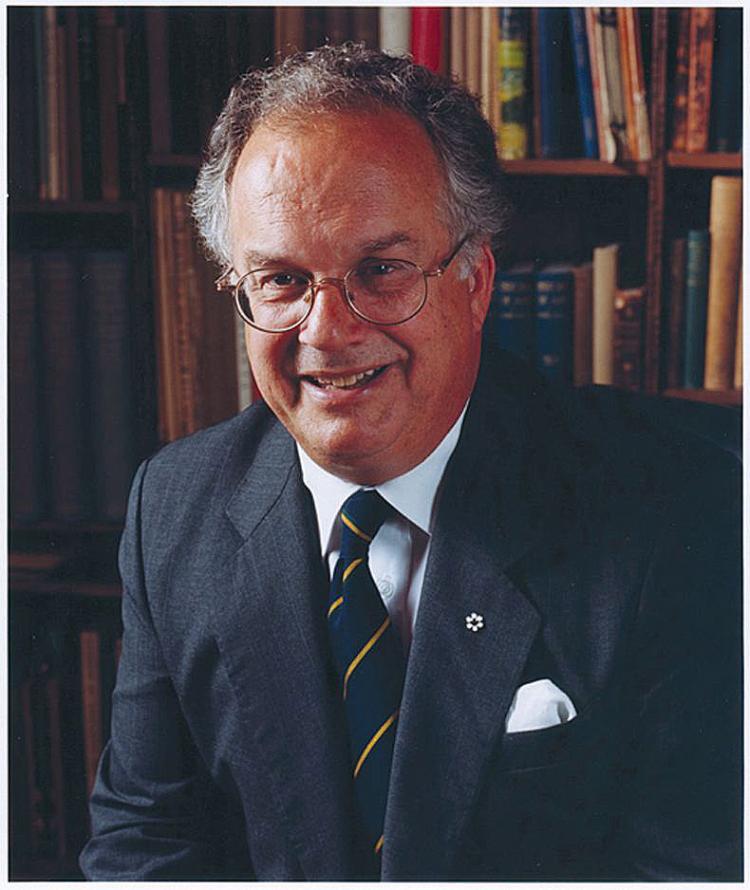
The Macdonald-Laurier Institute held a debate on the Crown on 14 March 2012 on the resolution that “The monarchy is a dangerous anachronism”. John Fraser opposed it, and Michael Bliss supported it. The erstwhile republican Jack Granastein presided over the debate but did not intervene. Regular readers will know that debunking republicans’ arguments has become one of this blog’s monarchist memes. I had hoped for an interesting debate from an informed republican who could offer legitimate criticism of the system, and an eloquent defence of constitutional monarchy and responsible government as the guardian of liberty and the form of government that best preserves accountability.

The Debate Itself

Jack Granastein started the debate by taking an informal poll of the audience and gauging our support for constitutional monarchy; by a show of hands, he reported that approximately 70% of the audience supported our system of government, and 30% opposed it. He asked the same question at the end of the debate and found the ratio unchanged, which means that both speakers failed to persuade anyone to change their views. Brian Lee Crowley raised his hand in favour of constitutional monarchy, and he told me in September 2011 of his support for constitutional monarchy. Crowley probably devised the resolution that “monarchy is a dangerous anachronism” in order to stir the passions of monarchists and republicans alike. I will analyze Bliss’s arguments, as well as some of Fraser’s responses that I considered inadequate.

Bliss started his presentation on a tautological note and spoke of the “self-evidence absurdity” of monarchy. If the monarchy were self-evidently absurd in the 21st century, then this debate would have been irrelevant, and Bliss and Fraser would have been wasting their time.
John Fraser

Bliss then advanced the trite republican idea, based on the superficial determinism of identity politics, that the Crown only “represents” Canadians of British origin. I deconstructed this argument in great depth in Right-wing Monarchists and Left-wing Republicans: The Inevitable Politicization of the Crown in Canada? This idea of course fails to take into account that some Canadians of British origin describe themselves as republicans and that many Canadians who lack British heritage support the Crown. In addition, it relies on what proponents of identity politics generally call “descriptive representation”, which is in fact not “representation” at all, but rather the affirmation or reflection of one’s values, “wilful self-righteousness”, and collective or individual self-assertion.[1] In addition, the Queen of Canada and the Governor General of Canada do not “represent Canadians”, though they may “represent Canada.” Only the House of Commons represents Canadians. The Governor General’s website, for instance, declares that the Governor General “represents Canada abroad”, upon the advice of the Prime Minister. The subtle distinction between representing the country and government on the one hand versus representing the people on the other is often lost in the cacophony. This superficial bastardization of representation, rendered into affirming and reflecting one’s belief system, derives from nationalist discourse and has no place with the Crown (Governor General) or with the Crown-in-Council (Cabinet).

Building on the language of self-assertive nationalism and identity politics, Bliss then proclaimed that we should abolish the Crown because no Canadian can ever become the Sovereign, our head of state. This is true, but I would argue, irrelevant. Instead of offering a definitive rebuttal to Bliss’s remark, Fraser took the dismissive approach and noted that because of recent royal marriages, two Canadians now find themselves in the line of succession. This is also true, but still irrelevant. Fraser should have responded that the Queen of Canada is a non-executive head of state, which means that the Prime Minister and Cabinet formulate and promulgate all government policies. Furthermore, anyone in Canada could work to become the Prime Minister of Canada – one does not even need to be a natural-born Canadian citizen in order to do so. Finally, the Letters Patent delegated most royal powers and authorities permanently to the Governor General, except in those rare cases when the Queen is actually in Canada, or when the Prime Minister asks her to travel abroad as Queen of Canada. Since 1952, all Governors General have been Canadian.

Bliss made several incorrect assertions throughout. He asserted that Spain is a republic, though he later acknowledged this error and corrected himself. However, he let two other significant mistakes stand; given his background as an historian, this disappointed me even more. One member of the audience asked what would become of the Crown’s treaties with Canadian aboriginals if the Crown of Canada were abolished. Admitting that he is not a lawyer, Bliss replied that the abolition of the Crown would not affect aboriginal treaties because Parliament now controls the Crown’s treaty-making powers. NO! The Crown has retained its prerogatives on defence and diplomacy, which includes despatching the armed forces and negotiating and signing treaties. Under responsible government, Cabinet now exercises these prerogatives through the Governor-in-Council. The House of Commons could withdraw its confidence from the government if it disagreed with a war or a treaty, but it neither initiates nor promulgates these policies. The ignorance toward the true nature of Crown prerogative in responsible government is more widespread that I had previously feared, infecting even political historians.

Michael Bliss

Some of my previous work deals extensively with Bliss’s other egregious mistakes and presumptions on the Governor General’s reserve powers and the constitutional relationship between the Governor General and the Prime Minister. I knew the correct answer; I was screaming it from the audience. Bliss asserted that Prime Minister Macdonald resigned in 1873 in order to avoid being dismissed by the Governor General, then Lord Dufferin. This is factually incorrect, as I demonstrated in “Dawson and Forsey Clash Over the Prorogation of 2008” and as Nick MacDonald and I explained in “No Discretion: On Prorogation and the Governor General.” In fact, Macdonald resigned because the House of Commons would certainly have withdrawn its confidence from his government. Lord Dufferin did not need to intervene because the system of responsible government worked as it properly should. Bliss also made an unsubstantial and unsubstantiatable counter-factual  that if the Governor General Michaelle Jean had dissolved the 40th Parliament in December 2008, “the Conservatives would have savaged her” and portrayed her as a meddling Liberal. First of all, this statement is impossible to prove, and as a counter-factual, is essentially irrelevant. Second, since the Governor General can only dissolve Parliament upon the advice of the Prime Minister and not on her own initiative; Jean could only have dissolved the 40th Parliament in accordance with Harper’s advice. He therefore would not have attacked her for having carried out his own advice.

Neither Bliss nor Fraser gave any indication of having considered the differences between presidential and parliamentary republics. Namely, in a presidential republic, the president serves as an executive head of state and thus exercises real power and formulates and promulgates the government’s policies. The United States is the classic example, but they seemed to consider it the only example! In a parliamentary republic, the president (or whatever) acts as a non-executive head of state and thus possesses varying degrees of official and personal authority but does not exercise power.[2]  Some parliamentary republics, like Ireland and Israel, allow voters to elect directly the president; in others, like Germany, the Parliament appoints a president instead. Bliss also boasted that he would describe his ideal republican system during the question-and-answer session if prompted. Unfortunately, he did not seem to understand the differences between a presidential republic and a parliamentary republic and frequently mixed up his responses. In some responses, Bliss said that he wants to introduce “checks and balances” onto the Prime Minister’s power, which suggests a presidential republic. But at other times, he spoke of both the Irish parliamentary republican model and the German parliamentary republic model. He also did not seem to understand that a parliamentary republic with its non-executive head of state would probably not curtail the power of a Prime Minister. Overall, he sounded utterly incoherent on the subject and incapable of articulating a clear argument. Worse still, Fraser took refuge in that a subtle but petty anti-American ad hominem and only reinforced the false notion that all republics are presidential.

Perhaps drawing on the Young Liberals of Canada’s republican motion to the Liberal Party’s recent policy convention, Bliss suggested that some kind of federal-provincial committee be struck in order “to consider the position of the monarchy” upon the demise of Queen Elizabeth II. This pointless idea overlooks that succession occurs automatically: upon the demise of the current monarch, the first in the line of succession immediately becomes the new Sovereign. Coronation ceremonies merely affirm a succession that has already occurred. This committee would therefore only consider one question: should the government abolish the Crown of Canada and become a republic? Contrary to what Bliss suggested throughout his presentation, the abolition of the Crown of Canada means throwing out and rewriting the entire Constitution of Canada, not merely amending it, because the Crown currently forms the basis of sovereignty and authority through the Crown-in-Council and the Crown-in-Parliament.

Conclusion

Unfortunately, neither speaker argued their respective positions as effectively as they could have. Michael Bliss made several blatant factual errors in addition to propagating several common republican misconceptions that I have already deconstructed in previous entries. (I will still reference them as needed). John Fraser did not offer a clear articulation of the benefits of responsible government and probably could have better explained why the Crown as an institution and constitutional monarchy protect liberty. Fraser also relied upon a subtle anti-Americanism as an argument against republicanism. I found Fraser’s anti-Americanism disappointing and ad hominem.  As I have written ad nauseam on Parliamentum, the American Revolution was in fact a civil war between two liberal factions, the Patriots and the Loyalists; both groups concerned themselves with good government that secured liberty, and they lived in both British America and in the United Kingdom itself. Of all the arguments in favour of constitutional monarchy and the Crown in Canada, “It distinguishes us from the Americans” is the weakest and most petty.  Overall, however, Fraser argued more effectively and persuasively. I do not draw that conclusion because I already agree with his position, but because Bliss made more blatant factual errors and severe misinterpretations of history.

Similar Posts:


[1] Paul Benoit. “State Ceremonial: The Constitutional Monarch’s Liturgical Authority,” in The Evolving Canadian Crown, edited by Jennifer Smith and D. Michael Jackson, 119-137. (Kingston: Institute of Intergovernmental Relations, School of Policy Studies, Queen’s University, 2012): 130.
[2]
Ibid.

Posted in Conferences and Speeches, Monarchism v Republicanism | Tagged , , , , , , , | 5 Comments

The Prime Minister Does Not “Represent All Canadians” – the House of Commons Does


Responsible Government and the Loyal Opposition

Many of the subtle misinterpretations of the nature of responsible government derive from what some (and perhaps some of you, dear readers!) would consider “quibbling”, constitutional pedantry, or “debates over semantics.” I would argue, however, that these small differences matter, and the language that one uses to describe parliamentarism reveals much about his implicit understandings (and misunderstandings) of how the system operates. For instance, as I described in detail in the previous two posts, the Canadian Armed Forces and the Civil Service serve the Crown and do not “serve the people,” but to varying degrees, “attend to the public good” based on the policies and mandates determined by Cabinet. So too, the Prime Minister “governs for all of Canada” but most certainly does not “represent all Canadians.”

Survey on Why “Quebeckers See Themselves Less in the Canada of Stephen Harper”

Justin Trudeau demonstrated his total ignorance of the purpose and function of loyal opposition a few weeks ago. Now the Le Journal de Montreal ran an article called “Les deux solitudes s’eloignent: Les Québécois se reconnaissent moins dans le Canada de Stephen Harper” that promotes the same narrative: that Quebeckers “do not see themselves” in Canada in general, or in the Harper government in particular. Both analyses conflate the government with the State and try a specious distinction between policy and values in the operation of government.

First, Canada is not the property of any individual Prime Minister. This is not “Stephen Harper’s Canada”, as the headline in French asserts, simply because the Harper Ministry currently governs Canada. The Canadian federal State exists because of the Crown and the Constitution, not because of the government of the day.

Second, this article contains an inherent tautology in the assertion that “Quebeckers see themselves less in Stephen Harper’s Canada”: obviously, Quebeckers do not possess “a significant spokesman” in the Harper government: they choose to elect candidates representing the New Democratic Party, which has necessarily “confined Quebeckers to the Opposition in the House of Commons.” If Quebeckers had elected more Conservatives, then they would have received commensurately more representation in Cabinet.

When electors in any given province choose to vote overwhelmingly for a party that occupies the Opposition benches, they will in turn “not see themselves” in the government. During the 1990s, most Western Canadians “did not see themselves” in the Chretien government because they choose to elect Members of Parliament from the Reform Party/Canadian Alliance and the New Democratic Party. They made the decision to elect Members of Parliament who would most likely end up in Opposition rather than form the Government. Then in 2006, when Stephen Harper formed a Conservative Ministry, many Western Canadians found their Members of Parliament inside the Government and on the government’s side of the House. In addition, Professor Louis Massicotte laments that “the program of the Harper government ‘reflects the priorities of electors other than those in Quebec.’” Yes, obviously, Massicotte’s tautological reasoning has stumbled upon the correct conclusion. Why does the paper report on these statements as if they were profound revelations?

Conclusion: Quebeckers Do Not “See Themselves in Canada” Because the PM and Government Do Not “Represent All Canadians”

I suspect that these Quebeckers lament that they “do not see themselves” in the Harper government based on an inherent misunderstanding of the true nature of responsible government.

Namely, the Prime Minister and Cabinet “govern all of Canada”, but they most certainly do not “represent all Canadians” in the sense of “reflecting their values”, as Professor Massicotte mentioned. The Government of Canada could only “represent all Canadians” if all Canadians voted for the same political party and elected a Parliament composed entirely of one political party!

The Prime Minister and Cabinet can and does “govern all of Canada” or represent all Canadians in the sense of articulating what they consider Canada’s interest and promoting it; however, the Prime Minister and Cabinet most certainly cannot “represent all Canadians” in the sense of “reflecting their values in government.” The nationalistic phrasing of Quebeckers “not seeing themselves in the government” in this case necessarily refers to the latter concept.

In short, the Sovereign represents and is the Crown and the Country, the House of Commons as a whole represents all Canadians, and the Prime Minister and Cabinet govern for all Canadians. Within the House of Commons, the loyal opposition represents “the political minority” and makes the representation of political dissent integral to Westminster parliamentarism.[1] Therefore, no Prime Minister could ever “represent all Canadians” unless the Prime Minister’s party won all 308 seats in the House of Commons and Canada became a one-party State.

All Canadians possess and should exercise their right to peaceful political dissent and their liberties of expression. However, no group in Canada should complain when “their values aren’t represented in the government” when they chose to elect parties that occupy the Opposition benches! “The supreme benefit of parliamentary government is that it protects political opposition, the right to dissent.”[2] The Opposition thus fulfills an integral and vital democratic function within Westminster parliamentarism, and by complaining in such a manner, these Quebeckers featured in the newspaper article are in fact (though probably unintentionally) denigrating the necessary and proper role of loyal opposition within the system of responsible government. The views of Quebeckers are well-represented in the New Democratic Party as Official Opposition, and that’s what matters.

Similar Posts:


[1] Janet Ajzenstat, “Bicameralism and Canada’s Founders: The Origins of the Canadian Senate,” in Protecting Canadian Democracy: The Senate You Never Knew, ed. Serge Joyal (Toronto: University of Toronto Press, 2003): 3, 7.

[2] Ibid., 7.

Posted in Loyal Opposition, Reaffirmation of, Responsible Government | Tagged , , , | 10 Comments

The Civil Service, Not the “Public” Service


The Center of the Civil Service of Canada

As part of my series on the true nature of responsible government and Crown prerogative, I will now turn my attention to another part of the government that derives its authority from the Crown: Her Majesty’s Civil Service. The civil service originated as and theoretically functions like the civilian equivalent of the Armed Forces: both derive their authorities from the Crown, both serve the Ministers of the Crown (i.e., the properly elected civilians who receive commission from the Sovereign or Governor General) and not Parliament or the public, and both operate under a clear, hierarchical chain of command. Contrary to popular belief, Parliament does not control the Civil Service; Parliament can hold only the responsible Minister to account. The Library of Parliament and the Officers of Parliament report to Parliament, but the Civil Service does not.

The official rebranding of the Civil Service of Canada as the “Public” Service of Canada has lent itself to the blurring of the constitutional lines of accountability and severing the chain of command: civil servants may “attend to the public good”, but they do not “serve” the public[1], because the latter term implies lines of authority and accountability. Civil servants serve the responsible Ministers of the Crown, who take responsibility and accountability for the civil service in Parliament.

Of the main Commonwealth Realms, only the United Kingdom has preserved the correct and proper name of “Her Majesty’s Civil Service”. Australia, Canada, and New Zealand have all changed theirs to some variant of the “Public Service”. But when “public servants” believe that they serve the public rather than the Crown through their responsible Ministers of the Crown, they may feel obliged to become insubordinate and not only break, but entirely invert, the chain of command: instead of going up through the hierarchy of director, director general, assistant deputy minister, deputy minister, and Minister of the Crown, they might feel compelled to go outside the service and directly to the public. The Civil Service’s ranks mirror those of the Armed Forces and roughly correspond to the following:[2]  Director is Lieutenant, Senior Director is Captain, Director General is Major, Assistant Deputy Ministers are Lieutenant-Colonels and Colonels, Deputy Ministers are Brigadier Generals, the Clerk of the Privy Council is a Major-General, the Prime Minister and Ministers of the Crown are Lieutenant-Generals, and the Governor-General or Sovereign as Commander-in-Chief is a full General. The non-commissioned officers likewise correspond to the non-executive civil servants; a manager is like a Chief Warrant Officer, and so on.

In principle, civil servants may express disagreement with their superiors in private under some circumstances, but never in public or amongst the organization as a whole. To do otherwise is to commit insubordination. This chain of command ensures that the responsible Ministers are accountable to Parliament and that the Civil Service is controlled by Cabinet. Members of the Armed Forces and Civil Service thus “serve their country” (i.e., the Crown), but they do not “serve the public.”

UPDATE:

According to the Ottawa Citizen, six public-sector unions have contributed to a campaign that inaccurately labelled itself “Professionals Serving Canadians” in order to protest the government’s policies.[1] Civil servants serve the Crown by carrying out the policies and priorities that the government determines. They may interact with Canadians and attend to the public good, but they do not “serve” the public.


Similar Posts:


[1] Philippe Lagassé, conversation with author, 3 March 2012.
[2]
I’m using Army rather than naval ranks.
[3] Kathryn May, “Public service unions abandon neutrality to challenge expected Conservative cuts,” Ottawa Citizen, 21 March 2012.

Posted in Reaffirmation of, Responsible Government | Tagged | 3 Comments

The Demise of Responsible Government and the Crown Prerogative on Defence


Perilous Precedents: Parliamentary Approval of Troop Deployments

Many scholars have lamented the Harper government’s alleged “abuse” of Crown prerogatives on prorogation and dissolution, and its overall attitude toward Parliament (i.e., the House of Commons). I of course disagree with the argument that Prime Minister Harper has “abused” Crown prerogative, based on the Government of Canada’s true method of operation as well as the Manual of Official Procedure of the Government of Canada, the little-known but still-used officialization of the conventional constitution from 1968.

Apart from Professor Philippe Lagassé, most scholars have also overlooked that the Harper government has been too deferential to parliament in at least one key area: defence policy. By allowing the House of Commons to approve troop deployments and the Canadian participation in NATO’s International Security Assistance Force (ISAF) in Afghanistan, the Harper government has created a series bad precedents and contributed to the development of new “contrived conventions” that will ultimately threaten the most important component of our conventional constitution: responsible government.

In my last entry on “The True Nature of Crown Prerogative and Responsible Government”, I explained why the Crown prerogatives on prorogation and dissolution properly rest with the Crown under the system of repsonsible government. This entry will extend that explanation to the Crown prerogative on defence.

Ministerial Answerability vs. Accountability and the Crown Prerogative on Defence

Philippe Lagassé wrote a comprehensive study for the Institute for Research on Public Policy on the Crown prerogative on defence; it explains the differences between the Minister’s responsibility to the House of Commons and Chief of Defence Staff’s answerability before Parliament. The Canadian Armed Forces “serve the Crown rather than Parliament.”[6] In short, the CDS is “answerable” before parliamentary committees and thus “limited to informing and explaining, rather than disclosing policy preferences or revealing what military advice was given to the defence minister.”[7] In contrast, the Minister of Defence is both accountable to the House of Commons and answerable to parliamentary committees.[8] The Minister of Defence takes individual responsibility for the management of DND, and Cabinet as a whole (or the relevant Cabinet committee) takes collective ministerial responsibility for any policy or decision that requires defence expenditures, such as troop deployments.[9] The Minister of Defence and the CDS are also accountable to the Prime Minister.

The Chief of Defence Staff exercises powers delegated from the Crown, not from Parliament.[10] However, the current CDS has demonstrated in public a disturbing ignorance of his lines of authority to the Crown. Presenting a keynote address before the Conference of Defence Associations on 24 February 2012, General Natynczyk acknowledged some Senators and MPs and highlighted their presence as an indication of “the Government’s support of the Canadian Forces.”[11] In reality, the presence of individual Senators and MPs signifies either the support of those individuals, the support of their parties, or the support of Parliament – but never the support of the Government. I found Natynczyk’s statement particularly bizarre because his civilian superior, the Minister of the Crown for National Defence, the Hon. Peter MacKay, had addressed the conference earlier that morning. It was the Peter MacKay’s presence that signified the Government’s support of the Canadian Armed Forces. Cabinet makes all policy for the Canadian Armed Forces and takes responsibility for its policies and expenditures before Parliament.

These direct lines of accountability from the CDS [Chief of Defence Staff] belie any notion that the CDS has accountabilities to Parliament or that Parliament directly “controls” the military. Both the National Defence Act and the power of appointment enforce the norm that the Canadian military serves those who are accountable to Parliament, not Parliament itself. […] [T]he armed forces serve the Crown rather than Parliament. Supreme authority for the command of the armed forces and the defence of Canada flows from the Crown.[12]

Natynczyk also stated that “Parliament” has made the CDS “responsible for the welfare of military families.” The Crown-in-Parliament deals with the Canadian Armed Forces only in the National Defence Act; Cabinet determines all policy for both DND and CF, through whitepapers and documents like the Canada-First Defence Strategy. Part I of the Act established the Department of National Defence (DND), the individual responsibility of the Minister of the Crown for National Defence for both DND and the CF, as well as the positions of the Deputy Minister and the Judge Advocate General. Part II established the Canadian Forces, including the position of the CDS. The Act makes no mention of “military families” and certainly does not charge the CDS for the well-being of military families. Therefore, Parliament never granted the CDS such authority.

The Harper Government Has Been Too Deferential To Parliament!

Canadian pundits often perpetuate this perception of Stephen Harper as the brilliant strategist. If anything, Harper and his political staff are good tacticians, but not necessarily good strategists: they normally apply short-term political pressure to the opposition parties (particularly the Liberals under Dion and Ignatieff) effectively, but sometimes at the expense of the Government’s long-term interest. On 22 November 2010, the Conservatives so succeeded in embarrassing the Liberals and shirking their ministerial responsibility that they managed to persuade the media to put the onus on Ignatieff, who initially considered a parliamentary vote on extending Canada’s participation in ISAF unnecessary (which it is) in order to avoid the embarassment of exposing the divisions within the Liberal ranks.[1] The Government controls the legislative agenda and would organize such votes, not the Official Opposition! Some PhDs in defence and security studies praised the Harper government’s approach. Professor Bob Bergen called parliament’s approval of Canada’s participation in ISAF “a democratic triumph”.[2] He criticized parliament’s “marginal role” in the deployment of troops abroad. In reality, the only role that Parliament should adopt with respect to the deployment of troops abroad is passing supply in the form of the budget and main estimates. David Bercuson criticized the Harper government for reverting the proper procedure whereby Cabinet determines defence policy:

Simply put, the excellent precedent that Prime Minister Stephen Harper established in 2006, and reiterated in 2008, is now being undone by he himself. But the Prime Minister isn’t alone in turning the clock back on troop deployment. The Liberal Opposition is going along right with him.[3]

In effect, the Harper government has “laundered” the Crown prerogative on defence and troop deployments through the House of Commons (not even the Crown-in-Parliament as a whole) in order to deflect public scrutiny and attention after from its own collective ministerial responsibility.[4] Responsible government means that Ministers of the Crown, led by the Prime Minister, take responsibility for acts of the Crown prerogative (policies and expenditure) and are responsible to the House of Commons.[5] These Crown prerogatives must necessarily include defence and the Armed Forces because waging war costs money – supply that the House of Commons must approve in the budget and main estimates. By outsourcing its Crown prerogative on defence, the Harper government has in fact undermined responsible government and given itself a form of plausible deniability: now whenever the House of Commons, the public, or the media criticize the role of the CF in Afghanistan, the Harper government can shirk its collective ministerial responsibility and place it on the House of Commons. The Harper government might reply, “The people’s representatives in the House of Commons voted to approve the extension of Canada’s involvement in the Afghan campaign, and the government merely followed Parliament’s will.” The House of Commons has become an eager and enthusiastic participant in its own demise. Cabinet governs; parliament grants (or not) supply. The Harper government, however, has unwittingly contributed to the formation of a new public perception of Parliament as a governing body and thus may have inadvertently restricted the conventional scope of Crown prerogative.

Conclusion: “Contrived Conventions” Threaten Responsible Government

“Constitutional conventions are unwritten, politically enforceable norms. These norms evolve from practices and customs that complement and contextualize laws or the written constitution.”[13] In this case, a “contrived convention” refers to a normative, or paradoxically, a statutory, constraint on Crown prerogative, when only a constitutional amendment would legally and truly restrict or narrow its scope of that prerogative power. The “contrived convention” therefore conflates an artificial or virtual constraint with a true legal limitation. The standard conventions arise in order to reinforce and protect the larger constitutional principle of responsible government, and its main corollary, the confidence convention.[14] I explained in full in the previous post why these Crown prerogatives properly belong to the Crown under our system of responsible government. In contrast, these “contrived conventions” threaten and undermine responsible government by breaking the link between the Cabinet, policy, and expenditure (as in this case of the prerogative on defence), or by imposing written rules that contradict the well-establish conventional constitution. This inherent conflict causes confusion and destabilizes the constitutional system.

I explored this notion in my earlier posts on the Canadian approach to fixed elections and the Senate Reform Bill. All the federal and provincial fixed-elections laws contain a provision to the effect that “Nothing in this Act affects the Governor General’s [or Lieutenant-Governor’s] power to dissolve Parliament”, because only an amendment following section 41 (a) of the Constitution Act, 1982 (“office of the governor general and lieutenant governor”) could narrow the scope of Crown prerogatives on prorogation and dissolution in law. The federal and provincial legislation therefore adopt this curious paradox of imposing a conventional (i.e., normative) limitation on the Crown prerogative of dissolution in statute, when normally conventions (i.e., norms) arise over time through best practices, and when only a constitutional amendment could truly limit this power in law. Similarly, the Senate Reform Bill would also impose by legislation a conventional restriction on the Prime Minister’s prerogative to nominate Senators. By a well-established and proper convention, the Governor General acts upon and in accordance with the Prime Minister’s advice and formally appoints the Prime Minister’s nominees. The Senate Reform Bill would stipulate that the Prime Minister “must consider” the results of the provinces’ senatorial advisory elections. The phrase “must consider” codifies the idea that the prime minister will voluntarily restrain his crown prerogative of advising the governor general to appoint only the winners of the provincial senatorial elections; however, it does not codify any substantial constitutional limitation on crown prerogative. “Must consider” does not mean “must nominate.” Only an amendment, using the general formula, to Section 24 of the Constitution Act, 1867 could formally limit in law the Crown prerogative of senatorial appointment. Aucoin, Jarvis, and Turnbull also criticized the fixed-elections laws and any other law as inherently flawed because they rely “the good faith of the prime minister” rather than one true legal limitations on Crown prerogative.[15]

The Harper government has set the perilous precedent that the House of Commons now approves troop deployments (i.e., expenditure); however, because the Harper government and the House of Commons agreed in all the votes on extending Canada’s participation in NATO’s ISAF in Afghanistan, these precedents did not directly reveal their long-term consequences. In the future, two scenarios could occur, more likely in a minority parliament, that would threaten responsible government: first, the Cabinet wants to despatch troops or go to war, and the House of Commons votes otherwise and then introduces a motion of non-confidence; second, and more ominously, the House of Commons could vote to go to despatch troops or go to war against the policy of Cabinet. The second scenario could then involve the intervention of a CDS like General Natynczyk, who confuses Parliament and the Government, and the total breakdown of the lines of authority between the Chief of Defence Staff, Minister of Defence, and Prime Minister. Lagassé argues that “a severe defence failure could cost the cabinet the confidence of the House of Commons.”[16]

The tactic of making troop deployments subject to the approval of the House of Commons embarrassed the Liberals by exposing the fissures within that party, and thus helped the Conservatives in the short-term. In the long term, Parliament could very well invoke these perilous precedents in order to bring down minority governments and fundamentally alter the conventions of responsible government. Responsible government means that the Ministers of the Crown are collectively and individually responsible for acts of the Crown and responsible to the House of Commons. The Cabinet is responsible for all policy and expenditure, and the House grants supply. If the House refuses supply, then it has automatically withdrawn its confidence in Cabinet; the prime minister must either resign on behalf of his Cabinet or advise the Governor General to dissolve parliament and issue the writs of election. Troop deployments and military operations of any kind – whether disaster relief, peacekeeping, or combat missions – always and necessarily entail expenditure; therefore, the Cabinet must approve of such operations involving the Canadian Armed Forces and make all decisions relating to defence policy. Defence is undoubtedly a Crown prerogative and so it should remain.

Similar Posts:


[1] CTV News, “Igantieff Now Open to House Vote on Afghan Mission”, 22 November 2010.
[2]
Bob Bergen, “Vote on Afghan Mission a Democratic Triumph,” monthly column for the Canadian Defence and Foreign Affairs Institute, 19 May 2006.
[3]
David Bercuson, “Canada and the Extension of the Afghan Mission,” blog entry for the Canadian Defence and Foreign Affairs Institute, 23 November 2010.
[4]
Philippe Lagassé, “Should the Commons Vote on Deploying the Forces?” Globe and Mail (24 November 2010). http://www.theglobeandmail.com/news/opinions/opinion/should-the-commons-vote-on-deploying-the-forces/article1810788/ [Accessed 22 February 2012]; Philippe Lagassé, Opening Statement on Maintaining Readiness in the Canadian Forces, House Standing Committee on National Defence, 16 February 2012.
[5]
Sir John George Bourinot, Parliamentary Procedure and Practice, 4th ed. (Montreal: Dawson Brothers Publishing, 1916): 102.
[6]
Philippe Lagassé, “Accountability for National Defence: Ministerial Responsibility, Military Command, and Parliamentary Oversight,” IRPP Study no. 4 (March 2010): 44.
[7]
Ibid., 45.
[8]
Ibid., 40.
[9]
Ibid.
[10]
Ibid.
[11]
Chief of Defence Staff General Walter Natynczyk, Keynote Address to the Conference of Defence Associations, Ottawa, Ontario, 24 February 2012.
[12]
Ibid., 44.
[13]
James W.J. Bowden and Nicholas A. MacDonald, “Writing the Unwritten: The Officialization of Constitutional Conventions in Canada, the United Kingdom, New Zealand, and Australia,” Journal of Parliamentary and Political Law 6 no. 2 (2011): forthcoming.
[14]
Ibid.
[15]
Peter Aucoin, Mark Jarvis, and Lori Turnbull, Democratizing the Constitution: Reforming Responsible Government (Toronto: Edmund Montgomery Publishing, 2011).
[16]
Philippe Lagassé, “Accountability for National Defence: Ministerial Responsibility, Military Command, and Parliamentary Oversight,” IRPP Study no. 4 (March 2010): 40.

Posted in Articles and Books, Cabinet's Powers, Crown (Powers and Office), Reaffirmation of, Responsible Government | Tagged , , , | 15 Comments

The True Nature of Crown Prerogative and Responsible Government


When PhDs Don’t Understand Westminster Parliamentarism

The debates in Westminster parliamentarism on the role of Crown-in-Parliament vs. the Crown-in-Council mostly result from legitimate differences of interpretation of Crown prerogative, such as between Dawson’s and Forsey’s respective schools of thought. Unfortunately, sometimes the debates result from factually incorrect assertions that even PhDs and tenured professors propagate, perhaps hoping that their credentials and their name will suffice in place of arguments or citations! Christian Nadeau, Professor of Philosophy at the University of Montreal, provides one such example.

Nadeau wrote “Constitutional Rule Bending: When Angry Citizens Push Back and Fight for Democracy” in the same issue of Canada Watch to which Peter Russell contributed the article featured in my previous blog entry. Essentially, Nadeau interprets the prorogations of 2008 and 2009 as evidence Harper’s desire to govern without the Crown-in-Parliament, and emblematic of a contempt for parliamentarism. Ironically, Nadeau shows contempt for Westminster parliamentarism through his sheer ignorance of this form of government. Sadly, Nadeau’s unsubstantiated opinions are all too common, even among academics. But how did these misunderstandings and faulty interpretations of parliamentarism become so prominent? I would argue that Trudeau’s reform of the estimates in 1968 hastened the decline of the House of Commons by preventing it from carrying out its centuries-old purpose of holding the Crown to account through scrutinizing its expenditures properly.

The Respective Roles of Cabinet (the Government) and Parliament

Cabinet governs; Parliament passes supply

Nadeau argues: “In effect, prorogation works to dissolve the confidence and trust between people and their government by allowing the government to function without those who were elected precisely to govern.”[1] This statement contains numerous inaccuracies and myths about “parliamentary democracy.” First and foremost, Cabinet governs; Parliament passes supply. Parliament, despite Nadeau’s claim, does not govern! Second, his argument that a prorogued House “allows the government to function without those who were elected to govern” contains an inherent contradiction because a government (i.e., the Cabinet consisting of Minister of the Crown) always exists, even when Parliament is dissolved. As the Guidelines on the caretaker convention explain, the government by convention exercises restraint during the writ period and until the appointment of the new government, but the legal powers of the government always remain in place.

Responsible government means that Ministers of the Crown, led by the Prime Minister, take responsibility for acts of the Crown (policies and expenditure) and are responsible to the House of Commons.[2] The implementation of policy normally requires expenditure as well as corresponding legislation. Therefore, the government takes responsibility for both, but the government must command the confidence of the House. The House in turn expresses its confidence by passing supply; withholding supply amounts to a loss of confidence, after which the Prime Minister must either resign or advise the Governor General to dissolve Parliament. Contrary to popular and academic belief, Parliament neither makes policy nor controls the legislative agenda. The Crown prerogatives of prorogation and dissolution correspond logically to our system in which the government controls the legislative agenda, must introduce and approve of all money bills, and be responsible for all expenditures (the Royal Recommendation). The Prime Minister decides when his government’s legislative agenda has been completed and advises prorogation accordingly. As some of my previous posts have shown, various Prime Minister have also legitimately and constitutionally invoked prorogation as a delay tactic. In a system of responsible government where Minister of the Crown, and not the Sovereign or Governor General determine policy, “the Governor General accepts the Prime Minister’s advice on summoning and proroguing Parliament”[3] and “the Governor General does not retain any discretion in the matter of summoning or proroguing Parliament, but acts directly on the advice of the Prime Minister.”[4]

The House of Commons does not make policy. If backbenchers who generally support the government and side on the government’s side of the House object to government policy, then can mount a revolt in caucus, or on the floor of the House of Commons, if necessarily. Her Majesty’s Loyal Opposition normally objects to the government’s policy as a matter of course and therefore presents itself to the electorate as an alternative government.

1968 and the Decline of the House as Granter of Supply

Jim McGrath, a former Progressive Conservative MP from 1957-1963 and from 1968 to 1986, argued that the Trudeau government’s reform of the estimates in exchange for the modern Question Period in 1968 marked the decline of the House of Commons as an institution.[5] I would add that it also marked the decline of loyal opposition as an institution. As Tom Hockin has established, when “the House of Commons” holds the government to account, this task invariably falls almost exclusively to the loyal opposition;[6] backbenchers who support the government rarely mount intra-party revolts here in Canada, unlike their Australian and British counter-parts.

We should begin by asking how effective is Question Period in holding the Government to account. That question speaks to the genesis of the Question Period as it currently exists. As you know, back in the ‘60s the government brought in some major rules changes. They did away with the Committee of Supply, that was the old committee of the whole, which examined estimates in the House. That was when the Government was truly accountable. When they took the Committee of Supply out of the House, the estimates were automatically referred to standing committees, which had to report back to the House by the end of May. If they didn’t report back to the House by midnight at the end of May, they were deemed to have reported to the House.[7]

McGrath served as a parliamentarian both before and after Trudeau’s reforms of 1968 that robbed the House of Commons of its core function: proper scrutiny of the Crown’s expenditure, the passage (or not) of supply. Since 1968, if a House Standing Committee fails to scrutinize government expenditure and to pass supply, the Crown still receives its supplies anyway on a fixed timetable. Trudeau’s reforms greatly emboldened the Cabinet vis-à-vis the House and severely restricted the primary historical function of Parliament since the Glorious Revolution and the Constitutional Settlement of 1689: to hold the Crown (now represented by Her Majesty’s Ministers) to account. While I favour maintaining the prerogatives that naturally belong and should continue to belong to the Crown in an era of responsible government – like prorogation and dissolution – I oppose new encroachments into the domain of the Crown-in-Parliament. Thankfully, some parliamentarians are now calling for reforms that would make the House Government Operations and Estimates committee more effective in holding the government to account.[8]

In the wake of this new arrangement, the House of Commons has been adrift and searching for a purpose. The Crown encroached upon the rights of the Crown-in-Parliament – and the latter eagerly participated in its own decline. Now the House of Commons – aided by PhDs like Peter Russell and Christian Nadeau – wants to encroach upon Crown prerogatives. Any meaningful reform of parliament would restore the balance based on the proper and ideals of responsible government that I listed above. Anything else would begin a transformation into a “post-responsible government” model of parliamentarism. Either way, we must fundamentally analyze our current state of parliamentarism and determine what system we ought to promulgate. Obviously, I favour the traditional system outline above.

Conclusion: “Parliamentary Democracy” vs. “Responsible Government”

Russell and the other social democratic Romantics reject the traditional and more accurate term responsible government and propagate instead parliamentary democracy. And by “parliamentary democracy”, they of course refer exclusively to the House of Commons and the confidence convention, not to the Crown-in-Parliament (Queen, Senate, Commons) as a whole.[9] The word “democracy” elicits an emotive and emotional appeal and thus derives from the vocabulary of political activism and Romanticism. I’m not describing Russell’s intent, merely my interpretation of the effect of this terminology.  Russell attributes to the same meaning to “parliamentary democracy” as other scholars do to “responsible government”; however, the more emotive connotation of “democracy”, as opposed to the rational “responsible government”, allows one to not merely disagree with the interpretations other scholars, but to treat their views as inherently anti-democratic. This idea of “parliamentary democracy” also emphasizes the role of the House of Commons both at the expense of the Crown-in-Parliament as a whole (Queen, Senate, House) and the Cabinet (the Crown-in-Council). It distorts the true nature of Crown prerogative within the system of responsible government and helps sow misunderstanding about the relationship between the Crown, Crown-in-Council, and Crown-in-Parliament.

In this video, Peter Russell subtly calls Prime Minister Harper an absolute monarch:

In “The Power and the Glory of the British Monarchy” (1992), Peter Hennessy, a pre-eminent English constitutional history from whom many Canadian PhDs could learn much, provided an accurate explanation of the Crown-in-Council vis-à-vis the Crown-in-Parliament and the basis of the Cabinet’s power in the system of responsible government. The basic formula applies to Canada, Australia, and New Zealand as well. Contrary to popular and academic belief, responsible government deliberately preserved the powers of the Crown and transferred them to the Crown-in-Council, which exercises them subject to the Crown-in-Parliament. By convention, Cabinet therefore must command the confidence of the House of Commons in order to govern; however, it derives its authority from the Crown, not from the Crown-in-Parliament. These basic facts of responsible government are anathema to any PhD who talks of “parliamentary democracy”. (Go to the 3-minute mark for Hennessy’s lucid remarks).

The British Prime Minister is strongest chief executive anywhere in the Western world because he’s largely taken the absolute powers of the monarchy unto himself or herself. It’s quite wrong to think that they shifted to Parliament. The lie is always that sovereignty is the Queen-in-Parliament. Most of the powers that matter stop halfway between the Palace and Westminster –in Number 10 Downing Street – either exercised by individual Secretaries of State or by the Prime Minister. All the ones that matter – peace, war, recognizing countries, unrecognized countries – are Royal prerogatives, but they’re carried out for the Queen by the Prime Minister. So those powers are Royal powers, but they’re put into commission in civilians – properly elected civilians, I have to say. But still, the basis of that power is Royal.

Similar Posts:


[1] Christian Nadeau, “Constitutional Rule Bending: When Angry Citizens Push Back and Fight for Democracy,” Canada Watch (Spring 2011): 19.
[2]
Sir John George Bourinot, Parliamentary Procedure and Practice, 4th ed. (Montreal: Dawson Brothers Publishing, 1916): 102.
[3]
Canada. Privy Council Office, Manual of Official Procedure of the Government of Canada, Henry F. Davis and André Millar. (Ottawa, Government of Canada, 1968): 149.
[4]
Canada. Privy Council Office, Manual of Official Procedure of the Government of Canada, Henry F. Davis and André Millar. (Ottawa, Government of Canada, 1968): 150.
[5]
Peter Dobell, ed. “The Question Period: What Former Members Think,” Occasional Papers on Parliamentary Government (Ottawa: Allegra Print and Imaging, May 2001): 4. [Accessed 10 April 2010].
[6]
Thomas A. Hockin, “The Loyal Opposition in Canada: An Introduction to Its Ideal Roles and their Practical Implementation For Representative and Responsible Government.” (PhD Thesis, Harvard University, March 1966): 14.
[7]
Peter Dobell, ed. “The Question Period: What Former Members Think,” Occasional Papers on Parliamentary Government (Ottawa: Allegra Print and Imaging, May 2001): 4-5. [Accessed 10 April 2010].
[8]
Jessica Bruno, “MPs Slam ‘Shoddy, Hasty’ Annual Review of Feds’ Spending Estimates, Franks Calls It ‘Depressing,’” The Hill Times (Monday, 20 February 2012). 
[9]
Peter H. Russell, “Prorogation – Prime Ministers Must Not Become Kings,” Canada Watch (Spring 2011): 17.

Posted in Cabinet's Powers, Crown (Powers and Office), Prime Minister's Powers, Reaffirmation of, Responsible Government | Tagged , , , , , , , , , | 19 Comments