The Constitution Act, 1982 Includes More Than Just The Charter of Rights and Freedoms!


The Significance of Patriation

After 50 years of intermittent effort, Canada finally achieved the patriation of its written constitution in 1982. “Patriation” meant primarily that the Parliament of Canada and the provincial legislatures as required could now amend its own constitution through a new all-Canadian amending formula and that the British Parliament no longer exercised any jurisdiction whatever over the amendment of Canada’s written constitution. The Statute of Westminster, 1931 marked the formal and legal independence of the Dominion of Canada, but our written constitution remained an act of the British Parliament until Patriation; as such, the British Parliament had to amend Canada’s constitution on the advice of the Canadian Parliament. Canada could have patriated as early as December 1931 with the passage of the Statute of Westminster, but our federal and provincial governments and parliaments could not agree on a suitable amending formula. We decided to leave the amendment of our written constitution to the British Parliament by default, as a neutral position until devising a new indigenous amending formula.

Other former Dominions never experienced this problem. From its establishment in 1901, the Commonwealth of Australia possessed an indigenous amending formula that it still uses today. New Zealand, as a unitary state, can amend its constitution by an act of its Parliament. However, Canada’s founders clearly wanted the British Parliament to possess the power to amend the British North America Act, 1867. This arrangement therefore might have been a mistake, but it was no oversight; it was deliberately put in place. By the 20th century, however, Canada needed to change this procedure.

In 1982, Canada patriated the British North America Act, 1867 and renamed it the Constitution Act, 1867. Canada also established another crucial pillar of its written constitution, the new Constitution Act, 1982. Through the new constitution, Canada codified and affirmed many common-law rights into the Charter of Rights and Freedoms (Part I), recognized the treaty rights of aboriginals (Part II), codified equalization (Part III), finally established an indigenous amending formula (Part V), and in the Schedule included some (but not an exhaustive list) of the other Orders-in-Council and Acts of Parliament that form part of the overall Constitution of Canada. The Constitution Act, 1982 as a whole represented a significant achievement in Canadian history, but most of the commentators – including former Liberal Attorney General and Prime Minister Jean Chretien and former Liberal Attorney General Irwin Cotler – have lauded only the Charter of Rights and Freedoms with great praise and all but ignored the other components of the Constitution Act, 1982.[1] In so doing, they have contributed to the popular and false narrative that Patriation exclusively refers to the Charter.

Misconceptions on Patriation and the Charter

Myth 1: Canada As Colony

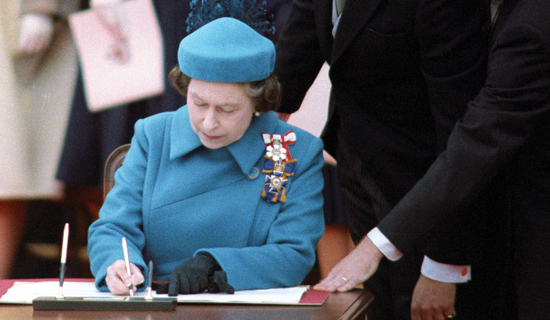
In a recent interview with Tom Clark, Jean Chretien, the great story-teller and myth-maker, also perpetuated other disturbing misconceptions about Patriation. As a former Attorney General and Prime Minister and as a lawyer, he should have known better! Chretien asserted, “You know, we were still legally a colony of Great Britain [until the Patriation of 1982].”[2] Chretien’s statement is demonstrably false. Canada ceased to be in law and in fact a colony of the United Kingdom with the passage of the Statute of Westminster, 1931, which established the Crown of Canada as a separate legal entity from the Crown of the United Kingdom. We cannot blame the United Kingdom for our homegrown Canadian failure to devise an appropriate indigenous amending formula until 1982! The Royal Proclamation that Queen Elizabeth II of Canada signed at the ceremony in Ottawa in recognition of Patriation even declared in the preamble, “Whereas it is in accord with the status of Canada as an independent state that Canadians be able to amend their Constitution in Canada in all respects.”[3] The Queen of Canada thus recognized that Canada had already attained the status of independent state before 1982. The most amusing aspect of Chretien’s false statement is that he was the Attorney General of Canada when Her Majesty issued that Proclamation – and he therefore counter-signed the same document!

Myth 2: Charter as Giver of All Rights

The Charter of Rights and Freedoms did not “give us our rights” per se, as the common refrain asserts. It did give Canadians some additional positive rights on official languages. But in large part, it codified and affirmed common-law rights that Canadians had already possessed based on centuries of judicial precedent and reception of British statutes.  Before the Charter, parliaments could infringe upon our common-law rights without judicial review, but these rights were still extant.  The Charter imposed a significant limitation on the Blackstonian doctrine of parliamentary sovereignty for the first time by subjecting acts of parliament to judicial review and by preventing the Parliament of Canada and the provincial legislatures from passing legislation that infringed upon our basic rights, “subject only to such reasonable limits prescribed by law as can be demonstrably justified in a free and democratic society.”[4] This Reasonable Limits Clause, Section 1 of the Charter, acts as a check and balance between Parliament and the courts in a new era of judicial review.

I support the Charter and consider judicial review of potential parliamentary infringements on individual rights a healthy and reasonable limitation of parliamentary sovereignty. Parliament should not possess the sovereignty to deny someone his basic rights as a free-born Canadian. As  a Whig and classical liberal, I support in principle a constitutional document that prevents all levels of government from infringing upon clearly defined, negative rights.  In addition, the Charter still strikes a balance between the legislature and the judiciary through the Reasonable Limits Clause and the Notwithstanding Clause; it does not deal in absolutes.

Myth 3: On the Constitution’s Application to Quebec

The Constitution Acts (1867 and 1982) apply to all provinces and to the federal level. The Levesque government did not agree with the Constitution Act, 1982, which frankly makes sense from their viewpoint: a secessionist party and officially secessionist government cannot realistically support an effort that would make Canada anew and reinforce Quebec’s place in the federation. Quebec did not “sign on to the constitution”, but the entirety of the  Constitution Act, 1982 applies to Quebec with the same force and effect as it applies to the other provinces and to the Dominion.

Conclusion

In conclusion, I agree with former Prime Minister Chretien that the Harper government probably should have included the 30th anniversary of the Constitution Act, 1982 in its list of celebrations of 2012 – but this commemoration most certainly should not focus exclusively on the Charter of Rights and Freedoms. We should commemorate Patriation and the Constitution Act, 1982 as a whole and the respective roles of the Trudeau government and the Queen of Canada therein, and we should celebrate integral place of the Constitution Act, 1982 and the Charter within the Constitution of Canada.

The Agenda with Steve Paiken recently hosted a panel with Chretien and Romanow. Any Canadian interested in the history of Patriation, the creation of our indigenous constitutional amending formula, and the establishment of the Charter should watch this video!

Similar Posts:


[1] Irwin Cotler, “Myopic Government Ignores Charter Anniversary,” Toronto Star (12 April 2012).
[2]
Global News, “If the War of 1812 Warrants Commemoration, So Does the Patriation of the Constitution: Chretien,The West Block (15 April 2012).
[3]
Canada Gazette, Constitution Act, 1982”, 12 May 1982.
[4]
Section 1 of the Charter, also known as the Reasonable Limits Clause.

Posted in Amending Formulas, Constitution (Written) | Tagged , , , , , , , | 4 Comments

Constitutional Issues in the Albertan Leaders’ Debate


This leadership debate dredged up several interesting constitutional issues and revealed a great deal of ignorance toward the principles of Responsible Government, the use of direct democracy (in this case, initiative-referendums and government-led referendums)in Canadian history, and the role of the Charter of Rights and Freedoms within the overall constitutional framework. In general, I support primaries within electoral districts (but would not for the election of a party leader), and I support referendums on broad questions such as changing the electoral system and amending the constitution. However, referendums on spending detract from Responsible Government. I oppose the Canadian method on fixed-elections, and I object to ambiguous pledges to allow for more free votes, particularly in the smaller provincial legislatures. I’m also skeptic toward the utility of recall.

Direct Democracy

The debate on direct democracy started around 28 minutes into the debate. New Democratic leader Brian Mason accused Wildrose leader Danielle Smith of promoting “an Americanization of our political system with citizen-initiated referenda that allow special interests to hijack the political agenda.” Judging by Danielle Smith’s description during the debate, a Wildrose government would promote a “British Columbianization” of Alberta’s politics by adopting a system most similar to that which British Columbia implemented in the early 1990s. Progressive Conservative Premier Allison Redford also choose to sow fear on the issue by invoking the spectre of California, which even within the United States is widely recognized for its dysfunctional system of direct democracy. However, several referendums have been held in Canada, including three at the federal level: on prohibition, on conscription, and on the Charlottetown Accord.

However, the Wildrose policy declaration remains ambiguous:

Implement legislation establishing the essential democratic tools of voter recall and citizen-initiated referenda. In a healthy democracy, ultimate power must reside with voters. This can only be truly achieved if there are legislated mechanisms in place that allow voters the opportunity to recall their representatives and/or initiate legislation that their representatives are unwilling to bring forward. Of course such tools should be used sparingly and without frivolity. The support thresholds for both must be high enough to ensure that only petitions with exceptionally strong grassroots support are permitted to proceed to a vote. As with all legislation, all proposed initiatives should be constitutionally sound and kept within the parameters of the provincial budget.[1]

On the Notwithstanding Clause

At 33 minutes, Danielle Smith said that a judge would review all citizen-initiated referendums in order to ensure the question conformed to both the division of powers (contained in the Constitution Act, 1867) and to the Charter (contained in the Constitution Act, 1982).  The new legislation on initiative-referendums would also ensure that all proposals be revenue neutral. This latter statement suggests that citizens would be able to initiative referendums on money-bills, which would in turn threaten some basic principles of Responsible Government. These initiatives could work best if they proposed questions that would not require the Royal Recommendation in order to be passed into law. Then Allison Redford, in her subtle ad hominem toward Wildrose, retorted:

So the issue becomes that everytime a question is asked of a federally appointed judge, you simply start by saying, ‘Should we use the Notwithstanding Clause?’ And every single time that you do that, a judge will have no choice but to approve that referendum – no matter what it’s about.

With the phrase “no matter what it’s about”, Redford asserted that a provincial legislature could invoke the Notwithstanding Clause in order to over-rule any constitutional challenge, whether it resulted from the federal-provincial division of powers contained in the Constitution Act, 1867 or from the Charter. This is false. The Notwithstanding Clause (Section 33 of the Constitution Act, 1982) allows the Parliament of Canada or any provincial legislature to pass a law notwithstanding Sections 2 and Sections 7 through 15 of the Charter. Such a statute would automatically expire after 5 years, but the legislature may re-enact the legislation in perpetuity.  The Charter is only one part of the Constitution Act, 1982, and the Notwithstanding Clause does even extend to all parts of the Constitution Act, 1982. The Notwithstanding Clause most certainly does not extend to the federal-provincial division of powers contained in the Constitution Act, 1867!

On Votes of Confidence

In Democracy & Accountability: Strengthening Alberta’s Democratic Rights, the Wildrose Party has released an incoherent and contradictory policy on party discipline and free votes in the legislature and an ill-advised policy on fixed dates for provincial elections, senatorial advisory elections, Speeches from the Throne, budgets, and legislative sessions.[2]

A Wildrose government would supposedly “restore the role of elected MLAs by mandating that all votes in the Legislature and caucus be free and transparently reported to the public.”[3] First, how would a Wildrose government “mandate” this policy? Would it pass legislation to this effect, or would it simply pledge its support? The latter seems more likely. Second, this proposal would eliminate the confidentiality of caucus and therefore might infringe upon the privileges of members. This policy would at the very least be ill-advised because the media would then highlight any division within the Wildrose caucus and portray it as an inherent weakness in the government or the precursor to a backbencher’s rebellion. And how would Wildrose “transparently report” votes in caucus to the public? Presumably, this declaration means that caucus would then become televised. Third and most fundamentally, Wildrose presumes the delegate theory of representation, that “the role of elected MLAs” involves channelling their constituents’ concerns to the legislature and therefore potentially withdrawing their confidence in the government.

The first sentence of the paragraph declares that “all votes in the Legislature” shall be free. Votes on ways and means (the budget) and supply (the main and supplementary estimates) occur in the legislature. By the conventions of Responsible Government, all money bills are matters of confidence. Therefore, MLAs of the Wildrose Party are free to vote against the Wildrose government on matters of confidence. This syllogism seems to incorporate the basic logic of the Wildrose Party’s platform.

The next sentence reveals that a Wildrose government would heavily modify the confidence convention – the essence of Responsible Government – by ensuring that votes on money bills are no longer matters of confidence. Instead, only specific motions “That this House has no confidence in the government” would qualify as matters of confidence.

Motions of non-confidence would remain an option, but would be held as separate stand-alone votes. This would allow MLAs to vote on each piece of proposed legislation based on the interests of their constituents and Albertans, rather than being forced to tow the party line.[4]

This radical break with tradition would allow MLAs to vote against money bills but still retain their confidence in the government. Such an arrangement would destroy Responsible Government by severing the link between the government, the parliament, and expenditures. Governments implement most of their policies by spending the taxpayers’ money, so it is inherently irresponsible and hypocritical of an MLA to express confidence in the government but then vote against its main policies. If they oppose the government’s proposed expenditures, then they oppose the policies of the government and therefore withdraw their confidence in the government itself!

There is an inverse relationship between the number of seats in a legislature and the importance of party discipline: the fewer seats in the legislature, the more crucial party discipline becomes in order that a government may remain in office. The British triple-vote system would be a realistic solution to excessive party discipline. On votes of confidence, both the cabinet and backbenchers must toe the party line; on matters where the government has not declared a position, all members may exercise a free vote; and on government policy that does not involve spending, Ministers of the Crown must maintain collective ministerial responsibility while backbenchers can vote freely.[5]

The Wildrose Party has in effect proposed the same idea as Heard and Aucoin et al., whereby the legislature could only withdraw its confidence from the government through a “constructive vote of non-confidence”, which proposes that the same parliament support a new government instead of allowing the first minster to advise the dissolution of the legislature.[6] It would follow the formula, “That this House has lost confidence in the current government and is of the opinion that a viable alternative government can be formed within the present House of Commons.”[7] This procedure of constructive non-confidence would only work if the legislative assembly could dissolve itself by an act of parliament, as the British Parliament now can through the Fixed-Term Parliaments Act, 2011. However, as the fixed-elections legislation of every other province and of Canada have shown, only a constitutional amendment to s. 41 (a) of the Constitution Act, 1982 could truly eliminate the Crown prerogative on dissolution and vest it in the Crown-in-Parliament, as the British legislation has done.

In other words, the Wildrose Party’s policy makes no sense and is totally incoherent. The headline on the page that introduces  these proposes reads “Get it Right.” I’m sorry, Wildrose, but you’ve got it all wrong.

Similar Posts:


[1] Wildrose Party, Democracy & Accountability: Strengthening Alberta’s Democratic Rights [accessed 11 April 2012]: 3.
[2] Wildrose Party, Democracy & Accountability: Strengthening Alberta’s Democratic Rights [accessed 11 April 2012].
[3]
Wildrose Party, Democracy & Accountability: Strengthening Alberta’s Democratic Rights [accessed 11 April 2012]: 3 [emphasis added].
[4]
Ibid.
[5]
Peter Aucoin et al, Democratizing the Constitution: Reforming Responsible Government (Toronto: Emond Montgomery Publications Limited, 2011): 128.
[6]
Peter Aucoin et al, Democratizing the Constitution: Reforming Responsible Government (Toronto: Emond Montgomery Publications Limited, 2011): 222.
[7]
Andrew Heard, “The Governor General’s Decision to Prorogue Parliament: A Chronology and Assessment,” Constitutional Forum (2009-2010): 3.

Posted in Constructive Non-Confidence, Direct Democracy, Fixed-Date Elections, Reform | Tagged , , , , , , , , , | 1 Comment

Neither the Queen Nor the Governor General Can Dissolve Parliament Unilaterally!


The Radicalism of the “Stop Harper” Lobby and of the High-Tory Monarchists

Last year, Bridget DePape abused her position as a Senate Page and mounted a silent protest with her “Stop Harper” sign in the Senate chamber while the Governor General read the Speech from the Throne that opened the 1st Session of the 41st Parliament. DePape has since inspired a new virulent “Stop Harper” Lobby, which has adopted histrionic extra-Parliamentary tactics and anti-constitutional viewpoints on the role of the Governor General of Canada and Queen of Canada in our system of Responsible Government.

Much to my surprise and chagrin, I have also recently learned of the existence of what I can only describe as a small fringe element of High Tories in Canada, who have expressed objection to this entry on some social media because they maintain that the Sovereign in the United Kingdom and Governors General in the Realms at least should be able to dissolve parliament unilaterally. As the tagline of Parliamentum indicates, I am a proud Whig and constitutional monarchist, so I will issue a rebuke to High-Tory monarchists and curb their excesses when necessary.

In short, both these radical leftists and the extremist High Tories either do not understand or explicitly reject the principle of Responsible Government: the Prime Minister exercises power, while the Queen and Governor General exercise authority. This dichotomy between power and authority is the essence of constitutional monarchy.

Petitions to Restore the Despotic Stuart Crown of the 17th Century – I mean, to “Stop Harper”

One Chantal Dupuis from Quebec wrote Buckingham Palace and asked Queen Elizabeth II to dismiss Stephen Harper as Prime Minister and dissolve Parliament unilaterally.[1] Curiously, she justified this flagrant violation of the principles of responsible government because “Canadian democracy is in danger like never before in history.”

Letter to the Queen

Chantal Dupuis wrote the following letter on 16 December 2011 to the Queen of Canada and asked her to engage in a blatant anti-constitutional act that violates every principle of Responsible Government.

As Your Majesty is our head of state, I have no other choice but to ask Your Majesty to help us Canadians to remove Stephen Harper from the office of Prime Minister of Canada, because Canadian democracy is in danger like never before in its history.

In the past, people went to prison for having been found in contempt of Parliament, but now, when the totality of the government Stephen Harper leads is found in contempt, nothing is done to protect Canadians and their constitutional rights.

As a Canadian, I was wondering when Your Majesty would intervene to protect us Canadians? How could Her Majesty, as the chief of Canada, do nothing?

The Senior Correspondence Officer of Buckingham Palace wrote back on 24 February 2012:

Her Majesty has taken note of the views you express but I should explain that there is no question of The Queen dismissing the Canadian Prime Minister or dissolving Parliament as you suggest.

The Governor General of Canada can only dissolve Parliament on the advice of the Prime Minister of Canada. As a practical matter, the Queen of Canada could only dissolve Parliament directly if she were in Canada and if the Prime Minister’s Office, Government House, and Buckingham Palace had made the appropriate arrangements before because of the nature of the Letters Patent, 1947. In other words, the Queen of Canada could also only dissolve the Parliament of Canada by and with the advice and consent of the Prime Minister of Canada. However, as one of my knowledgeable correspondents reminded me this morning, the Queen of Canada still has not exercised the power dissolve the Parliament of Canada when she finds herself on Canadian soil. In May 2005, when Her Majesty visited Canada in order to commemorate the 100th anniversary of the establishment of Alberta and Saskatchewan as provinces, the Martin government commanded the confidence of the Commons by the smallest of margins. The Palace, Government House, and the Office of the Prime Minister all agreed that if the Martin government had then fallen, Governor General Adrienne Clarkson would have issued the Proclamation of Dissolution, rather than Her Majesty the Queen of Canada.

The Queen of Canada tends to exercise only her authority for the more ceremonial and liturgical aspects of constitutional monarchy. For instance, Her Majesty read the Speeches from the Throne in 1957 and 1977 instead of the Governor General, by and with the advice and consent of Prime Ministers Diefenbaker and Trudeau, respectively. And sometimes the Queen of Canada travels abroad by and with the advice and consent of her Canadian Ministers; for instance, Her Majesty rededicated the Vimy Memorial in France in April 2007 as the Queen of Canada rather than as the Queen of the United Kingdom. This solemn ceremony also qualifies as a liturgical function. [A]

If the King or Queen of Canada attempted to dismiss the Prime Minister of Canada and dissolve the Parliament of Canada unilaterally, that action would surely go down in history as the most flagrant violation of the principles of Responsible Government.

Petition to the Governor General

I have also recently learned (hat-tip, Utsav Sanduja) that some of the more extreme left-wing activists have organized an online petition that calls on Governor General David Johnston to dissolve parliament unilaterally because of various alleged abuses of the Harper government.[2] The creator of the petition, one grammatically-challenged “Eve Of-Liberty”, even identifies himself or herself with a photo of the Sergeant-at-Arms dragging Brigdet DePape out of the Senate chamber.

“Eve Of-Liberty” and others have called on the Governor General to dissolve Parliament unilaterally because they hate Stephen Harper: “The Right Honourable David Johnston, Governor General of Canada: Dissolve Parliament. Call for a Full Election”. They introduce their petition with the following description on “why this is so important”:

Canadians do not expect a timely legal remedy to the various investigations surrounding the Conservative Party’s suppression of democratic voting. Election fraud has occurred in 77 ridings to date, however we may never know the full extent or full effect of this Criminal Act. We ask the Governor General to dissolve Parliament and call forth a new Full Election immediately, as we are currently under an illegitimate Government and have zero tolerance for voter suppression. We act in solidarity to use every democratic instrument at our disposition with resolve. It is an essential need for the preservation of the most fundamental and sacred right of every Canadian to see the Harper Government deposed.

The activists then provided the following template and encouraged their like-minded supporters to lend their signatures to the petition – grammatical errors and inaccurate salutations and all!

Dissolve Parliament. Call for a Full Election

To: The Right Honourable David Johnston Governor General of Canada

Excellency,

As a subject of her Royal Majesty, Queen Elizabeth II of England and a concerned Canadian;

I solicitate [sic] and petition you by the present, that you dissolve the current Parliament and declare an immediate Federal Election on grounds of “non-confidence and rejection” by the Canadian population of the current Government due to, individually and in whole of, proven multiple abuses of functions, creation of unconstitutional laws, proven multiple electoral frauds, illegal activities, proven forging of parliamentary documents by a cabinet member and the undemocratic nullification of the House of Commons due to native flaw in the Westminster system.

This solicitation and petition is in accordance of the Canadian Constitution (Constitution Act, 1867) and is within your power in accordance to the Royal Proclamation of 1947 (article V and VI) of the letter patent constituting the office of the Governor General of Canada.

Yours Truly,

[Your name]

The anti-constitutional activists boast as of 5 April 2012 that they have collected 2,675 signatures and intend to amass at least 5,000.

The first duty of the Governor General is to ensure that there is a government in office. Therefore, the dismissal of a government during a crisis is the last action that the Governor General should ever undertake! If anything, an emergency of some kind would only reinforce the necessity of the government of the day continuing in office. Among other things, these activists do not understand that if the Governor General were even able to dissolve Parliament unilaterally, he would in effect also dismiss the government of the day. He would therefore need to appoint a new one immediately thereafter. A true constitutional crisis would ensue.

Second, if the Governor General dissolve parliament unilaterally, and therefore dismissed the Harper government from office, before Elections Canada completed its investigation, the Governor General would in fact prevent both the House of Commons and the Canadian electorate from holding the government to account.

Third, these activists have made the common mistake of applying a fundamentalist interpretation to the written constitution and to the Letters Patent, 1947. By a literal reading of the Constitution Act, 1867, Canada would be akin to a despotic monarchy. However, as the Supreme Court ruled in the Patriation Reference, the conventional constitution plus the written constitution equals the total constitution of Canada. And by the constitutional conventions and principles of responsible government, the Governor General only dissolves parliament upon the advice of the Prime Minister. A unilateral dissolution on the part of the Queen of Canada or the Governor General of Canada would therefore be a wholly unconstitutional act.

Why Unilateral Dissolution Is Anti-Constitutional

King Charles I ruled for 11 years without Parliament, between 1629 and 1640 in what became known as the “Personal Rule” or the “11 Years’ Tyranny.” He then summoned a parliament in the spring of 1640, known as The Short Parliament, because he dissolved it in frustration three weeks later. The Bishops’ War in Scotland bankrupted Charles and forced him to summon another later in the fall of 1640. This Parliament took the radical step of eliminating outright the Crown prerogatives on both prorogation and dissolution through the Triennial Act, 1641. Parliament would prorogue or dissolve itself by act of parliament; both houses would pass the bill, and the King would be bound to give it Royal Assent. The Long Parliament ultimately lasted for 20 years because of the English Civil Wars of the 1640s, the regicide of Charles I in 1649, and the Cromwellian Interregnum of the 1650s. It finally voted to dissolve itself in 1660 after inviting Charles II to return to England. A new parliament then amended the Triennial Act under Charles II but made it ineffective.

After the Glorious Revolution and the installation of William III & Mary, Parliament decided to limit the Crown prerogative on dissolution again, with the Triennial Act, 1695. However, this Act did not eliminate the Crown’s powers to prorogue and dissolve Parliament, which allowed for the offices of prime minister and cabinet to assume this power by convention by the early 19th century. This version merely limited the prerogative by forcing the Sovereign to summon a parliament at least once every three years, which allowed for the possibility that the same parliament would remain in session for three years. Eventually, over the course of the 18th century and the early 19th century, the office of prime minister emerged by convention and the remaining Crown prerogatives on dissolution were transferred by convention from the Sovereign to the Prime Minister. Under Responsible Government, the Sovereign may only dissolve upon the advice of the Prime Minister.

Following the creative protest of Bridget DePape, these myopic activists seek pyrrhic victories. They would sacrifice the constitutional principles of Responsible Government in favour their perceived short-term partisan advantage. They should ask themselves the obvious question: would they advocate that the Governor General or the Queen dismiss a left-wing government that they support and for which they voted? I think not.

Proper Procedure for the Dissolution of One Parliament, Issuing of Writs of Election, and the Summoning of Another Parliament

The Manual of Official Procedure of the Government of Canada rules out all independent vice-regal dissolution: “The advice to dissolve is the prerogative of the Prime Minister.”[3] The Governor General can reject advice to dissolve under “those rare and almost indefinable circumstances when it is necessary for the protection of the constitution”, or when an alternative government that could command the confidence of a majority of the House of Commons exists.[4] The Manual interprets the King-Byng Affair as a significant point of reference for the limited circumstances in which the governor general can exercise the reserve powers.[5]

The Manual supports the notion that the governor general must retain confidence in his prime minister, which in turn implies that the prime minister would need to resign if the governor general rejected his advice.[6]

The discretion of the Governor General in selecting a Prime Minister is exercised within the limits of his position as representative of a constitutional monarch. He is looking for a Prime Minister who will be supported by a majority in the House of Commons and whose advice he will accept as long as he retains his confidence. […].[7]

The Governor General can, under exceptional circumstance circumstances, reject the Prime Minister’s advice to dissolve Parliament. When a Governor General rejects advice of such constitutional significance, he in effect forces the Prime Minister to resign, or may dismiss him directly. However, the Governor General could exercise this reserve power if he can appoint a new Prime Minister, usually by calling on the Leader of the Official Opposition, immediately thereafter so that this new Prime Minister can take responsibility for the Governor General’s actions. The King-Byng Affair of 1926 involved precisely this dynamic: Governor General Lord Byng reject Prime Minister King’s advice to dissolve parliament, so King resigned as Prime Minister. Lord Byng then appointed the Leader of the Official Opposition, Arthur Meighen as Prime Minister. When the new Meighen government lost the confidence of the House of Commons only one week later, Meighen advised Lord Byng to dissolve parliament, and Lord Byng agreed because that particular House of Commons could not support any government.[8]

Unilateral dissolution would mean that the Governor General dissolves Parliament without any prime ministerial advice. As the example above demonstrates, unilateral dissolution is an entirely different matter from rejectingone Prime Minister’s advice to dissolve and appointing a new Prime Minister. The principle of responsible government itself precludes any unilateral action on the part of the Queen or Governor General because they must remain neutral and outside the arena of policy and partisan politics. Responsible government means that the Ministers of the Crown (the Prime Minister and Cabinet, i.e., the government) are collectively and individually responsible for acts of the Crown and responsible to the House of Commons.[9] In addition, the first duty of the Governor General is to ensure that there is a government in office. The government (the Prime Minister and Cabinet) is responsible directly to the House of Commons and indirectly to the electorate. The government must also take collective responsibility for the acts of Crown prerogative, such as the prorogation and dissolution of parliament, which the Governor General carries out upon the advice of the Prime Minister. Unilateral vice-regal action would violate all the fundamental principles of responsible government and represent a retrogression to the despotic Crown of the Stuart Kings of the 17th century.

The documents in the Canada Gazette show that the Government of Canada still follows essentially the same procedure that the Manual of Official Procedure of the Government of Canada described in 1968. All three documents – the dissolution of the old parliament, the issuing of writs of election, and the pro forma summoning of a new parliament – show that the Governor General could not possibly dissolve parliament unilaterally. The Governor General issues the Proclamation Dissolving Parliament “by and with the advice of Our Prime Minister of Canada.”.[10] The Governor General as Governor-in-Council then issues the Proclamation Issuing Writs of Election “by and with the advice of Our Privy Council for Canada,” which means that Cabinet makes the decision.[11] Finally, the Governor General issues the Proclamation Summoning Parliament to Meet on 30 May 2011 “by and with the advice of Our Prime Minister of Canada”, because the Governor General retains no discretion on summoning and proroguing Parliament.[12]

The Deputy Attorney General and the Deputy Registrar General counter-sign the proclamation. The advice of the Prime Minister and the validation of two senior civil servants make unilateral vice-regal dissolution impossible. We have established a country of laws and utterly rejected the despotic Crown of the 17th century.

Similar Posts:


[1] Althia Raj, “Chantal Dupuis: Queen Elizabeth Writes Back After Getting Letter from Quebec Resident Calling For Stephen Harper to Be Fired.” The Huffington Post: Canada, 5 March 2012.
[A] Paul Benoit. “State Ceremonial: The Constitutional Monarch’s Liturgical Authority,” in The Evolving Canadian Crown, edited by Jennifer Smith and D. Michael Jackson, 119-137. (Kingston: Institute of Intergovernmental Relations, School of Policy Studies, Queen’s University, 2012).
[2]
Eve Of-Liberty. “Petition: The Right Honourable David Johnston, Governor General of Canada: Dissolve Parliament. Call for a Full Election.” Change.org [Accessed 4 April 2012].
[3]
Canada. Privy Council Office, Manual of Official Procedure of the Government of Canada, Henry F. Davis and André Millar.(Ottawa, Government of Canada, 1968): 408.
[4]
Ibid., 408-409; James W.J. Bowden and Nicholas A. MacDonald, “Writing the Unwritten: The Officialization of Constitutional Conventions,” Journal of Parliamentary and Political Law 6, no 2 (2012): forthcoming
[5]
James W.J. Bowden and Nicholas A. MacDonald, “Writing the Unwritten: The Officialization of Constitutional Conventions,” Journal of Parliamentary and Political Law 6, no 2 (2012): forthcoming
[6]
Ibid.
[7]
Canada. Privy Council Office, Manual of Official Procedure of the Government of Canada, Henry F. Davis and André Millar.(Ottawa, Government of Canada, 1968):, 146. The Manual provided the following citation for the quote: “Can. H. Of C. Debates, June 30, 1926, p. 5217.”
[8]
Peter H. Russell, Two Cheers for Minority Government: The Evolution of Canadian Parliamentary Democracy (Toronto: Emond Montgomery Publications, 2008):15-25.
[9]
Sir John George Bourinot, Parliamentary Procedure and Practice, 4th ed. (Montreal: Dawson Brothers Publishing, 1916): 102; Paul Benoit, “Parliament and Democracy in the 21st Century: The Crown and the Constitution,” Canadian Parliamentary Review 25, no. 2 (Summer 2002): 2-3.
[10]
Canada Gazette, “Proclamation Dissolving Parliament,” 28 March 2011.
[11]
Canada Gazette, Proclamation Issuing Writs of Election,” 28 March 2011.
[12]
Canada Gazette, Proclamation Summoning Parliament to Meet on 31 May 2011,” 28 March 2011.

Posted in Crown (Powers and Office), Dissolution, Governor's Discretion, Prime Minister's Powers, Reaffirmation of, Responsible Government, Whigs v Tories | Tagged , , , , , , , , , , , , , , , | 24 Comments

Abolishing the Crown of Canada: Political Difficulty versus Constitutional Significance


Christopher Moore, a Canadian author and historian, runs a blog called “History News,” which used to appear on my blogroll until I reciprocated Moore’s gesture of deletion. Yesterday, he wrote “Abolishing the Monarchy – What, Like It’s Hard?” in response to my analysis of the Macdonald-Laurier Institute’s Debate on the Crown: John Fraser vs Michael Bliss. The debate took place on 14 March 2012; John Fraser spoke against the resolution “monarchy as a dangerous anachronism” and defended constitutional monarchy, while Michael Bliss supported it and advanced his republican arguments. Chris and I find ourselves on opposite sides of the debate.

Chris objected to one of my main arguments and criticisms against Michael Bliss.

So where is the need to throw out and rewrite the whole Canadian Constitution?  No doubt the lawyers would be kept busy for a while, but it’s a technical exercise more than a substantial constitutional revision, surely.

The abolition of the Crown of Canada would require not merely an amendment to the written constitution; it would entail the elimination of our entire constitutional framework (both the written and conventional constitutions) because the Crown currently forms the basis of authority, power, and sovereignty through the Sovereign/Governor-General, Crown-in-Council, and the Crown-in-Parliament, respectively.[1] The abolition of the Crown would in fact be more similar to a “substantial constitutional revision” than to a “technical exercise.”

The third paragraph reveals that Chris and I were also in large part discussing two distinct issues: I explained the constitutional significance of abolishing the Crown of Canada, while he wrote about the political difficulty of following the unanimity amending formula of the Constitution Act, 1982, in which all 10 provincial legislatures and the Parliament of Canada must agree on  a resolution. I find this statement problematic for several reasons.

But if a political consensus were reached, how difficult would it be make the amendments that would transfer what remains of the Queen’s powers and responsibilities to the duly selected Canadian head of state (presumably the governor general)?  

First, a mere constitutional amendment cannot logically eliminate the underpinning of the entire constitution: the Crown. I’m not arguing that it is impossible to eliminate the Crown of Canada; I’m arguing that its elimination would require the drafting of a new written constitution that replaces the Crown, the first principle in Canadian government, with a new legal-constitutional Sovereign, likely either the people or the new republican constitution itself. Chris acknowledges the difficulty of arriving at such a political consensus through the constitutional amending formula. Indeed, I would argue that obtaining the approval of all 10 provincial legislatures and the Parliament of Canada would be highly improbable because the debate over abolishing the Crown of Canada would consume all the oxygen of political discourse and predominate over every other political consideration. The various governments and legislatures, and Canadians themselves, would need to determine what system of government should replace our current constitutional monarchy, probably through the national Referendum Act. Judging by Chris’s entry, he favours a parliamentary republic, either on the Irish model with the direct popular election of a non-executive president as head of state, or the German model in which the Parliament nominates and appoints a non-executive president as head of state. I think that he has underestimated the difficulty of “opening the constitution” over such a fundamental issue. Inevitably, other interests, such as reforming the Senate into an elective chamber, would follow the debate on abolishing the Crown. I’m sure that many aboriginals would object to abolishing the constituent authority of all aboriginal treaties. The abolition of the Crown of Canada would deny the provinces their representative heads of state in their Lieutenant-Governors. Would the new republican constitution allow the federal Prime Minister to retain the conventional power of nomination of the Lieutenant-Governors? Republicans rarely, if ever, consider the provinces in their grand constructivist visions. Other Crown prerogatives and constitutional conventions (such as the relationship between the Prime Minister, Governor General, and the Queen) would clearly need to be either codified and limited, or eliminated altogether, etc.

Second, “the Crown” encompasses the Queen of Canada and the Governor General of Canada as the Head of State and the representative of the Head of State, the Crown-in-Council as the Prime Minister and Cabinet, and the Crown-in-Parliament as the Parliament of Canada, which consists of the Queen, Senate, and House of Commons. In other words, the Queen forms part of Parliament and exercises her functions when the Governor General gives Royal Assent on the advice of Parliament in her name. Would the new republican president become the third part of a “president-in-parliament”?

Chris wrote about transferring the “powers and responsibilities” of the Queen and Governor General to a “duly selected Canadian head of State.” However, the Queen and Governor General possess more authority than power.  Dr. Paul Benoit made this essential distinctions in “State Ceremonial: The Constitutional Monarch’s Liturgical Authority”, as well as the differences between the role of a constitutional monarch within the State on the one hand (Crown-in-Council, Crown-in-Parliament), and within civil society on the other (the honours system, etc.). In general, authority refers to the “unquestioning recognition that some person or office is superior in some way and therefore worthy of respect and deference.”[2] “Power comes from a consent that is freely given in an explicit or tacit manner; it increases as the will of more and more people is united through agreement, cooperation, and organization.”[3] In constitutional monarchies like the United Kingdom and Canada, the Sovereign embodies authority (both within the State and government, and within civil society), while the Prime Minister and his government wield power, which they obtain by commanding the confidence of the House of Commons. How would the new republican president fulfill the liturgical function? Since the Crown provides “the fount of all honours”, we would also need to replace the honours system. These are just some examples of the considerations of which republicans often do not take into consideration.

Irrespective of the political difficulty with which the Crown of Canada could be abolished and the ease with which lawyers could draft the wording of a new constitution, the abolition of the Crown would undeniably eliminate the current constitutional framework of authority, power, and sovereignty. A new legal-constitutional sovereign, either the people or the new republican constitution itself, would replace the Crown. For example, the current French constitution of 1958 established the 5th Republic. Over the course of 225 years, France has oscillated from absolute monarchy to Empire to constitutional monarchy and to republic, and each transition required the establishment and promulgation of an entirely new constitution, not merely amendments to the existing constitution. The English Civil Wars of the 1640s pitted the Parliamentarians against the Royalists, and the former won. In 1649, they committed regicide against Charles I and abolished the Crown. England and Great Britain became a republic under Oliver Cromwell and radically changed its political system, codified the constitution, and created a new regime. After Cromwell’s death, Parliament invited Charles II to return from exile in France; the “Restoration” took place in 1661 and thus restored the old regime, the old Crown, and the old constitution. Sometimes the transitions between constitutional regimes occurred violently as after the English Civil War and the French Revolution, and they have occurred sometimes peacefully and democratically, as the self-governing Dominion Irish Free State became the Republic of Ireland in 1937. Similarly, the transition from constitutional monarchy to parliamentary republic in Canada would probably occur peacefully and democratically, but it would still nevertheless require a new constitution and represent a true regime change. Contrary to the republican portrayal, the Crown is not merely an anachronistic ornament that adorns the constitution; the Crown is the constitution. The Westminster system since the Glorious Revolution of 1689 has demonstrated its supreme virtue:  the Burkean quality of evolutionary change guided by usage, practice, and convention, which naturally eschews these grand constructivist visions to replace one constitutional regime with another.

Similar Post:


[1] Paul Benoit. “State Ceremonial: The Constitutional Monarch’s Liturgical Authority,” in The Evolving Canadian Crown, edited by Jennifer Smith and D. Michael Jackson, 119-137. (Kingston: Institute of Intergovernmental Relations, School of Policy Studies, Queen’s University, 2012).
[2]
Benoit, “State Ceremonial: The Constitutional Monarch’s Liturgical Authority,” 120.
[3]
Ibid.

Posted in Monarchism v Republicanism | Tagged , , , , | 5 Comments

Lack of Punctuation Turned the “Progressive Conservative” Parties into Oxymorons


The Conservative Party of Canada has undergone several name changes throughout its history. From the 1860s to the early 20th century, the forbearer of the modern political party called itself the “Liberal-Conservative Party”. The hyphen denotes the merging of two distinct political groupings that formed one new party. For a brief time, it called itself simply the “Conservative Party.” After winning the leadership in 1942, John Bracken, a former Progressive Premier of Manitoba, insisted that the party style itself as “Progressive Conservative”. The provincial Conservative parties also adopted the “Progressive Conservative” moniker – even in the Atlantic, where the Progressive Party was almost non-existent. The right united in 2003 under the new “Conservative Party of Canada”, and after nearly a decade, the provincial parties ought to follow suit – if only to eliminate the oxymoron that is “Progressive Conservative”!

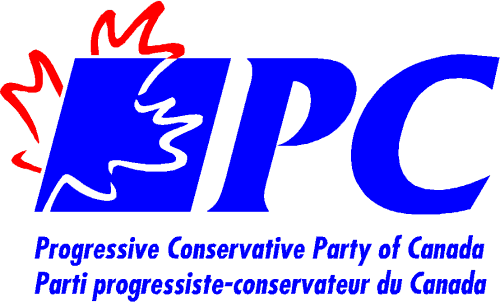
The French name of the former Progressive Conservative Party of Canada serves to highlight the curious error in the English name: Le Parti progressiste-conservateur du Canada.  The hyphen in between the French equivalents of “progressive” and “conservative” denotes that both of those words remain nouns. The English version, without the hyphen, turns “Progressive” into an adjective and thus renders the phrase “Progressive Conservative” a contradiction in terms. Logically, the English name should also have included the hyphen in order to denote the merger of two parties (nous) or two ideologies (also nouns). (I also prefer the French title, which would literally be rendered “Progressivist” in English, since the –ist morpheme turns abstract nouns into proper nouns.) However, the English name does not contain the hyphen, which means that “Progressive” becomes an adjective modifying the noun “Conservative.” Since ‘progressive’ generally refers to change and reform, while ‘conservative’ often means resistance to change and deference to tradition, the Progressive Conservatives created a curious contradiction.

The most infamous oxymoron in Canadian politics could have been avoided with proper punctuation!

Posted in Political Parties | 7 Comments