David Onley Defends Responsible Government


Introduction

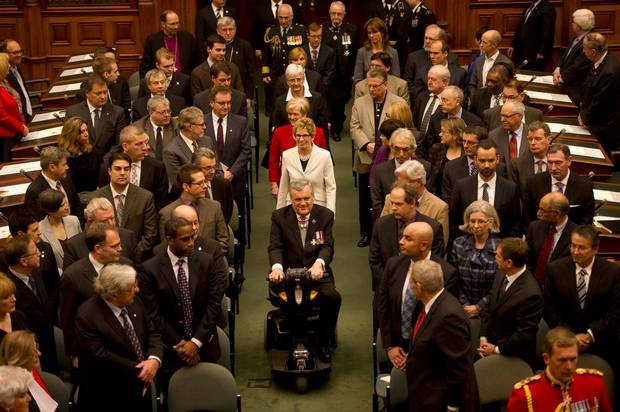
David Onley leads the procession before reading the Speech from the Throne.

David Onley leads the procession before reading the Speech from the Throne. (I didn’t know that the distance between the Government and Opposition benches was so wide!)

I’d like to thank David Watson of the Ottawa Citizen for having published my and Nick MacDonald’s column, “Onley Provides Much Needed Education.” It follows up on our earlier column from October 2012, “McGuinty Had Every Right to Prorogue,” and shows how the Lieutenant Governor of Ontario, His Honour David Onley, has explained and promoted Responsible Government during the intersession of McGuinty’s prorogation (15 October 2012 to 19 February 2013).

Why Governors Should Not Issue Written Explanations or Rationales Behind Acts of the Crown like Prorogation or Dissolution

David Onley has taken a unique and noteworthy approach and established a new model that the other Governors in Canada should consider adopting. In January, Professors Dodek and Sossin argued that Onley has established a new model but that he also broke convention by “justif[ying] his controversial decision in some detail.” They added,

We believe — as apparently Onley does — that when a viceregal representative exercises the rare discretion to prorogue the legislature he or she should explain the decision to the public.

I disagree with those statements. First, prorogation occurs every two years or so in Ontario, so it’s not particularly rare. Second, McGuinty’s prorogation of 2012 – including the unspecified duration of the intersession – conformed to the norm in Ontario and to the standard practice under Premiers Rae, Harris, and Eves. In addition, the legislature met more frequently and for a greater number of sitting days under the McGuinty government than under either the Rae or Harris governments. Third, the Governors do not possess the discretion to reject advice to prorogue, and Onley did not exercise any discretionary authority in this instance. Fourth, while Onley has established a new approach and implemented a new and successful media strategy, he did not explain the rationale behind McGuinty’s political decision to prorogue, and he did not break the convention of confidentiality between the governor and first minister. McGuinty explained the rationale and the political decision to prorogue the 1st session of the 40th Legislature. Onley merely explained the constitutional position on prorogation and the general constitutional relationship between the premier and first minister; more crucially, Onley did not divulge the contents of a particular consultation. This is an important distinction.

Responsible Government means that Ministers of the Crown take responsibility for all acts of the Crown (including government bills, supply bills, and all executive policy decisions), and that the Lieutenant Governor acts on and in accordance with ministerial advice. Government Ministers must also defend the political neutrality of the Lieutenant Governor by assuming the political responsibility for their executive decisions, because the Lieutenant Governor cannot advocate on behalf of himself without undermining his Ministers. Responsible Government also means that the First Minister must maintain the confidence of the Governor, as well as the more commonly stated and better known principle that the Government must maintain the confidence of the lower house. The Governor expresses that confidence in the First Minister by granting him a commission of authority to govern under the Crown and by acting on and in accordance with his advice. The Governor would revoke his confidence in the First Minister and Government, under exceptional circumstances, by refusing to promulgate or acting contrary to their advice – which in turn forces either the dismissal or resignation of the Ministry. This exceptional consequence is precisely why the Governor may only act contrary to ministerial advice under exceptional circumstances. The Governor’s discretionary authority to reject ministerial advice under exceptional circumstances (the “reserve power”) truly is the nuclear deterrent of Responsible Government, though most scholars since Bourinot and Dawson have not properly acknowledged why.

Responsible Government therefore requires that the consultations between the Premier and Governor remain confidential. This confidentiality does not require the strict “Sphinx-like silence” that Dodek and Sossin highlighted – it only means that neither the Premier nor the Governor may divulge the content of their consultations. The First Minister can and should explain the rationale behind his political decision, and the Governor may explain his role under Responsible Government.

However, under no circumstances should the Governor explain the rationale behind acts of the Crown or issue written reasons, because this arrangement would undermine Responsible Government. If the Governor breaks the confidentiality of his consultations with the First Minister, he would undermine the position of the First Minister and indirectly revoke his commission of authority under the Crown to govern. This would probably lead to the dismissal or resignation of the incumbent government. This entire idea derives from the worst precedent in the core Commonwealth: in Australia, Governor General Sir John Kerr dismissed Prime Minister Gough Whitlam on 11 November 1975 and appointed the Opposition Leader Malcolm Fraser as Prime Minister later that afternoon because the Liberal majority in the Senate blocked the the budget of Whitlam’s majority Labor Government. (Worse still, the Whitlam government undoubtedly commanded the confidence of the House of Representatives). Kerr issued four pages of reasons why he dismissed Whitlam; by accepting Kerr’s commission to form a new government, Fraser thereby accepted Whitlam’s dismissal and the rationale behind it, and then immediately advised a double dissolution in order to break the deadlock between the two houses. This example shows how the Governor cannot issue written reasons without necessarily undermining the incumbent First Minister and Government.

The First Minister – not the Governor – should issue explanations, which is what McGuinty did, even though he couched his rationale in the obfuscation of the standard Orwellian political rhetoric. As Nick and I explain in the column, McGuinty’s inadequate explanation is a political issue, not a constitutional one. That said, the inadequacy of McGuinty’s explanation indirectly exposes the true political, tactical reasons behind his decision.

I’ve also posted the unabridged version of the column below.

David Onley Promotes Responsible Government
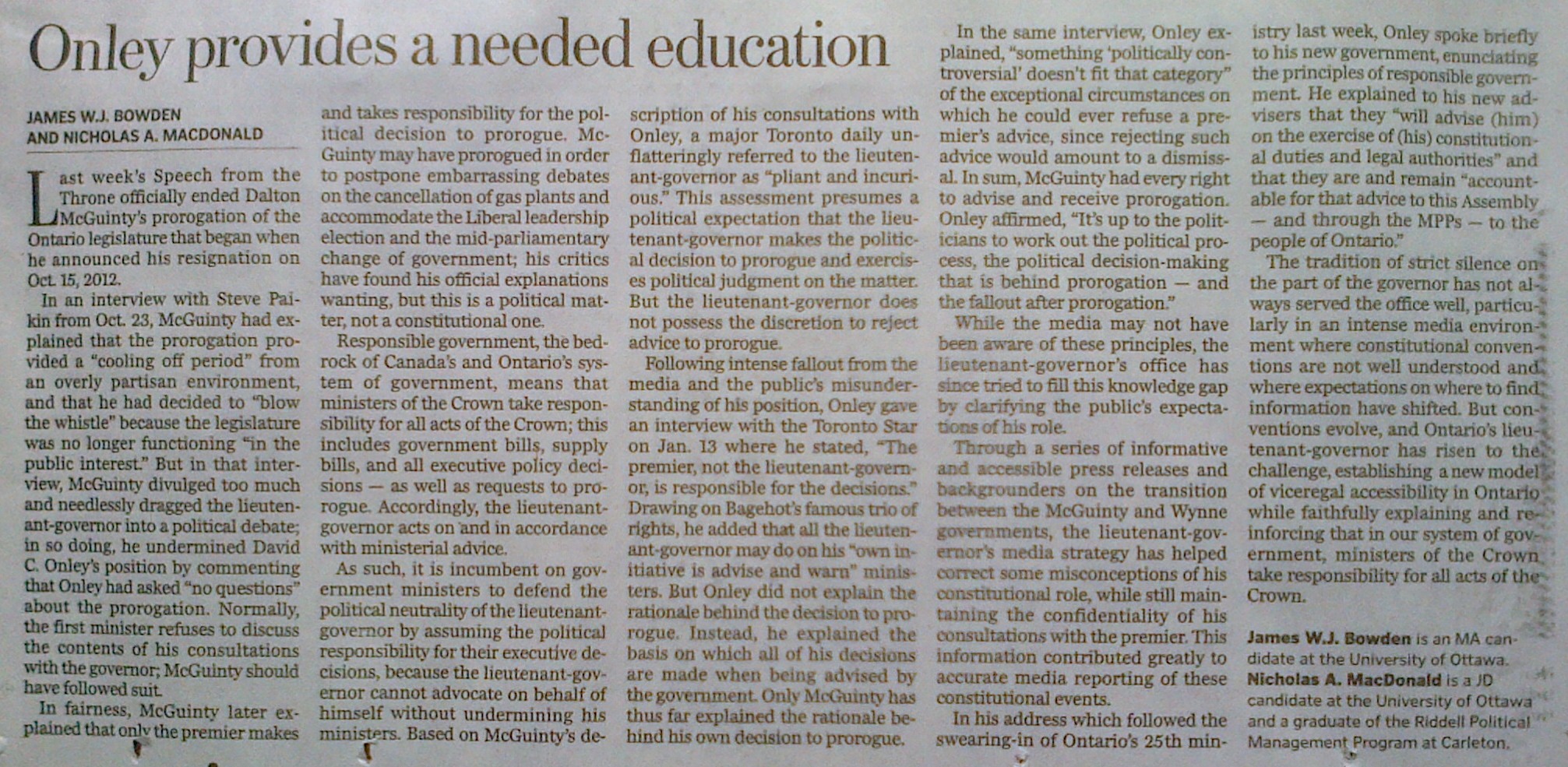
Bowden & MacDonald, "Ottawa Citizen, Onley Provides Much Needed Education"

Bowden & MacDonald, “Ottawa Citizen, Onley Provides Much Needed Education”

The Speech from the Throne of 19 February 2013 officially ended David McGuinty’s prorogation, started the 2nd session of the 40th Legislature of Ontario, and introduced the agenda of Kathleen Wynne’s government. Constitutional events have now come full circle since 15 October 2012, when Dalton McGuinty announced his intention to resign as both Liberal leader and Premier of Ontario, while also proroguing the legislature to an unspecified date.

In an interview with Steve Paikin from 23 October 2012, McGuinty explained that the prorogation provided a “cooling off period” from an overly partisan environment, and that he had decided to “blow the whistle” because the legislature was no longer functioning “in the public interest.” But McGuinty divulged too much and needlessly dragged the Lieutenant Governor into a political debate; in so doing, he undermined David C. Onley’s position by commenting that Onley had asked “no questions” about the prorogation. Normally, the first minister refuses to discuss the contents of his consultations with the governor; McGuinty should have followed suit.

In fairness, McGuinty also explained in a press conference on October 24 that only the Premier makes and takes responsibility for the political decision to prorogue. McGuinty may have prorogued in order to postpone embarrassing debates on the cancellation of gas plants and accommodate the Liberal leadership election and the mid-parliamentary change of government; his critics have found his official explanations wanting, but this is a political matter, not a constitutional one.

Responsible Government, the bedrock of Canada’s and Ontario’s system of government, means that Ministers of the Crown take responsibility for all acts of the Crown; this includes government bills, supply bills, and all executive policy decisions – as well as requests to prorogue. Accordingly, the lieutenant governor acts on and in accordance with ministerial advice.

As such, it is incumbent on government ministers to defend the political neutrality of the lieutenant governor by assuming the political responsibility for their executive decisions, because the lieutenant governor cannot advocate on behalf of himself without undermining his ministers.

Based on McGuinty’s description of his consultations with Onley, a major Toronto daily unflatteringly referred to the Lieutenant Governor as “pliant and incurious.”  This assessment presumes a political expectation that the Lieutenant Governor makes the political decision to prorogue and exercises political judgement on the matter. But the Lieutenant Governor does not possess the discretion to reject advice to prorogue.

Following intense fallout from the media and the public’s misunderstanding of his position, Onley gave an interview with the Toronto Star on 13 January 2013 where stated, “The premier, not the lieutenant-governor, is responsible for the decisions.” Drawing on Bagehot’s famous trio of rights, he added that all the Lieutenant Governor may do on his “own initiative is advise and warn” ministers. But Onley did not explain the rationale behind the decision to prorogue. Instead, he explained the basis on which all of his decisions are made when being advised by the government. Only McGuinty has thus far explained the rationale behind his own decision to prorogue.

Onley added, “There never has been a case where prorogation has been denied.” If the Governor refuses to act on the Premier’s advice, he forces the resignation of the Government precisely because it cannot take responsibility for an executive decision that contradicts the advice tendered. This exceptional consequence of dismissal or resignation shows why the Governor may only reject some types of ministerial advice under exceptional circumstances. In the same interview, Onley explained, “something ‘politically controversial’ doesn’t fit that category” of the exceptional circumstances on which he could ever refuse a premier’s advice, since rejecting such advice would amount to a dismissal of the government. In sum, McGuinty had every right to advise and receive prorogation. Onley affirmed, “It’s up to the politicians to work out the political process, the political decision-making that is behind prorogation — and the fallout after prorogation.”

While the media may not have been aware of these principles, the Lieutenant Governor’s Office has since tried to fill this knowledge gap by clarifying the public’s expectations of his role.

Through a series of informative and accessible press releases and backgrounders on the transition between the McGuinty and Wynne governments, the lieutenant governor’s media strategy has helped correct some misconceptions of his constitutional role, while still maintaining the confidentiality of his consultations with the Premier. This information contributed greatly to accurate media reporting of these constitutional events.

The Liberal Party of Ontario elected Kathleen Wynne as its new leader on 26 January. Onley then acknowledged Wynne as Premier-designate on 31 January and commissioned her to form a new Government. On 11 February, McGuinty formally resigned as Premier, and Onley swore in Wynne and her Cabinet as the 25th Ministry of Ontario that same afternoon. Onley then opened the new session on 19 February.

In his address which follows the swearing in of Ontario’s 25th ministry, Onley spoke briefly to his new government, enunciating the principles of responsible government. He explained to his new advisers that they “will advise [him] on the exercise of [his] constitutional duties and legal authorities” and that they are and remain “accountable for that advice to this Assembly—and through the MPPs—to the people of Ontario.”

The tradition of strict silence on the part of the governor has not always serve the office well, particularly in an intense media environment where constitutional conventions are not well-understood and where expectations on where to find information has shifted. But conventions evolve, and Ontario’s lieutenant governor has risen to the challenge. David Onley has established a new model of vice-regal accessibility in Ontario that includes an updated and expanded website, a strong presence on Facebook and Twitter, and issuing timely and informative press releases on his constitutional role – all while faithfully explaining and reinforcing that in our system of government, where ministers of the Crown take responsibility for all acts of the Crown.

Similar Posts

Posted in Appointment of PM, Consultations, Crown (Powers and Office), Formation of Governments, Governor's Discretion, Prorogation, Reaffirmation of, Responsible Government | Tagged , , , , | 7 Comments

Succession Falls Under the “Office of Queen”


This brief syllogism explains why succession to the Crown of Canada falls under the “office of Queen” of s.41(a) of the Constitution Act, 1982.

1. The Crown is as corporation sole.

The Supreme Court of Canada: “The Crown is technically a corporation sole, and is of course in the legal sense a person capable of being a subject of rights and duties.”

The Law Commission of the United Kingdom: “Corporation sole – a corporation consisting of one person and his or her successors in a particular office or station. Examples include the Crown, government ministers, and bishops.”

2. A corporation sole, by definition, includes the successors to that office.

The Law Commission of the United Kingdom: “A corporation sole consists of one person and his or her successors in some particular office or station, who are incorporated by law in order to give them certain legal capacities and advantages which they would not have in their natural person. Unlike a corporation aggregate, a corporation sole has a dual capacity, namely its corporate capacity, and its individual or natural capacity.”

The Queen’s Bench for Saskatchewan: “a ‘corporation sole’ is an unusual type of corporation consisting of only one person and his successors in some particular station, who are incorporated by law in order to give them some legal capacities and advantages. In this sense the sovereign in England is a sole corporation – so is a bishop.”

3. Therefore, succession pertains directly to the “office of Queen” of s.41(a) of the Constitution Act, 1982 and forms part of the Constitution of Canada. (The Crowns of the United Kingdom and Canada are separate corporations sole and legal persons vested in the same natural person).

4. Only a constitutional amendment can thus alter succession to the Crown of Canada.

Similar Posts:

Posted in Corporation Sole, Crown (Powers and Office), Succession (Sovereign) | Tagged | 10 Comments

My Column in the Ottawa Citizen: Why the Harper Government’s Succession Bill Is Unconstitutional


I thank David Watson and the editorial staff at the Ottawa Citizen for having publishing my column!

I thank David Watson and the editorial staff at the Ottawa Citizen for having publishing my column!

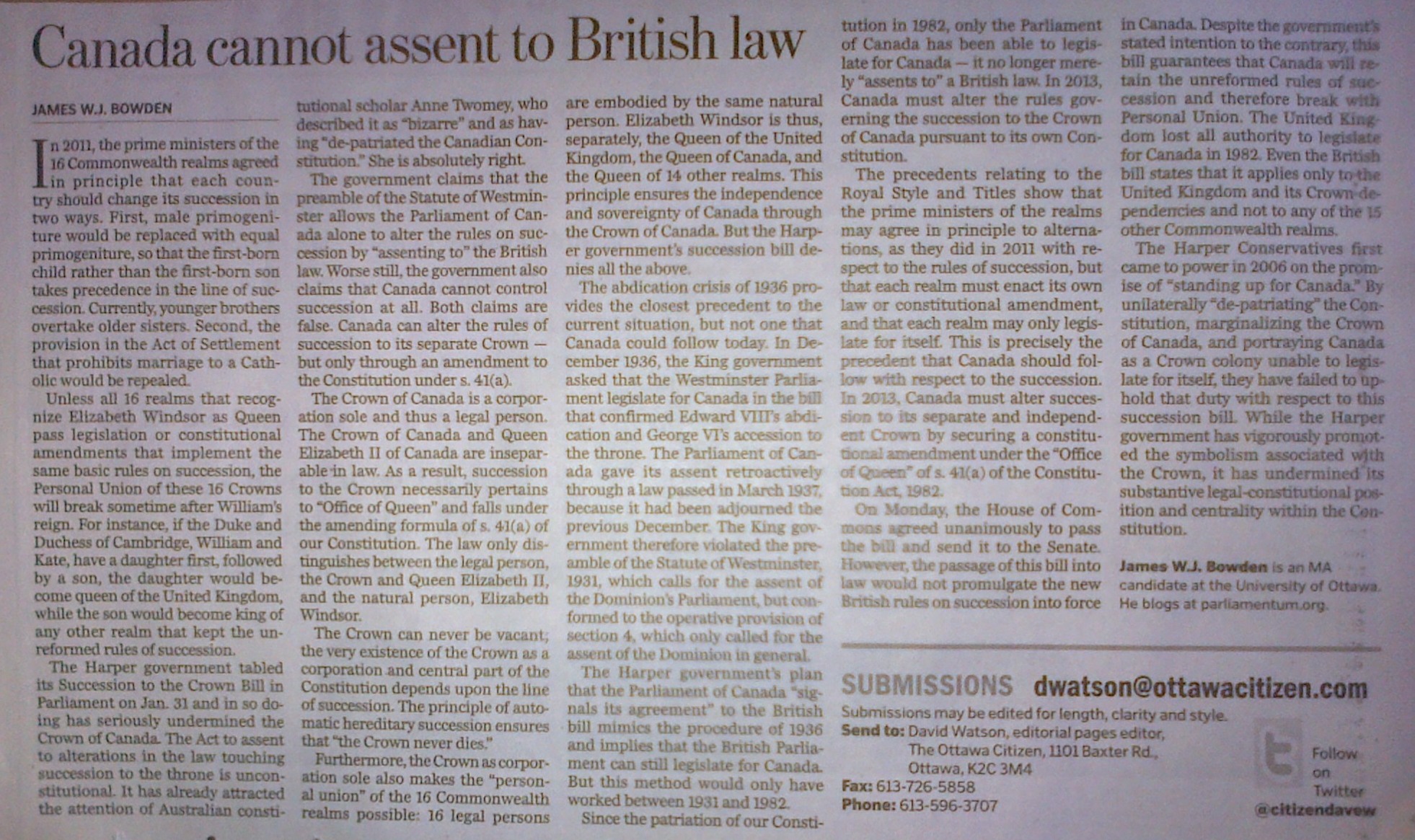
In 2011, the prime ministers of the 16 Commonwealth Realms agreed in principle that each country should change its succession in two ways. First, male primogeniture would be replaced with equal primogeniture, so that the first-born child rather than the first-born son takes precedence in the line of succession. Second, the provision in the Act of Settlement that prohibits marriage to a Catholic would be repealed. However, the statutory requirement that the Sovereign be a Protestant would remain intact.

Unless all 16 realms that recognize Elizabeth Windsor as Queen pass legislation or constitutional amendments that implement the same basic rules on succession, the Personal Union of these 16 Crowns will break sometime after William’s reign. For instance, if the Duke and Duchess of Cambridge have a daughter first, followed by a son, the older daughter would become Queen of the United Kingdom, while the younger son would become king of any other realm that kept the unreformed rules of succession.

The Harper government tabled its Succession to the Crown Bill in Parliament on Jan. 31 and in so doing has seriously undermined the Crown of Canada. The Act to assent to alterations in the law touching succession to the throne is unconstitutional. It has already attracted the attention of Australian constitutional scholar Anne Twomey, who described it as “bizarre” and as having “de-patriated the Canadian Constitution.”

The government claims that the preamble of the Statute of Westminster allows the Parliament of Canada alone to alter the rules on succession by “assenting to” the British law “touching on the succession to the throne or the Royal Style and Titles”. Worse still, the government also claims that Canada cannot control succession at all. Both claims are false. Canada can alter the rules of succession to its separate Crown — but only through an amendment to the Constitution under s.41(a).

The Crown of Canada is a corporation sole and thus a legal person. The Crown of Canada and Queen Elizabeth II of Canada are inseparable in law. The law only distinguishes between the legal person, the Crown and Queen Elizabeth II, and the natural person, Elizabeth Windsor. As a result, succession to the Crown necessarily pertains to “Office of Queen” and falls under the amending formula of s.41(a) of our Constitution. The Crown can never be vacant and “disembodied”. The Crown as a corporation and central part of the Constitution depends upon the chain of persons who succeed to the office, known as the line of succession. The principle of automatic hereditary succession ensures that “the Crown never dies.” Instead, the Crown only “demises” from the Sovereign to his or her successor, as prescribed by law. (Historically, the Crown has demised by conquest, and once, in 1936, by abdication as prescribed by law).

The Crown as corporation sole also makes the “Personal Union” of the 16 Commonwealth Realms possible: 16 legal persons are embodied by the same natural person. Elizabeth Windsor is thus, separately, the Queen of the United Kingdom, the Queen of Canada, and the Queen of 14 other Realms. This principle ensures the independence and sovereignty of Canada through the Crown of Canada. But the Harper government’s succession bill denies all the above.

The Abdication Crisis of 1936 provides the closest precedent to the current situation, but not one that Canada could follow today. In December 1936, the King government asked that the Westminster Parliament legislate for Canada in the bill that confirmed Edward VIII’s abdication and George VI’s accession to the throne. The Parliament of Canada gave its assent retroactively through a law passed in March 1937. The King government therefore violated the preamble of the Statute of Westminster, which calls for the assent of the Dominion’s Parliament, but conformed to the operative provision of section 4, which only called for the assent of the Dominion in general.

In 1953, each Realm legislated only for itself on alterations to the Royal Style and Titles. Canada could have requested that the UK Parliament invoke the Statute of Westminster and legislate for Canada, but instead asserted its own sovereignty and independence. The prime ministers of the Realms had agreed in principle on altering the Royal Style and Titles, as they did in 2011 on the rules of succession, but each Realm enacted its own laws and legislated for itself. We need to build on this precedent in 2013.

The Harper government’s plan that the Parliament of Canada “assent to” to the British bill mimics the procedure of 1936 and implies that the British parliament can still legislate for Canada. But this method would only have worked between 1931 and 1982 – and wasn’t even used in 1953. The Patriation of our Constitution in 1982 abolished all the British Parliament’s residual authority to legislate for Canada. Even the British bill states that it applies only to the United Kingdom and its Crown dependencies and not to any of the 15 other Commonwealth Realms. In 2013, Canada must alter succession to its separate and independent Crown by securing a constitutional amendment under the “Office of Queen” of s.41(a) of the Constitution Act, 1982.

On Monday, the House of Commons agreed unanimously to pass the bill and send it to the Senate. However, the passage of this bill into law would not promulgate the new British rules on succession into force in Canada. Ironically, this bill now guarantees that Canada will retain the unreformed rules of succession and therefore break with the Personal Union.

The Harper Conservatives first came to power in 2006 on the promise of “standing up for Canada.” By unilaterally “de-patriating” the Constitution, marginalizing the Crown of Canada, and portraying Canada as a Crown colony unable to legislate for itself, they have failed to uphold that duty with respect to this succession bill. While the Harper government has vigorously promoted the symbolism associated with the Crown, it has undermined its substantive legal-constitutional position and centrality within the Constitution.

James W.J. Bowden is an MA candidate at the University of Ottawa.

*I had made some minor changes which the Ottawa Citizen unfortunately couldn’t include due to limitations of space and my tardiness! I am very grateful to David Watson and the editorial staff for having given me the opportunity to express contrary arguments on the succession bill.

I will also post the full legal-constitutional case against the Harper Government’s succession bill later this week.

Similar Posts:

Posted in Corporation Sole, Crown (Powers and Office), Succession (Sovereign) | 11 Comments

The Harper Government’s (Probably Unconstitutional) Bill on Succession to the Crown


The Parliament of Canada has just updated the Notice Paper of the House of Commons. The Minister of Justice will soon table a bill relating to succession to the Crown called An Act to assent to alterations in the law touching the Succession to the Throne.

The wording of the title of the bill alone confirms the statements of the British House of Commons Library and the spokesman from the Privy Council Office: the Harper Government believes that the Statute of Westminster somehow still allows Canada to signal its “assent” to British legislation, even though Canada repealed s.4 and s.7(1) of that Act upon Patriation in 1982.

If Canada merely “assents to” a British law, this bill will severely undermine the Crown of Canada over the long term. First and foremost, if the Crown of Canada is not a separate corporation sole from the Crown of the United Kingdom, then Canada is not an independent, sovereign country. The Harper Government’s method of clinging to an inoperative provision (section 4) and a defunct, moot preamble of the Statute of Westminster will turn Canada into a Crown colony once again. Second, if succession falls outside of the Constitution of Canada as the Harper Government has claimed, then the succession to the Crown immediately becomes subject to the Charter. Someone could then easily challenge the Protestant succession, or even the hereditary principle itself, in court as “discrimination.” And of course, any challenge to the hereditary principle undermines constitutional monarchy itself, because it depends upon hereditary succession, as prescribed by law.

I shall provide a full analysis after the Parliament of Canada has uploaded a copy of the bill online. For now, I would direct you to my previous posts on the subject, particularly, Why Altering the Succession Requires a Constitutional Amendment.

Similar Posts:

Posted in Corporation Sole, Crown (Powers and Office), Succession (Sovereign) | Tagged | 7 Comments

Conservative Partisans Celebrate the Wrong Date! Transitions Between Ministries in Canada


Prime Ministerial succession does not occur automatically and instantaneously under our constitution, but only after a transition of two to three weeks, after the outgoing Prime Minister has tendered his formal resignation to the Governor, and after the Governor has formally appointed the new Prime Minister.

Unfortunately, some Conservative partisans and even some Conservative MPs have conflated the election with the appointment of a new government and entirely ignored the period of transition! Stephen Harper became Prime Minister on February 6th, 2006 — not on January 23rd, 2006. Parm Gill, Conservative MP for Brampton-Springdale, has conflated the two dates on Twitter.

Parm Gill on the Harper Government

First, the Harper government took office on February 6th, 2006 and not January 23rd.

Second, the Harper government has only served one “term” of office, contrary to the implication in Gill’s reference to “first taking office”. The tenure of the First Minister determines the term in office of his or her Ministry, which means that his or her resignation or death results in the automatic resignation of all other serving Cabinet ministers and the end of that Ministry. A First Minister can serve two or more terms if and only if he resigns from office and the Governor subsequently re-appoints him to that office. In addition, Governments in Canada are not elected, though they are responsible to the electorate. The Governor appoints as First Minister the leader of the party who stands the best chance of heading a government that can command the confidence of the legislature, thus granting him official commission under the Crown – which amounts to the Government’s true legal “mandate.”

Third, Gill is a backbench MP and not a Ministers of the Crown, so he can’t properly describe himself as a member of “the government”!

Can you spot the two errors from the Conservative Party's website?

Can you spot the two errors from the Conservative Party’s website?

The results of the election of the 39th Parliament of Canada came in on January 23rd, 2006 and resulted in what would become the second of three consecutive minority Parliaments. In the 38th Parliament (2004-2006), the Liberals held the plurality of seats and Prime Minister Martin’s 27th Ministry continued as a minority government.  Stephen Harper’s Conservatives gained the plurality in the 39th Parliament (2006-2008); upon seeing the results, Prime Minister Martin announced his intention to resign and called upon the Governor General to appoint Conservative leader Stephen Harper as his successor.

However, Prime Minister Martin did not submit his formal resignation until February 5th, 2006,  and Governor General Michaelle Jean did not appoint Stephen Harper as Prime Minister until February 6th, 2006! The dying days of the Martin government, from January 23rd, 2006 to February 6th, 2006, formed the “caretaker period” and provided for the transition from the 27th Ministry to the 28th Ministry. The transition from one government to another generally takes two to three weeks in Canada — it most certainly does not occur instantaneously after the results of the election and party standings become known. In countries where minority parliaments and coalition governments are common, this period of transition also involves a process of government formation, namely, crafting government programs based on backroom negotiations and the platforms of the political parties involved.

The Privy Council Office’s Guide to Ministries Since Confederation shows this clear transition:

  • 27th Ministry: Paul Martin served as Prime Minister from his appointment on 12 December 2003 to his resignation 5 February 2006.
  • 28th Ministry: Stephen Harper has served as Prime Minister since Governor General Jean appointed him with the official commission to govern on 6 February 2006. His “term” will end only upon his resignation (or, theoretically, death).

Conservative partisans may celebrate January 23rd as the anniversary of the Conservatives’ first electoral victory and the date on which Prime Minister Paul Martin announced his intention to resign so that the Governor General could appoint Stephen Harper as his successor. But they most certainly cannot portray January 23rd as the anniversary of forming government!

Similar Posts:

Posted in Appointment of PM, Constitutional Conventions, Crown (Powers and Office), Governor's Discretion, Succession (Prime Minister) | 1 Comment