How the General Election of 2017 Will Occur in Practice


Time’s up.

Introduction 

Earlier today, I was very confused to see that the Westminster Parliament is still sitting and conducting business. After all, MPs voted by a huge margin — well above even the two-thirds super-majority — to go to an early general election pursuant to the Fixed-Term Parliaments Act.

I committed the fallacy of mirror-imaging by presuming that the Mother of Parliaments would proceed with this matter in the same way that her wayward child the Parliament of Canada would. Here when the government loses a vote of confidence in the Commons, the House adjourns itself, and the Prime Minister typically advises the Governor General to dissolve parliament and issue the writs for a general federal election later that same day.

But this is not the case in the United Kingdom. First, I shall review the process of dissolution in the United Kingdom and then delve into the “Wash Up,” the week or two between a loss on a vote of confidence (or, in this unprecedented case, the successful passage of the motion to hold an early general election under the Fixed-Term Parliaments Act) that comes before dissolution and the general election.    

Continue reading

Posted in Crown (Powers and Office), Dissolution, Fixed-Date Elections | 12 Comments

Presentation to the “Constitution at 150 Conference”


I’m pleased to report that I will present a paper at the upcoming “Constitution at 150 Conference” in Montreal, Quebec, on the morning of May 16th.

The conference runs from 16 to 18 May. I’d encourage those of you who are in a position to attend it to register for it; if you read this blog, then, chances are, you’d find this conference interesting. The conference features an impressive line up, including, but not limited to, Professors Adam Dodek and Peter Oliver of the University of Ottawa, Jonathan Shanks of the Department of Justice, David E. Smith (Professor emeritus of Political Science of the University of Saskatchewan), and Clerk of the Senate Charles Robert.

My paper, “Canada’s Legal-Constitutional Continuity, 1791-1867” demonstrates how the Dominion of Canada is the continuator, or successor polity, to the Province of Canada (1841-1867), which is, in turn, the continuator of Upper Canada and Lower Canada (1791-1841). In a way, I suppose that it could be construed as contradicting the premise of the conference’s name because constitutional government in British North America pre-dates the British North America Act, 1867 itself.

Posted in Conference Papers | Leave a comment

More on the Fixed-term Parliaments Act


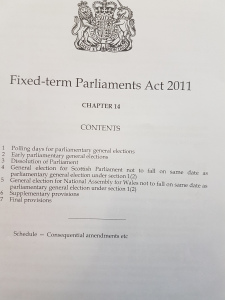
Philip Norton, a Conservative life peer and a Professor of Government at the University of Hull, provides his synopsis of the Fixed-Term Parliaments Act and why the Prime Minister of the UK no longer “calls” a snap election.

Incidentally, if our Senators were all even half as qualified as Norton, our upper chamber would be in much better shape today.

Lord Norton's avatarThe Norton View

The Prime Minister has announced she will be asking the House of Commons tomorrow to vote for the motion ‘That there shall be an early parliamentary general election’.  She correctly stated the provisions of the Act.  She is thus ‘calling for’ an election, not ‘calling’ an election.  The decision now rests with the House of Commons.  A two-thirds majority of all MPs is required for the motion to be passed.  That majority is expected to be achieved, given that Jeremy Corbyn has said Labour will vote for it.  Indeed, he made it clear some time ago that he would support an early election, thus doubtless aiding the PM in her consideration of whether to seek an election under section 2(2) of the Act.

The Act has only seven sections and one schedule – it is no more than nine pages, including the contents page – and was enacted in September 2011. …

View original post 316 more words

Posted in Dissolution, Electoral Reform | 1 Comment

British Prime Minister Theresa May Calls *For* An Early Election Under the Fixed-Term Parliaments Act


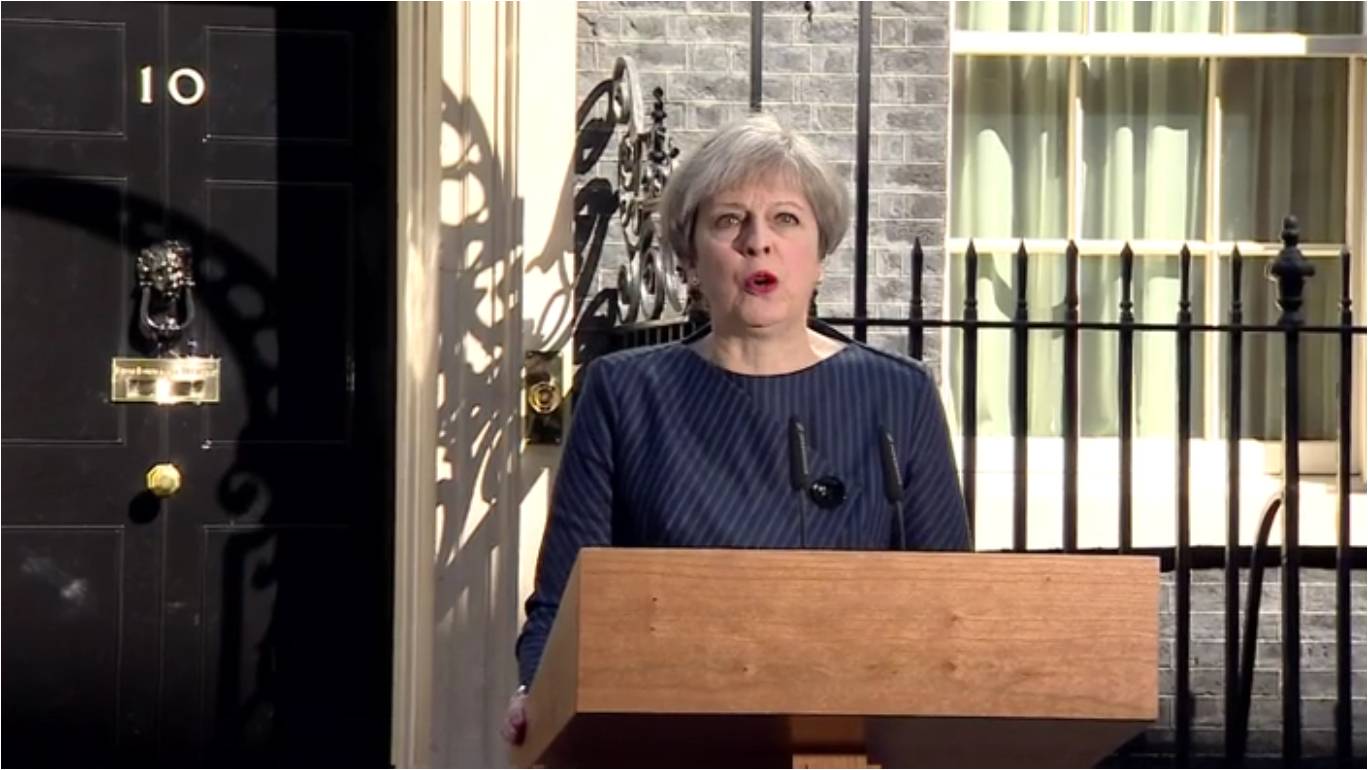
British Prime Minister Theresa May made an announcement outside of 10 Downing Street and has just called for an early general election. But she has not “called” an early general election — because the British Prime Minister no longer possesses this authority.

The BBC has highlighted an interview between Andrew Marr and Prime Minister May from September 2016 in which May said, “I’m not going to be calling a snap election.” Strictly speaking, May has kept her word. However, the Prime Minister no longer has the authority to call a snap election — so, if anything, the BBC should criticize May for having made a promise that she, in fact, had no authority to make in the first place.

Under the Fixed-Term Parliaments Act, 2011, the British Crown no longer holds any authority over or retains any involvement in dissolution. The Queen no longer dissolves Parliament on the Prime Minister’s advice. Instead, Parliament now dissolves automatically, by efflux of time, every five years, pursuant to the Fixed-Term Parliaments Act itself. The first general election under the act took place in 2015. The Cameron-Clegg government acknowledged in this press release with respect to the most recent dissolution and general election in 2015, “Parliament has been prorogued and will automatically dissolve on 30 March under the Fixed-term Parliaments Act.[1]

The Fixed-Term Parliaments Act also outlines two procedures for early dissolution, but the executive also plays no part and has no discretion in these mechanisms either. Section 2 of the Act outlines these procedures. In one case, parliament may be dissolved early if two-thirds of MPs pass a motion “That there shall be an early parliamentary general election.” In the other case, if the Commons votes non-confidence in Her Majesty’s Government by simple majority (“That this House has no confidence in Her Majesty’s Government”) but then fails to pass a confirmation vote for a new government (“That this House has confidence in Her Majesty’s Government”) within 14 days, then Parliament shall automatically dissolve in order to break the deadlock. The defeated government would remain in a caretaker capacity during the ensuing election and until the new Parliament meets and passes a confirmation vote in favour of a new government.

In this case, the procedure under section 2(1)(a) applies. The May government itself would likely table the motion in the Commons “That there shall be an early parliamentary general election,” and a two-thirds super-majority would have to vote in favour of it. The Leader of Her Majesty’s Loyal Opposition and the Labour Party, Jeremy Corbyn, has already indicated that he would support this motion, and so too, probably, would enough of the Labour Party to reach the threshold of a two-thirds super-majority.

Similarly, the Leader of the Liberal-Democratic Party, Tim Farron, has also endorsed the idea of holding an early general election.

Speaker Bercow would acknowledge that the motion had received the support of at least two-thirds of MPs on division, and that verbal acknowledgement alone (nothing more formal than that) would suffice to promulgate the early election into force. However, rather bizarrely, the Fixed-Term Parliaments Act did not put the British Crown’s authority over summoning parliament into abeyance, so the Prime Minister or Cabinet (I’m not sure precisely how that works in the United Kingdom, but in Canada it would be the Prime Minister alone) advises the Queen to issue the summons of the next Parliament at a certain date.

The rationale for the early general election is Brexit. Now that the Westminster Parliament has passed the European Union (Notification of Withdrawal) Act, 2017, the May government has triggered Article 50 of the Treaty of Lisbon and set in train the United Kingdom’s withdrawal from the European Union and now wants to consolidate those gains. And it seems that the other parties in Westminster are happy to religate the Brexit referendum in this upcoming general election campaign.

The early general election would be held on June 8th.

And we can rejoice in other news, too: invoking one of the procedures under section 2 of the Fixed-Term Parliaments Act, 2011 means that the British media will finally learn, out of necessity, that this statute has put the Crown’s authority over dissolution into abeyance and that the Queen no longer dissolves Parliament on the Prime Minister’s advice.

Similar Posts:

[1] United Kingdom, Prime Minister’s Office, 10 Downing Street, “Press Release: State Opening of Parliament to Take Place on 27 May 2015,” 26 March 2015 [accessed 20 August 2016].

Posted in Crown (Powers and Office), Dissolution, Fixed-Date Elections | 1 Comment

Which Are Better: Endnotes or Footnotes?


First, I’m sure that we can agree that Chicago-style notes are vastly superior to the stupid in-text citations of APA. Incidentally, since Cambridge University Press journals use Chicago while the Oxford University Press journals mandate some ghastly in-text citations, we can conclude that Cambridge is the better half of Oxbridge.

But within the note formats, I prefer endnotes over footnotes: ultimately, each format takes up the same amount of space on a manuscript, but endnotes keep it tidy and neat and therefore make it easier to read, especially if you need to include non-citation, explanatory notes. Only an academic would say that turning pages is labour-intensive and difficult work!

I inadvertently kicked off an academic nerdfight on social media earlier with an off-hand comment stating what I regard as self-evident, that endnotes are better that footnotes because they keep the paper tidy. Passions run so high in the endnote-footnote controversy precisely because the stakes are so low.

I’m curious to see what some of my readers think in this poll! I seem to be in the minority.

Posted in Random Thoughts | 4 Comments