The Contradictory American Presidency: Why An Elected Executive Head of State Can Only Be a Divider, Not a Uniter


Authority Makes the Presidency Unifying as Head of State; Power Renders Him Divisive as Head of Government

When campaigning for the presidency, George W. Bush, then Governor of Texas, famously proclaimed, “I’m uniter, not a divider.” I aim to show that no elected executive head of state (in other words, no head of state in a presidential or semi-presidential system) could possibly fulfill this function. The American Presidency has evolved into a contradictory office: as the head of state, the President represents the country and attempts to act as a unifying figure; as the head of government, the President acts as a divisive figure by representing his party and supporters and implementing his policies. This contradiction has arisen because the Framers who wrote the Constitution of 1787 designed the American Presidency as a republican version of the British Sovereign under the British Balanced Constitution of the 18th century. While Westminster parliamentarism evolved into Responsible Government in the 19th century, thus separating the head of state from the head of government, the American Presidency remains locked into the Balanced Constitution, which Americans now call “the separation of powers”, or “checks and balances.” Under this balanced constitution, the Framers intended that the House of Representatives represent the American people as a whole as the democratic element (which came from the House of Commons), that the Senate represent the States as the federal element (which derived from the aristocratic element of the House of Lords), and that the President represent the American State as the executive element (a republican adaptation of the British Sovereign). The only President whose contemporaries could plausibly have described him as a unifying figure was George Washington.

The inherent tension within the Presidency, between head of state and head of government, makes the office contradictory because two distinct, and sometimes contradictory, functions have become bound up in the same person. Even when the President emphasizes one role over the other, he still embodies both and must always bear both in mind. The American President is an “executive head of state” because he possesses both power and authority.[1] In terms of power, he determines government policy, plays an active role in promoting particular legislation in Congress, and runs the political executive. In terms of authority, he carries out ceremonial functions and leads national commemorations and celebrations. As head of state, the President possesses both official and personal authority; as head of government, he possesses real political power.[2] In contrast, a non-executive head of state possesses authority, but the Prime Minister and Cabinet exercise power.

The Political Forces of Power and Authority

Most political scientists do not properly articulate the differences between power, authority, and coercion, and influence as persuasion. However, Dr. Paul Benoit made these essential distinctions in “State Ceremonial: The Constitutional Monarch’s Liturgical Authority”. Though he wrote about the differences between the role of a constitutional monarch within the State and within civil society, the concepts still apply to republican presidencies. In general, authority refers to the “unquestioning recognition that some person or office is superior in some way and therefore worthy of respect and deference.”[3] In this case, the Constitution of the United States vests the Office of the Presidency with official authority, and the individual’s charisma, popular support, and personal conduct determine his personal authority. His personal authority can reinforce his power. “Power comes from a consent that is freely given in an explicit or tacit manner; it increases as the will of more and more people is united through agreement, cooperation, and organization.”[4] In constitutional monarchies like the United Kingdom, the Sovereign embodies authority (both within the State and government, and within civil society), while the Prime Minister and his government wield power, which they obtain by commanding the confidence of the House of Commons. Coercion refers to forcing someone to do something against his or her will through intimidation or threat.[5] Authority and power may manifest themselves as persuasion. Democratic political systems thereby operate primarily upon power, while dictatorships rely on coercion (the threat of force and retribution) in order to keep populations in line. This political force certainly does not apply to the American presidency, but several presidential republics in Latin America suffered from leaders who took power and subsequently resorted to coercion in order to solidify their grip on the office. Hugo Chavez comes to mind.

Juan Linz has argued that parliamentary systems (which includes both parliamentary republics and constitutional monarchies) lend themselves to long-term democratic stability more effectively than presidential republics and that they can secure the transition from authoritarian regime to a democratic institution more effectively than presidential republics.[6] The former allow for loyal opposition and separate the head of state from the head of government. The separation of the head of state from the head of government separates authority from power, and thus limits the capacity of each figure to become a despot or a demogogue. It is precisely this confluence of authority and power that could lead to despotism and demagoguery in countries that lack liberal democratic political cultures.

Head of State vs. Head of Government
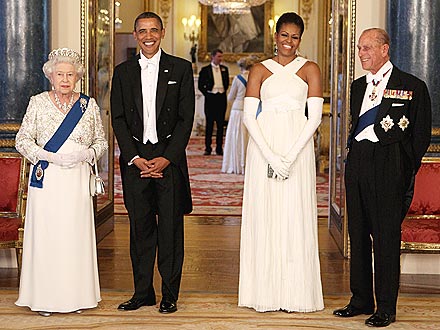
President Obama and Queen Elizabeth II both wear formal, state dress and stand respectably apart.
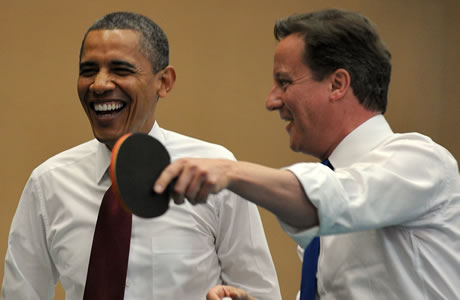
President Obama and Prime Minister Cameron are far more relaxed and familiar with one another.

The President acts unambiguously as head of state when he accepts the letters of credence of ambassadors and when he holds audiences or events with foreign non-executive heads of state (from republican or monarchical parliamentary systems), because these do not involve serious discussions on government policy. They could act as a prelude for subsequent meetings with that country’s head of government or other members of the political executive. However, the President emphasizes his role as head of government whenever he meets foreign executive heads of state and government and discusses real policy and political questions. For instance, the President acts differently when he hosts or visits the Queen of the United Kingdom versus the Prime Minister of the United Kingdom. When the President of the United States meets the Queen of the United Kingdom, he wears full State dress (normally white ties and long jackets), and the meetings focus on maintaining good diplomatic relations. When he meets the Prime Minister of the United Kingdom, he wears a normal business suit (or even less formal attire) and the two engage in substantive policy discussions and hold joint press conferences. President Obama endured an awkward official dinner — including a diplomatic faux pas of toasting the Queen during the playing of “God Save the Queen” — but he attended a basketball game and acted all chumy with Prime Minister Cameron.

The President’s Role in Civil Ceremony

President Obama fulfills his liturgical role by commemorating Memorial Day.

The President’s role of head of state and representative of the country can sometimes extend beyond the State and touch civil society, in the same way that a constitutional monarch fulfills a “liturgical role”[7] of a civic or quasi-religious ceremony. During times of national tragedy, the President must emphasize his role as head of state and articulate the country’s grief with dignified solemnity. President Reagan exemplified the role when he addressed the nation in the aftermath of the destruction of the Shuttle Challenger; President Bush fulfilled the function in response to a much larger event, after the terrorist attacks of September 11, 2001. Presidents even tend to evoke religious scripture and imagery in carrying out their liturgical function.  The President also fulfills his liturgical function on the annual commemorations for Memorial Day and Veterans’ Day and on the annual celebration of Independence Day. The President’s political opponents normally refrain from criticizing him on these occasions, because they would seem petty by putting partisanship above patriotism.

Criticizing the President’s Policies

That latter point raises some interesting implications and questions: namely, it is unpatriotic to criticize the President when he acts as head of state and fulfills the liturgical function of articulating the country’s grief. It may also be unpatriotic to criticize the President when he expresses clear statements on the national interests of the United States, particularly during times of war. In contrast, it is rarely if ever unpatriotic to criticize the Prime Minister in a Westminster system, and I would argue that such criticism should never be considered unpatriotic. In the absence of a non-executive head of state, bipartisanship serves as the closest American equivalent to the political neutrality of the Sovereign. Americans thus expect their President to be bipartisan (acknowledging both the Democrats and Republicans) during these solemn occasions, or with respect to important political questions that affect American interests and values. But bipartisanship – a temporary mutual truce against uni-partisanship – does not constitute neutrality, because each side retains its vested partisan political interests and ambitions throughout. Whoever first resumes partisan hostilities faces the consequences of appearing petty. The art and essence of being “presidential” lies in the mastery of this civic liturgy.

Presidentialism vs. Parliamentarism: Fusion of Power and Authority vs. the Separation of Power and Authority

In the Commonwealth realms, which operate under Responsible Government, the Queen or Governor General represents the country or the State, the Prime Minister represents the government, and the lower house represents the people.[8] The Queen or Governor General possesses authority, while the Prime Minister and Cabinet exercise power. The Westminster system of responsible government separates the head of state from the head of government and thus institutionalizes political dissent and allows the Sovereign to become a unifying, non-partisan figure precisely because he or she does not determine the government’s policies. Responsible Government thus reinforces the old “doctrine of royal infallibility” by transferring the powers of the Sovereign to the Prime Minister and Cabinet and leaving the Sovereign with authority.[9] Ministers of the Crown (the Prime Minister and Cabinet) take responsibility for all acts of the Crown (its policies and expenditures) – whether they be good or bad, successful or unsuccessful – and remain accountable and answerable to the House of Commons by commanding its confidence in order to govern. Liberated from the constraints and responsibilities of exercising political power, the Queen or Governor General rises above partisan politics and becomes a politically neutral figure. The Government must take responsibility and accept criticism for all its decisions,. which the Queen or Governor General merely carries out in accordance with its advice. In an interview with Brian Lamb on CSPAN, Margaret Thatcher explained this system to an American audience (at 9 minutes, 35 seconds):

Let me put it this way: the president is a combination of the monarch and the prime minister. […] Whatever happens, all the loyalty, the patriotism, and the affection go to the monarch […]. All the flack comes politically to the prime minister. [10]

This system also institutionalizes political dissent in the form of responsible loyal opposition, which opposes and criticizes the government’s policies but remains loyal to the Crown (and therefore to the country) and acts as the alternative government. Thus in Westminster systems, loyal opposition puts the country first by being partisan. On loyal opposition, Thatcher added (21 minutes, 20 seconds):

Once the president is the president, there is no leader of the opposition. There is no kind of  ‘president-in-waiting’. We have an opposition which is always an alternative government.

This is why, in the United Kingdom, Britons who disagree with the policy decision to invade Iraq in 2003 can casually refer to former Prime Minister Anthony Blair as a “war criminal,” or such such pejorative political epithets, without raising much controversy. (Such remarks feature prominently on British comedies such as Have I Got News For You and QI). If anything, most Britons treat such statements as a joke. But they would never think of calling Queen Elizabeth II a war criminal because Her Majesty’s Government, not Her Majesty, determines government policy. A notable exception to this general principle of Responsible Government and the Doctrine of Royal Infallibility occurred following the hysteria over Princess Diana’s death in August 1997: a majority of Britons felt (because they certainly were not thinking) that the Queen had not acknowledged their “grief”, and a curious inversion of roles took place. Prime Minister Anthony Blair gladly assumed the liturgical role through his “People’s Princess” speech.[11]

However, if an American were to refer to former to President Bush or former Vice-President Cheney as a war criminal (or even something as relatively innocous as the Dixie Chicks’ comment in 2003), he may well meet with strenuous opposition and provoke a backlash – perhaps even that most severe civic insult that one American can level against his fellow citizen: “you’re un-American.” [12] As Peter Hitchens observed on criticizing the foolish war in Iraq and President Bush:

There is nothing axiomatically wonderful about republics or presidents. And I often made this point during the Iraq War to those in [the United Kingdom] who protested against it, like me. I used a considerable amount of mockery and disrespect to the prime minister at the time, Mr. Blair. If you did that to President Bush in the United States, you’d be in serious trouble, because in the United States the head of government is also the head of state, [which] therefore demand[s] loyalty and patriotism from everybody. And to criticize him personally is viewed by many people as a form of lese-majeste.

Peter Hitchens also noted the same problem with respect to President Clinton and his perjury relating to his extra-marital affair with Monica Lewinsky:

Most British people don’t really under the office of the president; they confuse it with the prime minister and a politician and don’t realise than an American can simultaneously despise Bill Clinton but hold a strong respect the office of president, which makes them hold back from the sort of calls for instant resignation and dismissal which would certainly fall on the head of a British cabinet minister who had behaved like this. […] I think you have an elected king here, and what we need to understand more in England is that  respect that Americans have for the office — that is another thing that may well save Mr. Clinton from a fate that he would no doubt have suffered in England. [13]

Normally, an American citizen may criticize the President’s policies, but ironically, ad hominem commentary almost becomes seditious — as if lese-majeste laws still applied to this republican figure. Indeed, the Office of President commands a certain respect, or even reverence, that a patriotic American would rarely breach. I recall another such incident from my years in the United States, which also occurred in 2003 at the beginning of the war in Iraq: the Secret Service treated cartoonist Michael Ramirez’s political satire of President Bush as a death threat. [14]

Conclusion

Politics by nature is and should be divisive. Without the disagreement and dissent that comes from persons who sincerely hold opposing views and beliefs, politics would cease to exist altogether.[15] The exercise of political power is therefore also inherently divisive. Executive power entails decision-making: implementing one option to the exclusion of all others. Within any political system, each possible option, course of action, and set of policies retains the support of various competing interests; within a democratic political system, these competing interests – whether political parties, citizens, or other groups – may legitimately oppose one another and the executive’s decisions. With popular election comes what Przeworski famously dubbed the “institutionalized uncertainty” in which legitimate political opposition must oppose and offer an alternative to the government of the day. The inherently divisive nature of political and executive power means that no elective, executive head of state in a democratic country can act as a unifying national figure and command the loyalty and devotion of all citizens in the manner that absolute monarchs once sought (or coerced) from their subjects.[16]

In conclusion, I can think of only two possible scenarios in which the American Presidency could dispense with divisiveness — and neither, of course, is realistic or attainable. First, the President could only become a unifying national figure if all Americans voted for him and if democratic politics — divisiviness, dissent, and debate — ceased to exist. Alternatively, he could become a “uniter, not a divider” if the United States decided to become a parliamentary republic and render him a ceremonial head of state by transferring executive functions to a Prime Minister and Cabinet! Heads of government can only be divisive (sometimes despite their best efforts) because of the inherent divisive nature of power and the arrangement of parliamentary system. Only a non-partisan, neutral ceremonial head of state in a parliamentary republic or a constitutional monarchy can transcends the divisiveness of politics can hope to fulfill George W. Bush’s goal of being a “uniter, not a divider.”

Similar Posts:


[1] Paul Benoit. “State Ceremonial: The Constitutional Monarch’s Liturgical Authority,” in The Evolving Canadian Crown, edited by Jennifer Smith and D. Michael Jackson, 119-137. (Kingston: Institute of Intergovernmental Relations, School of Policy Studies, Queen’s University, 2012).
[2]
Ibid.
[3]
Benoit, “State Ceremonial: The Constitutional Monarch’s Liturgical Authority,” 120.
[4]
Ibid.
[5]
Paul Benoit, conversation with author, January 2012.
[6]
Juan Linz, “The Perils of Presidentialism,” Journal of Democracy 1, no. 1 (January 1990): 51-69.
[7]
Benoit. “State Ceremonial: The Constitutional Monarch’s Liturgical Authority,” 119-137.
[8]
I suppose that in Australia, both the House and Senate represent the people because they are both elective chambers.
[9]
Paul Benoit, “Parliament and Democracy in the 21st Century: The Crown and the Constitution,” Canadian Parliamentary Review 25, no. 2 (Summer 2002): 2-3.
[10] Margaret Thatcher, interview by Brian Lamb, CSPAN, 9 March 1991.
[11] Sarah Hagen, conversation with author, 2 June 2012.
[12] CNN, “Dixie Chicks Pulled From Air After Bashing Bush,” 14 March 2003; Peter Hitchens, presentation to the Orwell Prize Shortlist Debate, 27 April 2011.
[13] Peter Hitchens, interview with Brian Lamb, CSPAN, 30 January 1998.
[14] LA Times Cartoonist Investigated by Secret Service
[15] Christopher Hitchens, interview by Jeremy Paxman, Newsnight, BBC, 26 November 2010.  [accessed 1 June 2012].
[16] Peter Hitchens, The Abolition of Britain, interview by Brian Lamb, Booknotes, CSPAN, 20 October 2000.  [accessed 1 June 2012].
Posted in Loyal Opposition, Parliamentarism v Presidentialism, Reaffirmation of, Separation of Powers | Tagged , , , , , , , , , , , | 4 Comments

The Deleterious Effects of Bipartisanship and the Separation of Powers on Good Government


Recall Election in Wisconsin: Wisconsin Would Have Solved Its Political Standoff Last Year Under A Parliamentary System!

Governor Walker of Wisconsin now faces a recall election, scheduled for June 5th. I couldn’t help but conclude that if Wisconsin operated under Responsible Government, the political standoff between the Governor and the legislature would have been resolved last year. Either Prime Minister Walker and his government would have succeeded in shepherding their legislative program through a majority legislature, and the Democratic Official Opposition would have opposed him and pledged to repeal those policies when they next formed government, or a minority legislature would have defeated Prime Minister Walker’s government by voting against his austerity budget, withdrawing confidence in his government, and promoting him to advice dissolution and fresh elections. Either way, the controversy over Walker government’s budget would have been resolved within 6 weeks.[1]

However, the political systems of the several American states and of the central power in Washington still operate under the basic premise of the18th-century British model known as the Balanced Constitution: the strict separation of the executive and legislature. In contrast, Westminster parliamentarism evolved after the American Revolution to ensure the integration and inter-dependence of the executive and legislature.

Two types of recall are possible under the American system: legislative recall and executive recall. When the Governor becomes the object of recall, the resultant recall election can be characterized as the equivalent of “withdrawing confidence” in the Governor because of disagreements over his policies or performance. The legislature itself cannot remove the executive, so the recall mechanism acts as the only recourse. Recall thus by-passes the legislature and allows the electorate to withdraw or reaffirm confidence in the Governor. This class of recall would be covered by the conventions of responsible government, as well as intra-party and caucus dynamics, in a parliamentary system. Recall could also apply to individual legislators. In this case, their constituents would more likely want to express their indignation over the personal corruption and/or incompetence of their elected representative, given that legislators do not execute policy.

I also view recall as a democratic form of impeachment, to which the President may become subject: instead of giving the lower house the power to try and the upper house the power to convict the head of state, recall allows the electorate to fulfill this role, and thus also replaces legal enforceability with political enforceability. To extend the analogy, the organization of the recall election “puts the governor on trial”, and the electorate may determine whether to “convict” by voting against or to “acquit” by voting for.

Under the congressional-presidential political system, recall intrinsically makes sense as an innovative check and balance in the absence of Responsible Government: the legislature cannot withdraw its confidence from the governor and force him to resign or to advise that the legislature be dissolved in order to permit fresh elections. The recall mechanism therefore leaves the task of removing the governor to the electorate, because under the American system the people are the sovereign. In contrast, recall does not correspond well to responsible parliamentary government, where the legislature itself is the sovereign, because the prime minister and cabinet only remain in office as long as they command the support of a majority of representatives in the legislature.

Bipartisanship vs Responsible Government

This panel on Fox News, with former Senator Evan Bayh, highlighted what I consider the inherent flaw of the American political system: these panelists could not accept that Congress is “broken” because the presidential system of government promotes dysfunction and deadlock, and thus the diffusion of responsibility. Who takes responsibility in the American system when things go awry, such as the ever-expanding national debt? The President may plausibly blame the Congress, and the Congress in turn could plausibly blame the President. Under Responsible Parliamentary Government, the Prime Minister and Cabinet must take responsibility for all policies and expenditures before parliament. When monies are misappropriated or corruption exposed, we know exactly whom to blame and can vote accordingly.

Bayh inadvertently highlights why “more bipartisanship” has caused many political problems and why it would only continue to compound them. Responsible Government necessitates adversarialism between a Government that introduces and takes responsibility for all policies and expenditures and an Opposition that institutionalizes political dissent through opposition to the government’s policies while maintaining loyal to the State or the Constitution. Dan Gardner characterized bipartisanship as the American political system’s attempt to replicate the political neutrality of a hereditary monarch: neither the Republicans or Democrats could ever transcend politics – and nor should they – so they collude with one another in an artificial show of unity, or in institutional opposition toward the Presidency.[2] Bipartisanship and this notion of setting aside partisanship only encourage self-aggrandizing Congressional representatives who each may plausibly claim that their ideas would everyone to “come together as Americans and do what’s best for the country.” Bipartisanship thus encourages the worst form of political cynicism and mendacity: dressing up one’s personal political interest as the country’s interest, and then claiming that anyone who opposes those views therefore would harm the country as a whole. Political and policy debates can thus easily degenerate into questions of loyalty to the country and fidelity to the constitution.

Bayd also inadvertently shows that politicians take refuge in the comfort of platitude and resort to sloganeering in order to subvert substantive discussion and debate.

Question: We seem to live under a two-party dictatorship. What are you thoughts on that?

Answer: It’s true that we have two parties, and too often they’re polarized and unable to find common ground. I’d say to both Democrats and Republicans: ‘Look, we understand that you’re both part of a party, that’s fine. We understand that you have some principles and probably some ideological underpinnings – we respect that, too. But at the end of the day, you gotta [sic] put the country ahead of your party and ahead of your ideology. If you don’t, we’ll vote for someone else.’

I generally oppose bipartisanship because politics by nature is and should be divisive. In fact, without the disagreement and dissent that comes from persons who sincerely hold opposing views and beliefs, politics would cease to exist altogether.

The Balanced Constitution instead promotes a perpetual inter-institutional opposition between the branches of the political system – the executive and legislature, Presidency and Congress. Responsible Government encourages opposition to policies and distinctions between the parties in Government and Opposition; perhaps more importantly, Responsible Government institutionalizes loyal opposition and legitimate dissent such that both Government and Opposition act in the best interests of the country by offering competing alternatives. In that sense, this system of government better incorporates the inherent divisiveness of politics.

Similar Posts:

[1] Eugene Forsey, How Canadians Govern Themselves 7th Ed (Ottawa: Her Majesty the Queen in Right of Canada, 2007), 25-27.
[2]
Unfortunately, the specific column has sunken into the bowels of dead URLs.

Posted in Loyal Opposition, Parliamentarism v Presidentialism, Separation of Powers | Tagged , , , , , , , | 3 Comments

The Macdonald-Laurier Institute’s Debate on Prime Ministerial Power: Andrew Coyne vs. Sheila Copps


Introduction

On 10 May 2012, the Macdonald-Laurier Institute held a debate on “Power Corrupts Canadian Prime Minister”, the fourth instalment of its History Wars series. Theoretically, Andrew Coyne argued in favour of the resolution and therefore against prime ministerial power, while Sheila Copps defended the Prime Minister’s exercise of Crown-in-Council prerogative and the office’s powers within our system of Responsible Government. However, the debate proved a monumental disappointment overall: Andrew Coyne demogogued his way through several factual errors, contradictions, and precarious propositions and demonstrated a fundamental misapprehension toward the Westminster system, summed up in his assertion that we must “impose checks and balances”; and Sheila Copps embarked on a series of tangential legacy-reinforcing anecdotes, pointless politician’s platitudes (they never lose that skill, even after having been out of office for a decade!), and made some ill-conceived suggestions for reform. I had set some wholly unrealistic expectations that the participants would engage in an informed and insightful discussion on the Prime Minister’s Crown-in-Council prerogatives – and I received demagoguery, platitudes, and assertions.

As in the previous debate on whether Canada should continue as a constitutional monarchy, J.L. Granastein asked the audience before and after the debate to indicate whether they agreed with, disagreed with, or were undecided on the resolution “power corrupts Canadian prime ministers.” I find the formulation of this question imprecise, ambiguous, and almost meaningless; apt wording would have acknowledged the normative nature of the argument: “Should the Prime Minister possess and exercise less power?” (A question such as “Does the Prime Minister have too much power?” contains a latent normative element). First, one would have to define “corruption” relative to the political-constitutional requirements of the office and the comportment of the individual. Second, one would need to demonstrate that the powers of the Office of Prime Minister inevitably lead to this corruption of the individual, because the resolution is worded as a universal proposition. Furthermore, one must differentiate between the Prime Minister’s power and coercion over Cabinet on the one hand, and over the parliamentary caucus and party on the other. I will elaborate on this distinction in the conclusion.

The imprecision and ambiguity notwithstanding, I played along and voted “no” on both occasions because I have studied the evolution of Westminster parliamentarism and support the Prime Minister’s exercise of Crown-in-Council prerogatives.

The Debate Itself: Coyne vs Copps

 Coyne

Andrew Coyne argued that “Canadian Prime Ministers have amassed powers without limit” and that they are “more powerful” than first ministers elsewhere in the Commonwealth Realms. I consider this point debateable. Indeed, British constitutional historian Peter Hennessy argues that the “British Prime Minister is the most powerful chief executive in the Western world.”[1] He argued that while the Canadian Prime Minister possesses near absolute power, backbenchers constrain the British Prime Minister, coalition governments limit the power of European Prime Ministers, and the separation of powers impose constraints on the President of the United States. Coyne then asked rhetorically which elements of the political system could impose such constraints on the Prime Minister. He pontificated that the Governor General cannot, because the Prime Minister appoints him. In reality, the Queen appoints him on the advice of the Prime Minister. Further, Coyne demonstrated his misunderstanding of the upper chamber by insinuating that the Senate cannot check the Prime Minister because he nominates (and the Governor General appoints) Senators. In reality, the Senate acts primarily as a house of review; it normally suggests improvements upon, rather than rejecting outright, government legislation precisely because of its appointive nature. Finally, Coyne made the most absurd insinuation that judges do not check the Prime Minister because the Prime Minister also nominates them for appointment. Later in the debate, Copps rightly criticized this implicit repudiation of judicial independence – which Coyne shamelessly denied and attempted to obfuscate with ironic political skill.

Coyne then regurgitated the trite arguments of Peter Russell and Democratizing the Constitution. He made numerous factual errors and several debatable propositions that I have already debunked elsewhere on Parliamentum; indeed, it’s almost as if he read this blog and then took the opposite stance on every issue. Citing Peter Russell, he asserted that the Canadian political system has become a “presidential system without Congress” and that the Commons has become little more than an electoral college, in the sense that it only affirms the electorate rather than determining the government directly. Coyne complained that the Prime Minister possesses the power to determine what constitutes a matter of confidence, though much to my surprise, he did not mention Chretien’s curious play from 1998. He asserted that Prime Minister Harper “violated his own law” in 2008 when he advised the Governor General to dissolve the 39th Parliament. I debunked this commonly propagated falsehood in “Fixed Elections: Why Harper Did Not ‘Break His Own Law’ in 2008” and “Fixed Elections in the Provinces: Analyses and Conclusions.” Coyne also asserted, incorrectly, that a Government “no longer possesses the power” to govern if it appears to have lost the confidence of the Commons (but has not in a formal vote in the chamber), or during the writ period. I refuted this claim in “Guidelines on the Caretaker Convention.” Coyne expressed “satisfaction with the classical Westminster system, as in the United Kingdom”, and more bizarrely, he added and “as in Australia and New Zealand.” First, that statement contradicts his decree to “impose checks and balances” on the system, including an elected upper chamber and the elimination of the Crown prerogatives on prorogation and dissolution because neither of those provisions form part of the classic Westminster system. Second, neither Australia nor New Zealand adhere to the classical British model! Australian parliamentarism, known colloquially as the “Washminster system” combines federalism and strong bicameralism (with a Senate elected by pure proportional representation within each State) and grafts them onto the classic Westminster model. And New Zealand has also deviated from the British norm substantively: New Zealand abolished its upper chamber in the 1950s and retained only a unicameral parliament, and in 1996 replaced single-member plurality with mixed-member proportional. In other words, every Commonwealth Realm has adapted the classic British model in order to suit its own needs. He concluded his opening statement: “we are no longer a fully functioning democracy” and that various Prime Ministers have “subverted institutions that are supposed to check their power.”

In his closing statement, Coyne drew from Democratizing the Constitution and asserted that we need to “impose checks and balances” on the Canadian constitution by reforming the Senate into an elective chamber, by eliminating the Crown prerogatives on prorogation and dissolution, and by empowering Parliament to approve judicial appointments (presumably as the American Senate does). Coyne also argued that we should revert to the tradition whereby caucus alone elects leader (which I would support) because allowing the party membership to elect the party leader “gives the leader a mandate to ignore caucus.” He also advocated a “restoration of local democracy” and the elimination of the party leader’s veto over nominations of candidates.

Copps

Where Coyne pontificated and pandered to the audience with the political skill of Newt Gingrich, Copps stumbled into her opening statement and offered either tangential or totally unrelated anecdote and platitude. Turning her attention to the corporate world and other “spheres of endeavour”, Copps asserted: “Corruption is not restricted to politicians” and that “collective disdain for the ruling class is not uniquely Canadian.” Both of those statements are probably true – and definitely irrelevant to the resolution. After the first exchange between the two, Copps then made several absurd assertions on Responsible Government, though in contrast to her opening statement, they at least pertained to the main topic.

Copps suggested that the neutrality of the civil service serve as an example of the “separation of powers.” That a former Minister of the Crown would make such a fundamental error does not bode well for Canadian government. For a full explanation as to the sheer nonsense of these assertions, please read “The Demise of Responsible Government and the Crown Prerogative on Defence.” The civil service serves Cabinet under the Crown – not Parliament, and not the people – and it most certainly does not fall under the separation of powers, which in fact refers to the distinction between the legislature as the law-making power and Cabinet as the executive power. Copps also asserted that parliamentary committees should be able to initiate legislation independent of the Crown. She made the same assertion at the Canadian Study of Parliament Group’s Fall Seminar in October 2010.[2] At that event, I had asked her to elaborate on her suggestion , which would clearly threaten the basic principle of Responsible Government that Ministers of the Crown must take responsibility for all acts of the Crown, but she refused to provide a cogent response and instead gave a “politician’s answer” of five minutes that by-passed the substance of my question entirely. I presumed that she would similarly decline to answer my question this time as well, so I did not bother asking it. As with her previous idea, I found her misconceptions of Westminster parliamentarism intensely troubling, because she served as both a Member and a Minister of the Crown.

Conclusion: We Must Distinguish Between the Prime Minister’s Power Over Cabinet and Over Caucus – It Makes All the Difference

Having established the banal imprecision of the resolution that “Power corrupts Canadian prime ministers,” I will now highlight the crucial distinction between the Prime Minister’s power over Cabinet and over the parliamentary caucus, which both Andrew Coyne and Sheila Copps ignored. Andrew Coyne may well be entirely ignorant of this distinction, but given that Sheila Copps served as a Member and a Minister of the Crown for many years, she at least implicitly understand it, even if she refused to acknowledge it during the event. If I were organizing such a debate, I would also reformulate the resolution into its implicit question: “Does the Prime Minister possess too much power? If so, should he exercise less, and how should it be limited?” I would explain how evolution of Westminster parliamentarism accounts for the Prime Minister’s powers, to which I would add the specific Canadian experience, about which I wrote in “The Origins of the Prime Minister’s Centralization of Crown-in-Council Prerogative”. Finally, I would differentiate clearly between the Prime Minister’s power and influence over Cabinet through the exercise of Crown prerogatives on the one hand, and the Prime Minister’s and Cabinet’s power over the parliamentary caucus and the Commons on the other. I defend the Prime Minister’s control over the executive, but I disagree with such control over the legislature.

I explained why the Crown prerogatives on the summoning, prorogation, and dissolution of Parliament properly belong with the Prime Minister in The True Nature of Crown Prerogative and Responsible Government and in “Neither the Queen Nor the Governor General May Not Dissolve Parliament Unilaterally.” The Prime Minister or Cabinet as a whole also influence Parliament through the confidence convention. Under the core principles of responsible government, money bills are and must always be matters of confidence, and Cabinet as a whole must take responsibility for all of the Crown’s spending. In addition to this obligatory arrangement, the government may declare any of its bills matters of confidence. This is the power to which certain reformers object; where they cry “abuse!”, I simply political brinksmanship and tactics geared toward the strategy of the government’s survival and continuing capacity to command the confidence of the Commons. Contrary to the current anti-Harper political activism that often masquerades as legitimate constitutional scholarship, the Harper government in the minority 39th and 40th Parliaments did not set a new standard of “abuse” through its tactical declaration of all government bills as matters of confidence. The Harper government did not apply this tactic primarily in order to force its members to toe the party line, since they would surely would have done anyway within a minority parliament.  Harper implemented this tactic legitimately as classic brinksmanship: either at least one opposition would abstain or support the government, or the government would loss the confidence of the Commons, and Harper would therefore advise dissolution. (The proposed coalition of 2008 has since defenestrated this calculus, as well as the Canadian norm).

Plus ça change, plus c’est pareil.

David Docherty documented one particularly bizarre application of the Crown prerogative to declare a measure before Parliament a matter of confidence. If you take seriously some of the critics of the Harper government (such as the histrionic and hyperbolic Errol Mendes), you would think that Harper has most coerced and run roughshod over the parliamentary caucus. This perception would, however, contradict the record of the Chretien government. In perhaps the most brazen act of prime ministerial coercion over the parliamentary caucus (the backbenchers who do not form part of the government), Prime Minister Chretien in 1998 forced Liberal backbenchers, under the threat of expulsion from caucus, to vote against the Opposition Reform Party’s non-binding and symbolic motion that the Government compensate all victims of the Tainted Blood Scandal.[3] Intrinsically, a non-binding motion to the effect that the Government should compensate a greater number of victims of tainted blood does not pose any threat to the Government and its ability to command the confidence of the Commons – particularly in a majority Parliament. Chretien coerced the Liberal backbenchers into voting against a mere motion in order to maintain the veneer of unity and decisiveness that all party leaders seek.[4] Chretien sowed the seeds of his own demise and eventual ousting. In the 37th Parliament (2000-2004), the Liberals increased their majority, and the Liberal backbenchers grew more restless. In November 2002, the Canadian Alliance, then the Official Opposition, moved a motion that called for the election of committee chairs by secret ballot – and 56 Liberal backbenchers voted with the Official Opposition.[5]

John Reynolds of the Canadian Alliance led the charge on a supply day against the Chretien government.[6]

On 1 November 2002, Ken Epp (then with the Canadian Alliance) criticized Prime Minister Chretien as an autocrat and a tyrant, and predicted that the recently Paul Martin would become the leader of the Liberal Party and therefore, at the time, Prime Minister:

Mr. Ken Epp (Elk Island, Canadian Alliance): Mr. Speaker, yesterday we saw an amazing spectacle in the House. In a desperate attempt to hang on to every vestige of power, the Prime Minister, the government House leader and the whip pulled all the strings they could to prevent MPs from actually being able to select the chairs and vice-chairs of committees.

It is widely expected that one of the backbenchers may become prime minister. Is it the Prime Minister’s view that when a backbencher morphs into prime minister, he magically attains supreme wisdom, to know all things, with exclusive knowledge of who would be the best chair?[7]

Any Liberal or New Democratic Member of the 39th or 40th Parliaments would have levelled precisely the same accusation against Prime Minister Harper.

Solutions to Prime Ministerial Control Over Caucus

I argue that Members of Parliament need to assert their power vis-à-vis the Crown more frequently in order to reaffirm the role of the Commons within our system of responsible government. I would support some reforms, such as the abolition of the party leader’s power to veto the nominations of candidates, as well as the adoption of the triple-line whip, which Jarvis and Turnbull recommended in Democratizing the Constitution in one of their brief lapses into lucidity. On votes of confidence, both the cabinet and backbenchers must toe the party line; on matters where the government has not declared a position, all members may exercise a free vote; and on government policy that does not involve spending, Ministers of the Crown must maintain collective ministerial responsibility while backbenchers can vote freely.[8]

However, I reject the notion that Parliament should eliminate the Crown prerogatives on the summoning, prorogation, and dissolution of parliament through an amendment to the Constitution. I also reject the adoption of “constructive non-confidence.” Under this system, the legislature could only withdraw its confidence from the government through a “constructive vote of non-confidence”, which proposes that the same parliament support a new government instead of allowing the first minster to advise the dissolution of the legislature.[9] It would follow the formula, “That this House has lost confidence in the current government and is of the opinion that a viable alternative government can be formed within the present House of Commons.”[10] This procedure of constructive non-confidence would only work if the legislative assembly could dissolve itself by an act of parliament, as the British Parliament now can through the Fixed-Term Parliaments Act, 2011. However, as the fixed-elections legislation of every other province and of Canada have shown, only a constitutional amendment to s. 41 (a) of the Constitution Act, 1982 could truly eliminate the Crown prerogative on dissolution and vest it in the Crown-in-Parliament, as the British legislation has done.

I Volunteer Myself for A Real Debate on the Prime Minister’s Powers!

At least two of the chapters in my thesis will cover this evolution of Crown prerogative of the Prime Minister throughout Westminster parliamentarism, so I will direct readers to The Making of a Constitutional Monarch: The Powers of the Crown Under Responsible Government after its finalization and publication. In the meantime, if the Macdonald-Laurier Institute ever wants to hold a more serious and academic debate on the subject of the Prime Minister’s powers, I would gladly take on the role of the shameless defender of prime ministerial prerogative.

Similar Posts:


[1] Peter Hennessy in “The Power and the Glory of the British Monarchy.”
[2]
Canada, Library of Parliament. Questions of Decorum: A Summary of Two Conferences on the Work of Parliament, Michel Bedard and Erin Virgint(Ottawa: Library of Parliament, 13 October 2010): 4.
[3]
David Docherty, “House of Commons Reform in the Chretien Era,” Constitutional Forum 9, no. 1 &2 (2004): 295.
[4]
Ibid.
[5]
Ibid., 298.
[6]
Canada, Parliament of Canada, House of Commons Debates: 37th Parliament, 2nd Session, 31 October 2002.
[7]
Canada, Parliament of Canada. House of Commons Debates: 37th Parliament, 2nd Session, 1 November 2002.
[8]
Peter Aucoin et al, Democratizing the Constitution: Reforming Responsible Government (Toronto: Emond Montgomery Publications Limited, 2011): 128.
[9]
Peter Aucoin et al, Democratizing the Constitution: Reforming Responsible Government (Toronto: Emond Montgomery Publications Limited, 2011): 222.
[10]
Andrew Heard, “The Governor General’s Decision to Prorogue Parliament: A Chronology and Assessment,” Constitutional Forum (2009-2010): 3.

Posted in Conferences and Speeches, Confidence Convention, Constructive Non-Confidence, Crown (Powers and Office), Prime Minister's Powers, Reform | Tagged , , , , , , , , , , , , | Leave a comment

Commons Committee on Canadian Heritage: Officialization of Protocol


Introduction

The Commons Standing Committee on Canadian Heritage (CHPC)met on Tuesday, 1 May 2012 in order to review national standards on protocol. The Committee called upon witnesses from the protocol sections of both the Department of Canadian Heritage (representing the executive branch) and from the Parliament of Canada (representing the legislative branch). The Members’ questions focused mainly on the procedures and protocols surrounding Royal Visits and State funerals. Nicole Bourget, Assistant Deputy Minister of the Sport, Major Events and Regions Branch in the Department of Canadian Heritage, and of Audrey O’Brien, the Clerk of the House of Commons and co-author of House of Commons Procedure and Practice, provided insights into the debate on officialising conventions into guidebooks. I agree with Audrey O’Brien’s approach; she even made some of the same arguments that Nick MacDonald and I have in our upcoming article “Writing the Unwritten: The Officialization of Constitutional Conventions”.

Protocol in the Executive Branch: State Ceremonial and Protocol Directorate 

Ms. Bourget explained that the State Ceremonial and Protocol Directorate generally applies its expertise on protocol toward organizing Royal Tours, to the swearing in of a new Governor General, and to State funerals. PCH thus coordinates with the Office of the Governor General and those of the provincial vice-regals, the Canadian Secretary to the Queen, and with Buckingham Palace. PCH informs the Privy Council when a member of the Royal Family (an “HRH”, His/Her Royal Highness) makes an unofficial, private visit to Canada, but plays no official role therein. On these private visits, the HRH may bring his or her own entourage. However, the State Ceremonial and Protocol Directorate and the Canadian Secretary to the Queen coordinate all official Royal visits, during which Canadian officials accompany the members of the Royal Family because they would then be acting with respect to the Crown of Canada.

One MP asked whether there exists a manual on protocol that contains provisions for a State funeral. Ms. Bourget replied that “the department has various documents and administrative templates”, including some “evergreen” documents that chronicle precedents and past practices and may change over time, depending upon the case. Some of the arrangements for State funerals are also subject to the wishes of the family. Ms. Bourget explained that PCH does not rely on one single document and suggested that such a manual would indeed lead to inflexibility and prevent innovations as required. Audrey O’Brien gave an excellent explanation in the second half of the committee as to why this argument is demonstrably false.

Given the specificity of the Member’s question, I was surprised that no one mentioned the Manual of Official Procedure of the Government of Canada, which devotes an entire section to State funerals. It explains that current and former Governors General, current and former Prime Ministers, and current Ministers may receive State funerals.[1] The Manual also explains:

There is no accepted definition of what constitutes a State funeral in Canada. It should be regarded as a funeral which merits official participation at the highest level, organized and financed by the State even though the extent of actual Government involvement in each area, participation, organization and finance, may vary greatly according to the circumstance and the wishes of the family. A State funeral is justified on the ground that the State is a “co-bereaved” because of the position of the deceased.[2]

That open guideline allows room for interpretation and modification as required rather than a rigid binding legal rule that would prevent any future innovation. Finally, the Prime Minister possesses the personal discretion to offer a State funeral to any Canadian: “The Prime Minister, after consultation with Cabinet if he considers it desirable, decides whether a State funeral should be proposed and ascertains the wishes of the family of the deceased.”[3]

Another member asked about the “codification” of protocol (though such a manual would in fact “officialize” protocol) and the framework under which PCH operates and whether the Government would create a manual on protocol that combines procedures from all relevant federal departments, and perhaps even those of the provinces. I would support the creation of such reference material; it could devote separate chapters to each relevant federal department – PCH, DFAIT, PCO, DND – to the Parliament of Canada, and to each province’s executive and parliamentary practices.

Protocol in the Legislative Branch: Office of the Chief of Protocol

Representing the Parliament of Canada and the protocol of the legislative branch, Audrey O’Brien, the Law Clerk of the House of Commons,explained that the Parliament of Canada maintains its own Protocol Office separate from the Government of Canada. This separation emphasizes the independence of Parliament from the Crown. Elizabeth Rody, the Chief of Parliamentary Protocol,stated that the Chief of Protocol of the Parliament of Canada assists the Speakers of both Houses in their diplomatic and ceremonial roles, organizes parliamentary conferences, and lends expertise and advice on all matters of protocol. Parliamentary protocol ensures that official visits are properly identified, organized, and carried out.

O’Brien explained that the guidelines for parliamentary procedure derive from past practice and precedents. The Office with Parliamentary Protocol works with DFAIT, PCH, and DND and helps coordinate State funerals, foreign visits, and military ceremonies, as appropriate. Different protocols apply depending upon whether the event is executive (the State) or legislative (the Parliament). Protocol requires flexibility and common sense, and principles need to be considered. Protocol is more art than science.

Rody explained that her office has not assisted in the funerals of parliamentarians who died in office. She also noted that funerals for members of the legislative branch do not occur as State funerals, unless the PM designates otherwise, because “State” in this case refers to the executive (Cabinet and the civil service) and not to the legislature.

Some Member sasked whether the Office of Protocol of the Parliament of Canada should compile a manual or guidebook of procedures in order to make this information more accessible to the public. O’Brien replied that the Parliament of Canada has considered creating and may yet create a guidebook on procedures; these guidelines would probably be designed to transfer knowledge between practitioners and within the Parliament of Canada. However, this guide would not necessarily prevent changes in procedures from occurring: guidelines are not laws; they would retain the possibility of innovation and evolution of protocol over time and where necessary. Protocol for unprecedented ceremonies still derive from the underlying principles that inform standard protocol and existing precedents. Written guidelines would not prelude negotiation and agreement to change or modify protocol as required, because those principles still inform decision-makers how to act. O’Brien cited the Government of Canada’s official apology (which Parliament supported and affirmed) to aboriginals for having subjected them to residential schools an excellent example of how the Government and the Parliament have adapted protocol. Incidentally, this is precisely the same argument that Nick and I have put forward in “Writing the Unwritten: The Officialization of Constitutional Conventions.”

Similar Posts:

[1] Canada. Privy Council Office, Manual of Official Procedure of the Government of Canada, Henry F. Davis and André Millar.(Ottawa, Government of Canada, 1968): 61.
[2] Ibid.
[3]
Ibid.

Posted in Constitutional Conventions, Officialization of Convention | Tagged , , , , | 3 Comments

The Constitution Act, 1982 Includes More Than Just The Charter of Rights and Freedoms!


The Significance of Patriation

After 50 years of intermittent effort, Canada finally achieved the patriation of its written constitution in 1982. “Patriation” meant primarily that the Parliament of Canada and the provincial legislatures as required could now amend its own constitution through a new all-Canadian amending formula and that the British Parliament no longer exercised any jurisdiction whatever over the amendment of Canada’s written constitution. The Statute of Westminster, 1931 marked the formal and legal independence of the Dominion of Canada, but our written constitution remained an act of the British Parliament until Patriation; as such, the British Parliament had to amend Canada’s constitution on the advice of the Canadian Parliament. Canada could have patriated as early as December 1931 with the passage of the Statute of Westminster, but our federal and provincial governments and parliaments could not agree on a suitable amending formula. We decided to leave the amendment of our written constitution to the British Parliament by default, as a neutral position until devising a new indigenous amending formula.

Other former Dominions never experienced this problem. From its establishment in 1901, the Commonwealth of Australia possessed an indigenous amending formula that it still uses today. New Zealand, as a unitary state, can amend its constitution by an act of its Parliament. However, Canada’s founders clearly wanted the British Parliament to possess the power to amend the British North America Act, 1867. This arrangement therefore might have been a mistake, but it was no oversight; it was deliberately put in place. By the 20th century, however, Canada needed to change this procedure.

In 1982, Canada patriated the British North America Act, 1867 and renamed it the Constitution Act, 1867. Canada also established another crucial pillar of its written constitution, the new Constitution Act, 1982. Through the new constitution, Canada codified and affirmed many common-law rights into the Charter of Rights and Freedoms (Part I), recognized the treaty rights of aboriginals (Part II), codified equalization (Part III), finally established an indigenous amending formula (Part V), and in the Schedule included some (but not an exhaustive list) of the other Orders-in-Council and Acts of Parliament that form part of the overall Constitution of Canada. The Constitution Act, 1982 as a whole represented a significant achievement in Canadian history, but most of the commentators – including former Liberal Attorney General and Prime Minister Jean Chretien and former Liberal Attorney General Irwin Cotler – have lauded only the Charter of Rights and Freedoms with great praise and all but ignored the other components of the Constitution Act, 1982.[1] In so doing, they have contributed to the popular and false narrative that Patriation exclusively refers to the Charter.

Misconceptions on Patriation and the Charter

Myth 1: Canada As Colony

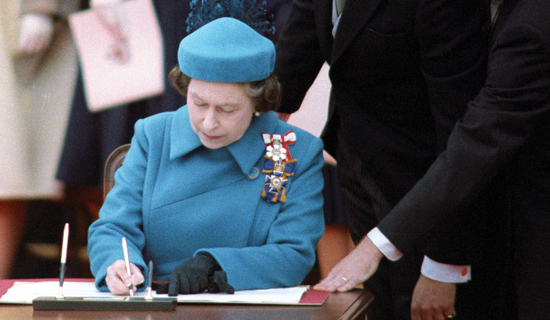
In a recent interview with Tom Clark, Jean Chretien, the great story-teller and myth-maker, also perpetuated other disturbing misconceptions about Patriation. As a former Attorney General and Prime Minister and as a lawyer, he should have known better! Chretien asserted, “You know, we were still legally a colony of Great Britain [until the Patriation of 1982].”[2] Chretien’s statement is demonstrably false. Canada ceased to be in law and in fact a colony of the United Kingdom with the passage of the Statute of Westminster, 1931, which established the Crown of Canada as a separate legal entity from the Crown of the United Kingdom. We cannot blame the United Kingdom for our homegrown Canadian failure to devise an appropriate indigenous amending formula until 1982! The Royal Proclamation that Queen Elizabeth II of Canada signed at the ceremony in Ottawa in recognition of Patriation even declared in the preamble, “Whereas it is in accord with the status of Canada as an independent state that Canadians be able to amend their Constitution in Canada in all respects.”[3] The Queen of Canada thus recognized that Canada had already attained the status of independent state before 1982. The most amusing aspect of Chretien’s false statement is that he was the Attorney General of Canada when Her Majesty issued that Proclamation – and he therefore counter-signed the same document!

Myth 2: Charter as Giver of All Rights

The Charter of Rights and Freedoms did not “give us our rights” per se, as the common refrain asserts. It did give Canadians some additional positive rights on official languages. But in large part, it codified and affirmed common-law rights that Canadians had already possessed based on centuries of judicial precedent and reception of British statutes.  Before the Charter, parliaments could infringe upon our common-law rights without judicial review, but these rights were still extant.  The Charter imposed a significant limitation on the Blackstonian doctrine of parliamentary sovereignty for the first time by subjecting acts of parliament to judicial review and by preventing the Parliament of Canada and the provincial legislatures from passing legislation that infringed upon our basic rights, “subject only to such reasonable limits prescribed by law as can be demonstrably justified in a free and democratic society.”[4] This Reasonable Limits Clause, Section 1 of the Charter, acts as a check and balance between Parliament and the courts in a new era of judicial review.

I support the Charter and consider judicial review of potential parliamentary infringements on individual rights a healthy and reasonable limitation of parliamentary sovereignty. Parliament should not possess the sovereignty to deny someone his basic rights as a free-born Canadian. As  a Whig and classical liberal, I support in principle a constitutional document that prevents all levels of government from infringing upon clearly defined, negative rights.  In addition, the Charter still strikes a balance between the legislature and the judiciary through the Reasonable Limits Clause and the Notwithstanding Clause; it does not deal in absolutes.

Myth 3: On the Constitution’s Application to Quebec

The Constitution Acts (1867 and 1982) apply to all provinces and to the federal level. The Levesque government did not agree with the Constitution Act, 1982, which frankly makes sense from their viewpoint: a secessionist party and officially secessionist government cannot realistically support an effort that would make Canada anew and reinforce Quebec’s place in the federation. Quebec did not “sign on to the constitution”, but the entirety of the  Constitution Act, 1982 applies to Quebec with the same force and effect as it applies to the other provinces and to the Dominion.

Conclusion

In conclusion, I agree with former Prime Minister Chretien that the Harper government probably should have included the 30th anniversary of the Constitution Act, 1982 in its list of celebrations of 2012 – but this commemoration most certainly should not focus exclusively on the Charter of Rights and Freedoms. We should commemorate Patriation and the Constitution Act, 1982 as a whole and the respective roles of the Trudeau government and the Queen of Canada therein, and we should celebrate integral place of the Constitution Act, 1982 and the Charter within the Constitution of Canada.

The Agenda with Steve Paiken recently hosted a panel with Chretien and Romanow. Any Canadian interested in the history of Patriation, the creation of our indigenous constitutional amending formula, and the establishment of the Charter should watch this video!

Similar Posts:


[1] Irwin Cotler, “Myopic Government Ignores Charter Anniversary,” Toronto Star (12 April 2012).
[2]
Global News, “If the War of 1812 Warrants Commemoration, So Does the Patriation of the Constitution: Chretien,The West Block (15 April 2012).
[3]
Canada Gazette, Constitution Act, 1982”, 12 May 1982.
[4]
Section 1 of the Charter, also known as the Reasonable Limits Clause.

Posted in Amending Formulas, Constitution (Written) | Tagged , , , , , , , | 4 Comments