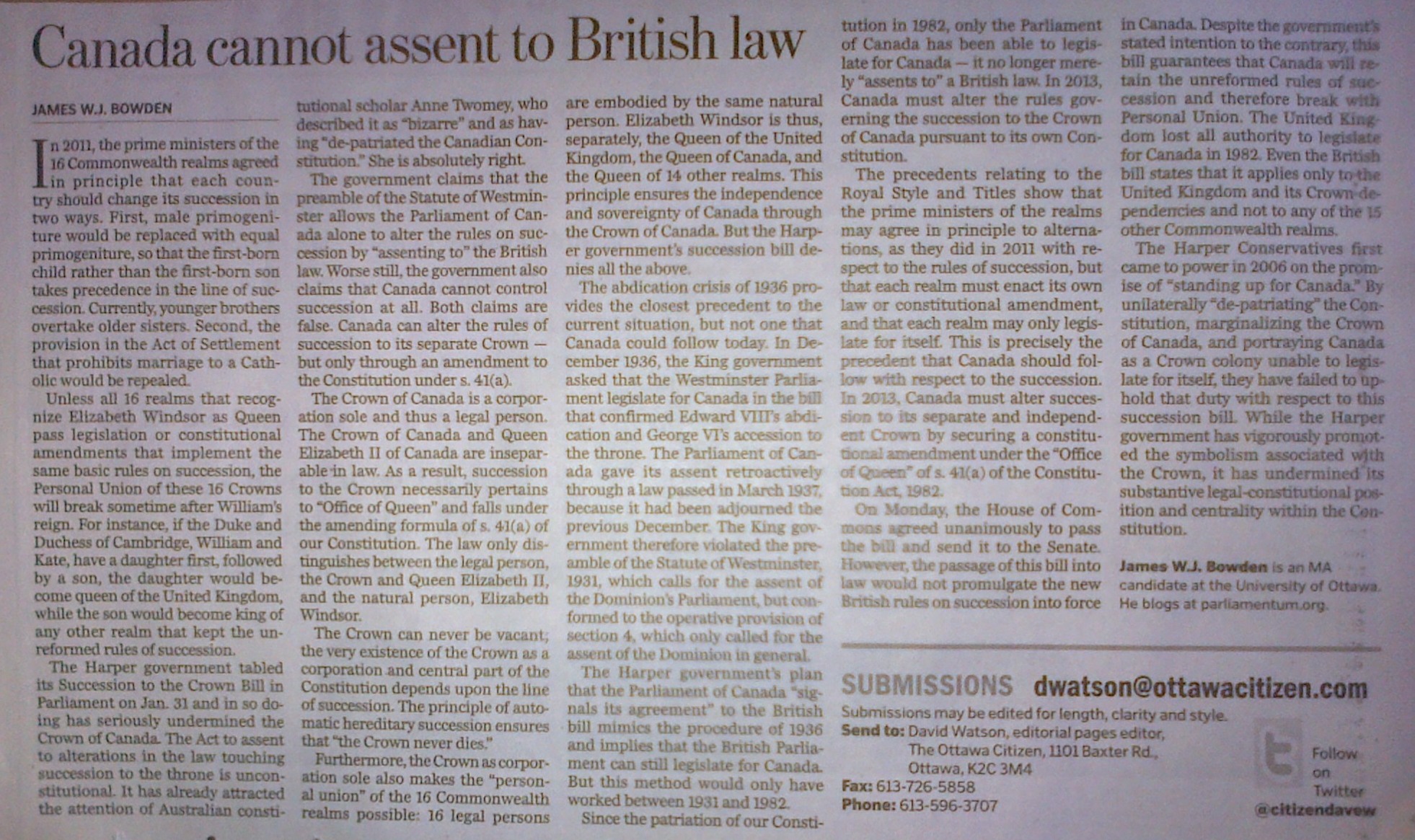
My Column in the Ottawa Citizen: Why the Harper Government’s Succession Bill Is Unconstitutional


I thank David Watson and the editorial staff at the Ottawa Citizen for having publishing my column!

I thank David Watson and the editorial staff at the Ottawa Citizen for having publishing my column!

In 2011, the prime ministers of the 16 Commonwealth Realms agreed in principle that each country should change its succession in two ways. First, male primogeniture would be replaced with equal primogeniture, so that the first-born child rather than the first-born son takes precedence in the line of succession. Second, the provision in the Act of Settlement that prohibits marriage to a Catholic would be repealed. However, the statutory requirement that the Sovereign be a Protestant would remain intact.

Unless all 16 realms that recognize Elizabeth Windsor as Queen pass legislation or constitutional amendments that implement the same basic rules on succession, the Personal Union of these 16 Crowns will break sometime after William’s reign. For instance, if the Duke and Duchess of Cambridge have a daughter first, followed by a son, the older daughter would become Queen of the United Kingdom, while the younger son would become king of any other realm that kept the unreformed rules of succession.

The Harper government tabled its Succession to the Crown Bill in Parliament on Jan. 31 and in so doing has seriously undermined the Crown of Canada. The Act to assent to alterations in the law touching succession to the throne is unconstitutional. It has already attracted the attention of Australian constitutional scholar Anne Twomey, who described it as “bizarre” and as having “de-patriated the Canadian Constitution.”

The government claims that the preamble of the Statute of Westminster allows the Parliament of Canada alone to alter the rules on succession by “assenting to” the British law “touching on the succession to the throne or the Royal Style and Titles”. Worse still, the government also claims that Canada cannot control succession at all. Both claims are false. Canada can alter the rules of succession to its separate Crown — but only through an amendment to the Constitution under s.41(a).

The Crown of Canada is a corporation sole and thus a legal person. The Crown of Canada and Queen Elizabeth II of Canada are inseparable in law. The law only distinguishes between the legal person, the Crown and Queen Elizabeth II, and the natural person, Elizabeth Windsor. As a result, succession to the Crown necessarily pertains to “Office of Queen” and falls under the amending formula of s.41(a) of our Constitution. The Crown can never be vacant and “disembodied”. The Crown as a corporation and central part of the Constitution depends upon the chain of persons who succeed to the office, known as the line of succession. The principle of automatic hereditary succession ensures that “the Crown never dies.” Instead, the Crown only “demises” from the Sovereign to his or her successor, as prescribed by law. (Historically, the Crown has demised by conquest, and once, in 1936, by abdication as prescribed by law).

The Crown as corporation sole also makes the “Personal Union” of the 16 Commonwealth Realms possible: 16 legal persons are embodied by the same natural person. Elizabeth Windsor is thus, separately, the Queen of the United Kingdom, the Queen of Canada, and the Queen of 14 other Realms. This principle ensures the independence and sovereignty of Canada through the Crown of Canada. But the Harper government’s succession bill denies all the above.

The Abdication Crisis of 1936 provides the closest precedent to the current situation, but not one that Canada could follow today. In December 1936, the King government asked that the Westminster Parliament legislate for Canada in the bill that confirmed Edward VIII’s abdication and George VI’s accession to the throne. The Parliament of Canada gave its assent retroactively through a law passed in March 1937. The King government therefore violated the preamble of the Statute of Westminster, which calls for the assent of the Dominion’s Parliament, but conformed to the operative provision of section 4, which only called for the assent of the Dominion in general.

In 1953, each Realm legislated only for itself on alterations to the Royal Style and Titles. Canada could have requested that the UK Parliament invoke the Statute of Westminster and legislate for Canada, but instead asserted its own sovereignty and independence. The prime ministers of the Realms had agreed in principle on altering the Royal Style and Titles, as they did in 2011 on the rules of succession, but each Realm enacted its own laws and legislated for itself. We need to build on this precedent in 2013.

The Harper government’s plan that the Parliament of Canada “assent to” to the British bill mimics the procedure of 1936 and implies that the British parliament can still legislate for Canada. But this method would only have worked between 1931 and 1982 – and wasn’t even used in 1953. The Patriation of our Constitution in 1982 abolished all the British Parliament’s residual authority to legislate for Canada. Even the British bill states that it applies only to the United Kingdom and its Crown dependencies and not to any of the 15 other Commonwealth Realms. In 2013, Canada must alter succession to its separate and independent Crown by securing a constitutional amendment under the “Office of Queen” of s.41(a) of the Constitution Act, 1982.

On Monday, the House of Commons agreed unanimously to pass the bill and send it to the Senate. However, the passage of this bill into law would not promulgate the new British rules on succession into force in Canada. Ironically, this bill now guarantees that Canada will retain the unreformed rules of succession and therefore break with the Personal Union.

The Harper Conservatives first came to power in 2006 on the promise of “standing up for Canada.” By unilaterally “de-patriating” the Constitution, marginalizing the Crown of Canada, and portraying Canada as a Crown colony unable to legislate for itself, they have failed to uphold that duty with respect to this succession bill. While the Harper government has vigorously promoted the symbolism associated with the Crown, it has undermined its substantive legal-constitutional position and centrality within the Constitution.

James W.J. Bowden is an MA candidate at the University of Ottawa.

*I had made some minor changes which the Ottawa Citizen unfortunately couldn’t include due to limitations of space and my tardiness! I am very grateful to David Watson and the editorial staff for having given me the opportunity to express contrary arguments on the succession bill.

I will also post the full legal-constitutional case against the Harper Government’s succession bill later this week.

Similar Posts:

Posted in Corporation Sole, Crown (Powers and Office), Succession (Sovereign) | 11 Comments

The Harper Government’s (Probably Unconstitutional) Bill on Succession to the Crown


The Parliament of Canada has just updated the Notice Paper of the House of Commons. The Minister of Justice will soon table a bill relating to succession to the Crown called An Act to assent to alterations in the law touching the Succession to the Throne.

The wording of the title of the bill alone confirms the statements of the British House of Commons Library and the spokesman from the Privy Council Office: the Harper Government believes that the Statute of Westminster somehow still allows Canada to signal its “assent” to British legislation, even though Canada repealed s.4 and s.7(1) of that Act upon Patriation in 1982.

If Canada merely “assents to” a British law, this bill will severely undermine the Crown of Canada over the long term. First and foremost, if the Crown of Canada is not a separate corporation sole from the Crown of the United Kingdom, then Canada is not an independent, sovereign country. The Harper Government’s method of clinging to an inoperative provision (section 4) and a defunct, moot preamble of the Statute of Westminster will turn Canada into a Crown colony once again. Second, if succession falls outside of the Constitution of Canada as the Harper Government has claimed, then the succession to the Crown immediately becomes subject to the Charter. Someone could then easily challenge the Protestant succession, or even the hereditary principle itself, in court as “discrimination.” And of course, any challenge to the hereditary principle undermines constitutional monarchy itself, because it depends upon hereditary succession, as prescribed by law.

I shall provide a full analysis after the Parliament of Canada has uploaded a copy of the bill online. For now, I would direct you to my previous posts on the subject, particularly, Why Altering the Succession Requires a Constitutional Amendment.

Similar Posts:

Posted in Corporation Sole, Crown (Powers and Office), Succession (Sovereign) | Tagged | 7 Comments

Conservative Partisans Celebrate the Wrong Date! Transitions Between Ministries in Canada


Prime Ministerial succession does not occur automatically and instantaneously under our constitution, but only after a transition of two to three weeks, after the outgoing Prime Minister has tendered his formal resignation to the Governor, and after the Governor has formally appointed the new Prime Minister.

Unfortunately, some Conservative partisans and even some Conservative MPs have conflated the election with the appointment of a new government and entirely ignored the period of transition! Stephen Harper became Prime Minister on February 6th, 2006 — not on January 23rd, 2006. Parm Gill, Conservative MP for Brampton-Springdale, has conflated the two dates on Twitter.

Parm Gill on the Harper Government

First, the Harper government took office on February 6th, 2006 and not January 23rd.

Second, the Harper government has only served one “term” of office, contrary to the implication in Gill’s reference to “first taking office”. The tenure of the First Minister determines the term in office of his or her Ministry, which means that his or her resignation or death results in the automatic resignation of all other serving Cabinet ministers and the end of that Ministry. A First Minister can serve two or more terms if and only if he resigns from office and the Governor subsequently re-appoints him to that office. In addition, Governments in Canada are not elected, though they are responsible to the electorate. The Governor appoints as First Minister the leader of the party who stands the best chance of heading a government that can command the confidence of the legislature, thus granting him official commission under the Crown – which amounts to the Government’s true legal “mandate.”

Third, Gill is a backbench MP and not a Ministers of the Crown, so he can’t properly describe himself as a member of “the government”!

Can you spot the two errors from the Conservative Party's website?

Can you spot the two errors from the Conservative Party’s website?

The results of the election of the 39th Parliament of Canada came in on January 23rd, 2006 and resulted in what would become the second of three consecutive minority Parliaments. In the 38th Parliament (2004-2006), the Liberals held the plurality of seats and Prime Minister Martin’s 27th Ministry continued as a minority government.  Stephen Harper’s Conservatives gained the plurality in the 39th Parliament (2006-2008); upon seeing the results, Prime Minister Martin announced his intention to resign and called upon the Governor General to appoint Conservative leader Stephen Harper as his successor.

However, Prime Minister Martin did not submit his formal resignation until February 5th, 2006,  and Governor General Michaelle Jean did not appoint Stephen Harper as Prime Minister until February 6th, 2006! The dying days of the Martin government, from January 23rd, 2006 to February 6th, 2006, formed the “caretaker period” and provided for the transition from the 27th Ministry to the 28th Ministry. The transition from one government to another generally takes two to three weeks in Canada — it most certainly does not occur instantaneously after the results of the election and party standings become known. In countries where minority parliaments and coalition governments are common, this period of transition also involves a process of government formation, namely, crafting government programs based on backroom negotiations and the platforms of the political parties involved.

The Privy Council Office’s Guide to Ministries Since Confederation shows this clear transition:

  • 27th Ministry: Paul Martin served as Prime Minister from his appointment on 12 December 2003 to his resignation 5 February 2006.
  • 28th Ministry: Stephen Harper has served as Prime Minister since Governor General Jean appointed him with the official commission to govern on 6 February 2006. His “term” will end only upon his resignation (or, theoretically, death).

Conservative partisans may celebrate January 23rd as the anniversary of the Conservatives’ first electoral victory and the date on which Prime Minister Paul Martin announced his intention to resign so that the Governor General could appoint Stephen Harper as his successor. But they most certainly cannot portray January 23rd as the anniversary of forming government!

Similar Posts:

Posted in Appointment of PM, Constitutional Conventions, Crown (Powers and Office), Governor's Discretion, Succession (Prime Minister) | 1 Comment

The McGuinty Government Repeals a Law While Parliament Is Prorogued


In one of its last acts as a Ministry, the McGuinty Government has promulgated section 20 of the Putting Students First Act and thus secured its repeal — all while the provincial parliament is prorogued and in an intersession.

I still maintain that the Putting Students First Act is unconstitutional, both in principle, and in terms of the poor legislative drafting of sections 20 and 22 which caused the Government to exceed the authority that the Act had delegated to it. The Act may even be unconstitutional for a third reason because it derogates from collective agreements in particular and collective bargaining in general. The Government’s own press releases suggest that certain collective agreements flowed from the Act; if so, logically, the repeal of the Act would also affect, or perhaps nullify, any such collective agreements. I don’t possess any expertise in labour law, so I shall leave this argument to those who know more on the subject.

You can read my full argument in my earlier post, hyperlinked below, on how the Cabinet can now repeal a law while Parliament is prorogued.

Similar Posts:

Posted in Cabinet's Powers, Crown (Powers and Office), Prorogation, Separation of Powers | 1 Comment

The Monarchist League of Canada’s Flip-Flop on Succession to the Crown


The Monarchist League of Canada. "Myths About the Monarchy" [accessed 13 January 2013].

The Monarchist League of Canada. “Myths About the Monarchy” [accessed 13 January 2013].

The Monarchist League of Canada includes a helpful section on its official website dedicated to debunking, in a concise manner, some of the common myths and misconceptions toward constitutional monarchy.

In “Myths About the Monarchy,” the Monarchist League offers a brief explanation on why the succession will not skip Charles, the Prince of Wales, and pass directly from Queen Elizabeth II to the Duke of Cambridge. Former British Prime Minister John Major once derisively referred to this notion as “newspaper sophistry.”

Generally, I agree with this explanation — particularly the part where the Monarchist League correctly acknowledges that succession forms part of the Constitution of Canada, and would thus require a constitutional amendment to alter. Practically speaking, all 16 Realms would indeed have to pass legislation or constitutional amendments promulgating an act of abdication to their respective Crowns in order to preserve the Personal Union.

[…] two factual points need underlining to those who favour a skipped succession. First, a change in the succession would involve opening up the constitution with all the debate and mischief attending it—and doing so in all 16 Commonwealth Realms. There is unlikely to be the political will to do this for what might prove unsuccessful and, in the end, prejudicial to the monarchy.

Admittedly, the Monarchist League probably hasn’t updated this section of its website in a few years, given that it omits any reference to the Duke and Duchess of Cambridge. But since the Monarchist League has argued, correctly, that an abdication in the succession to the Crown of Canada could only be promulgated by an amendment to the Constitution of Canada, then I can only surmise that the Monarchist League would, logically, also agree with my argument that the Parliament of Canada alone does not possess the authority to “signal its agreement” to the British Succession to the Crown Bill and thus bypass the Constitution. An instrument of abdication engages succession just as much as replacing male-preference primogeniture with equal primogeniture and repealing the penalty of marriage to a Catholic do.

If, however, the League agrees with the Harper government’s rationale (as reported by the British House of Commons Library and the Canadian Privy Council Office) that succession falls outside the Constitution of Canada and therefore does not engage any constitutional amending formula, I would be very curious to know why the League has reversed its stance. After all, the League touts itself as “ha[ving] gained a national reputation as the leading voice of intelligent monarchical opinion in Canada.”

UPDATE

The Monarchist League has now officially come up in support of the Harper Government’s unconstitutional bill to “assent to” the British law on succession. The organization has dutifully supported and propagated all the Government’s talking points on the issue and has now even updated itself website accordingly. Thankfully, I saved a record of the about-face. At this point, it is clear that the organization has changed its position from a correct and constitutionally consistent interpretation to an unconstitutional, politically expedient interpretation in order to support a Government that has treated the organization well — even if that means upholding the manifestly absurd. The Monarchist League has become a willing collaborator in the Crown’s demise and, ironically, the greatest ally of the republican movement in Canada.

The Monarchist League: taking the “constitutional” out of “constitutional monarchy.”

The Monarchist League of Canada. “Myths About the Monarchy” [accessed 31 January 2013].

The Monarchist League of Canada. “Myths About the Monarchy” [accessed 31 January 2013].

Similar Posts:

Posted in Crown (Powers and Office), Succession (Sovereign) | Tagged | 19 Comments