
A Response to the Broadbent Institute’s Polemic for Mixed-Member Proportional Representation


MMP in NZ

On Mixed-Member Proportional Representation

In March 2016, the Broadbent Institute released a report on electoral reform, “An Electoral System for All: Why Canada Should Adopt Proportional Representation,” and endorsed mixed-member proportional representation. It is in essence and in tone a polemic, so I shall rebut it here with a counter-polemic. 

In our current single-member plurality system, voters cast their ballots for candidates in geographic constituencies and the person who wins the largest number of votes, though not necessarily a majority and often a plurality, becomes the Member of Parliament-elect. (I regard “first past the post” as irretrievably pejorative, and so does the Broadbent Institute, judging by how it employs the term). Under pure proportional representation, voters cast their ballots for political parties themselves, and the seats in the parliament are allocated in direct proportion to the popular vote that each political party obtained; MPs are then selected based on the parties’ electoral lists, in descending order, until each party has filled the number of seats that it earned in the legislature based on its percentage of the popular vote.

Mixed-member proportional representation essentially combines single-member plurality with pure proportional representation; voters therefore cast two ballots, one for their constituency member of parliament and another for the political party itself. However, mixed-member proportional representation still strives for an overall proportional outcome by relying on a mathematical formula to allocate to the political parties that won fewer constituency seats than their popular vote merits x number of the non-geographical compensatory seats, based on a mathematical formula like the Hare Quota or the Droop Quota. In this way, the overall percentage of seats that the political parties hold in the assembly comes much closer to the percentage of the party vote that they won in the election.[1] Generally, this system benefits smaller parties, which would explain why the New Democratic Party has long advocated for it.

The geographical extent by which the compensatory seats are allocated – whether within each province or across two or more provinces –forms an important constitutional question in Canada.

Constitutional Amendments Required to Implement Two Types of Mixed-Member Proportional Representation

In short, switching to mixed-member proportional representation would necessarily require some kind of constitutional amendment, but the question of which amending formula would be necessary depends on the geographic point of reference from which compensatory seats are allocated, whether within a province or between provinces.

Section 51(1) of the Constitution Act, 1867 contains the formula by which seats in the House of Commons are allocated amongst the provinces, and section 52 of the Constitution Act, 1867 stipulates that the seats within the House of Commons must be distributed such that the “proportionate representation of the provinces” is not “disturbed.”  In this case, “proportionate representation” refers not to what we would today refer to proportional representation, but rather to the principle of representation by population under a single-member plurality electoral system. It has been established that the Parliament of Canada alone can amend section 51(1) pursuant to the constitutional amending formula in section 44 of the Constitution Act, 1982; this last occurred in 2011. However, section 42(1)(a) of the Constitution Act, 1982 subjects this principle of the “proportionate representation of the provinces” contained in section 52 of the Constitution Act, 1867 to the General Amending Formula.

Therefore, the constitutional amendment necessary for implementing mixed-member proportional representation depends on whether the compensatory party seats are allocated based on the party vote within each province or across multiple provinces. If the compensatory party seats are allocated to parties based on their vote within each province, then the Parliament of Canada alone could pass such a constitutional amendment under section 44 of the Constitution Act, 1982, because this system would not take away any seats from any province and would merely change the rules regulating the size of the remaining geographic constituencies and the ratio of geographical constituencies versus compensatory seats for the political parties. This corresponds closely to Germany’s model of mixed-member proportional representation, in which the compensatory seats are allocated based on the party vote within each of the 16 Landers (i.e., federated entities like provinces in Canada or states in Australia). If, however, we tried to create a system in which the compensatory seats are allocated based on the party vote between two or more provinces, or Canada-wide across all ten provinces, we would then need to pass a constitutional amendment under the General Amending Formula, because taking away seats from the provinces for the sake of establishing a pool of compensatory seats would “disturb” the “principle of the proportionate representation of the provinces.” Indeed, it would create a class of seats completely divorced from the provinces and wedded instead to political parties themselves.

The General Amending Formula requires that the House of Commons, Senate, and at least seven provincial assemblies representing at least one-half of the total Canadian population pass concurring resolutions. Many Canadian scholars and commentators refer to this laborious process as “opening the Constitution” – with the obvious, though perhaps unconscious, analogy to “opening Pandora’s Box” and unleashing a torrent of destruction upon the political landscape. This second model also corresponds more closely to how mixed-member proportional representation works in a unitary state like New Zealand.  

The Ambiguity of the Broadbent Institute’s Polemic

Not surprisingly, the Broadbent Institute does not venture into precisely how and what kind of system of mixed-member proportional representation it would like to implement in Canada. In particular, it does not specify whether it would to allocate the compensatory seats within each province, or, alternatively, between provinces or across Canada as a whole. At two points, the report alludes to both of these mutually exclusive options but does not decide definitively upon either. (Since this report appears online without a corresponding PDF or text version, I cannot cite specific page numbers or paragraphs).

At one point, the Broadbent Institute’s report acknowledges that mixed-member proportional representation would require larger geographic constituencies; it later concedes in a parenthetical aside – as if the precise structure of the electoral system were less important – that electoral “districts would probably be divided by province like they are now, but ridings would become larger.”[2] This wording suggests (though does not mean conclusively) that the Broadbent Institute would endorse the German Model by which the Parliament of Canada alone could implement mixed-member proportional representation pursuant to the amending formula under section 44 of the Constitution Act, 1982.

However, another paragraph later in the report implies, but does not state directly, that the Broadbent Institute would prefer a system of Canada-wide compensatory seats in order to stop rewarding political parties that currently benefit from regional pockets of support. The German Model would still allow, to some extent, for the geographic concentration of the compensatory party seats within each province and would therefore not solve what the Broadbent Institute regards as a significant flaw in Canada’s current electoral system.

[…]FPTP tends to punish small parties whose support is spread out across the country, while it rewards those whose support is geographically concentrated (and it can have the opposite effect on large parties). That’s how the Bloc Québécois became the Official Opposition in 1993 despite electing no members of Parliament outside Quebec, receiving less than 14 per cent of the popular vote, and taking in fewer votes (by more than 700,000) than the third-place Reform Party. It’s also how the Green Party of Canada, whose support is more geographically spread out, has received only one seat in two of the last five elections, and none in the other three, despite receiving between three and seven per cent of votes cast in each contest. (In a proportional system with similar popular returns, the party would likely have come away with 10–20 seats.)[3]

Other than these oblique and contradictory references, the Broadbent Institute’s polemic for mixed-member proportional representation does not venture into the constitutional and statutory mechanisms by which this electoral system could be implemented in Canada. The Broadbent Institute also does not specify what percentage of the popular vote parties would have to obtain as a minimum threshold in order to qualify for seats in the House of Commons, nor does it specify which formula – whether the Hare Quota or the Droop Quota – it would adopt for allocating the compensatory seats.

Argument from Teleology, False Consciousness, and the Myth of the “Wasted Vote”

Teleological Platitude

The Broadbent Institute relies on what I would classify as an Appeal to Teleology. This fallacy holds that history moves inexorably toward liberal-democratic (or perhaps social democratic) perfection and that therefore anything which attempts to slow or reverse this progression is manifestly bad and must be relegated to the dustbin of history. This Hegelian teleological impulse has been central to the ideology of the Progressive Movement since the early 20th century and is related to the Whiggish view of history and the Liberal Progress Narrative of the early 19th century. For example, Prime Minister Trudeau relies on this fallacy and appeals to teleology when he justifies his actions simply by stating what year it is, such as in his response to the question why he decided to appoint equal numbers of men and women to cabinet: “Because it’s 2015.” President Obama, and various other American politicians, often invoke the same fallacy through phrases like “to be on the right side of history,” meaning that one’s political opponent is not merely incorrect but is “on the wrong side of history.” On the surface, this fallacy sounds credible, but it conceals a pernicious purpose: politicians invoke it in an attempt to restrict the acceptable range of political discourse by delegitimating contrary viewpoints outright.

The Broadbent Institute relies on this Appeal to Teleology in order to dismiss single-member plurality as an inexcusable relic of the past and exalt mixed-member proportional representation as the ideal that we must realize in practice. In a series of sentence fragments, the Broadbent Institute portrays single-member plurality as an anachronism of the 19th century:

Our current electoral system has been with us since before Confederation. That is, since before 1867. Before automobiles took over our streets, before light bulbs lit our rooms, and before tin cans filled our shelves.[4]

Let’s ignore the fact that tin cans first appeared as a method of preserving food in the 1810s and gradually became more widespread throughout the 19th century. (Perhaps the Broadbent Institute could have strengthened its analogy by pointing out, for instance, that early tin cans were sealed with a lead solder which made their contents toxic). The Broadbent Institute here is suggesting that simply because we have improved materially and technologically since the mid-19th century, our electoral system must also be swept away into the dustbin of history along with lower life expectancy and steam engines, as if the single-member plurality electoral system and being materially worse off were somehow correlated to one another.

The Broadbent Institute also infuses its paper with some some Marxist tropes, particularly that of false consciousness. For instance, they steep their acknowledgement that mixed-member proportional would have to retain some geographic constituencies in such language: mixed-member proportional would have to maintain geographic constituencies of some kind because “many citizens, especially those outside of our larger cities, have a strong attachment to geographical representation […].” If only the rural proletariat would dispense with those “strong attachments” to geography and stop clinging to single-member plurality. If only they could be forced to see the truth. The Broadbent Institute picks up on its theme of false consciousness later in its report:

What we do know is that the system we now use is more familiar to Canadians, and that people tend to prefer things that are familiar to them. It’s likely true that the more Canadians learn about proportional representation, the more they will become comfortable with it, especially once they learn about the virtues of proportionality: fairness, representativeness, and engagement.[5]

Like most proponents of this electoral system, the Broadbent Institute holds that if only someone explained mixed-member proportional representation to Canadians, they would immediately begin to support it because of what the Broadbent Institute regards as its inherent and manifest superiority. More fundamentally, this viewpoint relies on a pernicious and cynical political tactic common to political parties and politicians of all ideological persuasions: the manner in which the idea is communicated is more important than the merits of the idea itself.

The So-Called “Wasted Vote”

The Broadbent Institute also relies heavily on the specious concept of the so-called “wasted vote.” The Broadbent Institute goes farther than most of its allies and defines a “wasted vote” as any vote “cast for a candidate who didn’t win.” But why does a vote cast for a candidate who ends up losing in a given riding count as having been “wasted”? This notion pre-supposes that all votes cast should somehow always translate into electing MPs, as if only the candidate for whom a citizen voted can “represent” him or her in parliament. This assertion also presupposes that citizens now possess a right to vote for a winning candidate. But we cannot pervert the constitutionally entrenched right to vote into an imaginary right to elect a winning candidate. We make choices to the exclusion of other options, and we work to allocate scarce resources. Furthermore, this begs the question as to what the Broadbent Institute would consider a non-wasted vote, because they seem to imply that even if a candidate wins 50%+1 of the votes in a riding, those who did not vote for the winning candidate still “wasted” their votes!

The Broadbent Institute laments that under the current system, “millions of Canadians are struck with a member of parliament they didn’t vote for.” But even under mixed-member proportional representation, there is no guarantee that the constituency MP for which a citizen votes would go on to win in that geographic district, which means, under the logic of the Broadbent Institute, that some Canadians would still be “stuck with a member of parliament they didn’t vote for.” With respect to the ballot dedicated to the party vote, the Broadbent Institute also doesn’t explain whether it would prefer a closed list or an open list, which means that citizens might not be able to choose their preferred party candidate either but would instead be limited to choosing the political party, whose list would then determine the order in which its compensatory seats are filled in the legislature.

Later on in the report, the authors define a “wasted vote” as one either “cast for candidates who don’t win” or “for parties that receive fewer seats than their public support indicates they deserve.” The second corresponds more closely to what other proponents of mixed-member proportional have put forward.  But the first illustrates the Broadbent Institute’s warped view on the nature of voting itself.

The Broadbent Institute Sets Some Myths of Its Own

Ironically, in the section on “Busting PR Myths,” the Broadbent Institute introduces some mendacious mythology of its own. For example, it defines political “stability” in a misleading manner; instead of linking stability to the number of ministries, or governments, in office over a given time, it ties “stability” to the number of general elections held and parliaments elected over a given time. In this manner, the Broadbent Institute propagandizes Italy as a paragon of political stability because it has held only 18 elections since 1945, while Canada has held 22 over the same period.  In a parliamentary system in which governments must maintain the confidence of the assembly, the true test of stability is the longevity of the ministry in office, not the number of general elections held. Stability depends upon the executive, not the legislature, because the government can survive across multiple parliaments, but once one parliament is dissolve, it is gone forever. Since 1945, there have been only 15 ministries in office in Canada – while over the same period there have been 41 in Italy. As Italy shows, when a country adopts a proportional system, elections matter less, because mid-parliamentary transitions of power between ministries become the norm.

The Broadbent Institute also conflates electing representatives with forming governments.

Some critics claim that PR makes accountability more difficult, since it’s hard to “punish” a single candidate or party that you’re dissatisfied with at election time. As with other systems, if as a voter in a PR system, you’re dissatisfied with a given representative or party, you’re free to choose any other alternative. But unlike in FPTP, your choice, no matter what it may be, is likely to count towards electing a representative.[6]

It notes, correctly, that critics of mixed-member proportional representation argue against this system on the grounds that it encourages coalition governments, which in turn makes punishing governments and the political parties that form them more difficult during elections. This is true. But then the report pivots away from this criticism and simply states that the voters remain free to reject their local representative or a given party – which is true, but this is not the same thing as rejecting a government and its policies, and it does not respond to the fact that rejecting coalition governments is more difficult than rejecting single-party majority governments.

The Broadbent Institute also tacitly acknowledges that adopting mixed-member proportional representation would form part of a larger institutional reform in how Canadians govern themselves and how parliamentary government operates. In other words, with mixed-member proportional comes, at the very least, coalition governments; it could also come with fixed-term parliaments, confirmation voting, and constructive non-confidence, because, as European parliamentary systems show, these institutional features normally go hand in hand in an attempt to maintain some modicum of stability.

It’s true that under a PR system, single party majority governments would probably be few and far between. Instead, parties would have to co-operate with one another to work in the best interest of Canadians. This would occur through minority and coalition governments—that is, parties that engage in public, formal power-sharing agreements in order to form a government. Globally, these arrangements are very common.[7]

Finally, the Broadbent Institute concludes its report on the same erroneous Appeal to Teleology on which it began. From the Broadbent Institute’s point of view, we must reject single-member plurality just as we have rejected a restricted franchise and have gradually expanded the right to vote from propertied white men to all adult citizens, irrespective of sex or ethnicity. This teleological claim also implies that single-member plurality discriminates on the basis of sex or race or some other criteria that would make it inconsistent with the Charter and that we must therefore reject single-member plurality outright and replace it with a new system. First, liberals and social democrats cannot claim credit for this progressive expansion of the franchise toward universal adult suffrage, because it was the Conservative government of Sir Robert Borden in 1918 that introduced the Act to confer the Electoral Franchise upon Women in 1918 and the Conservative government of John Diefenbaker that tabled the bill extending the franchise to all indigenous peoples. Second, universal adult suffrage and the right to vote itself, under section 3 of the Constitution Act, 1982, do not equate to the electoral system by which Canadian voters elect members of parliament. These are two separate issues – the first is a constitutional question; the second, a political question – but the Broadbent Institute relies on the false premise and disingenuous implication of combining the two together in order to delegitimate single-member plurality. You do not “waste” your vote simply because you happen to cast your ballot for a party that does not form government. To suggest otherwise would be to make the absurd assertion that our democratic rights include the right to elect members who then in turn must become cabinet ministers in government – a prosperous and unenforceable notion. 

Conclusion 

Since the Canadian proponents of mixed-member proportional representation remain silent on practical matters, it is unclear whether they would object to the limited, politically feasible method that would set up, in effect, 10 proportional systems in each province. Instead, they tend to rely on vague outlines couched in normative claims because they concern themselves more with convincing Canadians that mixed-member proportional representation is best and inherently more fair than single-member plurality than explaining precisely the constitutional and statutory by which their preferred option would be implemented. In this respect, the Broadbent Institute finds itself in the company of the Law Commission of Canada’s report on electoral reform from 2004, “Voting Counts: Electoral Reform for Canada,” as well as other advocacy groups like Fair Vote Canada and the Every Voter Counts Alliance.

The proponents of mixed-member proportional representation owe Canadians thoroughness and transparency.

Similar Posts: 

 Endnotes

[1] Citizens’ Assembly on Electoral Reform, “Description of The Ontario Citizens’ Assembly’s Mixed-Member Proportional System,” Part IV in Democracy at Work: The Ontario Citizens’ Assembly on Electoral Reform (Toronto: Citizens’ Assembly on Electoral Reform, 2007), 144-162.
[2] Broadbent Institute, An Electoral System for All: Why Canada Should Adopt Proportional Representation, March 2016. [Accessed 17 March 2016 < http://www.broadbentinstitute.ca/an_electoral_system_for_all>] Since this report appears online without a corresponding PDF or text version, I cannot cite specific page numbers or paragraphs.
[3] Ibid.
[4] Ibid.
[5] Ibid.
[6] Ibid.
[7] Ibid.
Posted in Electoral Reform, Reform | 7 Comments

A Caretaker Convention in the United States?


This is of interest to me from a comparative perspective. I’m by no means an expert on the current practices in the American system of government. My analytics tell me that Parliamentum does have an appreciable American readership, so I hope that some of my American readers will comment on this post and correct me if I’m wrong about anything or have overlooked something.

In response to the death of Justice Antonin Scalia, former Republican Congressman and Speaker of the House Newt Gingrich, in an interview with Fox News on 14 February 2016, spoke of precedents and something akin to constitutional conventions in the American system and argued that the President is subject to some kind of caretaker convention in the entire last year of his presidency — and not merely in the lame-duck period between, in this case, November 2016 and 20 January 2017 — that restricts his authority to nominate justices to the Supreme Court of the United States.

Gingrich said:

“I think it’s pretty clear that the historical precedents are that in the last year of a president’s term, there’s a bias towards the next president with the votes of the American people picking that person. [Senate Majority Leader] Mitch McConnell has to do two things: refuse to hold hearings and make sure that the Senate stays in pro forma session so that the president can’t make an interim appointment.”

What struck me most about Gingrich’s argument was his suggestion that the President, in his last year in office, should not make decisions that would restrict the freedom of action of his successor — because this same principle underpins the caretaker convention in parliamentary jurisdictions. The Privy Council Office’s Guidelines on the caretaker convention, for instance, states that while the caretaker convention is operable in Canada, the ministry should ensure that its decisions “are reversible by a new government without undue cost or disruption.”[1]

I’m skeptical of the principle underpinning Gingrich’s claim that there exists some kind of convention restricting the executive government of the United States. The Senate could of course refuse to confirm nominees. But the Senate’s refusal to confirm nominees is a political decision to exercise its constitutional authority in Article I in a manner that checks against the President’s authority under Article II to nominate judges; it is therefore an altogether different thing from asserting that some kind of convention restricts the President’s authority under Article II to recommend nominees to the Senate in the first place.

If there is a caretaker convention in the United States, it ought to apply only to the true lame-duck period between the presidential election in the first week of November and January 20th of the following year, when the outcome of the election is known and during this transition period when the President-elect is preparing himself and his incoming administration to take office. This maxim would also accord with how the caretaker convention operates in parliamentary countries like Canada. The caretaker convention certainly applies during the writ and after the writ until the day on which the incoming ministry takes office. But within the Commonwealth countries, for instance, there is debate and there are different precedents on whether the caretaker convention applies before the writ.

Ultimately, the Gingrich Doctrine  — that the president’s executive authority is restricted during the last year of his presidency — most resembles New Zealand’s extensive (and in my view, absurd) application of the caretaker convention with respect to appointments to the pre-writ period fully three months before dissolution.[2] In his recent article in PoliticoAmerican historian Josh Zeitz refers to Gingrich’s argument as “The Thurmond Rule,” and he easily debunks it:

Today’s Republicans consider as binding the so-called “Thurmond Rule”—a vague, non-statutory, largely undocumented position associated with exactly one former United States senator (Strom Thurmond), whom they claim opposed Fortas’ nomination on the grounds that LBJ was a lame-duck president. In fact, presidents don’t become lame ducks until their successors are chosen, and in 1968, Thurmond participated wholeheartedly in the nominee’s confirmation process.

I’d be very reticient indeed of citing Strom Thurmond as an authority on anything. That said, it’s interesting that Gingrich is talking of what would essentially be a political enforceable convention, because these are features normally associated with the Westminster system operating on fully or partially uncodified constitutions. Nick MacDonald and I posited in our article on officializing and codifying constitutional conventions from 2012 that in the United States, the only enforcement mechanism to check against a president’s violation of a convention is passing a constitutional amendment.[3] An example of this method occurred in 1951 with the passage of the 22nd Amendment, which imposed term limits on the President of the United States. George Washington, like Cincinnatus, had established a convention of relinquishing power voluntarily such that presidents serve only two terms; all presidents recognized and respected this convention until Franklin Delano Roosevelt broke it by running for a third term in 1940. (Theodore Roosevelt tried to buck the trend when he ran for a third, non-consecutive term in 1912, but the Bull Moose failed). To invoke R. Macgregor Dawson’s litmus test on exercising the reserve powers, I would say that the Second World War amount to an “exceptional circumstance” that warranted F.D. Roosevelt’s exceptional response.

In any event, I would argue that only a constitutional amendment could likewise limit the President’s executive authority under Article II to nominate judges during his last year in office; if the Senate so desires, it could block anyone whom President Obama nominates, but the Senate’s political decision to block a nominee does not derogate from the president’s authority under Article II to nominate someone in the first place.

Similar Posts:

[1] Canada. Privy Council Office, Guidelines on the Conduct of Ministers, Secretaries of State, Exempt Staff and Public Servants During An Election. (Ottawa: Her Majesty the Queen in Right of Canada, 2008): 1.
[2] New Zealand. Cabinet Office, Department of the Prime Minister and Cabinet, Cabinet Manual. (Wellington, Her Majesty the Queen in Right of New Zealand, 2008): 76-77.
[3] James W.J. Bowden and Nicholas A. MacDonald, “Writing the Unwritten: The Officialization of Constitutional Conventions in Canada, the United Kingdom, Australia, and New Zealand,” The Journal of Parliamentary and Political Law 6, no 2 (August 2012): 399.

Posted in Caretaker Convention & Government Formation, Constitutional Conventions, Parliamentarism v Presidentialism | 3 Comments

In Defence of Single-Member Plurality


Adopting a ranked ballot would in effect convert our single-member plurality into a system of single-member majority, like the electoral system for Australia’s House of Representatives, since it would still rely on single-member geographic constituencies and not party lists. Such a reform would not alter our system as radically as would a proportional voting system, but it could very produce mediocrity and would probably most benefit the Liberals, as a second-choice party, in Canada’s two-party-plus system. However, adopting a proportional system like mixed-member proportional, as the New Democrats would wish, would prove a radical break with our tradition.

Our system of government and British tradition flow not from a rationalist, technocratic Continental project, but instead of the accumulated practice and wisdom of centuries of evolution through common sense and trial and error.[1] Proportional representation is foreign to the British tradition, notwithstanding New Zealand’s reform of 1996; instead, it sprung from a Continental European construction in which effective parliamentary government and Responsible Government were imposed by rigidly codified constitutions and not until after various regional, sectarian, and linguistic groups had enough leverage to demand a system that would not weaken them as individual entities and force them to combine into effective governing parties.[2] Proportional representation leads to hung parliaments, which in turn lead to coalition governments and the inter-elite accommodation inherent to forming coalition governments, which, in effect, makes elections less significant than they might appear.

The Queen’s business must always carry on, which means that the ministry of the day must always be able to pass supply through the House of Commons. If the ministry cannot control the agenda of the Commons and obtain supplies for the Crown, then either there must be a new ministry (mid-parliamentary change of government) or a new parliament (fresh elections). Parties evolved in our system so that the House of Commons could support a government. The proponents of proportional representation have got it all backwards: parliament does not exist in order to serve parties; instead, it exists in order to support a government that can carry out the Queen’s business.[3] Unlike the horseshoe-shaped consensus parliaments of Continental Europe, which reformers here exalt, our House of Commons consists of two sides; to the Speaker’s right sits the Ministry and government backbenchers, and to his left sits the opposition, the largest party of which acts as the government-in-waiting. As Peter Hitchens argues:

The electoral system is not there for the good of the parties, but for the good of the country.It has two irreplaceable and unique characteristics. The first is that it provides strong government, constantly challenged by a vigilant and ambitious opposition.The next is that it allows the people, when enraged or otherwise disappointed by a bad government, to turn it out completely.[4]

In short, single-member plurality is for the good of the country; the  in contrast, proportional systems serve political parties themselves, particularly small irrelevant parties like the Greens which exist only in the hope of achieving what Pepall calls a grossly disproportionate “imbalance of power” in hung parliaments by suspending itself like the Sword of Damocles over the government’s head and extorting absurd demands from it in order to cater to the narrowest slices of the electorate. Under mixed-member proportional, we could no longer say that we elect members of parliament alone; instead, with one ballot, we would elect some members, and on another we would elect parties instead, but not the lists that determine the order in which parties fill up their quotas or the proportional seats distributed in order to match their share of seats with their seat of the popular vote. Proportional representation — whether pure or mixed-member proportional — springs from the false and presumed premise that the House of Commons exists to support parties, when in fact parties evolved in order to support ministries that could successfully carry out the Queen’s business and sustain their parliamentary majorities.  Political parties aggregate interests and exist in order to form government, and being in government is about taking responsibility for acts of the Crown and making decisions. Governing is about making decisions to the exclusive of all others; it is not about making multiple decisions in proportion to the share of votes that different parties and their platforms won in the previous general election. Ultimately, this is why the people as a whole — the constituent body of the realm — will invariably be unhappy or dissatisfied with what the government of the day does. As Pepall says, “to govern is to choose.”[5]

We cannot allow the proponents of mixed-member proportional to portray theirs as the only “legitimate” or morally righteous option, as if converting to this proportional system were a sacred and undeniable truth. As with everything else in politics, they have calculated their reform for political gain, which is why small parties that would otherwise have no chance in forming government most strongly support this system and why Elizabeth May has emerged as its most fervent advocate in Canada.

These constitutional vandals would presume to destroy the organic architecture of our system by importing this rationalist, mechanical Continental European monstrosity. It is little wonder, therefore, that those who support mixed-member proportional are also more likely to support codifying constitutional conventions and imposing true fixed-term parliaments, constructive non-confidence, confirmation voting, and the inter-elite accommodation of coalition government formation and ever-shifting coalition cabinets — the complete dissonant score of Continental European parliamentarism, exemplified by Belgium.

[1] John Pepall, Against Reform (Toronto: University of Toronto, 2010), 4.
[2] John Pepall, Against Reform (Toronto: University of Toronto, 2010), 34.
[3] John Pepall, Against Reform (Toronto: University of Toronto, 2010), 34.
[4] Peter Hitchens, “On ‘Legitimacy’ and Saving FPTP,” The Mail on Sunday, 7 May 2015.
[5] John Pepall, Against Reform (Toronto: University of Toronto Press, 2010), 30.

Similar Posts:

Posted in Electoral Reform, Reform | 1 Comment

The Trudeau II Government’s Electoral Teleology


The Liberal Platform and the Trudeau II Government’s Policy Proposal

During the last general election, the Liberals pledged to study changing the electoral system from single-member plurality (also known pejoratively by its opponents as “first past the post”) to some other system – whether that be mixed-member proportional, some form of single-member majority with preferential balloting, single transferable vote, or whatever. The Liberal Party’s website proclaims that the general federal election of 2015 “will be the last […] conducted under the first-past-the-post voting system.” The Liberals also pledged to do the following:

We will convene an all-party Parliamentary committee to review a wide variety of reforms, such as ranked ballots, proportional representation, mandatory voting, and online voting. This committee will deliver its recommendations to Parliament. Within 18 months of forming government, we will introduce legislation to enact electoral reform.

This wonderfully ambiguous proposition leaves various questions unanswered. What does “proportional representation” mean in this context? Pure proportional representation as in Israel? Mixed-member proportional in like New Zealand? It doesn’t say, but I would presume the latter. What is the point of striking a separate all-party committee given that the Conservative Party has indicated its opposition to changing the electoral system in any way? Recently, the NDP’s Critic for Democratic Reform, Nathan Cullen, submitted a request to the Minister of Democratic Institutions, Maryam Monsef, that the Liberals not command a majority of the all-party committee. That way, they could not impose their own recommendation over the objections of the other parties. Additionally, once the all-party committee delivers its recommendations to parliament, will the Trudeau II Government introduce legislation in order to implement what the committee recommends? Or would it reserve the right to break with the committee’s recommendations and implement its own plan instead? And if so, what is the point of striking the committee in the first place? Why not simply table a bill before the Commons and allow the regular House of Commons Standing Committee on Procedure and House Affairs to study it? Perhaps Trudeau II’s cultural appropriation of Sir Wilfrid Laurier’s “Sunny Ways” render clarity on all these questions unnecessary. (For instance, how many politicos — let alone Canadians writ large — know that Laurier derived his “sunny ways” from Aesop’s Fable of the Sun and the North Wind, or that he did so in light of how he contrasted the post-Macdonald Conservatives’ approach to the Manitoba Catholic Schools Question to his own proposed solution? Trudeau II’s use of the phrase “sunny ways” therefore has very little to do with Laurier’s beyond any critique of the previous Conservative government).

Prime Minister Trudeau II’s mandate letter to Minister Monsef says much the same as the Liberal platform; it asks that she “bring forward a proposal to establish a special parliamentary committee to consult on electoral reform, including preferential ballots, proportional representation, mandatory voting and online voting.”

Thus far, Monsef hasn’t given much indication of which system she would prefer, though Trudeau II has signalled his preference for a ranked ballot. Overall, the Liberals also haven’t yet ruled out holding a referendum on changing the electoral system either, but they seem to be leaning against it. In principle, Canadian voters should be able to vote on whether they want to change the electoral system, especially given that the voters of British Columbia (in 2005 and 2009), Ontario (in 2007), and Prince Edward Island (in 2005) had the opportunity to do so; ultimately, they all decided to stay with single-member plurality. Former NDP MP Pat Martin even tabled a series of private member’s bills in the 38th, 39th, and 40th Parliaments that proposed amending the Referendum Act in order to encourage any government of the day to put “any question relating to the Constitution of Canada or the reform of the electoral system of Canada” to a referendum.

On 1 February 2016, Conservative MP Scott Reid noted that citizens and residents of several jurisdictions over the last 20 years — New Zealand, the United Kingdom, British Columbia, Ontario, and Prince Edward Island — had voted in referendums on whether to change the electoral system by which they elect members to their respective parliaments and legislatures. He asked Minister Monsef whether the Trudeau II Government would do likewise. Monsef responded with a curious mixture of teleological pabulum and ambiguous obfuscation.

Last week, we acknowledged that it was not until 100 years ago that some women in Manitoba got the right to vote, a right that would only be extended to indigenous peoples in 1960. It is in that spirit of evolution and inclusion that we will undertake a process to consult with Canadians in a meaningful and thorough discussion about ways to modernize our democratic institutions.

This statement represents Monsef’s attempt to situate the Trudeau II Government’s preference to change the electoral system without holding a referendum into the wider teleology of the Whig Progress Narrative, which holds  that history moves inexorably toward liberal-democratic perfection and has been central to the ideology of the Progressive movement since the early 20th century. This teleology starts with broadening the franchise in the 19th century to non-propertied classes, then to women in the early 20th century, and to indigenous peoples in 1960; crucially, from Monsef’s point of view, all of these expansions of the franchise were accomplished by statute alone. Monsef thereby implies that holding a referendum would detract from this inevitable “evolution and inclusion” of the franchise and the electoral system through which voters exercise that franchise. This in turn would contradict the teleology and thus amount to an illegitimate rearguard action.

Monsef added in a recent interview: “We have an opportunity, with this government as we approach the 150th anniversary, to strengthen and modernize our democratic institutions and bring them into the 21st century and that is the mandate that we got from Canadians.”

It is interesting to say the least that a Minister, ultimately elected as a Member of Parliament under the banner of a party that received only 39.47% of the popular vote — yet won a parliamentary majority in the general federal election of 19 October 2015 — now boasts of having obtained a mandate from Canadians as a whole to abolish the current electoral system and impose an alternative unilaterally. Again, Monsef relies on this trite teleological trope: single-member plurality must necessarily give way to “modernizing our democratic institutions,” and it therefore seems to the Liberals that anyone who disagrees with this proposition is out to subvert democracy. It also appears from Monsef’s comments that the Trudeau II Government wants to impose these changes by the 150th anniversary of Confederation and of the Dominion of Canada in 2017.

How to Counter the Liberals’ False Electoral Teleology

The New Democrats have tried to make the special all-party something other than a Liberal fait accompli. But if the Conservatives want to mount a successful campaign against this Liberal proposal, but they must understand that the Liberals have constructed this bizarre teleological view of electoral reform and counter it effectively when they argue in favour of putting electoral reform to a referendum and in defending the virtues of single-member plurality.

First, the Conservatives must point out that they are responsible for the main milestones in Monsef’s statement of the electoral teleology so that the Liberals cannot appropriate this legacy as their own. In fact, it was the Conservative government of Sir Robert Borden in 1918 that tabled the Act to confer the Electoral Franchise upon Women in 1918 and the Conservative government of John Diefenbaker that tabled the bill extending the franchise to all indigenous peoples.

Second, the Conservatives must expose the red herring of the Liberals’ Electoral Teleology: universal adult suffrage and the right to vote itself, under section 3 of the Constitution Act, 1982, do not equate to the electoral system by which Canadian voters elect members of parliament. These are two separate issues, but the Liberals’ Electoral Teleology relies on the false premise of combining the two together in order to delegitimate single-member plurality, even going as far to imply that it is somehow unconstitutional and an intolerable form of bigotry designed to exclude marginalized groups. You do not “waste” your vote simply because you happen to cast your ballot for a party that does not form government. To suggest otherwise would be to make the absurd assertion that our democratic rights include the right to elect members who then in turn must become cabinet ministers in government.

Third, the Conservatives need to defend single-member plurality, which its critics pejoratively dismiss as “first past the post.” Peter Hitchens and John Pepall in his book Against Reform have mounted excellent defences of single-member plurality. You can read my defence on single-member plurality, too.

Similar Posts:

Posted in Electoral Reform, Reform | Leave a comment

Catching a Glimpse of a Long Forgotten Country: The Great Fire of 1916


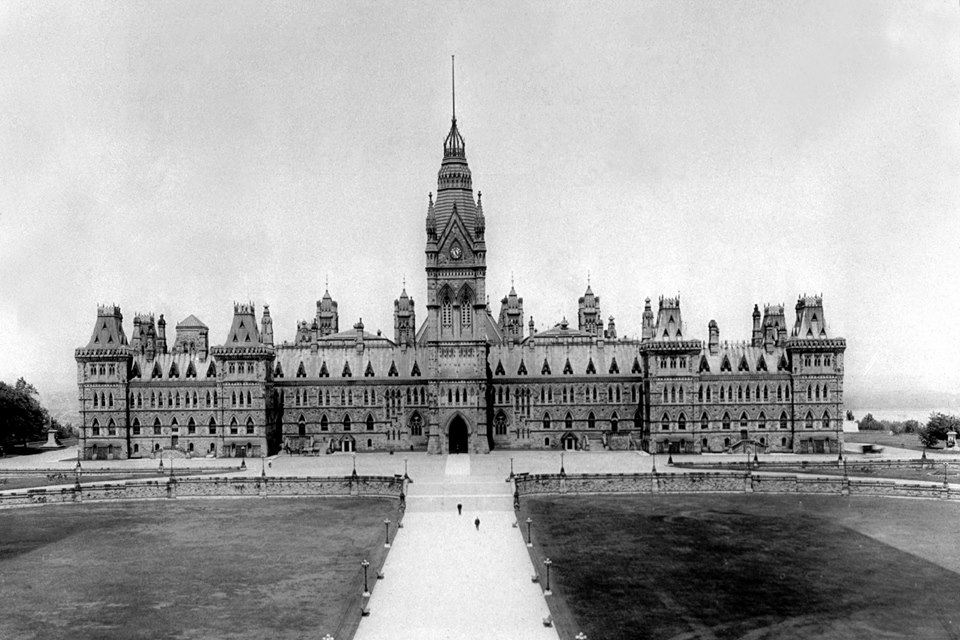
The Old Center Block

The Old Center Block

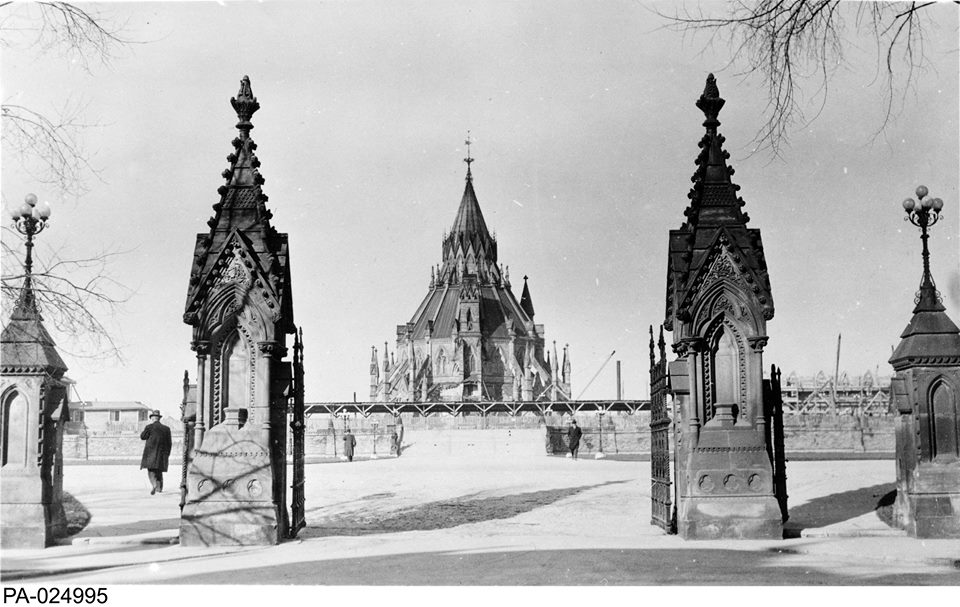
On 3 February 1916, one hundred years ago today, a raging inferno consumed the original Center Block and left it a smoldering ruin and a gutted husk of its former glory. Seven perished in the deadly blaze. Only the Library of Parliament and part of the hallway leading up to it survived thanks to the firefighters who doused the fire and the librarians who shut the steel door separating the library from the rest of the original Center Block.

Charles Bishop of the Ottawa Citizen wrote this contemporary account:

The grand old tower put up a magnificent fight for survival. Standing while the support seemed to have burned away, it sent a solid pillow of twisting, billowing gold up into the winter night. Finally, it came down, crashing into the concourse in front and with it, carrying the huge, old clock which had stayed illuminated and kept on striking to the last.

This photo album, “The Fire of 1916,” comes from a Facebook group called “Parliament of Canada — Youth Connection.” It chronicles the history of the Old Center Block from the 1880s until it met its fiery demise in 1916; it also shows the efforts to demolish the burned out husk of the Old Center Block and build the current structure in its place. In 1919, the Prince of Wales (who later become Edward VIII and after his abdication, the Duke of Windsor), laid the cornerstone of what would become the Peace Tower. Finally, on Dominion Day — 1 July 1927 — eleven years after the fire, Canadians celebrated the 60th anniversary of Confederation and the Dominion of Canada by opening the Peace Tower. But this Facebook group betrays the ignorance of those who created it and probably of most of those who read it by relying on this caption to describe what I just recounted above: “July 1, 1927: Canada turns 60 and the Peace Tower is inaugurated.” It omits entirely that at the time, we referred to July 1st as Dominion Day (and therefore by implication imparts to the reader that we always referred to July 1st by the banal “Canada Day”) and glosses over that it was not “Canada” per se that turned 60 in 1927, but rather the Dominion of Canada under the British North America Act, 1867, that became a sexagenarian. The second King ministry chose to celebrate the Dominion’s diamond jubilee because its golden jubilee fell during the Great War, only one year after the fire that destroyed the Old Center Block.

The Library of Parliament stands as the last lonely redoubt of the Old Center Block.

The Library of Parliament stands as the last lonely redoubt of the Old Center Block.

So I must ask, to what past are we, particularly my peers, “connected”? I can’t help but conclude that my generation has been robbed of this country’s history and brought up with a profound historical amnesia, after a cultural revolution so insidious in its gradualness yet thorough in its destruction of the past. These 41 photos depict a long forgotten world in which Canadians proudly adorned their official buildings with Union Flags and Red Ensigns and unarmed Peelite police officers dressed in the old British uniform stood vigil at Sir Wilfrid Laurier’s final repose.

I felt strangely wistful looking through these photographs of the Old Center Block and the aftermath of its destruction. They tell the story of a country ravaged by war and of the immense sacrifice in blood and treasury that the Dominion of Canada contributed for King & Country and the British Empire. (I think that the British Empire should have remained neutral in that Continental war in 1914, but that’s another issue). But the wistfulness creeps in because what we fought for no longer exists. The British Empire is long gone, and successive governments since Pearson’s have severed and suffocated our organic connection to the past and imposed an artificial monstrosity in its place. Looking at these fleeting glimpses into a blurred past is like gazing into an alternate universe. I feel like Boromir staring at the shards of Isildur’s sword; we’ve inherited nothing more than faded memories and broken heirlooms.

Similar Posts:

Posted in Parliament, Traditions and History | Leave a comment