Discussion on Government Formation at the University of Ottawa


Overall Impressions on the Discussion

I thank my friend Phil Lagassé for having invited me to speak on government formation and the caretaker convention to his seminar on parliamentary government and parliamentary reform on 25 January 2015. I’ve uploaded my original, English-language PowerPoint here to Parliamentum. I was obliged to give most of my presentation in French, which I found difficult, though it went better than I had expected.

I was very surprised that none of the students objected to the premise of “No Discretion: On Prorogation and the Governor General,” the old article that Nick MacDonald and I wrote over five years ago which set me off on this constitutional odyssey. Resigned agreement or even a tacit endorsement of those views would have been inconceivable a few years ago. It wasn’t because they supported prime ministerial authority per se, but rather because they really didn’t want to support any reforms that would force the Governors to play a more active role. In Belgium, for instance, there are well-established conventions on the King’s role in forming governments that run afoul of the norms in Canada and the United Kingdom – though as New Zealand post-1996 shows, these conventions would necessarily change to some extent in the Realms, too, if coalition government became the norm. (Australia is a special case, because the Liberals and Nationals are two ideological compatible parties in a perpetual coalition that doesn’t require much coaxing from the Crown).

More fundamentally, I would at this stage also attribute this shift to two main factors. First, subsequent experience has validated our argument, particularly in Ontario, where initially Lieutenant Governor Onley and now Lieutenant Governor Dowdeswell have explicitly endorsed the view which we promoted: “In Canada, by convention, the Crown must accept the advice of the First Minister concerning prorogation.” (Someone once asked me if I had been consulted on or wrote this material and interpretation. I was not consulted on it and did not write it, but I do agree with it and regard it as an accurate description of the practice and procedure based on all the historical evidence). Scholars can object as strenuously and as stridently as they like, but these are the facts established by history and accepted as constitutional practice. One can make a normative critique of this system and propose reforms, but one cannot deny the facts and then pretend to be engaging in the descriptive. Second, the passage of time has borne out one of my other suspicions: most of the criticism of Harper’s early dissolution of 2008 and prorogations of 2008 and 2009 were partisan criticisms masquerading as process arguments on constitutional procedures. (There’s nothing wrong with partisan criticism of an incumbent government, but it is mendacious to disguise such criticisms as a principled constitutional argument). Now that the Conservatives must content themselves with playing the role of Her Majesty’s Loyal Opposition in this 42nd Parliament and that Justin Trudeau has succeeded Stephen Harper as Prime Minister of Canada, we can assess Harper’s executive decisions more rationally without the stream of abuse that normally accompanied such discussions even as recently as this time last year. At least one scholar accused me of being an apologist for Harper, and some provincial Conservatives in Ontario accused me of the same with respect for Premier McGuinty after his tactical prorogation in October 2012. In fact, I am not an apologist for any political party; instead, I defend the principles and practices of executive authority within Canada’s system of government – irrespective of whatever party happens to form government.

In addition, I’ve long noted that the Two Solitudes of Canada even show themselves in the scholarship on the Crown’s executive authority, particularly the Governors’ discretionary authority to reject ministerial advice, often called the “reserve power.” The well-established constitutional scholars in Quebec – such as Henri Brun, Guy Tremblay, Eugénie Brouillet, and to some extent Louis Massicotte (based on our CSPG panel last week) – oppose in principle and downplay in practice the notion that a governor could or should ever reject a first minister’s advice to dissolve parliament. One of the few French-speaking Quebec scholars who conforms more to the English-language schools of thought is Hugo Cyr. If memory serves, Cyr even referred to the aforementioned four scholars, who are all from Université Laval, as “The Laval School” at Peter Russell’s workshop on constitutional conventions on 3 February 2011 when he contrasted his own views to theirs. Some of Phil’s students identified as republican in outlook (and they also fully acknowledged the normative nature of that view in the Canadian context, which as a realist, I greatly appreciate) and therefore did not approve in principle of reforming the Canadian system along, say, the lines of Belgium where the King necessarily plays an active role in government formation.

The Principles of Government Formation in Canada

Presentation: Government Formation

 1. Responsible Government

Government formation hinges upon the executive authority of the Crown. The Queen appoints the Governor General upon the advice of the Prime Minister. The Governor and Prime Minister both derive their executive authority from the Crown. The Governor General appoints the Prime Minister based on the authority that the Letters Patent have delegated to him[1], and the Prime Minister and ministry as a whole takes responsibility for all acts of the Crown promulgated in the name of the Queen.[2]

At its core, Responsible Government is a trinity (three in one) of responsibilities: ministerial responsibility to the Crown, individual ministerial responsibility before the Commons, and collective ministerial responsibility & solidarity before the Commons.[3] Responsible Government means that “Ministers of the Crown take responsibility of all acts of the Crown”[4] and that the Governor General acts on and in accordance with ministerial advice, save for exceptional circumstances.[5] In this manner, Responsible Government therefore preserves and fully incorporates the medieval principle of Royal Infallibility and reconciles it with popular rule and universal adult suffrage. The Queen can still do no wrong because it is the ministry which takes responsibility for all acts of the Crown, for good or ill. The Governor General can only refuse to promulgate ministerial advice in exceptional circumstances because the consequence of exercising such discretionary authority is equally and proportionately exceptional: the Governor General thereby dismisses the Prime Minister and ministry which tendered the original constitutional advice and must appoint in their place a new Prime Minister and ministry which can then take responsibility for the Governor’s decision to refuse advice and force the dismissal of their predecessors.[6]
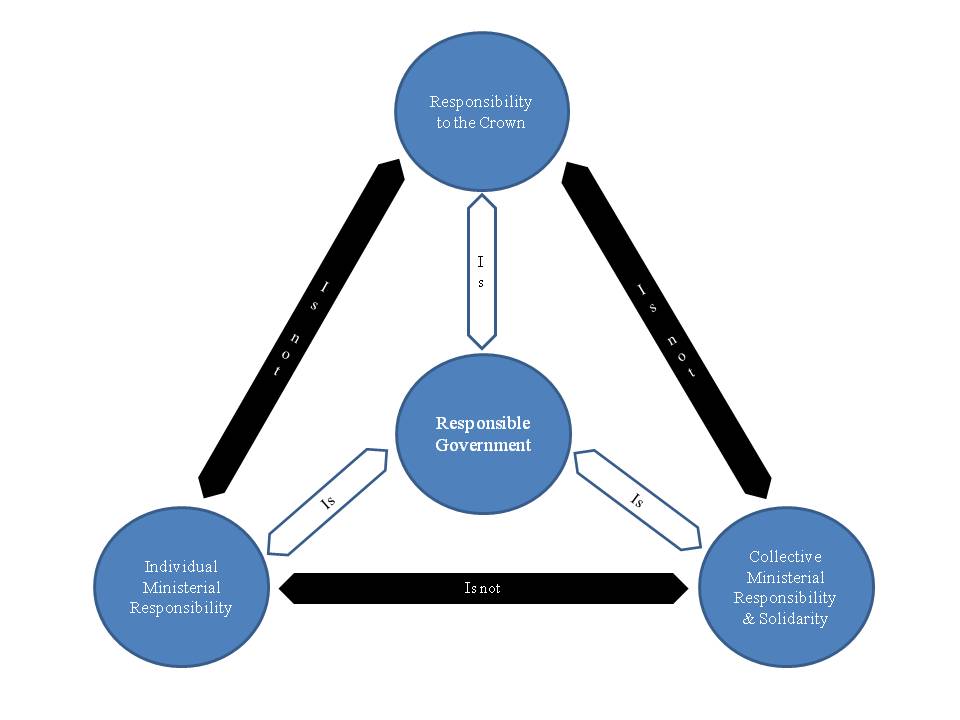
Responsible Government as a Trinity 2

Eglington referred to Responsible Government as a trinity, so I thought that I would make my down diagram representing the nature and aspects of Responsible Government based on the sorts of diagrams that illustrate the Holy Trinity and the three aspects of God in small-o orthodox Christianity


In addition, the first duty of the Governor General is to ensure that there is always a duly-appointed ministry in office because the Queen’s business must always carry on.[7] Put simply, there must always be and is always a ministry in office. At no point is there an “interregnum” in of the office of prime minister. In addition, the tenure, or term in office, of the prime minister determines the tenure of the ministry as a whole; the prime minister’s resignation automatically entails the resignation of the ministry as a whole.[8] For example, Stephen Harper’s term as prime minister extends from the day on which Governor General Michaelle Jean appointed him, on 6 February 2006, to the day on which he formally tendered his resignation to Governor General David Johnston on 4 November 2015.

  1. The Confidence Convention

The confidence convention therefore takes on a broader meaning than most contemporary scholars would summarize it. Most commonly, they will define the confidence convention as something to the effect, “The government must command the confidence of the House of Commons”; they might add something like, “if the government loses the confidence of the Commons, then either there would be a new government (through a mid-parliamentary transition of power) or a new parliament (through dissolution and fresh elections).” These statements are both truth – but they’re also incomplete and gloss over some crucial aspects of Responsible Government. They’re truth, but they’re not the whole truth.

The ministry must command the confidence of the Commons. Once the ministry has demonstrated that it commands the confidence of the Commons, it continues to hold that confidence until the moment that the Commons decides to withdraw it from the ministry.[9] Generally, the Address in the Reply to the Speech from the Throne acts as the first de facto confidence measure in a new session of parliament, which means that the ministry would command the confidence of the Commons if the Address in Reply passes. That said, the ministry can also judge when it has lost the confidence of the Commons, such as by deeming a bill or motion a matter of confidence and then losing a vote on it, or if it has, more generally, lost the ability to control the agenda of the Commons.[10]

But at select intervals, the ministry’s command of the confidence of the Commons is a sufficient condition and not a necessary condition. Logically, it cannot possibly be true that the ministry always commands the confidence of the Commons — because sometimes the Commons doesn’t exist (as in when Parliament is dissolved), and because sometimes the governor general promulgates the prime minister’s constitutional advice when the ministry has explicitly lost the confidence of the Commons (as with early dissolution in some minority parliaments).

First, the governor general expresses confidence in the prime minister by appointing him and granting him an official commission of authority to govern, which allows him to form a ministry. Second, the Commons either confirms that it also holds confidence in the ministry, or it expresses non-confidence in the ministry.

Most of the discussions surrounding Harper’s use of executive authority and early dissolution and prorogation between 2008 and 2010 glossed over this significant fact: if the Commons withdraws its confidence from the ministry, this does not automatically mean that the Crown also withdraws its confidence from the Ministry, which explains why the incumbent prime minister can advise — and apart from exceptional circumstances — receive, an early dissolution. If it were true that the governor general automatically withdraws his confidence from the prime minister and revokes his authority to govern as soon as the Commons withdraws its confidence from the ministry, then there would be no such thing as early dissolution, and there would instead only be mid-parliamentary transitions of power.

However, if the governor general refused to promulgate the prime minister’s advice to dissolve parliament, then would in so doing withdraw his confidence from the prime minister and revoke his authority to govern. At that stage, the governor general would then have to appoint a new prime minister and ministry who could take responsibility for these acts of the Crown (refusing the dissolution and dismissing the previous ministry), because a ministry can only take responsibility for advice that it has offered, not for the contrary advice that it did not offer.

  1. Constitutional Entrenchment of Executive Authority

Prorogation and dissolution are constitutionally entrenched executive authorities under sections 38 and 50, respectively, of the Constitution Act, 1867, which means that only a constitutional amendment pursuant to section 41(a) of the Constitution Act, 1982 could abolish this executive authority and transfer it to a constitutional provision. Prime Minister Trudeau outlined in Daniel Leblanc’s mandate letter that he should “change the House of Commons Standing Orders to end the improper use of omnibus bills and prorogation.” While the House of Commons could easily amend its Standing Orders in order to better regulate omnibus bus, the Standing Orders could not restrict the executive authority over prorogation because they would then be ultra vires of the Constitution Acts. (I’ve covered this issue in a previous entry, too). The House of Commons has the authority to manage its internal affairs, but its Standing Orders cannot supersede the constitution; more fundamentally, prorogation and dissolution are executive authorities, not parliamentary ones. Simply because they affect the conduct of parliament does not make them legislative authorities.

Parliament therefore cannot limit the prime minister’s discretion to advise and take responsibility for prorogation or dissolution without also necessarily limiting how the Governor promulgates that advice — because Responsible Government means that ministers take responsibility for all acts of the Crown, not that the Governor General practises a form of personal rule that would please a Stuart King. The Governor and First Minister form a chain of authority and ultimately both derive their commissions from the Queen.[11]

The law cannot drive a wedge between the Governor General and the Prime Minister. The law cannot limit the authority of the First Minister without also necessarily limiting the authority of the Governor, because the First Minister derives his authority as First Minister, i.e., role of the Crown’s primary constitutional adviser, by virtue of the Governor’s commission of appointment and confidence in him.

  1. The Steps Involved in a Transition of Power from One Ministry to Another

In Canada, transitions of power between ministries normally last two to three weeks and follow this general procedure. I shall remain eternally grateful to Lieutenant Governor Onley of Ontario for having published all of this information on the Lieutenant Governor’s website for public consumption.

  1. Incumbent first minister informs the governor of his intention to resign and becomes the “outgoing” first minister
  2. The party leader poised to become the next first minister then becomes the “incoming” first minister
  3. A few days later, the governor summons the incoming first minister, who then becomes the first minister-designate
  4. The outgoing first minister and first minister-designate agree to the exact timeline for the transition.
  5. 2 to 3 weeks later, the governor formally appoints the first minister-designate to office as first minister and swears in the rest of the cabinet

At the time, Lieutenant Governor Onley made clear that the intra-party, mid-parliamentary transition between the McGuinty and Wynne ministries occurred along the following timeline.

  1. 12 October 2012: Premier McGuinty announced his intention to resign. The Liberal Party of Ontario then held an election amongst its members to elect a new party leader.
  2. 26 January 2013: The Liberal Party elected Kathleen Wynne as its new leader.
  3. 31 January 2013: Lieutenant Governor Onley recognized Wynne as Premier-designate. McGuinty & Wynne then coordinated transition.
  4. 11 February 2013: McGuinty resigned, and Onley appointed Wynne as Premier.

If we apply those procedures to the most recent federal general election of 2015, we would derive the following steps. This transition proved straightforward because the voters gave the Liberals a parliamentary majority, and because it occurred after an election when parliament was dissolved rather than mid-parliament, as the aforesaid example in Ontario did.

  1. 19 October 2015: Canadians elected members for the 42nd Parliament. The Liberals won a parliamentary majority. Harper then became the outgoing prime minister & Trudeau became  the incoming prime minister.
  2. 20 October 2015: Harper informed His Excellency that he intended to resign. Governor General Johnston summon Justin Trudeau later that day and made him Prime Minister-designate.
  3. 4 November 2015: Harper resigned as prime minister, and the 28th Ministry went along with him. Governor General Johnston then appointed Justin Trudeau as Prime Minister and swore in the Cabinet for the 29th Ministry.
  1. The Caretaker Convention

The Government of Canada’s official position is set out in the Guidelines on the Conduct of Ministers, Ministers of State, Exempt Staff and Public Servants During an Election.

“[D]uring an election, a government should restrict itself – in matters of policy, expenditure and appointments – to activity that is: a) routine, or b) non-controversial, or c) urgent and in the public interest, or d) reversible by a new government without undue cost or disruption, or e) agreed to by the Opposition (in those cases where consultation is appropriate).”

The Manual of Official Procedure of the Government of Canada of 1968 refers to this concept as “the principle of restraint.”

1.[…] The extent of these restraints varies according to the situation and to the disposition of the Government to recognize them.
2. The possibility of restraint only arises if the continuation of confidence in the Government is called into question. A defeat in the House preceding dissolution or a defeat at the polls would be the usual causes of restraint.
3. The restraint has been recognized as applying to important policy decisions and appointments of permanence and importance. Urgent and routine matters necessary for the conduct of government are not affected.[12]

  1. The Prorogation-Coalition Controversy of 2008 As Case Study

As Nick MacDonald and I pointed out in our little article from 2011, a first minister’s advice to prorogue the assembly has never been refused since Responsible Government emerged in the 1840s.

Even if a governor tried to make a stand and break centuries of precedent, he would, in refusing a first minister’s advice to prorogue, force his resignation and then have to appoint a new first minister who could take responsibility for the advice not to prorogue. Therefore, if Governor General Jean had refused Prime Minister Harper’s advice to prorogue the 1st session of the 40th Parliament on 4 December 2008, she would have, in so doing, forced Harper to resign and then had to appoint Stephane Dion as prime minister.

Similar Posts:

[1] Christopher McCreery, “Myth and Misunderstanding: The Origins and Meaning of the Letters Patent Constituting the Office of the Governor General 1947,” Chapter 3 in The Evolving Canadian Crown, edited by Jennifer Smith and D. Michael Jackson, 31-56 (Montreal-Kingston: McGill-Queen’s University Press, 2011), 32. As McCreery shows, the Queen of the Canada – not the Governor General – remains the source of the constitutional powers and authorities by virtue of section 9 of the Constitution Act, 1867. This is why Letters Patent have delegated, not transferred, authority from the Queen, who personifies the Crown, to the Governor General, who represents the Queen.
[2] Sir John George Bourinot, Parliamentary Procedure and Practice, 4th ed. (Montreal: Dawson Brothers Publishing, 1916): 102.
[3] Robert Macgregor Dawson. “The Constitutional Question.” Dalhousie Review VI, no. 3 (October 1926): 332-337; Eugene Forsey and Graham C. Eglington, The Question of Confidence in Responsible Government (Ottawa: Parliament of Canada, 1985), 16-17.
[4] Sir John George Bourinot, Parliamentary Procedure and Practice, 4th ed. (Montreal: Dawson Brothers Publishing, 1916): 102.
[5] R. Macgregor Dawson, The Government of Canada. 5th ed. (1970), revised by Norman Ward (Toronto: University of Toronto Press, 1947): 175.
[6] Sir John George Bourinot, Parliamentary Procedure and Practice. 1st ed. (Montreal: Dawson Brothers Publishing, 1884): 58.
[7] Canada. Department of Canadian Heritage. Ceremonial and Protocol Handbook. (Ottawa: Government of Canada, c. 1998): G.4-2; Henri Brun, Guy Tremblay, and Eugénie Brouillet, Droit constitutionnel. 5th Ed. (Montreal : Éditions Yvon Blais, 2008): 371.
[8] Canada. Privy Council Office, Manual of Official Procedure of the Government of Canada, Henry F. Davis and André Millar. (Ottawa, Government of Canada, 1968): 77-79.
[9] Peter Neary, “Confidence: How Much Is Enough?” Constitutional Forum constitutionnel 18, no. 1 (2009): 51-54; United Kingdom. Cabinet Office, The Cabinet Manual — Draft: A Guide to Laws, Conventions and the Rules on the Operations of Government. (London: Crown Copy-right, December 2010): 25.
[10] Philip Norton, “Government Defeats in the House of Commons: The British Experience,” Canadian Parliamentary Review (Winter 1985-1986): 6.
[11] Eugene Forsey and Graham C. Eglington, The Question of Confidence in Responsible Government (Ottawa: Parliament of Canada, 1985), 13-14.
[12] Canada. Privy Council Office, Manual of Official Procedure of the Government of Canada, Henry F. Davis and André Millar.(Ottawa, Government of Canada, 1968): 89.
Posted in Appointment of PM, Caretaker Convention & Government Formation, Confidence Convention, Constitutional Conventions, Crown (Powers and Office), Succession (Prime Minister) | 1 Comment

Succession Planning


I hope, dear readers, that you’ll permit a departure from my normal pattern of blogging and article-writing and indulge me a bit here.

My managers don’t appreciate the unintentional hilarity of assigning me to working on activities relating to succession planning.  While I’m sorely tempted to submit this little blurb as a joke, I doubt that anyone here would appreciate the humour in it. But I’m sure that some of you will!

The Rule of Recognition means that the succession plans of the Department of Health of the United Kingdom apply automatically to Health Canada. But by convention, Health Canada should submit a briefing note to the Executive Committee assenting to the succession plans of the British Department of Health.     

If only my assignment could be that easy! If only I could submit a facile joke as a legitimate piece of work and then cloak this stupidity in legalese in a vain attempt to legitimate it. If only I didn’t actually have to do the research and work of coming up with a coherent, logical succession plan that didn’t throw the rest of the organization’s HR planning exercises into doubt.

Similar Posts:

Posted in Humour | Leave a comment

Lament for A Dominion


Dorchester Review

I’m very grateful to C.P. Champion for having included my lament for the “Dominion of Canada” in the latest issue of The Dorchester Review.

You can read it here: Bowden (2015) 1951: The Death of the Dominion

You also read the primary sources here:

A Lament for ‘Dominion’

James W.J. Bowden mourns the sadly misunderstood metonym

On July 1, 1867, the British North America Act re-organized three British North American Crown colonies – the United Province of Canada, New Brunswick, and Nova Scotia – into a unique type of polity known as the Dominion of Canada.

John A. Macdonald first sought to name the new federal state resulting from Confederation “The Kingdom of Canada” but the British Foreign Secretary vetoed the proposal, fearing that such a name would invite hostility from the American republic.[1] At the London Conference in 1866, the Fathers of Confederation and the British government needed to agree on a new name. Sir Samuel Leonard Tilley of New Brunswick supposedly provided this inspiration by looking to the King James Authorised Version of the Holy Bible, and Psalm 72:8, which reads: “He shall have dominion also from sea to sea, and from the river unto the ends of the earth.” Canadian historian A.H.U. Colquhoun considers the biblical origins of the “Dominion of Canada” apocryphal (pun intended),[2] though other Canadian symbols derive from Psalm 72:8 and the Department of Canadian Heritage acknowledges that the country’s official motto contained in the coat of arms, A mari usque ad mare (“from sea even to sea”), also comes from Psalm 72:8.[3] The Psalm is about good kingship (the “he” refers to King Solomon), and verse 8 evokes exerting control or sovereignty over a territory – which corresponds well to uniting British North America into one polity. While republicans would argue that “Dominion” meant British control over Canada, the word in fact referred to Canada’s consolidation of and control over British North America.

Sir Samuel Leonard Tilley did not invent the word “Dominion.” It also appears in the Bill of Rights, 1689 and in documents in British North America in the 17th century. During the Glorious Revolution, Bostonites and New Yorkers revolted and deposed the Governors appointed by King James II, and established the “Dominion of New England.” While this entity bore the name of Dominion, its political structure bore no resemblance to the Dominion of Canada and the other self-governing dominions of the 19th and 20th centuries. In other words, the same word was used to describe two completely different governing arrangements.

In 1879, the Parliament of Canada officially recognized July 1 as “Dominion Day” through the Dominion Day Act. The preamble of the bill noted the historic significance of July 1 and the created of the Dominion of Canada in 1867:

Whereas, it was on the first day of July that the Provinces of Canada, Nova Scotia, and New Brunswick became one Dominion, under the name of Canada;

And whereas Rupert’s Land and the North-west Territory, and the Province of British Columbia became part of the Dominion in the month of July, and Prince Edward Island became part of the Dominion of the first day of July; 

And whereas it is expedient that such important events should be commemorated:[4]

The commemoration of Confederation and the establishment of the Dominion of Canada as Dominion Day would endure for a century.

The first recital of the preamble of the British North America Act, 1867 refers to this new type of polity – a federation and constitutional monarchy under the Imperial Crown but self-governing in its internal affairs – as a “Dominion.”

Whereas the Provinces of Canada, Nova Scotia, and New Brunswick have expressed their Desire to be federally united into One Dominion under the Crown of the United Kingdom of Great Britain and Ireland, with a Constitution similar in Principle to that of the United Kingdom:

Section 3 of the BNA Act (which P.E. Trudeau in 1982 also re-named the “Constitution Act, 1867”) could be interpreted as establishing that the official, legal name of this country as simply “Canada” instead of as “The Dominion of Canada” – an argument that Prime Minister St. Laurent did make in 1951. But the same provision undoubtedly also refers to the new type of polity that it brought into being as a “Dominion.”

It shall be lawful for the Queen, by and with the Advice of Her Majesty’s Most Honourable Privy Council, to declare by Proclamation that, on and after a Day therein appointed, not being more than Six Months after the passing of this Act, the Provinces of Canada, Nova Scotia, and New Brunswick shall form and be One Dominion under the Name of Canada; and on and after that Day those Three Provinces shall form and be One Dominion under that Name accordingly.

By convention, we used to refer to the country as “The Dominion of Canada.” The Parliament of Canada proclaimed Dominion Day not because of the official name of this country is “The Dominion of Canada” (as it is not) but because the Confederation of British North America created a new type of polity: a Crown colony that re-organized several self-governing British Crown colonies into a federation, at that time under the sovereignty of the Imperial Crown but post-1930s under the sovereignty of the Crown of Canada, governed as a constitutional monarchy with parliamentary responsible government. The Dominion of Canada was the first polity in the world that combined federalism with constitutional monarchy. The use of “Dominion” to describe this new type of polity originated here in Canada and later came to be applied to other the self-governing British Crown colonies in the Antipodes. It is perhaps this expropriation of the term by Imperial authorities that ultimately sowed confusion on the meaning of “Dominion.” Various Imperial statutes would later refer to the “The Dominion of New Zealand,” the “Commonwealth of Australia” and the “Union of South Africa” as “Dominions”, even though the latter two had not incorporated “Dominion” into their official names.

In addition, “Dominion” served as a metonym for Canada as a State (the federal government or federal level of government) and to Canada as a country (in both the senses of le pays and la patrie) for decades, rather as Americans have historically referred to the United States as a State and as a country as “The Union.” What we would now call the “federal government” once went by the “Dominion government,” and various departments and agencies once bore the Dominion moniker: Statistics Canada was once the Dominion Bureau of Statistics, and what we now call “Federal-Provincial Conferences” were “Dominion-Provincial.”

Ottawa turned its back on “Dominion” in the 1940s and 1950s. In 1947, the Canada Gazette dropped “Dominion of Canada” in favour of “Canada.”[5] In 1949, the Journals of the House of Commons followed suit and dispensed with “Dominion of Canada” at the start of the 21st Parliament. (In 1955, the House of Commons Debates emulated the Journals and got rid of “The Dominion of Canada” between the 1st and 2nd sessions of the 22nd Parliament, during St. Laurent’s premiership..) In 1951, Prime Minister St. Laurent proclaimed during Commons debates on the periodic revision and consolidation of statutes that his government’s official policy of cleansing “Dominion” from the names of all federal departments, agencies, and organizations. “I think there has been progression,” St. Laurent said,

… and I can say at once that it is the policy of this government when statutes come up for review or consolidation to replace the word ‘Dominion’ with the word ‘Canada.’ There are some people in this country who rather like the name of Canada. That was the name given to the new nation by the British North America Act at the time it came into being. Section 3 of that act provides: It shall be lawful for the Queen, by and with the Advice of Her Majesty’s Most Honourable Privy Council, to declare by Proclamation that, on and after a Day therein appointed, not being more than Six Months after the passing of this Act, the Provinces of Canada, Nova Scotia, and New Brunswick shall form and be One Dominion under the Name of Canada; and on and after that Day those Three Provinces shall form and be One Dominion under that Name accordingly.

There has been a constant progression that some people in this country have attempted to impede and have resented, but nevertheless that progression culminated in the Statute of Westminster which recognized the equality of all the sister nations of the commonwealth. That progression has been resented by some, but not by the majority of the people of Canada or by the party that supports this government.  I think that party will be prepared to support this government in the policy of replacing the word ‘Dominion’ with ‘Canada’ in the statutes when they come up for review.[6]

In The Strange Demise of British Canada: The Liberals and Canadian Nationalism, 1964-1968, C.P. Champion notes that Pearson and his ministers legitimated their “neo-nationalism” of making Canada independent from the British Empire and United Kingdom ironically by portraying their ideas as having flowed naturally from Canada’s British inheritance.[7] In fact, they were trying to substitute one system for another. These neo-nationalists believed that Canada must replace its “traditional identity and symbols with new ones, no matter how many Canadians opposed it,” and they portrayed their political opponents as “reactionaries mired in nostalgia.”[8] In this way, neo-nationalists function rather like the vanguards of the proletarian revolution who must drag these “Ready, Aye, Ready” Canadians who cling to Empire into modernity and out of their false Imperial consciousness. The neo-nationalist views Canadian history as a “nationalist teleology” such that Canadians have inevitably sought to eliminate what they would consider colonial vestiges in an inexorable journey from colony to nation[9] – and perhaps ultimately, to a republic.

St. Laurent conformed precisely to this neo-nationalist teleology and methodology and set the precedent for Pearson. He sought to legitimate his radical argument by couching it in section 3 of the British North America Act and sought to de-legitimate all those paleo-nationalists (as Champion calls the more conservative elements) who wished to retain references to “Dominion.” Through a zeal for textual originalism worthy of Justice Scalia, St. Laurent argued that the traditional usage, “Dominion of Canada,” had always contradicted the wording the section 3 and thus “Dominion” never rested on a valid legal foundation.

St. Laurent’s assertion that “there has been a constant progression” moving inexorably toward the government’s policy expressed clearly the neo-nationalist teleology. Traditionalists were waging a futile struggle to “impede” this inevitable “progression”, which they simply “resented” because of their false consciousness. The Dominion Lands Surveys Act first fell victim to the neo-nationalist teleology and became the Canada Lands Surveys Act. St. Laurent set in motion the Federal (no longer Dominion) Government’s slow-moving but all-encompassing nomenclature revolution aimed at erasing all vestiges of the old order and expunging “Dominion” – but with such parliamentary rectitude through the existing procedure to revise and consolidate statutes. In Canada, even the revolutions are polite. In the French language, the nomenclature revolution of dispensing with the Dominion of Canada proved even more radical: it forced the country to undergo a sex change, in the linguistic sense. La Puissance du Canada, normally shortened to La Puissance, became instead Le Canada. 

After St. Laurent had turned against “Dominion” and begun phasing it out, only Dominion Day remained as the last redoubt of the old order. The standard parliamentary process had failed the neo-nationalists many times since the 1940s.[10] As such, some Liberal and New Democratic backbenchers mounted their final assault against this redoubt of paleo-nationalism on July 9, 1982, at 4:30 on that Friday afternoon, when thirteen MPs suddenly slipped a bill through Second Reading, Committee, Report, and Third Reading in mere minutes adopting the name “Canada Day” for July 1 – all without the quorum of 20 members required by section 48 of the BNA Act.

The incident began that quiet summer afternoon when Liberal MP Hal Herbert moved that Bill C-201 (a private member’s bill to amend the Holidays Act) be given Second Reading and referred to its corresponding Standing Committee, which would mean sending off the floor of the House of Commons that day into the hands of another group of MPs. The motion out of the blue caught Conservatives off guard. The MP for Nepean-Carleton, David Baker, exclaimed, “What is going on?” Without pause, the Deputy Speaker, Lloyd Francis, a Liberal MP, asked for unanimous consent that the bill be dealt with by Committee of the Whole, meaning the members of the House then present, rather than the formal Committee. David Smith, a Liberal MP (and since 2002 a Senator), rose on a point of order in favour of immediately passing the bill. Francis then chaired the Committee of the Whole, and peremptorily passed the bill: “Clause 1 agreed to. Preamble agreed to. Title agreed to. Bill reported, read the third time and passed.”[11] It was highly unusual to say the least.

They then agreed to deem the time to be five o’clock and immediately adjourned the House. Having participated without demur in this mini-hijack of the parliamentary process, New Democratic MP Mark Rose  proclaimed, “I think this is a day on which to develop and to celebrate our new holiday. It is only appropriate that, in celebrating our new holiday called Canada Day, we should at least take a holiday of 55 minutes for the afternoon”[12] — as if the Senate did not first need to approve the bill, or the Governor General give it Royal Assent, before this little coup d’état in the House became law.

All had transpired in a few minutes — the transcript of this incident takes up only one page (p. 19201) in the Commons Debates — with the concurrence of the Deputy Speaker, Lloyd Francis. Worse still, rather than reverse her deputy’s knavish tricks owing to a lack of quorum required by section 48, Speaker Jeanne Sauvé let the change stand.

In fact the House of Commons acted unconstitutionally and did not validly pass this bill, because section 48 mandates that a quorum in the House of Commons is 20, not 13: “The Presence of at least Twenty Members of the House of Commons shall be necessary to constitute a Meeting of the House for the Exercise of its Powers, and for that Purpose the Speaker shall be reckoned as a Member.” For example, later in the same year, on November 16, having failed to reach a quorum even after ringing the bells to summon more Members, the Speaker adjourned the House (Debates, p. 20729).

For this reason alone, the Canada Day bill did not legitimately pass onto the Senate, and the Senate should have rejected it. In addition, this private member’s bill was not, and could not have been construed as, a matter of confidence in the Trudeau government, so rejecting it would not have threatened the government’s parliamentary position.

In defence of the Speaker’s conduct on July 9, 1982 it can be argued that none of the MPs present protested the lack of quorum. This argument is flawed for two reasons. First, the Constitution is the supreme law, and though the House of Commons has authority over its internal affairs, its Standing Orders must conform to the Constitution. If the Standing Orders and the Constitution come into conflict, the Constitution must prevail to the extent of the inconsistency. Secondly, Tory MP David Baker probably would have objected at the time if he had grasped the significance of the usurpation that his colleagues were in the middle of orchestrating. When the bill arrived in the upper chamber, Conservative Senator David Walker noted that the Commons had passed it with only 13 members present and “to make sure that the bill slipped through, a member asked for ‘unanimous consent that the clock now read five o’clock,’” precluding further objections.[13] Since the Commons failed to uphold the Constitution, the Senate should have done so by rejecting the bill.

The Senate arguably failed to apply even “sober first thought” to this bill. Liberal Senator Florence Bird supported and moved it to Second Reading – all the while extolling Canada’s British inheritance of Westminster parliamentarism, trial by jury, the common law, and the recognition of fundamental freedoms like the freedom of speech.[14] She then portrayed the new name of Canada Day as the culmination of the teleology of Canada’s pathway from colony to independence as a sovereign state. Citing the Statute of Westminster, 1931, the Royal Style and Titles Act, 1953, and the Patriation of the Constitution earlier that year as precedents, she characterized this bill as “celebrating the national day of Canada as a completely independent country.”[15] She also sought to delegitimate “Dominion Day” by belittling it as an Imperial anachronism – suggesting a false dichotomy between “Dominion” and “Canada” as if they were contradictory rather than complementary. In reality, “Dominion Day” flows from the very same British traditions — parliamentarism, the common law, trial by jury, and liberty under law — that she praised.

To borrow from C.P. Champion’s terminology, Senator Bird implied that only paleo-nationalistic reactionaries beholden to a foreign country would opt for the colonial baggage of “Dominion,” while true and loyal Canadians would choose “Canada.” “Do you think that the men who fought in two world wars were fighting for dominion, or do you think that they were fighting for Canada?” she asked, imposing the neo-nationalist teleology of change. “Those men wore proudly the word ‘Canada’ on their shoulder patches…”[16] She concluded that Canada had finally “achieved full nationhood” in 1982 and that “the days of our so-called inferiority complex are over.”[17] In reality, of course, the adoption of the status of “Dominion” in 1867 was a Canadian invention, derived by a Canadian from a two-millennia old text (Psalm 72) that had everything to do with Canadian sovereignty under the Crown in Right of Canada.

During the Senate debate on Canada Day, Senator George McIlraith, a Liberal, argued that a Minister should have properly tabled the bill as a government bill and that the Senate should let the bill die on the Order Paper rather that defeating it, so that a Minister could re-introduce it as a government bill in the next session.[18] Senator Ernest C. Manning, the only-ever Social Credit member of the upper chamber (appointed by P.E. Trudeau in 1970), implored his colleagues to reject the bill outright because of the unconstitutional manner in which the Commons had passed it. He noted that the Trudeau government had tabled similar bills to this effect in the 1970s:

They [the previous iterations of this bill] were not proceeded with in the other place [the House of Commons] because opposition to them was such that the [Trudeau] government wisely did not want to make an issue out of the legislation. In this case, as has been outlined, the matter was sneaked through the other house without debate, with less than a quorum in the house, and it now turns up on the Order Paper on this chamber for sober second thought.[19]

Manning also protested against the Liberals’ attempt to “wipe out one more part of Canada’s heritage by abolishing Dominion Day and all that its name implies to millions of Canadians and replace it with a name that has absolutely no historic significance.”[20] Although the July 9 incident appeared to be spontaneous, it had obviously been orchestrated by Liberal MPs with NDP acquiescence – and Manning accused the Trudeau government of having engaged in “a long series of deliberate steps to chip away at all those things which pertain to the rich heritage of this country’s past.”[21]After all, “spontaneous” political actions tend to require a lot of planning.

The authors of the bill and Senator Bird could certainly have done better. “Confederation Day” would, in my view, have been a more suitable replacement because it dignifies the creation of the Dominion of Canada on July 1, 1867 with the historical gravitas and significance that the day deserves. Such a name would also implicitly recognize that Canada’s history does not start at a Revolutionary “Year Zero” in 1867. Confederation was a step in the evolution of Canada’s political order, not the beginning of its existence. In March 1970, the eminent constitutional historian Eugene Forsey (named to the Senate by P.E. Trudeau later that year) appeared before a Commons committee on an earlier bill that proposed to replace Dominion Day with Canada Day. He said:

Well, I think it [Canada Day] is devoid of the historical associations which you do get either in Dominion Day or in Mr. Hogarth’s suggestion Confederation Day. It takes the historical zip out of the thing somehow and it seems to me that you want to have something in the name of the day if possible. You want to have something to commemorate some historical event and this was a meaningful historical event. Just as I would say, if the United States called its national holiday “United States Day,” that would be a rather colourless and banal description of that day. They call it, to the best of my belief, “Independence Day,” and I think that immediately recalls to every American the fact that on July 4, 1776, the 13 colonies became the United States of America. I think it has an evocative touch to it that you would not get if you simply said “United States Day.” … Similarly, if you called the French national holiday “Bastille Day,” as I think it usually is called, again it seems to me that you would be taking some of the historical significance out of the thing.[22]

In contrast, “Canada Day” does not convey any concrete meaning. If anything, it implies that Canadian history began in 1867 and that anything which antedates Confederation is un-Canadian, “British,” or “Imperial” and therefore ought to be forgotten.

Some parliamentarians have made half-hearted efforts to resurrect Dominion Day. As a backbench Reform Party MP in 1996, Stephen Harper introduced a private member’s bill to restore Dominion Day. He said at First Reading:

Mr. Speaker, this bill would restore the name Dominion Day to the July 1 holiday. The country founded on July 1, 1867 was not Canada but the Federal State of the Dominion of Canada, still the country’s official name. … The word “dominion” has its linguistic roots in the French language and was chosen as the name for this country by the Fathers of Confederation from the 72nd Psalm: “He shall have dominion from sea to sea and from the rivers unto the ends of the earth. … It has been a mistake for this country to try and preserve its future by destroying its past and the name Dominion Day should be restored.[23]

Harper’s bill died on the Order Paper. Years later, as Prime Minister, Harper sometimes used the term “Dominion.” One of his ministers, Jason Kenney, often spoke of the “Dominion of Canada” and employed “Dominion” as a metonym – probably much to the confusion of some in the audience. On July 1, 2011, Kenney sat alongside the Duke and Duchess of Cambridge at a citizenship ceremony and commemorated the 144th anniversary of “The Dominion of Canada” and “our great Dominion.”[24]

I once thought that any attempt to restore the long-form of this country’s name to The Dominion of Canada – perhaps for the Sesquicentennial of Confederation in 2017 – would be portrayed as an unpardonable imperial retrogression. However I now suspect that it would, if anything, simply be met with confusion and bewilderment rather than hostility. While hostility would at least imply some kind of engagement, confusion would suggest that Canadians have been deracinated from their history and that “Dominion” has been successfully denormalized and delegitimated. Sadly, the much-maligned metonym has been consigned to the revolutionary dustbin of history. As L.P. Hartley wrote, “The past is a foreign country; they do things differently there.”

Notes

[1] Janet Ajzenstat et al., ed. Canada’s Founding Debates. (Toronto: University of Toronto Press, 1999): 60.
[2] George M. Wrong and H.H. Langton, ed. The Chronicles of Canada: Volume VIII – The Growth of Nationality (Tuscon, AZ: Fireship Press, 2009): 61.
[3] The ribbon of our coat of arms also contains the phrase desiderantes meliorem patriam (”desiring a better country”), which comes from Hebrews 11:16.
[4] Canada, Parliament of Canada. An Act to make the first day of July a Public Holiday, by the name of Dominion Day, 4th Parliament, 1st Session, Chapter 47, 15 May 1879.
[5] Canada, Library and Archives. “A Nation’s Chronicle: The Canada Gazette,” accessed 25 October 2015. https://www.collectionscanada.gc.ca/databases/canada-gazette/001060-100.04-e.php

The Library and Archives list three historical periods of the Canada Gazette: 1841-1869: The United Province of Canada; 1869-1946: The Dominion of Canada; 1947-1997: Parts I, II, and III. In 1947, the Dominion government began to publish the Canada Gazette under three parts: Part I “Notices and Proposed Regulations”, Part II “Official Regulations”, and Part III, “Acts of Parliament.”

[6] Prime Minister Louis St. Laurent in House of Commons Debates, 21st Parliament, 5th Session, 8 November 1951: 851-852.
[7] C.P. Champion, The Strange Demise of British Canada: The Liberals and Canadian Nationalism, 1964-1968 (Montreal-Kingston: McGill-Queen’s University Press, 2010), 3-15.
[8] Ibid., 15. For instance, Pearson even tabled the resolution to adopt the Maple Leaf flag on the 749th anniversary of Magna Carta.
[9] Ibid.
[10] MacInnis, in House of Commons Debates, 21st Parliament, 5th Session, 8 November 1951: 851-850. MacInnis mentions that Parliament voted on a Private Members’ Bill in the 1940s on changing the name of Dominion Day to Canada Day.
[11] Ibid.
[12] Ibid., 19202.
[13] Senator David Walker, Senate Debates, 31st Parliament, 1st Session, 3 August 1982.
[14] Ibid.
[15] Senator Bird in Senate Debates, 32nd Parliament, 1st Session, 22 July 1982: 4668.
[16] Senator Bird in Senate Debates, 32nd Parliament, 1st Session, 22 July 1982: 4668.
[17] Ibid., 4669.
[18] Senator McIlraith in Senate Debates, 32nd Parliament, 1st Session, 22 July 1982: 4671.
[19] Senator Ernest C. Manning in Senate Debates, 32nd Parliament, 1st Session, 22 July 1982: 4672.
[20] Ibid.
[21] Ibid., 4673.
[22] Canada, Parliament of Canada. Minutes of the Proceedings of the Standing Committee on Justice and Legal Affairs, 28th Parliament, 2nd Session, 12 March 1970.
[23] Stephen Harper in House of Commons Debates, 35th Parliament, 2nd Session, 13 December 1996: 7523.

http://www.parl.gc.ca/HousePublications/Publication.aspx?Language=E&Mode=1&Parl=35&Ses=2&DocId=2332659

[24] Jason Kenney, “Speaking notes for the Honourable Jason Kenney, P.C., M.P. Minister of Citizenship, Immigration and Multiculturalism at a special citizenship ceremony with Their Royal Highnesses The Duke and Duchess of Cambridge,” Gatineau, Quebec, 1 July 2011.

http://www.cic.gc.ca/english/department/media/speeches/2011/2011-07-01.asp

Posted in Dominion Day, Dorchester Review, History of British North America | 5 Comments

“Canada” Began in 1791: A Critique of the Government’s “Canada at 150” Campaign


Dorchester-9-Online

I’m very grateful to Christopher Champion and John Robson for having edited my piece and published it in the Dorchester Review as “1791: The True Birth of Canada.”

Introduction

Since coming into office on 6 February 2006, the Harper government has engaged in high-profile campaigns to commemorate important events in Canadian history, such as the 400th anniversary of Quebec City’s founding in 2008 and the 200th anniversary of various battles of the War of 1812 in 2012, 2013, and 2014. The government has also endured criticism for not having celebrated the 30th anniversary of the Constitution Act, 1982 (and the Charter in particular) in 2012 and for having ignored the 50th anniversary of the adoption of the Maple Leaf Flag on 15 February 2015. And the Government of Canada has now launched a campaign to celebrate the sesquicentennial of Confederation on 1 July 2017, called “Canada at 150.” Drawing on some of the lyrics to O, Canada, the Government proclaims on its official website, canada150.gc.ca:

Canada 150 (1867-2017): Strong. Proud. Free.

In 2017, Canadians across the country will celebrate Canada’s 150th anniversary. The Government of Canada invites Canadians to learn more about the major events that have shaped their country’s history and express their pride in everything that Canada represents – a strong, proud and free nation.[1]

The Government’s profile on Twitter echoes the theme under the handle “Canada150th”, as does its Facebook profile, “Canada’s 150th Anniversary.” While the website does contain some references to “the milestones on the road to the 150th anniversary of Confederation,”[2] most of the Government’s communications products emphasize 2017 as the sesquicentennial of Canada itself and not more accurately as the sesquicentennial of Confederation.

In fact, “Canada,” as in the Canadian State, dates back to the Constitutional Act, 1791, when the Westminster Parliament first established the Crown colonies of Upper Canada (now Ontario) and Lower Canada (now Quebec) and their respective legislatures and executive governments. Through the Act of Union, 1841, the Westminster Parliament amalgamated the two Canadas into the United Province of Canada; finally, through the British North America Act, 1867, the Imperial Parliament re-organized three Crown colonies – the United Province of Canada, New Brunswick, and Nova Scotia – into a new federal Crown colony called the Dominion of Canada. Therefore “Canada’s” sesquicentennial occurred in 1941, and its bicentennial occurred in 1991. In 2017, the Government of Canada ought to commemorate the sesquicentennial of Confederation, but not of Canada itself.

The Continuity of Canada

In 1791, the Imperial Parliament passed the Constitutional Act establishing Upper Canada and Lower Canada as Crown colonies operating under representative government, each having its own legislature and lieutenant governor. It is this polity, established by the Westminster Parliament through the Constitutional Act, 1791 that evolved, in a direct and unbroken line, into the modern Canadian state, a constitutional monarchy now under its own separate Crown of Canada.

While the Maritime Crown colonies had achieved representative government and elections to their respective legislative assemblies earlier (Nova Scotia, 1758, Prince Edward Island, 1773 and New Brunswick, 1784), the system of representative government in the Canadas derives from an act of parliament rather than from executive instruments in the form of instructions to the Governors.[3]

Canadians, to the extent that they know of the Constitutional Act, 1791 regard it as a failure because its institutional framework did not provide for the self-government necessary to a mature and free society, and its inadequacy brought about the Rebellions of 1837 in both Lower Canada and Upper Canada.[4] Nevertheless, it is this polity that the Westminster Parliament established through the Constitutional Act, 1791 that evolved, directly and unbroken, into the modern Canadian state, a constitutional monarchy now under its own separate Crown of Canada.

In light of Lord Durham’s report on the Rebellions of 1837, including his controversial recommendation that the French-Canadians be assimilated into Anglo-Saxon culture through the political institutions, the Westminster Parliament re-organized Upper Canada and Lower Canada into one Crown colony, the United Province of Canada, through the Act of Union, 1840. Ironically, unifying the two Crown colonies produced the exact opposite effect: rather than forcing the French-Canadians in the former Lower Canada, or Canada East, to assimilate into English-speaking culture, the United Province of Canada necessitated a political culture of consociationalism and elite accommodation between equivalent English- and French-speaking political parties and even produced a dual or co-premiership, with one English-speaker and one French-speaker heading each Ministry.

Furthermore, the British grant of Responsible Government in 1848 amounts to far more significant constitutional reform than the re-organization of the British North American Crown colonies a federal Crown colony upon Confederation in 1867, and the principles of Responsible Government in Canada have remained intact since. The Constitutional Act, 1791 marked the establishment of Representative Government in Canada, and, in accordance with Colonial Secretary Earl Grey’s letters and instructions, Lord Elgin implemented Responsible Government in the United Province of Canada after the general election of 1848 when he appointed Baldwin and Lafontaine, whose Ministry could command the confidence of the assembly. With respect to its institutional infrastructure, the Dominion of Canada is also the direct successor state to the United Province of Canada: the Parliament, Governor General, political executive, and civil service of the United Province of Canada became the Parliament, Governor General, political executive, and civil service of the Dominion of Canada on 1 July 1867.

The legislature of the United Province of Canada voted in 1858 to establish Ottawa as its capital. On 1 July 1867, the parliament buildings in Ottawa that once housed the Legislative Assembly and Legislative Council of the United Province of Canada became the House of Commons and Senate of the Dominion of Canada. The Library of Parliament also transferred from the United Province of Canada to the Dominion of Canada, as did its chief librarian, Alpheus Todd. Viscount Monck became Governor General of British North America on 2 November 1861 and served in that role until the United Province of Canada became the Dominion of Canada; Queen Victoria issued him a new commission on 1 July 1867, and he served as the Governor General of Canada until 14 November 1868.[5] Sir John A. Macdonald had served as Prime Minister of the United Province of Canada in three non-consecutive terms between 1856 and 1867. His last term began on 30 May 1864. Governor General Monck appointed Macdonald as the first Prime Minister of the Dominion of Canada on 1 July 1867; because the Queen’s business must go on, the first duty of the Governor is to ensure that there is a duly-constituted government in place. The first federal general election of the Dominion of Canada took place from August to September 1867, and Macdonald’s and Cartier’s Liberal-Conservatives won a parliamentary majority. With good reason, therefore, Alpheus Todd argues that Macdonald’s Ministry began not on 1 July 1867 but upon his previous appointment as Premier of the United Province of Canada on 30 May 1864.

Upon the confederation of the British North American provinces in 1867, Sir John A. Macdonald was appointed Premier (his ministry having already been in existence in the Province of Canada for three years); and he continued as prime minister until November 5, 1873, when the Mackenzie administration was formed. […] In 1878 Sir John A. Macdonald returned to power, bringing with him most of his former colleagues, and remained in office until death removed him on June 6, 1891, having but one change of ministry in twenty-seven years.[6]  

Finally, Confederation did not mark Canada’s emergence as a sovereign state. In 1867, the Dominion of Canada remained as much of a colony of the British Crown as had the United Province of Canada from which it inherited its legal and political infrastructure. Neither the United Province of Canada nor the Dominion of Canada had international legal personality and control over its defence and diplomacy. Not until the Statute of Westminster, 1931 and the emergence of the Crown of Canada as a separate legal person in the 1930s, particularly through the Royal Tour, Seals Act, and separate declaration of war in 1939, did Canada become truly sovereign and gain a distinct international legal personality.

In short, Canadian history does not lend itself to the Romanticism of grand ruptures, bold declarations, or pitched battles against its mother country. And to the extent that it does, Canadian history turns on 1848 with the grand of Responsible Government – not upon Confederation in 1867.[7] Canadian history is, in the main, political history, and this is why it has gained a popular reputation of being “boring.” There are no pitched battle cries that forged a nation out of turmoil of bloodshed; we lack the grandeur of French and American history precisely because Canada’s history does not flow from political Romanticism or a revolutionary ethos.

George Brown, Father of Confederation, best articulated the true significance of Confederation and Canada’s evolutionary political culture. He remarked in the debates on Confederation that the reorganization of the British North American colonies into a federal union – through peaceful and legal-constitutional means – represented a significant achievement in history because other countries resorted to civil war and revolution in order to achieve comparable aims:

And yet, sir, here we sit, patiently and temperately discussing how these great evils and hostilities may justly and amicably be swept away forever. We are endeavouring to adjust harmoniously greater difficulties than have plunged other countries into all the horrors of civil war. We are striving to do peacefully and satisfactorily what Holland and Belgium, after years of strife, were unable to accomplish. We are seeking by calm discussion to settle questions that Austria and Hungary, that Denmark and Germany, that Russia and Poland, could only crush by the iron heel or armed force. We are seeking to do without foreign intervention that which deluged in blood the sunny plains of Italy. We are striving to settle forever issues hardly less momentous that those that have rent the neighbouring republic and are now exposing it to all the horrors of civil war.[8]

Conclusion

The difference between celebrating the sesquicentennial of Confederation and celebrating the sesquicentennial of Canada itself might sound like a pedantic semantic debate, but it is in fact crucial and hinges upon an understanding of when Canadian history and the Canadian State began. “Canada at 150” implies that Canadian history begins in a French Revolution-style Year Zero of 1867 and that anything “BC” – before Canada – that antedates Confederation is “British” or “Imperial” and therefore ought to be filed under forgotten and treated as a shameful anachronism. Ironically, the Harper government has adopted the language of neo-nationalists who seek to relegate Canada’s British inheritance to a mere curiosity and historical vestige in an anti-monarchist teleology.[9] Through the same rationale, Parliament in 1982 purged Dominion Day from Canadian history and sanitized it into the prosaic and tautological “Canada Day.”[10] “Canada” existed before July 1, 1867 – but the Dominion of Canada did not.

We ought to celebrate the Sesquicentennial of Confederation in George Brown’s terms in 2017, and we would do well not to conflate Confederation with Canada itself. And the Harper government in particular ought to know better, because it generally opposes the Liberal neo-nationalism of the 1960s.

“Confederation at 150” would be a more accurate slogan because we are celebrating the sesquicentennial of Confederation, when the United Province of Canada became the Dominion of Canada and reorganized the existed Crown colonies into a federation, and not the sesquicentennial of “Canada” itself.

Similar Posts:

[1] Canada, Department of Canadian Heritage, “Canada 150.” http://canada150.gc.ca/eng/1342792785740/1342793251811 [accessed, 15 March 2015].
[2] Canada, Department of Canadian Heritage, “Canada 150 – Road to 2017 – Milestones” http://canada150.gc.ca/eng/1359662086503/1359989806481 [accessed 15 March 2015].
[3] Janet Ajzenstat, “Celebrating 1791: Two Hundred Years of Representative Government,” Canadian Parliamentary Review (Spring 1991): 26.
[4] Ibid.
[5] United Kingdom, Foreign Office, “Draft of a Commission Appointing Viscount Monck the Governor-General of Canada,” 24 May 1867.
[6] Alpheus Todd, Parliamentary Government in the British Colonies, 2nd Edition (London: Longmans, Green, and Co., 1894), 62-63. In that case, Todd used 1864, and not 1867, as his point of reference, since 1891 minus 27 years is 1864.
[7] Barbara Messamore, 1847-1878: Canada’s Governors General – Biography and Constitutional Evolution (Toronto: University of Toronto Press, 2006), 47.
[8] Janet Ajzenstat et al., editors, Canada’s Founding Debates (Toronto: University of Toronto Press, 1999), 14. I thank Nicholas A. MacDonald for having brought George Brown’s speech to my attention as well as for having shared his thoughts on the significance of Confederation.
[9] C.P. Champion, The Strange Demise of British Canada: The Liberals and Canadian Nationalism, 1964-1968 (Montreal-Kingston: McGill-Queen’s University Press, 2010), 3-15.
[10] James Bowden, “From Dominion Day to Canada Day: Historical Significance to Banality,” Parliamentum, 2 July 2014. https://parliamentum.org/2014/07/02/from-dominion-day-to-canada-day-from-historical-significance-to-banality/

Posted in Dorchester Review, History of British North America | 2 Comments

The Mandate Problem: Early Dissolutions and Fixed-Date Election Laws in Prince Edward Island and Alberta


Wade MacLauchlan

Introduction

This week, Premier Wade MacLaughlan of Prince Edward Island and Premier Jim Prentice of Alberta joined Prime Minister Stephen Harper, Premier Kathleen Wynne, and former Premier Pauline Marois as the four and fifth first ministers, respectively, in exposing the futility of Canada’s model of fixed-date election law, which preserves the Crown’s authority over dissolution.

These five first ministers all advised and received early dissolutions when their governments still possessed the confidence of their assemblies. Harper, Marois, and Wynne headed single-party minority governments in hung parliaments. But MacLaughlan and Prentice have broken new ground: both were appointed as premiers mid-parliament, both lead single-party majority governments, and both advised early dissolution of majority parliaments within a few months of their appointment in order to “seek their own mandates”, as the saying goes, and consolidate their own political power over their parties, cabinets, and the legislative assemblies of their provinces.

In effect, MacLaughlan and Prentice have adhered to the principle contained in Newfoundland & Labrador’s unique fixed-date election law, which requires a new premier appointed mid-parliament to advise early dissolution under some circumstances, as described here.

Prince Edward Island

On 13 November 2014, Robert Ghiz announced that he planned to resign as both Leader of the Liberal Party and Premier of Prince Edward Island as soon as the party selected his successor.[1] Unlike Premier Redford of Alberta and Premier Dunderdale of Newfoundland & Labrador, Ghiz seems to have left on his own accord; rather than resigning abruptly and forcing the party to select an interim leader, Ghiz stayed on during the transition. The Liberal Party of Prince Edward Island acclaimed Wade MacLaughlan as leader on 21 February 2015.[2] The Lieutenant Governor then appointed him as Premier on 23 February 2015.[3] MacLaughlan in turn advised his superior to dissolve the legislature and issue writs for a “long-expected spring election” on 6 April 2015.[4]

The Guardian, the Island’s main newspaper, didn’t seem to object to the early election.[5] The CBC reported nonchalantly that MacLaughlan had decided not to abide by the fixed calendar – but I hesitate to call its tone “matter of fact” because the following passage contains some curious factual errors.

Fixed election-date legislation had set the next provincial election for Oct. 5, but an earlier date comes as no surprise. A spring election call was set up when Robert Ghiz announced his resignation as premier in November, pending the selection of a new Liberal leader.

MacLauchlan was named leader on Feb. 21 and sworn in as premier two days later. Few expected he would wait until October to attempt to win his own mandate.[6]

Originally, Prince Edward Island’s next general election was scheduled to take place in October 2015. However, the Legislature of Prince Edward Island passed an amendment to its fixed-date elections law in 2014 that would delay the scheduled provincial general election from October to the following April if a federal general election were also scheduled for October.[7] PEI’s legislature thus passed a law similar to those of Manitoba and Saskatchewan, which were also designed to prevent a federal general election and provincial general election from ever coinciding or overlapping. Since the next federal general election is still scheduled for October 2015, Prince Edward Island is holding its provincial general election fully one year earlier than scheduled and not 6 months in advance!

In the legislative debates that preceded the passage of this amendment, former Premier Robert Ghiz also stated very clearly that he reserved the right to advise an early dissolution at any time before the scheduled date. Ghiz threatened that he might decide to advise an early dissolution if the Opposition dared him to do so, as Stockwell Day unwisely taunted Prime Minister Chretien in 2000:

There could be a new leader who gets elected a says: ‘I’m challenging that […] the current Premier to an election right now.’ I have the prerogative to say: ‘There’s a new leader in place, and they want to go to the polls, we want to go to the polls.’ I’ll go see the Lieutenant Governor.[8]

Ghiz concluded that he would probably stick to the timetable for the next fixed-date election but that he would “always keep [his] options open.”[9]

MacLaughlan kept his options open as well.

Alberta

Premier Jim Prentice surprised no one by advising the Lieutenant Governor to dissolve the 28th Legislature on 7 April 2015. He wasn’t exactly subtle in the lead up; the previous evening, he even issued a press release that he would make a “major announcement” the following morning.

In fact, Premier Jim Prentice had been preparing himself for the last few months to advise an early dissolution so that he can obtain a mandate from Albertans on his government’s upcoming budget. More generally, Prentice will also seek a mandate for himself because the Lieutenant Governor appointed him mid-parliament after a furore surrounding Premier Redford.

Prentice has stated, correctly, that he retains the authority to advise the Lieutenant Governor to call an early election. He told iPolitics:

 We do need an election eventually. In the legislation that we have in place, there needs to be an election by the window of March of 2016. The legislation does permit an earlier date. Clearly when that provision was put in place, no one contemplated the financial situation we’re in now. […]

I think Albertans need to have a say in that, I think they need to be consulted. […] It would be irresponsible to not give them the final say in terms of whether they agree with that or not. I’ve not chosen when an election will happen but I do think a premier and a government facing these kinds of exigent circumstances needs to have the strong support of Albertans.[10]

Echoing David Onley, Donald Ethell, the Lieutenant Governor of Alberta, has explained the established constitutional position on dissolution: he acknowledged that he would be bound to accept the advice of a premier whose government commands the confidence of the legislative assembly and that the premier takes responsibility for the political decision to hold an early election:

I’m the one who’s got to sign off on the Order in Council and I would think that it would be represented by the premier as having the confidence of the house. If he has the confidence of the House, then I really don’t have any argument with that.

[Albertans] just want the government to get on with business so if that means dissolving and going for an election then so be it, but that’s a political decision, not mine.[11]

The CBC reported on Prentice’s decision to cut short the life Alberta’s legislative assembly by one full year as follows, clearly not perturbed by the early dissolution:

Fixed election-date legislation had set the next provincial election to be held no later than the spring of 2016, but an earlier date comes as no surprise. Over the past weeks, Prentice has continued to say he needed a mandate to put this year’s budget into action.[12]

The Edmonton Journal merely noted that this provincial general election is taking place “one year earlier than expected.”[13]

Conclusion: Early Elections for Premiers Appointed Mid-Parliament

In terms of the media coverage, journalists have demonstrated yet again their new-found acceptance and acknowledged of the fact that the Canadian model of fixed-date election laws preserves the Crown’s authority over dissolution. However, I suspect that it would suddenly evapourate if Prime Minister Harper advised the Governor General to dissolve this 41st Parliament early.

In reality, all the Canadian fixed-date election laws preserve the established constitutional positions of the Governor and First Minister. They preserve the Governors’ authority to dissolve the legislature earlier than the date of the next scheduled election cycle and thereby also preserve the First Minister’s authority to advise that early dissolution. The law cannot drive a wedge between the Governor and First Minister. The law cannot limit the authority of the First Minister without also necessarily limiting the authority of the Governor, because the First Minister derives his authority as First Minister, i.e., role of the Crown’s primary constitutional adviser, by virtue of the Governor’s commission of appointment and confidence in him. In other words, the office of premier derives its authority and existence from the Crown, and the First Minister and Cabinet, the Ministry, exercise their executive authority in the name of and on behalf of the Crown. The office of premier only exists by uncodified convention because the Crown exists under the codified Constitution Acts.

Only a constitutional amendment passed pursuant to section 41(a) of the Constitution Act, 1982 – the unanimity formula – could eliminate the Crown’s authority over dissolution and create true fixed-term parliaments. And this is precisely why all the Canadian fixed-date election laws incorporate non-derogation clauses that preserve the Crown’s authority over dissolution. As such, the fixed-date election laws have succeeded only in limiting the maximum life of the legislature from five years to four years — except in Manitoba, Saskatchewan, and Prince Edward Island, where the legislature would last four and one-half years under some circumstances. The Constitution Act sets the maximum at five years, but a statute law can exceed the baseline standard established in a constitutional provision; in this case, exceeding the baseline means shortening the life of the legislature.

Under Responsible Government, ministers of the crown take responsibility for all acts of the Crown, which includes dissolution and drawing up the writs of election. As Forsey and Eglington showed, Responsible Government is a “trinity – three responsibilities in one.”[14] The First Minister must maintain the confidence of the Governor, which the latter gives by appointing the former and continuing to implement his constitutional advice. In addition, the Ministry must establish and maintain the confidence of the assembly and maintain solidarity within itself (collective ministerial responsibility), and each individual Minister takes responsibility for his own portfolio (individual ministerial responsibility). The Governor does possess the authority to reject a First Minister’s advice to dissolve the legislature. However, if the Governor rejects such constitutional advice, he thereby either dismisses the First Minister, or forces him to withdraw his advice (which is difficult in the case of dissolution), by withdrawing his confidence and commission of authority to govern from him. A First Minister can only take responsibility for advice that he tendered to the Governor, not the opposite of that advice. The Governor’s first duty is to ensure that there is always a duly-constituted government in office because Her Majesty’s Government and business must carry on; therefore, if the Governor dismisses one First Minister and ministry, he has to appoint a new First Minister and ministry which will accept responsibility for his dismissal of their predecessors and refusal to dissolve the legislature.

But in a majority parliament, the Governor is bound to accept the advice of a First Minister to dissolve the legislature early because there is no alternative government that could take responsibility for the Governor’s dismissal of the First Minister who tendered that advice of early dissolution and a new general election. Such was the case in both Prince Edward Island and Alberta, where the MacLaughlan government and the Prentice government, respectively, both commanded overwhelming parliamentary majorities.

MacLaughlan and Prentice raise another interesting question: should premiers appointed mid-parliament “seek their own mandates” through early dissolution? Is there something intrinsically “democratic” about this endeavour? I would say not in these cases. Sometimes early dissolution is justified, but there is nothing at all exceptional about a premier or prime minister appointed mid-parliament – in fact, it is the necessary standard operating procedure for most intra-party transfers of power from one ministry to another. Only when another party or coalition of parties wins a parliamentary majority in the general election does the inter-party transfer of power takes place outside the life of a parliament. Both Alberta and Prince Edward Island were scheduled to hold their next general elections in the spring of 2016, only one year from now, both the MacLaughlan and Prentice governments were supported overwhelming parliamentary majorities, both governing parties would probably win a general election whether it were held now or one year from now – and holding general elections has become increasingly more expensive. One recent counter-example to MacLaughlan and Prentice is Premier Christie Clark. In British Columbia, the Lieutenant Governor appointed Christie Clark as premier on 14 March 2011 mid-parliament; the next scheduled general election took place in May 2013, as planned. Contrary to all expectation and public opinion polling at the time, Clark led the BC Liberals to a parliamentary majority and thus “won her own mandate,” but without incurring additional cost to the treasury. This is reasonable and sensible. After all, in a parliamentary system, we elect members, not prime ministers.

Similar Posts:

[1] CBC News, “PEI Premier Robert Ghiz Announces Resignation,” 13 November 2014 [accessed 8 April 2015].
[2] CBC News, “Wade MacLaughlan Confirmed as P.E.I. Liberal Leader,” 21 February 2015. [accessed 8 April 2015].
[3] CBC News, “P.E.I. Election Called for May 4: Premier Wade MacLaughlan Calls Long-Expected Spring Election,” 6 April 2015 [accessed 8 April 2015].
[4] Ibid.
[5] The Guardian, “Election Buzz Rife in Prince Edward Island,” 6 April 2015; The Guardian, “It’s Official: Islanders Go to the Polls May 4th,” 6 April 2015.
[6] Ibid.
[7] Prince Edward Island, Legislative Assembly. An Act to Amend the Election Act. Bill 34, 64th General Assembly, 4th Session, 2014.
[8] Premier Robert Ghiz, [“Orders of the Day (Government)”] in Prince Edward Island, Legislative Assembly. Hansard, 64th General Assembly, 4th Session, 4 April 2014 (Charlottetown, Prince Edward Island Legislative Assembly, 2014), 1013.
[9] Ibid.
[10] iPolitics, “‘We’ll Get Through This’ – Jim Prentice in Conversation,” 8 March 2015. http://www.ipolitics.ca/2015/03/08/we-will-get-through-this-jim-prentice-in-conversation/
[11]
Matt Dykstra, “Alberta’s Lt-Gov. Donald Ethell Talks About Budget 2015, Looming Election,” Edmonton Sun, 9 March 2015. http://www.edmontonsun.com/2015/03/09/albertas-lt-gov-donald-ethell-talks-about-budget-2015-looming-election
[12]
CBC News, “Alberta Election 2015: Ballots to Be Cast on May 5th,” 7 April 2015.
[13] Karen Kleiss and Mariam Ibrahim, “Alberta Kicks Off Campaign After Early Election Call: We Go To Polls May 5th,Edmonton Journal, 8 April 2015.
[14] Forsey and Eglington 1985, 18-19.

Posted in Crown (Powers and Office), Dissolution, Fixed-Date Elections, Reform | 1 Comment