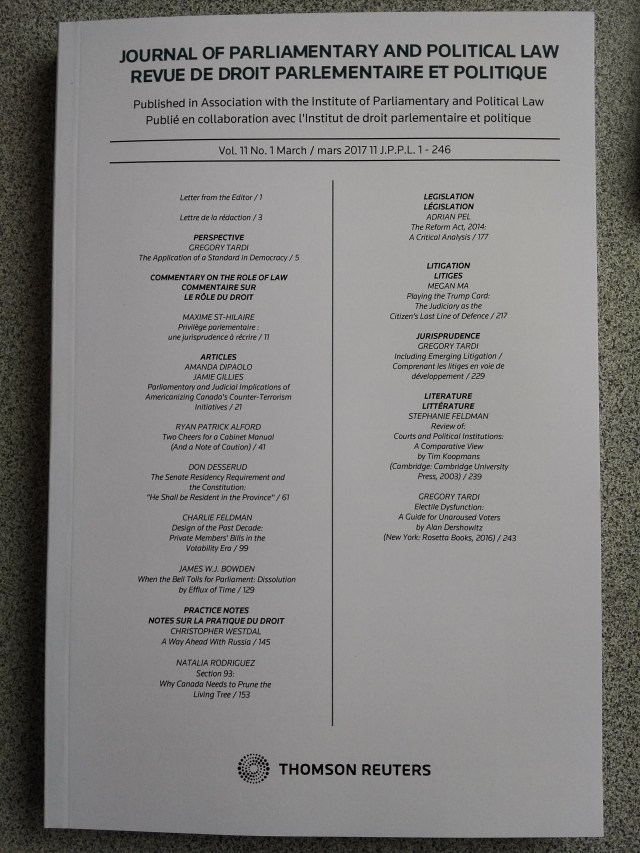
You can read my article on dissolution by effluxion here: Bowden, James W.J. “When the Bell Tolls for Parliament: Dissolution by Efflux of Time.” Journal of Parliamentary and Political Law 11, no. 1 (2017): 129-144.
As sometimes happens with writers, I only noticed a better way of expressing my argument after publication! But I can at least share this update here and ask that you treat it as a supplement if you choose to read the PDF. This following goes with the material on page 135 of the manuscript. Also, I apologise for having misattributed the surname of the name of Prince Edward Island’s Premier; I wrote “MacLaughlin” instead of “MacLauchlan.” (If I’m not mistaken, they are pronounced in the same way, and this was the source of my mix up).
I think that the strongest evidence in support of my claim that the fixed-date election laws have lowered the threshold from the maximum life of the parliament or legislature derives from how Manitoba, Saskatchewan, and Prince Edward Island chose to react to the fact that their provincial general elections were originally scheduled to coincide with the federal general election of 2015. These three provinces were also scheduled to hold their general elections in October 2015. So, too, was Ontario for a while, but the early dissolution of the 41st Legislature in May 2014 re-set the clock and prevented the scheduled overlap from occurring in 2015. And Ontario has now also altered the schedule of its elections so that they happen every 4th June, starting in June 2018, instead of every 4th October, as they previous were scheduled.
The legislatures of Manitoba, Saskatchewan, and Prince Edward Island all passed legislation amending their fixed-date election laws to the effect that if their provincial general elections were ever scheduled for the same time as a federal general election, they would postpone their provincial general elections by six months to the following spring.[1] Manitoba and Saskatchewan did indeed hold general elections in April 2016, instead of October 2015. But as it turned out, Prince Edward Island did not need to invoke its legislation in October 2015, because Premier Wade MacLauchlan advised an early dissolution in May 2015. But since the next federal election and Prince Edward Island’s next provincial election are both scheduled for October 2019, Prince Edward Island will have to invoke the procedure under the new legislation to extend the life of the current legislature to spring 2020 — which means that this current 65th Legislature will be scheduled to live for the full five years.
Why would all three of these provinces have taken this course of action? Why would their premiers simply not have decided to postpone their province’s elections through prerogative authority alone, on the grounds that the Constitution Act provided that provincial legislatures can live for a maximum of 5 years? The answer is very simple: the justice departments in these three provinces all concluded that their province’s fixed-date election laws had, in fact, decreased the maximum lifespan of the legislature to somewhere between four and five years. Therefore, only by amending these laws could the legislature increase its maximum lifespan beyond four years and to somewhere between four and five years. At the very least, these provinces’ justice departments believed that this is probably true, or the best legal advice.
Therefore, I would argue that the recent precedents of how Manitoba, Saskatchewan, and Prince Edward Island amended their fixed-date election laws in order to extend the lifespan of their legislatures if federal and provincial general elections would ever overlap demonstrates that my argument is correct. Fixed-date election laws have in fact lowered the maximum lifespans of provincial legislatures and the Parliament of Canada. They would dissolve by efflux of time (i.e., automatically) when they reach their maximum life. This is the only explanation that makes sense and accounts for why these three provinces acted in this manner.
Similar Posts:
[1] Manitoba, Legislative Assembly. The Election Financing Act and Elections Amendment Act. Bill 33, 40th Legislature, 1st session, 2012; Saskatchewan, Legislative Assembly. The An Act to Amend the Legislative Assembly and Executive Council Act, 2007. Bill 35, 27th Legislature, 1st Session, 2012; Prince Edward Island, Legislative Assembly. An Act to Amend the Election Act. Bill 34, 64th General Assembly, 4th Session, 2014.



 James Bowden's Blog