
Why Can’t Anti-Monarchists Get the Basic Facts Right?


Maybe the Queen of Canada’s effigy looks at us through her peripheral vision — but I wouldn’t even call that a one-eyed stare.

I normally don’t bother responding any longer to these obligatory anti-monarchist op-eds that tend to appear each July, if only because the republican arguments remain constantly inaccurate — almost like a political science equivalent of Newton’s Laws. Most republican op-eds and essays these days adhere to the same formulaic tropes, like vague appeals to an over-arching historical dialectic or teleology, and refusal to acknowledge how the Crown of Canada has evolved since the 19th century. They’ve become boring to read.

From 2011 to 2014, I wrote about a dozen blog entries on the subject of anti-monarchism, and I’ve covered all of their core arguments therein. In particular, I’d point readers to my response to Paul Heinbecker from July 2014. (July is their favourite month). As I’ve demonstrated and documented in depth in these previous posts, prominent republicans like Paul Heinbecker and Duff Conacher present mendacious or outright deceptive and false assertions as truth and can’t (or choose not to) get the basic facts right. One can make a normative case for republicanism or present proposals on precisely how the Dominion of Canada could become the First Federal Republic of Canada. I suspect that republicans can’t or don’t get the facts right because they care more about normative propositions than how the current system in fact works. Why would they waste time learning about a constitution that they want to mutilate or destroy outright?
Continue reading →

Posted in Monarchism v Republicanism | 3 Comments

Happy Dominion Day! Let’s Celebrate the Incoherence of “Canada at 150”


The July 1st Specials

Happy Dominion Day! Or “Happy Canada Day” to the uninitiated. Here are some my articles and blog posts pertaining to the celebrations on July 1st.

Continue reading →

Posted in Dominion Day, Dorchester Review, History of British North America | Leave a comment

Clark’s Resignation, Horgan’s Appointment, and Responsible Government In British Columbia


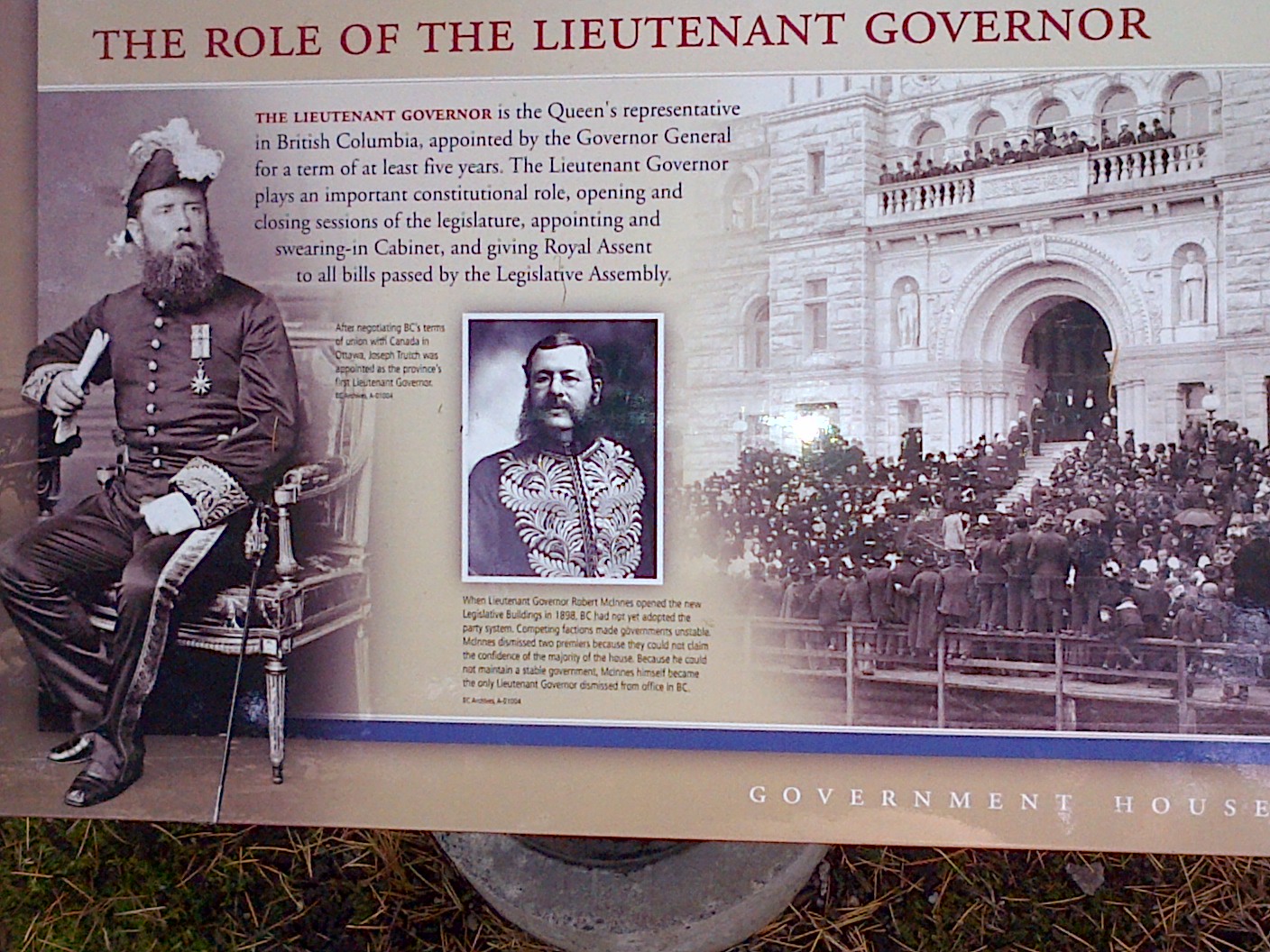
I took this photo in June 2013 when I visited Government House in Victoria. The grounds host an array of beautiful gardens, which Victoria’s mild oceanic climate sustains year round.

The Vote in the Legislative Assembly

At around 5:30 Pacific Daylight Time on 29 June 2017, the Legislative Assembly of British Columbia carried New Democratic Party leader John Horgan’s motion of non-confidence and thereby defeated the Clark Ministry, by a vote of 44 New Democratic and Green MLAs to 42 Liberal MLAs.[1]

2  Mr. Horgan to move in amendment, seconded by Ms. Furstenau —

Be it resolved that the motion “We, Her Majesty’s most dutiful and loyal subjects, the Legislative Assembly of British Columbia in Session assembled, beg leave to thank Your Honour for the gracious Speech which Your Honour has addressed to us at the opening of the present Session,” be amended by adding the following:

“but Her Honour’s present government does not have the confidence of this House.” (MOVED.)[2]

In principle, Horgan’s amendment attaching a statement of non-confidence to the Address-in-Reply was redundant, because the Address-in-Reply to the Speech from the Throne  itself serves as a vote of confidence anyway. But whether the assembly votes against the motion to adopt the Address-in-Reply or votes in favour of an opposition amendment to the Address-in-Reply, the outcome remains the same: the assembly withdraws its confidence from the Ministry. The three Greens MLAs held up their end of the supply agreement and voted with the New Democrats.

Continue reading →

Posted in Caretaker Convention & Government Formation, Dissolution, Formation of Governments | 4 Comments

Some Discretion: On Dissolution and the Lieutenant Governor


Here are the general principles at play in dissolving legislatures and appointing premiers if Premier Clark’s ministry loses the confidence of the legislative assembly today. Continue reading →

Posted in Appointment of PM, Caretaker Convention & Government Formation, Crown (Powers and Office), Dissolution, Formation of Governments, Lieutenant Governors | 1 Comment

What The Conservative-DUP Agreement Says about Votes of Confidence Under the Fixed-Term Parliaments Act


Arlene Foster, leader of the Democratic Union Party, and Theresa May, Prime Minister of the United Kingdom of Great Britain and Northern Ireland and leader of the Conservative and Unionist Party

The Conservative and Unionist Party and the Democratic Unionist Party have finally hammered out a supply agreement that would give May’s minority government a parliamentary majority.

You can read it here: Confidence and Supply Agreement between the Conservative Party and the DUP.

Continue reading →

Posted in Confidence Convention, Fixed-Date Elections, Formation of Governments | 2 Comments