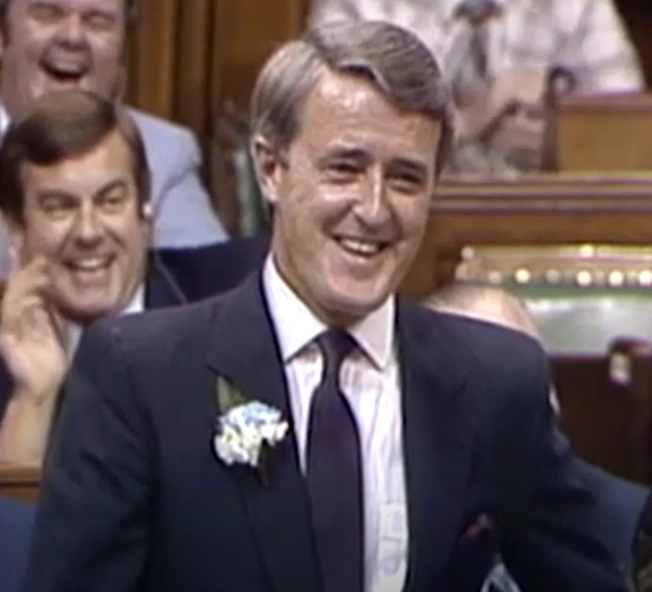
Brian Mulroney responded to Pierre Trudeau with convivial good humour, and his half of the exchange provides an example of my observation yesterday that MPs in the 1980s often spoke to their counterparts directly in the second person. Mulroney’s jovial speech contains several “yous”.
I think that it was Paul Wells who described Mulroney’s voice as a “loungebar baritone.” I’ve always thought that if Mulroney gets bored and wants to supplement his income, he could make good money narrating audiobooks. He has, in my view, the best speaking voice of any Prime Minister, at least since the advent of radio and certainly of the last half of the 20th century up to today.
The first televised proceedings of the House of Commons of Canada began in 1977, fully two years before C-SPAN began televising the United States House of Representatives. Our equivalent of C-SPAN, CPAC, has now uploaded online all the video footage going back to the late 1970s and the first ministry of Pierre Trudeau. CPAC’s archives provide a window into the past. Don – “Welcome to the Brooooaaaaaadcaaast” – Newman has observed that the House of Commons changed starkly after the election in 1993, which wiped out the old Progressive Conservative Party and saw the rise of Quebec nationalism in the Bloc and Western alienation in the Reform Party; having now watched far too many of these videos or listened to them in the background whilst working on other things, I have begun to grasp what he means. The House of Commons truly did seem more collegial – and therefore more witty and entertaining – and full of banter rather than truly bitter acrimony during the Trudeau and Mulroney governments than it has since at least 2000 or 2004; I would regard the 35th and 36th Parliaments elected in 1993 and 1997 as a transitional phase. Chretien, in his rhetorical clumsiness, seems to have popularised the practice of speaking from notes in the House of Commons of Canada, while Trudeau and Mulroney could carry out quite eloquently without them.
The Journal of Parliamentary and Political Law published my and Lyle Skinner’s piece on recent developments concerning the Caretaker Convention in Newfoundland & Labrador, including the Executive Council Office’s Guidelines from 2019 (similar to those of PCO in Ottawa) and how the previous Liberal Premier, Dwight Ball, circumvented them in a minority legislature by asking the Lieutenant Governor to re-appoint him to the office that he already occupied.
Prime Minister Trudeau advised Governor General Mary Simon to dissolve the 43rd Parliament of Canada and issue the writs of election on 15 August 2021. The Privy Council Office marked the occasion by releasing another edition of its Guidelines on the Conduct of Ministers, Ministers of State, Exempt Staff and Public Servants During an Election – naturally, in HTML alone, and using the same URL as the earlier editions from 2019 and 2015, now over-ridden and consigned to Internet oblivion. This document contains guidance on the Caretaker Convention.
On 15 August 2021, Prime Minister Boris Johnson requested that the Speaker recall the House of Commons from its summer recess early so that MPs could hold an emergency debate over the fallout of the American withdrawal from Afghanistan, which the Taliban took as an opportunity to recapture Kabul and to install themselves as the de facto government once more.[1] The House of Commons would originally have reconvened on 6 September under its regular sitting calendar but met instead on 18 August.[2] The Lords Speaker also recalled the House of Lords for the same day. The British House of Commons and House of Lords could meet to discuss the British response and efforts to evacuate their diplomatic personnel and refugees because the two houses had merely adjourned for their regular summer recess. The British House of Commons has cut short its adjournments in such a manner on 34 occasions since 1948.[3]
In Canada on 15 August 2021, Governor General Mary Simon dissolved the 43rd Parliament of Canada and issued the writs of election on Prime Minister Trudeau’s advice. Perhaps drawing inspiration from across the Atlantic, Annamie Paul, leader of the Green Paper, argued on Monday, 16 August that the Parliament of Canada should be recalled so that MPs can hold an emergency debate on the aftermath of the American withdrawal from Afghanistan. The Green Party’s statement reads:
OTTAWA – The Green Party is calling on the Prime Minister to ask the Governor General to reconvene Parliament to debate Canada’s response to the foreign policy emergency unfolding in Afghanistan, and to ensure that Canada remains accountable for the safety of the Afghan nationals who assisted our mission and who are now desperate to flee the country.
“As of yesterday, the Taliban had captured all major cities in Afghanistan, including the capital Kabul.” said Ms. Paul. “The Taliban’s advance has been swift and merciless; we are witnessing the complete recapture of Afghanistan by the Taliban. […]
“Parliament has been dissolved and therefore cannot debate this emergency situation and determine how Canada can do its utmost to protect Afghan civilians and ensure global security in honour of the sacrifice of our military who served in Afghanistan. This is yet one more agonising item to add to the list of reasons that this national election should not have been called at this time.”[4]
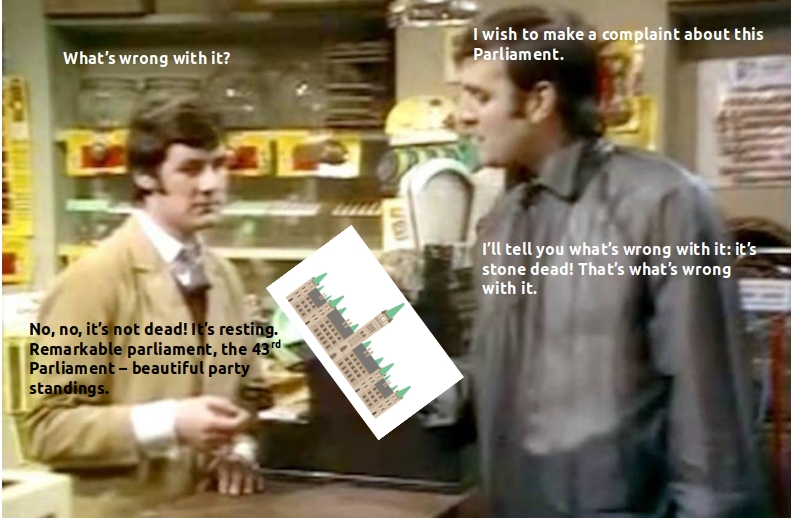
The first sentence of the last paragraph of the Green Party’s statement sums it up: “Parliament has been dissolved and therefore cannot debate this emergency”. In Canada, a dissolved parliament cannot be recalled. But in other jurisdictions, death is not the end.



 James Bowden's Blog