1774: Thomas Jefferson, The Rights of British Americans, and the Origins of the Commonwealth Realms


A Summary View of the Rights of British America
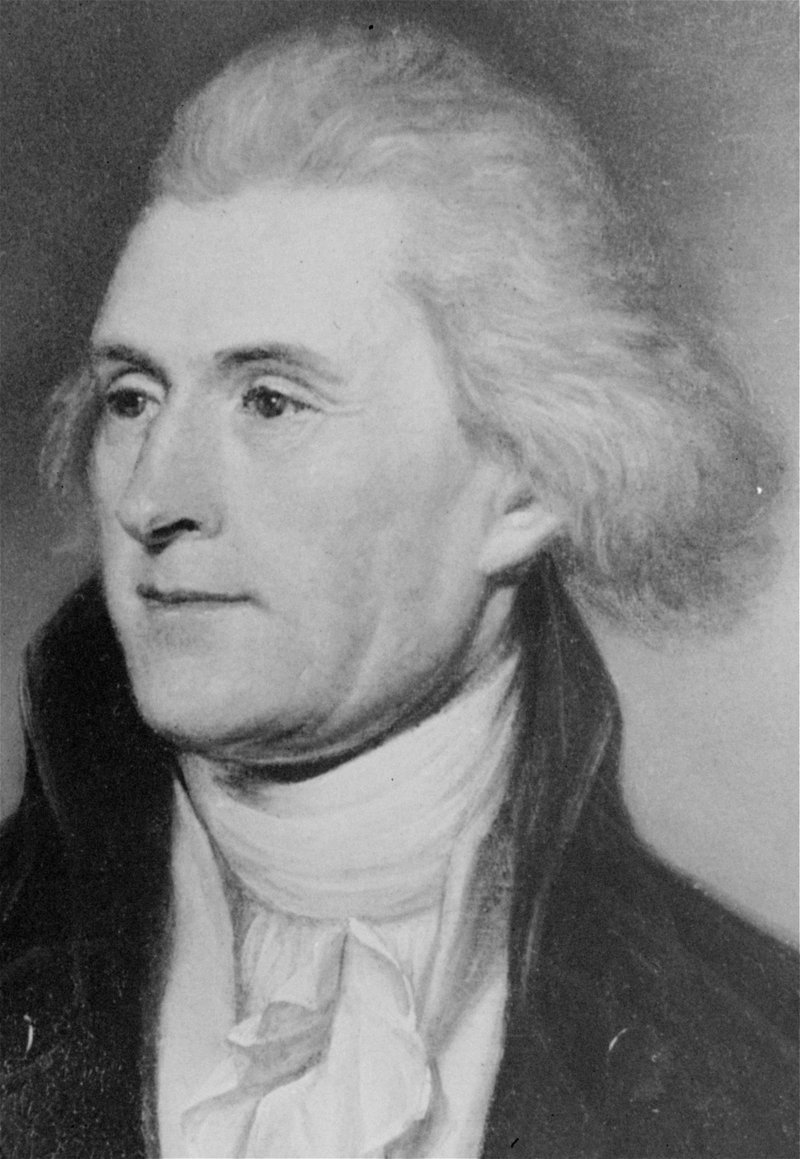
In “George III and the Loss of the American Colonies,” I cited one of Thomas Jefferson’s earlier works from 1774, A Summary View of the Rights of British America, as evidence that we should regard the American Revolution as another English civil war and the logical extension of the Glorious Revolution of 1688, because the American colonists saw themselves as “British Americans” and invoked the ideology of the Constitutional Settlement of 1688, which one hundred years earlier had secured parliamentary supremacy and sovereignty in the Crown-in-Parliament. Steeped in Whiggism and firmly anchored in constitutional constraints on the monarchy, Thomas Jefferson summarized the British American position in the first paragraph: that George III, as a constitutional monarch and one part of the machinery of government, must obey Parliament; that the British Parliament may exercise its sovereignty and legislate only in the United Kingdom because the American colonial parliaments enjoyed that same sovereignty to legislate in their jurisdictions; and that therefore only the Crown – and not the Westminster Parliament – unified the Thirteen American Colonies to the United Kingdom. In one fell swoop, Jefferson both alluded to the principle of responsible government and created the legal rationale of the Commonwealth realms (Canada, Australia, New Zealand, etc.) that only the Crown binds them together, which did not come in effect until 1931 with the Statute of Westminster.

“Resolved, that it be an instruction to the said deputies, when assembled in general congress with the deputies from the other states of British America, to propose to the said congress that an humble and dutiful address be presented to his majesty, begging leave to lay before him, as chief magistrate of the British empire, the united complaints of his majesty’s subjects in America; complaints which are excited by many unwarrantable encroachments and usurpations, attempted to be made by the legislature of one part of the empire, upon those rights which God and the laws have given equally and independently to all. To represent to his majesty that these his states have often individually made humble application to his imperial throne to obtain, through its intervention, some redress of their injured rights, to none of which was ever even an answer condescended; humbly to hope that this their joint address, penned in the language of truth, and divested of those expressions of servility which would persuade his majesty that we are asking favours, and not rights, shall obtain from his majesty a more respectful acceptance. And this his majesty will think we have reason to expect when he reflects that he is no more than the chief officer of the people, appointed by the laws, and circumscribed with definite powers, to assist in working the great machine of government, erected for their use, and consequently subject to their superintendence [emphasis added].”

My favourite Whig historian David Starkey confirms this interpretation in Crown & Country: “This idea of a monarch who, as sovereign of free and independent peoples, holds an empire together was both ingenious and far-sighted. Indeed, it became the foundation of Britain’s twentieth-century imperial policy as the empire evolved into a commonwealth of self-governing dominions, united only by allegiance to a common crown.” (Starkey stated the last phrase incorrectly, because there are 16 Commonwealth realms and 16 crowns held together in the personal union of the British sovereign. “Allegiance to a common Head of State” would be more accurate). Starkey adds that George III himself rejected this principle and supported the policies of Prime Minister Lord North’s administration. Jefferson also over-reached in many respects and placed too much of the onus on George III rather than on Lord North’s administration, which had created the hated taxes of the 1770s in the first place.

In the absence of a strong prime minster like Robert Walpole or William Pitt the Elder, George III himself thus came to represent the struggle, even though the policies came from the British Parliament. George III “did not want the power of an American monarch independent of Parliament”. This confusion arose because neither George III nor the Westminster Parliament could accept the fundamental principle of Jefferson’s argument: the legislative assemblies of the 13 Colonies enjoyed equal status to the Westminster Parliament, both of which fell under a personal union of American Crowns and the original British Crown. This idea proved so radical in 1774 that the British did not adopt it until the Balfour Declaration of 1926, and it did not become law until the Statute of Westminster of 1931.

The Declaration of Independence
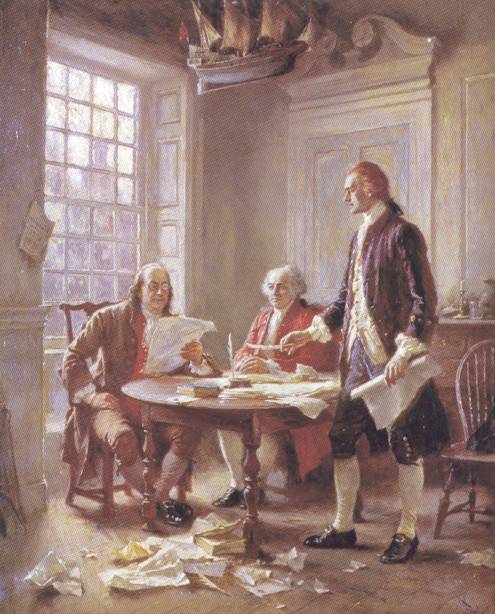
Benjamin Franklin, John Adams, and Thomas Jefferson draft the Declaration of Independence

An overview of the often ignored “nuts and bolts” of the Declaration of Independence reveals the structure of the representative government in the 13 Colonies that led to the “long train of abuses and usurpations.” Above all, the Declaration of Independence should be read as an open letter to George III and as a scathing rebuke of the policies of Lord North’s administration toward the American colonies. This rallying cry of rebelling against “Taxation without Representation” is in fact a superficial rendering of the broader principle that the British Parliament could not legislate in the Thirteen Colonies, because in so doing it would infringe upon the sovereignty of the colonial legislatures. Only the British Crown could have bound the Thirteen Colonies to Britain, but by 1776, even that proposal had become untenable. And thus, the Declaration of Independence came into being.

These sections suggest that the colonial system of representative government in the Thirteen Colonies included a system of reservation and disallowance: the colonial Governor oversaw the colonial legislatures and sent their bills to London, where the British sovereign would formally give them Royal Assent. It also suggests that the colonial Governors enjoyed a direct relationship with the British sovereign, rather than with parliament, and that they could also exercise broad executive powers (like Orders-in-Council) to legislate in the affairs of the colonies.

“He has refused to Assent to Laws, the most wholesome and necessary for the public Good.”

“He has forbidden his Governors to pass Laws of immediate and pressing Importance, unless suspended in their Operation till his Assent should be obtained; and when so suspended, he has utterly neglected to attend to them.”

The Declaration also implies that the colonial form of government in the Thirteen Colonies vested the power to summon and dissolve legislatures in the British sovereign himself, even though the William III gave up the royal prerogative to dissolve the Westminster Parliament in 1694 with the passage of the Triennial Act, which provided for the automatic election of a new House of Commons every three years.

“He has dissolved Representative Houses repeatedly […].”

“He has refused for a long Time, after such Dissolutions, to cause others to be elected […].”

William III also relinquished the royal prerogative on calling forth and raising money for standing armies in 1697 and vested that power in the Westminster Parliament. But the Westminster Parliament exercised this right over the colonial parliaments and imposed this pre-Glorious Revolutionary constitutional settlement on the Thirteen colonies:

“He has kept among us, in Times of Peace Standing Armies, without the consent of our Legislatures.”

Jefferson reiterated his claim for A Summary View of the Rights of British America that only the colonial legislatures ought to exercise legislative authority in their respective jurisdictions, and that the Westminster Parliament’s sovereignty applied only to Britain. This long grievance and its sub-points strike at the heart of the colonists’ arguments against George III and Lord North’s administration. In 1765, “the Virginian Assembly passed the first resolution against the Stamp Act,” declaring that “the taxation of the people by themselves, or by persons chosen to represent them is the distinguishing characteristic of British freedom, without which the ancient constitution cannot exist.” In repealing the Stamp Act, the British parliament asserted its right to pass legislation on behalf of all the British colonies “in all cases whatsoever.” Jefferson even included that phrase in the Declaration of Independence. (Starkey didn’t footnote this book, so he may have been quoting the Declaration instead). The second point in this list refers to the Quebec Act, 1774, which expanded the frontiers of Quebec all the way to Detroit and granted the French-speaking Catholic inhabitants their French civil law, French language, and protected their Catholic faith – which in turn deprived them of the possibility of representative government in the traditional English sense. The American colonists saw the Quebec Act as a direct threat to the sovereignty of the Thirteen Colonies and feared the imposition of such a system there.

 “He has combined with others to subject us to a Jurisdiction foreign to our Laws; giving his Assent to their Acts of pretended Legislation [The British Parliament cannot legislate in the colonies]:

For imposing Taxes on us without our Consent [the Stamp Act, etc.]:

For abolishing the free System of English Laws in a neighbouring Province, establishing therein an arbitrary Government, and enlarging its Boundaries, so as to render it at once an Example and fit Instrument for introducing the same absolute Rule into these Colonies [the Quebec Act, 1774]:

For taking away our Charters, abolishing our most valuable Laws, and altering fundamentally the Forms of our Governments

For suspending our Legislatures, and declaring themselves [the Westminster Parliament] invested with Power to legislate for us in all Cases whatsoever.”

Jefferson even cited himself in the penultimate paragraph in a reference to the Summary View of the Rights of British America:

“We have warned them from Time to Time of Attempts by their Legislature to extend an unwarrantable Jurisdiction over us.”

 Representative Government vs. Responsible Government

The great Canadian constitutional scholar MacGregor Dawson called the first chapter of The Government of Canada “Representative and Responsible Government” in order to describe the political evolution in the British colonies in the 18th and 19th centuries. “Representative government” refers to a system in which the propertied colonists voted for representatives in their respective colonial legislative assemblies, which passed laws of local concern and represented the colonies. However, the legislature remained separate from the executive. The British sovereign appointed, by and with the advice and consent of the British cabinet, colonial governors who represented the Crown in their colony and acted as chief magistrate. Judging by Jefferson’s writings, the colonial governor would forward legislation passed by the colonial legislatures to the British sovereign, who would sign off, or the colonial governor would exercise the powers to summon and dissolve the colonial legislatures and give Royal Assent to their laws. (This will require some further research on my part). In contrast, responsible government in the colonial sense means self-government. Responsible government incorporates the necessary precondition of representative government, but then goes further and ensures that the executive, rather than functioning separately and above the legislature, becomes integrated with and accountable and responsible to the legislature. Responsible government means that the government derives its authority to govern by commanding the confidence of the legislature.
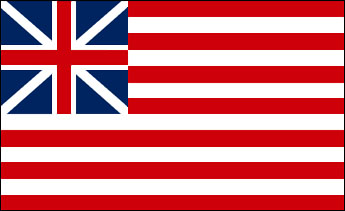
The Grand Union Flag of 1775: The First Flag of the 13 Colonies

Jefferson did not use this terminology as such, but the logical extension of his proposals would have led to a system of colonial self-government and true constitutional monarchy in which the King reigned but parliament ruled. If Lord North’s administration and George III had listened to these proposals, the English civil war that was the American Revolution might have been averted, even as late as 1775. The original flag of the united Thirteen Colonies in 1775 featured the Union Flag in the canton, in order to demonstrate that the British North American colonies adhered to the principles of English liberty — but that they wanted them to apply equally in British North America. Ironically, the British needed to sacrifice the Thirteen Colonies in order to make Jefferson’s idea viable and learn that they could not deny their “sons of liberty” in the New World the same rights that they themselves had fought and died for in the bloody civil wars of the 17th century, culminating the in the Glorious Revolution and constitutional settlement of the 1690s. When some Canadians rebelled in 1837 against the system of mere representative government in Upper Canada and Lower Canada, the British relented and granted the Canadian crown colonies self-government in the form of responsible government.

Dawson remarked that in the late 1760s, British North America practised a system of representative government in the British West Indies, Prince Edward Island, Nova Scotia, and all the Thirteen Colonies and that therefore their systems all stemmed from the same source and greatly resembled one another. British North America represented one fertile branch of the British oak of liberty.

Peter McCormick of the University of Lethbridge argues that the Judicial Committee of the Privy Council came into being in order to act as a court from the colonies, and fell direclty under the Crown, because the Westminster Parliament did not legislate for the colonies. Loren P. Beth in “The Judicial Committee: Its Development, Organisation and Procedure” Public Law (1975) wrote that “[T]erritories that were held by the Crown which were not considered part of the English realm, and which were therefore not subject to the regular courts of the governance of Parliament.” McCormick added that “In English practice, the colonies had nothing to do with Parliament but were under the direct authority of the monarch.” Perhaps the British accepted Jefferson’s principle after the American Revolutionary War, or perhaps Lord North’s administration broke with convention, just as George III himself did with respect to regal power.

 The Origins of Responsible Government     

The Constitutional Settlement of 1688 produced the English Bill of Rights, installed King William and Queen Mary as monarchs, and saw the entrenchment of parliamentary supremacy. Canadian historian William Leggo wrote in 1878 that responsible government had “been slowly evolving itself in Great Britain since the reign of George III [1760-1820]”

Starkey has shown that cabinet government and constitutional monarchy developed in earnest under Queen Anne. Under William III, Parliament took on its modern trappings: “in 1689, he offered the Commons scrutiny of public accounts.” In 1694, William III surrendered the sovereign’s prerogative power to summon and dissolve parliament independently via the Triennial Act, “which provided instead for the automatic summoning of a new parliament every three years.” The invocation of the Act of Settlement, 1700 upon the death of Queen Anne in 1714 brought the Hanoverian succession and a much weakened monarchy, which resulted in “an extraordinary an unprecedented political development”: the prime ministership, which Starkey called “the parallel monarchy”, and the rise of cabinet government. The website of the British monarchy states that “after 1717, George rarely attended Cabinet meetings. This allowed the Cabinet to act collectively and formulate policies, which, provided they were backed by a majority in the Commons, the king was usually powerless to resist.” Robert Walpole became Britain’s first de facto prime minister. (The title did not enter into official usage until the early 20th century). His administration lasted from 1721 to 1742. A politically weakened Walpole set a significant precedent in 1742: he resigned after winning a vote of confidence in the House of Commons by the narrow margin of 253 to 250 because he could no longer govern effectively.[v] However, responsible government had yet to take hold. While Walpole’s administration managed to survive the death of George I in 1727, “Walpole could remain in office only as long as he retained his favour with the king [George II].”Under responsible government, the Prime Minister can only remain in office while his government maintains the confidence of the House of Commons.

Despite Leggo’s claim that responsible government developed under George III, “in 1801, [George III] forced Pitt the Younger to resign” over their disagreement on legislation that would have given Catholics full civil rights. William IV, however, gave Royal Assent to the Great Reform Bills (which broadened the franchise, acknowledged the civil rights of Catholics, and reformed the rotten borough constituencies) because he felt bound “to support the Prime Minister until Parliament by its vote determines that the Prime Minister no longer possesses the confidence of the nation.” William IV also resigned himself to a mass creation of peers in order to break the deadlock between the two houses in 1832 so that the Great Reform Bill could pass parliament. This stacking of the House of Lords with Whig peers set an important precedent in favour of responsible government by reinforcing the notion that the government only derived its authority from the House of Commons, and that therefore the House of Lords could not act as a confidence chamber. Parliament finally codified this principle with the Parliament Act, 1911 after King George V threatened to allow another mass appointment of peers in order to break an impasse over Asquith’s People’s Budget. Responsible government became entrenched under the reign of Queen Victoria.

The United Kingdom then extended the right of self-government and responsible government to the Canadian colonies in 1848, and the Australasian colonies in 1856, and in so doing implemented the logical extension of an idea that Thomas Jefferson proposed as early as 1774. The British learned from their mistakes in the American colonies, which destroyed the First British Empire. Responsible government means self-government, and in the Second British Empire, the British applied this principle readily as recognition of the maturity and growth of the colonies.

Related Posts
Posted in History of British North America, Origins, Whigs v Tories | 18 Comments

Reversal of “Republicanism by Stealth”


Australian constitutional scholar Peter Boyce in The Queen’s Other Realms: The Crown in Australia, Canada, and New Zealand argued that all three of these Commonwealth realms have faced since the 1960s a gradual de-monarchization, or republicanism by stealth. These measures focused mostly on removing the Crown and its symbols from the public sphere, such as by removing Her Majesty’s portrait from government buildings, or omitting references to the Head of State as the Queen of Australia, Canada, or New Zealand in favour of those countries’ Governors-General. In Canada’s case, this republicanism by stealth ostensibly worked for “national unity” (i.e., making Quebec happy). The Parliament of Canada at some point changed the official name of this country from The Dominion of Canada to just Canada, and in 1980, the Speaker allowed a small group of MPs to dispose of the historically significant “Dominion Day” and replace it with the pedestrian “Canada Day”, as if Canadians need their government to remind them of their country’s name.

The Commonwealth of Australia has fostered the most open republican movement, and sadly, the constitutional monarchist-republican divide has fallen largely about a right-left cleavage; the Leader of the Australian Labor Party and current Prime Minister Julia Gillard openly supports the abolition of the Crown of Australia after the death of Queen Elizabeth II, but the Liberal leader and Leader of Her Majesty’s Loyal Opposition Tony Abbot is a stanch monarchist and even led a monarchist organization in the 1990s. Australia even held a referendum on republicanism in 1999, which failed. Interesting, Peter Hogg mentioned at the Canadian Study of Parliament Group’s Annual Spring Conference in 2010 that because the six Australian states, unlike the ten Canadian provinces, enjoy a direct legal relationship with the sovereign, the Australian referendum would only have succeeded in eliminating the federal Crown but left the six state Crowns intact. When I point out the federal-provincial implications of abolishing the Crown (i.e, “What will become of the provincial Lieutenant Governors?”), most Canadian republicans dismiss such questions as minor details, even though most have in turn never even stopped to consider them!

I fully support the Harper government’s latest policies on bringing the Crown of Canada back into the public sphere, such as by restoring the Royal designations of the Royal Canadian Air Force and Royal Canadian Navy, or by reminding all embassies, high commissions, and consulates to display portraits of The Queen of Canada, our Head of State. These policies are part of the government’s crown prerogative and thus taken as Orders-in-Council rather than through Acts of Parliament; the republicanism by stealth and the Royal restorations both followed these kinds of procedures.

Many columnists, like Bob Hepburn, have criticized these recent decisions and characterized them as anachronistic and divisive. Stephen Maher called constitutional monarchy PM Harper’s “secret love”, in a slightly patronizing lament.

Dan Gardner lambasted “creeping republicanism” earlier this year in the column “Creeping Republicanism in Full Retreat” (which he wrote even before the Royal restorations of the Air Force and Navy) and concluded with this message:

“Important changes should never be driven by a manipulative few relying on the ignorance and apathy of the many. It is simply a fact that this nation is a constitutional monarchy whose head of state is Elizabeth II, Queen of Canada. Those who wish to change that should not deny it, distort it, paper it over, or cover it up. They should make their case. And those of us who think the monarchy is a great Canadian institution will make ours.”

Australian republicans have at least stated their intentions openly and honestly. It is time that Canadian republicans follow suit, instead of taking advantage of the apathy of their fellow Canadians. The Crown of Canada has served us well, and the onus rests with republicans to explain why we need to undertake revolutionary constitutional reform in order to abolish it.

Related Posts:

Posted in Monarchism v Republicanism | 3 Comments

Open Primaries in The Westminster System


In 2008, British Conservative MP Douglas Carswell and British Conservative MEP Daniel Hannan co-authored a veritable manifesto for direct democracy and wholescale renewal of the Conservative Party, called The Plan: Twelve Months to Renew Britain.  They represent what I would call a neo-Whiggish constituency within the British Conservative Party that since 2005 or so has advocated strongly in favour of localism and for significant parliamentary and political reforms that would secure their agenda. The Localist Papers (an apt allusion to the Federalist Papers) lay out a radical program of reform in order to strengthen parliament vis-a-vis the political executive (and civil service) by ensuring that parliamentarians answer first to their constituents and by formally abolishing Crown prerogative. I find the latter suggestion entirely too radical and ill-conceived because the abolition of Crown prerogative altogether would constitute the most significant constitutional overhaul – not merely reform – since the Glorious Revolution of 1688 and destroy the essence of the Crown-in-Parliament. I agree with some of the other reforms, however.

One of those reforms called for the adoption of “open primaries,” based on the American system, which would allow all registered electors in a given constituency to vote in the selection of each party’s candidate. The candidates standing in each party’s primary would need to be a member of their respective parties, however. The Plan describes neither the political process nor potential constitutional implications in any detail, but promotes open primaries as electoral dynamism, preventing stagnation and eliminating the safe seats, which they claim describe 70% of the seats in parliament today. Carswell introduced a Private Members’ Bill on 13 October 2009, the Parliamentary Elections (Recall and Primaries) Bill. As he explained to the House: “At 4 of the last 5 general elections, less than 1 in 10 parliamentary constituencies changed hands. The 5th was of course the Labour landslide of 1997, but even there, more than 70% of seats were held by the parties that already controlled them. In other words, most of us represent pocket boroughs. We have tenure. Our incentives are thus twisted: instead of answering outwards to the voters, MPs and safe seats are encouraged by the system to answer upwards to their whips.” Carswell’s bill did not reach Second Reading, so the website does not include the text of the bill itself.

An open primary has already occurred in the United Kingdom. Carswell mentioned that the Conservative Party held an open primary already in the constituency of Totnes in August 2009; his bill would have provided a framework for these primaries. The Independent described the primary: “After local Tories drew up a short-list of three potential candidates, ballot papers were sent to all 69,000 registered electors in Totnes. The Conservatives spent £38,000 on the primary – equivalent to £2.30 for every vote cast – but declared that the experiment in democracy had been a success in engaging the constituency’s electors.” Carswell added that 26% of registered electors of all parties participated in this primary, or 16,000 people.

I support open primaries in principle for the reasons that Carswell and Hannan enumerated: open primaries give all voters a choice, particularly in safe seats where currently the ruling party’s riding nomination effectively determines the next Member of Parliament, and they remind parliamentarians that they serve their constituents first. I had significant reservations with respect to the implications for responsible government until Douglas Carswell was kind enough to reply to my question via Twitter and direct me to his proposed legislation, which I had not examined until today.

The Parliamentary Elections Bill would have provided a framework for open primaries that parties could follow, based on the Conservative Party’s experiment in Totnes in August 2009, but it would not have forced primaries upon all parties and constituencies. Carswell  said: “Under my Bill, local people—supported by one or more parties—could petition their returning officer to organise a primary contest at the same time as a pre-existing local or European ballot. The primary election would be piggy-backed on to an election already due to take place. The returning officer would have to include an extra ballot paper with the names of those on the shortlist. Each party that chose to take part would have to pay the marginal additional cost for having its ballot paper included, but it would be a cost of hundreds not thousands of pounds.” This principle would be more difficult to apply in Canada, being a federation of 10 provinces, all of which could also apply open primaries to their provincial legislative assemblies!)

Carswell understands that open primaries in a Westminster system would necessarily differ from open primaries in the United States because of responsible government, particularly in the context of minority parliaments. Primaries would thus not become automatic, but instead would require support of the electors in a given constituency for a particular election. Based on his speech at First Reading, I can only conclude that the early dissolution of a minority parliament would effectively prevent the holding of open primaries. However, the Parliamentary Elections Bill would probably have encouraged the organic development of a new system whereby one party’s adoption of open primaries would persuade the other parties to follow suit. In turn, voters in any constituency could precipitate the holding of a primary. If the system were beneficial and functioned as planned, it would quickly catch on with voters. If not, it would remain a Conservative experiment in Totnes. So what does the UK have to lose?

This system would surely constitute a radical shift in Canada, where candidates are currently elected in “riding nominations”, which correspond loosely to the “closed primaries” in the United States, where only party members vote on the candidates. In an open primary, however, all registered voters could cast ballots for the candidate of one party, even if they have no intention of voting for that party in the general elections. The prospect of opening up the process to all electors surely seems frightening to many partisans, and critics would argue that this system, rife for abuse, could see rigged voting. These are valid concerns. Thought Undermined (an excellent blog on parliamentary issues) addressed these concerns well: essentially, in a safe riding where only party can win, an open primary would allow all voters to participate and ensure that their votes aren’t simply wasted in the general election on a candidate who has no chance of winning. And in a competitive swing riding (or “marginal constituency”, as our British friends would say) where two parties compete fiercely and either could reasonably win the general election, open primaries would help attract better candidates. Above all, electors seek a good MP, so if the other party that they don’t support could win in the general election, they wouldn’t rig the vote by selecting the weakest candidate from that other party; they would instead pick the stronger candidate precisely because he or she could win in the general election, and they wouldn’t want to saddle themselves with the burden of bad representation in Parliament. Given that a small and decreasing percentage of the Canadian population holds membership in political parties, the adoption of this system would re-enfranchise swaths of voters into a crucial part of the political process.

Where primaries in the United States function under the guarantee of biennial or quadrennial periodicity, if a parliament is dissolved early because the government losses the confidence of the House and no alternative government can be formed, then the parties probably wouldn’t be able to organize open primaries in time before the general election. We could of course proceed with the understanding that open primaries in our Westminster system cannot necessarily be held biennially or quadrennially like in the United States because of our system of responsible government, but parties could still organize open primaries before most elections. If the Parliament of the United Kingdom can accommodate such a system, then so too can all the other Westminster parliaments scattered across the earth. I hope that some Canadian political parties implement the idea as well, and thus eliminate this horrid practice of “parachuting” “star candidates” into safe seats simply so that they can take a seat in the House of Commons.

Related Posts:

Posted in Direct Democracy | 6 Comments

Prorogation As Prime Ministerial Delay Tactic: A Legitimate Parliamentary Tool, Not “Abuse” of Prerogative


UPDATE, July 2019: Please see this post on “Sir John Major’s Hypocrisy on Prorogation” for an in-depth explanation of how Major obtained a prorogation in 1997 in order to prevent Sir Gordon Downey from tabling his report into the Cash-for-Questions Scandal.

Jean Chretien, 2003

As Nick MacDonald and I explained in “No Discretion: On Prorogation and the Governor General”, prime ministers before Stephen Harper have used prorogation as a chiefly political and partisan delay tactic. Few Canadian academics have acknowledged that Prime Minister Jean Chretien also used prorogation as a delaying tactic at least once: in November 2003, probably because the use as delay tactic coincided with a thoroughly logical reason. PM Chretien advised prorogation, ostensibly in order to ease the transition between his government and the incoming Martin government, but this prorogation also delayed the tabling of Auditor General Shelia Fraser’s first report on what became known as the Sponsorship Scandal. Nelson Wiseman commented on that prorogation in “The Use, Misuse, and Abuse of Prorogation.” Despite any political consequences and the duration of the intersession, I fully support the constitutionality of Prime Minister Chretien’s advice; Governor General Clarkson had to accept it and issue the proclamation of prorogation.

John Major, 1997

British Prime Minister John Major may also have used prorogation as a tactic to delay the tabling of an inconvenient parliamentary report until after the general election of 1997. (In the United Kingdom, parliament is normally prorogued before being dissolved, but that intersession normally only lasts for one week at most). On 18 March 1997,  Liberal-Democrat MP Simon Hughes accused Prime Minister Major of abusing the crown prerogative on prorogation.

Mr. Hughes: The Prime Minister yesterday made the uniquely personal decision not only to have a general election on 1 May and to dissolve Parliament on 8 April but that Parliament should be prorogued and sent away this Friday. [Interruption.] Is it not obvious that one of the reasons for that decision and for the unprecedented gap between prorogation and dissolution is that[…] the Prime Minister knows that the report of the Parliamentary Commissioner for Standards on cash for questions will be ready on Monday or Tuesday. That report will therefore not be seen by hon. Members in this Parliament and will be hidden until after the general election.

In a wit that so characterizes all successful British parliamentarians (as opposed to our puerile parliamentarians), the Prime Minister took advantage of Speaker Boothroyd’s intervention and all the several minutes of commotion that resulted from Hughes’s question and artfully dodged it:

The Prime Minister: One of the reasons for making the announcement on Monday and arranging for Parliament to be prorogued on Friday was to give the hon. Gentleman time to finish his question. As for Sir Gordon’s report, I have no knowledge when it will be presented.

The Independent also considered the timing of Major’s prorogation as suspicious and cited one of Gordon Brown’s statements:

But Gordon Brown, the shadow Chancellor, said the Prime Minister could adjourn Parliament, putting it into recess, instead of insisting on prorogation – which would allow the Committee to order publication of Sir Gordon’s report. The timing of the election, would not be affected because there is still more than a fortnight to go before the dissolution.

Brown stated the principle correctly, and Major’s preference for prorogation over adjournment at least gives the perception of using prorogation as a delaying tactic – which is perfectly legitimate. In these parliamentary disputes, sometimes the Government gains the upper hand over the Commons, and sometimes the Commons gains the upper hand over the Government. In any event, Major’s final prorogation did not pose any constitutional problems and did not prevent Labour from winning by a landslide in 1997.

Posted in Crown (Powers and Office), Governor's Discretion, Prime Minister's Powers, Prorogation | 14 Comments

Her Majesty’s Loyal Opposition


I contend that the Bloc Quebecois should never have taken on the role or title of “Her Majesty’s Loyal Opposition” in the 35th Parliament simply because it became the second largest party with 54 seats, compared to the Reform Party’s 52. This is not an argument against the presence of the Bloc quebecois in parliament in general (they were duly elected representatives), but a rebuke of the parliamentary injustice that allowed such a party to become Her Majesty’s Loyal Opposition during the 35th Parliament. I base this argument on interpretations of both British and Canadian sources, because the Canadian tradition developed directly from its British tradition, and on the nature of convention itself. I refuse to elevate the custom that the party with the second largest number of seats becomes the Official Opposition to a constitutional convention. Certainly, the presence of an Official Opposition is a constitutional requirement and practical necessity in order that parliament effectively hold the government to account – but the presence of such a function is distinct from the determination of which party takes on the role. I will also examine Speaker Gilbert Parent’s ruling from 1996 (the second session of the 35th Parliament) on the status of the Official Opposition and point out some bizarre inconsistencies and mistakes therein.

The Origins of Her Majesty’s Loyal Opposition

Westminster Parliamentarism presumes the loyalty of the Leader of Her Majesty's Loyal Opposition. Without this understanding, the system disintegrates.

According to the Library of the House of Commons of the United Kingdom, the formal title of the Official Opposition, “Her Majesty’s Loyal Opposition”, emerged in 1826. Sir John Hobhouse remarked: “It is said to be hard on His Majesty’s Ministers to raise objections of this character but it is more hard on His Majesty’s Opposition to compel them to take this course.” The concept of Her Majesty’s Loyal Opposition, however, traces its roots back to the 18th century. Nevil Johnson explains in “Opposition in the British Political System”:

“what emerged was recognition of the right of politicians in Parliament to oppose the government, to criticize it and to seek to replace it, though as yet there was no overt questioning of the royal prerogative of actually choosing a chief minister and his colleagues.  In practice, however, royal discretion was even by 1784 severely limited by the need to turn to politicians capable of organizing support in Parliament.  By the early nineteenth century parliamentary politics clearly took precedence over direct involvement of the monarch in the day-to-day management of public affairs, and in 1826 there occurred the first recorded use of the term ‘His Majesty’s loyal Opposition’, a phrase that quickly caught on.  But it was the Tory opposition under Sir Robert Peel which in 1841 provided the first example of a party taking power after winning an election as the ‘alternative government’.”

Johnson characterized “the British conception of opposition as the institutionalization […] of a standing alternative to the government of the day” and argued that “Her Majesty’s ‘loyal Opposition’ has been institutionalized for the modern electorate as the standing possibility of an alternative government to replace the one in power.” Crucially, this role as “alternative government”, sometimes called “government in waiting”, applies whether the Her Majesty’s Loyal Opposition forms a new government in the same parliament, without an election, or when it wins the most seats in the next election and forms government in the new parliament. Her Majesty’s Loyal Opposition can therefore be characterized as a “potential government”.

Erskine May (the British equivalent of O’Brien and Bosc) describes Her Majesty’s Loyal Opposition as “the largest minority party which is prepared, in the event of the resignation of the government, to assume office.”

The Question of Convention and the Speaker’s Ruling

The Ministers of the Crown Act, 1937 finally recognised the constitutional status of Her Majesty’s Loyal Opposition and established the principle in the British House of Commons that the Speaker would decide which party would become Her Majesty’s Loyal Opposition. The Ministerial and Other Salaries Act, 1975 codifies the position of Leader of Her Majesty’s Loyal Opposition and the Speaker’s role in determining who holds that position, where necessary: “If any doubt arises as to which is or was at any material time the party in opposition to Her Majesty’s Government having the greatest numerical strength in the House of Commons, or as to who is or was at any material time the leader in that House of such a party, the question shall be decided for the purposes of this Act by the Speaker of the House of Commons, and his decision, certified in writing under his hand, shall be final and conclusive.”

The Parliament of Canada recognized in statute the Leader of the Opposition in 1905, before the other core Commonwealth countries. However, O’Brien and Bosc offer little insight into the role of Her Majesty’s Loyal Opposition as “alternative government” or “potential government.” Instead, they define Her Majesty’s Loyal Opposition as such: “By convention, the opposition party with the largest number of seats in the House is designated as the Official Opposition (and referred to as “Her Majesty’s Opposition”), although nowhere is this set down in any Canadian rule or statute.” The footnote explains that the title Her Majesty’s Loyal Opposition “emphasize[s] the notion that an opposition is loyal to the Crown.” The Bloc quebecois certainly did not meet that requirement; they advocated for the secession of Quebec from a Commonwealth realm, and an independent Quebec would certainly have become La republique quebecoise, not another Commonwealth realm.    

O’Brien and Bosc suggest that the aforesaid convention that the largest opposition party becomes Her Majesty’s Loyal Opposition would only come into doubt in the event of a tie:  “Should an equality of seats among the largest opposition parties occur, the Speaker may be called upon to decide which party should be designated as the Official Opposition. In 1996, when a tie occurred between the two largest opposition parties during the course of a Parliament, Speaker Parent ruled that incumbency was the determining factor and that the status quo should be maintained.”

The Crown (the Queen in the UK and the Governors in the core Commonwealth) appoints the first minister -- but not the Leader of the Opposition!

They refer to the Speaker’s Ruling on the Official Opposition of Tuesday, 27 February 1996. At the outset of the second session of the 35th Parliament, the Bloc’s representation had fallen from 54 seats to 52; the Reform Party of Canada and the Bloc quebecois thus had the same number of seats. Speaker Gilbert Parent made his ruling by responding to the Reform Party’s submission on other parliamentary precedents. But the Reform Party’s approach presents numerous problems, because the idea of a secessionist party as Her Majesty’s Loyal Opposition is unprecedented in Westminster parliamentarism, which explains why the Reform Party grasped at such bizarre instances of Speaker’s inventions. O’Brien and Bosc say that “by convention, the opposition party with the largest number of seats in the House is designated as the Official Opposition.” The argument for a case without precedent should therefore have examined the underlying principles of the convention and explained why they needed to amend the convention. More fundamentally, why does this convention exist? What presumptions underpin this convention? I established in the earlier sections of this analysis that the convention that the largest opposition party becomes Her Majesty’s Loyal Opposition presumes that this party is a “potential government” or a “government in waiting.” The Bloc clearly did not meet this requirement. The British conventions, which Canada largely inherited, also presume the loyalty to the country of the second largest party in parliament! The British simply would never have questioned this basic presumption, because it is a mathematical impossibility that Sein Fein, or the Scottish or Welsh nationalists, would win the second largest number of seats. Indeed, even in Canada prior to the political fragmentation and realignment of the 1990s and 2000s, a secessionist or nationalist party would not become the second largest formation in parliament. The Bloc achieved this status by electoral flute and idiosyncrasy, fuelled by powerful vote splitting on the right between the Reform Party of Canada and the Progressive Conservative Party of Canada. All conventions derive their normative justification from underlying principles, so the Reformers should have asked not, “What are the precedents?” but rather, “What are the reasons for these convention, and how does the Bloc’s status of Her Majesty’s Loyal Opposition call the current convention into question?”

While the Reformers framed their approach incorrectly, Speaker Gilbert Parent made several blatantly false claims in his ruling that undermine his authority as Speaker. Parent’s most absurd claim shows that he fundamentally did not understand Canada’s constitution:

“I must respectfully differ with the hon. member. Your Speaker of the House has no role to play in the selection of a government. In our system the Speaker chooses neither the government nor the government in waiting. That prerogative belongs to the Governor General of Canada on the advice of his privy council. To put the Speaker in a position in which he would be choosing not only the official opposition but perhaps the next government based not on any objective criteria such as numbers in the House but rather on a qualitative judgment about the performance of the current official opposition party seems to me an untenable proposition. It would also be an encroachment on the royal prerogative and a violation of our long established constitutional practices [emphasis added].”

Her Majesty the Queen of Canada, His Excellency the Governor General, and the Right Honourable the Prime Minister. The Leader of the Opposition does not figure into this equation.

Parent implicitly acknowledged Her Majesty’s Loyal Opposition as the “government in waiting” – but the rest of his statement betrays his fundamental (and dangerous) misunderstanding of Canada’s constitution. He suggested that the Governor General chooses both Her Majesty’s Government and Her Majesty’s Loyal Opposition, but in reality, the Governor General only appoints a government that can likely command the confidence of a majority of the House of Commons. The Governor General plays no constitutional role whatever in the determination of which party becomes Her Majesty’s Loyal Opposition! Parent must not have read the Ministers of the Crown Act, 1937 or the Ministerial and other Salaries Act, 1975, both of which decree that the Speaker of the British House of Commons must act as an arbiter and make the final decision on which party becomes Her Majesty’s Opposition if necessary. That British legislation did not bind the Parliament of Canada, but it does offer an instructive and logical framework that all Westminster parliaments should follow. The designation of Official Opposition therefore either occurs automatically after the election, or the Speaker makes a ruling; the Governor General simply never intervenes into parliamentary affairs by designating Her Majesty’s Opposition. It would therefore not be “an encroachment on royal prerogative”, because the royal prerogative does not apply. If a government fell (highly unlikely in a majority parliament), then the Governor General may call upon the Leader of Her Majesty’s Loyal Opposition in order to access whether he can form a government in the same parliament. But in that instance, the Governor General would exercise the royal prerogative to appoint a new government, not the opposition. The Governor General, as a politically neutral figure and representative of the Crown, cannot intervene in partisan minutia without violating that principle of neutrality and impartiality; therefore, the Governor General’s selection of the Official Opposition would violate both current practice and the constitutional principles of responsible government. Parent’s false interpretation would also imply a direct relationship between the Governor General (or British sovereign) and the Leader of Her Majesty’s Loyal Opposition, when in fact, the Prime Minister acts as the Queen’s or Governor General’s primary constitutional adviser; no one else can fulfill this function. Furthermore, the Reformers did not ask to replace the Bloc as Official Opposition because of “a qualitative judgement about the performance of [the Bloc]”; they made the request because the Bloc never met the requirements of “Her Majesty’s Loyal Opposition.” This criticism strikes at the heart of the Bloc’s ethos and purpose, not its performance in the House of Commons. Gilbert Parent knew not of what he spoke, with respect to “long established constitutional practices.”

The Reform Party of Canada Should Have Become Her Majesty’s Loyal Opposition

Those who inherently disagree with my interpretation will probably argue something to the effect, “the Reform Party could not have formed the government in 1993”, or “the Reform Party was not a national party in 1993.”  Johnson and others described Her Majesty’s Loyal Opposition as an “alternate government” or a “potential government”, and that the electorate would determine whether to replace incumbent government or not in the next election. (This reasoning presumes majority parliaments, which made sense in 1997 in the United Kingdom and conformed to the practice of post-War Britain). A “potential” government does not mean that this party automatically becomes government upon the next election: the phrase merely recognizes that of all the parties available, Her Majesty’s Loyal Opposition could most probably form the next government, if the incumbent government can no longer command the confidence of the House. The Bloc quebecois fielded candidates in only one province and therefore could never possibly have formed government; since the party sought above all (at least in the 35th Parliament) the secession of Quebec from the Canadian federation, it also could never have morally formed government. The Reform Party of Canada ran candidates across the country and returned elected MPs from five provinces in 1993. That the Reform Party did not succeed in returning MPs from every province does not disqualify it from “potential government”. In the 35th Parliament, the Reform Party of Canada met the criteria for “potential government” better than of the other three opposition parties – the Bloc quebecois, the rump of the Progressive Conservatives, and the New Democrats – and at the time was best poised to form the next government.

The Progressive Party won the second largest number of seats in the 14th Parliament but, as a protest party, refused to act as Her Majesty’s Loyal Opposition. If all other conventional and institutional checks failed, Bouchard should have demonstrated the same moral consistency as the Progressives by refusing to take on a role that the Bloc could not fulfill. Perhaps he took on the role in order to make a mockery of the system and demonstrate its inefficacy and failures to Quebeckers, for the sheer irony. If so, he certainly succeeded in making a mockery of Her Majesty’s Loyal Opposition by repudiating the principle of loyalty. Johnson described the British Parliament after the election of 1997 and Labour’s landslide victory, but it aptly describes the Canadian opposition from the 35th Parliament onward: “Understandably some of the doubts about the traditional practice of opposition are expressed most vigorously by the smaller minority parties which oppose, but do not aspire to be the official opposition, or like the Liberal Democrats are perennially unable to realize their dream of becoming the official opposition and, therefore, a potential government.” This means that official opposition normally acts as a prerequisite to forming a government.

I attribute the lack of critical thinking on determining the official opposition to a misplaced political correctness which dictates that any criticism of the Bloc quebecois attacks its legitimacy as a party in parliament (when in this case, the issue arises over its status as Official Opposition, not its standing in parliament), or attacks Quebeckers writ large; it also speaks to the fear of re-evaluating conventions, or perhaps a widespread misunderstanding of the purpose of convention. In light of the inherently flawed and incorrect Speaker’s ruling of 1996 and the British method, the parliament should amend the Parliament of Canada Act by codifying the principle that the Speaker shall be called upon to determine which party becomes Her Majesty’s Loyal Opposition when necessary, as in the British Parliament. More fundamentally, however, we must always check the convention against the principle that it represents and from which it is derived. When the convention no longer matches the principle (in this case, loyalty), the convention must be re-evaluated and modified. To pretend otherwise is to betray the principles of Westminster parliamentarism.

Related Posts:

Posted in Loyal Opposition | 28 Comments