The Maple Crown and the Commonwealth Realms


On September 21, 2011, the Macdonald-Laurier Institute, an excellent new thinktank on public policy, hosted a presentation on a recently published book 1911: The Decisive Election that Shaped the Country precisely 100 years to the day when the results of that election. I enjoyed the presentations by one of the co-authors, Patrice Dutil; Derek Burney, former diplomat and adviser to PM Mulroney; and Jack Granastein, a Canadian political and military historian. As a Whig, I would definitely have been a Clear Grit or Reformer in 19th century, and I would have wholehearted supported Laurier in every election that he contested as Leader of the Liberal Party — including the free-trade election of 1911. I treasure the institutions, tradition, and values that we inherited from the United Kingdom, but I refuse to accept the notion that upholding them requires Canada to be reflexively anti-American. Indeed, as I have written earlier, we share those fundamental historical origins and philosophic underpinnings with our Americans friends. After all, the crown colonies of British North America enjoyed free trade with the United States between 1854 and 1866, when the United States Congress unilaterally abrogated the Reciprocity Treaty. The colonies never lost their British identity then, so I reject the argument that the Laurier government’s agreement would have allowed the US to annex Canada, economically or politically.

Unfortunately, after someone in the audience asked Patrice Dutil to clarify the Conservatives’ accusations that support of the free-trade agreement with the Americans amounted to treason against the Crown (a claim that I would have steadfastly refuted) and annexation into the United States, the panellists and subsequent questioners turned to what I have earlier identified as trite republican arguments. Author and journalist William Johnson commented that as a Canadian of Irish and French-Canadian heritage, he opposes constitutional monarchy and would prefer a Republic of Canada, the implication being that all Canadians of either Irish or French-Canadian heritage should also inherently and automatically oppose the crown. Jack Granastein, another republican, agreed and took the opportunity to criticize the Harper government for having restored the Royal designations of the Air Force and Navy. He found the decision bizarre and argued that the royal restoration appealed to no one born after 1960; I couldn’t resist telling him after the panel that I supported the change despite having been born in 1988. Neither Johnson nor Granastien acknowledged in their criticism of the “British crown” the existence of the constitutionally and legally separate Maple Crown.

Derek Burney responded to the republican commentaries of William Johnson and Jack Granastein through a anecdote from the 1980s about a conversation with a British diplomat on the subject of the Queen’s foreign travels. Burney asked the British diplomat why, if the Queen is also Canada’s Head of State, Her Majesty doesn’t also represent Canada when she travels abroad. The British diplomat replied, “Well, we haven’t really thought about that!” Thankfully, I have thought about it.

Queen Elizabeth II is the Head of State of 16 countries — the Commonwealth realms — in a personal union, which means that each of the 16 crowns is legally and constitutionally separate. The Crowns of Antigua and Barbuda, Australia, The Bahamas, Barbados, Belize, Canada Grenada, Jamaica, New Zealand, Papua New Guinea, Saint Kitts and Nevis, Saint Lucia, Saint Vincent and the Grenadines, Soloman Islands, Tuvalu, and the United Kingdom exist as constitutionally and legally separately entities. In effect, the Queen is crowned 16 times (the six Australian states and Scotland are not sovereign jurisdictions in war and diplomacy). Australia, Canada, New Zealand, and the United Kingdom are often called the “core Commonwealth.”

The sovereign today does not travel abroad as a representative of any of those realms except on and with the advice and consent of the her Ministers of the Crown in that realm. When the British cabinet asks the Queen to travel abroad, she does so only in her capacity as Queen of the United Kingdom of Great Britain and Northern Ireland. The Queen does not automatically represent all 16 Commonwealth realms when travelling abroad, because as a constitutional monarch, the Queen acts only upon the advice of her ministers, not unilaterally. In responsible government, Her Majesty’s Ministers (of whatever realm) are responsible for the actions of the Crown and responsible to their respective lower houses. Ironically, if the logical extension of Derek Burkey’s remarks were implemented, the Queen would be put in a position of subverting constitutional and responsible government.

Sometimes Her Majesty does travel abroad as the Queen of Canada and not as the Queen of the UK. For instance, when Her Majesty rededicated the Vimy Memorial on April 9, 2007, she did not attend as Queen of the United Kingdom. Her Majesty attended the ceremony as Queen of Canada and acted in her capacity of Canada’s Head of State, by and with the advice and consent of the Government of Canada.

In light of this impromptu discussion of the role of the Maple Crown, I very much look forward to the Macdonald-Laurier Institute’s upcoming History Wars, Debate 3 “Monarchy Is a Dangerous Anachronism”, to be held on March 14, 2012.

Similar Posts

Posted in Conferences and Speeches, Monarchism v Republicanism, The Personal Union | 21 Comments

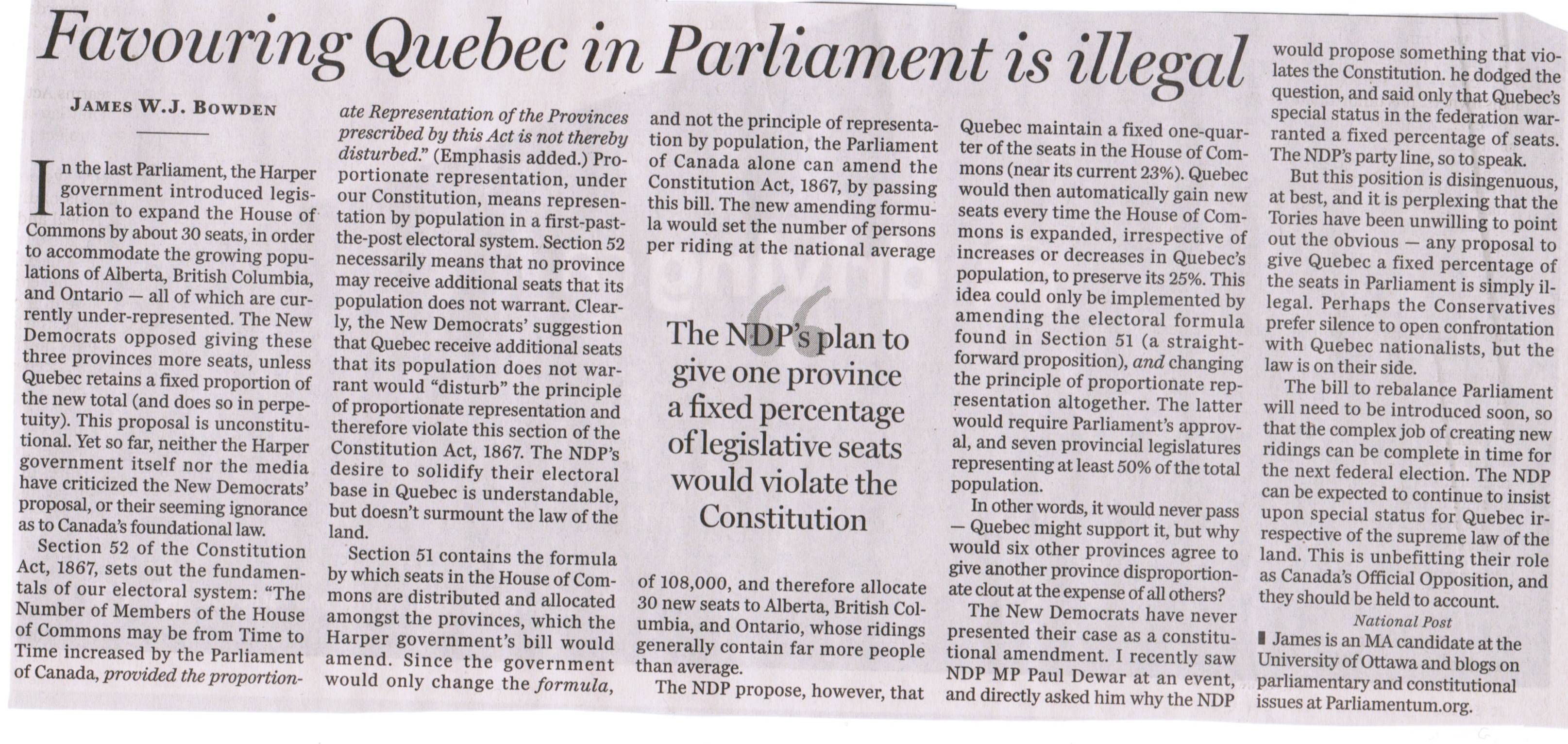
My Column in the National Post on the New Democrats’ Unconstitutional Bill to Give Quebec Fixed Proportion of Seats


Bowden, National Post

Bowden, National Post

Here’s my less hasty take on the New Democrats’ anti-constitutional policies on electoral redistribution. I had forgotten to mention Section 52 of the Constitution Act, 1867! The National Post also published this as a column entitled, “Favouring Quebec in Parliament Is Illegal.”

In the last Parliament, the Harper government introduced legislation to expand the House of Commons by about 30 seats in order to accommodate the growing populations of Alberta, British Columbia, and Ontario – all of which are currently under-represented. The New Democrats opposed giving these three provinces more seats, unless Quebec also receives additional seats. This argument is anti-constitutional. Yet so far, neither the Harper government itself nor the Parliamentary Press Gallery have criticized the New Democrats’ anti-constitutional stance.

Section 52 of the Constitution Act, 1867 sets out the fundamentals of our electoral system: “The Number of Members of the House of Commons may be from Time to Time increased by the Parliament of Canada, provided the proportionate Representation of the Provinces prescribed by this Act is not thereby disturbed.” Proportionate Representation means representation proportionate to population of each province in a single-member plurality (first-past-the-post) electoral system. Section 52 necessarily means that no province may receive additional seats that its population does not warrant. Clearly, the New Democrats’ suggestion that Quebec receive additional seats that its population does not warrant would “disturb” the principle of proportionate Representation and therefore violate this section of the Constitution Act, 1867.

The Conservatives introduced Bill C-12, An Act to Amend the Constitution Act (Democratic Representation) in the last Parliament. It would amend section 51 of the Constitution Act, 1867 by changing the formula by which seats in the House of Commons are distributed and allocated amongst the provinces after each decennial census. Since this legislation would only change the formula, and not the principle, of representation by population, the Parliament of Canada alone can amend the Constitution Act, 1867 by passing this bill. The use of this new amending formula would set the number of persons per riding  at 108,000, and therefore allocate 30 new seats to Alberta, British Columbia, and Ontario, whose ridings generally contain far more people than the national average.

The NDP proposed that Quebec maintain a fixed percentage of the seats in the House of Commons (something like its current 23%), which means that Quebec would automatically gain new seats every time the House of Commons is expanded to take into account population growth in other provinces, irrespective of increases or decreases in Quebec’s population. The New Democrats’ proposal could only be implemented by amending Section 52; however, because an amendment to this section would change “the principle of proportionate representation”, it would require the use of the general amending formula (the Parliament of Canada and 7 provincial legislatures representing at least 50% of the total Canadian population), not simply the Parliament of Canada alone as with Section 51. For their part, the New Democrats have never presented their case as a constitutional amendment – even though they necessarily need to do so. Perhaps the Conservatives haven’t criticized the New Democrats openly because they don’t want to be put in the difficult political position of opposing Quebec.

The Harper government ought to reintroduce this bill in the current 41st Parliament and ensure that the Conservative majority passes it as soon as possible so that the provincial boundary commissions can complete their work in time for the next federal election, likely in 2015. And the media should not continue to let the New Democrats get away with making blatantly anti-constitutional remarks and indeed, criticize them when they do. The New Democrats are now Her Majesty’s Loyal Opposition, and therefore the alternate government, so their policies must be subjected to the light of public scrutiny.

Related Posts:

Posted in Electoral Boundaries Readjustments | 1 Comment

The New Democrats’ Anti-Constitutional Stance on Electoral Redistribution


Recent statements of Thomas Mulcair and Nycole Turmel on electoral redistribution are not only wrong, but contradict the Constitution Act, 1867. Yet so far, neither the Harper government itself nor the Parliamentary Press Gallery have called them out.

In the 40th Parliament, the Harper government introduced legislation to allow for the expansion of the House of Commons in order to accommodate the growing populations of Ontario, Alberta, and British Columbia, which are currently under-represented. The Harper government’s proposal legislation Bill C-12, An Act to Amend the Constitution Act (Democratic Representation) would thus amend section 51 of the Constitution Act, 1867 by changing the formula from 1986 by which seats in the House of Commons are distributed and allocated amongst the provinces. Elections Canada provides a succinct summary of the current formula of electoral redistribution from 1986, which as the chart shows, uses the number of seats in the House of Commons from 1976 as the “electoral divisor” in determining all subsequent expansions of the House. In contrast, the Harper government’s legislation would amend the “electoral divisor” of section 51 to the national average of citizens per constituency upon the 40th general election of 108,000. Each province’s number of seats equals the province’s population divided by the electoral divisor. For instance, according to Statistics Canada, the population of Ontario reached 13,210,000 in 2010. By the formula contained in Bill C-12, Ontario would obtain 130 seats, whereas today Ontario only possesses 106.  Rule 2 of Bill C-12 would preserve section 51 A of the Constitution Act (or as Elections Canada describes as the “Senate Floor Rule), which ensures that a province shall possess no fewer seats in the House of Commons than it possesses in the Senate. This Rule 2 would also ensure that if a province lost seats as a result of the above formula, its total number of seats in 1986 would become its new guaranteed constitutional minimum.

Interim Leader Nycole Turmel described this legislation as “really divisible” and “not constructive” because “it’s not nation-building.” Typical of Quebec nationalists, Turmel’s view comes from the idea that Confederation represented a compact between two founding nations, English and French. Therefore, by the comment “it’s not nation-building”, Turmel probably has the Nation quebecoise in mind, and this bill surely would not serve to build up that nation. However, the Harper government’s legislation conforms to and augments the Constitution Act, 1867 by better protecting the principle of “proportionate Representation”. The percentage of seats in the House of Commons allocated to Quebec will decrease – but the absolute number of Quebec’s seats, 75, will always remain intact.

Section 52 of the Constitution Act, 1867 has thus far never been amended: “The Number of Members of the House of Commons may be from Time to Time increased by the Parliament of Canada, provided the proportionate Representation of the Provinces prescribed by this Act is not thereby disturbed.” (Try to ignore the capitalization of all nouns that affects English-language writing up to the 19th century based on the German style!) In 1867, the phrase “proportionate Representation” meant representation proportionate to population of each province in the context of a single-member plurality electoral system; it does NOT correspond to the modern usage of “proportional representation” and proportional electoral systems, like New Zealand’s. Clearly, the New Democrats’ suggestion that Quebec receive additional seats that its population does not warrant would “disturb” the principle of proportionate Representation and therefore violate the Constitution Act, 1867. Section 52 necessarily means that a province may only receive additional seats proportionate to its growth in population since the last electoral distribution, and that no province may receive additional seats that its population does not warrant.

Today, the Vancouver Sun reported on Thomas Mulcair’s anti-constitutional remarks in “NDP not ‘pandering’ to Quebec over more Western seats, Mulcair says”. Mulcair raised the stakes in the New Democrats’ competition as to which MP can make the most anti-constitutional argument by citing a decision of the Supreme Court of Canada incorrectly. The case Reference re Prov. Electoral Boundaries (Sask.), [1991] 2 S.C.R. 158 dealt with the Government of Saskatchewan’s redistribution of the boundaries of its electoral districts within Saskatchewan based on an act of the Legislative Assembly of Saskatchewan and whether the actions of the boundary commission were in accordance with section 3 of the Charter (democratic rights on voting). This case from 1991 has absolutely nothing to do with the federal redistribution of seats and the allocation of seats to each of the ten provinces as per sections 51 and 52 of the Constitution Act, 1867. In other words, the Electoral Boundaries case is completely irrelevant to the New Democrats’ argument and serves as a perfect example of the “red herring” logical fallacy.

The New Democrats have also suggested over the past few months that the province of Quebec should possess 25% of the seats in the House of Commons, and thus should receive additional seats in the next electoral redistribution and expansion of the House of Commons. There is simply no legal or constitutional basis for this argument. The Charlottetown Accord would have codified the principle in the written constitution that Quebec maintain 25% of the seats in the House of Commons, but the Canadian electorate rejected the Charlottetown Accord in 1992, which ensured that this provision never found its way into the Constitution Acts.

In light of all these blatantly false, anti-constitutional arguments, the New Democratic Party might as well renamed itself Le nouveau bloc québécois anti-constitutionnel.

*I thank my girlfriend, third-year law student Sarah Hagen, who first alerted me to sections 51 and 52 and its ramifications for the New Democrats’ blatantly anti-constitutional positions earlier this summer and thus helped focus my research on this important topic!

Posted in Electoral Boundaries Readjustments, Reform | 3 Comments

Parliamentary Privilege in the United States Congress


With so many American presidential candidates proclaiming the virtues of the Constitution of the United States of America, I sometimes take to re-reading my “pocket constitution” in order to verify their interpretations of its various clauses and amendments. I originally acquired this pocket constitution  in 2003 in Honors History 10-1, taught by the indefatigable Mainer Perry Lewis, whom I credit as the inspiration for all of these posts on American constitutionalism, my interest in American history of the 18th century, and ultimately my reliance on traditional historical methods in political science.

Though I originally started studying the history of the Canadian constitution, its history inevitably led me toward the British constitution from whence it came, as well as what I re-discovered as the intriguing early Lockean offshoot of the British constitution. I argued in an earlier post (see below) that the American Constitution can best be understood as a republican version of Westminster parliamentarism as it existed from the Restoration in 1660 to the coronation of George III in 1760. This crucial century saw the rise of parliamentary sovereignty via the crown-in-parliament and the successive constitutional limitations of royal power in favour of parliament; however, it pre-dates the modern regime of responsible government and subordination of the political executive to the House of Commons.

Every time I re-read the American Constitution, I spot additional material that clearly derives from this crucial century in parliamentarism. Article I, Section 6 contains provisions that I can only describe as a codification of the basic tenets of parliamentary privilege. O’Brien and Bosc define it as follows:

Parliamentary privilege refers […] to the rights and immunities that are deemed necessary for the House of Commons, as an institution, and its Members, as representatives of the electorate, to fulfil their functions. It also refers to the powers possessed by the House to protect itself, its Members, and its procedures from undue interference, so that it can effectively carry out its principal functions which are to legislate, deliberate and hold the government to account.

More particularly, privilege for individual members includes: “freedom of speech; freedom from arrest in civil actions; exemption from jury duty; exemption from being subpoenaed to attend court as a witness; and freedom from obstruction, interference, intimidation and molestation.”

Article I, Section 6, Paragraph 1 of the American Constitution codifies the basic principles of parliamentary privilege that the Bill of Rights, 1689 affirmed for English Members of Parliament:

[Senators and Representatives] shall in all Cases, except Treason, Felony and Breach of the Peace, be privileged from Arrest during their Attendance at the Session of their respective Houses, and in going to and returning from the same; and for any Speech or Debate in either House, they shall not be questioned in any other Place.

The Framers understood that Congress, like the Westminster Parliament, would need to confer certain immunities and privileges upon its members so that they could truly hold the executive branch to account without fear of reprisal — particularly in the aftermath of the Revolutionary War and in the fragile development of the fledgling republic.

Similar Posts

Posted in Parliamentary Privilege | 6 Comments

Development of Responsible Government and the Principle of Restraint (Caretaker Convention)


Responsible Government

The famous Persons Case (more formally, Reference re: British North America Act 1867 (UK) Section 24 IN THE MATTER OF a Reference as to the meaning of the word “Persons” in Section 24 of the British North America Act, 1867. [1928] S.C.R. 276) shows that while the introduction of responsible government to the Canadian crown colonies occurred in 1848 and 1849, the principle underwent significant developments in between its introduction and Confederation, and until at least the Dominion Conference of 1926 that formally amended the role of the Governors-General. Prior to that time, the Governors functioned as representatives of the British government in the colonies, and also as ambassadors. Well into the 1860s, cabinet still required the Governor’s presence to enact “Commissions, Instructions and Statutes” on behalf of the Crown, which implies that the Governor took an active role in meetings of the Queen’s Privy Council.

“The subject of ‘responsible government,’ as the phrase went, had been for many years the field of a bitter controversy, especially in the province of Canada. The Colonial office had encountered great difficulties in reconciling, in practice, the full adoption of this principle with proper recognization of the position of the Governor as the representative of the Imperial Government. It was only a few years before 1867 that Sir John Macdonald’s suggestion had been accepted, by which “Governor-in-Council” in Commissions, Instructions and Statutes was read as the Governor acting on the advice of his Council, which was thus enabled to transact business in the Governor’s absence. There can be no doubt that this inter-relation between the executive and the representative branches of the government was in the view of the framers of the Act, a most important element in the constitutional principles which they intended to be the foundation of the new structure.”

Caretaker Convention

In The Supreme Court of Canada: History of an Institution, Snell and Vaughan unintentionally highlighted an appointment that would clearly violate the caretaker convention today, whether in Canada, the UK, or New Zealand. “Two days before leaving office in 1878 and twenty days after its defeat at the polls, the Mackenzie government named Taschereau to the Supreme Court of Canada.” Such a major appointment after the election but just before the appointment of the new government would simply not be acceptable today.

Related Posts

Posted in Caretaker Convention & Government Formation, Officialization of Convention, Responsible Government | 4 Comments