Nathan Tidridge has written an excellent and accessible introduction to constitutional monarchy in Canada – its history, heraldic symbols, role in the constitution – and the evolution of the Crown in Canada and the Crown of Canada. Tidrigde effectively differentiates between the Queen of Canada, the Governor General, and the Lieutenant Governors; and it explains the Crown in relation to First Nations, heraldic symbols, and the Armed Forces. Overall, Canada’s Constitutional Monarchy strikes a fine balance of offering accessible explanations for a wide audience eager to learn about our system without compromising constitutional accuracy. It even shows the more jovial nature of the Canadian Crown through the use of an iconic painting of Queen Elizabeth II and moose.
Statute of Westminster (Tidridge 2011, 47)
Tidridge’s diagrams illustrating the some key constitutional functions of the Crown are particularly instructive. The following images effectively explain the significance of the Statute of Westminster of 1931, which formally established the Crowns of the Dominions as legally separate entities. The Dominions started out as Crown colonies, but as responsible government developed in the United Kingdom, the British Cabinet (rather than the reigning monarch) exercised practical control over policy affecting the Dominions. The legislatures of the Dominions were therefore not sovereign; they consisted of the King of the United Kingdom, and their upper and lower houses. This colonial control extended to the Governor General, who used to function as an agent of the British government that nominated him. But the Statute of Westminster, as this diagram shows, fundamentally altered that relationship by establishing a personal union of legally separate Crowns such that, for instance, the Parliament of Canada consisted of (at the time) the King of Canada, the Senate, and the House of Commons. The Governors General also became representatives of the Dominion Crowns rather than agents of the British government.
Canada’s Constitutional Monarchy also includes an approximation of what the constitutional scholar David E. Smith has dubbed “the compound monarchy” that constitutes Canada as a federation. The diagram depicts the classical federalism that the Judicial Committee of the Privy Council shaped in Canada: the provinces and the federal are co-equal in their spheres of jurisdiction. Parenthetically, republicans often overlook the Crown in its capacity as the guarantor of Canadian federalism and rarely explain how their new form of government would take into account the void left by the elimination of the provincial Heads of State, the Lieutenant Governors.
I highly recommend Canada’s Constitutional Monarchy.
Constitutional monarchies benefit from the separation between the Head of State and Head of Government: under responsible government, (what Paul Benoit considers “the doctrine of royal infallibility”[1]) Ministers of the Crown are responsible for acts of the Crown and responsible before the House because the Queen or Governor General acts only on and in accordance with their advice, except in exceptional circumstances.[2] The doctrine of royal infallibility allows the Queen or Governor General to become neutral political figures. Responsible government institutionalizes and legitimates loyal opposition, and therefore political dissent[3], because the Prime Minister and cabinet take responsibility for acts of the Crown; they, rather than the Queen, thus bear the brunt of all political attacks. The dignified part of the Crown (the Queen and/or the Governor General) must remain above politics and act as the neutral arbiter and the ultimate guarantor of the constitution. The dignified Crown therefore cannot logically advocate for itself; the efficient part of the Crown (the prime minister and cabinet) must defend it and uphold its role in our system.[4] The long-term vitality of the Crown and its political-partisan neutrality depends upon broad support and understanding of its function: it should not become a political wedge of one party but remain the guarantor of parliamentary government and liberty for all Canadians. Ideally, as I’ve argued in posts on “Her Majesty’s Loyal Opposition” and “Parliamentary Oaths of Allegiance in the Westminster System”, both Her Majesty’s Government and Her Majesty’s Opposition should uphold their duty and protect the dignified part of the Crown and preserved its primal role in our system. However, this arrangement seems to be breaking down in Australia and New Zealand – and Canada may soon follow.
The Monarchist Right versus The Republican Left in Australia and New Zealand: Is Canada Next?
Over the last two years, similar rifts have opened up in Canada. They probably already existed, but the Harper government’s recent restorations of the public roles of the Queen and Governor General (which I support) have exposed this old fault line, which in turn is becoming a partisan wedge. The political parties in Canada are starting to mimic this Australasian pattern: under the Harper government, the Conservative Party has become staunchly monarchist, and after the tragic death of Jack Layton, the New Democrats have begun tentatively experimenting with republicanism (though it remains to be seen whether the New Democrats will seriously pursue the issue). The Harper government recently restored the Royal prefix to the Royal Canadian Navy and Royal Canadian Air Force, ordered that all embassies and consulates display portraits of the Queen of Canada, and has invited members of the Royal Family to tour the country. The outspoken New Democratic MP Pat Martin has called for the abolition of the Crown of Canada upon the demise of Queen Elizabeth II, declaring that “It’s time for us to get rid of the monarchy and grow up.”Thomas Mulcair, a candidate for the leadership of the New Democratic Party from Quebec, shares the sentiment. Certain elements within the derelict Liberal Party has also started aimlessly drifting toward republicanism as well, though any weak political party remains susceptible to being hijacked by a special interest group (like the defunct Progressive Conservative Party in the 1990s).
Nathan Cullen, MP and candidate for the leadership of the New Democratic Party, suggested holding a referendum on whether Canada should abolish the Crown and become a republic, like Australia did in 1999. Under the guise of “Improving Our Democracy”, Cullen would pledge himself to:
Hold a plebiscite on the future of the monarchy in conjunction with a referendum on voting reform. This would be the first time citizens have been asked about whether the monarchy plays a valuable role in 21st Century Canada. It’s hoped the results would guide Parliament and legislatures on Constitutional changes, should Canadians indicate a desire for change.[5]
Cullen’s analysis misses the point completely, of course: whether Canadians see the role of the Crown or not, it certainly “plays a vital role in 21st century Canada”. In reality, Cullen needs to reformulate his question as to whether the Crown should continue to fulfill its constitutional functions or whether it should be abolished, acknowledging that the abolition of the Crown means the abolition of the constitution. All sovereign authority rests with the Crown of Canada; therefore, the Crown cannot be abolished through a constitutional amendment, but only through: the establishment of an entirely new constitution – nothing short of revolution and regime change.
The Civic Republicanism and Romanticism of the Young Liberals of Canada
The Liberal Party might also gravitate toward republicanism. The Young Liberals of Canada submitted a resolution to their party’s upcoming convention, “Canadian Identity in the 21st Century,” that calls for the abolition of the Crown of Canada and the establishment of a Canadian (presumably federal) republic in which the Head of State would be popularly elected (presumably directly, like the French president). I will deconstruct this resolution and then infuse my analysis with Professor Ajzenstat’s work on “civic humanism/republicanism” vs “liberal constitutionalism” from Canada‘s Origins: Liberal, Tory, or Republican?.
At first, I was at a loss to explain the ideological source of the fundamental disagreements between republicans and constitutional monarchists. Then, at the behest of a colleague, I re-read one of Ajzenstat’s older pieces and intend to read The Once and Future Canadian Democracy soon. I consider myself a Whig and support constitutional monarchy because this system of government best secures liberty – the classic argument of a liberal constitutionalist. I better understand the republican philosophy behind this resolution after re-reading the introduction of Canada’s Origins and the distinction between liberal constitutionalism and civic republicanism. Ajzenstat and Smith define liberal constituitonalism as inherently Lockean, though I also consider it Burkean. The liberal constituitonalist seeks above all a system of government that secures liberty and therefore supports responsible government, pluralism, constitutional monarchy, and the mixed constitution of the Crown-in-Parliament; they fear most of all the degeneration of the government into tyranny of the majority.[6] In contrast, civic republicanism emanates from the counter-Enlightenment philosophy of Rousseau[7] and emphasizes “a sense of the common good and an idea of civic virtue to which all members of the polity adhere.”[8] The latter clause that I highlighted shows that civic republicanism can easily preclude liberal pluralism, which accommodates political dissent. Parenthetically, the most severe accusation that one American can level against another – “You’re un-American” – probably also derives from civic republicanism: any American who somehow contradicts republican virtue is not American at all. Moreover, virtue refers primarily to citizenship and “necessitated certain moral qualities, for example, the ability to act selflessly for the public good.”[9] But how does one define the public good? Tyrants and despots can rationalize dictatorship under the guise of the public good.
This presumption of virtue often manifests itself in the argument that becoming a republican represents the natural culmination and political finality of Canada’s development. Republicans rely on this facile and circular argument on the inevitability of becoming a republic, which they see as the natural culmination in a gradual process of independence. C.P. Champion refers to this process as republican “teleology”.[i] Neo-nationalist republicans, thoroughly steeped in French Revolutionary, counter-Enlightenment romanticism, seek to force Canadians to be free from what they consider reactionary, nostalgic British colonialism.[ii]
But why is Canada’s political finality a republic and not a constitutional monarchy? Most republicans fail to answer this question. Canada should therefore become a republic because, from their point of view, only this form of government secures “democracy” (which also often remains undefined and unexplained). This romantic, counter-enlightenment obsession with “democracy” (whatever that means) often takes the form of poorly explained normative statements based on identity politics, circular logic that portrays constitutional monarchy as inherently bad and a republic as inherently good, ignores the liberal, rational underpinning of constitutional monarchy, and glosses over the question as to which form of government best secures liberty.
The Young Liberals of Canada managed to capture most of these counter-enlightenment, romantic republican sentiments into one resolution:
WHEREAS Canada is a multicultural nation, built by people from many diverse backgrounds and where at present no Canadian citizen can ever aspire to be head of state of our own country; WHEREAS Canadians believe in earning one’s position in life and not being simply born into privilege; WHEREAS our head of state should be a true representative of the People of Canada; WHEREAS Canada prides itself in being a democratic nation, with democratic institutions; WHEREAS foreign law bars individuals not of the Anglican faith from rising to the position of head of state of Canada; WHEREAS Canada’s head of state should conform to Canadian laws of gender and religious equality represented in the Charter of Rights and Freedom; WHEREAS Canadians pay more to maintain the monarchy than the British; WHEREAS an unelected individual can and is prepared to supersede the will of the Parliament; BE IT RESLOVED that the Liberal Party of Canada, urge the Parliament of Canada to form an all party committee to study the implementation of instituting a Canadian head of state popularly elected and sever formal ties with the British Crown.[10]
This resolution contains several factual errors and numerous flawed conceptions. However, I am pleased that the Young Liberals accept the Queen of Canada as the Head of State instead of conferring that title on the Governor General. I agree with this conclusion but will point out where the Young Liberals use it in order to mask other facts about our institutions. I will explore this issue in more detail in a subsequent post, but, contrary to the wording of the resolution, Canada severed ties with the “British Crown” in 1931 when the Statute of Westminster established the Crown of Canada as a legal entity separate from the original British Crown.
The first preambular clause puts forward the omnipresent zoological, superficial argument that forms the implicit basis of all republican identity politics: that because of our system’s British origins and because the Crown of Canada is vested in Queen Elizabeth II, only Canadians whose ancestors came from the British Isles should support the Crown of Canada because it only “represents” (whatever that means) them, to the exclusion of Canadians of all other national or ethnic backgrounds. I find the third preambular clause difficult to refute precisely because of the implied normative argument and the sheer ambiguity and contained in the phrase “true representative of the people of Canada”; I can therefore only infer the authors’ intent based on my past experience with republican writings. Probably, this statement draws from that superficial, pseudo-intellectual movement for the half-educated known as identity politics; in this case, the Queen only “represents” (whatever that means) Canadians of British descent. I consider identity politics the epitome of superficiality because it reduces human beings to their most base and crude biological characteristics – sex, ethnicity, skin pigmentation, etc. – and asserts that these collectivist factors form the basis of each individual’s political interest; this pernicious ideology therefore dismisses the influence of substantive influences of political thought and that ideas matter more than biology in politics. In fact, identity politics also tends to downplay individual ideational decision-making in favour of collectivization based on crude biological categorization. You’re a woman? Then you must be a feminist. You’re not English? Then you have no business supporting constitutional monarchy in Canada because the Queen doesn’t “represent” you. Interestingly, republican identity politics cannot account for the converse: republicans of British descent. In the cruel world of identity politics, “representation” refers exclusively to this crude biological determinism and leaves no room for the representation of differences in political thought and ideas.
In response to the second point, I must question and dispute the intrinsic value that the republican Young Liberals attach to “aspiring to become the head of state.” Practically speaking, it is irrelevant that a Canadian cannot become the King or Queen of Canada because the King or Queen of Canada acts only upon and in accordance with the advice Prime Minister, as head of government, and the other responsible Ministers of the Crown; and because the latest Letters Patent, 1947 delegate almost all the powers of the King or Queen of Canada to the Governor General of Canada, the Prime Minister rarely advises the King or Queen directly and normally only advises on the appointment of the Governor General. Since 1952, all Governors General have been Canadian citizens, and the Prime Minister who actually formulates policy is Canadian. The wording of this preambular clause therefore precludes any debate (even from the flawed perspective of identity politics) on the “representativeness” of the Governor General of Canada. The second phrase perfectly captures that republican notion of virtue, something to the effect that: “Constitutional monarchy is an illegitimate form of government because members of the Royal Family are born into privilege”. This simplistic mentality and single-minded focus on republican virtue neatly precludes the possibility of discussing the merits of constitutional monarchy and the Crown-in-Parliament as the most effective guarantors of liberty. But why engage in such discussions? Constitutional monarchy inherently lacks virtue – so what more could we possibly debate? A form of government should not exist in order to ensure that every citizen could potentially become the Head of State – particularly not when the Head of Government formulates policy and controls the political power. And it also glosses over the role of the Governor General of Canada, who carries out virtually all of the Sovereign’s powers and authorities. I would argue, from my classical liberal standpoint, that the State exists above all in order to secure our liberties. Therefore, republicans must first demonstrate how a constitutional monarchy threatens liberty and why a republic offers superior protection. They remain content to maintain that constitutional monarchy should be abolished because not everyone can become the King or Queen of Canada.
I can only counter the symbolic civic republicanism with an account of how our institutions work in reality, so I will never succeed in convincing the most enthusiastic republicans of their rectitude because they focus solely on normative propositions, their interpretation of civic virtue, and “democracy” – which they rarely define, though the fourth preambular clause implies that that Canada must become a republic in order to become democratic. But our democracy emanates from and is inextricably linked to our main democratic institution, the Crown-in-Parliament, the three parts of Parliament: the House of Commons, the Senate, and the Queen. The Young Liberals’ statement implies, falsely, that Canada would not become democratic (whatever they mean by that) until after the abolition of the Crown. I would add that Canada should also pride itself, in addition to being democratic, on being liberal (in the classical sense of that word) and pluralist.
Luke Bradley, a Young Liberal from Carleton University who spearheaded this resolution, appears in the video below. He prefaced his arguments against the Crown of Canada (which he erroneously labels the Crown of the United Kingdom throughout) with the rather absurd claim that “[he] is not trying to take an extreme stance against the monarchy, and calling for a new republic or something like that. I’m trying to open a discussion between a whole bunch of different Canadians.”
He then argued that we abolish the Office of Governor General (and presumably also the Office of Queen) and allocate their funding to feeding school children breakfast (even though education is a provincial jurisdiction); he seemed oblivious to his own resolution, which calls for the abolition of the Crown and the replacement with the Offices of Queen and Governor General with another all-Canadian head of state who would also cost money, and probably more money than the current system. This nonsensical double-speak (“Abolish the Crown of Canada — but we aren’t calling for a republic!”) showcases the mendacity of the republican movement in Canada, or perhaps merely the vacuous rhetoric that passes for profound discourse in the Liberal Party of Canada.
Then again, he identifies himself as an actor on his Twitter page, so perhaps his performance in that interview was indeed just an act.
Conclusion
Richard Carthwright, one of our Fathers of Confederation, summarized these distinctions succinctly: “I prefer British liberty to American equality.” I support the Harper government on these issues of reversing decades of republicanism by stealth and restoring royal symbols, but we must ensure that these policies do not provoke a strong backlash such that the New Democratic Party (or the Liberal Party) identifies with republicanism as an alternative to the monarchist Conservative Party. The long-term vitality of the Crown and its political-partisan neutrality depends upon broad support and understanding of its function: it should not become a political wedge of one party but remain the guarantor of parliamentary government and liberty for all Canadians. I conclude that left-right politicization of the Crown is not inevitable, even if our political system encourages the development of such tendencies. In order to combat politicization, constitutional monarchists would do well to portray themselves as “Friends of the Crown,”[11] who can range from classical liberals to social democrats – encompassing both the left and the right – and include persons of all ethnicities and national backgrounds. Friends of the Crown on the left in particular need to come forward in order to help preserve the political neutrality of the Crown, “the first principle in Canadian government”, and continue the social democratic tradition of men like Tommy Douglas, Stanley Knowles, Eugene Forsey, and Jack Layton.
[1] Paul Benoit, “The Crown and the Constitution,” Canadian Parliamentary Review 25, no. 2 (Summer 2002): 2. http://www.revparl.ca/english/issue.asp?param=83&art=250[2] James W.J. Bowden and Nicholas A. MacDonald, “The Officialization of Constitutional Convention in Canada, the United Kingdom, New Zealand, and Australia,” Journal of Parliamentary and Political Law 6, no. 2 (2012): forthcoming.
[3]Ajzenstat in several works explains that the Fathers of Confederation referred to political dissenters (in other words, the loyal opposition) as “minorities”, in contrast to modern political discourse in which “minority” normally derives from identity politics and refers to ethnic or religious groups in the demographic minority.
[4] Nick MacDonald, conversation with author, 31 October 2011.
[5] Nathan Cullen, “Improving Our Democracy,” (29 November 2011). http://www.nathancullen.ca/en/policies/improving-our-democracy [Accessed 29 December 2011].
[6] Janet Ajzenstat and Peter J. Smith, “Liberal-Republicanism: The Revisionist Picture of Canada’s Founding” in Canada’s Origins: Liberal, Tory, or Republican? edited by Janet Ajzenstat and Peter J. Smith (Ottawa: Carleton University Press, 1995) : 1-16.
[7]Ibid., 11.
[8]Ibid., 8.
[9] Peter J. Smith, “Civic Humanism vs Liberalism,” in Canada’s Origins: Liberal, Tory, or Republican? edited by Janet Ajzenstat and Peter J. Smith (Ottawa: Carleton University Press, 1995): 111.
[i] C.P. Champion, The Strange Demise of British Canada: The Liberals and Canadian Nationalism, 1964-1968 (Montreal & Kingston: McGill-Queen’s University Press, 2010): 15.
[ii]Ibid.
[10] The Liberal Party of Canada. The Liberal Biennial Convention : Ottawa 2012, January 13-15. “Resolution 114: Canadian Identity in the 21st Century.” http://convention.liberal.ca/priority-resolutions/114-canadian-identity-in-the-21st-century/ [Accessed 26 December 2011].
[11] Michael Jackson COV SOM CD, “The Crown in Canada – A Re-awakening,” Canadian Monarchist News (Spring 2011): 23; Michael Jackson, “The New Zealand Monarchy,” Canadian Monarchist News (Spring 2011): 24-25; Jason Kenney PC MP, “Citizenship and the Crown,” Address to the Canadian Royal Heritage Trust, Toronto, Ontario, 31 October 2011.
The final design of our old national flag, the Canadian Red Ensign, flew proudly from 1956 to 1965
After the acrimonious Great Flag Debate, the Parliament of Canada adopted the current Canadian flag, the Maple Leaf, and first flew it on 15 February 1965. The Maple Leaf replaced the Canadian Red Ensign as our unofficial national flag and the Royal Union Flag as our official national flag. Parenthetically, Diefenbaker and many journalists pronounced the flag’s name /ˈɛnsaɪn/ instead of /ˈɛnsɪn/. Despite my historical nostalgia for the Red Ensign, I would never seriously advocate for its official reinstatement; I grew up entirely under the standard of the Maple Leaf and know no other Canadian flag. From a marketing perspective, this flag makes Canada easy to identify on the international stage; and from a national perspective, it offers a simple, effective symbol of unity. Certain groups of course, such as some Quebec nationalists and secessionists, will never accept it, but the vast majority of Canadians do identify with the Maple Leaf.
In fact, I argue that republicanism is more prominent in Australia and New Zealand (though especially the former) than in Canada partially because we adopted our own unique national flag that eliminated the Royal Union Flag from the canton; the Maple Leaf, therefore, may have deprived the republican movement in Canada of the perfect symbol of colonial subordination.
Prime Minister Pearson argued before the Legion that the Canadian Red Ensign confined Canada to a narrow ethnic identity and that the Maple Leaf would better serve as a unifying symbol, because the shield of the Canadian Red Ensign contains the English Lions, the Scottish Lion, the Irish harp, and the French fleur-de-lys.
Former Prime Minister John George Diefenbaker and Leader of the New Democratic Party Tommy C. Douglas responded to Prime Minister Pearson’s invocation of closure in December 1964. In his characteristic rhetorical flourish, Diefenbaker – the most ardent defender of the Red Ensign – declared:
Just imagine: in the month of May or June, the Prime Minister said that he would have his flag by July 1st – he didn’t say “Dominion Day” because that’s an expression that’s taboo in the Liberal circles. Then he was going to have his flag by the time the Queen visited Canada. And then he was going to have a flag by Christmas. And when he found difficulty in achieving the latest of his predictions, he brought in a flag by closure.
In his wonderful Scottish brogue, Douglas objected to Pearson’s invocation of closure and wanted to move onto other matters like pensions, but seemed to support the adoption of the Maple Leaf in principle.
While I’d like to see the filibuster brought to an end, I don’t think that the government was justified in introducing closure, because in a way they painted themselves into this corner. By saying that he would have a flag before Christmas, […] the Prime Minister really forced the House into supporting closure or having a continued debate. […] I don’t think that this is the best way to get a flag.
The Australian Flag contains the Southern Cross (the constellation on the right) as well as the Commonwealth Star
New Zealand’s flag also depicts the Union Flag in the canton and the Southern Cross.
In Australia and New Zealand, the debate on removing the Royal Union Flag from the canton of their national flags serves as a proxy war for and has become inextricably bound up with the broader, more fundamental political question of preserving the current constitutional monarchy or abolishing it in favour of a republican form of government. In other words, it is difficult if not impossible to separate the two questions and advocate for a new, distinct national flag that erases the Union Flag from the canton while still arguing in favour of constitutional monarchy. The current national flags of Australia and New Zealand both contain the Southern Cross (a constellation visible only from the southern hemisphere) and are therefore probably difficult to differentiate and have thus become symbolic lighting rods of debate around which both the monarchist defenders and republican detractors alike have coalesced, though flags should act as unifying national symbols that promote harmony. I hypothesize, therefore, that if Canada had kept the Canadian Red Ensign, it too would have become the symbol and standard-bearer of intense acrimony and disunity, completely politicized, and divisive.
Australia’s 60 Minutes aired this documentary on the festering Australia Flag Debate and the typical boisterousness of Australians.
The chairman of one of New Zealand’s republican groups argues that the debate on the flag and debate on the republic should be kept separate. Canada demonstrates that they certainly can be kept separate, but New Zealand may not be able to follow the same course.
The Centre Block of Parliament Hill stands out as one of the most impressive examples of neo-Gothic architecture in Canada. While attending a presentation there earlier this year, I walked along the Rotunda and admired the ornate grandeur and vivid detail of the masonry and continued into the Hall of Honour, which leads to the Library of Parliament. The elegant vaulted ceilings of the Hall of Honour resemble old Medieval cathedrals; as I gazed up transfixed by the beauty of the arches and keystones, I considered the entire structure “hallowed ground”.
The Rotunda
Parliament as an institution refers both to the physical structure – the parliamentary precinct itself – but also to the idea of parliamentarism as a form of government. The dignified neo-Gothic architecture, thoroughly steeped in history, illustrates the “ancient tradition of ordered liberty” and captures the Christian origins of Westminster parliamentarism far more effectively than any other architectural style. The Gothic Revival during the Victorian era also corresponds to a rejection of republican radicalism and a repudiation of the French Revolution, with which the neo-classical architecture (wrongly, in my view) had become associated. I also admire neo-classical architecture, which the Capitol Building and the Parliament of New Zealand exemplify, but it lacks the magic of neo-Gothicism. Even though the current Centre Block of the Parliament of Canada dates to only 1927, the neo-Gothic style effectively maintains the illusion that Centre Block is as old as the institution of parliament itself. Parliament originated in the Middle Ages – the Christian Age – so naturally it derived important ideas from Christianity.
Hall of Honour
Some scholars have interpreted the tripartite Crown-in-Parliament as the expression of the humanist ideal of a balanced constitution or the institutional embodiment of the “three estates”: the Queen (monarchy), the Senate (aristocracy), and the House of Commons (democracy).[1] Canadian historian William D. Gairdner interpreted the tri-partite Crown-in-Parliament as the institutional representation of “the classical and deeply Christian image of the human being,” which consists of the “Sprit (monarchy), Mind (Senate), and Body (House of Commons).”[2] Perhaps one could also think of the Crown-in-Parliament as the parliamentary equivalent of the Holy Trinity. The Crown-in-Parliament has evolved away from the strictly Christian (and later, exclusively Protestant) foundation and accommodates persons of all faiths, as well as those without faith – particularly in the Commonwealth realms like Canada that do not recognize any faith or sect as an official state religion.
“The Dominion of Canada” and Our Biblical National Motto
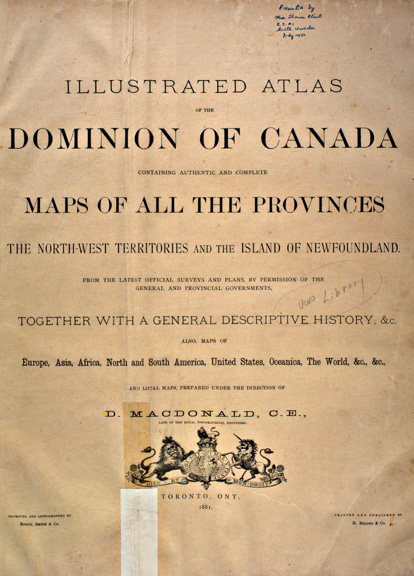
The Coat of Arms of the Dominion of Canada for an old illustrated atlas.
John A. Macdonald first sought to name the result of Confederation “The Kingdom of Canada”, but the British Foreign Secretary vetoed the proposal, fearing that such a name would invite hostility from the American republic.[3] At the London Conference, the Fathers of Confederation and the British government needed to agree on a new name. In the King James version of the Holy Bible, Psalm 72: 8 reads: “And he shall have dominion also from sea to sea, from the rivers unto the ends of the earth.” This passage probably influenced the original choice of name of this country, “The Dominion of Canada.” Canadian historian A.H.U. Colquhoun considers the biblical origins of the “Dominion of Canada” apocryphal (pun intended)[4]. The Department of Canadian Heritage acknowledges that the national motto contained in our coat of arms, Ad mari usque ad mare (“From Sea to Sea”), comes from Psalm 72:8. The ribbon of our coat of arms contains the phrase desiderantes meliorem patriam (“desiring a better country”), which comes from Hebrews 11:16. Given that our national motto comes from Psalm 72:8 and that this same passage also discusses “dominion”, I wouldn’t be surprised if the framers derived the idea of the Dominion of Canada from the Bible as well. Parenthetically, I have only determined that the “Dominion of Canada” fell out of use sometime under Prime Ministers Pearson or Trudeau, though the patriation in 1982 and Parliament’s elimination of “Dominion Day” with “Canada Day” the same year certainly marks its final end.
[1] Paul Benoit, “The Crown and the Constitution,” Canadian Parliamentary Review 25, no. 2 (2002): 2-3.
[2] Janet Ajzenstat et al., ed. Canada’s Founding Debates. (Toronto: University of Toronto Press, 1999): 83.
[3]Ibid., 60.
[4] George M. Wrong and H.H. Langton, ed. The Chronicles of Canada: Volume VIII – The Growth of Nationality (Tuscon, AZ: Fireship Press, 2009): 61.
I have published this account somewhat belatedly; however, regardless of the current state of the constitutional crisis in Papua New Guinea, it brings some fundamental underlying principles of Westminster parliamentarism to light and provides an excellent case study in the consequences of combining a highly codified constitution with a system that traditionally rests on unwritten constitutional convention. Papua New Guinea’s codified constitution illustrates the dynamic between the Sovereign (Head of State), the Governor-General (the Queen’s representative), the Prime Minister, and Parliament. Interestingly, it also incorporates several elements that the Forseyite camp of Canadian constitutional scholars have studied or advocated: the constructive vote on non-confidence, the prime ministerial confirmation vote at the beginning of the session, the elimination of crown prerogative on dissolution, etc.
I argue that Papua New Guinea’s present constitutional crisis ultimately derives from its highly codified constitution, which, for instance, attempts to reconcile the contradictory concepts of popular sovereignty, as in a republic, and the sovereignty of the crown, as in a constitutional monarchy. The Constitution of Papua New Guinea provides an interest case study relative to my upcoming article that I co-authored with Nick MacDonald on “Writing the Unwritten: The Officialization of Constitutional Conventions in Canada, the United Kingdom, New Zealand, and Australia”
The Crisis
Papua New Guinea has descended into a bizarre constitutional crisis that pits the ousted Prime Minister Sir Michael Somare and the Supreme Court on one side against Prime Minister Peter O’Neill and Parliament on the other. The Governor-General of Papua New Guinea Sir Michael Ogio and the Queen – the supposed neutral, dignified parts of the Crown – find themselves trapped between the two political factions.
Papua New Guinea held its last election in June 2007. The Prime Minister Sir Michael Somare left Papua New Guinea in April 2011 in order to undergo heart surgery in Singapore; he appointed Sam Abal as Acting Prime Minister. Somare’s family announced his resignation in June 2011 while he was still recovering from surgery in Singapore; however, Sir Michael himself did not submit his resignation to the Governor-General as per Section 146 of the constitution.
The Paradox of Codification: Making Conventions Justiciable Limits Parliament and Empowers The Courts
The Constitution of Papua New Guinea contains numerous contradictions and codifies almost all aspects of government over the course of 166 pages, including the roles of the Queen – which the constitution unreservedly calls “the Head of State” –, her representative the Governor-General, the Prime Minister, the National Executive (the equivalent of our Privy Council), the confidence convention, motions of non-confidence, and the procedures for dissolution.
Popular Sovereignty or Parliamentary Sovereignty?
The preamble borrows its introduction from the American constitution and asserts that “We the People of Papua New Guinea […] hereby establish, adopt, and give to ourselves this constitution […].” This wording therefore adopts the republican concept of popular sovereignty and formally vests sovereign authority in the people of Papua New Guinea; in contrast, a constitutional monarchy would vest sovereignty in the Crown-in-Parliament. However, Section 82 defines Queen Elizabeth II as “Queen and Head of State of Papua New Guinea” after “having been requested by the people, through their Constituent Assembly” to assume this role. Essentially, the Queen is the Head of State of Papua New Guinea because the people so asked her. This provision seems inherently contradictory with the idea of constitutional monarchy; however, history shows that the Westminster parliament changed the line of succession twice, in 1688 and in 1707, in order to secure the Protestant succession. William III and George I became kings because Parliament asked them to assume the role of Sovereign. The invitation extends to all the Queen’s rightful heirs and successors: “The provisions of this Constitution referring to the Queen extend to Her Majesty’s heirs and successors in the sovereignty of the United Kingdom of Great Britain and Northern Ireland.” The difference hinges on parliamentary sovereignty vs popular sovereignty, but the idea of “electing a Sovereign” remains the same in principle.
The constitution prescribes both a “Declaration of Loyalty” and an “Oath of Allegiance.” The Declaration of Loyalty requires the office holder to “freely and willingly declare [his] loyalty to the Independent State of Papua New Guinea and its People and to the Constitution of Papua New Guinea […] and promise [to] uphold the Constitution and the laws of Papua New Guinea.” The Declaration of Loyalty also follows the classic republican model and acknowledges the sovereignty of the people and significance of the constitution in securing their sovereignty. However, the Oath or Affirmation of Allegiance follows the Australian standard: “I,…, do swear that I will well and truly serve and bear true allegiance to Her Majesty Queen Elizabeth II. Her heirs and successors according to law. SO HELP ME GOD.” While I can accept the idea of “electing a Sovereign”, because the Westminster parliament has done so twice in its history, I cannot reconcile the Declaration of Loyalty and the Oath of Allegiance: the former recognizes the republican principle of popular sovereignty, and the latter recognizes the sovereignty of the Crown-in-Parliament.
The Queen and the Governor-General
The constitution also codifies the powers of the Queen and Governor-General and the procedure by which the Governor-General is appointed. After defining the Queen as “Head of State”, the constitution then refers to this office by the latter appellation. Section 86 outlines the functions of the Queen; paragraphs 1 and 2 essentially eliminate all the reserve powers by declaring that the Queen “shall act only with,and in accordance with,the advice of the National Executive Council, or of some other body or authority prescribed by a Constitutional Law or an Act of the Parliament for a particular purpose as the body or authority in accordance with whose advice the Head of State is obliged, in a particular case, to act.”
The phrase the Queen “shall act only with […] the advice of the National Executive Council” (the cabinet) eliminates the exercise of royal prerogative at the Queen’s personal discretion or initiative. The addition of “and in accordance with the advice of the National Executive Council” means that the Queen must carry out the advice of her Ministers in Papua New Guinea, “in accordance with whose advice the [Queen] is obliged […] to act.” This paragraph also recognizes that additional Acts of Parliament may further regulate, limit, or abolish the exercise of crown prerogative.
Curiously, Paragraph 4 stipulates that the advice that the Cabinet or Prime Minister offers to the Queen is “non-justiciable” – notwithstanding that almost all the other codified provisions are by definition justiciable.
The Governor-General acts as the Queen’s representative and carries out all powers and functions of that office, except where the constitution otherwise notes. Section 87 Paragraph 5 states that the Governor-General will normally serve only one term, but that Parliament may, but a two-thirds supermajority, approve a second term. By Section 88, “The Governor-General shall be appointed by the Head of State, acting with, and in accordance with, the advice of the National Executive Council given in accordance with a decision of the Parliament.” Judging by the wording, Parliament nominates a person for Governor-General through a simple majority vote and “exhaustive secret ballot”, after which the government must give the Queen binding advice to appoint the nominee. The Queen must remove the Governor General from office on the advice of the government; interestingly, an absolute majority in parliament can also force the government to advise the Queen to remove the Governor General. After the Queen’s dismissal of the Governor General, the Speaker or Chief Justice (in that other of precedence) becomes the “Acting Governor General.” Prime Minister O’Neill invoked this procedure.
The Prime Minister
Upon its first sitting after an election, the Parliament of Papua New Guinea nominates the Prime Minister in a confirmation vote, and the Governor-General is bound to appoint Parliament’s nominee.
Section 142: (2) The Prime Minister shall be appointed, at the first meeting of the Parliament after a general election and otherwise from time to time as the occasion for the appointment of a Prime Minister arises, by the Head of State, acting in accordance with a decision of the Parliament.
The Codification of the Confidence Convention and Procedures for the Dissolution of Parliament
Section 105 describes the three procedures through which a general election can be held.
1.A general election to the Parliament shall be held— (a) within the period of three months before the fifth anniversary of the day fixed for the return of the writs for the previous general election; or (b) if, during the last 12 months before the fifth anniversary of the day fixed for the return of the writs for the previous general election— (i) a vote of no confidence in the Prime Minister or the Ministry is passed in accordance with Section 145 (motions of no confidence); or (ii) the Government is defeated on the vote on a question that the Prime Minister has declared to the Parliament to be a question of confidence; or (c) if the Parliament, by an absolute majority vote, so decides.
Papua New Guinea operates parliaments on a fixed term of five years. The specification in part b) seems unusual and only makes sense in light of Section 145. Essentially, it means that parliament can only defeat the government in order to precipitate fresh elections in the last 12 months of the life of the parliament, whether by passing a vote of non-confidence or by defeating the government on legislation that the Prime Minister has deemed a matter of confidence. However, Part c) seems to mean that “an absolute majority” of parliament can decide to dissolve itself at any time during the life of the parliament. The Fixed-Term Parliaments Act of the United Kingdom now allows the Westminster Parliament to follow a similar procedure. The crown prerogative on dissolution does not exist under the constitution of Papua New Guinea.
Section 145 codifies the confidence convention. It also allow demonstrates that the resignation or dismissal of the Prime Minister does not automatically entail the resignation of the Ministry as a whole. Linking back to Section 105, parliament can introduce only constructive votes of non-confidence during the first four years of the life of the parliament: the motion must nominate the next Prime Minister, and parliament cannot be dissolved for an election. And parliament can only introduce traditional motions of non-confidence during the last year of the life of the parliament: this motion must not nominate a new Prime Minister and necessarily triggers an election. Finally, subsection 4 states that parliament may not put forward any motions of non-confidence in the Prime Minister or the Ministry during the first 18 months of the Prime Minister’s tenure.
Conclusion
Section 145 places bizarre and unwarranted limits on parliament’s power. However, based on this section, I can only conclude that the Supreme Court ruled correctly that parliament violated the constitution by removing Sir Michael Somare as Prime Minister. The last election in Papua New Guinea occurred in June 2007, which means that 11 August 2011, the date on which Parliament nominated Peter O’Neill as Prime Minister, fell within the last 12 months of the life of the parliament. Section 145 clearly stipulates that Parliament may not nominate a new Prime Minister within the last 12 months of the life of the parliament; instead, fresh elections must be held.
Australian constitutional scholar Anne Twomey argued that, rather than involving the Queen, the Parliament should be dissolved so that the people of Papua New Guinea – who, after all, are the sovereign according to their constitution – can resolve this crisis through the ballot box. According to Section 105 of the Constitution of Papua New Guinea, “A general election to the Parliament shall be held if the Parliament, by an absolute majority, so decides”, which presumably means that Parliament can dissolve itself at any point during its constitutional limit of 5 years. Since the Parliament of Papua New Guinea possess the power to dissolve itself, I agree with Professor Twomey that fresh elections offer the best solution to the current crisis, especially given that Papua New Guinea must hold elections by June 2012 anyway. The people should determine the outcome in order to preserve what neutrality of the Crown remains, and hopefully, an election would ensure that all parties put aside their differences in order to avoid violence and bloodshed.
In that upcoming article on “The Officialization of Constitutional Convention”, Nick MacDonald and I describe “the codification of convention” as a paradox. Conventions are, by definition, politicallyenforceable norms that complement the written constitution or statutory law. In contrast, Acts of Parliament and the written constitution are justiciable – enforceable in the courts. Codification thus eliminates the politically-enforceable character of constitutional convention altogether by converting these political rules into justiciable law. Under a highly codified constitution, the government’s decisions are subject not merely to parliamentary scrutiny or approval, but to judicial review. Papua New Guinea proves our hypothesis beyond any doubt, and offers a warning to any other Commonwealth Realm on the perils of codification. If only we could have included this example in the article! The article therefore recommends only the “officialization” of constitutional convention: the creation of official interpretations of convention endorsed by Cabinet (in the form of a handbook or manual) that describe the proper exercise of constitutional authority. Officialization preserves the fundamental character of constitutional convention: their adaptability, particularly in difficult situations that would force the normal application of a convention to deviate from the underlying constitutional norm or principle that it represents.
Overall, I can only conclude that Papua New Guinea’s highly codified constitution has little bearing on Canada; Papua New Guinean precedents are therefore not “persuasive” (to use the legal-constitutional term) on Canada, but they do warrant further study. I must admit: while there are 16 Commonwealth Realms, I have only examined the 4 “core Commonwealth realms” (the United Kingdom, Canada, Australia, and New Zealand) in any detail and neglected the remaining 12 others. The constitutional crisis in Papua New Guinea showed me the incredible institutional diversity of the Commonwealth Realms and the excellent opportunities for comparative analyses that they provide.


 Canada’s Constitutional Monarchy also includes an approximation of what the constitutional scholar David E. Smith has dubbed “the compound monarchy” that constitutes Canada as a federation. The diagram depicts the classical federalism that the Judicial Committee of the Privy Council shaped in Canada: the provinces and the federal are co-equal in their spheres of jurisdiction. Parenthetically, republicans often overlook the Crown in its capacity as the guarantor of Canadian federalism and rarely explain how their new form of government would take into account the void left by the elimination of the provincial Heads of State, the Lieutenant Governors.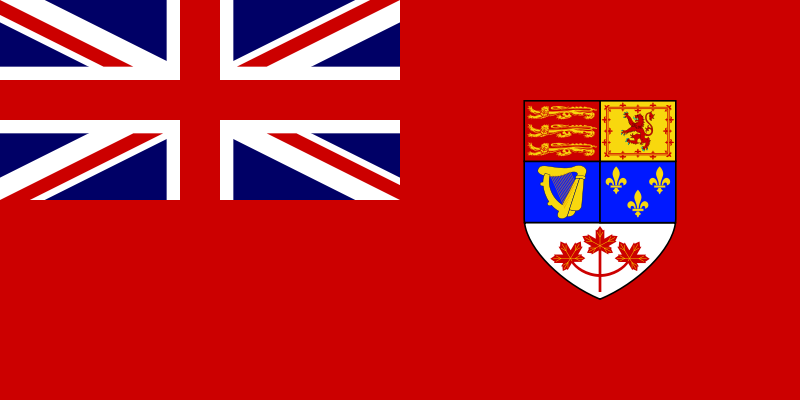




 James Bowden's Blog