Peter Russell on the Prorogation-Coalition Controversy of 2008


Russell’s Errors of Interpretation on Prorogation

Ontario News Watch uploaded an interview with Peter Russell on 25 June 2012, in which he displayed his unalloyed Forseyite interpretation of the reserve powers. Russell made several demonstrably incorrect assertions throughout the interview, which I shall enumerate below and support with the appropriate scholarship and primary sources, such as the proclamations of prorogation themselves contained in the Canada Gazette.

“Unprecedented” Advice to Prorogue

Russell incorrectly characterized the prorogation of 2008 as “unprecedented.” Canadian historian Barbara Messamore wrote a book on the early Governors General of the United Province of Canada and the Dominion of Canada and thoroughly debunked Russell’s assertion. In “No Discretion: On Prorogation and the Governor General,” Nick MacDonald and I demonstrated that the prorogation of 1873 took place under almost identical circumstances as did the prorogation of 2008: with a government facing imminent defeat in the Commons, the Prime Minister advised the Governor General to prorogue Parliament, and the Governor General did so. As The Globe (a Liberal paper) and the Ottawa Citizen (then a steadfastly Conservative paper) show, Macdonald’s prorogation of 1873 also provoked an enormous public controversy and heated debate for and against his advice. In 1873 as in 2008, critics decried a breach of parliamentary principles and denigration of Responsible Government.

The difference between the two prorogations rests with the response of the House of Commons. Macdonald advised prorogation, which Lord Dufferin formally implemented on 13 August 1873, with a pro forma summoning for “the despatch of business” on 22 September 1873.[1] Macdonald then advised Dufferin to extend the length of the intersession to 23 October 1873, at which point the 2nd Parliament reconvened. In this case, the Commons decided to withdraw its confidence in the Macdonald government after the intersession and despite the prorogation. The first Macdonald ministry resigned on 5 November 1873, and Governor General Lord Dufferin formally appointed Alexander Mackenzie as Prime Minister on 7 November 1873.[2] Alexander Mackenzie then advised Governor General Dufferin to prorogue the 2nd Parliament that same day, and to extend the intersession of the prorogation yet further on 12 December 1873.[3] Finally, he advised dissolution on the 2nd Parliament for 4 January 1874, even though it had sat for only two years.[4]

However, when the 40th Parliament resumed for its 2nd session in January 2009, the Commons saw fit to pass the Harper government’s Keynesian budget and thus maintained its confidence in that Government. The identical inputs of these situations produced divergent outputs, but the House of Commons decided the fate of both the Macdonald government and the Harper government. Therefore, Russell and all those who agree with him should blame the House of Commons and the breakdown of the Liberal-New Democratic “cooperative government” agreement and the second Liberal-New Democratic agreement with the Bloc Québécois[5] – not Prime Minister Harper.

The Meaning of Responsible Government

Russell gave an unbridled, classic recap of Forsey’s interpretation of the reserve powers at 1 minute, 50 seconds:

The power to summon, prorogue, and dissolve Parliament […] are powers of the Crown, which are exercised in Canada by the Governor General. […] There’s no question that the power is hers and hers to use as she sees fit. [The Governor General] has to think what is in the best interest of parliamentary democracy and the well-being of Canadians. […] The Crown has the reserve power […]. It’s a tough call, which lots of arguments on either side of the issue. […] The Crown is our safeguard over our Prime Ministers who might want to ride roughshod over Parliament, ignore its will, not be willing to submit themselves to its judgement. That was the big worry: was this a Prime Minister not willing to submit his government to the judgement of Parliament? [The Governor General] has an important job to project the integrity of parliamentary democracy.  

Russell has omitted the conventional constitution and thus lost sight of the definition of Responsible Government itself. Responsible Government means that “Ministers of the Crown” (the Prime Minister and Cabinet) “take responsibility for all acts of the Crown” (policies, expenditure, decisions).[6] Under Responsible Government, the Sovereign does not act unilaterally and independently, but on the advice of the Prime Minister alone or the Cabinet as a whole and in accordance with that advice, except in extraordinary circumstances where the “reserve powers” may apply.[7] The Government must command the confidence of the Commons, gauged by formal votes in the chamber, in order to govern, though it retains all its formal legal powers and authority when Parliament is prorogued or dissolved.[8] The Government must also command the confidence of the Commons in order that the Governor General act in accordance with the advice of the Prime Minister to prorogue and dissolve. Notwithstanding the extra-parliamentary declarations of Members, the Harper government had already demonstrated that it possessed the confidence of the 40th Parliament through the Address in Reply to the Speech from the Throne when Harper advised prorogation on 4 December 2008.[9]

The Supreme Court of Canada and the Court of Appeal for Ontario have recognized the validity of the aforesaid interpretation of Responsible Government. In Black v Chretien (2001), the Court of Appeal for Ontario ruled:

By convention, the Governor General exercises her powers on the advice of the Prime Minister or Cabinet. Although the Governor General retains discretion to refuse to follow this advice, in Canada that discretion has been exercised only in the most exceptional circumstances. Still, nothing in the Letters Patent or the case law requires that all prerogative powers by exercised exclusively by the Governor General. As members of the Privy Council, the Prime Minister and other Ministers of the Crown may also exercise the Crown prerogative. The reasons of Wilson J. in Operation Dismantle [case of the Supreme Court] affirm that prerogative power may be exercised by cabinet ministers and therefore does not lie exclusively with the Governor General.[10]   

Russell has therefore conflated the discretionary authority of the Sovereign or vice-regal to reject the Prime Minister’s advice under exceptional circumstances (the reserve powers) with the total powers of the Crown as a whole, which Ministers of the Crown routinely exercise in the name of the Queen or Governor General and for which they must take responsibility. Russell also uses “the Crown” to mean “the Governor General”; in reality, even Walter Bagehot, writing in 1867, recognized that “the Crown” consists of the “dignified” function, represented by the Queen or Governor General, and the “efficient” function, carried out by Ministers of the Crown.[11] Where the written constitution declares that the Governor General carries out a function, he does so by convention on and in accordance with the advice of the Prime Minister. Where the written constitution declares that the Governor-in-Council carries out a function, he does so on and with accordance to the advice of Cabinet. Russell is therefore wrong to assert that “There’s no question that the power [to summon, prorogue, and dissolve] is [the Governor General’s] and hers to use as she sees fit” because the Governor General does not act unilaterally and independently. The Governor General may reject advice, but must always ensure that the government can defend that decision, which is why vice-regal rejection of constitutional advice to prorogue or dissolve parliament would require the Governor General to dismiss the Prime Minister and government whose advice he rejected and appoint another. Just as the Governor General cannot dissolve parliament unilaterally, he cannot prorogue it unilaterally.

Procedure of Prorogation and the Duration of the Intersession

Russell ignores the written constitution’s limit on the duration of an intersession and ignores the proclamations on pro forma summoning. At 5 minutes and 5 seconds, he argues that the Governor General would “be bound to refuse [advice to prorogue]” under certain conditions. “One would be proroguing Parliament for an indefinite period or for months.”

Nick MacDonald and I already thoroughly debunked this spurious claim in our article, “No Discretion: On Prorogation and the Governor General,” but I will cite the relevant passage here.

[A] government in fact cannot indefinitely avoid or postpone a vote of non-confidence via prorogation, because it necessarily results in a new session of parliament, which in turn necessitates a new Speech from the Throne. The Address in Reply of the Speech from the Throne marks the first vote of confidence of any session, and parliament must debate this before conducting other business. The opposition can vote against this and thus defeat the government. The government can therefore only invoke prorogation once before the House of Commons could withdraw its confidence. In addition, the Constitution Act, 1982 requires that parliament meet at least once annually. Parliament must convene in order, at the very least, to pass supply in the form of the budget and estimates; the bills associated with supply constitute votes of confidence on which the government cannot evade parliament’s will.[12]

The documents in the first section show that each proclamation of prorogation (or before 1982, each Throne Speech than ended a session) and each proclamation of dissolution also entail a “pro forma summoning” of the next session or next Parliament. The Manual of Official Procedure of the Government of Canada, which Russell consciously dismisses and ignores despite its accurate descriptions of historical practice, explains this tradition and accounts for the proclamations extending the prorogations of 1873, which I included earlier in this column.

It is customary for a parliament to be always on summons, so Parliament must be prorogued to a specific date, even if there is no intention of convening it on that day. Historically, if no date for meeting is selected, it was customary to prorogue it pro forma for 40 days. The period of prorogation could be extended by proclamations for periods of 40 days.  The 40-day custom is based on the Magna Carta of King John, which agreed to give a minimum of 40 days’ notice for the summoning of Parliament.[13]   

The Canada Gazette contains the proclamations of prorogation, which also include the proclamation for the pro forma summoning of the next session of parliament. The prorogation of 4 December 2008 consisted of a “Proclamation Proroguing Parliament to 26 January 2009” as well as a “Proclamation Summoning Parliament to Meet on 26 January 2009,” both of which the Governor General issued “by and with the advice and consent of the Prime Minister of Canada.”[14] This wording demonstrates that contrary to Russell’s implication, the Governor General does not prorogue unilaterally and independently. The same applies to the prorogation of 2009.

Russell’s Dismissal of the Manual of Official Procedure of the Government of Canada

Russell again consciously dismissed the Manual of Official Procedure of the Government of Canada and pretended that it does not exist. Russell most certainly knows about the Manual because MacDonald and I once showed him a complete copy. Where Forsey described the reserve powers as “the last bulwark against prime ministerial absolutism,”[15] Russell described their raison d’etre as the “protect[ion] of our democracy.” He lamented, “I wish some of the principles governing their use were better set out in writing and available to the people and the media and the politicians – and agreed upon by the politicians […] We’re working on that – it’s a work in progress.”

Russell dismisses this cabinet handbook and its officialization of constitutional convention because it contradicts all his writings and assertions since the prorogation of 2008. For instance, the Manual states, “The Governor General does not retain any discretion in the matter of summoning or proroguing Parliament, but acts directly on the advice of the Prime Minister.”[16] However, the governor general can reject advice to dissolve under “those rare and almost indefinable circumstances when it is necessary for the protection of the constitution”.[17]

Activism vs Scholarship: Coalition of 2008

Russell was right on some key points, such as the constitutionality of coalition governments, and criticized “the government’s propaganda” with respect to the coalition agreements. He also confirmed that the Conservatives negotiated with the Liberals in order to secure passage of the budget in January 2009.

Like so many other scholars in the wake of the Prorogation of 2008, Russell has descended into anti-Conservative and anti-Harper political activism, which he insists on portraying as genuine constitutional scholarship. He characterized some unnamed ministers in the Harper government as “disgusting rather than ignorant” for having portrayed the proposed coalition as an unconstitutional coup d’état. He added,

[the Harper government] did two things which I think are disgusting – and I’ll use that word: one is misleading the people that there’s some rule that you can’t have a coalition unless it’s put before the public prior to the election – that’s absolutely BS, and there’s no parliamentary democracy in the world that has any such rule. […] [The Harper government] was also disgusting in that it treated the Bloc Québécois […] as an illegitimate group of MPs whose support for that [proposed coalition] government made it illegitimate […] because their long-term political program was an independent Quebec.

Obviously, coalition governments are not illegal or unconstitutional (contrary to some of the Harper government’s rhetoric), though I would argue that they are undesirable. And the proposed Liberal-New Democratic government certainly did not qualify as a coup d’état, contary to the most absurd and hyperbolic Conservative claims. The mendacity of the coalition-prorogation crisis knew no bounds and certainly did not apply exclusively to the Conservatives. In his memoirs, Brian Topp revealed that before Dion, Layton, and Duceppe held their joint press conference, he had identified on 30 November 2008 the possibility that the “Tories [would] prorogue to January” as a “short-term risk” to the fledging coalition.[18] Topp also acknowledged that he knew of “a manual drafted in the 1960s by the Privy Council Office […] that directs the governor general to grant a prorogation of the house to the prime minister, unconditionally and in every case.”[19] Topp served as one of the New Democrats’ chief negotiators and political operators; if he considered prorogation a legitimate delay tactic on 30 November 2008, then the New Democrats should not have question the constitutional legitimacy of Harper’s advice to prorogue. Of course, political parties operate under politicians’ logic and must shore up their respective bases of support, whether with integrity, or more likely, through the official mendacity and soft deception that so often characterize politics.

In addition, the evidence also leads to the conclusion that coalition governments do not form part of Canada’s political-cultural norms, and norms matter in a country that operates under a hybridized written-conventional constitution. Of the 41 Parliaments of Canada, 11 have been minority parliaments. All 11 supported single-party minority governments, sometimes with general support from an opposition party (as the New Democrats supported Pearson’s and Trudeau’s minorities) but never in formal coalition government, which means that the Prime Minister nominates Ministers of the Crown from more than one political party.[20] In fact, I would argue that the Conservatives’ and Harper government’s mendacity on the illegality of coalition government so resonated with the Canadian electorate and succeeded in shifting public opinion precisely because coalitions do not figure into our federal political norms.

The only coalition government at the federal level consisted of Robert Borden’s Conservatives and most English-speaking Liberals and governed from 1917 to 1920 through two majority parliaments; even Russell himself has acknowledged this fact.[21] This Unionist government formed in order to help better manage Canada’s war effort in Europe. The Cabinet itself consisted of 15 Conservatives, 9 Liberals, and 1 Labourite, which the Governor General appointed on 12 October 1917.[22] Most importantly for the purposes of this discussion, the Liberals and Conservatives adopted the platform of the Unionist Coalition Government, led by Prime Minister Robert Borden, and thus campaigned in the election of 17 December 1917 as a coalition.[23] Therefore, contrary to Russell’s assertions, the proposed Liberal-New Democratic coalition of 2008 was the only “unprecedented” element of the prorogation-coalition controversy because the parties did not campaign in the 40th general election as a coalition. Finally, if anyone wants to argue that national emergencies warrant coalition governments, then I must point out that the scale of crisis that the recession of 2008 posed does not even come close to the futile carnage of the First World War.

Unfortunately, I suspect that to the extent that media outlets pay this interview any attention, they will proclaim Russell’s words gospel, shun any critical examination of his assertions, and gloss over the factual errors.

Similar Posts:


[1] Canada, The Canada Gazette, “Proclamation” for the Despatch of Business (Ottawa: Her Majesty the Queen in Right of Canada, 22 September 1873): 470-471.
[2]
Canada, Privy Council Office, “First Ministry” and “Second Ministry,” Guide to Canadian Ministries Since Confederation. [accessed 25 June 2012]
[3]
Canada, The Canada Gazette, “7th November, 1873: Chamber of the Senate, [Governor General’s] Speech,” no. 10, volume VII (Ottawa: Her Majesty the Queen in Right of Canada, 8 November 1873): 531; Canada, The Canada Gazette, “Proclamation,” no. 10, volume VII (Ottawa: Her Majesty the Queen in Right of Canada, 13 December 1873).
[4]
Canada, The Canada Gazette, “Proclamations,” no. 27, volume VII (Ottawa: Her Majesty the Queen in Right of Canada, 3 January 1873). This packet includes the proclamation dissolving the 2nd Parliament, the issuing of the writs of the 3rd general election, and a pro forma summoning of the 3rd Parliament.
[5]
The Liberals and New Democrats would have based their coalition government on “An Accord on a Cooperative Government to Address the Present Economic Crisis.” In turn, the Bloc pledged to provide the necessary parliamentary support of the Liberal-New Democratic coalition until June 2011 in “A Policy Accord to Address the Present Economic Crisis.
[6]
Sir John George Bourinot, Parliamentary Procedure and Practice, 4th ed. (Montreal: Dawson Brothers Publishing, 1916): 102.
[7]
Black v Canada (Prime Minister) (2001), 199 D.L.R.
[8]
Canada. Privy Council Office, Guidelines on the Conduct of Ministers, Secretaries of State, Exempt Staff and Public Servants During An Election. (Ottawa: Her Majesty the Queen in Right of Canada, 2008): 1.
[9]
Nicholas A. MacDonald and James W.J. Bowden, “No Discretion: On Prorogation and the Governor General,” 34, no. 1 (Spring 2011): 7-16.
[10]
Black v Canada (Prime Minister) (2001), 199 D.L.R., para. 31-32.
[11]
Walter Bagehot. The English Constitution. 2nd Ed. 1873.  http://socserv.mcmaster.ca/econ/ugcm/3ll3/bagehot/constitution.pdf
[12]
Nicholas A. MacDonald and James W.J. Bowden, “No Discretion: On Prorogation and the Governor General,” 34, no. 1 (Spring 2011): 14.
[13]
Canada. Privy Council Office, Manual of Official Procedure of the Government of Canada, Henry F. Davis and André Millar.(Ottawa: Government of Canada, 1968): 403.
[14]
Canada, Canada Gazette, Part II, Proclamation Proroguing Parliament to 26 January 2009” (Ottawa, Her Majesty the Queen in Right of Canada, 4 December 2008).
[15]
Eugene Forsey, The Royal Power of Dissolution of Parliament in the British Commonwealth (Oxford University Press, 1968): 259.
[16]
Canada. Privy Council Office, Manual of Official Procedure of the Government of Canada, Henry F. Davis and André Millar. (Ottawa: Government of Canada, 1968):,149.
[17]
Ibid., 408-409.
[18]
Brian Topp, How We Almost Gave The Tories The Boot: The Inside Story Behind the Coalition (Toronto: James Lorimer & Company Ltd, 2010): 118, 122.
[19]
Ibid., 156.
[20]
Peter Russell. Two Cheers for Minority Government: The Evolution of Canadian Parliamentary Democracy. (Toronto: Emond Montgomery Publications Limited, 2008): 8-10.
[21]
Ibid., 10. “‘COAL’ refers to the one and only coalition government Canada has had at the federal level.”
[22]
Canada, Privy Council Office, “Tenth Ministry,” Guide to Canadian Ministries Since Confederation. [accessed 25 June 2012]
[23]
The Globe, “Working Out the Details for Election New Interests: Understanding Reached Is There Shall Be No Distinction Between Liberal and Conservative Candidates Supporting the Union Government,” 13 October 1917, page 3.

Posted in Caretaker Convention & Government Formation, Coalition Government, Conferences and Speeches, Confidence Convention, Constitutional Conventions, Crown (Powers and Office), Formation of Governments, Governor's Discretion, Prime Minister's Powers, Prorogation, Reaffirmation of, Responsible Government, Reviews | Tagged , , , , , , , , , , , | 10 Comments

Your Canada, Your Constitution: Constitutional Sophistry and Political Activism Trump Scholarly Research and Educating Canadians


Introduction: The Mendacity of Your Canada, Your Constitution

Your Canada, Your Constitution (YCYC) has published three other media releases since its formal launch on 4 June 2012; they all demonstrate beyond reasonable doubt that this organization actively promotes constitutional sophistry and attempts to conceal its political activism behind a veneer of scholarly respectability. It portrays itself as an “educational charity” (according to the Canada Revenue Agency’s database) but acts more like a political action committee. Call me old-fashioned, but I always thought that education and research entail the pursuit of truth – following the logos – which in turn require description and analysis of phenomena as they exist. Instead, YCYC presents a poorly articulated normative case on what its organizers and donors think that the Constitution of Canada ought to be. They even lack the decency to proclaim their anti-monarchism openly and concisely; they use code phrase like “popular sovereignty” and “rethinking monarchy” in order to promote the abolition of the Crown of Canada and the creation of the Federal Republic of Canada. I of course disagree with YCYC’s republican message; more importantly, I object to YCYC’s method of couching their republican arguments in the language of legitimate descriptions of the monarchical constitution.

Even the name of the organization – “Your Canada, Your Constitution” – is steeped in the identity politics of “wilful self-righteousness” and Romanticist collective and individual self-assertion.[1] The organization thus provides a forum in which like-minded individuals gather in order to affirm and reflect each other’s views. The name subtly evokes popular sovereignty and implies that the righteous Canadian people must seize “their” constitution from that evil, despotic Crown in order to thoroughly “democratize” it and cleanse it of all kingly pomp. As Carl Turkstra and Andrew Cohen made clear in their speeches on 4 June 2012, and Duff Conacher stated in his letter to the editor of 5 June 2012, YCYC seeks nothing less than a bloodless revolution of “democratization” in order to rid Canada of its symbol of colonial subjugation: the Crown. (Citizens for a Canadian Republic even lists Andrew Cohen as a republican).  They couch that intention in innocuous-sounding language such as, YCYC seeks to “involve Canadians in their democracy.” I demonstrated in “Contrarian for the Crown Infiltrates Your Canada, Your Constitution” and “Abolishing the Crown of Canada: Political Difficulty vs. Constitutional Significance” that Conacher, Cohen, Bliss, Moore, and others base their arguments on abolishing the Crown on a fundamental misunderstanding of the Crown’s centrality in the constitution.

As the following analysis will show, Your Canada, Your Constitution engages in political activism and promotes constitutional sophistry, not constitutional scholarship.

Conacher’s Letter to the Editor

In response to Andrew Coyne’s laudatory column on Her Majesty’s Diamond Jubilee, Duff Conacher wrote a short Letter to the Editor: Constitution’s Rules Not Followed and Unclear, Allow for Abuses of Power by the Prime Minister, Premiers, and their Cabinets. It plays fast and loose with constitutional facts.[2]

Conacher dismisses the Crown of Canada as an anachronism and propagates the incorrect constitutional interpretation of the Crown-as-Ornament. He relegates the Crown to the “historical basis for Canada and the structure of power in its governments.” In constitutional fact, the Crown provides the basis of government’s powers and authorities still.

Conacher then asserted a gross misrepresentation of the content of the Constitution Acts, the conventions of Responsible Government, and the nature of the total constitution:

However, while Canada’s Constitution states that the Queen (via the Governor General and provincial lieutenant governors) has final decision-making power over most key parts of federal and provincial government operations, this power has been essentially symbolic for decades.

Section 9 of the Constitution Act, 1867 states, “The Executive Government and Authority of and over Canada is hereby declared to continue and be vested in the Queen.” However, this acknowledgement of the source of executive power does notmean that “the Queen has final decision-making power over most key parts of federal and provincial government operations,” as Conacher would have us believe. Even Section 13 of the Constitution Act, 1867 affirms the constitutional relationship between the Cabinet and the Governor General: “The Provisions of this Act referring to the Governor General in Council shall be construed as referring to the Governor General acting by and with the Advice of the Queen’s Privy Council for Canada.” The conventional constitution must then be added to the written constitution.

As I never tire of reminding the constitutional sophists, Responsible Government means that Ministers of the Crown (the Prime Minister and Cabinet) take responsibility for all acts of the Crown (policies, expenditure, decisions) and that they must command the confidence of the Commons in order to govern.[3] Responsible Government arose by convention in the 19th century in the United Kingdom, and it was exported to British North America in 1848. The preamble of the Constitution Act, 1867 incorporates the constitution conventions of Responsible Government by affirming that Canada’s constitution is “similar in principle to that of the United Kingdom.” Legal scholars have recognized this principle since the 19th century.

Under Responsible Government, the Sovereign does not act unilaterally and independently, but on the advice of the Prime Minister alone or the Cabinet as a whole and in accordance with that advice, except in extraordinary circumstances where the “reserve powers” may apply. In a strange way, Conacher seems to object to these basic premises of Responsible Government and constitutional monarchy through the assertion that the Queen’s powers “have been essentially symbolic for decades.” He conflates the discretionary authority of the Sovereign or vice-regal to reject the Prime Minister’s advice under exceptional circumstances (the reserve powers) with the total powers of the Crown as a whole, which Ministers of the Crown routinely exercise in the name of the Queen or Governor General.

Conacher then makes another inaccurate series of assertions on the conventional constitution and political enforceability:

Unwritten rules (called “constitutional conventions”) have developed democratically to restrict the power of the royal-appointed governors to say no to an elected Prime Minister or premier when they want to pass a bill, appoint someone, call an election or shut down the legislature, even if they are abusing their powers. These unwritten rules are very unclear (experts don’t even agree what they are) and unenforceable (according to the Supreme Court of Canada).

I object to the overall tone of and word choice in this passage, which clearly derive from the narrative in Democratizing the Constitution: Reforming Responsible Government. Overall, Conacher has again misrepresented the powers and functions of the Governor General and Prime Minister, as well as the constitutional relationship between the two.

First, the Prime Minister and Cabinet do not pass bills – Parliament does. I explained this process in more detail in “No Discretion: On Royal Assent and the Governor General.” In this case, I use “Parliament” as shorthand for the Crown-in-Parliament, which consists of the Queen, the Senate, and the House of Commons. Royal Assent represents the approbation of a bill of all three parts of the Crown-in-Parliament. The preamble of all bills even indicates that the Governor General gives Royal Assent on the advice of the Senate and the House of Commons – certainly not on the advice of the Prime Minister or Cabinet! Cabinet only coordinates the scheduling of the ceremony for Royal Assent in Parliament Assembled. In addition, Royal Assent is automatic; there is simply no question that the Governor General would veto a bill that both houses of parliament passed. No Sovereign has refused Royal Assent since Queen Anne in 1707.

Second, Conacher should use more accurate terminology. By “call an election”, he means that the Prime Minister advises the Governor General to dissolve Parliament, that the Cabinet advises the Governor-in-Council to issue the writs of election, and that the Prime Minister advises the Governor General to issue a pro forma summoning of the next Parliament. (I explained this process in greater depth in “Neither the Queen Nor the Governor General Can Dissolve Parliament Unilaterally“). Conacher has adopted the political activist’s pejorative term for prorogation (which terminates a session of parliament) by referring to this Crown prerogative as “shutting down” Parliament. If he wants to adopt the political activist’s lexicon, “he should be out on the street shouting and hollering with a cardboard sign that reads ‘Stop Harper’ and selling pencils from a cup.”

Third, Conacher propagates the Aucoin School’s interpretation of “abusing power” as if it were undeniable constitutional fact. It most certainly is not, as my scholarship and the Bowden-MacDonald collaboration have demonstrated and will continue to show.

Fourth and finally, Conacher misinterpreted what the Supreme Court of Canada has ruled with respect to the conventional constitution – and as a lawyer, he should know better. In the Patriation Reference and in the Secession Reference, the Supreme Court of Canada acknowledged that constitutional conventions are not legally enforceable because they are instead politically enforceable.[4] Therefore, contrary to Conacher’s claim, the Supreme Court has never determined that conventions “are unenforceable” in general. And if experts cannot agree on constitutional conventions today (which is true), then I cannot fathom why Conacher would believe that they could agree on wording that codifies them into statute!

Conacher concludes his letter to the editor with a rallying cry to write down constitutional conventions. However, half of his statement implies an officialization of constitutional convention in a cabinet handbook, while the other half implies a strict codification of constitutional conventions in statute or in the written constitution itself.

So it seems that steps forward for all concerned would be to change the Constitution to address the current reality and problem areas by acknowledging the British monarchy’s historical role, but also clearing up and writing down key governance rules to make them enforceable, and giving the GG and provincial governors legitimacy to enforce the rules through a non-partisan, representative appointment or election process, or (likely a better option) giving that enforcement power to the Supreme Court of Canada. Britain, Australia and New Zealand have all written down these key rules and made them more enforceable.

First, Conacher refuses to acknowledge the legal fact that the Statute of Westminster, 1931 created separate Crowns for all the Commonwealth Realms that share a Head of State in a personal union. Before 1931, there was only the Crown of the United Kingdom. The Statute of Westminster established the Crowns of Canada, Australia, New Zealand, etc. as separate legal entities and thus made Canada, Australia, and New Zealand independent states. There are currently 16 Commonwealth Realms, and this doctrine applies to all of them. Her Majesty Queen Elizabeth II therefore wears 16 Crowns and is separately the Queen of the United Kingdom, the Queen of Canada, the Queen of Australia, the Queen of New Zealand, and the Queen of 12 other Realms. The Prime Minister of the United Kingdom advises the Queen in Right of the United Kingdom, while the Prime Minister of Canada advises the Queen in Right of Canada. Nathan Tidridge’s diagram perfectly represents this evolution. When Conacher offers the platitude of “acknowledging the British monarchy’s historical role,” he ignores these crucial legal-constitutional and practical distinctions and suggests that he doesn’t even understand that the Crown of Canada and the Crown of the United Kingdom are separate.

Second, he opined that constitutional conventions should be “written down” and thus “made enforceable,” but he does not explain whether he means officialization in cabinet handbook or codification in law. He alludes to the respective cabinet handbooks of the United Kingdom, New Zealand, and Australia – which implies officialization – and he also argues that the Supreme Court should posses the power to enforce them legally – which implies codification. Well, which is it? You have to pick one or the other. Neither the United Kingdom, nor Australia, nor New Zealand has codified constitutional convention in statute; in other words, conventions in all three countries remain politically enforceable and thus not justiciable. Papua New Guinea, however, has codified several important former conventions into its constitution, which allowed a political crisis to morph into a full-fledged constitutional crisis in December 2011 and January 2012, as I demonstrate in Constitutional Crisis in Papua New Guinea: Codification Causes Confusion.

Third, Conacher misinterprets the consequences of officializing constitutional conventions in cabinet handbooks and couples that concept with this absurd notion of “giving the GG and provincial governors legitimacy to enforce the rules through a non-partisan, representative appointment or election process.” As Nick MacDonald and I explain in “Writing the Unwritten: The Officialization of Constitutional Conventions in Canada, the United Kingdom, New Zealand, and Australia,” the officialization of constitutional convention in cabinet handbooks does not necessarily led to more regal or vice-regal interventions in the political decisions of the Prime Minister and Cabinet. Cabinets endorse a particular version of a cabinet handbook in order to bind themselves politically to its contents, which, if anything, helps prevent regal or vice-regal intervention by clarifying the responsibilities of the Prime Minister, Cabinet, and Parliament. Cabinet handbooks are not designed embolden the Governor General or the Queen to don shining armour, mount white steeds, and become gallant Enforcers of Convention and Protectors Against the Abusive Prime Minister. Conacher seems to be alluding to the “vice-regal advisory elections” that other constitutional sophists have advocated; they would turn the vice-regals into de facto elected officials by, in effect, binding the Prime Minister to appoint the winner of the vice-regal election to the office. Such an arrangement represents a republican attempt to circumvent Section 41 (a) of the Constitution Act, 1982, but it would stillconstitute a fundamental change to the Offices of Governor General and the Lieutenant Governors.

Finally, I must also point out another curious contradiction: on the one hand, Conacher and the other main contributors to YCYC want to abolish the Crown of Canada, and on the other, Conacher argues in his letter to the editor that vice-regals should wield more power. When presented with two contrary proposition, both may be wrong and one must be wrong!

YCYC’s Second Press Release

The headline at least captures YCYC’s hyperbole, though within a clumsy sentence structure: “Experts tell conference Canada’s Constitution is a confusing mess of written and unwritten rules that allows for abuses by Prime Minister and premiers and their Cabinets.”[5] The opening paragraph does not bode well for the rest of the press release, which contains numerous factual errors and tenuous assertions.

The main speakers, all experts, detailed how Canada’s written Constitution contains rules for the decisions and actions of the Governor General and provincial lieutenant governors, and the Prime Minister and provincial premiers, but those rules are contradicted by unwritten rules (known as “conventions”) whose meaning and scope are debated by experts.

The Supreme Court of Canada explained in the Patriation Reference and in the Secession Reference that the contradiction that YCYC asserts in fact does not exist. As Nick MacDonald and I explained in “Writing the Unwritten: The Officialization of Constitutional Conventions in Canada, the United Kingdom, New Zealand, and Australia”:

The Supreme Court of Canada has described the conventional constitution as an integral component of Canada’s constitution and of equal standing to the Constitution Act, 1867 and the Constitution Act, 1982. The Supreme Court has also declared: “constitutional conventions plus constitutional law equal the total constitution of the country.”[6]

The Supreme Court also declared: “The Constitution is more than a written text.  It embraces the entire global system of rules and principles which govern the exercise of constitutional authority.  A superficial reading of selected provisions of the written constitutional enactment, without more, may be misleading.”[7]

If you look at only one part of the constitution instead of the whole of the constitution, then these matters will appear contradictory!

YCYC then adopts the Aucoin School’s narrative on “abuse” of Crown prerogative and presents it as fact, when it only forms one interpretation among many.

The gap between the two sets of rules creates a confusing mess that allow for what most commentators see as abuses of power. Politicians in Britain, Australia and New Zealand have all agreed to new written rules that clearly define the powers of the Prime Minister in various situations, such as calling elections, opening and closing the legislature, and votes (including on budgets) and appointments.

The so-called “gap between the two sets of rules” does not exist, and the conventional constitution can only be misconstrued and maligned as a “confusing mess” if one does not understand the history and evolution of Westminster parliamentarism or the way that Responsible Government works today. In addition, YCYC has consistently ignored the Manual of Official Procedure of the Government of Canada and even refuses to acknowledge its existence alongside the British Cabinet Manual, the New Zealand Cabinet Manual, and the Australian Cabinet Handbook.  Perhaps YCYC ignores the document beacuse it spcifically contradicts their narrative on prime ministerial “abuse” of power; it explains that the Governor General has no discretion to reject the Prime Minister’s advice to summon or prorogue Parliament and may only refuse advice to dissolve under exceptional circumstances.[8] Contrary to the implication of the press release, the three Realms that YCYC mentioned have not followed each other lockstep with the same approach: The British and New Zealand Cabinet Manuals cover similar topics in similar depth, but the Australian Cabinet Handbook sets out a far more limited range of officializations. None of them come close to the detail and historical examples of the Canadian Manual.

The press release then quotes another of Conacher’s logically inconsistent and factually incorrect statements:

Experts agree that Canada’s written Constitution sets out rules that are not followed concerning the powers of the Governor General, provincial lieutenant governors, and the Prime Minister and premiers and their cabinets, and that no one agrees what our unwritten constitutional rules concerning these powers actually are,” said Duff Conacher, Spokesperson for YCYC. “Britain, Australia and New Zealand have written down their rules, and made it clear who has the power to do what, and when, and so made their governments more democratic and accountable. Canada could do the same by simply passing a law changing the Parliament of Canada Act and other laws, and changing the related law in each province.

First, if “no one agrees” what rules of the conventional constitution are, then how can “[all] experts agree” that the rules of the written constitution are not followed?[9] Ponder on that for a moment: the statement just doesn’t make sense!

Second, as in his letter to the editor, Conacher has fused officialization in cabinet handbook and officialization in statutory law into one concept, when they are in fact two distinct and different methods of writing down the conventional constitution. The British, Australian, and New Zealand cabinet handbooks, along with the often-ignored Canadian manual, officialize parts of the conventional constitution – they do not codify anything. Yet Conacher cited those cabinet handbooks as examples of codification in statutory law when he mused that the Parliament of Canada Act could somehow be amended. Presumably, Conacher is talking about limiting the Crown prerogatives on prorogation and dissolution – which, by the way, none of the cabinet handbooks have done. If so, then he is wrong to suggest that Parliament could restrict or eliminate these powers by passing a law. Only an amendment to Section 41 (a) of the Constitution Act, 1982 could do so.

I found the next short paragraph amusing, because it conceals relevant information by omission. Professor Lagassé discussed the Crown prerogatives on foreign affairs and defence – and he defended the Crown in general and those prerogative powers in particular. The press release omitted the second part because Lagassé’s scholarship directly contradicts the narrative of the despotic Crown that YCYC has established.

In a Non-Coincidental Coincidence, YCYC’s Push Poll Tells Them Exactly What They Want to Hear

Just when I thought that I had completed my critique of YCYC, the organization released another press release on 20 June 2012. YCYC conducted a shameless push poll on the roles of the Governor General and Lieutenant Governors and found, in a not so coincidental coincidence, that about two-thirds of Canadians support Duff Conacher’s normative prescription, almost to the precise wording of his letter to the editor of 5 June 2012. Apparently, “65% of Canadians want clear rules to regulate key decision-making powers of Governor General and provincial lieutenant governors, enforced by Supreme Court of Canada.”[10] This self-reinforcing, tautological, manipulative, and maligned poll says more about the depths to which YCYC is willing to stoop in order to buttress its normative narrative than it does about Canadians’ views on the vice-regals.  The poll’s results are about as accurate and truthful as the 90-odd percent approval ratings that dictators receive.

The survey’s two questions reveal the manipulative nature and factual errors of this push poll, which clearly cajoles the respondents to give the “right” answer. The questions are inherently flawed, so I put no stock whatsoever in the responses. A poorly-worded, manipulative input yields an irrelevant output.

Question1

Under Canada’s current Constitution, the British Monarch together with an appointed Governor General (Lieutenant Governors for the Provinces) have the following decision-making powers:

  1. To approve or reject any law passed by our elected politicians;
  2. To determine when elections are held;
  3. To chose Canada’s Prime Minister and the Premier of each province after an election, and;
  4. To determine when Parliament and Provincial Legislatures are opened and closed.

To what extent do you agree or disagree with the British Monarch and Governor General and Lieutenant Governors having these decision-making powers?

  1. Strongly agree
  2. Agree
  3. Disagree
  4. Strongly disagree
  5. [Do not read] Don’t know/refused

Question 2
Do you think that these decision-making powers of the British Monarch and Governor General and Lieutenant Governors should be…

  1. Set out in clear rules that are enforced by the Supreme Court of Canada.
  2. Given to a person in a new position who is elected by Canadians.
  3. Both
  4. Neither
  5. [Do not read] Don’t know/refused

I suspect that Conacher himself wrote these questions, because they contain the same factual errors as his letter to the editor and the press release of 5 June 2012. These questions assert that the vice-regals give Royal Assent, make appointments, and summon, prorogue, and dissolve unilaterally and independently. In reality, vice-regals give Royal Assent as part of the Crown-in-Parliament and therefore on and in accordance with the advice of the legislature – not on the advice of the Cabinet. And with respect to the other functions, the vice-regal acts on and in accordance with the advice of Ministers of the Crown. Second, exactly zero out of those four powers is carried out in the name of the Queen of Canada. The Queen of Canada appoints or dismisses Governors General and appoints four or eight additional Senators (Section 26 of the Constitution Act, 1867) on and in accordance with the advice of the Prime Minister of Canada. I highlight Queen of Canada because between 1931 and 1982 the “British Monarch” carried out few functions in right of Canada. The King or Queen of the UK had to give Royal Assent to acts of the British Parliament that amended the British North America Act, which were undertaken on the advice of the Government of Canada. (I explained that situation in more detail in “The Constitution Act, 1982 Includes More Than the Charter of Rights and Freedoms“). Again, Conacher does not understand the difference between the Queen of the United Kingdom and the Queen of Canada. Incidentally, neither does Carl Turkstra. At the launch on 4 June 2012, he dismissed the legal-constitutional doctrine of the separate Crowns as “dogma.” Of course, it is is legal-constitutional fact.

Conclusion: The Facts on the Officialization of Constitutional Conventions in the Core Commonwealth

Therein lies the problem with Your Canada, Your Constitution: the donors and players within the organization barely contain their sheer contempt for the Crown of Canada and in so doing deny the facts of the constitution. Instead, they want to make their own facts and construct their own reality. Those behind YCYC may campaign against constitutional monarchy all they like, but they must not try to pass off their normative arguments and crypto-republicanism as valid factual descriptions of how the constitution and machinery of government actually work in Canada.

Nick MacDonald and I co-authored “Writing the Unwritten: The Officialization of Constitutional Conventions in Canada, the United Kingdom, New Zealand, and Australia,” which will soon appear in the summer issue of the Journal of Parliamentary and Political Law. It provides proper descriptions of many of the issues that YCYC has misinterpreted and misrepresented.

Similar Posts:


[1] Paul Benoit. “State Ceremonial: The Constitutional Monarch’s Liturgical Authority,” in The Evolving Canadian Crown, edited by Jennifer Smith and D. Michael Jackson, 119-137. (Kingston: Institute of Intergovernmental Relations, School of Policy Studies, Queen’s University, 2012): 130.
[2]
Duff Conacher, “Letter to the Editor: Constitution’s Rules Not Followed and Unclear, Allow for Abuses of Power by the Prime Minister, Premiers, and their Cabinets,” Your Canada, Your Constitution, 5 June 2012.
[3]
Sir John George Bourinot, Parliamentary Procedure and Practice, 4th ed. (Montreal: Dawson Brothers Publishing, 1916): 102.
[4]
Reference re Resolution to Amend the Constitution, [1981] S.C.R. 883-884.
[5]
Your Canada, Your Constitution, “Experts tell conference Canada’s Constitution is a confusing mess of written and unwritten rules that allows for abuses by Prime Minister and premiers and their Cabinets,” 14 June 2012.
[6]
Reference re Resolution to Amend the Constitution, [1981] S.C.R.884.
[7]
Reference re Secession of Quebec, [1998] S.C.R. supra note 5 at para 32.
[8]
Canada. Privy Council Office, Manual of Official Procedure of the Government of Canada, Henry F. Davis and André Millar. (Ottawa, Government of Canada, 1968): 150.
[9]
In formal logic, generalized statements like “experts agree” are treated as universal (as opposed to particular) propositions and thus treated as “all experts agree.”
[10]
Your Canada, Your Constitution, “Two-thirds of Canadians want changes to GG and prov. governors powers and positions,” 20 June 2012. You’ll notice the grammatical error in the headline, which should use the possessive “governors’ powers”, and for the sake of consistency and accuracy, use “GG” for Governor General and “LGs” for Lieutenant Governors.

Posted in Conferences and Speeches, Crown (Powers and Office), Governor's Discretion, Monarchism v Republicanism, Reviews, The Personal Union | Tagged , , , , , , , , , , , , , , , , , , | 9 Comments

Bruce Hyer’s Rage Against Responsible Government and Loyal Opposition


Thomas Mulcair: Steeped in the Tradition of Opposition as Alternative Government 

On 24 March 2012, the New Democratic party members elected Thomas Mulcair as their new leader. In a television interview a few hours after becoming the leader of the New Democratic Party and therefore the Leader of the Official Opposition in the 41st Parliament, Mulcair declared that the New Democrats will seek to form the next government after the next election, likely to occur in 2015, by “pospos[ing] a concrete plan and by presenting “capable people as candidates.” He also commented that “as Official Opposition, the New Democrats have already recruited high-level candidates more easily” and will put forward a team who will “offer the New Democrats as the next government.” Finally, Mulcair reflected on the failed Liberal-New Democratic coalition agreement of 2008 and criticized the Liberals’ reticence to treat the New Democrats as a serious partner. He unequivocally rejected the possibility of entering into a parliamentary coalition with the Liberals, whom he accused of being “good at flashing left and turning right.” He concluded that “Canadians want a real option” that can form the next government.[1] He added:

For the first time, we’re poised [to form government]. We have to take a state of fact [being the Official Opposition] and turn it into a state of mind: in other words, a perception by the public that [the New Democrats are] the government in waiting, that the New Democrats can actually form the next government. That’s our challenge for the next three and a half years. […] I want to bring all people who want to get rid of Stephen Harper’s Conservatives [to the NDP]. […] We are capable of rallying progressives of all strips under the NDP banner to form our first progressive NDP government in Canada.[2]

Thomas Mulcair will emerge as the most effective Leader of the Opposition since Stephen Harper, because he intrinsically understands that the Official Opposition must present itself as an alternative government and that he, as leader, must therefore present himself as the alternative prime minister.

Bruce Hyer’s Proposal to Eliminate the Adversarialism Essential to Responsible Government and Loyal Opposition

In contrast, Bruce Hyer, in an effort to integrate himself permanently into the media narrative on the evils of party discipline, put forward some propositions in “Why I Quit the NDP (And What Might Make Me Come Back)” that would undermine the principles of Responsible Government and Loyal Opposition. At least three of the four steps in the Plan to Restore Democracy to Parliament” would derogate from the principles of Responsible Government and Loyal Opposition and make the Commons more superficial and meaningless. I agree with him only on point two, that party leaders should not possess the power of veto over the nomination of candidates. I strongly oppose proportional representation and its corollary of perpetual coalition government. His conception of “collaboration between parties” misrepresents the roles of Government and Opposition under Responsible Government, and fits into the general criticism of “randomized seating” as a method of encouraging more free votes.

The Reform Party, that old bastion of right-wing Romanticism, first seriously introduced the delegate theory of representation to Canadian politics, which they often expressed as a normative statement: MPs should vote based on their constituents’ interests. In the early sittings of the 35th Parliament, Preston Manning (the populist son of a premier of Alberta who has now ironically succeeded in integrating himself into the federal political establishment) flouted parliamentary custom by refusing to sit in the first row.[3] Bruce Hyer has adopted both these views. Under Responsible Government, Members cannot and should not vote primarily “according to the wishes of their constituents.” Since Ministers of the Crown determine the government’s policies, Members could only act on their constituents’ behalf by voting for or against any given government legislation. Members cannot introduce legislation that requires spending. Such money bills require the Royal Recommendation (the approbation of Cabinet) because under Responsible Government, Ministers of Crown must take responsibility for all expenditure. Parliament must then approve of that expenditure by granting supply before the Government can spend money. In other words, Members could only propose legislation that benefits their constituents within the limited confines of the Private Members’ Bill. This idea that Members should vote based on the interests of their constituents could more properly be articulated as an argument to better delineate between votes of confidence and all other votes. Members could vote however they like on votes that do not pertain to matters of confidence, but they must toe the line on votes of confidence.

Reaffirmation of Responsible Government  

Responsible Government means that Ministers of the Crown (the Prime Minister and Cabinet) take responsibility for all acts of the Crown (policies, expenditure, decisions) and that they must command the confidence of the Commons in order to govern.[4] The implementation of policy sometimes requires expenditure as well as corresponding legislation. The Commons in turn expresses its confidence by passing supply; withholding supply thus amounts to a loss of confidence, after which the Prime Minister must either resign or advise the Governor General to dissolve Parliament.

Responsible Government operates on the premise of adversarialism between the Government and the Opposition within the House of Commons. The Opposition presents itself to the electorate as the alternative government so that it can implement its own policies and expenditures. As such, the Government sits to the Speaker’s right, and the mace points toward the same side of the Commons in order to symbolize that Ministers of the Crown possess the power to introduce bills and expenditure and have received official commission from the Governor General; the Opposition sits to the Speaker’s left and acts as a loyal, responsible alternative government. Thomas Mulcair understands and appreciates these principles; Bruce Hyer does not.

Members do not make policy. If Members want to augment their relevance, they need only reaffirm their necessary and proper roles of holding the Government to account by scrutinizing expenditures. However, Members like Bruce Hyer have so thoroughly lost sight of Responsible Government and Westminster parliamentarism that they now have designs on becoming Congressional Representatives, or what Americans call “law-makers,” and bolster their careers through Private Members Bills. In reality, Members hold the Sword of Damocles over the Government in the form of the confidence convention, not by embracing this mythology of the Independent, Virtuous Law-Maker who competes with the Government’s legislative agenda by introducing alternative legislation.

Hyer’s proposal to “randomize seating” derives from a romanticized version of the Balanced Constitution, in which political opposition took the form of a constant conflict between the King and the Commons, executive vs. the legislature. The American separation of powers replicates this inter-institutional opposition between the President and Congress. As Mann and Ornstein explained in their new book, the separation of powers (in which the executive does not depend upon the legislature) and inter-institutional opposition necessitate cross-party cooperation within the legislature. However, Responsible Government requires adversarialism between the Government and Opposition, which clash within the House of Commons.

I count myself as one “Independent Democrat” who will not facilitate Hyer’s systematic destruction of Responsible Government.

Similar Posts:


[1] CBC News, “Mulcair Says NDP Are ‘Poised’ to Form Next Government,” 24 March 2012. http://www.cbc.ca/news/canada/story/2012/03/24/pol-ndp-leadership-convention-vote-result.html [accessed 14 April 2012].
[2]
Ibid.
[3]
See note 247 in Robert Marleau and Camille Montpetit, House of Commons Procedure and Practice (2000).
[4]
Sir John George Bourinot, Parliamentary Procedure and Practice, 4th ed. (Montreal: Dawson Brothers Publishing, 1916): 102.

Posted in Confidence Convention, Loyal Opposition, Reaffirmation of, Responsible Government, Separation of Powers | Tagged , , , , , , | Leave a comment

Presidents Shouldn’t Play the Game of Thrones


By Convention, Lèse-Majesté Applies to the American Presidency

A long-haired prosthetic likeness of a head of a head of state adorns a pike in King’s Landing.

Game of Thrones has sparked a feigned moral outrage because a prosthetic likeness of the head of President George W. Bush appears on a pike alongside Lord Eddard Stark’s, if only for a brief few seconds at the bottom left of the frame. Lèse-majesté only applied by law to the Office of Presidency for a brief period under the Sedition Act, which President John Adams happily supported. Section 2 of the Sedition Act made illegal any “false, scandalous and malicious writing” against the House of Representatives, Senate, or the President of the United States. In illiberal countries today and throughout mediaeval Europe, lèse-majesté (from Latin via French, “injured Majesty”) made mockery or insults against the Sovereign a criminal offence because the Sovereign’s person is inviolable.

The symbolism of the evil Lannisters having killed honourable righteous men like Ned Stark (and apparently long-haired George Bush) notwithstanding, this bizarre little incident shows that by convention, lèse-majesté applies to the American president. I offered an explanation why Americans normally hold the Office of President in high esteem in “The Contradictory American Presidency” and would add this specific case to my general argument therein.

Responsible Government Made Lèse-Majesté Redundant in Westminster Systems

Responsible Government means that Ministers of the Crown (the Prime Minister and Cabinet) take responsibility for all acts of the Crown (policies, expenditures, and decisions), which therefore allows the Sovereign to become politically neutral and a non-partisan, unifying figure. In this way, Responsible Government preserves the old doctrine of the inviolability of the Sovereign. The Prime Minister as head of government and his Cabinet take responsibility for all operations of government because the Sovereign merely implements their decisions, which makes any personal criticism of Her Majesty for the decisions of Her Majesty’s Government wholly redundant and severely misplaced.

One commenter on the Daily Mail’s article wrote, “I think it’s funny – I doubt anyone here [in the United Kingdom] would object if it had been [Prime Ministers] Tony Blair or Gordon Brown! Lol.” This is probably correct: if Game of Thrones had displayed the head of a head of government – specifically, a British or Canadian Prime Minister – on a pike, any public objections would have been confined to a hyper-partisan fringe. However, if the head of Queen Elizabeth II were displayed on a pike, a widespread public backlash would indeed have occurred. This British commenter therefore overlooked that the President of the United States is an elected, executive head of state (and therefore acts as both the head of state and head of government) and that the American backlash derives from a reverence to the President’s role as head of state. That said, most Britons would not even think of putting the Queen’s head on a pike because they intrinsically understand that the Prime Minister and his or her Cabinet take responsibility for the policies and expenditures of Her Majesty’s Government.

The Game of Constitutions

I find the public backlash misplaced, particularly because the episode in which the likeness of President Bush’s head on a pike aired last year and the DVD has been on sale for a few weeks. However, I understand why some Americans would object to that depiction, (though I still maintain that the presidential system lacks a non-executive head of state who can act plausibly as a unifying national figure). In any case, HBO and the producers of Game of Thrones should have anticipated such a negative reaction to their decision to boast about the prosthetic replica of President Bush’s head on a pike on the DVD commentary.

As Queen Cersei told Lord Stark, “When you play the Game of Thrones, you either win or you die.” The above is true under a system of the law of rule or right of the stronger, where war and politics converge into one and where the King both reigns and rules as an absolute monarch. However, under a constitutional system and the rule of law that constrain executive action, “institutionalized uncertainty and dissent encourage the survival of both winners and losers. Presidents are indeed ill-suited to the Game of Thrones.

Similar Posts:


Posted in Parliamentarism v Presidentialism, Reaffirmation of, Responsible Government | Tagged , , | 2 Comments

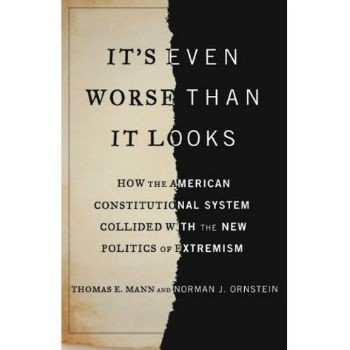
Thoughts on “It’s Even Worse Than It Looks: How the American Constitutional System Collided With the New Politics of Extremism”, By Mann and Ornstein


Introduction

Thomas E. Mann and Norman J. Ornstein, two eminent Congressional scholars, co-authored their latest book on Congress earlier this year. In It’s Worse Than It Looks: How the American Constitutional System Collided With the New Politics of Extremism, the authors analyse and lament the “asymmetric polarization” that the Tea Party Republicans have brought to the 112th Congress (2011-2013) by opposing almost all Democratic initiatives like an adversarial, parliamentary party. They conclude that the American system of a separation of powers necessitates inter-institutional opposition between the Presidency and Congress as a whole, and therefore “cross-party cooperation” between Democrats and Republicans in Congress in order to achieve meaningful outcomes. They reject the tendency toward parliamentary-like opposition between Democrats and Republicans within Congress as inherently incompatible with the separation of powers (i.e., the Balanced Constitution) that defines the presidential system.

(Unfortunately, my e-reader version of the book does not preserve the proper page numbers).

Statements of Interest

On Constitutions

In Chapter 6, “Reforming U.S. Political Institutions”, the authors muse about constitutional amendments that would turn the United States into a parliamentary republic or, less drastically, eliminate the mid-term elections such that the House of Representatives and the President would be both elected every four years, and Senators would serve terms of 8 years. They reject both ideas out of hand because they are unattainable; after all, Americans “are understandably proud of the world’s oldest constitution and an independently elected president” and would not support such a drastic constitutional shift.

First, even a parliamentary republic could include a directly elected president, though he would most likely be a non-executive head of state. Second, I must disagree with their characterization of the American constitution of 1787 as the world’s oldest. They could reasonably conclude that their Constitution of 1787 serves as the oldest codified constitution that has remained constantly intact throughout its history and is still of full legal force and effect today. Their statement glosses over some important distinctions and demonstrates a strong tendency toward what intelligence analysts call “mirror imaging.”[1] Americans understand “constitution” as a specific written document that codifies a general framework for the functioning of the political system, whether at the federal or state levels, and requires a super-majority to be amended. The Constitution therefore occupies a place over and above standard legislative statute and executive regulation. However, in the British sense, “constitution” refers not to a single written text, but to an “entire global system of rules and principles which govern the exercise of constitutional authority,” which may include legislative statutes of constitutional significance and certainly includes a conventional constitution of unwritten rules and norms that evolves over time.[2] I would therefore argue that the British Constitution is far older than its erstwhile 18th-century American offshoot. The “mirror imaging” comes into play because Mann and Ornstein probably never even considered the possibility that “constitution” entails a different meaning and outlook on government, depending upon the jurisdiction. They of course wrote this book for an American audience, but as scholars of Congressional history, they should be aware of its parliamentary antecedents. I will not excuse them for having omitted “oldest codified constitution”!

Power Itself vs. Checks on Power

Thomas E. Mann and Norman J. Ornstein

In the same chapter, they discussed the possibility of “shifting authority between and within branches” as a remedy to deadlock and political paralysis. The general trend in American history has seen a transfer of power from the legislature to the executive. However, I know of no formal constitutional amendment that has transferred powers and authorities from the legislature – which the Framers intended to be the most powerful branch – to the executive. They also do not mention any statutes that have effected these shifts. Curiously, they also described such transfers of power as “an inevitable consequence of a constitutional system that enables separate institutions to compete for the exercise of shared power.” This assertion presents several problems. First, the transfer of power (presumably by convention and not by the written constitution) from the legislature to the executive is not “inevitable.” I refuse to legitimate such facile dialectics as sound scholarship. Second, in many cases the Congress does not “share power” with the Presidency; instead, Congress (particularly the Senate) can only check the powers that the Constitution of 1787 granted exclusively to the President. For instance, the Constitution grants the President the power of appointment of his cabinet, ambassadors, and judges, but the Senate must confirm those appointments. The Senate therefore does not possess the power of appointment per se – it simply affirms or rejects the President’s choices. It acts as a safeguard. In diplomacy and war Congress does possess its own constitutional powers that balance out those of the President. The President possesses the power to conduct foreign relations and is commander-in-chief of the armed forces; meanwhile, the Senate holds the power to ratify treaties, and Congress as a whole possesses the power to declare war. However, by convention, Congress’s power to declare war has become inoperable or irrelevant, because countries no longer declare war on one another.

Meaning of “Republic”

I lived in the United States from grade 8 to grade 12 and recall an interesting exchange on government fromy my 9th-grade history course. Much to my surprise, Mann and Ornstein repeated the same misconception in their book. My teacher asserted, “America is not a democracy. It is a republic” — as if “democracy” and “republic” were mutually exclusive. She attributed “republic” to representative institutions and regular free and fair elections, etc., and democracy to ochlocracy, or mob rule and tyranny of the majority. Mann and Ornstein also adopt this imprecise definition in Chapter 7, “Navigating the Current System,” where they argue that “America’s [system] is a republican (that is, representative) form of government, not a direct democracy.” By Mann’s and Ornstein’s definition, the United Kingdom and Canada would also be republics – which clearly they are not – because their Houses of Commons qualify as representative institutions.

Americans tend to think of “republic” in strict 18th-century terms as a political system based on the rule of law and a constitution that somehow delineates between the executive, legislature, and the courts. Before the advent of Responsible Government within a constitutional monarchy and parliamentary system in the 19th century, the American view of republic made more sense than it did in the 20th century or does in the 21st. But even then, the United Kingdom has operated under some form of constitutional monarchy, with firm legal limitations of the King’s powers, since the Constitutional Settlement of 1688. The classic American view also ironically relegates “democracy” (which the Ancient Greeks considered the good variant of rule by the people) to the pejorative status of ochlocracy (which the Ancient Greeks considered the bad variant of rule by the people). In reality, a republic refers to a polity whose head of state is not a hereditary Sovereign; the term can therefore encompass both dictatorships like China and constitutional systems like the United States. Similarly, a monarchy can manifest itself in a myriad of forms, from a totalitarian dictatorship like North Korea (it does have a hereditary ruler), or a constitutional system like the United Kingdom.

Mann’s and Ornstein’s conception of a republic in fact describes any constitutional system based on the rule of law and could therefore include both constitutional republics and constitutional monarchies. As I never tire of reminding extreme republicans in Canada, a constitutional monarchy under Responsible Government secures liberty and operates under the rule of law just as ably as a constitutional republic. They should only oppose monarchy if it entails something akin to Stuart absolutism.

The Oxymoron of “Post-Partisan Politics”

Unfortunately, Mann and Ornstein also cling to this impossible idea that the American president can become “post-partisan”, or a “uniter, not a divider.”

They lament that “President Obama promised the country post-partisan politics, built on commonalities among Americans, not the divisive differences.” In my previous post on “The Contradictory American Presidency,” I demonstrated the absurdity of this line of thinking. Politics by nature is divisive because reasonable people may in good faith hold opposing views and beliefs on the same subject. “Post-partisan politics” is therefore a contradiction in terms because without disagreement, dissent, and debate, politics ceases to exist altogether, and we descend into some awful dictatorship of the absence of independent thought and speech. However, Mann and Ornstein instead foolishly attribute the failure of Obama’s promise of post-partisan politics to the Republicans, who “operated as a parliamentary-like, unified opposition party” in the 112th Congress. In reality, post-partisan politics quickly collapsed under the weight of its inherent contradiction. Any elected executive head of state who exercises political power, as the American president does, can only divide the electorate into those who support his policies and those who oppose them. In a free country, citizens can and should express their disagreement with their government, which is why I find this widespread denial of the basic facts of power and politics so frustrating.

Political Enforcement of Political Norms and “Divided Government”

In Westminster systems, “constitutional conventions are unwritten, politically enforceable norms, which evolve from practices and customs that complement and contextualize laws or the written constitution.”[3] The political enforceability of convention operates through two main mechanisms: the confidence convention within the Commons (the corollary of Responsible Government), and through the voters themselves during a general election. Mann and Ornstein have recommended that American voters enforce “republican norms” more vigorously through the ballot box in order to remedy asymmetrical polarization and political extremism. They argued normatively that voters should “promote the essential norms of the republican form of government (respect for opposing views, acceptance of the opposition party’s legitimacy, bargaining, and compromise) by demanding that their elected representatives and their parties adhere to the norms and [by] punishing those who don’t.”

This recommendation also contains an imprecise definition of republicanism. By “republican norms,” they refer to the cross-party compromise within Congress and inter-institutional opposition between Congress and the Presidency that a presidential republic requires in order to function smoothly. But of course, the American electorate voted in 2010 for the Tea Party Republicans, whom Mann and Ornstein blame for the “asymmetrical polarization” that has paralyzed the Obama Presidency and accounts for the 12% approval rating of the 112th Congress. If the American electorate failed, in their view, to promote republican norms in 2010, they may yet fail again in 2012 and in any subsequent election.

Americans use “divided government” to describe a state of affairs in which one party controls the Presidency while the other controls Congress (normally the House). The French refer to their equivalent as “co-habitation”. The phrase itself is misleading. Americans and Canadian often refer to “the three branches of government” (executive, legislature, and judiciary), but I maintain that “three branches of the political system” would be more accurate because “the government” refers to the executive. In the United States, the President, Cabinet, the armed forces, and federal governmental departments and agencies make up “the government,” for which the President takes ultimately responsibility. In contrast, Congress is the federal legislature and independent of the government. The legislature is the supreme law-making authority, while the government enforces and promulgates laws through statutory instruments like executive orders and regulations and through law enforcement.

The authors also caution the American electorate against voting in “divided government” and argue that they vote for the same party for both the President and the Congress. I found this rationale curious in light of some of their earlier recommendations and arguments. First, “aligned government” would only encourage polarization and the intra-institutional opposition between Republicans and Democrats in Congress characteristic of a parliamentary system rather than the inter-institutional opposition between Congress and the President that the authors correctly identified as a hallmark of and necessary arrangement in a presidential system. In other words, this recommendation would, if implemented, probably serve only to contradict their own analysis of the nature of presidential republics! Second, the strategy wouldn’t necessarily work and would certainly not guarantee good government; after all, sometimes the President’s co-partisans in Congress vote against his initiatives, particularly in his second term or when he has become politically toxic.   

Conclusion

The Balanced Constitution necessitates compromise; as the authors argue in Chapter 5, “Fixing the Party System”, the American system of government “requires an unusual degree of consensus to act.” I therefore agree with the premise that congressional parties cannot act like parliamentary parties because of the fundamental differences between the Balanced Constitution and Responsible Government. Their view supports my hypothesis on the differences between loyal opposition in parliamentary-cabinet and presidential-congressional  systems!

I would also argue that any attempt to inject elements of the Balanced Constitution into the Westminster system in order to “check the government” would detract from loyal opposition under Responsible Government. The Government and Opposition both sit in the House of Commons, and the Official Opposition acts as a loyal, responsible alternative government that holds the current Government to account. Constitutional arrangement for inter-institutional opposition would change Responsible Government as we know it in Canada.

Similar Posts:


[1] Mark Lowenthal, Intelligence: From Secrets to Policy, 4th Ed. (Washington, DC: QC Press, 2009): 7-8.
[2]
Reference re Secession of Quebec, [1998] S.C.R. supra note 5 at para 32.
[3]
James W.J. Bowden and Nicholas A. MacDonald, “Writing the Unwritten: The Officialization of Constitutional Conventions in Canada, the United Kingdom, New Zealand, and Australia,” Journal of Parliamentary and Political Law 6, no 2 (June 2012): 366-400.

Posted in Loyal Opposition, Parliamentarism v Presidentialism, Reviews, Separation of Powers | Tagged , , , , , , , , , , , , | 2 Comments