The Confidence Convention in Ontario: How the Standing Orders Kept the Wynne Government in Power


I’d like to thank James Anderson for publishing a slightly abridged version of this column on National News Watch.

Introduction

Proponents of democratic reform in Canada focus their efforts at the federal level and have overlooked Canada’s most populous province. However, the Government and Legislature of Ontario have perverted Responsible Government and deviated from necessary and proper federal practices and customs with respect to prorogation, delegated legislation, and the confidence convention.

In Ontario, prorogations do not occur along intersessions of 40 days as at the federal level; instead, prorogations come with unspecified intersessions, and McGuinty’s lasted from 15 October 2012 to 19 February 2013. The Legislature of Ontario sometimes abdicates its own law-making authority to the executive through delegated legislation. The bill that imposed new contracts on teachers included a sleeper-cell clause, “This act is repealed,” which the McGuinty government promulgated while the legislature was still prorogued. Finally, the Legislative Assembly of Ontario has severely restricted its own freedom of action with respect to motions of non-confidence through its own Standing Orders.

The Confidence Convention

Responsible Government means that Ministers of the Crown take responsibility for all acts of the Crown and that the Governor acts on, and apart from exceptional circumstances, in accordance with the advice of Ministers. The Ministry must also retain the confidence of the elected Assembly in order to remain in office. If the Assembly withdraws its confidence from the Government, the Premier must either advise the Lieutenant Governor to dissolve the legislature, or resign.

But the Legislative Assembly of Ontario has severely restricted its own freedom of action with respect to motions of non-confidence through its own Standing Orders and has voluntarily given the Government too much power over a legislative privilege.

At the federal level, a vote of confidence generally includes the Address in the Reply to the Speech from the Throne, supply bills, any government bill that the government deems a matter of confidence, or a motion of non-confidence itself. Theoretically, the Government could accept the Opposition’s amendments to a supply bill and thus retain the confidence of the Assembly, but Governments in Canada have generally taken a hard line on this class of confidence vote. The Government judges when it has lost the confidence of the Assembly on some votes, but the Assembly determines when it has withdrawn confidence from the Government on an unambiguous motion of non-confidence.

Standing Orders in Ontario

The Standing Orders of the Legislative Assembly of Ontario have all but banned the fourth category of confidence vote and restricted the Assembly’s power to withdraw its confidence from the Government of Ontario.

First, section 43 forbids the Opposition from introducing a motion of non-confidence (under the older term “motion of want of confidence”) on an Opposition Day. It states, “Opposition Day motions […] shall not be motions of want of confidence in the government.” The Standing Orders of the Legislative Assembly of Ontario provide for ten Opposition Days per calendar year. This strange rule contradicts the very concept of the Opposition Day (also known as a “Supply Day” or an “Allotted Day” in the Parliament of Canada), which normally refers to a day on which the Opposition, rather than the Government, chooses the topics for debate. In contrast, the Standing Orders of the federal House of Commons provide for 22 “Allotted Days” per calendar year with no restrictions on what motion the Opposition MP can table. While the Government of Canada can alter the scheduling of Allotted Days as a tactic against the Opposition, nothing in the Standing Orders of the House of Commons prohibits the Opposition from introducing a motion of non-confidence in the Government.

Second, section 44(a) of Ontario’s Standing Orders limit the Opposition’s latitude yet further. The Official Opposition can introduce no more than three motions of non-confidence per session, and the second largest party in opposition can introduce no more than two per session. Sessions in Ontario often last for two years. (An adjournment ends a sitting, a prorogation ends a session, and a dissolution ends a parliament). Worse still, section 44(b) effectively empowers the Government to veto altogether holding a vote on the motion of non-confidence, because the Assembly can only vote on the motion “at a time allotted by agreement of the House Leaders of the recognized Parties.” In other words, the Government decides when the Legislative Assembly may attempt withdraw its confidence. Even if the Government House Leader agreed to such motions of non-confidence, the Opposition could quickly use up all of them if the Government wins each vote.

The Legislative Debates

The legislative debates in May 2013 have shown the consequences of this policy. Premier Wynne inherited her Liberal minority government from her predecessor Premier McGuinty. Wynne has since admitted that the McGuinty government cancelled the construction of powerplants for political reasons in 2011, which cost Ontarian taxpayers at least $585 million in penalties. The Wynne government still has yet to pass a budget but recently secured the support of the New Democrats. The Conservatives, being the Official Opposition, introduced a motion of non-confidence in the Wynne government, which in turn has invoked section 44 and refused to put the motion of non-confidence to a vote.

On 29 April, the Conservatives filed their motion of want of confidence, and it has sat on the Order and Notice Paper ever since. The Conservatives condemn the cancellation of the gas plants and the Government’s “prima facie breach of privilege” for not releasing documents on the cancellation of the gas plants and conclude, “the Government has lost the confidence of the House.”

Over the weeks of May 6 and May 13, Conservative leader Tim Hudak and his front bench pressed the Government House Leader and the Premier why the Government would not allow the Assembly to vote on their non-confidence motion. On May 15, the Government House Leader John Milloy praised “the consensus of all the recognized House leaders” required under section 44. Milloy also explained that the Legislative Assembly first adopted the rule sometime under the Davis government (1971-1985). Perhaps this rule helped the Davis government survive through two minority parliaments. Milloy then emphasized that the Opposition would have the chance to vote against the government’s upcoming supply bills “within the next several weeks.”         

Conclusion

In a majority parliament, sections 43 and 44 would rarely become pertinent political issues; even if the Government refused to bring the motion to a vote, its single-party parliamentary majority would virtually guarantee that it retains the confidence of the Assembly. But the confidence convention becomes more significant when a volatile minority parliament could easily withdraw its confidence from a single-party minority government – particularly one plagued by scandal.

The Standing Orders have distorted and place unwarranted restrictions on the confidence convention in Ontario and ensured that the Government only loses the confidence of the Assembly of its own terms and not the Assembly’s. The Assembly could only withdraw its confidence from the Government on the Address in Reply, supply bills, or government bills that the Government deems matters of confidence. Sections 43(b)(vi) and 44(a) of the Standing Orders have destroyed spontaneity by unduly restricting what the Opposition can do on Opposition Days and by allowing the Government to bide its time if it fears a loss of confidence.

The Wynne Government used section 44 to shield itself against a vote of non-confidence and bought itself enough time to remain in power until at least the fall of 2013. The Conservatives introduced a motion of non-confidence in an effort to force an early dissolution and fresh elections, which gave the New Democrats the balance of power. After playing coy with the Assembly and media for several weeks, New Democratic Leader Andrea Horwath announced on May 21 that her party would support the Wynne Government’s upcoming budget.

It is therefore reasonable to conclude that section 44 of the Standing Orders helped keep Premier Wynne’s Liberal minority government in power, because the Government’s refusal to call the vote on the motion of non-confidence after it sat on the Order and Notice Paper for weeks allowed the New Democrats to extract concessions from the Liberals.

But if the Assembly had voted on the Conservatives’ non-confidence motion at the beginning of May, the New Democrats would have found supporting the Liberal minority government politically unpalatable after criticizing its scandals and receiving no budgetary concessions in return.

The Opposition should more certainly be able to introduce a motion of non-confidence on an Opposition Day, and the Assembly should not require the Government’s permission in order to vote on a motion of non-confidence. At its next review of its Standing Orders, the Legislative Assembly should follow the recommendation of Conservative MPP Randy Hillier and repeal sections 43(b)(vi) and 44 because they give the Government unwarranted control over a legislative privilege.

Perhaps the Legislature and Government of Ontario have gotten away with the poor practices on duration of prorogation, legislative drafting, and the confidence convention because the simple amendments that could fix these three problems do not lend themselves to broader rallying cries or catchy media lines. But sometimes simple changes prove the most effective.

I’d like to thank Utsav Sanduja for alerting me to sections 43 and 44 of the Standing Orders.

Similar Posts:
Posted in Confidence Convention, Constitutional Conventions, Reform | 6 Comments

An Account of Prorogation Similar in Principle


I see that my ideas on both prorogation and the constitutional relationship between the First Minister and Governor have taken hold in a wider academic audience, as Dr. Radha Persaud has shown in his column, “Prorogation: A Matter of Restraint.”

I could almost have written it myself.

Similar Posts:

Posted in Crown (Powers and Office), Prorogation | Leave a comment

The Wrong Way to Limit a Premier’s Power to Prorogue: Why Catherine Fife’s Bill Is Unconstitutional


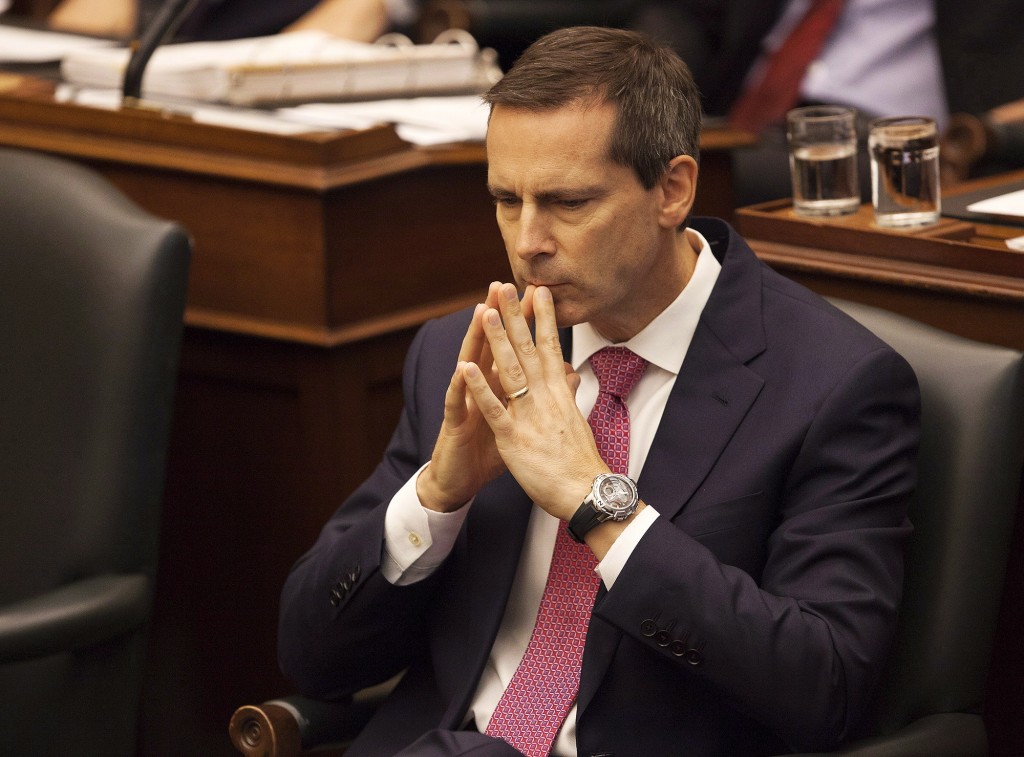
Dalton McGuinty

Premier McGuinty pensively plots his pernicious prorogation.

My column appears in iPolitics under the title, “The Wrong Way to Limit a Premier’s Power to Prorogue.” I am grateful to Doug Beazley for having published it in the “Insight” section.

The controversial prorogation of former Liberal Premier Dalton McGuinty lasted from 15 October 2012 to 19 February 2013. With the legislature back in session, the political backlash to this political tactic has just begun.

On 5 March 2013, New Democratic MPP Catherine Fife introduced a private members’ bill that would amend the Legislative Assembly Act so that the Premier could no longer exercise the judgement and discretion when to advise the Lieutenant Governor to summon and prorogue the legislature. Instead, the Premier could only offer this constitutional advice after “the Legislature has adopted a resolution in support of the prorogation.”

The bill would also require that “the Premier shall also advise the Lieutenant Governor to summon the Legislature in accordance with the recommendation of the Assembly.” The Legislative Assembly would de facto prorogue and summon itself, and the Premier would no longer be able take responsibility the act of the Crown for prorogation.

Despite the bill’s assertion that “nothing alters or abridges the powers of the Crown, including the power to prorogue, dissolve or summon the Legislature,” all the preceding sections would alter and abridge the power to summon and prorogue the legislature.

This bill would be unconstitutional because only an amendment under section 41(a) of the Constitution Act, 1982 can change anything “in relation to the office of the Lieutenant Governor of a province.”

The Lieutenant Governor’s powers to summon (and, implicitly, to prorogue) the legislature come directly from section 82 of the Constitution Act, 1867. Section 5 of the Constitution Act, 1982 further requires that the Legislature sit at least once per year, which puts the maximum theoretical duration of a prorogation at 364 days. The Legislative Assembly Act affirms those powers as part of the Constitution of Ontario.

The Constitution of Ontario includes both the Lieutenant Governor’s written constitutional power to summon and prorogue and the uncodified conventions of Responsible Government that Ministers of the Crown take responsibility for all acts of the Crown and that the Lieutenant Governor acts on and in accordance with the Premier’s advice in summoning and proroguing the legislature. Fife’s bill even acknowledges that the Premier alone advises the Lieutenant Governor to summon, prorogue, and dissolve the legislature.

This bill would limit how the Premier can exercise the discretion to advise and take responsibility for summoning and prorogation and therefore necessarily limit how the Lieutenant Governor promulgates that advice. The legislature cannot drive a wedge between the Governor and First Minister of the Crown without a constitutional amendment.

However, the Legislature could pass a bill that better defines prorogation, provided that it also preserves the respective constitutional roles of the Premier and Lieutenant Governor. The Government would only have to advise the Lieutenant Governor to give the bill Crown Consent (if the provincial legislatures, like the Parliament of Canada, also recognize this procedure).

First, the Legislature could define “prorogation” and “intersession” in statute without infringing upon the power itself. The Legislative Assembly Act currently states, “It is not necessary for the Lieutenant Governor in proroguing the Legislature to name a day to which it is prorogued.”

The Legislature could amend that law such that the Lieutenant Governor issues two proclamations (on and in accordance with the Premier’s advice): the first would prorogue the legislature and the second would summon the next session for despatch of business at, say, intervals of 40 days. The Premier could only advise the Lieutenant Governor to extend the intersession through another 40 days through a subsequent proclamation. Such an amendment would bring Ontario in line with the federal convention on prorogation.

Second, the legislature could also amend the Financial Administration Act in order restrict Special Warrants to periods of 60 days and only when parliament is dissolved. The federal parliament adopted such a reform in the 1990s. Special Warrants give the Government an emergency power to implement spending without first obtaining parliamentary authorization, which directly contradicts the historical and modern purpose of parliament. The current legislation allows the Lieutenant Governor to issue Special Warrants on and in accordance with the advice of the Government “if the legislature is not in session,” which includes both the intersessions when parliament is prorogued and the writ when parliament is dissolved.

Special Warrants are a pure statutory power and pertain neither to the written constitution nor to constitutional conventions. MPPs could simply amend section 1.0.7(1) of the Financial Administration Act to read “If the legislature is dissolved” without raising any constitutional questions. By restricting the Special Warrants to the writ, the legislature would place an indirect but practical and important limit on the duration of a prorogation. Whenever the Government ran out of money during an intersession, Parliament would have to be recalled in order to approve any additional spending.

NDP leader Andrea Horwath has touted this bill as “taking the politics out of prorogation.” In reality, this bill would inject even more politics into every subsequent prorogation – particularly in a minority parliament – and would be unconstitutional. Thankfully, the Legislature could amend the bill at committee so that it both promotes the same principle of better defining prorogation and conforms to the constitution.

James W.J. Bowden is an M.A. Candidate at the University of Ottawa.

Similar Posts:

Posted in Crown (Powers and Office), Prorogation | Tagged , , , , | 9 Comments

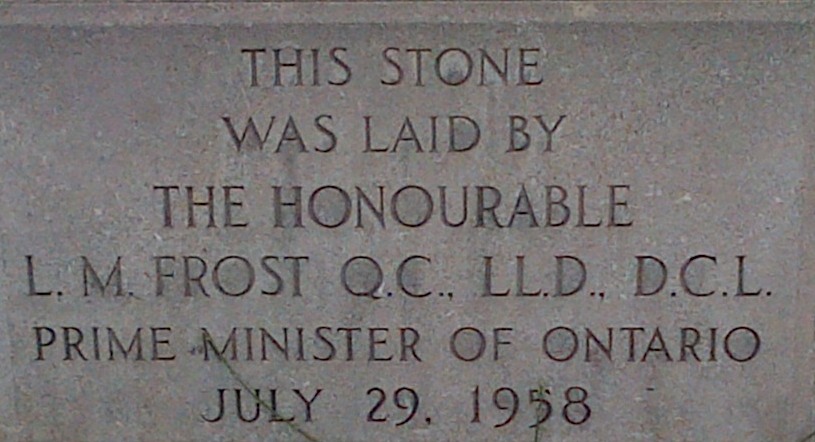
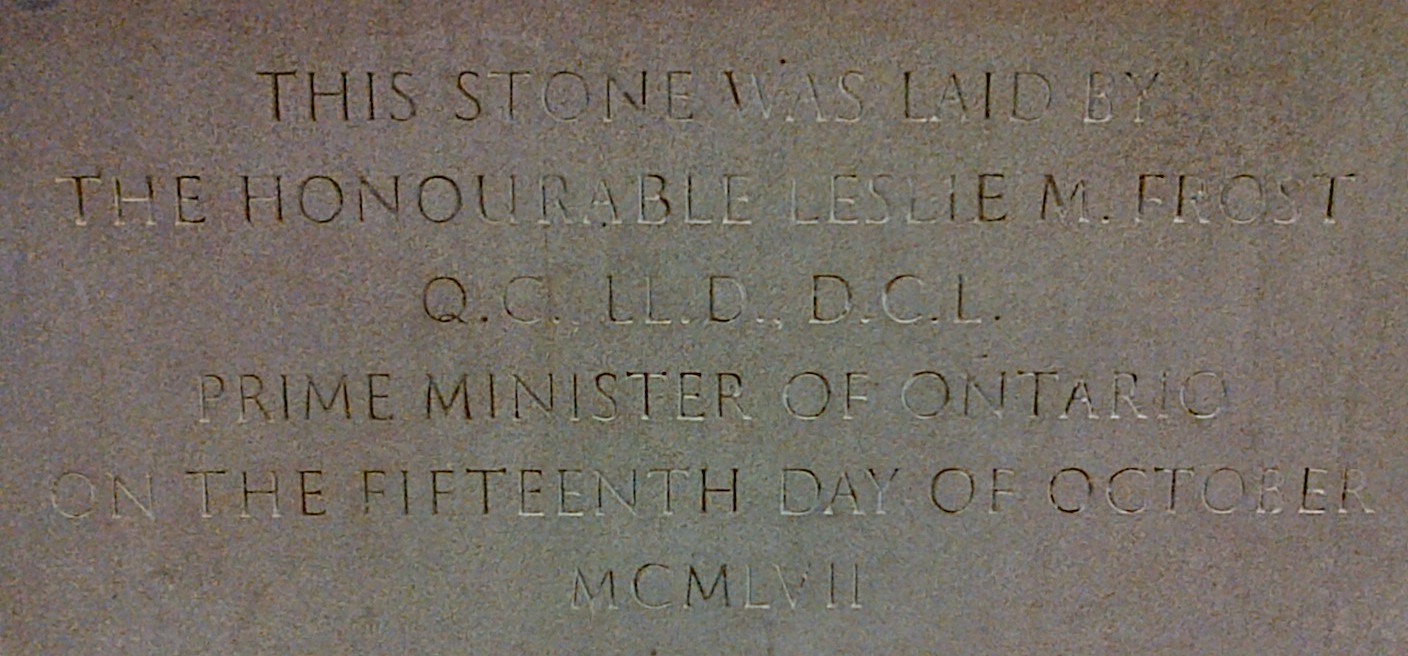
“Prime Minister of Ontario”: The Old Title of Leslie Frost and John Robarts


Leslie Frost, Prime Minister of Ontario, commemorates a building in downtown Toronto

Leslie Frost, Prime Minister of Ontario, commemorates a building in downtown Toronto

In the English language, three titles within Commonwealth Realms refer to the same office of head of government: “first minister,” “premier,” and “prime minister.”  One of my correspondents informed me of a fourth title found within the Commonwealth of Nations: the heads of government in the several Indian states go by “Chief Minister,” while the head of government of the Republic of India goes by the conventional “Prime Minister.” The same goes for the heads of government of the United Kingdom,  New Zealand, and Canada and Australia at the federal level. The heads of government of the Canadian provinces and Australian states are referred to as “premiers”, probably in order to distinguish them from each country’s federal prime minister.  The heads of the governments of the devolved jurisdictions within the United Kingdom – Scotland, Wales, and Northern Ireland – became “First Minister,” probably to differentiate them from the Prime Minister of the United Kingdom. (I often use “First Minister” as a convenient generic label that would cover both provincial and federal heads of government in Canada and Australia).

In contrast, the French language only includes one title that covers all four of its English equivalents, premier ministre. Unfortunately, the most bizarre form of pedantic antipathy that English-speaking Canadians sometimes show toward Quebec is the critique that Quebeckers refer to their premier as “prime minister,” as if to elevate the province to the equivalent of a fully sovereign state. I’ve heard this nonsensical assertion on many occasions, and I’m sure that many you have as well. Worse still, some English-speaking scholars, like Sujit Choudhry, have even promoted this bizarre claim:

Quebec’s political elites have long referred to the province, its institutions, its symbols and its collective goals in national terms. The provincial legislature is the National Assembly, its head of government the Prime Minister as opposed to a mere Premier […].[1]

In the French language, the title premier ministre applies to all 10 premiers in Canada, not just to the premier of Quebec, because of a fundamental fact of the French language that has nothing to do with nationalist or secessionist politics in Quebec. The “Premier of Ontario” is le premier ministre de l’Ontario – and no one would suggest that this French-language title would amount to an aggrandizement of the office.

Leslie Frost, Prime Minister of Ontario, commemorates the Tory Building

Leslie Frost, Prime Minister of Ontario, commemorates the Tory Building on 15 October 1957.


Ironically, however, the use of “Prime Minister of Ontario” in English does propagate a political statement and seeks to elevate Ontario to the level of Canada. Leslie Frost served as the 16th Premier of Ontario from 4 May 1949 to 8 November 1961 – but he referred to himself as “Prime Minister of Ontario” rather than as “Premier of Ontario.” As the two photos in this blog entry show, several plaques on buildings that he commemorated have etched this title in stone. I found the first in downtown Toronto, and the other comes from the Tory Building at Carleton University. Frost’s moniker built on another precedent of self-aggrandizement: Ontario also dubbed its provincial legislature the “Provincial Parliament” and “Members of Provincial Parliament” in 1938. [4]

Frost reportedly enjoyed good relations with both Prime Ministers St. Laurent and Diefenbaker, so he probably did not adopt the title “Prime Minister of Ontario” in order to anger or challenge the federal level. [2] Canadian political scientist Rand Dyck concludes that Frost’s premiership “was characterized by […] a lack of concern with provincial status.” [3] (Perhaps Frost merely concerned himself with his own personal status!)

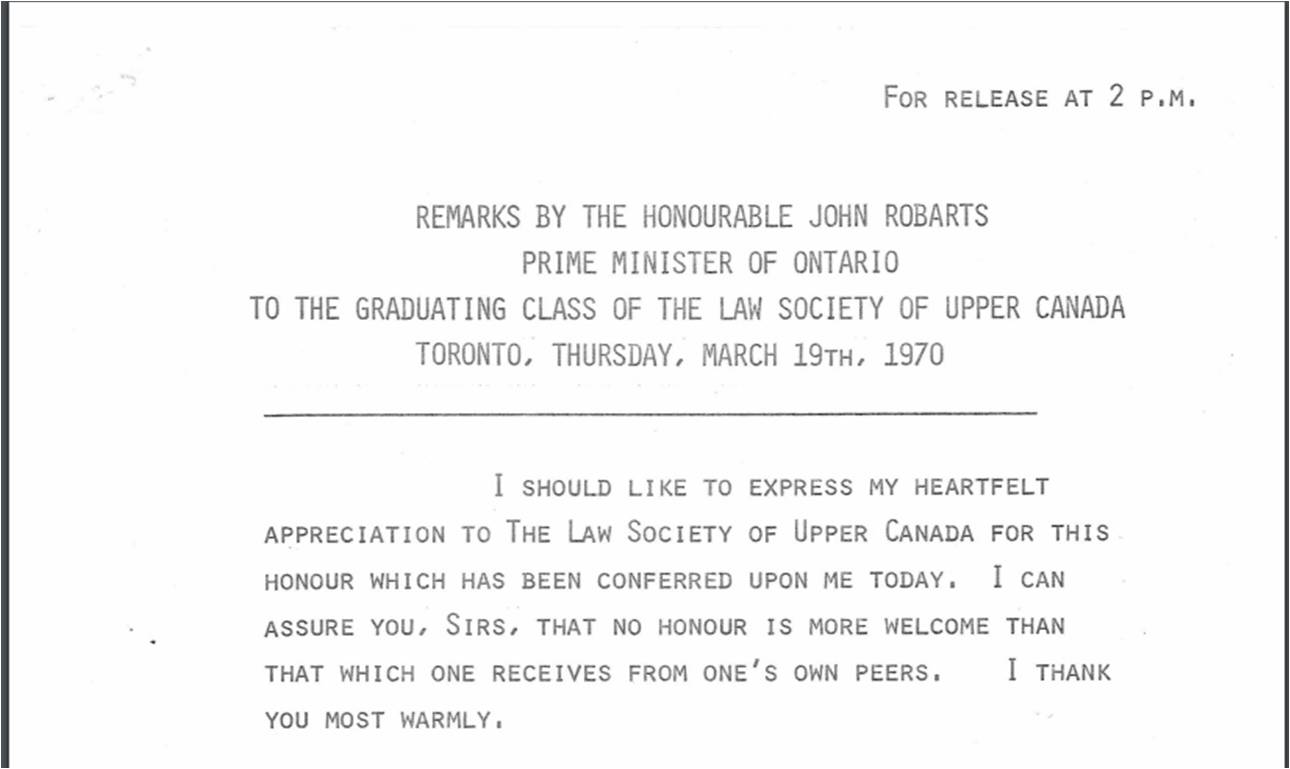
john-robarts-prime-minister-of-ontario

John Robarts also preferred the title “Prime Minister of Ontario,” as his address to the Law Society of Upper Canada in 1970 shows. But the last long-tenured premier of the post-war Progressive Conservative dynasty, Bill Davis, switched the title to “Premier of Ontario”, where it has remained since. Perhaps “Prime Minister of Ontario” sounds self-aggrandizing, but the first minister possesses the prerogative power to alter his own title.

*Update: 2016-06-28: I thank Pierre Allard for having taken an interest in this old entry and for having informed me that it was Davis who changed the title.

Similar Posts:


[1] Sujit Choudhry, “Bills of Rights as Instruments of Nation-Building in Multinational States: The Canadian Charter and Quebec Nationalism”, University of Toronto Legal Studies Series, Research Paper 1006905 (August 2007): 1.
[2] Rand Dyck, Ontario Government and Politics. (Ottawa: Carleton University Graphic Services, 2009): 36.
[3] Rand Dyck, Ontario Government and Politics. (Ottawa: Carleton University Graphic Services, 2009): 37.
[4] Rand Dyck, Provincial Politics in Canada: Toward the Turn of the Century. 3rd Ed. (Scarborough, ON: Prentice-Hall of Canada, 1996), 327.

Posted in Crown (Powers and Office), Prime Minister's Powers | Tagged , | 2 Comments

David Onley Defends Responsible Government


Introduction

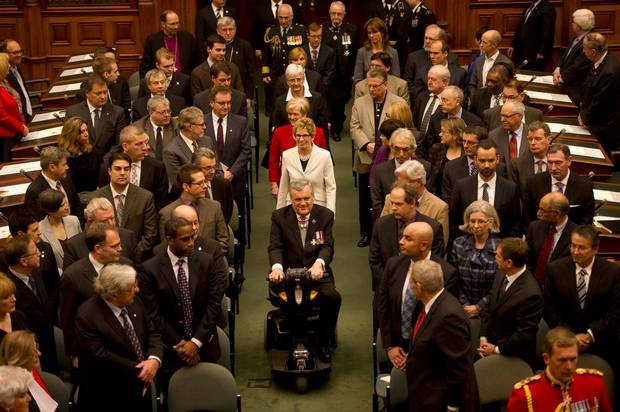
David Onley leads the procession before reading the Speech from the Throne.

David Onley leads the procession before reading the Speech from the Throne. (I didn’t know that the distance between the Government and Opposition benches was so wide!)

I’d like to thank David Watson of the Ottawa Citizen for having published my and Nick MacDonald’s column, “Onley Provides Much Needed Education.” It follows up on our earlier column from October 2012, “McGuinty Had Every Right to Prorogue,” and shows how the Lieutenant Governor of Ontario, His Honour David Onley, has explained and promoted Responsible Government during the intersession of McGuinty’s prorogation (15 October 2012 to 19 February 2013).

Why Governors Should Not Issue Written Explanations or Rationales Behind Acts of the Crown like Prorogation or Dissolution

David Onley has taken a unique and noteworthy approach and established a new model that the other Governors in Canada should consider adopting. In January, Professors Dodek and Sossin argued that Onley has established a new model but that he also broke convention by “justif[ying] his controversial decision in some detail.” They added,

We believe — as apparently Onley does — that when a viceregal representative exercises the rare discretion to prorogue the legislature he or she should explain the decision to the public.

I disagree with those statements. First, prorogation occurs every two years or so in Ontario, so it’s not particularly rare. Second, McGuinty’s prorogation of 2012 – including the unspecified duration of the intersession – conformed to the norm in Ontario and to the standard practice under Premiers Rae, Harris, and Eves. In addition, the legislature met more frequently and for a greater number of sitting days under the McGuinty government than under either the Rae or Harris governments. Third, the Governors do not possess the discretion to reject advice to prorogue, and Onley did not exercise any discretionary authority in this instance. Fourth, while Onley has established a new approach and implemented a new and successful media strategy, he did not explain the rationale behind McGuinty’s political decision to prorogue, and he did not break the convention of confidentiality between the governor and first minister. McGuinty explained the rationale and the political decision to prorogue the 1st session of the 40th Legislature. Onley merely explained the constitutional position on prorogation and the general constitutional relationship between the premier and first minister; more crucially, Onley did not divulge the contents of a particular consultation. This is an important distinction.

Responsible Government means that Ministers of the Crown take responsibility for all acts of the Crown (including government bills, supply bills, and all executive policy decisions), and that the Lieutenant Governor acts on and in accordance with ministerial advice. Government Ministers must also defend the political neutrality of the Lieutenant Governor by assuming the political responsibility for their executive decisions, because the Lieutenant Governor cannot advocate on behalf of himself without undermining his Ministers. Responsible Government also means that the First Minister must maintain the confidence of the Governor, as well as the more commonly stated and better known principle that the Government must maintain the confidence of the lower house. The Governor expresses that confidence in the First Minister by granting him a commission of authority to govern under the Crown and by acting on and in accordance with his advice. The Governor would revoke his confidence in the First Minister and Government, under exceptional circumstances, by refusing to promulgate or acting contrary to their advice – which in turn forces either the dismissal or resignation of the Ministry. This exceptional consequence is precisely why the Governor may only act contrary to ministerial advice under exceptional circumstances. The Governor’s discretionary authority to reject ministerial advice under exceptional circumstances (the “reserve power”) truly is the nuclear deterrent of Responsible Government, though most scholars since Bourinot and Dawson have not properly acknowledged why.

Responsible Government therefore requires that the consultations between the Premier and Governor remain confidential. This confidentiality does not require the strict “Sphinx-like silence” that Dodek and Sossin highlighted – it only means that neither the Premier nor the Governor may divulge the content of their consultations. The First Minister can and should explain the rationale behind his political decision, and the Governor may explain his role under Responsible Government.

However, under no circumstances should the Governor explain the rationale behind acts of the Crown or issue written reasons, because this arrangement would undermine Responsible Government. If the Governor breaks the confidentiality of his consultations with the First Minister, he would undermine the position of the First Minister and indirectly revoke his commission of authority under the Crown to govern. This would probably lead to the dismissal or resignation of the incumbent government. This entire idea derives from the worst precedent in the core Commonwealth: in Australia, Governor General Sir John Kerr dismissed Prime Minister Gough Whitlam on 11 November 1975 and appointed the Opposition Leader Malcolm Fraser as Prime Minister later that afternoon because the Liberal majority in the Senate blocked the the budget of Whitlam’s majority Labor Government. (Worse still, the Whitlam government undoubtedly commanded the confidence of the House of Representatives). Kerr issued four pages of reasons why he dismissed Whitlam; by accepting Kerr’s commission to form a new government, Fraser thereby accepted Whitlam’s dismissal and the rationale behind it, and then immediately advised a double dissolution in order to break the deadlock between the two houses. This example shows how the Governor cannot issue written reasons without necessarily undermining the incumbent First Minister and Government.

The First Minister – not the Governor – should issue explanations, which is what McGuinty did, even though he couched his rationale in the obfuscation of the standard Orwellian political rhetoric. As Nick and I explain in the column, McGuinty’s inadequate explanation is a political issue, not a constitutional one. That said, the inadequacy of McGuinty’s explanation indirectly exposes the true political, tactical reasons behind his decision.

I’ve also posted the unabridged version of the column below.

David Onley Promotes Responsible Government

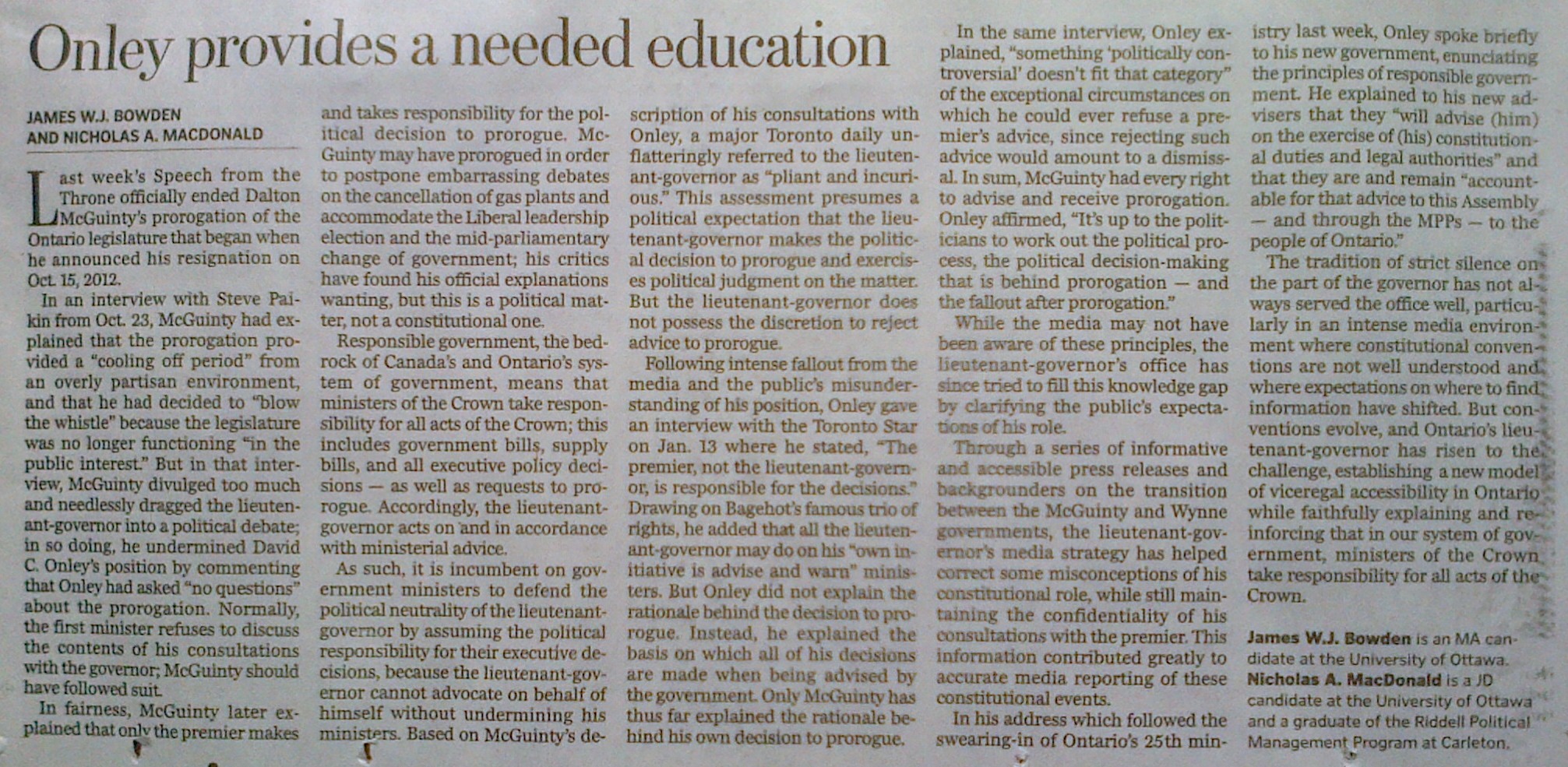
Bowden & MacDonald, "Ottawa Citizen, Onley Provides Much Needed Education"

Bowden & MacDonald, “Ottawa Citizen, Onley Provides Much Needed Education”

The Speech from the Throne of 19 February 2013 officially ended David McGuinty’s prorogation, started the 2nd session of the 40th Legislature of Ontario, and introduced the agenda of Kathleen Wynne’s government. Constitutional events have now come full circle since 15 October 2012, when Dalton McGuinty announced his intention to resign as both Liberal leader and Premier of Ontario, while also proroguing the legislature to an unspecified date.

In an interview with Steve Paikin from 23 October 2012, McGuinty explained that the prorogation provided a “cooling off period” from an overly partisan environment, and that he had decided to “blow the whistle” because the legislature was no longer functioning “in the public interest.” But McGuinty divulged too much and needlessly dragged the Lieutenant Governor into a political debate; in so doing, he undermined David C. Onley’s position by commenting that Onley had asked “no questions” about the prorogation. Normally, the first minister refuses to discuss the contents of his consultations with the governor; McGuinty should have followed suit.

In fairness, McGuinty also explained in a press conference on October 24 that only the Premier makes and takes responsibility for the political decision to prorogue. McGuinty may have prorogued in order to postpone embarrassing debates on the cancellation of gas plants and accommodate the Liberal leadership election and the mid-parliamentary change of government; his critics have found his official explanations wanting, but this is a political matter, not a constitutional one.

Responsible Government, the bedrock of Canada’s and Ontario’s system of government, means that Ministers of the Crown take responsibility for all acts of the Crown; this includes government bills, supply bills, and all executive policy decisions – as well as requests to prorogue. Accordingly, the lieutenant governor acts on and in accordance with ministerial advice.

As such, it is incumbent on government ministers to defend the political neutrality of the lieutenant governor by assuming the political responsibility for their executive decisions, because the lieutenant governor cannot advocate on behalf of himself without undermining his ministers.

Based on McGuinty’s description of his consultations with Onley, a major Toronto daily unflatteringly referred to the Lieutenant Governor as “pliant and incurious.”  This assessment presumes a political expectation that the Lieutenant Governor makes the political decision to prorogue and exercises political judgement on the matter. But the Lieutenant Governor does not possess the discretion to reject advice to prorogue.

Following intense fallout from the media and the public’s misunderstanding of his position, Onley gave an interview with the Toronto Star on 13 January 2013 where stated, “The premier, not the lieutenant-governor, is responsible for the decisions.” Drawing on Bagehot’s famous trio of rights, he added that all the Lieutenant Governor may do on his “own initiative is advise and warn” ministers. But Onley did not explain the rationale behind the decision to prorogue. Instead, he explained the basis on which all of his decisions are made when being advised by the government. Only McGuinty has thus far explained the rationale behind his own decision to prorogue.

Onley added, “There never has been a case where prorogation has been denied.” If the Governor refuses to act on the Premier’s advice, he forces the resignation of the Government precisely because it cannot take responsibility for an executive decision that contradicts the advice tendered. This exceptional consequence of dismissal or resignation shows why the Governor may only reject some types of ministerial advice under exceptional circumstances. In the same interview, Onley explained, “something ‘politically controversial’ doesn’t fit that category” of the exceptional circumstances on which he could ever refuse a premier’s advice, since rejecting such advice would amount to a dismissal of the government. In sum, McGuinty had every right to advise and receive prorogation. Onley affirmed, “It’s up to the politicians to work out the political process, the political decision-making that is behind prorogation — and the fallout after prorogation.”

While the media may not have been aware of these principles, the Lieutenant Governor’s Office has since tried to fill this knowledge gap by clarifying the public’s expectations of his role.

Through a series of informative and accessible press releases and backgrounders on the transition between the McGuinty and Wynne governments, the lieutenant governor’s media strategy has helped correct some misconceptions of his constitutional role, while still maintaining the confidentiality of his consultations with the Premier. This information contributed greatly to accurate media reporting of these constitutional events.

The Liberal Party of Ontario elected Kathleen Wynne as its new leader on 26 January. Onley then acknowledged Wynne as Premier-designate on 31 January and commissioned her to form a new Government. On 11 February, McGuinty formally resigned as Premier, and Onley swore in Wynne and her Cabinet as the 25th Ministry of Ontario that same afternoon. Onley then opened the new session on 19 February.

In his address which follows the swearing in of Ontario’s 25th ministry, Onley spoke briefly to his new government, enunciating the principles of responsible government. He explained to his new advisers that they “will advise [him] on the exercise of [his] constitutional duties and legal authorities” and that they are and remain “accountable for that advice to this Assembly—and through the MPPs—to the people of Ontario.”

The tradition of strict silence on the part of the governor has not always serve the office well, particularly in an intense media environment where constitutional conventions are not well-understood and where expectations on where to find information has shifted. But conventions evolve, and Ontario’s lieutenant governor has risen to the challenge. David Onley has established a new model of vice-regal accessibility in Ontario that includes an updated and expanded website, a strong presence on Facebook and Twitter, and issuing timely and informative press releases on his constitutional role – all while faithfully explaining and reinforcing that in our system of government, where ministers of the Crown take responsibility for all acts of the Crown.

Similar Posts

Posted in Appointment of PM, Consultations, Crown (Powers and Office), Formation of Governments, Governor's Discretion, Prorogation, Reaffirmation of, Responsible Government | Tagged , , , , | 7 Comments