Will Wynne Pull a Harper? Fixed-Election Laws and Dissolution in Ontario


Wynne Reassures Ontarians That She Won’t Pull a Harper -Yet 

In an interview with the Toronto Star, Premier Wynne assured MPPs and Ontarians that she would not advise an early dissolution if the Conservative Party of Ontario voted to oust Tim Hudak as leader at the policy convention this past weekend (even though that was never really a possibility).

I would not do that. […] I don’t think that would be fair. […] It’s important for people to know that wouldn’t be a trigger. They would need to have the time to go through their leadership process.

Responsible Government, Fixed-Election Dates, and Dissolution

However, this article made no mention of Ontario’s fixed-election law – which the McGuinty government introduced in 2005 with the stated intention of avoiding these so-called “snap elections.” Ontario’s law conforms to the standard Canadian model. Section 9(1) of Elections Act states in its non-derogation clause, “Nothing in this section affects the powers of the Lieutenant Governor, including the power to dissolve the Legislature, by proclamation in Her Majesty’s name, when the Lieutenant Governor sees fit.”[1] Section 9(2) sets fixed elections on the first Thursday in October in 2007 an every four years thereafter. The second fixed election (not in the nefarious sense of the phrase!) occurred as planned in October 2011; the next election would therefore occur in October 2015.

The Minister responsible, Michael Bryant, told the Assembly that the bill would abolish “the right of the Premier to call elections based on partisan and political considerations.”[2] In reality, of course, Canada’s model of fixed-election laws do no such thing. In fact, they deliberately preserve the Governor’s power to dissolve the legislature on and in accordance with the advice of the First Minister. Certain individuals who either do not understand what Responsible Government means, or pretend not to understand for their own mendacious purposes say: “Aha! The statute only mentions the Lieutenant Governor, not the Premier, which means that the Lieutenant Governor personally and formally controls the exercise of executive power, including dissolution.” For instance, Duff Conacher of that mendacious “educational charity” Your Canada, Your Constitution (YCYC) once argued with me over Twitter that the phrase “as the Governor sees fit” means that the Governors can cavalierly reject the advice of First Ministers for any reason, as if such interventions carried with them no consequences. This is not so; under our constitutional system, statutory interpretation is not as absolute as a strictly literal reading. Responsible Government belies fundamentalist interpretations of executive power!

Responsible Government means that Ministers of the Crown take responsibility for all acts of the Crown, and therefore that the Governor acts on and, save for exceptional circumstances, in accordance with the advice of the First Minister or Cabinet. The Governors still possess the discretionary authority to reject advise to dissolve parliament and thus refuse fresh elections; however, a Governor can only justify his intervention into the executive government under extraordinary circumstances precisely because of the exceptional consequence of his discretion. By refusing to act on the advice of the First Minister or Cabinet, the Governor dismisses them from office or forces them to resign, because a Ministry can only take responsibility for advice that it has offered, not for the contrary advice that it did not offer. In addition, the Governor can reject ministerial advice in this fashion if and only if he can then appoint a new First Minister who will take responsibility the dismissal or resignation of the outgoing Ministry. Some First Minister must always take responsibility for dissolution. Finally, refusing advice to dissolve is not the equivalent of dissolving unilaterally. Under our system, Governors do not and cannot undertake any executive act unilaterally because every proclamation, order-in-council, or other executive instruments requires the counter-signature of a responsible Minister of the Crown before the Governor can formally promulgate it. The proclamations of dissolution, the writs of election, and calling together the next parliament after the general election all require ministerial counter-signatures.

Conclusion: We Need More Examples of Fixed-Election Dates and Minority Parliaments

As it turned out, the Conservative Party rejected a proposal to change its constitution to allow for a leadership review that could have resulted in Hudak’s ousting or resignation, so Wynne would not have to take a Conservative leadership election into account. The Globe and Mail has reported that the Liberals and Conservatives agreed to pass eight bills through the legislature that do not amount to votes of confidence or supply; this agreement did not include the New Democrats. This is not surprising, given that Conservative leader Hudak opted to meet with Liberal Premier Wynne at her suggestions, while New Democratic leader Andrea Horwath declined. The latter article also argued that Hudak will allow some of these “non-contentious” Liberal bills to pass in order to position himself to oppose the Government on its upcoming supply bills and economic policies. However, this article also offers no information on whether Wynne would advise an early dissolution unprompted after these non-contentious bills pass, or whether her minority Liberal government would allow Hudak’s Conservatives to table a motion of non-confidence on which the Legislative Assembly would then take an up-or-down vote.

It is possible that since Prime Minister Harper’s unprompted early dissolution in 2008, Canadian journalists have accepted the truth of Canada’s fixed-election laws: that they do not create stable fixed-term parliaments, that they deliberately preserve the Governors’ power to dissolve on prime ministerial advice and thus the status quo, and that they therefore do nothing but provide rhetorical cover to politicians who want the voters to perceive them as having done something. We would need to collect more examples of minority parliaments in the provinces that have fixed-election laws in order to test this theory and draw a definitive conclusion. But it is also possible that the media have decided to apply a different standard to Ontario, whether for purely partisan reasons or otherwise. Unfortunately, I suspect that the latter applies in this case.

All the Canadian fixed-election laws are useless; Harper did not “break his own law” in 2008, and nor would Wynne “break the law” in Ontario if she were to advise an early dissolution. I ask only that the media cover similar situations with the same level of scrutiny.

Similar Posts:


[1] Ontario, Legislative Assembly. An Act to Amend the Elections Act, The Election Finances Act, and the Legislative Assembly Act, to Repeal the Representation Act, 1996, and to Enact the Representation Act, 2005. Bill 176, 38th Legislature, 1st Session, 2005.
[2] Bryant, Michael [“Election Statute Law Amendment Act, 2005,”] In Ontario, Legislative Assembly of Ontario, Hansard, 38th Legislature, 1st Session, Thursday, 5 May 2005.

Posted in Crown (Powers and Office), Dissolution, Fixed-Date Elections, Reform | 2 Comments

The Government of Canada’s Position on Succession in 1937, 1943, & 1981


Introduction

Since December 2012, Professor Philippe Lagassé and I have put forward some arguments on the nature of the Crown of Canada as a corporation sole and all that this legal concept entails for the royal succession and the emergence of the Crown of Canada as a separate legal entity from the Crown of the United Kingdom. Perhaps we have engaged in a futile academic exercise, but I believe that the historical evidence supports our claims.

The Government of Canada in 2013 has acknowledged that the Crown of Canada is a separate legal person relative to the Crown of the United Kingdom; however, the Department of Justice also insists that the preamble of the Constitution Act, 1867 has created a “principle of symmetry” out of the personal union such that the Queen of the United Kingdom automatically becomes the Queen of Canada without any Canadian intervention. In effect, the only Canadian law relating to succession is the preamble of the Constitution Act, 1867. This is a false argument. From the primary and secondary sources that I have gathered thus far, I can make the following hypothesis on why succession to the Crown lost its clear place in Canadian law and in the Constitution of Canada. First, the Trudeau government shifted the constitutional focus from the patriation of the British North America Act and establishing an indigenous amending formula to entrenching a bill of rights. Consequently, most constitutional questions since the 1980s have centered on the Charter, and any talk of amending the constitution has become anathema to Canadian politics since the failure of the Charlottetown Accord in 1992. Canadian political observers even refer to amending the constitution as “opening” the constitution – with the obvious allusion to perils that await those who dare open Pandora’s Box. Second, the Department of Justice and the Privy Council Office lost vital institutional memory and expertise on the nature of the Crown of Canada.

I have presented several primary sources on this blog in order to refute the Government of Canada’s main argument that Canada has no law on succession. In fact, Canada has several laws on succession, which now falls under “the office of the Queen” under section 41(a) of the Constitution Act, 1982. In this entry, I present the following documents that complement Prime Minister King’s arguments of January 1937:

1937: Attorney-General Ernest Lapointe Explained How the Statute of Westminster Gave Canada Control Over British Statutes That Apply as Part of Canadian Law

In a debate on the Foreign Enlistment Act, Justice Minister Lapointe explained to the Commons the status of British statutes under Canadian law on19 March 1937. Prior to 1931, several British statutes automatically applied to Canada as part of Canadian law because the Westminster Parliament exercised legislative sovereignty over the Crown colonies. The Colonial Laws Validity Act, 1865 gave British statutes paramount force over all colonial statutes; as such, any colonial statutes that were “repugnant to” a British statute automatically became void to the extent of its repugnancy. However, section 2 of the Statute of Westminster repealed the Colonial Laws Validity Act and thus gave the self-governing Dominions the power to repeal or amend any Imperial statute that applied as part of their laws. Section 4 of the Statute of Westminster stated that the British Parliament would then only legislate for a Dominion at its request and with its consent. Some scholars, like Andrew Heard and Arthur Berriedale Keith, have interpreted section 4 as a mere “self-denying ordinance,” such that the Westminster Parliament could have continued to legislate for the Dominions even without their request and consent. Strictly speaking, this is true. However, the Dominion Parliament could then simply invoke section 2 of the Statute of Westminster and repeal such a law through whichthe British Parliament claimed the authority to apply to the Dominions outside of the procedure under section 4. This is why the Statute of Westminster did in fact grant the Dominions independence.

Lapointe explained: “Under the Statute of Westminster, any dominion may re-enact, repeal, or amend any statute already applying to it.”[1] As such, he introduced a bill to amend the Foreign Enlistment Act, a British statute that applied to Canada as part of its law, which the Parliament of Canada could then amend by virtue of the Statute of Westminster. Lapointe also deemed the Parliament of Canada to have accepted the principle of his bill, because the British statute had already become part of Canadian law as well. 

Charles Cahan, a Conservative MP and former Minister of the Crown under the Bennett government, agreed with Lapointe’s interpretation. In fact, Cahan went further and added with great enthusiasm that he and Conservative Opposition Leader R. B. Bennett embraced “the purpose and intent of the bill to take additional measures to exercise the rights of nationality and sovereignty which we believe are now inherent in the Parliament of Canada.”[2] King, Lapointe, Bennett, and Cahan would probably all look on what the Harper government did in 2013 with shame and incredulity, because today’s government has denied several decades of history and precedent into to avoid “opening” the Constitution. This is what the Government’s supporters now call a “practical” approach — with the clear implication that Lagassé, Toffoli, and I are mere woolly-browed academics who simply cannot grasp the complexities of modern government.

Cahan also noted that in his practice as a lawyer, he “was astonished to find that the judges presiding in the courts had no idea that any such acts [of the British Parliament] were in existence extending to and applicable to Canada.”[3] Sadly, many lawyers and judges today would not cease to astonish Cahan with their ignorance of this subject, mainly because most law schools offer only a superficial overview of Crown law in this post-Charter era.

Lapointe and Cahan accurately described the constitutional position as of 1937: the Statute of Westminster had placed the British acts that applied as part of Canadian law under “the legislative jurisdiction of the Parliament of Canada.”[4] While the Parliament of Canada alone could have legislated on this matters between 1931 and 1982, it no longer possesses this authority. Those statutes relating to “the office of the Queen” which then fell within the exclusive jurisdiction of the federal Parliament and are now subject to the Constitution Act, 1982. In effect, the Government of Canada wasted the easy opportunity to consolidate Canada’s laws relating to the Crown within those 50 years.

Cahan once requested (presumably when he served in the Cabinet) “a return from the Department of External Affairs showing the existing statutes of the parliament of the United Kingdom which extend to this dominion.”[5] He continued, “From my personal research, I have tabulated scores of such statutes which then and still apply to Canada, although under the act of 1867 they are now within the legislative jurisdiction of the parliament of Canada.” Lapointe replied, “I have a list of 150” British statutes that apply to Canada as part of the laws of Canada.[6] Cahan suggested that the Departments of Justice and External Affairs compile an exhaustive list of all British statutes that “extend to and are applicable to Canada,” publish that list, and recommend which acts be repealed and which be retained.[7]

Unfortunately, the King Government did not aggressively pursue that policy. While J.E. Read, a government lawyer in the Department of External Affairs, did produce such a list in 1943, neither King nor St. Laurent introduced a bill to rationalize the Imperial laws that Canada had inherited. The Trudeau government also neglected the issue when it patriated the British North America Acts in 1982.

1943: Read Consolidates Lapointe’s List of British Statutes That Apply to Canada As Part of the Laws of Canada

Maurice Ollivier served as a law clerk in the House of Commons in the mid-20th century and wrote three books on Canada’s transition from self-governing colony to independent, sovereign state. In Problems of Canadian Sovereignty, he included an appendix of “Enactments of the Parliament of Great Britain Which By Their Express Terms or By Necessary Implication Apply to the Dominion of Canada.”[8] The footnote indicates that Mr. J.E. Read, a government lawyer in the Department of External Affairs, compiled this “tentative list” and updated it to 1943. This may be the same list to which Lapointe alluded in 1937.

This list includes several British statues governing succession to the throne that apply as part of the laws of Canada, such as the Bill of Rights, 1689, the Act of Settlement, 1701, the Royal Marriages Act, 1774, as well as the various Crown Private Estates Acts and Demise of the Crown Acts. Crucially, His Majesty’s Declaration of Abdication Act, 1936 also forms part of Canadian law because the Government of Canada requested and consented that the British Parliament extend it to Canada pursuant to section 4 of the Statute of Westminster.

In 1938, Canadian constitutional scholar W.P.M. Kennedy defined the Constitution of Canada as a hybrid amalgam of codified and uncodified elements:

The unwritten constitution includes all the great landmarks in British history in so far as they are working principles – Magna Carta, the Petition of Right, the Bill of Rights, the Habeus Corpus Act, the Act of Settlement – as well as the generally recognized conventions and usages. The written constitution is found in a series of Acts known and quoted as the British North America Acts, 1867-1915.[9]

The laws and principles governing the succession to the Crown of Canada certainly fall under the category of “working principles”, and the Bill of Rights, 1689 and the Act of Settlement, 1701 both deal with succession; Kennedy is arguing that Canada has received these British statutes, and thus the royal succession itself, into its law. Kennedy thus corroborates Read’s list with respect to succession to the Crown.

Canada has clearly always had laws on succession, contrary to the Government of Canada’s claims in 2013. British statutes form part of Canadian law and the Constitution of Canada

1981: Jean Chretien and Barry L. Strayer Explain that Section 52(2) Incorporates Non-Enumerated Statutes

The primary sources show that in 1937, the Government of Canada believed that succession formed part of Canadian law, just as in 2013, the Governments of Australia and New Zealand understand that succession forms part of their countries’ respective bodies of law. The Government of Canada maintained that position in 1947-1948 and 1952-1953 after enacting alterations to the Royal Style and Titles. But for whatever reason, the Government of Canada never affirmed its long-held position in 1982 by adopting an Imperial Laws Application Act to replace the Colonial Laws Validity Act, as Australia and New Zealand had done in the 20th century. Barry L. Strayer, a former judge and Assistant Deputy Minister of Justice, recently wrote an autobiography on his involvement in patriating the constitution in the 1960s, 1970s, and 1980s. Perhaps Canada never passed equivalent legislation because section 52(2) of the Constitution Act, 1982 “maintain[ed] the continuity of our system” by “reaffirming the constitutional supremacy principle” that before 1982 resided in section 7(1) of the Statute of Westminster and section 2 of the Colonial Laws Validity Act.[10] Strayer explained that section 2 of the Colonial Laws Validity Act, 1865 (a British statute) ensured that an Imperial law (passed at Westminster) would supersede a colonial law to the extent that they conflicted with one another. Until 1982, the British North America Acts served as Canada’s written constitution and existed as Imperial laws. Section 7(1) of the Statute of Westminster “saved” the British North America Acts and made them supreme over all federal and provincial Canadian statutes. Since Canada repealed section 4 and section 7(1) of the Statute of Westminster in 1982, and then made that amended act part of Canada’s constitution, the Constitution Act, 1982 needed to ensure the continuity of the principle of constitutional supremacy through section 52(2). In other words, section 52(2) of the Constitution Act, 1982 should therefore guarantee that the British statutes that applied to Canada as part of the laws of Canada before 1982 continued to do so after 1982. The Patriation of the Constitution did not alter their status. As such, section 52(2) does not limit itself to an exhaustive definition of the Constitution of Canada; instead, it declares that the Constitution “includes” the statutes in the schedule – but it is not limited only to those statutes. In Canadian law and legislative drafting, “includes” means “including but not limited to”.

This means that if we can demonstrate that if the Government of Canada regarded certain British statutes as part of Canadian law before 1982, it should continue to regard those statutes as part of the Constitution.  In fact, Assistant Attorney General Strayer and Attorney General Jean Chretien confirmed this interpretation before the Special Joint Committee on the Constitution in 1982! One of the Conservative MPs on the committee, Mr. John Munro, asked Chretien and Strayer about “certain omissions in Schedule I” of the Constitution Act, 1982.[11] Munro based his question on Maurice Ollivier’s other book, British North America Acts and Selected Statutes, 1867-1962, and the heading “Federal Statutes of Constitutional Significance.”[12] Under that category, Ollivier placed the Succession to the Throne Act, 1937, the Seals Act, the Governor General’s Act, and various other statutes – most of which the Schedule to the Constitution Act, 1982 now lists. But for whatever reason, the Department of Justice opted to exclude some of these statutes of constitutional character from the Schedule. Munro criticized these “selective omissions” and argued that the Schedule should include the Succession to the Throne Act, 1937, The Demise of the Crown Act, 1901, the Seals Act, the Governor General’s Act, and the Royal Style and Titles Act, 1953. Chretien referred to the Supremacy Clause, section 52(2): “The Constitution of Canada includes (a) the Canada Act, 1982, including this Act; (b) the Acts and orders referred to the schedule; and (c) any amendment to any Act or ordered referred to in paragraph (a) or (b).” Chretien also replied that the Succession to the Throne Act, 1937 would form part of the Constitution of Canada under section 52(2).

When you use the word ‘includes,’ and the way that ‘c’ is drafted, it means that if ever there is another thing related to the Canadian constitution as part of it, should have been there, or might have been there, it is covered. So we do not have to renumerate [sic] the ones that you are mentioning.[13]  

Munro then asked whether the Department of Justice listed only some of Ollivier’s selected statutes because the Government intended to entrench only those acts enumerated in the schedule, and subject them to one of the amending formulas under Part V, and thus leave the omitted acts subject to the authority of the Parliament of Canada alone. Strayer explained that the Department of Justice did not take that view.

[…] that is certainly not the intention, nor is it, I think, the effect of the schedule the way it is.

The purpose was to identify the main instruments of the Constitution of Canada, but, as the Minister [Chretien] pointed out, Clause 52(2) is not an exhaustive definition of the Constitution of Canada so that while we have certain things listed in the schedule which are clearly part of the constitution, that does not mean that there are not other things which are part of the constitution. […] [The schedule] is not an exhaustive list.[14]

Chretien agreed with Strayer’s explanation, declaring: “You cannot get a better answer than that one.” Strayer then argued that the Letters Patent Constituting the Office of Governor General of 1947 form part of the Constitution of Canada under section 52(2) – even though this prerogative instrument does not appear in the schedule. Strayer reiterated his earlier argument: “The point of Clause 52(2) is that it does not purport to list exhaustively the whole Constitution.[15]

Barry Strayer – then an Assistant Deputy Minister in the Department of Justice and one of the main architects of the Constitution Act, 1982 – argued cogently and precisely that the Supremacy Clause “includes” various statutes that do not appear in the schedule, which “does not purport to list exhaustively the whole of the constitution.” Strayer also explained in his autobiography Canada’s Constitution Revolution that he designed section 52(2) to replace the Colonial Laws Validity Act, 1865 and section 7(1) of the Statute of Westminster, 1931, which “saved” the British North America Acts and left them within the jurisdiction of the British Parliament until Canada devised an indigenous amending formula. Logically, section 52(2), the Supremacy Clause, must now incorporate several British statutes into the Constitution of Canada because it replaced the Colonial Laws Validity Act, through which the British Parliament used to exercise its sovereignty over the Crown colonies to ensure that several British statutes automatically applied to Canada as part of the laws of Canada by necessary implication or their express terms. Attorney General Lapointe confirmed this interpretation as early as 1937.

Robert Macgregor Dawson – the most underappreciated Canadian constitutional scholar of the 20th century – offers a potential explanation why the Department of Justice jettisoned its own sound legal interpretations of the mid-20th century: the Government’s lawyers simply forgot about succession, and the Department lost its expertise on the subject through attrition and retirement. Dawson explains, “the Canadian constitution also includes a number of British statutes expressly referring to Canada or to the empire.”[16] Dawson corroborates Prime Minister King and Attorney General Lapointe; he also argues that His Majesty’s Declaration of Abdication Act, 1936 applies to Canada as part of the laws of Canada because the King Government requested and consented that the British Parliament apply it to Canada pursuant to section 4 of the Statute of Westminster, 1931.

The surviving British statutes of major constitutional importance are few indeed. They are, as of 1970, the British North America Act and its amendments […] and the Statute of Westminster together with any acts which may have been passed at the express request of the Canadian government. The Declaration of Abdication Act, for example, is in the last group.[17]

Dawson predicted that the Government of Canada would resolve the status of all the British statutes that apply to Canada as part of the law of Canada “when the British North America Act is ‘patriated’ to Canada.”[18] Unfortunately, the Department of Justice in 1982 focused on entrenching the Charter of Rights and Freedoms into the Constitution and neglected this equally important issue – even though the Government should have built upon the work of eminent lawyers like Ernest Lapointe and J.R. Read. Barry Strayer argues that the Supremacy Clause resolved this issue; in reality, however, the Department of Justice’s Great Neglect of 1981-1982 now means that the courts would have to adjudicate on whether section 52(2) “includes” x or y statute and incorporates it into the Constitution. The Government of Canada should have drawn up an “Imperial Laws Application Act” and included it in the schedule of the Constitution Act, 1982.

Conclusion

Despite all the primary-source evidence that Lagassé and I have gathered on succession to the Crown and Royal Style and Titles and despite the secondary sources on the Crown as corporation that we have put forward, I can now only come to the depressing conclusion that nothing that we uncover and argue will sway the Government of Canada and the scholars who support the lawyers in the Department of Justice. Even the Government of Canada of 1937 and 1943 cannot convince the Government of Canada of 2013 to see reason. The Harper Government has morphed this pure legal-constitutional issue into a political question – and in politics, the Orwellian tactics of assertion and mendacious rhetoric count for more than do facts and clearly historical precedents.

I have provided several pieces of evidence that disprove the Department of Justice’s assertion – yet these facts have not dissuaded the Government’s greatest supporters. In fact, Canada does possess its own laws on succession: Canada has not only received British statute pertaining to the succession like the Bill of Rights and Act of Settlement, but in 1936, the King Government invoked section 4 of the Statute of Westminster and requested and consented that the Westminster Parliament legislate for Canada. Consequently, His Majesty’s Declaration of Abdication Act, 1936 applies as part of Canadian law – since that is what “to legislate on behalf of” means. Furthermore, the Parliament of Canada even assented retroactively to this British statute in March 1937 through the Succession to the Throne Act, 1937, which also incorporated the His Majesty’s Declaration of Abdication Act, 1936 into Canadian law a second time by listing it as a statutory schedule. The Commons Debates from 1937 clearly show that Prime Minister Mackenzie King and Justice Minister Ernest Lapointe made the necessary decisions to ensure that the Abdication Acts applied to Canada as part of Canadian law, because they sought to affirm the “equality of status” that the Statute of Westminster had codified in 1931. (In “The Government of Canada’s Position on Succession in 1937,” I laid out all these arguments in more detail). In 1937, Lapointe explained to the Commons that various British statutes form part of the laws of Canada, and that the Parliament of Canada could now amend, repeal, or re-enact of such British statute by virtue of section 2 of the Statute of Westminster, which repealed the Colonial Laws Validity Act, 1865. Lapointe also alluded to the Government of Canada’s compilation of the various British statutes that form part of Canadian law. In 1943, J.E. Read, a government lawyer working in the Department of External Affairs, forwarded his list of British statutes that apply as part of Canadian law by necessary implication or by express enactment to Maurice Ollivier, a law clerk at the House of Commons. Finally, in 1981, Chretien and Strayer explained that the Supremacy Clause would cover the Succession to the Throne Act, 1937 and the Letters Patent Constituting the Office of Governor General and Commander-in-Chief of 1947. All the historical evidence shows that the Government of Canada believed – at least between 1937 and 1981 – that succession forms part of Canadian law because Canada has received the Bill of Rights, 1689 and the Act of Settlement, 1701 and because the British parliament passed His Majesty’s Declaration of Abdication Act, 1936 for the United Kingdom, Australia, New Zealand, and Canada.

I doubt that anyone will pay this evidence any attention; the proponents of the Government of Canada’s position of 2013 may remark that I have “nicely lain out” my argument or acknowledge that these primary sources are “interesting” – but they would probably also dismiss them as “irrelevant” (without properly explaining why, of course!). I, however, will continue to adhere to the Government of Canada’s position on succession of 1936-1981. Alternatively, they will praise the Government’s approach as “practical” – a choice of words that betrays their fear of facing the consequences if Lagassé and I are right that succession to the Crown falls under section 41(a) of the Constitution Act, 1982 because it pertains to “the office of the Queen,” since the Crown is a corporation sole.

Thankfully, Canada will have several decades to bring its laws on succession in line with those of the United Kingdom, Australia, and New Zealand. The succession to the British Crown now operates on equal primogeniture, while the succession to Canada’s Crown has thus far retained the male-preference cognatic primogeniture that gives preference to younger sons over older daughters. However, the distinct British and Canadian laws on succession will not come into conflict for at least three generations: as Prime Minister Harper remarked when a reporter first asked him about this subject during the federal election of 2011, the heir to the throne – the Prince of Wales – is a man, and the next heir to the throne – the Duke of Cambridge – is a man. In July 2013, the Duke and Duchess of Cambridge were safely delivered of a son, which means that the third heir to the throne – Prince George – will also be a man. Given that Canada can “open” the constitution at the opportune moment in order to alter the law on succession at any point over the next few decades, the court in Quebec currently reviewing this case should not impose any undue constraints on itself, consider all the available historical evidence, and treat this issue with the dignity and diligence that it deserves and so desperately needs.

Similar Posts:


[1] Ernest Lapointe in [“Foreign Enlistment,”] in Canada, Parliament of Canada, Commons Debates, 18th Parliament, 2nd Session, 18 March 1937: 1939.
[2] Charles Cahan in [“Foreign Enlistment,”] in Canada, Parliament of Canada, Commons Debates, 18th Parliament, 2nd Session, 18 March 1937: 1940.
[3] Charles Cahan in [“Foreign Enlistment,”] in Canada, Parliament of Canada, Commons Debates, 18th Parliament, 2nd Session, 18 March 1937: 1941.
[4] Charles Cahan in [“Foreign Enlistment,”] in Canada, Parliament of Canada, Commons Debates, 18th Parliament, 2nd Session, 18 March 1937: 1940.
[5] Charles Cahan in [“Foreign Enlistment,”] in Canada, Parliament of Canada, Commons Debates, 18th Parliament, 2nd Session, 18 March 1937: 1940.
[6] Ernest Lapointe in [“Foreign Enlistment,”] in Canada, Parliament of Canada, Commons Debates, 18th Parliament, 2nd Session, 18 March 1937: 1941.
[7] Charles Cahan in [“Foreign Enlistment,”] in Canada, Parliament of Canada, Commons Debates, 18th Parliament, 2nd Session, 18 March 1937: 1941.
[8] Maurice Ollivier, Problems of Canadian Sovereignty from the British North America Act, 1867 to the Statute of Westminster, 1931 (Toronto: Canada Law Book Company, 1945), 465-469.
[9] W.P.M. Kennedy, The Constitution of Canada, 1534-1937: An Introduction to Its Development, Law, and Custom. 2nd Ed. (Toronto: Oxford University Press, 1938), 378.
[10] Barry L. Strayer, Canada’s Constitutional Revolution (Edmonton: University of Alberta Press, 2013), 163-164.
[11] John Munro. In Canada, Parliament of Canada, Minutes of the Proceedings and Evidence of the Special Joint Committee of the Senate and of the House of Commons on the Constitution of Canada, 32nd Parliament (1st Session), Thursday, 5 February 1981, 54: 105.
[12] Maurice Ollivier, British North America Acts and Selected Statutes, 1867-1962 (Ottawa: Crown Copyright, 1962).
[13] Jean Chretien. In Canada, Parliament of Canada, Minutes of the Proceedings and Evidence of the Special Joint Committee of the Senate and of the House of Commons on the Constitution of Canada, 32nd Parliament (1st Session), Thursday, 5 February 1981, 54: 106.
[14] Barry L. Strayer. In Canada, Parliament of Canada, Minutes of the Proceedings and Evidence of the Special Joint Committee of the Senate and of the House of Commons on the Constitution of Canada, 32nd Parliament (1st Session), Thursday, 5 February 1981, 54: 106.
[15] Barry L. Strayer. In Canada, Parliament of Canada, Minutes of the Proceedings and Evidence of the Special Joint Committee of the Senate and of the House of Commons on the Constitution of Canada, 32nd Parliament (1st Session), Thursday, 5 February 1981, 54: 107.
[16] Robert Macgregor Dawson (Norman Ward), The Government of Canada. 5th Ed (Toronto: University of Toronto Press, 1970), 62.
[17] Robert Macgregor Dawson (Norman Ward), The Government of Canada. 5th Ed (Toronto: University of Toronto Press, 1970), 63.
[18] Robert Macgregor Dawson (Norman Ward), The Government of Canada. 5th Ed (Toronto: University of Toronto Press, 1970), 62.

Posted in Corporation Sole, Crown (Powers and Office), Succession (Sovereign) | 3 Comments

Premier Wynne Adopts Prime Minister Harper’s Tactics on Early Dissolution: Will the Media and Scholars Now Vilify Her Accordingly?


Harper Showed the Futility and Uselessness of Canadian-Style Fixed-Election Laws in 2008

As the CBC reported in late August 2008, Prime Minister Harper described the 39th Parliament as “dysfunctional”; in other words, he had judged that his minority government would soon lose control of the legislative agenda and, in effect, the confidence of the Commons. Harper then met individually with New Democratic leader Jack Layton and Bloc Quebecois leader Gilles Duceppe, but Liberal leader Stephane Dion opted not to meet him. Harper shrewdly cited these meetings as evidence that the 39th Parliament would have become too dysfunctional in its scheduled fall sitting to pass any government bills. On 26 August 2008, Harper remarked:

There’s a growing number of parliamentary legislation that is not moving. If you look at most of the legislation that’s still left from the last session, we see little prospect of most of that moving forward.

Harper also told reporters:

We [Dion and I] don’t need to wait three weeks for a meeting to occur. […] As I have already said, this shows a fundamental difference between the government and the opposition parties, and particularly Mr. Dion, who has proposed an economic agenda [the carbon-tax plan] which is completely the opposition of the government’s program.

Shortly thereafter, Harper advised Governor General Michaelle Jean to dissolve the 39th Parliament on 7 September 2008 and to call an election for 14 October 2008. Prime Minister Harper met with a howling zoo of critical journalists and pundits who derided him for having “broken his own law” on fixed elections.

In fact, Prime Minister Harper did not such thing. All the federal and provincial fixed-elections laws deliberately keep intact the Crown’s power of dissolution precisely in order to avoid the prospect of amending the Constitution Acts. Ontario’s law does so through the phrase, “Nothing in this section affects the powers of the Lieutenant Governor, including the power to dissolve the Legislature, by proclamation in Her Majesty’s name, when the Lieutenant Governor sees fit.”Under our system of Responsible Government, Ministers of the Crown take responsibility for all acts of the Crown, and the Lieutenant Governor thus acts on and in accordance with ministerial advice (save for exceptional circumstances, which would not apply to this case). Consequently, the federal Prime Minister and provincial Premiers do in fact possess the authority to advise the Governor General or Lieutenant Governors to dissolve and call a general election. The government does not first have to lose the confidence of the elected assembly. Only a constitutional amendment under s.41(a) that modifies or eliminates the Crown’s power of dissolution and transfers this authority to parliament could implement true fixed elections, as the British Fixed-Term Parliaments Act of 2011 has done. That’s why Canadian governments deliberately avoided the prospect of “opening the constitution” and instead introduced these decorative and redundant style of fixed elections.

Wynne Now Faces the Useless Fixed-Election Law Under Similar Circumstances

The 2nd session of the 40th Legislature of Ontario resumed on 9 September 2013, and Premier Wynne faces almost identical circumstances: she leads a single-party minority government in a hostile but election-averse minority parliament, and the Legislature of Ontario also followed the trend by passing a useless Canadian-style fixed-elections law. Wynne also made a remarkably similar statement. Will Wynne face the same howling zoo of criticism from the media if she exercises his constitutional right as Premier to advise and receive an early dissolution without first having officially lost the confidence of the Assembly? I supsect that she would not.

Premier Wynne warned the Conservative and New Democratic opposition that they will face an early dissolution if her minority government loses control of the legislative assembly’s agenda. Wynne crafted a deliberately ambiguous threat toward this tenuous minority parliament; adopting both of Prime Minister Harper’s tactics of 2008 almost exactly, Wynne pledged to meet with Conservative leader Tim Hudak and New Democratic leader Andrea Horwath, but placed in the responsibility of an early election squarely on the opposition parties. The Premier told reporters:

There’s not an indefinite option to continue to wrangle on every single piece of legislation. […]

I want to be clear with people that I’m going to meet with the leaders of the opposition and I’m going to suggest to them that there’s some things we can work together on. […]

If there is absolutely no possibility for collaboration, then the legislature will grind to a halt, and the Opposition will have made clear that they want a general election. […] The practical reality is if the House cannot function, and if we can’t see a way forward, then the Opposition will have to explain to people why they think an election is the better option.

Crucially, the Premier did not specify whether she would advise Lieutenant Governor Onley to dissolve the legislature unprompted, as Prime Minister Harper did in 2008, or whether she would advise dissolution after the assembly has clearly withdrawn its confidence from the government, as Harper did in 2011. Premier Wynne can choose either option. In particular, Wynne would be well within her rights and responsibilities to as Premier to conclude that since her government has lost control of the legislative agenda and can no longer pass its legislation, that only a direct appeal to the electorate through early elections could break the deadlock and dysfunction of the 40th Legislature. The provincial legislature’s bizarre rules on motions of non-confidence give the Premier more of an incentive to pre-empt the assembly and advise dissolution. Unlike at the federal level, the opposition can only introduce and vote on a motion of non-confidence against the government with the government’s consent.

Inconsistent Reaction from Scholars and the Media

If the most recent media coverage offers any long-term indication, Wynne – unlike Harper – would not have to contend with the hostile criticism of scholars and journalists if she chooses to advise an early dissolution before her government loses the confidence of the Assembly. The CBC, the National Post, the Globe and Mail, and the Toronto Star have thus far all taken reasonable positions on this issue; curiously, however, none have even mentioned the fixed-elections law of Ontario. In this case, the media should mention it not to criticise the Premier, but merely to highlight the absurdity of Canadian-style fixed elections, all of which deliberately preserve the Crown’s power to dissolve and thus do not constrain the First Ministers. The National Post later reported that Wynne has met with Hudak, but that Horwath has declined such a meeting. Wynne has followed Harper’s method; she would now only have to advise the Lieutenant Governor to dissolve the legislature, unprompted, in order to hold a snap election.

Some journalists might counter that since Harper campaigned on fixed elections in 2006, they regard his early dissolution of 2008 as hypocritical and therefore newsworthy. But this is a political argument, not a legal-constitutional one. And surely the uselessness of the Canadian model of fixed-election laws – not Harper’s apparent hypocrisy – should have defined the debate.

Scholars and journalists who claim to oppose the powers of the Crown on prorogation and dissolution do so consistently, irrespective of whether a Conservative or Liberal first minister advises and takes responsibility for those acts of the Crown. Premier Wynne has the authority to advise an early dissolution in 2013, even if her government does not first lose the confidence of the assembly, precisely because Ontario’s fixed-election law preserves the Crown’s power of dissolution, which the Lieutenant Governor exercises on the advice of the Premier. If Wynne decides to rely on that option in 2013 as Harper did in 2008, her early dissolution would only underscore that the current Canadian model of fixed-election laws does nothing substantive and attempted to solve a problem that never existed. Only a constitutional amendment could implement true fixed-term parliaments. Perhaps that’s a discussion worth having.

Similar Posts:

Posted in Confidence Convention, Constitutional Conventions, Fixed-Date Elections, Reform | 3 Comments

Allegiance to the Queen Means Allegiance to Canada


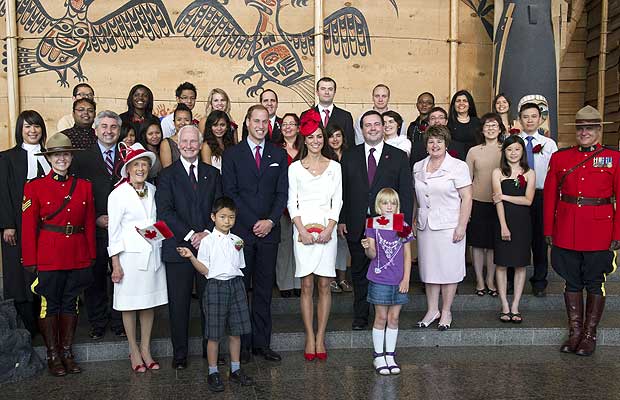
The Duke and Duchess of Cambridge -- our future King William V and Queen Katherine -- preside over a ceremony for naturalized citizens in 2011.

The Duke and Duchess of Cambridge — our future King William V and Queen Katherine — preside over a ceremony for naturalized citizens in 2011, along with Governor General Johnston and Jason Kenney, then Minister of Citizenship and Immigration .

Permanent residences in Canada must swear or affirm loyalty to the Queen of Canada in order to become naturalized Canadian citizens. Military personnel, parliamentarians, lawyers, judges, and cabinet ministers must swear a similar oath (or make a solemn affirmation) before assuming their offices and duties. The Governor General commissions the Prime Minister, in the Queen’s name, to form a government, which means that the Ministry derives its authority to govern from the Crown and must subsequently maintain the confidence of the Commons.

Candidates for naturalized citizenship must swear or affirm the following, as per the Citizenship Act:

I swear (or affirm) that I will be faithful and bear true allegiance to Her Majesty Queen Elizabeth the Second, Queen of Canada, Her Heirs and Successors, and that I will faithfully observe the laws of Canada and fulfil my duties as a Canadian citizen.      

Charles Roach, a lawyer from Toronto who immigrated to Canada in 1955, launched the first legal challenge against this oath or affirmation in the 1990s; he contended that the oath violates an anti-monarchist’s Charter right to freedom of conscience under s. 2(a). His three challenges reached the Federal Court in 1994 and the Ontario Superior Court of Justice in 2007 and 2009. The courts have thus far. In Roach v Canada from 1994, the Federal Court ruled:

The appellant can hardly be heard to complain that, in order to become a Canadian citizen, he has to express agreement with the fundamental structure of our country as it is. […] He cannot use his dream of a republican Constitution as a legal basis for denying the legitimacy of the present form of government. […] 

In addition, the Federal Court also upheld the constitutionality of the military’s oath of allegiance to the Queen in Chainnigh v Canada in 2008. Roach passed away last year, but his case has continued with three other anti-monarchist applicants.

The “Queen of Canada” has an objective legal meaning; Elizabeth II personifies the Crown of Canada and represents the country in both political senses of the word (the State and the people), as well as lawful executive and legislative authority. In 1977, the Parliament of Canada added the phrase “Queen of Canada” to the oath in order to emphasize the Queen of Canada is a separate legal person from the Queen of the United Kingdom and the Queen of Australia; consequently, Canada is a sovereign, independent state. (The previous wording of the oath referred to “Queen Elizabeth II” without her official Canadian titles). The Crown is not a foreign institution – it has always formed an integral part of Canada’s constitution and heritage. The Crown of Canada is also a corporation sole, and we swear or affirm our allegiance to the legal person such that an oath to Queen Elizabeth II automatically applies also to Charles III, William V, and eventually to the new-born and yet unnamed Prince Cambridge.

The oath or affirmation of allegiance to the Queen therefore reflects Canada’s constitutional monarchy and legal-constitutional position. Section 9 of the Constitution Act, 1867 vests executive authority in the Queen, and section 17 establishes the Crown-in-Parliament as the Queen, Senate, and House of Commons. A bill only becomes law upon Royal Assent, and an order-in-council or proclamation is only promulgated with the Crown’s approval. In addition, the oath of allegiance that all parliamentarians must swear or affirm before taking their seats appears in the fifth schedule to the Constitution Act, 1867. The basic form of the oath therefore forms part of the Constitution of Canada. The other oaths are statutory, but flow from the Constitution.

Similarly, in order to become a naturalized citizen of the United States, one must “bear true faith and allegiance” to “the Constitution and the laws of the United States”, because that document forms the basis of all legislative, executive, and judicial authority in and over the United States of America. Americans do not pledge allegiance to the United States itself in order to assume public offices and duties and naturalized citizenship. (By tradition, American students pledge allegiance to their flag, Old Glory, through the “Pledge of Allegiance” does not enjoy the same official, legal status as formal oaths of office, which all refer to the Constitution of 1787). So even if prospective citizens pledged allegiance to the Constitution of Canada, they would still necessarily pledge allegiance to the Crown because it forms an integral part of the Constitution.

In the oath for naturalized citizenship, the reference to “observing the laws of Canada” in the second main clause flows naturally from the first main clause, because all laws are passed in the Queen’s name. By swearing or affirming to “faithfully observe the laws of Canada,” the naturalized citizen pledges to observe the Queen’s laws. This second main clause depends on the first and cannot be taken in isolation. In contrast, an ambiguous pledge to “Canada” alone lacks an objective grounding in law and the constitution and could refer to either the country as in State or as in patria, or to the people, or to be left to each individual’s own interpretation.

The appellants of the current case argue that they should be able to swear or oath or make an affirmation to Canada alone, and not to the Queen of Canada. In reality, “Allegiance to the King means allegiance to the Country,” as Beauchense’s Rules and Forms of the House of Commons of Canada states. More recently, O’Brien and O’Bosc have reiterated the same principle:

When Members swear or solemnly affirm allegiance to the Queen as Sovereign of Canada, they are also swearing or solemnly affirming allegiance to the institutions [that] the Queen represents, including the concept of democracy.

Furthermore, Canada’s citizenship guide, Discover Canada: The Rights and Responsibilities of Citizenship, explains:

In Canada, we profess our loyalty to a person who represents all Canadians and not to a document such as a constitution, a banner such as a flag, or a geopolitical entity such as a country. In our constitutional monarchy, these elements are encompassed by the Sovereign (Queen or King). It is a remarkably simple yet powerful principle: Canada is personified by the Sovereign just as the Sovereign is personified by Canada. 

The oath should retain this reference to the Queen of Canada because in any country an oath should represent the present legal-constitutional position and must be universal – the oath does not reflect a normative aspiration for what republicans want the constitution to become. As long as Canada remains a constitutional monarchy, pledging allegiance to the Sovereign will continue to mean pledging allegiance to the country. As Justice McDonald ruled in Roach v Canada of 1994:

The Constitution, as it exists at any given time, cannot be unconstitutional, nor can it be constitutionally burdensome. It is itself the ultimate criterion by which all laws, actions and discriminatory burdens are measured. 

We should regard this case for what it is: an attempt to chip away at the legal-constitutional framework and historical tradition of Canada through republicanism by stealth. Given that the Federal Court has upheld the constitutionality of the civil and military oaths of allegiance to the Queen in 1994 and 2008, respectively, the provincial court should dismiss the case.

Similar Posts:

Posted in Corporation Sole, Crown (Powers and Office), Monarchism v Republicanism, Oaths of Allegiance | 5 Comments

Law Professors from the University of Ottawa on Succession to the Crown


Another new development has just emerged in the ongoing narrative of royal succession. Earlier today, four professors of law at the University of Ottawa co-authored a column in Le Devoir and explained their constitutional objections to the Government of Canada’s approach to succession. However, I disagree with some parts of my colleagues’ analysis.

In their column, Professors Thibault, Theriault, Robitaille, Sylvestre argue that only a constitutional amendment to the “office of the Queen” under section 41(a) of the Constitution Act, 1982 can alter the succession to the Crown of Canada. This unanimity procedure requires that the House of Commons, Senate, and the assemblies of all 10 provinces pass concurring resolutions. The procedure does not require the consent of the “Parliament of Canada,” (Queen, Senate, and Commons), which would instead involve a law passed by both houses and given Royal Assent, rather than joint resolutions of the two houses. In so doing, they therefore reject the Government of Canada’s argument that the preamble of the Constitution Act, 1867 contains an implied principle of symmetry and guarantees that the Sovereign of the United Kingdom is automatically the Sovereign of Canada. But they also argue that the Protestant succession (the requirement in all 16 Realms that the Sovereign be a Protestant) is unconstitutional under sections 2(a) and 15 of the Charter. This is where I disagree with their analysis.

If succession falls under the ambit of the Constitution of Canada in general and section 41(a) of the Constitution Act, 1982 in particular (which the authors believe), then the rules of succession are not subject to the Charter because, as the Supreme Court of Canada has upheld in various rulings, one part of the Constitution cannot abrogate another. In other words, the Charter could only invalidate the Protestant succession as discriminatory if succession did not fall under the Constitution. Since the authors have already argued that succession pertains to section 41(a), they cannot invoke the Charter argument. The argument as to whether the Protestant succession would satisfy the Reasonable Limits Test under section 1 of the Charter therefore does not apply to this question of royal succession. At this stage, the authors are presenting a republican argument against constitutional monarchy itself rather than a pure criticism of the process by which the Government of Canada sought to alter the rules of succession to the Crown of Canada; the authors freely acknowledge that they “do not agree with the principles and basis of monarchy.” Rather than acting as an argument against the Government of Canada’s position on succession, the logical extension of this contention would amount to nothing less than the disestablishment of the entire constitutional system of this Dominion by using sections 2(a) and 15 of the Charter to make succession to the Crown unconstitutional. If this contention were correct, then the Crown of Canada itself would have been unconstitutional since the adoption of the Charter in 1982.

They have also accepted the Government of Canada’s incorrect assertion that the Succession to the Crown Bill, 2013 followed the precedents set on abdication and succession in 1936-1937 and on the Royal Style and Titles in 1947-1948 and 1952-1953. They countered that these “precedents are of no utility, because section 41(a) was not in force at the time” and because the ‘office’ includes the person who occupies it. They are absolutely right on the second point because the Crown of Canada is a corporation sole, but they are not quite right on the first point, if only because the Government of Canada of 2013 has misrepresented the position of the Government of Canada in 1937. In 1936-1937, the Government of Canada believed that His Majesty’s Declaration of Abdication Act had extended succession to Canada as part of its laws, which the Succession to the Throne Act, 1937 affirmed retroactively. The professors are correct that Patriation removed the possibility of allowing the Westminster Parliament to legislate for Canada under section 4 of the Statute of Westminster, as it did in 1936, and that the Constitution Act, 1982 imposes a new set of legal-constitutional requirements that did not exist prior to its adoption.

Similar Posts:

Posted in Corporation Sole, Crown (Powers and Office), Succession (Sovereign) | 3 Comments