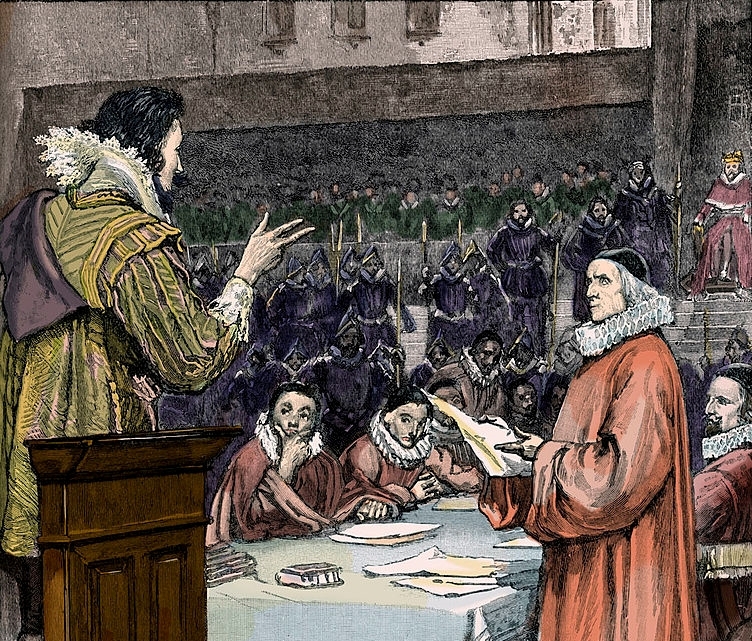
The Duke of Buckingham’s Impeachment at the Bar of the House of Lords
Introduction: Ian Brodie’s Article in The Dorchester Review
Ian Brodie, one of Stephen Harper’s former chiefs of staff who served him both as Leader of Her Majesty’s Loyal Opposition and as Prime Minister, contributed an interesting article to the most recent issue of The Dorchester Review — to which, if you enjoy this blog, I recommend that you subscribe, since you’d probably also like the journal.
You should take as many grains of salt you deem appropriate before reading “Harper the Constitutionalist” in full, given that Brodie worked for Harper. However, I think that Brodie’s analysis of this incident is constitutionally correct and quite interesting, since it had never occurred to me before and flew under my radar in 2006. What is more, this example illustrates the principle of collective ministerial responsibility, and it rather complements my piece in the same issue of The Dorchester Review, “1841 or 1848: When Did Responsible Government Begin?” and my early findings on how the emergence of proper collective ministerial responsibility determines when Responsible Government truly came to its own.
On 21 and 22 June 2006, controversy erupted when New Democratic MP Nathan Cullen introduced a motion before the House of Commons Standing Committee on Environment and Sustainable Development (as it was then known) asking that Minister Ambrose alone be dismissed from Cabinet. Brodie summarizes the events as such:
Harper had long been a clear opponent of the Kyoto Protocol on greenhouse gas emissions. The Chrétien and Martin governments both advertised their support for the Protocol, but refused to take the steps required to meet the commitments Chrétien’s government had made in Kyoto. By 2006, Canada had no realistic options for meeting these targets, and Harper’s first environment minister, Rona Ambrose, admitted as much in public. NDP MP Nathan Cullen, unhappy with Ambrose’s admission, moved a motion in the House of Commons Environment Committee calling for her dismissal. The motion was based on the fundamentally unconstitutional idea that the House can vote non-confidence in a single minister.
Responsible government rests on the tenet that while ministers are individually and collectively accountable to the House, the House can only vote non-confidence in the government as a whole. Mr. Harper reminded everyone of this fundamental rule when he announced would see any vote of non-confidence in his environment minister as a lack of confidence in his government. The Liberals hurriedly voted with the Conservatives to defeat Cullen’s motion at the Committee’s next meeting, ending the manoeuvre quickly. But the American-style effort to impeach a single member of the ministry over a policy matter gave Harper the opportunity to correct a profound misunderstanding of Canadian constitutionalism. Ministerial responsibility has an individual dimension to it when malfeasance or bad administration is at issue. But on policy matters, the government are collectively responsible to the House. Harper’s timely warning was an astute effort to remind everyone of the appropriate separation of powers.[1]
In short, Brodie is undoubtedly correct in his analysis of the constitution and of how Responsible Government works.
Nathan Cullen’s Unconstitutional Motion of Impeachment Over Policy Disagreements
Cullen had proposed the following motion to the committee on 21 June 2006, which would have amounted to a de facto impeachment of Minister Ambrose, if even Cullen himself did not use that word. His seven articles of impeachment are as follows:
That because the Minister of the Environment has:
1) indicated in Bonn that Canada would not live up to its international obligations under the Kyoto Protocol;
2) refused to address the municipal mayors and councillors of the Federation of Canadian Municipalities assembled in Montreal in June, 2006;
3) been the first Federal Minister of the Environment to refuse to attend the annual Smog Summit in Toronto;
4) refused to appear before this committee in spite of a standing and open invitation;
5) tabled no plan for Canada to reduce Greenhouse Gas Emissions or to address Canada’s pollution problems;
6) done nothing to stop the regressive cuts to beneficial environmental programs such as Energuide for Houses Retrofit Incentive Program and for Low-Income Households;
7) implemented no single measure to conserve or protect Canada’s environment to date;That the Standing Committee of the Environment and Sustainable Development call on the Government of Canada dismiss the Minister of the Environment from her current cabinet position and that this decision be reported to the House.[2]
The Minutes of Proceedings indicate that while the Chair had ruled the motion in order, Conservative MP Maurice Vellacott appealed the decision, and the committee ultimately agreed 7 to 3 that Cullen’s motion was out of order.[3] While Mark Warawa touched upon the absurdity of Cullen’s impeachment motion, the committee ultimately voted out of order without explicitly exposing the unconstitutionality of Cullen’s proposal. As Brodie points out, this motion had nothing to do with personal misconduct on the part of Minister Ambrose, nor did it even pertain to administrative incompetence in Environment Canada, for which the minister is responsible. Instead, the motion pertained purely to the policies of the Harper government. Cullen’s only recourse would therefore have involved tabling a motion of non-confidence in the government as a whole.
And what does “that the Government of Canada dismiss the Minister of the Environment” even mean? The phrasing betrays Cullen’s ignorance of the constitution. (Conservative MP Mark Warawa touched upon this during the committee). The Governor General appoints and dismisses Ministers of the Crown on and in accordance with the advice of the Prime Minister, who normally conveys his views to the Governor General in writing through an instrument of advice. Ultimately, this authority derives from sections 9 and 11 of the Constitution Act, 1867, which, by the established constitutional conventions of Responsible Government, the Governor General exercises on and in accordance with the Prime Minister’s advice. The House of Commons has no business in ordering the Prime Minister to shuffle his cabinet, and no statute – let alone a mere motion – can purport to bind the Prime Minister without also binding the Governor General, or else it would be unconstitutional and ultra vires of section 41(a) of the Constitution Act, 1982.
But Nathan Cullen insisted on pursuing his unconstitutional motion. The following day, he rose in the House of Commons on a spurious point of privilege and took the extraordinary step of asking that Speaker Milliken overrule the vote of the committee and deem his unconstitutional motion in order so that the committee would have to vote on the motion itself at its next sitting. He droned on for several paragraphs, culminating in this reasonable-sounding but fundamentally incorrect and self-serving nonsense — and probably delivered without a hint of irony:
When a majority is used to abolish the rules and deprive me of a fundamental right to hold the minister to account, our system has fallen into disrepute. I ask you, Mr. Speaker, to see the prima facie case in my question of privilege, have the committee look at the motion, have the system that has allowed this travesty to be reviewed at the procedure and House affairs committee, and help restore my faith and that of the people who sent me to this place.[4]
Speaker Milliken, correctly, ruled against Cullen:
The committee is master of its own proceedings. It has made a decision. The hon. member clearly objects to it. I invite him to take up the matter with the committee once again, because in my view that is the proper venue for his complaint in this case. I do not believe he has raised a question of privilege.[5]
In short, the Standing Committee and the Speaker made the correct rulings, but for the wrong reasons. In particular, Milliken should have upheld the committee’s ruling on the grounds that impeachment of individual ministers is obsolete and incompatible with Responsible Government. Nathan Cullen’s motion was out of order because it proposed something unconstitutional. Prime Minister Harper correctly declared that he would regard such a motion for the impeachment of an individual minister on a matter of policy as a motion of non-confidence in the government as a whole, thus forcing the correct resolution of the issue.
Through his unconstitutional motion, Nathan Cullen attempted to re-introduce the idea that the Commons can impeach and force the Crown to remove a single minister for any reason. Brodie characterizes impeachment as an “American-style” procedure, which it is, in a way — but we should also bear in mind that the Americans derived both the concept and procedure for impeachment (the lower house tries, and the upper house convicts or acquits) from Stuart and Hanoverian England. Therefore, impeachment pre-dates the advent of Responsible Government and the principle of collective ministerial responsibility and cabinet solidarity; instead, the constitutionality and rationale of impeachment relies on a Tudor, Stuart, and early Hanoverian understanding of individual ministerial responsibility in which Privy Councillors were responsible only to the King and for their portfolio, but not responsible to one another as a group and not collectively responsible for all acts of the Crown. Worse still for Cullen, even the impeachments of the Tudor, Stuart, and Hanoverian eras normally pertained to personal misconduct — not mere disagreements in policy. For example, the English House of Commons impeached the Duke of Buckingham in 1626 because of his failure as a military commander (“his neglect of guarding the seas”) and personal corruption.[6] Cullen’s proposed impeachment of Rona Ambrose, on the other hand, was truly without precedent because it focused purely on policy, and his disagreement with it, and not at all about Ambrose’s personal conduct.
Conclusion: Collective Ministerial Responsibility Made Impeachment of Individual Ministers Obsolete
it should be stated unequivocally that for all practical purposes the procedure of impeachment is obsolete.
The earliest recorded impeachment was that of Lord Latimer in 1376 and the last was in 1806, when Lord Melville (Dundas) was charged by the Commons, but acquitted, of misappropriating official funds. Before Melville, the last impeachment had been against Warren Hastings in 1787 in relation to his role in India. An attempt to impeach Ministers occurred in 1713 for their part in the negotiating the Treaty of Utrecht. The Jacobite lords were impeached in 1716 and 1746 for rebellion. The last attempt to persuade the Commons to bring an impeachment was against Palmerston as Foreign Secretary, when private members alleged a secret treaty with Russia. The preliminary motion was not successful. Impeachment has not been used since 1806.
There have been fewer than seventy impeachments during the whole course of English history. There are two distinct periods in which impeachment was relatively common; firstly in the 14th century until the establishment of the Tudor dynasty and secondly in the 17-18th century. A quarter of all of them occurred in the years 1640-2.[7]
The British House of Commons held impeachment proceedings mostly enthusiastically during periods when the Commons and King clashed most often, as under the reign of Charles I between 1640 and 1642, and when members of the House of Peers supported the first and second Jacobite Rebellions in 1716 and 1746. In the latter case, grounds for impeachment certainly fell under the category that Erskine-May and the US Constitution of 1787 both call “high treason or of certain high crimes and misdemeanours.” Again, the Americans took this procedure from the British because their constitution and strict separation of powers also pre-date Responsible Government. By necessity, impeachment remains the only means of forcing corrupt or criminal officials from office because the President and his cabinet do not govern based on commanding the confidence of a majority in Congress.
It’s not a coincidence that the last impeachment proceedings took place in 1806, during the period where collective ministerial responsibility, what we call Responsible Government and what the British call Cabinet Government, was emerging. As the British House of Commons acknowledges, “Ministers have been impeached, but before the modern concept of the Cabinet was established.”[8] Why? Because collective ministerial responsibility and votes of non-confidence have replaced impeachment.
The advent of Responsible Government rendered impeachment unconstitutional. Votes of non-confidence in the cabinet as a whole have replaced impeachment, but could, in a way, be regarded as a collective impeachment of the government’s policies and conduct. Essentially, Cullen orchestrated this too-clever-by-half move so that the Opposition could both get rid of Ambrose but also prevent the Harper government from losing the confidence of the Commons and triggering an election; Harper called their bluff and exposed the impossibility of that course of action. While it is possible that the controversy over Ambrose influenced his decision to assign her to a new portfolio is his first cabinet shuffle in 2007, this is not anything near equivalent to impeachment.
Similar Posts:
[1] Ian Brodie, “Harper the Constitutionalist,” The Dorchester Review, 6, no. 2 (2016): 36-37.
[2] Canada, House of Commons, Evidence: Standing Committee on Environment and Sustainable Development, 39th Parliament, 1st Session, Meeting No. 11 (21 June 2006), at 1 (Nathan Cullen).
[3] Canada, House of Commons, Minutes of Proceedings: Standing Committee on Environment and Sustainable Development, 39th Parliament, 1st Session, Meeting no. 11 (21 June 2006), 1.
[4] Canada, House of Commons, Debates, 39th Parliament, 1st Session, Volume 141, No. 046 (22 June 2006), 2816 (Nathan Cullen).
[5] Canada, House of Commons, Debates, 39th Parliament, 1st Session, Volume 141, No. 046 (22 June 2006), at 2817 (Peter Milliken).
[6] John Rushworth, ‘Historical Collections: The impeachment of Buckingham (1626)’, in Historical Collections of Private Passages of State: Volume 1, 1618-29 (London, 1721), pp. 302-358. British History Online http://www.british-history.ac.uk/rushworth-papers/vol1/pp302-358 [accessed 7 December 2018].
[7] United Kingdom, House of Commons Freedom of Information Disclosures, “Impeachment (2015)”. < https://www.parliament.uk/site-information/foi/foi-and-eir/commons-foi-disclosures/other-house-matters/impeachment-2015/> [accessed 1 January 2017].
[8] United Kingdom, House of Commons Freedom of Information Disclosures, “Impeachment (2015)”. < https://www.parliament.uk/site-information/foi/foi-and-eir/commons-foi-disclosures/other-house-matters/impeachment-2015/> [accessed 1 January 2017].