
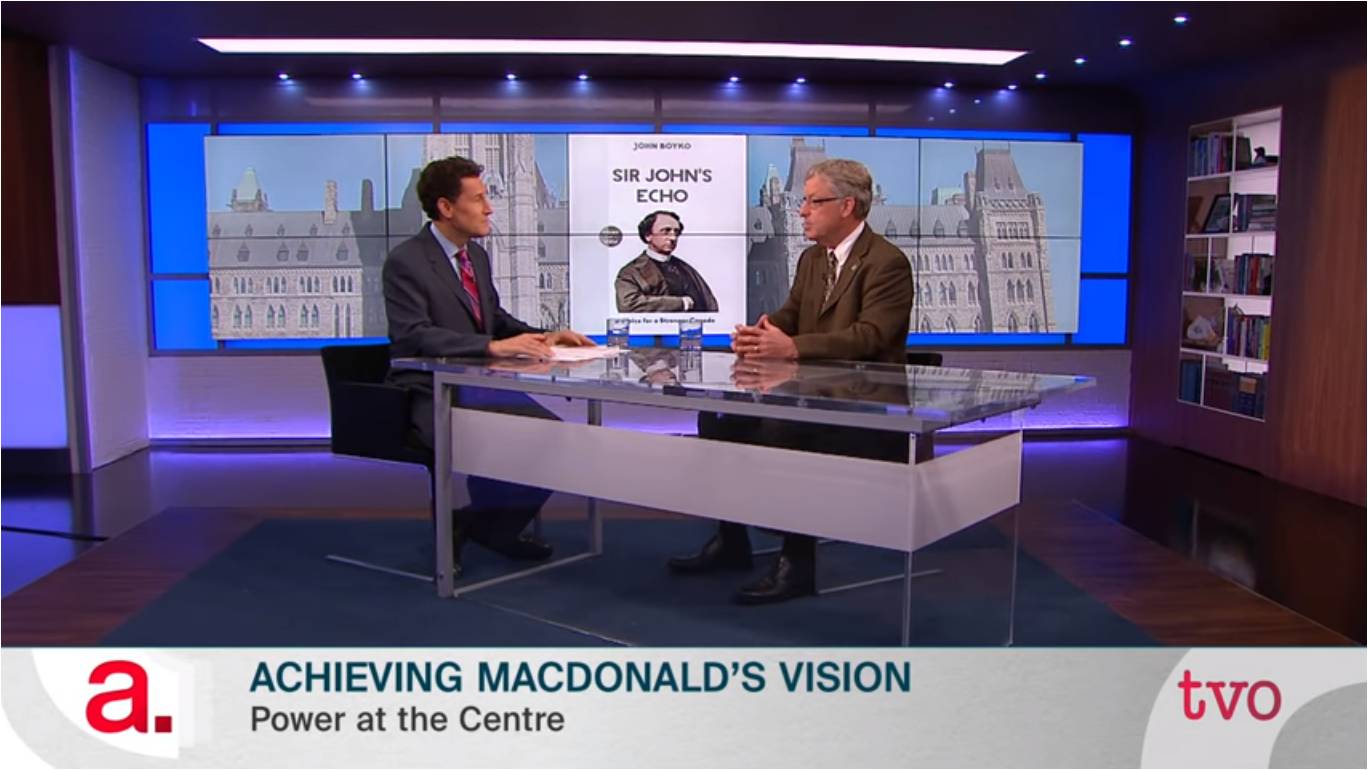
John Boyko’s Book on John A. Macdonald
Historian John Boyko appeared on The Agenda with Steve Paikin on 30 May in order to promote his new book, Sir John’s Echo: The Voice for a Stronger Canada. Boyko presents this warmed over case for Macdonald’s centralized view of federalism and his initial support for a “legislative union” (i.e., a unitary state) of amalgamating the various British North American colonies into one new colony with one order of government. Boyko therefore focuses on the division of powers contained in sections 91 and 92 of the British North America Act, 1867, and emphasizes his own support of the principle in the POGG Clause in section 91 that non-enumerated, residual authorities fall within the competence of the Parliament of Canada and not the provincial legislatures.
He subscribes to what I call The 1867 as Year Zero School of Canadian history: for him and his peers, everything started ex nihilo upon Confederation and the entering into force of the British North America Act, 1867. Nothing else matters — certainly not the political history of British North America prior to 1867. Boyko and other adherents to this school of thought therefore see Confederation as the be all and end all and either ignore outright or egregiously misinterpret what came before.
This view thereby causes Boyko to make statements like that at 4:37, in response to Paikin’s question on the Compact Theory of Confederation:

 James Bowden's Blog