
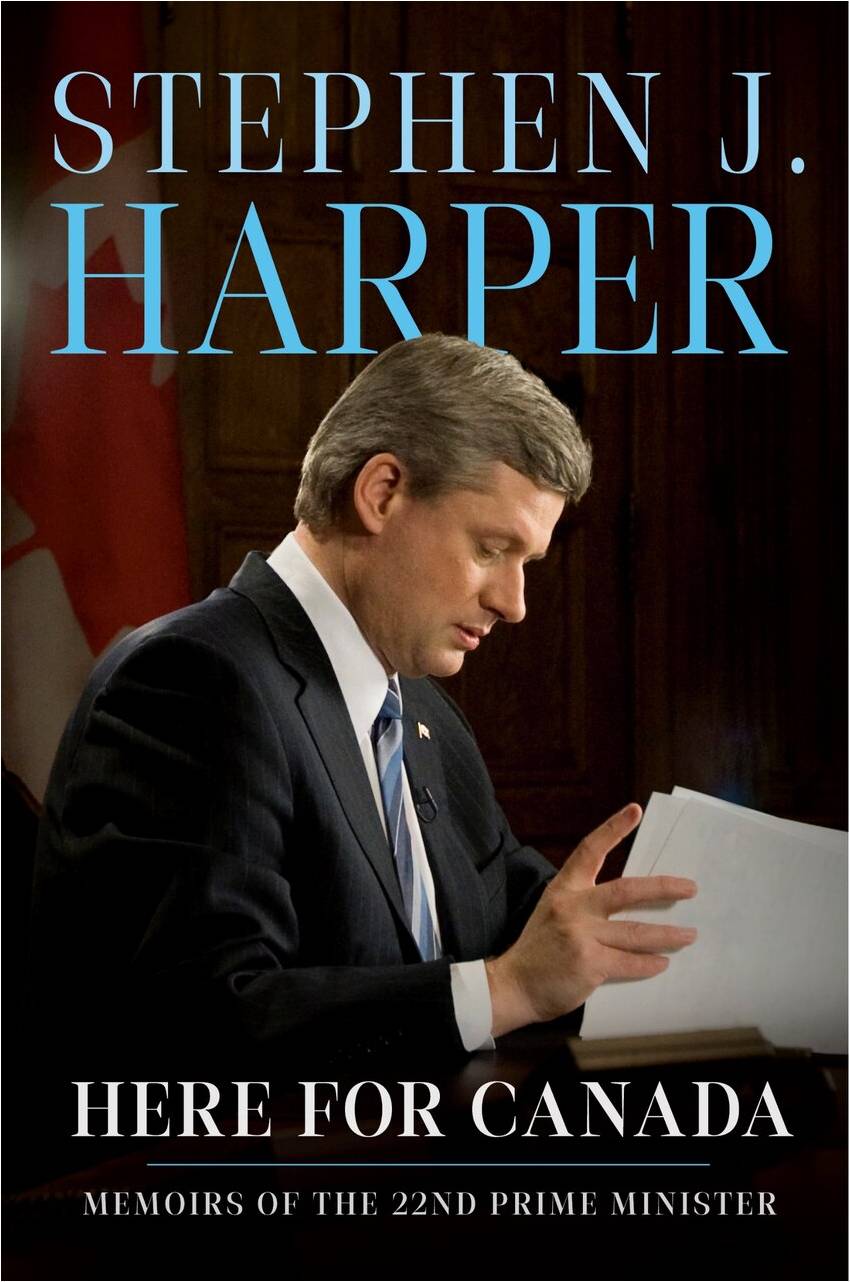
The Prospect of Memoirs
John Ibbitson wrote his biography on Stephen Harper (entitled Stephen Harper) just in time for the Conservatives’ defeat in 2015 and mentioned that Harper jotted down the sort of notes on all his activities and meetings as prime minister that would have served as the backbone of a political memoir:
“Harper has been keeping a diary of sorts since he became prime minister. It grew more or less haphazardly out of the detailed schedule of his day that is printed out for him each morning by staff. After a particular meeting, or at the end of the day, on a flight, or when he otherwise feels like it, Harper jots notes beside the itinerary of his pression of this meeting, that leader, this briefing, that phonecall. The more interesting or important the event, the longer and more detailed the annotations. Not only do they serve to remind him of who has committed to what, they also allow him to talk to himself about what is going on in his life and in the government.”[1]
Stephen Harper said off hand before of the Council of State Governments’ Midwestern Conference in Saskatoon on 28 July 2025 that he had just finished drafting his political memoirs but conceded that they cannot include the most interesting stories: “I just completed a draft of my memoirs. Now I have to be honest: all the best stories can’t go in – they really can’t. I think that some day, I should just do them like Margaret Thatcher and write them for after I die.”[2]
I began eagerly anticipating adding them to my collection, along with those of Lester Pearson, Pierre Trudeau, Brian Mulroney, Jean Chretien (two memoirs and two collections of stories in his case), and Paul Martin. Joe Clark never bothered to write a political memoir about his brief and inconsequential premiership or tenure in cabinet under Mulroney; after all, what would he have to say aside from claiming to suffer from dyscalculia? Neither has Kim Campbell as far as I know, but I also couldn’t be bothered to verify whether she has written memoirs or not. I enjoy reading the memoirs of former prime ministers, if only to compare how they see themselves and remember various events compared to the primary sources like Hansard or secondary sources like contemporary news coverage. I even deign to read the memoirs of lesser politicians who failed to become prime minister, such as the self-parodic Michael Ignatieff – who did, in fact and as the Conservatives had correctly predicted, “ask Harvard to let him back” in 2014 after suffering a massive electoral defeat; he later moved to Hungary of all places in 2016.[3]
I reserved a copy of Here for Canada: Memoirs of the 22nd Prime Minister, which should arrive soon. But until such time, I have to content myself with the excerpt “Exclusive: How I Faced Down the ‘Coalition Coup’” that the National Post published on Halloween.
“The Liberal-Socialist-Separatist Coalition”
Harper did not list any dates for these events, but he claims to have met with individually with Stephane Dion, Jack Layton, and Gilles Duceppe just before the start of the 1st session of the 40th Parliament on November 18th, 2008 and found Layton and Duceppe uncharacteristically laconic – which he, in retrospect, now interprets to mean that the three leaders had already plotted with each other to defeat his government even before Jim Flaherty, the Minister of Finance, had vowed to eliminate the public subsidy to political parties. Interestingly enough, New Democratic operative Brian Topp lends credence to this narrative.
In his mini-memoir from 2010, Topp acknowledges that the New Democratic Party drafted a letter on the afternoon of election day, 14 October 2008, wherein Jack Layton suggested to Stephane Dion that the New Democrats and Liberals cooperate in the next parliament; if the Conservatives won another plurality and met the new House of Commons, the New Democrats and Liberals would then band together “to remove Harper and replace his government” – presumably upon the Address-in-Reply, though Topp does not say precisely.[4] Layton ended up not sending Dion the letter because the arithmetic did not give the New Democrats and Liberals together a majority. However, Layton called Dion the night of the election after the results had started coming in “to commiserate a little and to see if Dion was in any mood to discuss what options might lie before Parliament.” Topp continues: “Dion was clearly appalled by the results, and told Layton that now was not the time to explore those options [a coalition]. Perhaps the topic could be discussed later.”[5] Layton remained optimistic that he could convince the Liberals and the Bloc to take down Harper, and “Some backchannelling after the 2008 election confirmed [that] the Bloc was willing to consider working with us the replace the Harper Conservatives.”[6]
Jack Layton lobbied the Liberals and Bloc for the entire month before the House of Commons met to persuade them to join the New Democrats in defeating the Conservatives; consequently, Topp’s memoir supports the claim that the opposition parties had, in fact, conspired to bring down the Harper government before Jim Flaherty tabled the measure to eliminate the public subsidy to political parties. Harper’s Conservatives therefore unwittingly walked into a trap and gave what they called the Liberal-Socialist-Separatist Coalition the perfect pretext to force his resignation and form a new government. But they would have done so anyway even if the Harper government had not announced its intention to abolish the public subsidy to political parties based on the number of votes cast in the previous general election.
To Prorogue to To Dissolve?
Aside from this interesting revelation, however, I find Harper’s account of the Coalition-Prorogation Controversy of November and December 2008 cryptic and not entirely believable on at least one key point: Harper claims to have rejected asking Governor General Michaelle Jean to dissolve the 40th Parliament in late November or early December 2008 because he believed that the public did not want another election: “The second option would have been to call an election ourselves, given the surge of public opinion and the spectacular polls in favour of our government. But we quickly took that off the table as well. The public did not really want an election.”[7] Yet he also says that the Conservatives would have won a huge majority overall and most of the seats outside Quebec if such a general election had happened: “Our data suggested that, had an election been called at that moment on that issue, we would have had a shot at winning every single riding outside Quebec. That is how bad it was for the opposition.”[8]
So which is it? I say neither: Harper did not advise Jean to dissolve parliament because he feared that she would reject such advice, thus forcing him to resign the premiership; Jean would then have appointed Dion as prime minister after all, and Dion would have gleefully taken responsibility for Harper’s dismissal. And if Harper had asked Jean to dissolve the 40th Parliament instead of merely proroguing it, she probably would – quite rightly – have rejected that advice and dismissed Harper from office. Simply proroguing the 1st session of the 40th Parliament provided Harper the ideal solution: the same parliament would reconvene a few weeks later, at which time the House of Commons could still choose to withdraw its confidence from the Harper government by voting against the new economic measures in response to the Great Recession. Adrienne Clarkson went further and hinted on 3 February 2011 at the University of Toronto that she would have rejected even Harper’s advise to prorogue parliament if she had still been Governor General on 4 December 2008.
But, of course, the erstwhile coalition between Liberals and New Democrats – which would, in turn, have needed a separate confidence-and-supply agreement with the Bloc to survive – collapsed during the intersession; after announcing his intention to resign the leadership before abruptly unresigning, the Liberals ousted Stephane Dion as leader and acclaimed Michael Ignatieff in his place. Harper slew Ignatieff in 2011 and won a parliamentary majority that year before suffering defeat at the hands of Justin Trudeau’s resurgent Liberals in 2015.
Fixed-Date Elections
The Toronto Star also included an interesting excerpt of what Harper said about fixed-date election laws, which “ha[ve] essentially lengthened the electoral period. Full campaigning can be undertaken very early, given certain knowledge of the election date. That includes high-profile, well-funded, well-coordinated advocacy campaigns by groups strongly aligned with particular political parties.” Harper conceded that the fixed-date election law which he championed “was the wrong solution to the problem” and that “All that really had to be done to address that problem was to lengthen the minimum campaign period.”[9] I find this conclusion baffling to say the least – at least as the Star presented the excerpt.
First, increasing the minimum writ from 36 days to whatever longer duration has nothing to do with the fact that Parliament only has a maximum lifespan but no corresponding minimum under section 4(2) of the Constitution Act, 1982 and that the prime minister can therefore advise the governor general to dissolve parliament at any time before the maximum of five years. Second, the Trudeau government tabled an amendment to the Canada Elections Act in 2018 to define the writ as a minimum of 36 days and a maximum of 50 days, and to create a pre-writ period in advance of a fixed-date election, precisely in response to Harper’s absurdly long writ in 2015, where we all had to endure incessant electioneering for nearly 80 days. Finally, Harper himself once headed the National Citizens’ Coalition – one of these “high-profile, well-funded, well-coordinated advocacy” groups that he subtly derides here; he even brought forth litigation against the Government of Canada in a case which ultimately went to the Supreme Court of Canada as Harper v Canada 2004 SCC 33, by which time he had become leader of the opposition across Paul Martin.
Conclusion
Stephen Harper has enjoyed something of a renaissance in 2026 through several prominent public appearances. On 2 February, he spoke along side Jean Chretien (whom Harper clearly respects and admires) before the Royal Canadian Geographical Society on 2 February. The next day, the House of Commons unveiled his official prime ministerial portrait, and Mark Carney offered him genuine praise. Finally, Carney also invited Harper to deliver the closing remarks before the Canada Investment Summit on 15 September.[10] Mark Carney has dragged the Liberals back toward the political center as they existed under Jean Chretien, helped create a more hospitable environment in which to examine Harper’s historical legacy, and banished Justin Trudeau to the world of formerly well-known celebrities where he seems most at ease. Carney, notably, did not invite Trudeau to speak before the Canada Investment Summit – a serious matter not conducive to showcasing the latest advancements in socks. Stephen Harper remains the only living former Conservative prime minister of consequence – sorry, not sorry, Joe Clark and Kim Campbell – after the death of Brian Mulroney in 2024. Perhaps Harper’s own memoirs will also help shape the historiography on his premiership. I have long thought that comity in federal-provincial relations would emerge as one of Harper’s accomplishments, under-appreciated at the time but all the more clear in retrospect.
Similar Posts:
Notes
[1] John Ibbtison, Stephen Harper (Toronto: Signal, McCleland & Stewart, 2015), 240.
[2] CPAC, “Stephen Harper Discusses Canada-U.S. Relations at Saskatoon Conference – July 28, 2025,” accessed 3 November 2026. Harper made those remarks at 3 minutes, 10 seconds.
[3] Conservative Party of Canada, “Michael Igntieff Is Back in Canada,” political advertisement, March 2011, accessed on Canuck Politics on YouTube on 3 November 2026 ; Jason Fekete, “Michael Ignatieff Returns to Harvard Full-Time,” Ottawa Citizen, 24 June 2014, accessed 3 November 2026; Toronto Star, “Michael Ignatieff Named President of Budapest’s Central European University,” 5 May 2016, accessed 3 November 2026
[4] Brian Topp, How We Almost Gave the Tories the Boot: The Inside Story Behind the Coalition (Toronto: Lorimer, 2010), 49-50.
[5] Brian Topp, How We Almost Gave the Tories the Boot: The Inside Story Behind the Coalition (Toronto: Lorimer, 2010), 50.
[6] Brian Topp, How We Almost Gave the Tories the Boot: The Inside Story Behind the Coalition (Toronto: Lorimer, 2010), 52.
[7] Stephen Harper, “Exclusive: How I Faced Down the ‘Coalition Coup,’” National Post, 31 October 2026.
[8] Stephen Harper, “Exclusive: How I Faced Down the ‘Coalition Coup,’” National Post, 31 October 2026.
[9] Toronto Star, “Stephen Harper’s New Memoir Revisits Mark Carney Rivalry, Pierre Poilievre and a Day of Fear on the Hill,” 3 November 2026.
[10] CPAC, “Unveiling of Stephen Harper’s Official Portrait – February 3, 2026,” accessed 3 November 2026; CTV News, “Stephen Harper and Jean Chretien Discuss Canada and the World,” 2 February 2026, accessed 3 November 2026; CPAC, “Former Prime Minister Stephen Harper Speaks at Canada Investment Summit – September 15, 2026,” accessed 3 November 2026.


Prime Minister Harper’s account of prorogation was extremely disappointing. This was a historically important event and Harper treats it very casually and provides little insight. He states that there was agreement on the law re prorogation (there was not; there was heated debate) and he does not acknowledge the Conservative campaign against the GG. I don’t wish to relitigate prorogation. I did wish for more candour, insight and, above all, information!!!
LikeLike