
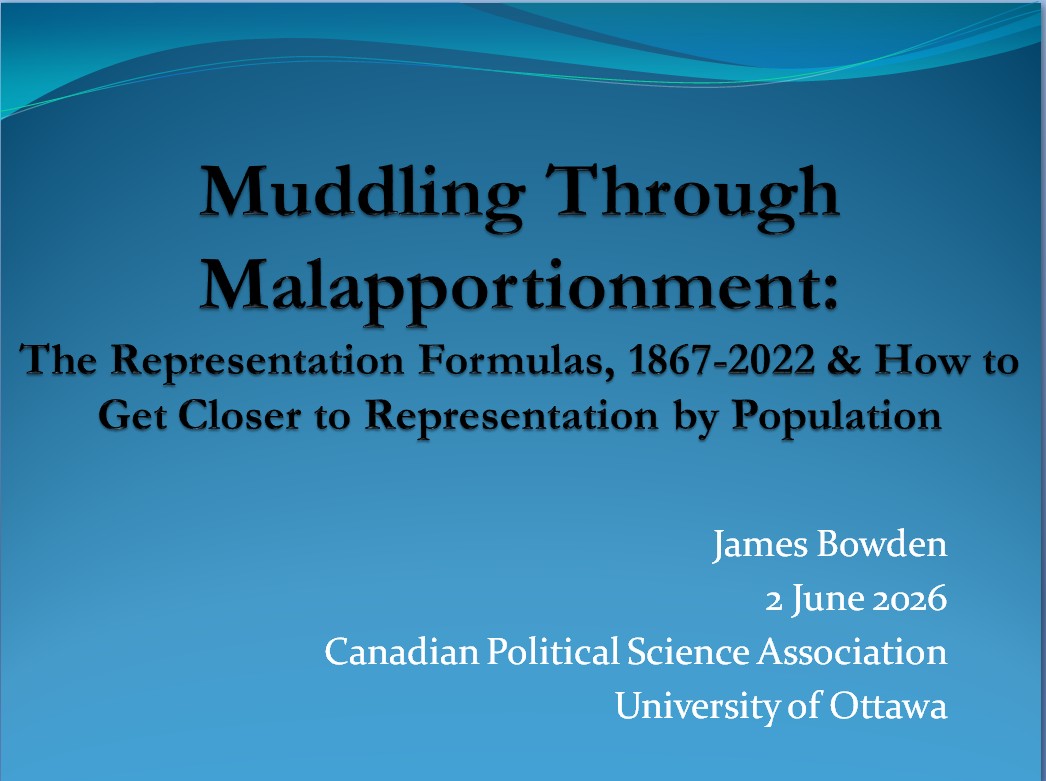
I presented an abridged history of malapportionment in the House of Commons at the Canadian Political Science Association’s annual conference on 2 June, which this year took place at the University of Ottawa. Ideally, one would like to go on at great length instead of only speaking for twelve minutes, but the necessities of brevity limited the presentation into a brief overview of the principle of representation by population, the true malapportionment of MPs per province each decade from the 1860s to the 2020s along the Loosemore-Hanby Index, the main features of each Representation Formula, and some basic methods through which Parliament could lower malapportionment in the 2030s. The discussant described my paper (a highly abridged version of the first five chapters of Representation by Population in the House of Commons) as reading more like a work of history rather than political science – which I readily admit and accept, either as criticism or as praise, given that I’ve never thought of myself as a conventional political scientist. Much to my pleasant surprise, my presentation on “Muddling through Malapportionment” generated some genuine interest during the questions and answers and even some praise from various other scholars after the panel.
Bowden. J.W.J. “Muddling Through Malapportionment: An Abridged History of the Representation Formulas under Section 51 of the Constitution Act, 1867 and Proposals for Improving Representation by Population.” Presentation to the Canadian Political Science Association. University of Ottawa, 2 June 2026.
This all might even have started some buzz for the books! A fellow researcher who has also written about readjusting electoral boundaries recently even made me realise after our conversation that if my books prove successful and generate as much interest as my presentation, then Representation by Population in the House of Commons could serve as a successor to Norman Ward’s The Canadian House of Commons: Representation, the last edition of which came out all the way back in 1963 and therefore could only cover the first three Representation Formulas; similarly, Where to Draw the Line: Readjusting Federal Electoral Boundaries in Canada would become the 21st-century companion to John C. Courtney’s Commissioned Ridings, which came out in 2001 and therefore could only include the electoral readjustments under EBRA from the 1960s to the 1990s. We shall see. Perhaps more opportunities to present on the books will arise after they come out in early 2027.
Similar Posts:


