
The last round of Federal Electoral Boundaries Commissions (FEBCs) finished their work in 2023, and the Governor-in-Council proclaimed the electoral maps – names and boundaries both – of 340 federal electoral districts under the Representation Orders, 2023. Canadians first voted along these new lines in April 2025. Yet this did not spell the end of what Elections Canada calls Redistribution 2022.
Parliament has never dared undermine the Electoral Boundaries Readjustment Act (EBRA) by enacting legislation to alter the boundaries of electoral districts, apart from one instance in February 2005 in direct response to the courts. However, parliament set the precedent in the 1960s of passing laws which amend the representation order to change the names of electoral districts. In the 1990s, Parliament adopted several private members’ bills to change the names of 44 out of the 298 electoral districts under the Representation Order, 1996.[1] In 2004, An Act to change the names of certain electoral districts changed of 38 out of the 305 ridings in eight provinces under the Representation Order, 2003.[2] Parliament also enacted the Riding Name Change Act in 2014 and changed the names of 30 out of 335 electoral districts in five provinces under the Representation Order, 2013.[3] And now the new 45th Parliament elected in April and convened in May 2025 has sprung into action to carry on this questionable tradition.
The Carney government tabled an omnibus Bill C-25 on 26 March 2026. Part 1, the main portion, would become the Strong and Free Elections Act and amend the Canada Elections Act, though that does not concern my inquiry here. Part 2, however, contains the last gasp of Redistribution 2022, this final and now inevitable stage where sitting MPs take the opportunity to get Parliament to amend the most recent Representation Order under EBRA to over-rule the Federal Electoral Boundaries Commissions and change the names of their ridings. The summary of Bill C-25 makes clear that the Act to change the names of certain electoral districts, 2026 results from “proposals by the members of the House of Commons who represent those electoral districts.”[4] In other words, other MPs would not hold a veto over how a member wants to change the name of his or her own riding. We will never hear the discussions or see the papertrail that went into creating this list, and the House of Commons would not normally question or amend such requests either out of a kind of mutually assured destruction between MPs and the parties. The Senate would certainly never question any of it and has not in previous decades either.
MPs registered no objections to the preliminary reports for Newfoundland and Labrador and for Prince Edward Island. But three MPs from Newfoundland have put in some changes in 2026. Liberal MP Tom Osborne found Cape Spear too short and would prefer Cape Spear—Mount Pearl— Paradise. In fairness, he won it for the first time in 2025 and therefore could not have done anything before PROC in 2023. Jonathan Rowe similarly only became an MP in 2025; he mislikes Terra Nova—The Peninsulas and has opted for a shorter name instead, The Eastern Peninsulas. However, Conservative MP Clifford Small decided not to object in 2023 when Newfoundland and Labrador’s FEBC changed Coast of Bays—Central—Notre Dame to Central Newfoundland. He would now like to restore the old name under which he first won election in 2021.
In 2023, New Brunswick’s FEBC rejected the one registered objection to the name of a riding. John Williamson (Conservative MP for New Brunswick Southwest) disagreed with the decision to change the name of his riding to “Saint John—St. Croix” and asked that it remain “New Brunswick Southwest.” Williamson objected to the decision to change the name of his riding for two reasons: first, the generic name “New Brunswick Southwest” does not exclude any of the communities within it, and second, because he insists on pronouncing “St. Croix” in the English way and strenuously objected to saying it à la française. In his estimation, since local English-speakers pronounce “St. Croix” as /ˈseɪnt ˈkrɔɪ/ and reject the French \sɛ̃ kʁwa\, everyone else must also utter the name of the city in the English way. Williamson would not want to hear other MPs or the Speaker refer to him in the House of Commons as the member for \sɛ̃.ʒɑ̃ sɛ̃ kʁwa\ but only as the member of
/ˈseɪnt ˈd͡ʒɒn ˈseɪnt ˈkrɔɪ/.[5] Not surprisingly, Williamson’s New Brunswick Southwest would make its triumphant return until this new statute in 2026.
Nova Scotia’s FEBC accepted Liberal MP Sean Fraser’s plea in 2023 to keep Central Nova intact. Liberal MP Lena Metledge Diab had objected to the new boundaries of her riding in 2022 (after not having attended any of the public hearings in Halifax in 2022), but she had not objected to the name of Halifax West, which she has represented since 2021. Now, however, she would dub it Halifax West—Peggy’s Cove, perhaps if only to highlight a placename already famous.
Alberta’s FEBC received two objections, accepting one and rejecting the other. George Chahal asked that the commission change the name of Calgary McKnight to Calgary Skyview, and, in turn, to call the new riding of Calgary Skyview either Calgary Stoney or Calgary Country Hills to reflect the neighbourhoods that this riding encompasses. This the commission rejected. But when Gerald Soroka ask to keep the name of his riding intact (Yellowhead) instead of renaming it to Jasper—Banff—Canmore, the FEBC saw the logic of keeping the shorter name and kept Yellowhead. Chahal went down in defeat in 2025, and the new Conservative MP Dalwinder Gill had no problem with the name Calgary McKnight.
No MPs from Saskatchewan objected to the names of their ridings in 2023. However, Conservative MP Corey Tochor would now like to turn Saskatoon—University into Saskatoon East, despite having represented the riding continuously since 2019 under the name Saskatoon—University. Having grown up in Manitoba, I understand that the inhabitants of the Prairies need to make their own amusements where they can.
Quebec’s FEBC accepted fully nine of the ten requests to change the names of ridings back in 2023. Maxime Blanchette-Joncas (Bloc MP for Rimouski-Neigette—Témiscouata—Les Basques) had objected to the decision to rename his riding Rimouski—La Matapédia asked that the commission come up with a new name but did not suggest one himself, but this half-hearted rebuke the FEBC rejected. Since then, however, Blanchette-Joncas has had time to come up with that new name after all within the last two and a half years and gave his riding the absurdly long moniker of Rimouski-Neigette—Mitis—Matapédia—Les Basques. The other six ridings in Quebec the names of which would change had no antecedent under Redistribution 2022.
British Columbia’s FEBC accepted five of the ten requests back in 2023, and the MPs whom the commission spurned all went down in defeat or retired in 2025. While Conservative MP Todd Doherty registered no objection to the name of his Cariboo—Prince George (which he has represented since 2015) back in 2023, he decided at some point over the last three years that his riding needed an addition to Cariboo—Prince George—Omineca.
Ontario’s FEBC accepted six of the seven requests to change the names of electoral districts, rejecting only that of Liberal MP Salma Zahid, who had asked that Scarborough Centre stay as it was instead of turning into Scarborough Centre—Don Valley East. However, Zahid either had a change of heart and made peace with her riding’s new name or decided not to participate in this process, because this riding does not appear in the list of those in Ontario the names of which would change.
The five ridings in Ontario the names of which would change did not show up at all during Redistribution 2022, and a curious pattern emerged with three of these five. Conservative MP Roman Baber has opted to change York Centre to North York, a benign amendment and readily understandable because he only became an MP for the first time in 2025 and therefore could have had no say at PROC in 2023. However, Conservative MP Scot Davidson first won election to York—Simcoe in 2019 and re-election to the same in 2021, but he never objected in 2023 when Ontario’s FEBC renamed his riding New Tecumseth—Gwillimbury. He now wants to call it York— South Simcoe instead, more similar to its previous name.
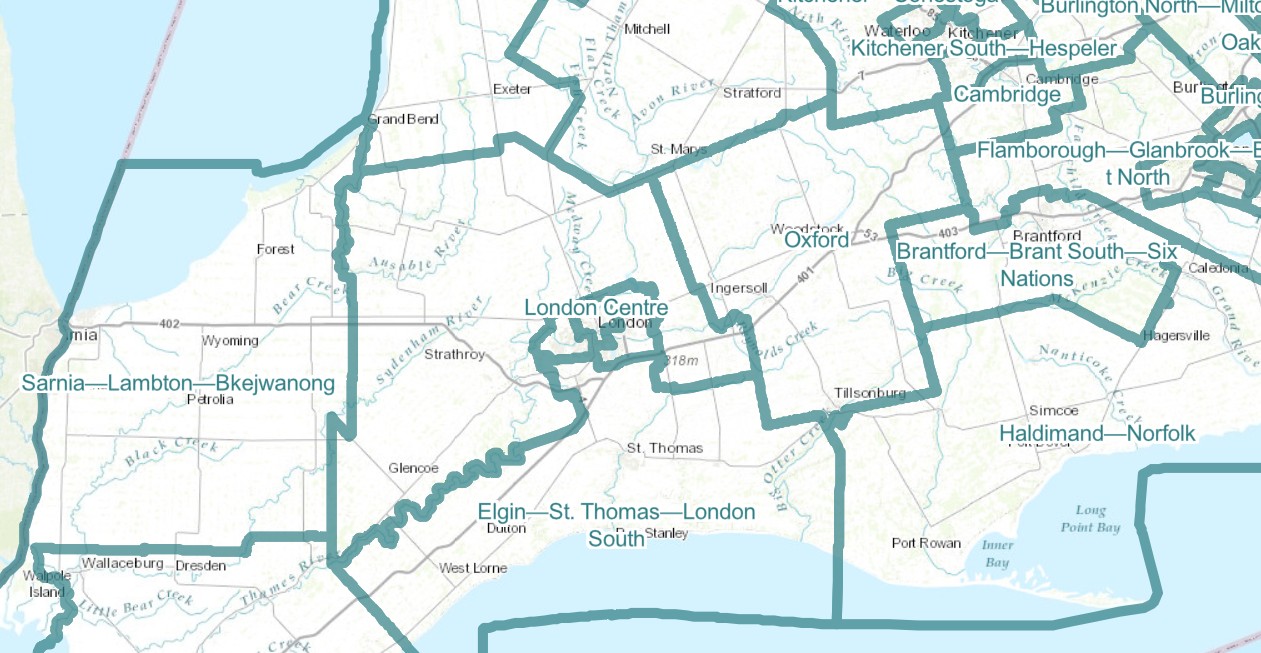
Three other Conservative MPs from Ontario have applied to remove indigenous placenames from their ridings. Larry Brock first won election to Brantford—Brant in 2021 and raised no objection to Brantford—Brant South—Six Nations before PROC in 2023. But now he has decided to remove the “Six Nations” and leave his riding as Brantford—Brant South. Similarly, Shelby Kramp-Neuman first won election to Hastings—Lennox and Addington in 2021 and then raised no objections before PROC in 2023 when Ontario’s FEBC changed the name of her riding to Hastings—Lennox and Addington—Tyendinaga. Yet now she would see her riding revert back to Hastings—Lennox and Addington. Kramp-Neuman, no stranger to hyphenation herself, only objected to the last em-dash and placename. Finally, Conservative MP Marilyn Gladu first won the riding of Sarnia—Lambton in 2015, then again in 2019, and once more in 2021. Not only did Gladu present no objection in 2023 to tacking on Bkejwanong to her riding, but she took on an active role throughout PROC’s study of Ontario’s preliminary report and even admonished Liberal MP Peter Fragiskatos during PROC on 4 May 2023 for had not attended the public hearings in and around London, Ontario. Gladu thought that Fragiskatos should have attended the public hearing and there asked the FEBC to make big changes to the proposal in advance of the preliminary report, instead of asking PROC to endorse significant alterations to the preliminary report in advance of the final report. Yet in 2026, Gladu would now restore her riding’s previous name, Sarnia—Lambton, and delete Bkejwanong without scrutiny.
Some observers might conclude that these Conservative MPs deliberately avoided drawing attention to their desire to remove the new indigenous names from their ridings during the very public and prominent process before PROC in 2023, before which they would have needed to articulate clear reasons for their objections and create all sorts of public records in PROC’s Evidence, the video on ParlVU, and in PROC’s reports; instead, they waited until Parliament would inevitably enact legislation to amend the names of ridings established under the Representation Orders, 2023 at a time when such a technical bill would go through no real public debate in the House of Commons and no opposition in the Senate.
In previous decades, MPs rarely the names of their ridings shorter and instead tended to tack on the names of other communities, mediated by em-dashes,[6] in what Canadian political scientist Norman Ruff denounced as “galloping hyphenation.”[7] John Courtney called it “the Canadian disease of ‘hyphenitis’” in contrast to the shorter names of Australian electorates and as well as the sequential ordinal numbers used to designate American congressional districts within each state.[8] In fact, FEBCs and MPs only add em-dashes, not hyphens, to the names of federal electoral districts, followed by the names of other regions or towns within the riding. The names of federal electoral districts only employ hyphens where the name of a municipality or region already does so. These hyphens appear most commonly in Quebec’s ridings, simply because the French language employs this punctuation more often in placenames than does English. Ontario’s Niagara Falls—Niagara-on-the-Lake from 2023 provides a rare example in the English language of a federal electoral district which contains both the em-dash to separate two different municipalities or regions and the hyphens which already appear in the name of the town.
The pattern that Courtney identified in 2001 based on the data from the 1960s to the 1990s held true in the 2000s and 2010s but just barely clung to relevance in the 2020s. An Act to change the names of certain electoral districts, 2004 changed the names of 36 of the 305 ridings established under the Representation Order, 2003; 28 of those 36 ridings (78% of them) ended up with longer names, and they grew by an average of 11 characters. Similarly, the Riding Name Change Act, 2014 changed the names of 28 out of 335 ridings established under the Representation Order, 2013, and 22 of those 28 (79%) grew larger by tacking on more em-dashes and placenames by an average of 9 characters. In contrast, An Act to change the names of certain electoral districts, 2026 would modify the names of 19 out of the 340 ridings established under the Representation Orders, 2023; only 10 of the 19 ridings, or only 53%, grew in length, and only by an average of 4 characters. While six out of the seven from Quebec conformed to the old pattern and grew appreciably, the names of all five of these ridings in Ontario would shrink – three of them for the same reason. One of the three from Newfoundland and Labrador would also get shorter, as would the one from Saskatchewan.
Parliament ought never to have set the precedent in the 1960s of meddling with work of the FEBCs and amending the Representation Orders only after the FEBCs have disappeared and can no longer fight back. But this practice has now become entrenched after more than sixty years. These examples show that MPs get the names of their own ridings changed on a whim with no rhyme or reason. Capricious politicians reign supreme, but we should count ourselves lucky that they limit their meddling to the names and never to the boundaries themselves apart from once in 2005 following on a ruling of the Federal Court.
Similar Posts:
- Readjusting Electoral Boundaries
- Ontario Needs to Readjust Its Provincial Electoral Boundaries Regularly(December 2025)
- Doug Ford Wins Snap Election on an Extremely Disproportional Electoral Map(March 2025)
- Doug Ford’s Gibberish on Gerrymandering: Why Ontario Needs Its Own Separate Provincial Electoral Boundaries Commission(August 2024)
- Bowden, J.W.J. “Adjusting Federal Electoral Boundaries in Canada: Redistribution 2022,” Canadian Parliamentary Review: A Focus on Electoral Boundaries Redistribution 47, no.1 (2024): 3-13.
- Out with the 338 and in the 343: The New Federal Electoral Boundaries Just Entered into Force Today!(April 2024)
Notes
[1] John C. Courtney, Commissioned Ridings: Designing Canada’s Electoral Districts (McGill-Queen’s University Press, 2001), 89.
[2] An Act to change the names of certain electoral districts, S.C. 2004, c.19.
[3] Riding Name Change Act, 2014, S.C. 2014, chapter 19.
[4] Bill C-25, An Act to amend the Canada Elections Act and the enact An Act to change the names of certain electoral districts, 2026, 45th Parliament, 1st Session, 3-4 Charles III, 2025-2026, First Reading, 26 March 2026.
[5] John Williamson (Conservative MP for New Brunswick Southwest), “Study on the Report of the Federal Electoral Boundaries Commission for the Province of New Brunswick,” Evidence: Standing Committee on Procedure and House Affairs, 44th Parliament, 1st Session, Number 048, Tuesday, 31 January 2023, at page 3.
[6] Courtney, Commissioned Ridings, 89.
[7] Courtney, Commissioned Ridings, 89.
[8] Courtney, Commissioned Ridings, 91.

 James Bowden's Blog
Finally, something not too serious into which you can pour your whole sense of humour!
LikeLike