
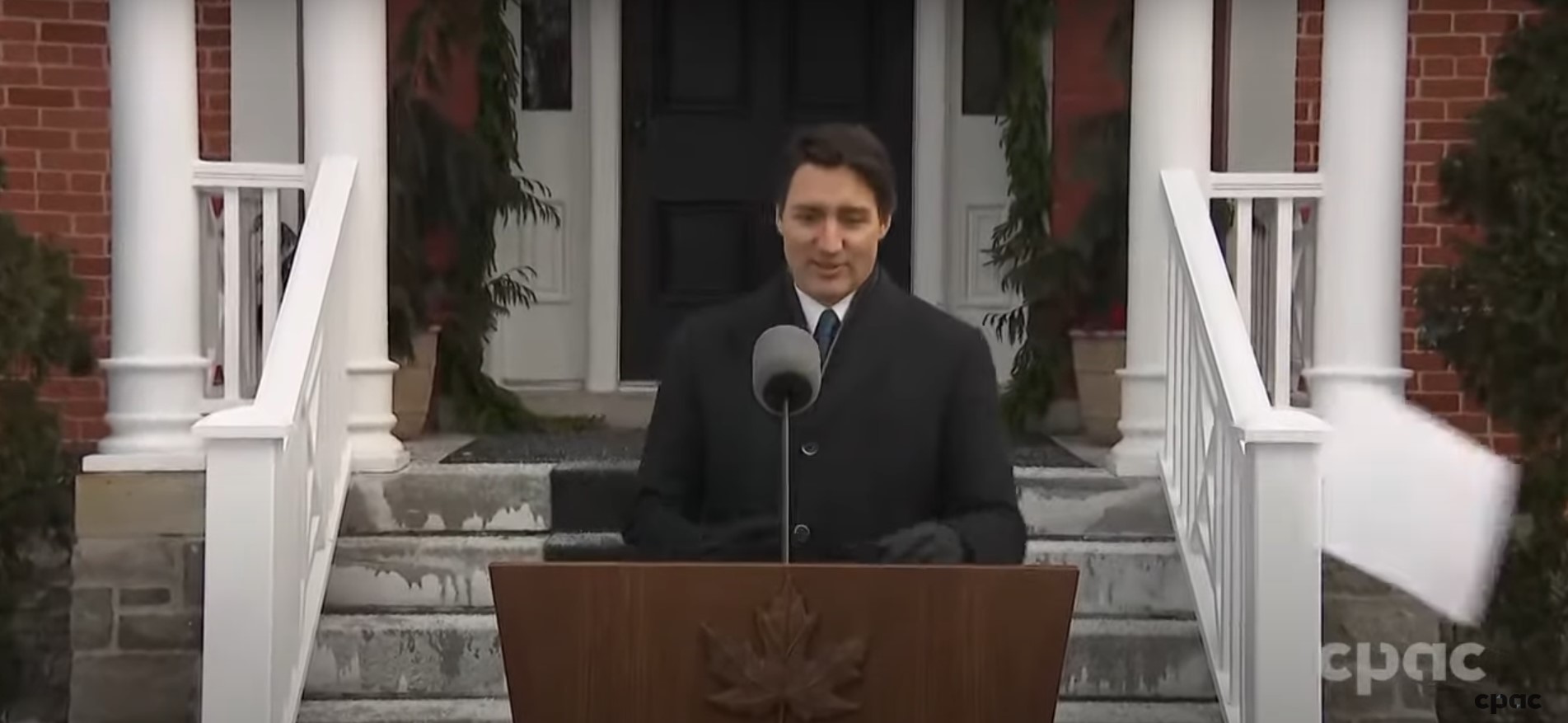
CPAC cut off the rest of footage showing the rest of the papers blowing away before Trudeau emerged, but this portion at least remained visible as perhaps a bad omen equivalent to Rishi Sunak’s speech in the rain in 2024.
On the Twelfth Day of Christmas, the Prime Minister gave to me his second tactical prorogation and endorsed what I had written in 2011.
Introduction
At around 10:45 on the morning of 6 January 2025 – the Feast of Epiphany and the Day of the Three Kings – Prime Minister Justin Trudeau revealed that he had grappled with a personal epiphany of sorts over the weekend and announced that he had advised Her Excellency Mary Simon to prorogue the 1st session of the 44th Parliament until 24 March 2025 because he intended to resign as leader of the Liberal Party and as Prime Minister and wanted to give the Liberal Party time to hold a leadership election during the intersession.[1] The press had begun to report on 5 January that Trudeau would resign before meeting the Liberal caucus on Wednesday, 8 January,[2] because the Liberal parliamentary party’s regional caucuses for the Atlantic, Quebec, and Ontario had already all publicly announced over the holidays that Trudeau should resign.[3] The Liberals elected so few MPs west of Thunder Bay in 2021, but Ben Carr, MP for Winnipeg South Centre and chair of PROC, had also called upon Trudeau to resign.[4] All this turmoil followed Chrystia Freeland’s spectacular resignation as Minister of Finance and Deputy Prime Minister on 16 December 2024, where she accused Trudeau in an open letter of pursuing “costly political gimmicks” in the face of President-elect Trump’s threats to impose tariffs against Canada.[5]
Brewings of a Want of Confidence
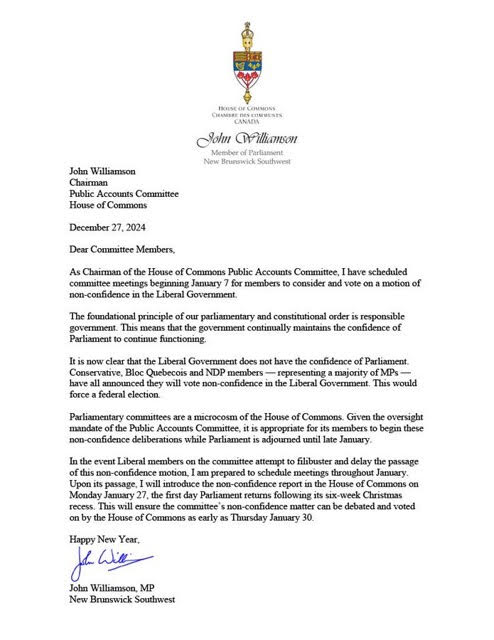
The signs began over the holidays. John Williamson announced in an open letter on 27 December 2024 that he would schedule a meeting of the Public Accounts Committee on 7 January 2025 “for members to consider a vote on a motion of non-confidence in the Liberal government” on the grounds that “it is now clear that the Liberal Government does not have the confidence of Parliament.” Williamson noted the open letter of Jagmeet Singh and the various public statements of Yves-Francois Blanchet and concluded that “Conservative, Bloc Quebecois, and NDP members – representing a majority of MPs – have all announced that they will vote non-confidence in the Liberal Government.” Williamson then pledged to “introduce the non-confidence report in the House of Commons on Monday, January 27,” which would mean that “the committee’s non-confidence matter can be debated and voted on by the House of Commons as early as Thursday, January 30.”[6] Williamson’s plan relies upon an unfavourable precedent from 10 May 2005, where Stephen Harper’s Conservatives and Gilles Duceppe’s Blocists tried to topple Prime Minister Paul Martin’s minority government by way of a motion to report back to a committee; their motion passed 153 to 150.
the First Report of the Standing Committee on Public Accounts, presented on Thursday, October 28, 2004, be not now concurred in, but that it be recommitted to the Standing Committee on Public Accounts with instruction that it amend the same so as to recommend that the government resign because of its failure to address the deficiencies in governance of the public service addressed in the report. [7]
However, the Martin government simply ignored this vote and refused to recognise it as a want of confidence and then ended up surviving by the narrowest of margins the vote on the budget one week later when Speaker Milliken broke the tie in favour of the government to allow debate to continue.[8] The Trudeau government could therefore have relied on this precedent to ignore a report from the Public Accounts Committee and held out until a vote on a supply bill or opposition motion had taken place, perhaps as late as March 2025 anyway. An even stranger precedent would have supported the Trudeau government as well. On 19 February 1968, the Pearson government lost a vote on the Third Reading of a C-193, an Act to amend the Income Tax Act by a margin of 2, 82 to 84.[9] Pearson neither resigned nor requested a dissolution of parliament; instead, on 23 February 1968, he introduced a motion to nullify the vote which had previously taken place:
“That this House does not regard its vote on February 19th in connection with the third read of Bill C-193, which had carried in all previous steps, as a vote of non-confidence in the Government.”[10]
The Commons then voted 138 to 119 to affirm that it held confidence in the Pearson government after all on 28 February 1968.[11]
In any event, the Trudeau government still held the confidence of the House of Commons, and the Order Paper and Notice Paper included no motion by which the Commons could have withdrawn it, upon the prorogation of 6 January 2025.
Trudeau’s Statement
Trudeau affected almost the same air of blissful ignorance and seemed almost as cheerfully delusional as Boris Johnson did in 2022 when he proclaimed that he left 10 Downing Street “with [his] head held high,” though perhaps a bit less personally triumphal. But a few seconds before he trotted down to the podium, the wind blew away some of the papers of his speech in an inauspicious omen, rather like how Rishi Sunak announced the most recent dissolution of the British parliament and his party’s impending electoral doom whilst standing out in the rain, which failed to wash away Tory sins. And Trudeau rounded out unintentionally channelling the trio of the most recent British Conservative Prime Ministers by insisting, like Liz Truss, “I am a fighter.”
He read his statement as follows:
“Every morning, I’ve woken up as prime minister, I’ve been inspired by the resilience, the generosity and the determination of Canadians. It is the driving force of every single day I have the privilege of serving in this office.
That is why, since 2015 I’ve fought for this country, for you, to strengthen and grow the middle class, why we rallied to support each other through the pandemic, to advance reconciliation, to defend free trade on this continent, to stand strong with Ukraine and our democracy and to fight climate change and get our economy ready for the future.
We are at a critical moment in the world.
As you all know, I’m a fighter. Every bone in my body has always told me to fight because I care deeply about Canadians. I care deeply about this country, and I will always be motivated by what is in the best interest of Canadians.
And the fact is, despite best efforts to work through it, Parliament has been paralyzed for months after what has been the longest session of a minority Parliament in Canadian history.
That’s why this morning, I advised the Governor General that we need a new session of Parliament. She has granted this request, and the House will now be prorogued until March 24.
Over the holidays, I’ve also had a chance to reflect, and have had long talks with my family about our future. Throughout the course of my career, any success I have personally achieved has been because of their support and with their encouragement.
So last night, over dinner, I told my kids about the decision that I’m sharing with you today.
I intend to resign as party leader as prime minister, after the party selects its next leader through a robust, nationwide, competitive process. Last night, I asked the president of the Liberal Party to begin that process.
This country deserves a real choice in the next election, and it has become clear to me that if I’m having to fight internal battles, I cannot be the best option in that election.
The Liberal Party of Canada is an important institution in the history of our great country and democracy. A new prime minister and leader of the Liberal party will carry its values and ideals into that next election.
I’m excited to see the process unfold in the months ahead.
We were elected for the third time in 2021 to strengthen the economy post-pandemic and advance Canada’s interests in a complicated world, and that is exactly the job that I, and we will continue to do for Canadians.”[12]
But Trudeau provided some genuinely interesting insight in the exchanges with reporters outside of Rideau Cottage.
Trudeau’s Questions and Answers with the Press
Trudeau before the press officially endorsed the central pillars of the argument that Nick MacDonald and I advanced in our article “No Discretion: On Prorogation and the Governor General” in January 2011:
Helene Buzetti asked Trudeau the following:
Buzetti : « Il y a seize ans, en décembre 2008, Stephen Harper a prorogé le parlement pour s’éviter un vote de confiance qu’il savait qu’il va perdre parce que les trois partis de l’opposition allaient voter contre lui, exactement dans la même situation que vous vous trouvez aujourd’hui. À l’époque, le chef libéral Stéphane Dion avait dit, et je cite, que “C’était un outrage à la constitution et un affront à la démocratie.” Alors, j’aimerais savoir, pourquoi est-ce que ce qu’il était mauvais pour les Conservateurs de Stephen Harper est devenu bon pour les Libéraux de Justin Trudeau ?»
Trudeau : « La gouverneure générale en 2008 avait correctement conclu que la Chambre venait juste d’accorder leur confiance de façon formelle au gouvernement de Monsieur Harper. Malgré même une lettre signée – qui était un document politique – la voix de la Chambre compte. Or, avant d’arrêter le travail à la Chambre pour les fêtes, on a gagné trois votes de confiance, et nous allons devoirs retester la confiance de la Chambre dès le mois de mars pour passer les éléments budgétaires nécessaires pour faire fonctionner le gouvernment. »
Contrary to Buzetti’s preamble, Trudeau does not “find himself in exactly the same situation” in January 2025 as did Harper in 2008. First, Trudeau has lost the confidence primarily of his own Liberal parliamentary party, not of the House of Commons as a whole, while Harper never lost the confidence of the Conservative parliamentary party in 2008. Second, Harper’s prorogation cleared a scheduled vote from the Order Paper, while Trudeau’s prorogation has merely prevented a vote from taking place but did not quash anything already scheduled. In French, Trudeau pointed out that the Harper government had already secured the confidence of the House of Commons before Harper advised Jean to prorogue parliament. Trudeau then dismissed both the proposed Liberal-New Democratic coalition and its accompanying confidence-and-supply agreement with the Bloc quebecois as “political documents” and emphasized that “the voice of the House counts”, not what partyleaders say or write outside the House of Commons.
Trudeau then switched to English and repeated the substance of his remarks in French:
“In 2008, the Governor General correctly concluded that because the very last times in the previous weeks that the confidence of the house had been tested, it [the Harper government] had passed that confidence test. Stephen Harper continued to have the confidence of the House – and it actually would bear out, because as soon as they came back from a prorogation, Stephen Harper won a confidence vote once again. So a political document or political speeches doesn’t carry the kind of weight that winning a confidence vote means. But this prorogation will take us only into March, and there will be confidence votes in March in the passing of supply that will allow Parliament to weigh in on confidence in a way that is entirely in keeping with all the principles of democracy and the workings of our strong institutions.”
All the way back in 2011, Nick and I wrote:
[…] the governor general only receives and acts upon advice from either the cabinet as a whole or the prime minister individually. Under no circumstances can the governor general treat statements from the opposition as binding or constitutionally legitimate advice. In 2004 as Leader of the Opposition, Stephen Harper made the same presumptuous mistake, though couched in more ambiguous language, when he, Jack Layton, and Gilles Duceppe sent a joint letter to Governor General Adrienne Clarkson that asked her to “consider all her options.” The letter also declared that “we respectfully point out that the opposition parties, who together constitute a majority in the House, have been in close consultation.” In 1873, after sending a formal letter of protest to Governor General Lord Dufferin, the Liberals held an “Indignation Meeting”, which resolved “that the prorogation of Parliament without giving the House of Commons the opportunity of prosecuting the enquiry it had already taken was a gross violation of the privileges and independence of Parliament, and of the rights of the people.”23 The cases from 1873, 2004, and 2008 all serve to demonstrate the constitutional irrelevancy of advice given to the governor general by any party other than the cabinet or the prime minister.[13]
We also argued:
When the prime minister no longer commands the formal confidence of the House of Commons, the governor general can invoke the reserve power on any advice that the prime minister gives. Building on that principle, Professor Hogg contends that an imminent loss of confidence also frees the governor general from the obligation of carrying out the prime minister’s advice and invokes her reserve powers because otherwise, “a Prime Minister could always avoid (or at least postpone) a pending vote of no-confidence simply by advising the prorogation (or dissolution) of the pesky Parliament.” However, a basic overview of parliamentary procedure invalidates Professor Hogg’s assertion and demonstrates that a government in fact cannot indefinitely avoid or postpone a vote of nonconfidence via prorogation, because it necessarily results in a new session of parliament, which in turn necessitates a new Speech from the Throne. The Address in Reply of the Speech from the Throne marks the first vote of confidence of any session, and parliament must debate this before conducting other business. The opposition can vote against this and thus defeat the government.[14]
Phil Lagassé and I also reiterated last week that we should all have learned from the Prorogation-Coalition Controversy of November-December 2008 that none of us – least of all the Governor General – should treat the public statements of partyleaders as the equivalent of a proper vote of all MPs held in the House of Commons itself.[15] Contrary to some claims bandied about in the Conservative press, the Trudeau government had not lost the confidence of the House of Commons before the Prime Minister advised that the Governor General prorogue the 1st session of the 44th Parliament on 6 January 2025.[16] Furthermore, since writing my last essay on this subject, some New Democratic MP Charlie Angus told the National Post that he would not support a want of confidence in the Trudeau government once the House of Commons had resumed on 27 January 2025.[17] In this statement, Angus (who had already decided not to run again in the next election) contradicted Jagmeet Singh, leader of the New Democratic Party, on how New Democratic MPs would have voted. Only formal votes in the House of Commons on questions of supply or opposition motions unambiguously qualify as questions of confidence.
Another Precedent of a Tactical Prorogation
Neither Lester Pearson in 1968 nor Pierre Trudeau in 1984 prorogued Parliament so that the Liberal Party of Canada could hold its leadership election. Pearson merely moved to adjourn the House of Commons on 27 March1968 – and he also headed a minority government on the verge of losing the confidence of the House of Commons.[18] Trudeau the First did not even move to adjourn during the leadership election in the spring and instead allowed the Commons to rise for the summer on 29 June 1984.[19] Trudeau the Younger’s prorogation therefore qualifies as a tactical means of avoiding a potential loss of confidence and postponing an election.
In this case, Trudeau has merely prevented a hypothetical want of confidence rather than postponing a vote scheduled on the Order Paper and Notice Paper, which makes his tactical prorogation more similar to that of Sir John A. Macdonald in 1873 rather than that of Stephen Harper in 2008. Macdonald secured a prorogation from Governor General Lord Dufferin on 13 August 1873 in anticipation of a damning committee report on what became the Pacific Scandal, where Sir Hugh Allan had contributed funds to Macdonald’s party in the election of 1872 in exchange for obtaining the government contract to build the Canadian Pacific Railway.[20] Once Dufferin opened the 2nd session of the 2nd Parliament on 23 October 1873, the House of Commons used the debate on the Address-in-Reply to chip away at Macdonald’s support in an era of looser partydiscipline and forced him to resign on 7 November 1873 before the final vote which he would have surely lost.[21] In contrast, Harper obtained a prorogation of the 40th Parliament while a vote of want of confidence and de facto constructive non-confidence remained on the Notice Paper.[22] This prorogation tested the mettle of the proposed coalition between the Liberals and New Democrats and its adjacent confidence-and-supply agreement with the Bloc quebecois and found it wanting when parliament reopened and the Commons began sitting again in January 2009. Instead, the Harper government accepted Michael Ignatieff’s amendment and voted “to approve in general the budgetary policy of the government” on 2 February 2009.[23]
Rejecting the Advice to Prorogue Means Dismissing the Prime Minister
Canadian historian Christopher Dummitt argued in the National Post on 6 January 2025 that Governor General Mary Simon should not have accepted Prime Minister Trudeau’s constitutional advice to prorogue parliament:
“With all the uncertainty about just exactly who is leading the Liberal party, and when an election might be called, one thing is crystal clear: Governor General Mary Simon was wrong to approve Prime Minister Justin’s Trudeau’s request to prorogue Parliament. She should have flat out refused.
Why?
It’s based on a simple but easily misunderstood reality: the Liberal party is not the government. The whole issue of the Liberal leadership selection is irrelevant. Our government is headed by Trudeau and his ministers. These are the people who must hold the confidence of Parliament. And at present, they obviously do not.
Every single other party in Parliament has now announced publicly that they no longer have confidence in the current government. This might not matter if the Trudeau government had a majority. But, of course, it does not. It has been a government in a minority situation and at the whim of the other parties, mostly the NDP. […]
So given what we know — that the current government is on its last legs, that the other leaders in Parliament have announced publicly their lack of confidence — for a governor general to prorogue Parliament and allow the Liberal government to escape a vote of confidence would be a betrayal of the very system of government the governor general has been put in a position of authority to protect. […]
As the representative of the Crown and the nation, the Governor General has one major reserve power — to dissolve or prorogue Parliament, and to decide if a government can shut down that Parliament or delay meeting it. […]
There is one precedent which Simon might have considered before granting the prorogation request, that could seem confusing but it needn’t be — the decision in 2008 of then-Governor General Michaël Jean to grant Stephen Harper a prorogation in what might seem to be a similar situation. Then too Harper was fleeing the censure of a Parliament that had announced its intention not to support his government.
At that time too, Jean arguably should have refused Harper’s request. That she didn’t do so is an embarrassment to her own knowledge of her role, and that of her advisers. But the situation today is also vastly different.
In 2008, the Canadian people had just been through an election. Harper’s party had won the most seats, if not a majority. And the alternative government to Harper’s would have needed the support of the separatist Bloc Québecois. All of this goes some way to making her decision more understandable if not correct.
In 2025, we are in a very different world. This is already an election year, with a historically unpopular government, and with calls not for a new government to take over, but simply for a new election — to go to the people. That should have made the the Governor General’s decision all that much more simple. […]”
I respectfully disagree with Professor Dummitt’s conclusion here. However, I appreciate that he maintains consistency and also opposes Harper’s tactical prorogation of 4 December 2008, given that, for all the aforesaid reasons, one would have regard Harper’s as “worse” than Trudeau’s by invoking an imminent or implied loss of confidence. As for myself, I stand by what Nick and I wrote all the way back in 2010, which we presented at the Canadian Study of Parliament Group’s conference in January 2011 to much vitriol and heckling from Professor William Cross and the sarcastic, passive-aggressive pseudo-compliments of Professor Jonathan Malloy, who found our manuscript “highly polished” – with the unstated implication that we had created highly polished dissembling sophistry rather than a good argument in and of itself. The Canadian Parliamentary Review also published it in January 2011. But I would also present something of a concurring opinion with myself. We argued that prorogation does not meet the threshold where the Governor General can invoke her vice-regal discretion to reject a Prime Minister’s constitutional advice based on R. Macgregor Dawson’s rubric.
Today, I would add that the Governor General cannot reject the constitutional advice of the Prime Minister to prorogue or dissolve parliament without forcing him to resign. As I have outlined in some of my previous publications, several precedents in Canadian history support this fact.[24] Governor General Head forced George Brown to resign in 1858 when he rejected his advice to dissolve the Province of Canada’s legislature. In 1896, Governor General Lord Aberdeen forced Prime Minister Sir Charles Tupper to resign a bit earlier than he had intended when he refused to sign off on his nominations of Senators and judges. In 1926, Governor General Lord Byng forced Prime Minister King to resign when he rejected his advice to dissolve the 15th Parliament. More recently, in 2017, Lieutenant Governor Judith Guichon forced Christie Clark to resign as Premier of British Columbia when she rejected her advice to dissolve the legislature. In short, Governors can reject their Prime Ministers’ constitutional advice, but only if they could commission another party leader in the assembly to form a new ministry and take responsibility for the resignation or dismissal of their predecessor. But Professor Dummitt does not address this fact at all. If Mary Simon had rejected Trudeau’s advice to prorogue, she would have forced him to resign and then would have to have appointed another Liberal MP as the next Prime Minister, which would surely have put a damper on the Liberal Party’s upcoming leadership election.
On another note, I found Dummitt’s aside about the Liberal leadership convention of August 1948 and how King insisted on remaining in office until November 1948 fascinating. However, I also respectfully disagree with Dummitt that Mackenzie King holds the record as the longest-serving Prime Minister in any of the Commonwealth Realms. I also wrote an article covering this question in depth back in 2020. In essence, “Canada” as a polity dates back to 1791 rather than to 1867, which means that we should count the tenure of the co-premiers of the Province of Canada from 1848 to 1867 in the equation of determining “Canada’s” longest-serving Prime Minister – and even more so if you want to measure the premierships in the Commonwealth Realms as a whole. And on this score, Sir John A. Macdonald served about 27 years between 1856 and 1891 as Co-Premier of the Province of Canada and Prime Minister of the Dominion of Canada, while Mackenzie King managed a mere 21 years between 1921 and 1948.[25] So King only bested Macdonald’s record from Confederation onward but certainly cannot claim the title of the longest-serving Prime Minister anywhere in the Commonwealth.
Challenging the Constitutionality of Trudeau’s Advice to Prorogue Parliament in the Courts
The National Post reported on 2 January that Duff Conacher would continue his crusader against the Crown’s executive authority over summoning, proroguing, and dissolving parliament:
“Democracy Watch will consider filing a court challenge if the Prime Minister asks the Governor General to prorogue Parliament at a time where it is clear that the prorogation is a self-interested move to protect the interests of the Liberal Party by preventing a majority of MPs from voting non-confidence in the government.”[26]
Here Conacher would have to fight against Canadian jurisprudence and instead import the rationale of the British Supreme Court’s Miller 2 ruling into Canada.
Conacher challenged the early dissolution of the 39th Parliament of 2008 before the Federal Court, which denied the application in 2009.[27] The Federal Court of Appeal then dismissed Democracy Watch’s appeal in 2011.[28] However, the Federal Court did respond to the arguments of the applicants and the respondents, providing some valuable insights into the established constitutional positions of the Governor General and Prime Minister. The Federal Court ruled in Conacher that “votes of non-confidence are political in nature and lack legal aspects” and that therefore the Prime Minister, not the courts, would judge whether the Government had lost the confidence of the Commons: “The determination of when a government has lost the confidence of the House should be left to the Prime Minister and not be turned into a legal issue for the courts to decide.” [29] The Federal Court of Appeal upheld the Federal Court’s ruling in full, which means that only the Supreme Court of Canada could overturn and contradict this clear rationale that political questions, like whether or when the government has lost the confidence of the House of Commons, are not justiciable at all. Furthermore, the Supreme Court here would also have to overturn some of its own significant rulings in the Patriation Reference, Secession Reference, and Senate Reform Reference, where it treated constitutional conventions as non-justiciable “rules of the constitution.”[30]
In contrast, the British Supreme Court preserved royal infallibility by ruling not against Her Majesty the Queen’s prorogation of parliament in 2019 but by declaring unconstitutional and invalidating the advice to prorogue parliament that Prime Minister Boris Johnson had tendered.
This court is not, therefore, precluded by article 9 or by any wider Parliamentary privilege from considering the validity of the prorogation itself. The logical approach to that question is to start at the beginning, with the advice that led to it. That advice was unlawful. It was outside the powers of the Prime Minister to give it. This means that it was null and of no effect: see, if authority were needed, R (UNISON) v Lord Chancellor [2017] UKSC 51, para 119. It led to the Order in Council which, being founded on unlawful advice, was likewise unlawful, null and of no effect and should be quashed. This led to the actual prorogation, which was as if the Commissioners had walked into Parliament with a blank piece of paper. It too was unlawful, null and of no effect.[31]
The avowed anti-monarchist Duff Conacher would, in other words, have to persuade the Federal Court, Federal Court of Appeal, and the Supreme Court in succession to overturn over forty years of Canadian jurisprudence which declares matters of confidence and the constitutional advice that Prime Ministers provide Governors General as non-justiciable in favour of slavishly adopting British jurisprudence instead, like a good colony would in a judicial equivalent of the old Imperial Tory battlecry, “Ready, aye, ready!”
The Caretaker Convention Need Not Apply
The Saskatchewan Law Review published my and David Brock’s article “Beyond the Writ: The Expansion of the Caretaker Convention in the 21st Century” in May 2024. In this piece, which you can read on CanLii, David and I chronicled and tried to explain why most scholars, politicians, and civil servants believed as recently as twenty years ago that the caretaker convention, or principle of restraint, only applied the post-writ and transfer of power between governments after an election but why the caretaker convention rapidly and suddenly expanded to include the writ and even the pre-writ since 2010 or so. We traced the hinge upon which this transformation turns to the federal election of 2005-2006 and the aftermath of the transfer of power between Paul Martin and Stephen Harper in January and February 2006. This happened mainly because of Guiliano Zachardelli, the Commissioner of the RCMP, who pulled a Jim Comey eleven years before Jim Comey and announced in December 2005 – in the middle of the election – that the RCMP issued a press release that it had begun a criminal investigation into allegations of insider trading before the Martin government’s official announcements on taxing income trusts but stressed, in an amusingly gratuitous way, that Finance Minister Ralph Goodale himself was not under investigation. The trend toward expanding the caretaker convention accelerated yet further after the Privy Council Office released the second edition of the Guidelines upon the dissolution of parliament in 2015 and then the third and fourth editions upon the dissolutions of parliament in 2019 and 2021. The provincial and territorial civil services followed suit.
We cited what Phil Lagassé has called “convention creep.” I would therefore not be surprised if the civil service tries to treat this prorogation and intersession until March 2025 as a kind of caretaker period as well – even though prorogations have never activated the caretaker convention before. For instance, Stephen Harper secured the prorogation of the 1st session of the 40th Parliament on 4 December 2008 and later that month nominated 18 appointees to the Senate of Canada in haste and in panic as a desperate contingency in case that the House of Commons still supported the Liberal-New Democratic coalition in January 2009 and forced him to resign as prime minister. Three of those Senators — Pamela Wallin, Patrick Brazeau, and Mike Duffy — later precipitated and came to represent the Senate Expenses Scandal; a fourth, Don Meredith, resigned the Senate in 2017 in light of allegations of sexual assault and stood trial in December 2024.[32] The Caretaker Convention would not have allowed these sorts of political appointments.
As David and I noted, the Caretaker Convention recognizes that the House of Commons can no longer hold the ministry to account when parliament is dissolved and legally does not exist, or after the ministry has already lost the confidence of the House of Commons. While members of the House of Commons cease to be MPs upon the dissolution of Parliament, the ministry remains in office until the Governor General appoints a new prime minister. The Caretaker Convention thus dictates that the incumbent ministry should restrict itself to routine, necessary, or urgent business during the election and until either the results of the election sustain the ministry or until the prime minister resigns to make way for their successor. This simply does not apply during an intersession when Parliament stands prorogued, if only because the Governor General cannot prorogue parliament if the House of Commons has already withdrawn its confidence of the government in a formal vote; at that point, the Prime Minister can only resign or advise a dissolution of parliament. The Trudeau government had the confidence of the Commons when the Governor General prorogued parliament on 6 January 2025.
The Next Prime Minister and the Question of Special Warrants
The Governor General will appoint whoever becomes the next leader of the Liberal Party as the next Prime Minister and head of the 30th Ministry since Confederation. Here Her Excellency would follow the precedents of 1948 (from King to St. Laurent), 1968 (from Pearson to Trudeau the Elder), 1984 (from Trudeau the Elder to Turner), and 1993 (from Mulroney to Campbell). The next Prime Minister might decide to meet and test the confidence of the House of Commons in March, or he or she could simply advise the Governor General to put the 44th Parliament out of its misery and finally allow the Canadian people to vote in a general election on the pressing question of who should deal with President Trump and who should represent Canada the year that we hold the rotating presidency of the Group of Seven.
If the next Prime Minister chooses to test the confidence of the House of Commons and if the House of Commons does not pass new supply by April 2025, then the next Prime Minister would have to obtain a dissolution of parliament anyway and subsequently invoke the Governor General’s Special Warrants to cover for the cost of operating the Government of Canada and paying members of the Canadian Armed Forces, Royal Canadian Mounted Police, and civil servants.[33] Since 1997, the Governor General’s Special Warrants can appropriate public funds only when Parliament is dissolved, and only for a limited duration of 60 days beginning on the date fixed for the return of writs.[34] (Previously, the government could rely on Special Warrants instead of summoning parliament when parliament stood merely prorogued. Peter Milliken introduced the private members’ bill, which became law, that ended up limiting the Governor General’s Special Warrants).[35] The Government of Canada last issued Special Warrants in 2006 and 2011 because general elections held in those years meant that the new parliaments did not convene until after the new fiscal year began on 1 April.[36]
The Great Inversion Between 2008 and 2025
Justin Trudeau has now fully endorsed my interpretation from 14 years ago on why the tactical prorogation of his immediate predecessor, Stephen Harper, passes constitutional muster, for the same reasons that I outlined. I do take heart that two consecutive Prime Ministers of Canada have endorsed my reasoning on prorogation. And to be perfectly frank, I also claim sweet vindication against all those older scholars who heaped scorn on me fourteen years ago, denounced me as a “Harper apologist”, and who refused to engage with the merits of my argument simply because of my age and credentials, as if truth could only emanate from special post-nominals. Funnily, some of my former detractors at some point between 2011 and 2025 came ’round to my point of view – all while pretending that they had never changed their minds, of course.
Similar Posts:
- Prorogation
- All I Want for Christmas Is a Constitutional Crisis (December 2024)
- Ousting Party Leaders: From the King Doctrine to the Unenforceable Reform Act (October 2024)
- Replacing the Prime Minister During an Election: A Forgotten Canadian Precedent (June 2024)
- Brock, David M. and J.W.J. Bowden. “Beyond the Writ: The Expansion and Ambiguity of the Caretaker Convention in the 21st Century.” Saskatchewan Law Review 87, no. 1 (May 2024): 1-49.
- Tactical Prorogation in Nova Scotia (February 2021)
- PROC Examines the Retroactive Rationale for Prorogation After All (December 2020)
- The Trudeau Government’s Retroactive Rationale for Prorogation Under Standing Order 32(7) (October 2020)
- Justin Trudeau Has Made Prorogation Great Again (October 2020)
- Minority Parliaments and the Governor General’s Special Warrants (October 2019)
- Bowden, James W.J. “Repealing a Statute When the Legislature Is Prorogued: The Practice in Ontario.” Journal of Parliamentary and Political Law 12, no. 2 (August 2018): 505-512.
- The Politics of Prorogation in Canada (June 2017)
- Justin Trudeau Will Make Prorogation Great Again (April 2017)
- Harper’s Fourth Prorogation Looks Much Like His First (September 2013)
- The Wrong Way to Limit a Premier’s Power to Prorogue: What Catherine Fife’s Bill Is Unconstitutional (March 2013)
- McGuinty Has Every Right to Prorogue (October 2012)
- MacDonald, Nicholas A. and James W.J. Bowden. “No Discretion: On Prorogation and the Governor General.” Canadian Parliamentary Review34, no. 1 (Spring 2011): 7-16.
Notes
[1] CPAC, “Just Trudeau Announces His Intention to Step Down as PM and Liberal Leader – January 6, 2025,” YouTube Video, accessed 6 January 2025.
[2] Robert Fife and Marieke Walsh, “Trudeau Expect to Announce Exist as Party Leader Before National Caucus Meeting Wednesday,” The Globe and Mail, 5 January 2025.
[3] Catherine Cullen et al., “Ontario Liberal MPs Want Justin Trudeau to Step Down: Sources,” CBC News, 21 December 2024; Racy Rafique, “Atlantic Liberal Caucus Calls for Trudeau to Step Down as Leader,” CBC News, 29 December 2024; Racy Rafique and David Thurton, “Quebec Liberal Caucus Wants Trudeau to Resign: Sources,” CBC News, 31 December 2024;
[4] Benjamin Lopez Steven, “London, Ont. MP Peter Fragiskatos Joins Chorus of Liberals Publicly Calling on Trudeau to Resign,” CBC News, 4 January 2025.
[5] Chrystia Freeland, @cafreeland, “See my letter to the Prime Minister below,” tweet on 16 December 2024.
[6] John Williamson, MP, Open Letter, 27 December 2024.
[7] House of Commons, 38th Parliament, 1st Session, Journals, No. 95, Tuesday, 10 May 2005, at pages 731-733.
[8] House of Commons, 38th Parliament, 1st Session, Journals, No. 102, Thursday, 19 May 2005, at pages 783-785.
[9] House of Commons, 27th Parliament, 2nd Session, Journals, Session 1967-68, Volume 114, 19 February 1968, at pages 702-703.
[10] House of Commons, 27th Parliament, 2nd Session, Journals, Session 1967-68, Volume 114, Friday, 23 February 1968, at page 713.
[11] House of Commons, 27th Parliament, 2nd Session, Journals, Session 1967-68, Volume 114, Wednesday, 28 February 1968, at pages 720-721.
[12] National Post, “Read the Full Text of Justin Trudeau’s Resignation Speech,” 6 January 2025.
[13] Nicholas A. MacDonald and James W.J. Bowden, “No Discretion: On Prorogation and the Governor General,” Canadian Parliamentary Review, 34, no. 1 (Spring 2011): 11.
[14] Nicholas A. MacDonald and James W.J. Bowden, “No Discretion: On Prorogation and the Governor General,” Canadian Parliamentary Review, 34, no. 1 (Spring 2011): 14.
[15] Bill Curry, “Can Trudeau Prorogue? Rideau Hall Is Back at the Centre of Politics,” The Globe and Mail, 21 December 2024.
[16] Christopher Dummitt, “Governor General Betrays Constitution by Letting Liberals Escape Parliament,” National Post, 6 January 2025.
[17] Rahim Mohamed and Stuart Thomson, “NDP MP Says He Won’t Play Poilievre’s ‘Procedural Games’ to Bring Down Trudeau,” National Post, 30 December 2024.
[18] Speaker Lucien Lameureux, “The Royal Assent,” in Debates of the House of Commons, Volume VII, 1968, 27th Parliament, 2nd Session, 16 Elizabeth II, 27 March 1968, at page 8143.
[19] House of Commons Debates, 32nd Parliament, 2nd Session, 33 Elizabeth II, Volume IV, 1984, “Message from the Senate: The Royal Assent,” 29 June 1984, at page 5345.
[20] Nicholas A. MacDonald and James W.J. Bowden, “No Discretion: On Prorogation and the Governor General,” Canadian Parliamentary Review, 34, no. 1 (Spring 2011): 8-9.
[21] House of Commons Debates, 2nd Parliament, 2nd Session, 37 Victoria, Volume VII, 7 November 1873, at page 175.
[22] House of Commons, 40th Parliament, 1st Session, Order Paper and Notice Paper, No. 10, Monday, December 1, 2008, at page 18. November 28, 2008 — Mr. Dion (Saint-Laurent—Cartierville) — That, in light of the Conservatives’ failure to recognize the seriousness of Canada’s economic situation, and its failure in particular to present any credible plan to stimulate the Canadian economy and to help workers and businesses in hard-pressed sectors such as manufacturing, the automotive industry and forestry, this House has lost confidence in this government, and is of the opinion that a viable alternative government can be formed within the present House of Commons.
[23] House of Commons, 40th Parliament, 2nd Session, Journals, no. 6, Monday, February 2, 2009, at pages 74-76. I should correct my and Nick’s earlier work to say that this supply vote, rather than the Address-in-Reply, served as the first test in early 2009. But they amount to the same thing: confidence in the government either eay.
[24] J.W.J. Bowden, “The Origins of the Caretaker Convention: When Governor General Lord Aberdeen Dismissed Prime Minister Tupper in 1896,” Journal of Parliamentary and Political Law 16, no. 2 (2022): 435-438.
[25] J.W.J. Bowden, “Canada’s Legal-Constitutional Continuity, 1791-1867,” Journal of Parliamentary and Political Law 16, no. 2 (2022): 598-599.
[26] Ramid Mohamed, “Expect a Court Challenge if Justin Trudeau Puts Parliament on Pause,” National Post, 2 January 2025.
[27] Conacher v. Canada (Prime Minister), 2009 FC 920
[28] Conacher v Canada 2011 FCA 131
[29] Conacher v. Canada (Prime Minister), 2009 FC 920, at para. 59.
[30] Re: Resolution to Amend the Constitution [1981] 1 S.C.R., at pages 876-878
[31] Re Miller v the Prime MInister, [2019] UKSC 41, at para. 69.
[32] CBC News, “Wallin, Duffy Among 18 Named to Fill Senate Seats,” 22 December 2008; Catherine Levesque, “‘I Was Feeling Trapped’: Ex-Senator’s Former Employee Described Alleged Sexual Assaults,” National Post, 14 December 2024.
[33] Government of Canada, Treasury Board Secretariat, “Governor General’s Special Warrants,” 19 October 2015.
[34] Financial Administration Act R.S.C., 1985, c. F-11, at sections 30.
[35] Peter Milliken, “Appropriate Acts and Governor General Warrants,” Canadian Parliamentary Review (Summer 1990): 22-24.
[36] Government of Canada, Treasury Board Secretariat, “Governor General’s Special Warrants (for the fiscal years ending March 31, 2006 and March 31, 2007),” 7 October 2008; Government of Canada, Treasury Board Secretariat, “Statement on the Use of Governor General’s Special Warrants for the Fiscal Year Ending March 31, 2012,” December 2011.

 James Bowden's Blog
A fantastic rundown of a whirlwind day and a gratifying, but not gratuitous, corrective against various points of received wisdom. My only regret is that David Onley is not here to see it!
LikeLike
Thanks, John.
I agree; David Onley would have found this fascinating as well.
LikeLike
A fantastic rundown of a whirlwind day and a gratifying, but not gratuitous, corrective against various points of received wisdom. My only regret is that David Onley is not here to see it!
LikeLike