
The Most Chaotic Week in Ottawa Since February 1963
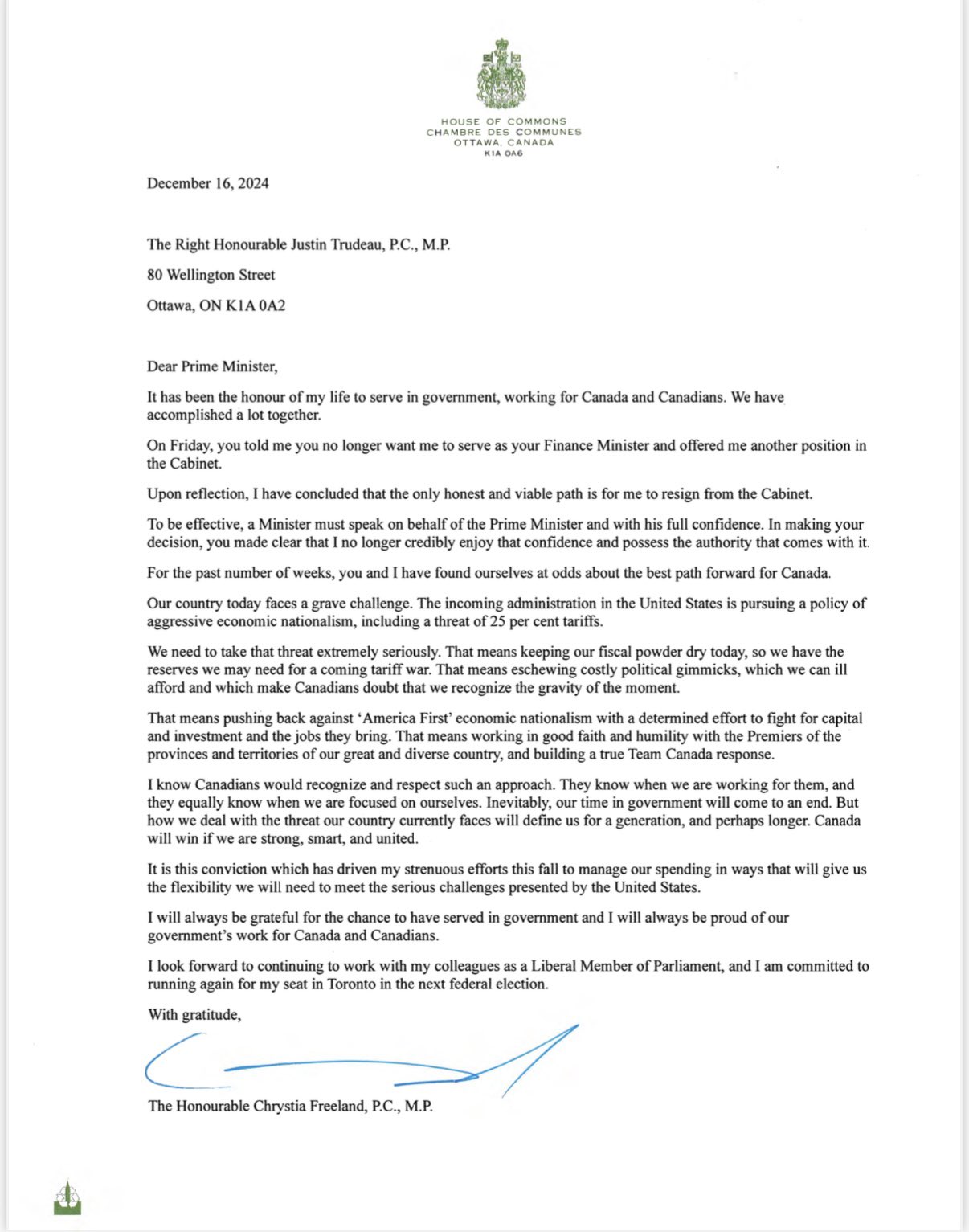
Chrystia Freeland resigned as Minister of Finance and Deputy Prime Minister in spectacular fashion on Monday, 16 December 2024 mere hours before she would have delivered the Fall Economic Update in the House of Commons. She revealed that Trudeau had informed her the previous Friday that he intended to shuffle her out of the most powerful and important portfolio in cabinet and accused him of having pursued “costly political gimmicks” in the face of the serious threats posed by President-elect Donald Trump, who might impose tariffs of 25% on Canadian products coming in to the United States.[1] Trudeau appointed Dominic LeBlanc as the new Minister of Finance later that evening and then shuffled cabinet more broadly on Friday the 20th.[2]
Not since Douglas Harkness resigned as Minister of National Defence on 3 February 1963 over a profound irreconcilable disagreement with Prime Minister Diefenbaker on the handling of the Cuban Missile Crisis and the question of allowing American nuclear warheads in Canada has a ministerial resignation on a question of policy shaken an incumbent government so badly and taken Parliament, the press, and the public by such surprise.[3] The House of Commons withdrew its confidence from the collapsing Diefenbaker ministry two days later on 5 February 1963 and forced an early election less that one year after the previous.[4] Unlike in 1963 when the ministerial chaos happened squarely in the middle of a regular late-winter sitting, the House of Commons had already scheduled itself to adjourn until late January 2025 as of Tuesday, 17 December 2024, which prevented the crisis from playing out in the same way.
This ministerial crisis has ultimately arisen because Liberal members of the House of Commons surrendered their authority to oust and elect party leaders in 1919 and refused to reassert that authority in 2024. The Conservatives followed suit in the 1920s but have at least made some effort to reassert that ancient and necessary authority over the partyleader by adopting the Reform Act in the last two parliaments.[5] If Justin Trudeau had been Prime Minister of Australia, the Labour parliamentary party would have held a spill vote and ousted him as party leader and therefore as Prime Minister at the latest after the snap election of 2021 which resulted in a House of Commons virtually identical to that election in 2019, and possibly as early as after the election of 2019 where the Liberals lost their parliamentary majority and limped on with only a plurality. Justin Trudeau has become the most hated incumbent Prime Minister amongst the general public since Brian Mulroney in 1992-1993; however, where Mulroney earned and always maintained the adoration of the Progressive Conservative parliamentary party, even when they sat at less than 20% in the polls,[6] Trudeau started to lose the confidence of the Liberal parliamentary party after the devastating loss of the Liberal safe seat of Toronto—St. Paul’s in a by-election in June. His internal support has only continued to erode over the last six months, even though Trudeau survived a half-hearted ousting in October 2024 that drowned in its own mealy-mouthed psychobabble of male Liberals who still insisted, “We have to process this.” As of 23 December, 21 Liberal MPs have publicly called upon Trudeau to resign the premiership and leadership of their party, and CBC News reported that some 50 Liberal MPs from Ontario alone – not all of whom have said so in public – believe that Trudeau ought to resign.[7]
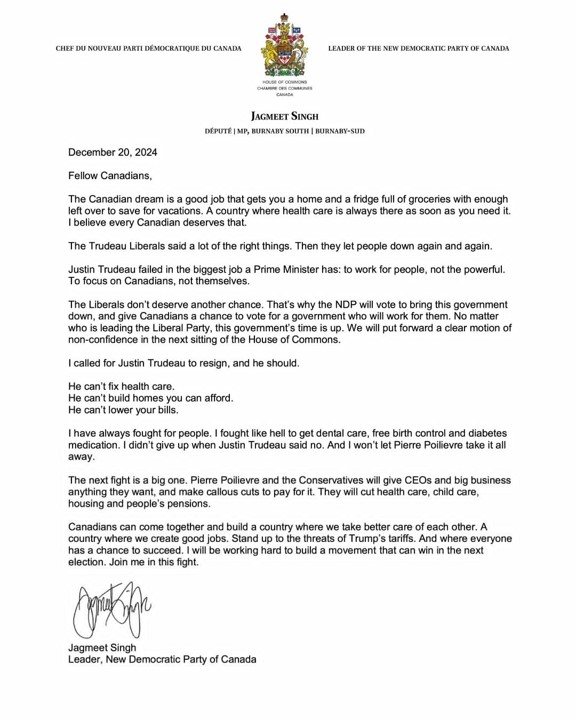
On 20 December, Jagmeet Singh, Leader of the New Democratic Party, published an open letter echoing that sentiment:
“The Liberals don’t deserve another chance. That’s why the NDP will vote to bring this government down, and give Canadians a chance to vote for a government who will work for them. No matter who is leading the Liberal Party, this government’s time is up. We will put forward a clear motion of non-confidence in the next sitting of the House of Commons. I called for Justin Trudeau to resign, and he should.”[8]
(Singh also, presumably inadvertently, quoted the Conservatives’ slogan about “time’s up.”) Yves-François Blanchet, the leader of the Bloc Québécois, had already called upon Trudeau not to resign but to advise the Governor General to dissolve the 44th Parliament for an election the same day that Freeland resigned from cabinet: « Justin Trudeau «n’a plus d’autre choix qu’au tout début 2025 [d’]aller voir la gouverneure générale, [de] dissoudre le Parlement […] ».[9] “Trudeau has no other choice but at the very beginning of 2025 to go see the Governor General [and ask her] to dissolve Parliament.”
Pierre Poilievre’s Letter to Governor General and Other Similar Letters
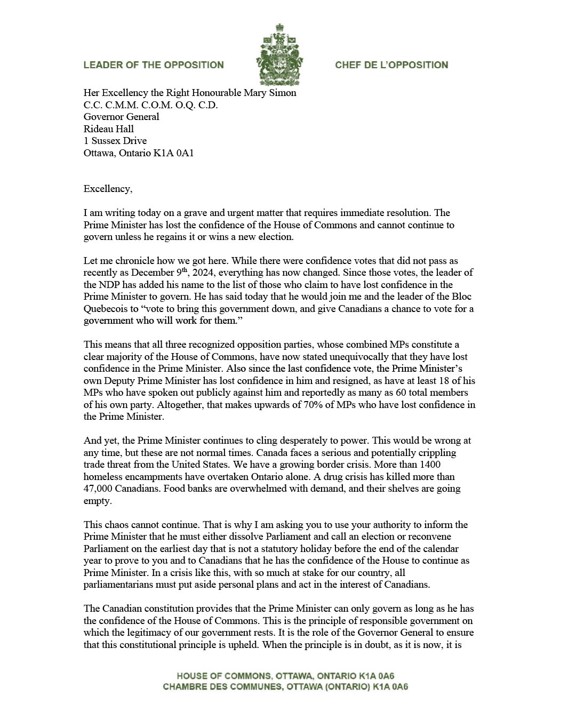
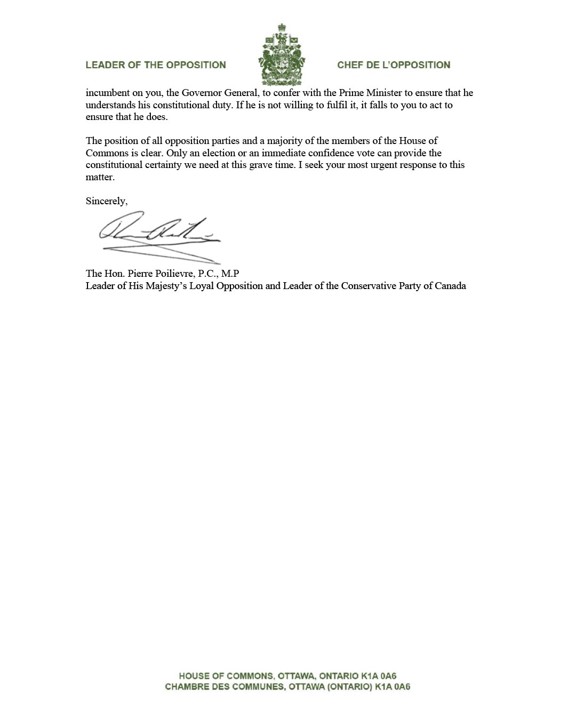
Poilievre published on the platform formerly known as Twitter his open letter to Her Excellency the Governor General of Canada on 20 December 2024:
“[…] The Prime Minister has lost the confidence of the House of Commons and cannot continue to govern unless he regains it or wins a new election. […]
This chaos cannot continue. That is why I am asking you to use your authority to inform the Prime Minister that he must either dissolve Parliament and call an election or reconvene Parliament on the earliest day that is not a statutory holiday before the end of the calendar year to prove to you and to Canadians that he has the confidence of the House to continue as Prime Minister. […]
“The Canadian constitution provides that the Prime Minister can only govern as long as he has the confidence of the House of Commons. This is the principle of responsible government on which the legitimacy of our government rests. It is the role of the Governor General to ensure that this constitutional principle is upheld. When the principle is in doubt, as it is now, it is incumbent on you, the Governor General, to confer with the Prime Minister to ensure that he understands his constitutional duty. It he is not willing to fulfil it, it falls to you to act to ensure that he does.”
He now joins a long time of opposition politicians in Canada who write presumptuous open letters to the Governor General. Stephen Harper, Jack Layton, and Gilles Duceppe wrote one to Adrienne Clarkson in September 2004. Bob Rae as the interim leader of the Liberal Party similarly pestered David Johnston in 2011. Elizabeth May outshined them all by writing a letter to the Queen of Canada in 2012 asking Her Majesty to call a royal inquiry, without any ministerial advice, to investigate May’s conspiracy theories about the federal election of 2011.
Poilievre here seems to be asking that Mary Simon exercise her Baghotian rights to encourage and warn the Prime Minister that he ought to advise Speaker Greg Fergus to recall the House of Commons earlier than 27 January 2025. Thanks to her extraordinary indiscretion in writing a memoir only one year after leaving officer, we know of at least one example where Governor General Adrienne Clarkson exercised her vice-regal role against Paul Martin. Clarkson revealed that she had rebuked Martin in December 2003 and rejected his request to be sworn in as Prime Minister in the foyer of the House of Commons. While he was merely the Prime Minister-designate at this stage and therefore not yet in a position to give binding constitutional advice, Clarkson quite rightly insisted that he and his incoming ministers come to her and present themselves at Rideau Hall like everyone else.
“I was informed that the Prime Minister’s Office wanted [Paul Martin] to be sworn in at the Hall of Honour at Parliament Hill. I immediately said that the Governor General could not go to Parliament to swear in the prime minister. In the entire history of Canada, and in the mandates of my twenty-five predecessors, this had never been done. The prime minister always goes to Rideau Hall to be sworn in, as does his cabinet. […]. The idea of having a big ceremony at the Hall of Honour at Parliament Hill seemed to me to be imposing a presidential-type installation on our unpresidential system. I refused three entreaties from the Prime Minister’s Office, including one from Mr. Martin himself.” [10]
Clarkson also reputedly warned Martin in May 2005 that he needed to pass supply and demonstrate that his government still commanded the confidence of the House of Commons after the opposition expressed through a procedural motion that it had lost confidence in the government by a vote of 153 to 150. [11] (She does not mention this episode in her memoir, but it tracks). Gilles Duceppe, then the leader of the Bloc Quebecois, declared on 11 May 2005 that the Martin government no longer held the confidence of the House of Commons and that Martin should resign.[12] Yet the next week, the House of Commons expressed its confidence in the Martin government by passing the budget.[13] Only votes in the chamber matter, not the pronouncements of partyleaders to the press.
Her Excellency Mary Simon could certainly discuss these matters with Prime Minister Trudeau in private, but there it would remain; the audiences between the Crown and Prime Minister should remain confidential and not fodder for politicians and the press.
Contrary to what Poilievre declares in his open letter, the Prime Minister Trudeau has not lost the confidence of the House of Commons. The Trudeau government commands the confidence of the House of Commons until MPs withdraw it – not because the leaders of the opposition parties write letters or give interviews. As Phil Lagassé told The Globe and Mail earlier this week, we should all have learned from the Prorogation-Coalition Controversy of November-December 2008 that none of us – least of all the Governor General – should treat the public statements of partyleaders as the equivalent of a proper vote of all MPs held in the House of Commons itself.[14] (I would add that the aforesaid events of May 2005 taught precisely the same lesson as well). On 1 December 2008, the Liberals and New Democrats pledged to form a formal coalition, with both parties represented in Cabinet, under a lame-duck Prime Minister Stephane Dion, who would have to had pulled a Pierre Trudeau and un-resigned as Liberal leader; the Bloc Québécois signed a confidence-and-supply agreement with the Liberal-New Democratic coalition the same day.[15] The leaders of the three parties and their MPs publicly signed these two documents and claimed to hold the support of their respective parliamentary parties, yet they could not keep their alliance together in the face of Harper’s tactical prorogation of 4 December 2008; by the time that the House of Commons reconvened in January 2009, Michael Ignatieff had replaced Dion as the leader of the Liberal Party and withdrawn from the coalition.
The 38th Parliament elected in June 2004 and dissolved in November 2005 provides another example of why no one should trust the letters written by partyleaders and treat them as equivalent to proper votes in the House of Commons. And on 9 September 2004, Stephen Harper, Jack Layton, and Gilles Duceppe sent a joint letter to Governor General Adrienne Clarkson which noted:
Excellency,
As leaders of the opposition parties, we are well aware that, given the Liberal minority government, you could be asked by the Prime Minister to dissolve the 38th Parliament at any time should the House of Commons fail to support some part of the government’s program.
We respectfully point out that the opposition parties, who together constitute a majority in the House, have been in close consultation. We believe that, should a request for dissolution arise this should give you cause, as constitutional practice has determined, to consult the opposition leaders and consider all of your options before exercising your constitutional authority.
Your attention to this matter is appreciated.
Sincerely,
Hon. Stephen Harper, P.C., M.P. Leader of the Opposition Leader of the Conservative Party of Canada
Gilles Duceppe, M.P. Leader of the Bloc Quebecois
Jack Layton, M.P. Leader of the New Democratic Party[16]
(This one predates social media, so we don’t have a clean original like with the others). This letter did not commit the Conservatives, New Democrats, and Bloc to any sort of coalition or confidence-and-supply agreement, but it implied the possibility at least of the latter. Yet nothing came of this letter in September 2004, because the letters that MPs send to the Governor General or post on social media mean nothing. Twenty years later, Jagmeet Singh’s letter means nothing, and Yves-François Blanchet’s public statements mean nothing. All that matters is a vote of all MPs in the House of Commons. Funnily enough, even Poilievre himself seems to agree with this proposition.
In criticising Singh, Poilievre contradicted himself. He wrote in his letter categorically that “The Prime Minister has lost the confidence of the House of Commons and cannot continue to govern unless he regains it or wins a new election.” But at a press conference on 20 December, Poilievre mused that the House of Commons must urgently meet in late December and settle whether the Trudeau government holds its confidence precisely because Singh might not follow through on what he wrote in his open letter and declared in a press conference and would probably continue supporting the Trudeau government until March so that he can attain his six years of service and thereby secure his parliamentarian’s pension.
“If Jagmeet Singh this time is telling the truth – which remains to the seen – then he will join with me and write the Governor General. […] Mr. Singh […] is talking about hold a non-confidence vote in March. So we’re gonna have months and months and months of this total chaos, and conveniently will get him his pension. So the whole 41 million Canadians are being held hostage by the pension of one man. So I’m asking Mr Singh to put patriotism ahead of pension, sign a letter to the Governor General confirming in writing what he said in front of the cameras: that is, that he no longer has confidence in this prime minister and that he is ready to go to an Axe-the-Tax Election.” [17]
In other words, by this logic that Singh’s word means nothing, the Trudeau government would continue holding the confidence of the House of Commons until March 2025 and could not have lost the confidence of the House of Commons in December 2024.
The precedents of the 21st century have shown the Governor General and the Lieutenant Governors that they should only intervene after the House of Commons or legislative assembly have withdrawn confidence from the ministry. For instance, in British Columbia in 2017 and New Brunswick in 2018, the Lieutenant Governors only took action after the legislative assemblies in these provinces voted down incumbent Premiers Christie Clark and Brian Gallant on the Address-in-Reply to the Speech from the Throne.[18]
The Question of Prorogation
Poilievre said in an interview on 18 December: “I would say to the governor general, that prorogation that prevents us from testing the confidence of this crumbling government would not be allowed under the rules.”[19] He later contrasted Harper’s first tactical prorogation of December 2008 to Trudeau’s potential second tactical prorogation in 2024 or 2025 at the aforesaid press conference: “The difference is that we, in the Harper era, he prorogued to stop an undemocratic coalition from taking over against the will of the people. In this case, a prorogation would be to preserve an undemocratic coalition that has lost the confidence of both the House and of Canadians.”[20] But if Trudeau cannot legitimately obtain a prorogation of the 1st session of the 44th Parliament now, then Harper did not legitimately advise Governor General Michaelle Jean to prorogue the 1st session of the 39th Parliament sixteen years ago.
In reality, nothing would prevent Trudeau from advising the Governor General to prorogue this 1st session of the 44th Parliament before such another vote on a question of confidence could take place, and only the necessity of passing supply would limit the duration of such a prorogation to around the end of March 2025 before the new fiscal year begins on 1 April. Furthermore, the Governor General cannot dissolve parliament unilaterally contrary to or independent of the Prime Minister’s advice. If the Governor General did wish to dissolve the 44th Parliament, she would have to dismiss Trudeau from her counsels unless he agreed that parliament should be dissolved for an early general election.
Ending an Adjournment of the House of Commons Early
The House of Commons stands adjourned until Monday, 27 January 2025, which means that only the Speaker could resume the sitting earlier under Standing Order 28(3) “after consulting with the government.”
Recall of House.
28 (3) Whenever the House stands adjourned, if the Speaker is satisfied, after consultation with the government, that the public interest requires that the House should meet at an earlier time, the Speaker may give notice that being so satisfied the House shall meet, and thereupon the House shall meet to transact its business as if it had been duly adjourned to that time. In the event of the Speaker being unable to act owing to illness or other cause, the Deputy Speaker, the Assistant Deputy Speaker and Deputy Chair of Committees of the Whole or the Assistant Deputy Speaker and Assistant Deputy Chair of Committees of the Whole shall act in the Speaker’s stead for all the purposes of this section.[21]
House of Commons Procedure and Practice adds that “the rule makes no reference to criteria other than the public interest.”[22] If the three opposition parties truly have lost confidence in the Trudeau government, then one could make the case that holding a vote on a matter of confidence falls under the public interest. Crucially, however, this decision also falls under the Prime Minister’s control.
The Governor General would play no role whatsoever in reconvening the House of Commons unless she had prorogued the 1st session of the 44th Parliament or dissolved the 44th Parliament altogether on the Prime Minister’s advice. At the time of writing on 23 December, this has not happened. Here presumably Poilievre wants the Governor General to exercise her vice-regal right to warn the Prime Minister that he should ask the Speaker to reconvene the Commons earlier than 27 January. In any event, the House of Commons would probably not hold a vote on a question of confidence immediately on 27 January 2025 or immediately upon an earlier day. The Government controls the Order Paper of the House of Commons apart from what Standing Order 81(10)(a) calls 22 “allotted days” and what Official Ottawa often call “Opposition Days”, where the Commons debates a motion from the Opposition. Even then, the Government controls when the Opposition Day shall occur, and often with only one day’s notice.[23] The Government must allow seven such allotted days in the spring sitting after 10 December and by 26 March.[24] So even if the Speaker ended the regular adjournment early and the Commons sat before 27 January, we have no guarantee on what day one of the opposition parties could table a motion withdrawing the confidence of the House of Commons from the Trudeau government.
All I wanted for Christmas was a constitutional crisis. Instead, I amassed yet another lesson in why we should not trust the public statements of partyleaders but only votes of confidence of all MPs in the chamber.
Archival Newspaper Articles Cited:
- Globe and Mail (1963-02-06) Commons Defeats Dief
- Globe and Mail (2005-05-20) Liberals Survive
- Ottawa Citizen (2005-05-11) 1 of 93
- Ottawa Citizen (2005-05-11) 4 of 93
- Ottawa Citizen (2005-05-13) Deadlock is not a crisis
- The Ottawa Citizen (1963-02-07) Opposition Defeats Tories
Similar Posts:
- Ousting Party Leaders: From the King Doctrine to the Unenforceable Reform Act (October 2024)
- Dissenting Liberal MPs Fail to Thatcher Trudeau (October 2024)
- Replacing the Prime Minister During an Election: A Forgotten Canadian Precedent (June 2024)
- A Mature Country Does not Demand Absolutist Party Discipline (February 2023)
- J.W.J. “Party Discipline and Its Fate: Canada’s Ironclad Controls Are Beginning to Rust.” The Dorchester Review12, no. 2 (2022): 47-58.
- Stop Appealing to the Governor General to Overthrow Responsible Government (November 2016)
- David Johnston on the Constitutional Relationship Between the Governor General and the Prime Minister (December 2012)
- Neither the Queen Nor the Governor General Can Dissolve Parliament Unilaterally! (April 2012)
Notes
[1] Chrystia Freeland, @cafreeland, “See my letter to the Prime Minister below,” tweet on 16 December 2024.
[2] Jennifer Sweet, “LeBlanc Optimistic Canada Can Avoid Tariffs from Incoming Trump Administration,” CBC News, 17 December 2024; Peter Zimonjic and David Cochrane, “Prime Minister Trudeau Adds 8 New MPs to cabinet, Changes the Roles of 4 Others,” CBC News, 20 December 2024.
[3] Privy Council Office, “Eighteenth Ministry: Progressive-Conservative – 27 June 1957-22 April 1963,” in Guide to Canadian Ministries Since Confederation, 25 September 2023 [accessed 22 December 2024].
[4] Charles Lynch, “Three Opposition Parties Combine to Defeat Tories,” The Ottawa Citizen, 6 February 1963, at page 1.
[5] J.W.J. Bowden, “Party Discipline and Its Fate: Canada’s Ironclad Controls Are Beginning to Rust,” The Dorchester Review 12, no. 2 (2022): 47-48.
[6] University of Waterloo, “Political Scientists Assess Mulroney,” 25 February 1993.
[7] Mayson Maharaj, “Most Liberals in Caucus Want Trudeau to Go, Says Longtime Loyalist,” CBC News, 22 December 2024.
[8] New Democratic Party of Canada, “Jagmeet Singh’s Letter to Canadians,” 20 December 2024.
[9] TVA Nouvelles, « Le gouvernement de Justin Trudeau est terminé » : Yves-François Blanchet veut une dissolution au début de 2025, le 16 décembre 2024.
[10] Adrienne Clarkson, Heart Matters (Toronto: Penguin Canada, 2006), 195. If you search “Hall of Honour” in the Google Book, you will find the reference that way, too.
[11] The National Post, “Tories Win Vote, Grits Ignore It,” 11 May 2005, A1; Glen McGregor and Joanne Laucius, “Deadlock Is Not a Crisis, Experts Say,” The Ottawa Citizen, 13 May 2005, A4. The Citizen said: “There were rumours that Madame Clarkson met with the prime minister this week, although the Prime Minister’s Office would say only that the two regularly discuss Madame Clarkson’s schedule.”
[12] Anne Dawson, Allan Woods, and Tim Naumetz, “Parliament ‘Is Finished,’ Tories Declare – Motion to defeat government passes 153-1950, but Liberals refuse to resign,” The Ottawa Citizen, 11 May 2005, A1, A4.
[13] Clark Campbell and Gloria Galloway, “The Liberals Survive,” The Globe and Mail, 20 May 2005, A1.
[14] Bill Curry, “Can Trudeau Prorogue? Rideau Hall Is Back at the Centre of Politics,” The Globe and Mail, 21 December 2024.
[15] Stéphane Dion (Leader of the Liberal Party) and Jack Layton (Leader of the New Democratic Party), An Accord on a Cooperative Government to Address the Present Economic Crisis, 1 December 2008; Stéphane Dion (Leader of the Liberal Party), Jack Layton (Leader of the New Democratic Party), and Gilles Duceppe (Leader of the Bloc Quebecois), A Policy Accord to Address the Present Economic Crisis, 1 December 2008.
[16] The Globe and Mail, “The Infamous Letter,” 2 December 2008.
[17] CPAC, “Pierre Poilievre to Request Governor General to Reconvene Parliament – December 20, 2024,” 20 December 2024, from 17:05 to 18:26.
[18] David Brock and J.W.J. Bowden, “Beyond the Writ: The Expansion of the Caretaker Convention in the Twenty-First Century,” Saskatchewan Law Review 87, no. 1 (May 2024), 17-18, 46.
[19] Morgana Abdy, “Conservative Party of Canada Leader Suggests It Could be Unconstitutional to Prorogue Parliament Right Now,” C-Fax 1070, 18 December 2024.
[20] CPAC, “Pierre Poilievre to Request Governor General to Reconvene Parliament – December 20, 2024,” 20 December 2024, from 16:32 to 17:05
[21] Standing Orders of the House of Commons, Including Appendices (Ottawa: House of Commons of Canada, 18 September 2023), S.O. 28(3), at page 18.
[22] Audrey O’Brien and Marc Bosc, House of Commons Procedure and Practice, 2nd Edition (Ottawa: House of Commons of Canada, 2009), at page 379.
[23] Audrey O’Brien and Marc Bosc, House of Commons Procedure and Practice, 2nd Edition (Ottawa: House of Commons of Canada, 2009), at page 852.
[24] Standing Orders of the House of Commons, Including Appendices (Ottawa: House of Commons of Canada, 18 September 2023), S.O. 81(10)(a), at page 83.

 James Bowden's Blog

What I find frustrating is that it seems no one is pointing out that Freelabnd was okay with these ‘political gimmicks’ while she was Dep PM and Finance Minister and only raised the issue when Justin was going to fire her. She was also fine with running huge deficits since 2015 and only objected when Justin betrayed her. Few are noting how stupid Justin was in telling Freeland that she was being fired but still expecting here to read the economic statement with its 61.9 billion dollar deficit. She would have read it and gone along if she was to remain finance minister. It bothers me that so-called reporters now see her as a leadership candidate…seriously? Lots of baggage… Good post
Dad
LikeLike