The Accidental Development of Cabinet Government


Our system of Westminster parliamentarism depends upon unwritten constitutional conventions. I will discuss my take on convention in further detail in subsequent posts, but generally, a constitutional convention evolves from a custom or practice that served a valuable purpose and ultimately became integral to parliamentary government. Sometimes these customs develop by design, usually after a significant written declaration; for instance, after The Great Charter of King John of 1215, customs evolved in order to accommodate that supreme written law that parliament must approve any and all levying of taxes. But during the Middle Ages, Kings still exercised the prerogative power to dissolve parliament and would sometimes extract Parliament’s approval to levy a specific tax in order to finance his war and then simply dissolve it. The idea of “grievance before supply”, which forced the King to take the grievances of his people’s representatives into account before asking them to approve taxes, arose in response to this development (I suspect, in this case, more by design than by chance).

George I

But sometimes a custom that leads to the founding of a significant constitutional convention does develop by pure happenstance from seemingly the most minor of causes. As my friend Nick MacDonald recounted, the entire development of cabinet government started by accident. After Queen Anne Stuart died in 1714 with no legitimate issue, Parliament formally changed the line of succession by invoking the Act of Settlement of 1701 and declared that the Crown would then pass onto the closest Protestant relatives of the Stuarts, Sophia of Hanover and her descendents. The Crown thus passed to the German-speaking George of Hanover, who became George I. Precisely because he spoke very little English and was a foreigner whom Parliament had invited to become King, he needed to rely on Parliament for advice more than his predecessors. Parliament itself was also maturing into an institution that supported a polarized two-party system of Whigs (I would have been with them!) and Tories. George I gradually withdrew from the meetings of the King’s Privy Council, which allowed the privy councillors, drawn from Parliament, to govern collectively. This custom eventually evolved into the Cabinet. And one of the Privy Councillors, Sir Robert Walpole, became the King’s chief advisor, or Prime Minister, if you will.
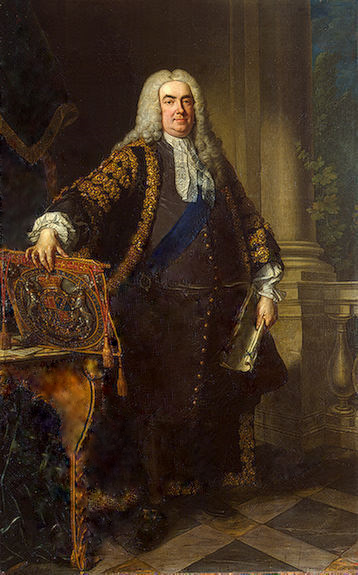
Sir Robert Walpole, the UK’s first de facto Prime Minister

The official website of the British monarchy provided an succinct explanation of these humble origins of cabinet government: “After 1717, George rarely attended Cabinet meetings. This allowed the Cabinet to act collectively and formulate policies, which, provided they were backed by a majority in the Commons, the king was usually powerless to resist. After the South Sea Bubble crisis of 1720 (when the South Sea Company, with heavy government and royal investments, crashed), Robert Walpole took over. The most able of George’s ministers, and known as the first ‘Prime Minister’, Walpole’s was the longest running administration in British history (1721-42).”

So there you go. We have cabinet government and responsible government today because George I didn’t speak English very well.
Posted in Cabinet's Powers, Origins | 8 Comments

In Defence of Parliamentarism


After a tumultuous cycle of single-party minority government from 2004 to 2011, the 41st Parliament gave the Conservative Party a parliamentary majority. Many Canadians would think that the results of the last election give Prime Minister Harper unlimited latitude to pass all the policies that he so desires. But they would be wrong – at least, in theory – and they are missing the point entirely, because Parliament, not Cabinet, determines who governs. Sadly, most parliamentarians miss the point as well. The principle of responsible government, arguably the most important unwritten constitutional convention in modern Westminster parliamentarism, affirms Parliament’s ancient right to exercise its sovereignty, and underscores that the cabinet is subordinate to the House of Commons. In other words, the government can only govern inasmuch as it commands the confidence of a majority of the House of Commons. A single-party majority government can normally do so, but cabinet ought never to take that support for granted – and nor should government backbenchers unconditionally lend their support to cabinet.

If a government fails to pass its budget, then the principle of responsible government dictates that it has lost the confidence of the House and can therefore no longer legally govern. But why is this? Because ultimately, the convention of responsible government, which developed throughout the latter half of the 18th century and became firmly entrenched during the reign of Queen Victoria, rests on principles even more ancient, hard won through centuries of strife and conflict. The core function of parliament is to pass supply. After the establishment of Magna Carta at Runnymede in 1215, the reigning monarch become legally and morally bound to convene a parliament in order to levy any taxes; without parliamentary approval, the king could not extract revenue from his kingdom. In the modern era, the cabinet exercises power on behalf of the crown. Some kings – particularly the Stuarts, who were fond of invoking the so-called “divine right of kings” in the era of European absolutism – attempted to usurp Parliament’s authority and bypass it altogether. King Charles I ultimately lost his head for his intransigence. The English fought a bloody civil war in the 1640s over the issue of whether sovereignty rests with the Crown or with Parliament – and Parliament won. The Restoration of 1661 reinstated the Stuarts, but it marked end of the absolute monarchy and birth of constitutional monarchy in which the king reigns, but Parliament rules. King James II fled the United Kingdom in disgrace in 1688 after clashing extensively with Parliament, ultimately because of his inability to accept the new constitutional arrangements. Parliament then deemed James II to have abdicated and changed the line of succession in order to crown William of Orange (a firmly Protestant Dutchman) and Mary Stuart new co-monarchs.

Charles I paid the price for pushing parliament too far.

 Parliament has flexed its muscle against intransigent kings, so why now is the Parliament of Canada so reticent to exercise its basic constitutional duties and authority? In an era of complacency where most MPs feel content to ignore our history and shirk their constitutional duty of holding the government to account for its expenditures, Conservative MP Mike Wallace stands out as the lone defender of parliamentarism in the House itself. Likewise, Parliamentary Budget Officer Kevin Page is an exemplary public servant who genuinely believes in his duty and clearly takes his position seriously, and he has excelled in exposing the potential government’s spending anomalies. But fundamentally, the existence of the Parliamentary Budget Office has only served to hasten and officialise the death of parliament’s core function – which parliament has now outsourced. In the 17th century, my English ancestors fought a long and bloody civil war in order to determine whether the crown or parliament governs and capped off that struggle with the Glorious Revolution and the English Bill of Rights of 1689; now in the 21st, without a shot fired and with little concerted opposition, parliamentarians have obliviously become the caretakers of parliament’s demise as the true sovereign power.

 British Conservative MEP Daniel Hannan best summarized the relationship between parliament and cabinet: “The House of Commons exists to exert financial control over the government. Everything else it does is a corollary of that ancient duty. An MP who acts upon that duty, far from being a rebel, is a champion and steward of our parliamentary settlement.”

 In order that individual MPs uphold their sacred constitutional duties, Canada’s parliamentary system requires first not grand schemes of new reforms, but a renaissance of study and understanding of parliament’s core purpose: to pass supply, and its logical extension of holding the government to account for its expenditures.  The latter necessarily means that the House withdraw its confidence when the government doesn’t meet with its satisfaction. Academics and commentators like me can lament the loss of parliamentarism ad naseum, but ultimately, individual Members of Parliament need to exercise their rights – indeed, their constitutional obligations – properly and faithfully before the true restoration of parliamentary sovereignty and power begins in earnest. I applaud Mike Wallace MP for taking up the parliamentarian’s standard and hope that he will convince his colleagues on both sides of the House to take their roles and privileges as parliamentarians more seriously and hold the government to account properly.

Posted in Parliament | 9 Comments