Guidelines on the Caretaker Convention


Former Clerk of the Privy Council Mel Cappe wrote an introductory piece The Caretaker Convention in Canada arguing that the Privy Council Office should release its official guidelines on the caretaker convention that place limitations on the government’s authority during elections, and that the guidelines should be updated as needed. Mr. Cappe presented his report at a workshop hosted by the Asper Centre for Constitutional Rights in February 2011.

As Nick MacDonald and I explained in a column in the Hill Times from April 4 (and as we examine in even greater detail in an upcoming article!), the caretaker convention means that from the issuing of the writs of election to the appointment of the next government, the current government ought not to exercise the full extent of its legal powers by declining to take on any major spending that Parliament had not already approved before the writs, and by voluntarily limiting the Crown prerogative on major appointments. The caretaker convention exists in the absence of any formalized, legal limitations on the government’s power during the writ period. When Parliament is not in session, the House of Commons cannot fulfill its core function of  holding the government to account for its expenditures; therefore, in order to adhere the principle of responsible government as closely as possible, the government must constrain itself by convention. While the caretaker convention is in effect, the government carries out only routine spending and appointments necessary for the basic functioning of the country.

After reading Mel Cappe’s article, I submitted an ATIP request to the Privy Council Office for this supposedly “secret” document and received a complete and non-redacted copy in the mail the following week. The Guidelines On The Conduct of Ministers, Secretaries of State, Exempt Staff and Public Servants During An Election (see Documents tab) consist of 11 pages and introduces the caretaker convention before, as the title suggests, issuing more specific “guidelines” (in fact, directives or instructions) to ministers, secretaries of state, exempt staff (political staffers), and public servants. Most of these directives serve as common-sense reminders to separate government and partisan activity.

The Guidelines summarize the caretaker convention: “[D]uring an election, a government should restrict itself – in matters of policy, expenditure and appointments – to activity that is: a) routine, or b) non-controversial, or c) urgent and in the public interest, or d) reversible by a new government without undue cost or disruption, or e) agreed to by the Opposition (in those cases where consultation is appropriate).”

During the election, Nick and I had identified at least one instance where the government acted in accordance with these Guidelines. On Tuesday, April 12, 2011, the Globe and Mail reported that Minister Cannon had consulted with the Opposition on the Libyan matter before deciding to travel abroad. These international meetings pertaining to Canada’s participation in the NATO mission in Libya required the attendance of a minister of the crown and were both “urgent and in the public interest” and were “agreed to by the Opposition”. The government thus satisfied the main criteria of the Guidelines (as quoted in the previous paragraph).

I concur with Mel Cappe’s main conclusions: that the government should officially make public the Guidelines in order to better explain to the public the decisions made during writ periods. Unfortunately, our column in the Hill Times in which we wrote the official title of the “secret” document didn’t garner much attention, and few scholars have so far taken advantage of the availability of these Guidelines. I hope that this post and the link to the document will contribute meaningfully to further debate and discussion.

Related Posts


Posted in Caretaker Convention & Government Formation, Officialization of Convention | 14 Comments

Parliamentary Privilege and National Security


My partner in parliamentarism Nick MacDonald has taught me much on parliamentary privilege, and I’m sure that in time, he will become one of the foremost experts on the subject in Canada and the Commonwealth! In his forthcoming article “Parliamentarians and National Security in Canada” (Canadian Parliamentary Review, Fall 2011), he thoroughly documents how the Westminster parliaments of the United Kingdom, Australia, and New Zealand deal with the relationship between Members of Parliament (i.e, those outside of the cabinet) and issues of national security, in contrast to the American method. Ultimately, this relationship strikes at the heart of parliamentary sovereignty and parliamentary privilege in the Westminster system.

In the course of his research, he stumbled upon a publication available on the website of the Australian House of Representatives called “Patterns of change – parliamentary privilege” (2007) by Mr. Bernard Wright. It compares Australia’s system to those of other countries, but mistakenly concludes that in Canada, parliamentary privilege is now subject to the Charter, so Nick informed the Australian House of Representatives of this error. In fact, as he informed them, the Supreme Court of Canada ruled in the Vaid case that “parliamentary privilege enjoys the same weight and status as the Charter itself.”

The Australian House of Representatives would be wise to revise that report upon his advice. I encourage all of you to read his article upon the release of the fall issue of the Canadian Parliamentary Review!


Posted in Articles and Books, Reviews | 1 Comment

The Westminster Origins of the United States Congress


Despite my earlier criticism of the American form of government, I believe that its institutional origins rest fundamentally in a British mould – but from an earlier time that predates the entrenchment of responsible government. The American Congressional-Presidential system of government draws directly upon the principles that governed Westminster between the Restoration in 1661 and the coronation of George III in 1760, not from a blank, all-American slate in 1776 or 1787. This crucial century in England witnessed the shift from absolute monarchy to parliamentary sovereignty and real parliamentary power, the Glorious Revolution of 1688 and the English Bill of Rights of 1689, and the Act of Settlement under the Stuarts, and the nascent origins of cabinet government under the Hanoverian Kings George I and George II. Britain’s first de facto prime minister Sir Robert Walpole and William Pitt the Elder exercised real power during the reigns of George I and II, and cabinet government and Whiggish constitutional principles made great strides under these first two Hanoverian kings.

English constitutional historian David Starkey explains in his comprehensive documentary series Monarchy that “Britain in the 18th century witnessed a major political development: the rise of a second, parallel monarchy, the premiership. It was leaders of this new kind who created the First British Empire, and the old monarchy which presided over the loss of it. The holders of this new position of “prime minister”, as it became known, increasingly took control of the running of the country from the King and began to establish the pattern of modern government that we know today.”

Then came George III. He sought to reverse some of the constitutional development that had taken place during the reigns of his two predecessors and reassert regal authority. I am therefore sympathetic to the American patriots and believe that they were justified in taking up arms against George III’s conception of the British constitution. The American founders like Franklin, Adams, Jefferson, and Madison knew full well of this constitutional legacy that George III had violated. And this Whiggish argument did not find refuge exclusively in the United States. While a Member of Parliament, the great Whig Edmund Burke supported the cause of the American colonists because he believed that George III had violated their rights as free-born Englishmen. He referred to Americans as “the sons of liberty”, and Samuel Adams, cousin of John Adams, subsequently adopted the label for his own group that advocated American independence.

In the construction of their constitution of 1787, the Americans drew upon Westminster as it existed from 1661 to 1760. Westminster operates on a tripartite Crown-in-Parliament composed of the House of Commons, the House of Lords, and the Crown – all of which must pass and approve a bill become it becomes law. In the American system, a bill must pass the House of Representatives and the Senate, after which the President must sign into law. However, during this crucial century of development of the Westminster system, the monarchs did sometimes invoke the now-defunct reserve power on royal assent, effectively vetoing a bill passed by both houses. The Americans adopted the reserve powers to summon parliament and refuse royal assent and incorporated them into the powers of the President, who can summon Congress and veto bills passed by both Houses. The Senate of the United States originally consisted of appointees chosen by the state legislatures and thus mimicked the role of the Lords as a counter-weight to the Commons. Where the House of Lords included the Law Lords, the American framers vested the power to convict presidents and judges in the Senate. According to Responsibility In the Constitution, before the development of responsible government, the Commons could impeach ministers as a check against the executive and the crown. Where the British sovereign can only address the Lords at the annual State Opening of Parliament (the British PMs use prorogation differently), the American President must also be formally invited to speak before Congress in order to deliver his annual State of the Union Address.

Bruce Hicks explains in “The Crown’s Democratic Reserve Powers” that the reserve power of the monarch that when the British sovereign still wielded the reserve power to withhold Royal Assent (essentially a veto), Westminster had the habit of passing supply encased in large omnibus bills so that the sovereign could not withhold Royal Assent without bringing the government to a standstill. Today, the American Congress suffers from the profligacy of over-spending and endless riders attached to appropriations bills, thus effectively forcing the President to sanction Congressional over-spending and pork-barrelling in order to avoid vetoing the budget and shutting down the entire federal government, as once happened under President Clinton and Speaker Gingrich.

Essentially, I seek to reintegrate the United States into the liberal-Whiggish and fundamentally English political history and radicalism that made the American Revolution possible. Without the English Civil War, the Glorious Revolution, and the English Bill of Rights, the American Revolution (itself another English Civil War) could never have happened. Drawing on the Hartz-Horowitz thesis, I view the United States the fulfillment of Whiggish liberalism, which the United Kingdom has long since rejected. In order to secure that great Whiggish contribution to history and political philosophy, the United States adopted the fundamentals of British institutions and justified its independence with the radical Whiggish elements of English political thought.

Related Posts

Posted in History of British North America, Whigs v Tories | 9 Comments

Defining Canada’s Constitution: Canada Did Have One Before Trudeau and 1982!


Part of my research includes studying the unwritten constitution. When Americans refer to their constitution, they mean one complete and concise document; while Americans can frame a copy of their constitution and hand it on a wall, Canadians cannot, because our constitution consists of several written sources and unwritten convention. To many, perhaps because of an unconscious reference point to the American system, which is not truly comparable to Westminster parliamentarism in some crucial ways, the very concept of an “unwritten constitution” may sound inherently paradoxical, so I will attempt to explain here why it is not.

An unwritten constitution consists of conventions. In my earlier post on the accidental development of cabinet government, I argued that constitutional convention evolves from a custom or practice that served a valuable purpose by complementing written rules and statutes, and ultimately became integral to the conduct of parliamentary government. They are also politically enforceable, and therefore not justiciable; parliamentarians, not the courts, must sort out their implications. As a result, conventions tend to develop and change over time and practice as needed. Problems can admittedly arise when substantial disagreement exists over their interpretation, which we witnessed here in Canada in December 2008. (More on that later!) In Canada, these conventions have become as essential to the function of government as the written Constitution Act, 1867 and the Constitution Act, 1982. Moreover, the Constitution Act, 1867 acknowledges that unwritten convention forms an integral part of the Canadian constitution by describing the latter in the preamble as “similar in Principle to that of the United Kingdom.” For example, the cornerstone of parliamentary government, responsible government, is but one of these unwritten constitutional conventions, and without it, modern Westminster parliamentarism would cease to function and representative government.

A constitution based on unwritten conventions is in many respects more substantive and powerful than a written constitution, because the former can only exist when it holds a moral authority over the system that compels people to respect and observe it. In other words, an unwritten constitution like that of the United Kingdom can only flourish when a genuine, well-established democratic spirit already exists. This is the sublime and subtle virtue of an unwritten constitution. In contrast, written constitutions, under the wrong conditions, can become nothing more than worthless scraps of paper: Article 50 of the Soviet Union’s written constitution enshrined the freedom of speech, for instance – and we all know of that document’s effectiveness in securing liberty.

That is why I would have expected a respectable historian and a former Member of Parliament like John English to respond to the false premise of the reporter’s question. Pierre Trudeau did not “give Canada its own constitution”, as the interviewer claims and as English tacitly accepts.

Sadly, however, English merely shares a false opinion popular among many laymen and, more disturbingly, political scientists alike. I’ve engaged some professors who study or teach “Canadian politics” and yet know little to nothing about our constitution ­– the practical foundation that makes all of their studies possible – but prefer instead of focus exclusively on perfunctory and trite issues like political parties and identity politics. One professor in particular from Carleton University didn’t even seem to understand the distinction between the Charter of Rights and Freedoms and the Constitution Act, 1982 – let alone the nuances of the amending formula contained in the latter – and another professor, also from Carleton, demonstrated before an entire audience his lack of appreciation for the fact that history matters in Westminster parliamentarism.

Peter Hogg’s magnum opus Constitutional Law of Canada provides in the first chapter an excellent summary of Canada’s constitution and the role of constitutional convention. I learned from Hogg and Rand Dyck’s lecture in his course Canadian Constitutional Politics (which any student of political science at Carleton should take!) that the Canadian constitution consists of the following elements:

  1. Constitution Act, 1867 and its amendments
  2. Constitution Act, 1982 and its amendments
    • The Charter of Rights and Freedoms
  3. British statues and Orders-in-Council
    • Magna Carta
    • The English Bill of Rights
    • The Act of Settlement
    • The Mutiny Act
    • The Statute of Westminster
    • Orders-in-Council transferring Rupert’s Land and other British crown colonies to the Dominion of Canada
    • Etc.
  4. Organic Canadian statutes
    • Canada Elections Act
    • Supreme Court Act
    • Official Languages Act
    • Financial Administration Act
    • Etc.
  5. Judicial decision, particularly those relating to the division of powers and the Charter of Rights and Freedoms
  6. Conventions
    • Responsible government
      • The confidence convention
    • The role of the crown
    • Cabinet government
      • Collective and individual ministerial responsibility
    • Etc.

The Supreme Court of Canada recognised in the Secession Reference that the third point on British statutes incorporates Magna Carta and the English Bill of Rights into the Canadian constitution: “The evolution of our democratic tradition can be traced back to Magna Carta (1215) and before, through the long struggle for Parliamentary supremacy which culminated in the English Bill of Rights of 1689, the emergence of representative institutions in the colonial era, [and] the development of responsible government in the 19th century […].”

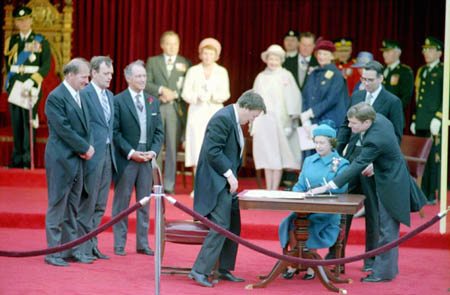
Queen Elizabeth II signs off on patriation

The fourth point of organic Canadian statutes refers to legislation passed by the Parliament of Canada of constitutional significance integral to our system of government. I’m not sure if a precise definition of this list exists, but it would probably include the following: The Elections Act, the Supreme Court Act, the Financial Administration Act, the Official Languages Act, etc.

Pierre Trudeau did many things, but he did not give Canada its own constitution – his government merely build upon a constitution that, contrary to popular belief, had already been well-established. The Trudeau government did “give us the Charter” – but Trudeau did not suddenly confer rights upon previously subjugated Canadians. The Charter merely codified most of the rights that Canadians had already long enjoyed.

Related Posts

Posted in Constitution (Written) | 6 Comments

The King’s Speech


I thought that this documentary “George VI: The Reluctant King” would prove of interest.

Posted in Articles and Books, Reviews | 1 Comment