Flawed Republican Arguments Sadden One Canadian


Bob Hepburn of the Toronto Star expressed his dismay over the Harper government’s decision to restore the Royal designations to the Royal Canadian Air Force and the Royal Canadian Navy in his column Royal Return Saddens One Canadian. For the record, I wholeheartedly support the restoration of the Royal designations and agree with Defence Minister MacKay that it corrects the last vestige of Defence Minister Hellyer’s historic mistake from 1968 of collapsing the three separate branches of the Canadian Armed Forces into one entity. Paul Hellyer himself also wrote a column criticizing the decision, but unlike Hepburn, he made logical arguments and gave reasonable explanations on his opposition to the policy decision. Like many republicans, Hepburn based his arguments on incorrect, emotive statements that obscure the true nature of constitutional monarchy and the Commonwealth realms.

Hepburn made several arguments based on incorrect interpretations of constitutional monarchy and the constitutional arrangements of the Commonwealth Realms (i.e., Canada, Australia, New Zealand, and the other 12 former colonies that share the British sovereign as head of state). I know that he’s a republican, but he should do his readers the courtesy of basing his arguments against constitutional monarchy on accurate information. In that sense, his column saddens me.

Elizabeth I is the only Elizabeth to take the title of “Queen of England.” Her Majesty Queen Elizabeth II, however, is the Queen of the United Kingdom of Great Britain and Northern Ireland. Canada and the other Commonwealth realms in fact gained their independence in 1931 with the Statute of Westminster. Canada did not exercise the full extent of its independence with immediate effect, but constitutionally, Canada could have taken on all the trappings of independence in 1931: patriation of the constitution, appointment of Canadians as our governors general, the creation of a separate Canadian citizenship, the use of the Supreme Court of Canada as our final court of appeal, etc. The Statute of Westminster established the principle that henceforth, the former colonies, now independent, would now only be linked by the Crown. Queen Elizabeth II is therefore the Queen of the United Kingdom of Great Britain and Northern Ireland, and separately, the Queen of Canada, the Queen of Australia, the Queen of New Zealand, etc. The Royal designation of the Royal Canadian Navy and the Royal Canadian Air Force refer to the Queen Elizabeth II in her constitutionally distinct role as Queen of Canada.

Hepburn made two other incorrect arguments in particular, some of the typical refuges of republicanism.

“With this move, the Harper government is taking us back to a time that has long since ended, a time when Canada was part of the “British Empire” and when all parts of the country except Quebec was dominated by Anglo society.”

The Pearson government, under Minister of Defence Paul Hellyer, erased the distinction between the three branches of the Canadian Armed Forces and collapsed the Royal Canadian Air Force, the Canadian Army, and the Royal Canadian Navy into one entity – the Canadian Forces. Hellyer even forced the three former branches to adopt the same uniform. This policy entered into force in 1968 – long after Canada ceased to be a part of the British Empire that he so derides. The British Empire had disintegrated by 1968, and the Commonwealth of Nations came into being in 1949. The Harper government now in 2011 has corrected the Pearson government’s mistake by restoring the Royal designations to the Air Force and Navy.

“Maybe [Prime Minister Harper] just doesn’t care if he is insensitive to the millions of Canadians from Asia, Africa and elsewhere who have no historic ties to England.”

I find this republican argument particularly bizarre. (“England” should probably read “The United Kingdom” in that sentence as well). But more significantly, Hepburn is essentially trying to argue the following: “One must be white, and in particular, Anglo-Saxon, in order to support the monarchy. Therefore anyone who is not Anglo-Saxon should oppose it on principle because the Crown inherently excludes them.” The Crown of Canada knows no racial or ethnic distinctions and represents all Canadians, who can support the Crown proudly. Conversely and ironically, as someone with a thoroughly English name like Bob Hepburn demonstrates, even Canadians of British heritage can be republicans and oppose the Crown!

Related Posts

Posted in Monarchism v Republicanism | 11 Comments

Fixed Elections: Stephen Harper Did Not “Break His Own Law” in 2008


Historical Context of Fixed Elections in Canada

Admittedly, this controversy occurred three years ago and may no longer be as relevant, but many Canadians (even academics!) still remain confused (or harbour resentment) regarding Prime Minister Harper’s advice to dissolve the 39th Parliament of 7 September 2008. In short, PM Harper most certainly did not break his own law, as so many pundits and opposition MPs claimed at the time, though it is true that he did not conform to the spirit of the law. While courts may take into account parliamentary debate on how the law ought to be applied, that debate on a law cannot supersede the text of the law itself.

Two Early Dissolutions: “A Proof Is A Proof”

The Reform Party proposed in its platform in 1993: “If elected, a Reform Government will enact legislation to ensure that elections are held every four years at a predetermined time of the year. If a government were defeated in the House such that an election would be called immediately, the date of the subsequent election would be four years from the predetermined time of the year following the election.” In addition to the Reform Party’s long-standing goal, many Conservative MPs had long resented that Prime Minister Chretien requested early dissolutions in both 1997 and 2000, both only three and one-half years into the respective parliaments, for political advantage and therefore sought with great zeal to restrain this virtual prime ministerial prerogative. I for once fully support the constitutional rationale of both of these dissolutions: the Chretien government, in both cases, commanded the confidence of the majority of the House of Commons with a Liberal majority government, so clearly no alternative government could have been formed in either parliament. Indeed, this Chretien government’s command of confidence of the House in both instances bound by constitutional convention the governor general to carry out the advice to dissolve. While I believe that the governor general’s reserve powers still apply to dissolution, in no way did the dissolutions of 1997 and 2000 meet the threshold of “most exceptional circumstances” in which a governor general could legitimately reject a prime minister’s advice. Being mean to Preston Manning and Stockwell Day don’t count. Even if a prime minister led only a minority government, when he obviously commands the confidence of the House and requests dissolution after 12 months or more into the life of the parliament, I see no constitutional argument against the advice to dissolve. (I’ll write more on this issue of the reserve powers and dissolution later, and the spectrum of academic interpretations on the matter.)

The Law Itself

The Harper government’s amendment to the Canada Elections Act responded to this context of a powerful prime minister in a majority parliament, in which the prime minister alone wields effective control of the timing of dissolution, in contrast to a hung parliament, where the House could withdraw its confidence at any time. During the 39th Parliament, the Harper government introduced a bill to amend the Canada Elections Act in order to provide for fixed elections on the third Monday in October every four years after the previous election. The bill passed. Section 56.1, however, preserves the governor general’s powers on dissolution, because any change to the offices of the queen or governor general requires the unanimous consent of all provincial legislatures and the federal parliament, as per the Constitution Act, 1982.  It says: “Nothing in this section affects the powers of the Governor General, including the power to dissolve Parliament at the Governor General’s discretion.” The constitutional conventions of responsible government mean that the prime minister alone advises the governor general on summoning, proroguing, and dissolving parliament, and that powers essentially reside with him. While the governor general retains some personal discretion in the form of the reserve powers on dissolution (though not on the summoning and prorogation of parliament), the exercise of the reserve powers to reject a prime minister’s advice to dissolve is distinct from the initial proffering of that advice. The governor general absolutely cannot independently dissolve parliament without any input from the prime minister or cabinet because William III relinquished the independent royal power on dissolution in 1694 as part of Westminster’s consolidation of the Glorious Revolution and the modern constitutional settlement. Therefore, the insertion of this language into the Canada Elections Act, though necessary in order to avoid constitutional problems, rendered the fixed-elections provisions almost useless: these provisions limit only the power of a prime minister who feels morally or politically bound to follow them, rather than limiting the powers of the offices of prime minister or governor general.

Stephen Harper Calgary StampedeIn a majority parliament, most prime ministers would abide by section 56 of the Canada Elections Act, particularly because political expediency would compel them to follow it; however, the political considerations of a minority parliament are altogether different, focussing on the short-term and the tactical, and the inherent difficulty of passing government legislation. Harper himself even retroactively stated that section 56.1 only worked properly in a majority parliament, and he thought that he was merely pre-empting a withdrawal of confidence that would likely have taken place in the fall of 2008. When Prime Minister Harper advised Governor General Michaelle Jean to dissolve the 39th Parliament on 7 September 2008, for the election to occur on 14 October 2008, the Harper government indisputably commanded the confidence of the House of Commons. The conventions of responsible government stipulate that when a prime minister’s government commands the confidence of the House of Commons, the governor general must carry out his advice, because the reserve powers that allow the governor general to reject prime ministerial advice only apply when the government has lost the formal confidence of the House, or under other “exceptional circumstances”. That Harper acted in bad faith or broke the spirit of section 56, or even contradicted some of his own statements in the House, most certainly did not meet the threshold of most exceptional circumstances; therefore, the governor general was bound to carry out the prime minister’s advice.

Issues to Consider

The Fixed-Term Parliaments Bill currently before Westminster, and fixed elections in Canada and the provinces will make the issue remain pertinent in the UK and Canada for a while yet. (The British bill proposes a much more radical approach, however. More on that later). Incidentally, the Canadian terminology of “fixed elections” differs from the British “fixed parliaments” and reveals a significant difference of focus. I prefer the British term because it implicitly acknowledges that ultimately the House of Commons provides the government its legitimate authority to govern, and once the term of the parliament expires by the “efflux of time” (the formal, legal term) after five years. In contrast, the Canadian idea of “fixed elections” draws attention to the government and the prime minister’s role in advising the governor general to dissolve parliament; the term probably comes from the influence of the American system and its fixed biannual and quadrennial elections.

I find the nature of this law unusual. As I mentioned above, section 56 only limits the prerogative powers of a prime minister who considers the provision binding, because it clearly avoids changing the powers of the governor general in order to avoid a constitutional amendment. But therein lies the problem: section 56 attempts to alter an aspect of crown prerogative so fundamental that any real, binding change would necessitate a constitutional amendment. This new provision could not open up the constitution. So in effect, section 56 as a law attempts to force the establishment of a new constitutional convention, whereby the prime minister would only advise dissolution if the House of Commons withdrew its confidence in his government. But can law create convention? Certainly, conventions can develop in order to fill gaps in or act as political interpretations of law. But a law cannot establish a convention per se, for conventions by nature are unwritten; any convention written into statute ceases to be convention and becomes codified.

In general, I’m undecided on the normative value and desirability of fixed elections. On the one hand, they bring stability under majority parliaments and can establish a reliable periodicity. But on the other hand, minority parliament exposes the significant shortcomings of the Canadian model of fixed elections and that they make a mockery of responsible government – that the House of Commons empowers the government to govern – and seem like an inappropriate attempt to graft American methods onto the Westminster system. For instance, Canadians often incorrectly talk of prime ministers and premiers seeking “a second term” or a “third term.” Nonsense! Dalton McGuinty of Ontario is not seeking a “third term” as Premier of Ontario, but rather a third consecutive parliament in which the Liberals hold a majority of seats. Canada is now on its 40th Parliament but only its 28th ministry, as this webpage of the Privy Council Office shows, precisely because a prime minister’s “term” in fact refers to the number of consecutive years of presiding over cabinet as prime minister. Prime Minister Trudeau served two terms as Prime Minister, 1968 to 1979 and then 1980 to 1984, despite leading the Liberal party to five electoral victories. Prime Minister Harper has served only one “term” but through three parliaments. So in my future posts, I will use the more accurate British parlance.

And here’s something to ponder: if Ontarians elect another majority government this fall 2011, then the next provincial election will coincide with the next federal election in October 2015. What would happen then? Surely, Canada and Ontario can’t hold their election campaigns simultaneously.

Related Posts:

Posted in Crown (Powers and Office), Dissolution, Fixed-Date Elections, Prime Minister's Powers | 12 Comments

The Components of Canada’s Written Constitution


In an earlier post on defining Canada’s constitution and its various written and unwritten components, I classified the types of written components and listed some of them. Thankfully, the Faculty of Law of the University of Ottawa provides an excellent explanation of the British and Canadian statutes and orders-in-council that make up the constitution, as well as a comprehensive list. The Supreme Court of Canada considers Magna Carta and the English Bill of Rights parts of Canada’s constitution, so logically the Royal Proclamation of 1763 and the Quebec Act, 1774 also enjoy constitutional status.

I recommend this webpage for identifying the written constitution.

Related Posts

Posted in Constitution (Written) | 4 Comments

The “Republic of Canada, Est. 1837”: Distortion of History and of Responsible Government


The Institute for Liberal Studies sells t-shirts emblazened with the flag of the short-lived Republic of Canada and the text “Republic of Canada est. 1837”, accompanied by the following description:

The short-lived Republic of Canada is a little-known chapter in Canadian history. From 1837 to 1838 William Lyon Mackenzie and a small group of supporters occupied Navy Island in the Niagara River. The rebels were agitating for a government that was both responsible and representative. Although their struggle was not successful, eventually these ideals came to be represented in the government of Upper Canada and, later, the country of Canada we now know. Liberty was such an important value to this little group that they put the word on the flag, making this short, but important, episode of Canadian history something worth remembering [emphasis added].

Republic of Canada “Since” 1837? That doesn’t make sense!

Allow me to state the most pedantic arguments first: how can a republic that only lasted for at most a few months lend itself to the statement “Republic of Canada established 1837″? That wording implies that the Republic of Canada still exists, the equivalent of “since 1837”, indicating a continuous existence from that time in the past to the present. Perhaps “Republic of Canada in 1837″ would work, but even that statement entirely obscures the true historical significance of the Rebellions of 1837. I therefore object strongly to the historical interpretations contained in this statement, and not merely the republicanism. Apparently, the two stars represent Upper Canada and Lower Canada, though the Institute for Liberal Studies decided to omit all the history associated with Louis Joseph Papineau, perhaps because his rebellion also incorporated a liberal anti-clericalism that didn’t apply to Protestant Upper Canada. The Institute for Liberal Studies chose, not surprisingly, to fixate on the “Liberty” contained in the flag of the failed republic and has thus overlooked and completely misinterpreted the true significance of the Rebellions of 1837 in both Upper Canada and Lower Canada. If the rebels in Upper Canada indeed sought “representative and responsible government”, then they did in fact succeed, because the Rebellions of 1837 precipitated the Durham Report and the establishment of responsible government in all the British North American colonies by 1848. I am thankful that these rebellions caused the British to speed up devolution of self-government to the colonies, but ultimately, Canada achieved responsible and representative government under the Crown.

Finlay and Sprague in The Structure of Canadian History wrote about another faction of reformers in the 1830s, led by Egerton Ryerson and Robert Baldwin, who shared Mackenzie’s desire to enact democratic reforms but opposed his republicanism. Robert Baldwin went on to lead some governments with Lafontaine in the new United Province of Canada, while Mackenzie fled to the American republic. As it turns out, the Baldwin reformers who sought change within the constitutional monarchy enjoyed more popular support among the Upper Canadians. So for whose “liberty” were the republicans fighting? They represented a small minority of Upper Canadians. Finlay and Sprague say that

fewer than 500 persons joined Mackenzie in his march down Yonge Street on 5 December. […] Indeed, the biggest problem for the government was feeding and lodging the many thousands [of colonial militia men] who rushed to Toronto to take part on the side of the Crown.

The flag of the “Republic of Canada”

I wouldn’t expect the Institute for Liberal Studies to go into great detail on the other Upper Canadian politics, but I would have preferred that it put the Rebellions of 1837 into their correct historical context: they acted as a catalyst for necessary political change and reforms so that allowed British North Americans to enjoy the same rights as their cousins in the United Kingdom. So we should therefore consider them useful in that sense, and successful in having precipitated a series of events that ultimately led to the securing of our constitutional rights as Canadians. But writing “Liberty” on the flag and advocating for the violent overthrow of the Crown through armed rebellion in favour of a republic do not automatically secure liberty.

Related Posts

Posted in History of British North America, Monarchism v Republicanism, Origins | 12 Comments

Senate Reform and Responsible Government


The discussion and debate over the reform of the Senate of Canada into an elected chamber has dominated the opinion sections of Canadian newspapers and the academic journals of Canadian political science since the late 1970s when the Trudeau government reinvigorated interest in the patriation and reform of the written constitution, which ultimately culminated in the Constitution Act, 1982. Trudeau’s final product conspicuously omitted the reform of the upper house, and ever since various political parties, academics, and think tanks have debated options for reform. They typically justify their positions based on theories of democracy (that an unelected legislative chamber in the 21st century violates all democratic principles) and federalism (that a federation, particularly one as vast and diverse as Canada, needs a chamber that better represents the interests of the provinces). I have supported the reform of the Senate into an elected chamber for a good many years and still do. Indeed, I wrote several undergraduate papers on the subject and studied it obsessively from 2007 to 2010 – but never in the course of my research did I come across another equally, if not more important, normative principle with respect to reform of the Senate: parliamentarism. My papers included various summaries of past institutional proposals for reform, which I would like to discuss out of academic interest, but in a separate entry on the history of Senate reform in Canada. Some scholars opposed to the reform of the Senate into an elected body have argued in favour of the status quo based upon these the parliamentarist’s considerations; however, I have yet to encounter a scholar in favour of reform who has adequately responded to, let alone acknowledged, the issue of the Senate’s role as one of two houses of parliament and one of three components of the tri-partite Crown-in-Parliament, which consists of the Crown, the Senate, and the House of Commons. In short, we must understand the Senate as part of its larger whole, the Crown-in-Parliament, and parliamentarism, the evolution and history of the institution of parliament – not as an separate chambered isolated from the House of Commons.
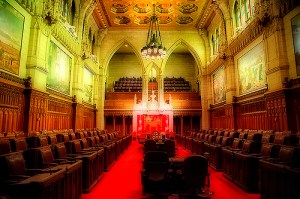
Senate of Canada

I underwent a significant intellectual transformation in 2010, which started in the summer during the Royal Tour of 2010 and culminated during my research for an essay on the prorogation-coalition crisis of 2008 and the subsequent article that Nick MacDonald and I co-authored on the same subject. I used to be a republican, but I become a constitutional monarchist after studying in depth the Crown and its reserve powers and Parliament because I based my republicanism on a profound ignorance of constitutional monarchy, partially due to the American influence accumulated over 5 years of living there and observing the American system of government and his purely written constitution. I’m not arguing that all republicans are ignorant, merely that I gravitated toward republicanism due to a fundamentalism misunderstanding of constitutional monarchy. During this transformation, I also modified my views on Senate reform; I used to wholeheartedly endorse the Triple-E Senate model (equal provincial representation, effective counterweight to the House, and election of Senators) that the CanWest Foundation, the Government of Alberta, and the Reform Party advocated. I still support reform of the Senate into an elected body, but I’ve become skeptical about the other two Es. Now I seek to respond vigorously to the parliamentarist’s argument that the opposing academic camp on this issue has long argued. So far, no scholar in favour of reform has come up with a cogent counter-argument. (Let me know if I’ve overlooked someone’s work!)
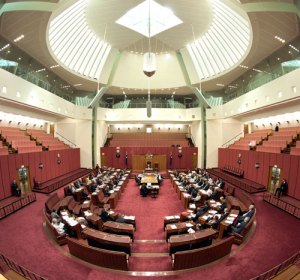
Senate of Australia

Namely, I seek to answer this question: how can we reconcile an elected Senate with the principle of responsible government? After all, responsible government means that “the government derives its legal authority to govern so long as it commands the confidence of a majority of the House of Commons” – not a majority of the House and Senate. And crucial pieces of legislation like the budget are universally recognized as confidence measures. But if Senators were elected, they would feel emboldened to oppose the House more forcefully, even to the point of refusing to pass supply, but that refusal would be anti-constitutional and violate the principle of responsible government. This concern is not merely a theoretical abstraction. The Constitutional Crisis of 1975 in Australia, known as “The Dismissal” because the Governor-General dismissed the Labor Prime Minster and installed the Liberal leader in his place, started in the Senate because the senatorial Liberal-National majority refused to pass the budget of a majority Labor government that commanded the confidence of a majority of the House. (I’ll also write about this horrific incident in more detail later on in conjunction with the King-Byng Affair). An elected Senate of Canada absolutely must not be and can never become a confidence chamber, otherwise our Westminster system — premised on providing a balance between liberty and efficiency — would take on the characteristics of American congressional deadlock and irresponsible government.

Australian scholar Charles Sampford explained in “‘Recognise and Declare’: An Australian Experiment in Codifying Constitutional Conventions” (1987) why the Senate of Australia cannot logically function as a confidence chamber in the Westminster system, despite its having been an elected chamber since the creation of the Australian federal state in 1901. “The [Liberal-National] Opposition argued that federalism justified a strong Upper House with the same power over supply as the House of Representatives despite the fact that federalism is a principle about the division of powers not who exercises them at the federal level and, despite the fact that the US Senate, on which the Australian institution was modelled, has more formal powers but no such power to use supply to force a change of government.” In other words, the Senate of the United States can exercise significant power in rejecting legislation passed by the House of Representatives precisely because its rejection of House legislation does not threaten the survival of the government, which is itself divided between the White House, the House of Representatives, and the Senate. However, if the Senate became a confidence chamber in a Westminster parliament, it would invariably destroy the principle of responsible government and render Westminster worse than the irresponsible government of the American separation of powers and totally dysfunctional.

If the Senate of Canada were reformed into an elected body by amending the Constitution Act, 1867, that amendment would probably need to codify the constitutional conventions that govern the relationship between the House and the Senate in order to avoid constitutional crisis and enshrine responsible government as relating only to the House of Commons.

The Parliament of Australia's official explanation states that the government must depend upon the House of Representatives -- not both Houses.

The Parliament Act, 1911 and the Parliament Act, 1949 in the United Kingdom limited the formal powers of the House of Lords and formally granted the House of Commons legislative supremacy, and essentially relegated the role of the House of Lords to a chamber of “sober second thought”, as Canadians would say. The Lords recognize that as unelected officials, they must tread carefully. But no such legal limitation constrains the powers of Canadian senators, who enjoy all the same powers as their colleagues in the House, apart from the introduction of money bills because of an ancient English custom. Unfortunately, the conventional limitations on the Senate’s power do not always apply. In 1987-1988, a Liberal majority in the Senate refused passage of the Free Trade Agreement until Prime Minister Mulroney advised the governor general to dissolve the House of Commons and call and election. Therefore, the Senate inappropriately turned itself into a confidence chamber, just as the Senate of Australia did in 1975 when the Liberal majority refused to pass the supply of the Labor government in the House of Representatives, thus precipitating a significant constitutional crisis. Then in the next parliament, the Liberal majority in the Senate turned itself into a confidence chamber again by refusing to pass the Mulroney government’s GST bill. In order to avoid the necessity of requesting another dissolution, Mulroney resorted to the emergency provision and rather extraordinary measure contained in section 26 of the Constitution Act, 1867 that allows the Queen to appoint an additional 8 senators on the advice of the Prime Minister of Canada. There are two types of people in the world: those who understand what I’m talking about, and those who criticized Brian Mulroney for this particular decision. I view section 26 of the Constitution Act, 1867 as the Canadian equivalent to section 57 of the Commonwealth of Australia Act, 1901 that allows the Prime Minister of Australia to advise the Governor General to dissolve both Houses simultaneously in the event of prolonged deadlock. As Ironically, Professor Sampford relegated that gem of wisdom that I quoted above to a footnote in his paper, but it is a fundamental concept: deadlock between the two Houses in a Westminster system has profound consequences on the government and can precipitate unnecessary early dissolution, or even full-fledged constitutional crises.

As I stated at the beginning of veritable treatise, I still support the reform of the Senate into an elected body — provided that any such reform adequately takes into account the problem of upper chambers and responsible government in the Westminster system. The Commonwealth of Australia has functioned with an elected Senate since its inception in 1901 and encountered only one, albeit it very serious, problem. But one serious problem in 110 years does not invalidate the model, and thankfully since Australia already experienced this constitutional crisis, we could build an elected Senate here in Canada that could steer clear of those treacherous waters. The Parliament of Australia operates on the same tripartite Crown-in-Parliament as does the Parliament of Canada and shows overall that an elected upper house can work when it respects the principle of responsible government, that the government does not derive any authority to govern from the upper house.

Related Posts:

Posted in Senate Reform | 14 Comments