The Harper Government’s Senate Reform Bill (C-7) and Its Implications on Crown Prerogative and Responsible Government


Introduction

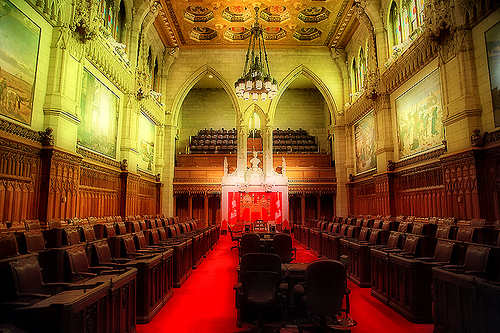
The Red Chamber

Since the 39th Parliament, the Harper government has tried and failed to pass bills that would limit the tenure of Senators to somewhere between 8 and 12 years and provide a legislative framework for provincial senatorial elections along the lines of Alberta’s Senatorial Selection Act that would form the basis of the governor general’s appointment of new senators on the advice of the prime minister. As LegisInfo shows, the Harper government introduced these two bills fully seven times previously in the 39th and 40th Parliaments. After forming a majority government in the 41st Parliament, the Harper government then introduced these two bills as one omnibus bill, Bill C-7, The Senate Reform Act. Given that the Conservatives have finally achieved a majority in the Senate, the bill will probably pass. I shall examine the two parts of Bill C-7 and analyze their implications on both the crown prerogative and bicameralism (and therefore also to responsible government).

I consider both parts of the omnibus bill constitutional in principle because they fall within Section 44 of the Constitution Act, 1982, the amending formula by which the Parliament of Canada alone may amend the parts of the constitution that fall exclusively within its jurisdiction. However, the current language of this bill presents several problems, and I have some reservations in particular about the establishment of provincial senatorial elections.

The Limitation of Senatorial Tenure

 I consider this portion of the omnibus bill acceptable, with no real constitutional or political implications. This part of Bill C-7 would limit the tenure of each senator to “one term of nine years.” This provision would merely codify the status quo: as Jack Stilborn notes on page 10 of his report “Senate Reform: Issues and Recent Developments”, the average tenure of senators (since 1975) is 9.7 years. This provision would therefore not alter the essential character of the Senate of Canada. However, section 29 paragraph 2 slyly codifies the bad precedent that PM Harper set earlier this year by re-appointing Fabian Manning and appointing Josee Verner to the Senate after they lost their respective constituencies in the 41st federal election: “Subject to sections 29A to 31, a person referred to in subsection (1) whose term is interrupted may be summoned against to fill the remainder of the term.”

In addition, section 4 of this legislation would delineate between PM Harper’s nominees and all the other senators. This provision would grandfather in all the senators appointed before 14 October 2008 such that they face no term limits and would retire at the mandatory retirement age of 75, but it would impose the limit of nine years on the senators whom Harper nominated after the coming into force of this legislation. (It would not make their term limit of these senators retroactive to 14 October 2008). This provision could pose some constitutional difficulties.

Responsible Government and the Appointment of Senators Nominated in Provincial Elections     

Bert Brown

The Legislative Assembly of Alberta passed the Senatorial Selection Act in the 1980s, and the province held its first senatorial election on 16 October 1989. Stanley Waters won that election under the Reform Party banner, and PM Mulroney agreed to nominate him to the Senate of Canada in 1990 because of his commitment to the impending Charlottetown Accord, which would have turned the Senate into an elective chamber. Contrary to all the short-sighted media coverage at the time, PM Harper nominated Bert Brown on 10 July 2007 as the second democratically-selected senator.

Bill C-7 used the Albertan legislation as a model and encourages, though does not require, all the other provinces and territories to follow suit. This part of the bill attempts to circumvent the normal process of constitutional amendment, because converting the Senate of Canada into a proper elective chamber would require the 7/50 amending formula – which almost certainly would not happen under the current political climate.

The Harper government’s current proposals risks the creation of a peculiar type of deadlock rooted not in the written constitution and inherent bicameral institutional arrangement, but in the form of the new conventions on the use of the prime minister’s prerogative and on the relationship between the House of Commons and the Senate that would almost certainly arise. Unfortunately, based on the exchange between my friend Nick MacDonald and the Minister of State for Democratic Reform at the Canadian Study of Parliament Group’s event a few weeks ago (the same one where Paul Dewar dodged my constitutional question!), I am not confident that the Harper government has fully considered the constitutional and conventional implications that this bill will entail. It is clearly designed as a stepping stone toward a formal constitutional amendment for an elective Senate (which I would support if it met my criteria contained in this blog), but I worry that in the meantime, this bill will complicate and strain the relationship between the two houses and turn the semi-elective Senate into a de facto confidence chamber.

The legislation would in effect create two classes of senators, and those nominated after winning a provincial senatorial election would surely consider themselves more democratically legitimate than their colleagues who were appointed before the coming into force of this legislation. With democratic legitimacy comes the emboldened will to oppose legislation emanating from the House — and the Senate of Canada still, by the Constitution Act, 1867, may exercise all the same powers as the House (apart from the introduction of money bills) and could therefore block supply. The Senate isn’t likely to do so under the Harper government,  but it might if the New Democrats ever form government, because that party does not officially recognize New Democrats as senators and favours the outright abolition of the Senate of Canada.

The conventional implications of this bill could also result in deadlock between the two Houses to the extent that Canadians may oppose a properly elective upper chamber.

Crown Prerogative and the Appointment of Senators Nominated in Provincial Elections

The Harper government adopted the tactic of effectively amending the constitution without truly amending, or “opening”, it by adding the fixed-election date to the Canada Elections Act. It will adopt the same tactic with Bill C-7, The Senate Reform Act. I would argue that substantial, binding constitutional amendment that formally limits any part of crown prerogative – whether on the appointment of senators or judges, or the summoning, prorogation, or dissolution of parliament, or the prerogative of war and diplomacy, etc. – would fall under Section 41 (a) of the Constitution Act, 1982 (“the Office of the Queen, Governor General and Lieutenant Governor of a province”) and thus require the unanimous consent of the Parliament of Canada and all 10 legislative assemblies. Therefore, the only method of absolutely curtailing any aspect of crown prerogative involves codifying such restrictions in the written constitution, because the governor general makes these appointments (by constitutional convention only on the advice of the prime minister).

As I explained in a previous post, that legislation implemented a novel, even paradoxical, concept: the use of codification that preserves the formal legal powers of crown prerogative as a means of forcing the creation of a new convention of how the prime minister should voluntarily restrict his application of crown prerogative. Section 52 of the Canada Elections Act establishes fixed-elections every fourth October, but codifies the current legal power of crown prorogation by inserting this phrase: “Nothing in this section affects the powers of the Governor General, including the power to dissolve Parliament at the Governor General’s discretion.” The legislation thus forces the creation of a new convention that the prime minister will restraint his use the crown prerogative to the confines of the act. This is precisely why the prime minister can, constitutionally and legally,still disregard the legislative provision.

Part I, “Senatorial Selection”, section 3 states that “If a province or territory has enacted legislation that is substantially in accordance with the framework set out in the schedule, the Prime Minister, in recommending Senate nominees to the Governor General, must consider names from the most current list of Senate nominees selected for that province or territory.” The phrase “must consider” codifies the idea that the prime minister will voluntarily restrain his crown prerogative of advising the governor general to appoint only the winners of the provincial senatorial elections; however, it does not codify any substantial constitutional limitation on crown prerogative. “Must consider” does not mean “must nominate.”

This is why a new convention, similar to that of the proper exercise of crown prerogative on dissolution and fixed-elections, would need to develop in order to reconcile the provincial senatorial elections contained in Bill C-7, The Senate Reform Act and its preservation of the prime minister’s crown prerogative to advise the governor general to make appointments to the senate, because upholding those provisions of the act are politically enforceable, not legally enforceable. The legislation would, in effect, suggest that the prime minister place voluntary limits on his crown prerogative such that he advises the governor general to appoint only those who won their respective provincial senatorial elections. However, the prime minister could still legally and constitutionally advise the governor general to appoint whomever he sees fit and disregard the results the provincial senatorial election. More than likely, the provisions of this bill would entail the creation of a new convention, and if a future prime minister broke with that convention and advised the governor general to appoint someone other than the winner of a provincial senatorial election, he would face grave political consequences.

Which Amending Formula Applies to the Senate? It Depends…

The Queen’s Proclamation of the Constitution Act, 1982

Our written constitution is complicated. Unlike Australia’s written constitution, which has only one amending formula (a referendum that must receive the support of the majority of Australians from a majority of the States), the Constitution Act, 1982 contains five amending formulas (sections 41, 42, 43, 44, and 45). Section 41 requires the unanimous consent of the Parliament of Canada and all 10 provincial legislatures, and Section 42, the “general amending formula” requires the support of the Parliament of Canada and 7 provincial legislatures representing at least 50% of the population, though the Regional Veto Act has increased that threshold. These two amending formulas have never been used successfully on anything of significance because of the political difficulties of attaining those high thresholds. That’s why you’ll hear the media and elected officials caution against “reopening the constitution.” Section 43 applies to one or more, but not all, of the provinces such that the Parliament of Canada and the relevant provincial legislatures must give their consent. Section 44 allows the Parliament of Canada to “exclusively make laws amending the Constitution of Canada in relation to the executive government of Canada or the Senate and House of Commons.” And Section 45 allows “the legislature of each province may exclusively make laws amending the constitution of the province.”

Now let’s turn to the Senate. This Bill C-7, An Act respecting the selection of senators and amending the Constitution Act, 1867 in respect of Senate term limits is in fact a constitutional amendment that the Government of Canada has tabled under Section 44. But some aspects of the Senate fall under Sections 41 and 42! The “powers of the Senate and the method of selecting Senators” and “the number of members by which a province is entitled to be represented in the Senate and the residence qualifications of Senators” fall under Section 42, the general amending formula. And the “Senate Floor Rule” (“the right of a province to a number of members in the House of Commons not less than the number of Senators by which the province is entitled to be represented”) falls under Section 41, the unanimity formula.

Thus the Senate of Canada as a whole falls under three amending formulas, depending on how the amendment affects the Senate. Bill C-7 changes neither the powers of the Senate nor the number of senators from each province, so it does not fall under Section 42. And Bill C-7 also leaves the Senate Floor Rule intact, so it steers clear of Section 41 as well. The provisions of Bill C-7 apply to Section 44 — but not without political consequences.

As I said in the introduction, I think that the two provisions contained in Bill C-7 fall under Section 44 in principle, but the current wording will pose some constitutional difficulties relating to crown prerogative and unwritten convention and to the relationship between the two Houses. I say “will pose” because the Conservatives hold majorities in both the House and the Senate, so this bill will surely pass, and because this bill will entrench in the written constitution the conundrum of crown prerogative and unwritten convention. And I say “difficulties” because anything that appears in the written constitution is obviously constitutional, even though different sections of the written constitution can come into conflict or generate political friction.

Conclusion

I suggested a general outline for an elective Senate in a previous post, and I discussed the implications of an elective Senate on responsible government in another, and the proposals for Senate reform from 1867 to 1913 in yet another. But repetition is emphasis, as they say.

In order to determine the true purpose of bicameralism, we should look to the former Legislative Councils in the Canadian provinces and the current Legislative Councils of the Australian states, since the “federal question” simply does not exist in the provincial legislatures or state parliaments (the Aussies do call their state assemblies “parliaments” as well). Clearly at the provincial or state level, the upper chamber functions as a house of review, or what we commonly call in Canada the chamber of “sober second thought.” They cannot possibly fulfill a federative function. Then this arrangement brings up the question of redundancy of the proponents of the appointive Senate: what is the purpose of two elective chambers? I would respond that two elective chambers that both elect their members on the basis of single-member plurality is indeed redundant. The old Legislative Council of the United Province of Canada (1856 to 1867) proves that point, and I would argue that the state senates in America continue to prove that point today. But since only the lower house determines which party or parties form government, the upper house can dispense entirely with these considerations of stability and government formation and focus on an electoral system that best secures its proper function as a house of review. Most of the Australian Legislative Councils are elected on the basis of proportionate representation, like the Senate of Australia, which normally results in a different partisan composition instead of merely doubling the scale of the constituencies and replicating the makeup of the lower house.

Ultimately, I would prefer an elective Senate possessing powers similar to those of the current House of Lords so that it would act primarily as a house of review, but not as an obstruction and constitutional threat to responsible government, and certainly not as a house of the provinces. The proponents of the current appointive Senate raise valid concerns about the threat of deadlock between two elective chambers. That is why I support an elective senate limited, like the House of Lords, to a suspensive veto over money bills. The Australian Senate precipitated a significant constitutional crisis in 1975 precisely because it wields too much power over supply bills. The combination of an election, like the Australian Senate with powers limited to a suspensive veto and delay, like the British House of Lords, would result in a true house of review that could provide a healthy check on governments (which necessarily derive from the lower house) without becoming a de facto confidence chamber. This elective upper chamber would become a respected, measured, democratically legitimate addition to the Crown-in-Parliament without harming the principle of responsible government in the lower house.

Related Posts

Posted in Crown (Powers and Office), Prime Minister's Powers, Responsible Government, Senate Reform | Tagged , , , , , , | 12 Comments

The First Edition of the British Cabinet Manual Is Now Available


After waiting in eager anticipation for months (as only an aspiring constitutional scholar could), I jumped for joy earlier this week when the British Cabinet Office finally released the first edition of The Cabinet Manual: A Guide to Laws, Conventions and Rules on the Operation of Government. In drafting this officialization of convention, the Cabinet Office conducted a thorough period of consultation with the public and parliament and thus also included Her Majesty’s Government’s responses to the Commons and Lords committees that examined the draft cabinet manual earlier this year. The front cover describes this as the first edition and therefore encourages the creation of subsequent editions that will take into account the ever-evolving precedent and convention. Let us hope that this edition will indeed be the first of many and that this document bequeathed a legacy of the recognition of conventional evolution.

I hope that Her Majesty’s Government will also choose to publish its latest version of its more detailed practitioner’s manual, the Precedent Book, which, as its name suggests, outlines a near exhaustive list of all precedents. (The version from 1954 appears in the documents section on this blog). In any case, the Manual of Official Procedure of the Government of Canada will always serve as the superb exemplar in this category.

Related Posts:

Posted in Constitution (Written), Officialization of Convention | Tagged , , , , | Leave a comment

A True Parliamentarist: The Speaker of the New Zealand House of Representatives Dr Lockwood Smith


In “The Role of the Speaker”, The Speaker of the House of Representatives Lockwood Smith talked about the history of parliament as an institution and the core function, or main authority, of the House of Representatives: to hold the Crown to account for its expenditures. He based his core normative principle on his interpretation of the role of the Speaker and the Speaker’s authority in upholding the right of the House to hold the Crown to account.

Speaker Dr. Lockwood Smith in full regalia — including the wig!

In the 1600’s Charles I tried to bypass Parliament and levy forced loans without parliamentary approval. So desperate for money did he become that in 1640 he summoned the Long Parliament. Frustrated at not getting his way, he forced his way into the Commons in 1642 to arrest five senior Members. History has it that Speaker William Lenthal sent Charles I packing with the words: “May it please your Majesty, I have neither eyes to see nor tongue to speak in this place, but as this House is pleased to direct me, whose servant I am here”. The English Civil War followed five months later and Charles I was eventually to lose his head. Since that time, no monarch has entered the U.K. Commons or our Debating Chamber here in New Zealand. In that courageous action, Speaker William Lenthal established the Speaker as Parliament’s man and set the standard for future speakers in protecting the rights and privileges of Parliament. Of course the monarchy was restored in 1660 with Charles II followed by James II, but religious tensions saw Parliament at odds with the Crown until the glorious revolution in 1688 and the passage of the Bill of Rights Act. It was the start of the constitutional monarchy and, in 1690, the Commons took control over the Crown’s use of revenue as well as taxation. Those crucial separations of power so fiercely fought for over hundreds of years, remain today and establish, to my mind, the breadth and depth of the Speaker’s role. The role is not just chairing or presiding over the House. It is, in its full context, about ensuring the House of Representatives is free and able to function effectively both as a legislature and in the vital role of holding the Crown or Executive to account.

Speaker Lockwood’s bold declaration of guiding principle based on the history of Westminster parliamentarism stands in stark contrast to Speaker’s Milliken’s perfunctory articulation of his core role as Speaker in our House of Commons. Milliken insists that while the Speaker of the Canadian House of Commons is responsible for overall decorum, he cannot force a minister to answer a question intended for him or be held liable for the minister’s non-answer. In contrast, Smith argues that the Speaker must compel a Minister of the Crown to respond to a question in some circumstances:

It is where Ministers are tested with a clear, concise question seeking information that I apply the full force of the Standing Order that an answer must be given if can be given consistently with the public interest.

A wise friend recently suggested that we should think of constitutional conventions in the Westminster system as such: the decision-maker should based his decisions upon the normative purpose of the convention, taking into account exceptions and exemptions in order to make the right decision case by case. Speaker Smith seems to adhere to this approach: “It would be fair to say that, as a former scientist and not a lawyer, I am more guided by primary analysis than precedent.” Based on Smith’s explanation below, I interpret “primary analysis” as the examination of each situation case by case and making the decision based on a core set of norms rather than a slavish devotion to bad precedents that ought not to be followed.

Smith identified his core norm that he seeks to enforce as Speaker:

Having analysed the Standing Order somewhat differently from my recent predecessors, I have then applied my second test – what interpretation of the Standing Order best serves the rights of the House of Representatives in holding the Crown to account? – the Speaker William Lenthal test, if you like.

Speaker Lockwood Smith is a true parliamentarist because he appreciates the centuries of history that his office embodies and that he must exercise his authority as Speaker of the New Zealand House of Representatives in order to allow the House to undertake its core function of holding the Crown to account. The Speaker thus supports responsible government. Speakers Bercow and Sheer should take note of their erudite Kiwi counterpart!

Related Posts:

Posted in Parliament, Parliamentary Privilege, Reaffirmation of, Traditions and History | Tagged , , , , , , | 6 Comments

Parliamentary Oaths of Allegiance in the Westminster System


In Canada, Australia, and New Zealand, the MP must take the oath of allegiance in order to take his or her seat in the House and gain the emoluments of the office. I will list the oaths and briefly enumerate some of their implications.

The Constitution Act, 1867 (formerly the British North America Act) includes the parliamentary oath in its Fifth Schedule:
“I A.B. do swear, That I will be faithful and bear true Allegiance to Her Majesty Queen Victoria.” The Commonwealth of Australia Act, 1900 includes similar language, but adds the clause on the succession and an enthusiastic flourish at the end:

“I, A.B., do swear that I will be faithful and bear true allegiance to Her Majesty Queen Victoria, Her heirs and successors according to law. SO HELP ME GOD!”

The Ministry of Justice of New Zealand lists the current parliamentary oath of allegiance as defined by the Oath and Declarations Act, 1957. Other than the name of reigning sovereign, it is identical to the Australian oath.

“I, [full name], swear that I will be faithful and bear true allegiance to Her Majesty Queen Elizabeth the Second, Her heirs and successors, according to law. So help me God.”

I haven’t yet found any record of a Canadian MP-elect who refused to take the oath of the sovereign. However, New Zealand presents at least one such example. In July 2011, the Speaker of the New Zealand House of Representatives, Lockwood Smith, ejected Maori MP Hone Harawira from the chamber because he refused to take the oath to the sovereign precisely as stated in the Oath and Declaration Act, 1957. Harawira sought to preface his parliamentary oath with an oath to the Treaty of Waitangi and the people:

“I, Hone Pani Tamati Waka Nene Harawira, swear that I will be faithful and bear true allegiance to Te Tiriti o Waitangi, that I will be honest and forthright in my efforts to advance the rights of the people of Tai Tokerau, that I will do my utmost to help all Maori people become full and proud citizens of this land, and that I will do whatever I can to reduce inequalities in this country, so that all may one day be proud to call Aotearoa home.”

You can view the video footage of Lockwood Smith’s ruling as well.

Two weeks later, Hone Harawira took the standard oath, and Speaker Smith allowed him to take his seat. However, Harawira clearly took the oath in bad faith because he told the media “before the ceremony [that] he did not find it difficult to swear an oath he did not believe in, comparing the task to having to wear a suit at Parliament.” The idea of taking an oath in bad faith is a contradiction in terms: an oath presumes acting in good faith, that one will act in order to uphold that oath to the best of his ability. So how do we square this circle? How does Harawira justify his blatant hypocrisy? These circumstances pose some very difficult philosophical and political questions to which I don’t have the answers.

The Parliament of Canada has also bore witness to such blatant hypocrisy. In my project on the evolution of loyal opposition in the Westminster system, I argued that the Bloc Quebecois was prima facie a disloyal opposition because that party contradicts the definition of loyal opposition: opposition to the government’s policies but loyalty to the Crown (and therefore to the country). I then mused that the Bloc MPs must have crossed their fingers when they swore allegiance to the sovereign and the Crown of Canada in their parliamentary oaths, because someone who advocates for the secession of a province so that it can become a new, independent republic clearly never intended to uphold that oath and therefore took it in bad faith. In 1990, Gilles Duceppe himself rationalized his cognitive dissonance by dismissing the parliamentary oath to the sovereign as a mere formality: “I mean, it’s a formality, a technicality, just like Labour has been doing for years in the British Parliament, even if half of them are asking for the abolition of the monarchy.” (Hat-tip to Nick MacDonald for finding this little gem!)

According to a backgrounder prepared by the Library of Parliament in 1990,

“The House of Commons has the power to expel or otherwise discipline Members who contravene the oath. There do not appear to be any precedents for use of this power, however, and, given the general vagueness of the concept, considerable difficulties would seem to lie in the way of establishing the validity of allegations of contravention.”

This matter falls under parliamentary privilege.

I only used the crossing of fingers as a metaphor in order to demonstrate that the Bloc MPs had acted in bad faith. Interestingly, the New Zealand House of Representatives also offers a literal precedent: “In 1994, Tau Henare MP noted that he had crossed his fingers when he took his oath of allegiance as a member of Parliament, and that his allegiance was primarily to New Zealand as a country.” Prima facie, this MP also acted in bad faith by swearing an oath that he never intended to fulfill or uphold in any way.

The Ministry of Justice of New Zealand also reported that “in 1999, Hon Margaret Wilson, in her maiden speech, called for Members of Parliament to replace their oath of allegiance to the Queen with a pledge of loyalty to the New Zealand people.” (Margaret Wilson served as Speaker of the House of Representatives). I disagree with this argument because it misrepresents the nature of the Westminster system. Legal sovereignty lies in the Crown-in-Parliament, not in the people, even though they may act as what Dicey called “the political sovereign.” A pledge of loyalty to the people of New Zealand would conflate these two principles and obscure the source of sovereignty as the Crown of New Zealand, from which all legal and democratic authority flows. This argument applies equally to Australia and Canada.

Columnist Matt McCarten argued that “There’s something surreal when a Maori MP is thrown out for swearing allegiance to Te Tiriti O Waitangi and his electors before promising to be loyal to an English queen.” Like Canadian republicans, McMarten’s argument rests on the fundamental error that Elizabeth II is necessarily “an English queen.” (He should at least have called her a “British queen”!) Elizabeth II is the Queen of the United Kingdom of Great Britain and Northern Ireland, but she’s also the Queen of New Zealand – and MPs in the New Zealand House of Representatives pledge allegiance to Elizabeth II in her capacity as Queen of New Zealand. To be fair to McCarten, the wording of the oath should clearly acknowledge this difference.

Canada, Australia, and New Zealand should ideally amend their parliamentary oaths – but in order to emphasize that their respective crowns rather than to some anti-historical republican alternative. For instance, Canada’s oath should read:

“I, [full name], swear that I will be faithful and bear true allegiance to Her Majesty Queen Elizabeth the Second, Queen of Canada, Her heirs and successors, according to law. So help me God.”

The insertion of the constitutionally correct phrase “Queen of Canada” (and “Queen of Australia” and “Queen of New Zealand”) would serve both to emphasize that the oath refers to the Maple Crown and not to the British Crown and to educate republicans who always seem to conflate the British Crown with the Maple Crown! Unfortunately, an amendment to this oath would probably require the use of the 7/50 formula because it applies not only to the Parliament of Canada but also to all the provincial legislative assemblies. Australia’s constitution only includes one amending formula (a referendum that must receive the support of the majority of Australians from a majority of the States); given the volatility of republicanism there, this minor amendment would only stoke the fires of republican protest. New Zealand, however, being a unitary state with a unicameral parliament, could easily change its oath by amending the Oath and Declaration Act.

This analysis leaves many questions open for further study, and I will explore the implications of oath, breach of oath, and parliamentary privilege with respect to my project on loyal opposition in the Westminster system and the 35th Parliament of Canada.

Related Posts:

Posted in Crown (Powers and Office), Loyal Opposition, Oaths of Allegiance, Parliamentary Privilege | 15 Comments

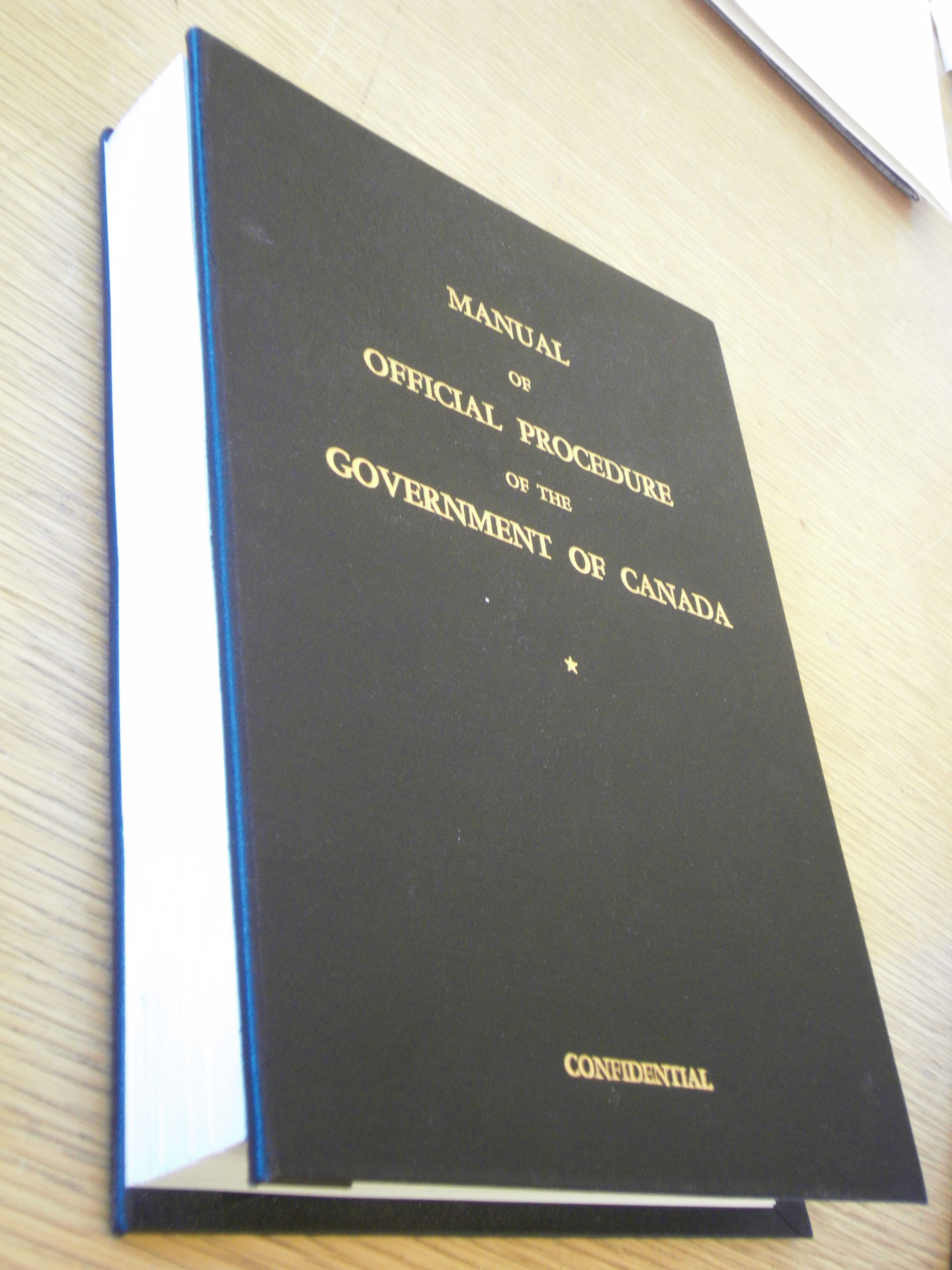
The Manual of Official Procedure of the Government of Canada


Volume 1, as I found it in the Library and Archives before reproduction

Three consecutive minority parliaments from 2004 to 2011 renewed interest in the creation of a cabinet manual describing the unwritten rules, or constitutional conventions, that underpin Westminster parliamentarism. The United Kingdom just established its Draft Cabinet Manual in 2010, with a final version to follow soon, and New Zealand has long relied on its Cabinet Manual, now on its 8th edition as of 2008. In 2011, the Asper Centre for Constitutional Rights, the Public Policy Forum, and the Canadian Bar Association produced reports recommending that constitutional conventions be codified in a Canadian cabinet manual. They focused on conventions relating to the formation of governments, the governor general’s reserve powers (particularly on prorogation and dissolution), and the principle of restraint (as known as the caretaker convention).

The scholars and columnists who have recently called for codification have thus far overlooked some importance considerations. “Codification” of convention would mean writing in an Act of Parliament or the written constitution, but the British and New Zealand cabinet manuals are neither legal nor justiciable; instead they are universally regarded as politically enforceable. The British and New Zealand manuals are, in effect, officializations – not codification – of convention. Codification doesn’t merely “ossify” convention, as Forsey wrote: in fact, codification eliminates the concept of politically-enforceable convention altogether by converting these political rules into justiciable law. We spent a lot of time ruminating over the conundrum of codification, so we would be very happy if “officialization” caught on in the literature! 🙂

Most crucially, those calling for the creation of a “Canadian cabinet manual” have overlooked the existence of the Manual of Official Procedure of the Government of Canada, which the Privy Council Office produced under Prime Minister Lester B. Pearson in 1968. At the time of its production, no other Commonwealth country had ever produced a handbook on constitutional conventions of the Manual’s breadth and depth – a staggering 1,500 pages over two volumes. Sadly, as the Public Policy Forum pointed out in one of its reports, the Manual  has since been “shrouded in secrecy and kept from all but a few senior officials.” It was likely kept in cabinet confidence until at least 1988 and never generated much interest, until the wake of our latest cycle of minority parliaments.

My partner in parliamentarism Nick MacDonald and I first stumbled upon a reference to the Manual of Official Procedure of the Government of Canada in Michael Valpy’s article in the Globe and Mail from December 3, 2008, “Going Where No Governor General Has Gone Before” while we were researching for our first article “No Discretion: On Prorogation and the Governor General.” We finally uncovered this veritable constitutional treasure-trove after thorough research and patient application of ATIP requests with Library & Archives and months of waiting in total. But our persistence paid off marvellously!

The Manual of Official Procedure of the Government of Canada and its Appendices are an exemplary officialization of constitutional conventions and must undoubtedly be considered in any effort to produce a new or updated Canadian cabinet manual on constitutional conventions. I hope that the Manual will help facilitate discussion of the key principles and core conventions of Westminster parliamentarism in Canada and give pause to those who called for the creation of a new Canadian cabinet manual from scratch.

Nick MacDonald and I also wrote this short academic article on the Manual, which you can download from the link contained in the bibliographical citation below. A longer article comparing the Manual to its British, Australian, and New Zealand counter-parts will appear in the new year.

MacDonald, Nicholas A. and James W.J. Bowden.The Manual of Official Procedure of the Government of Canada: An Expose“. Constitutional Forum constitutionnel 20, no. 1 (17 October 2011): 33-39.

Related Posts

Posted in Officialization of Convention | 14 Comments