No Discretion: On Royal Assent and the Governor General


Introduction

Under our system of responsible government, the Sovereign or Governor General exercises his prerogative powers on the advice of the Crown-in-Council, and his constitutional powers relating to Parliament on the advice of the Prime Minister alone. Responsible government means that “Ministers of the Crown are responsible for acts of the Crown” and responsible to the House of Commons.[1] The Sovereign or Governor General acts as a neutral figure and remains above partisan politics. The Prime Minister is the Governor General’s principle constitutional advisor, and while his government commands the confidence of the House, the Governor General must carry out the Prime Minister’s advice. Under no circumstances can the Leader of the Opposition, the leader of the third opposition party, or any other government or opposition backbencher offer legitimate, binding constitutional advice to the Governor General.

The Crown-in-Parliament (Tidridge 2011, 63)

We must also situation this constitutional relationship between the Governor General (the crown personified) and the Prime Minister and cabinet (Crown-in-Council) to the Parliament of Canada (the Crown-in-Parliament). The Crown-in-Parliament consists of three parts: the House of Commons, the Senate, and the Queen (whom the Governor General of Canada represents as per the Constitution Acts and the Letters Patent, 1947). All three parts of the Crown-in-Parliament must approve of a bill before it becomes law. The House of Commons and Senate must pass the bill, and as the final act, the Governor General must give Royal Assent so that the bill becomes law. Royal Assent represents the pro forma approval of the Queen and her acknowledgement that the bill in question has passed through the House of Commons and the Senate; the final stage of the Crown-in-Parliament thus legitimates the other two. The Crown-in-Council plays no part in this process apart from scheduling the ceremony of Royal Assent. The Prime Minister may not advise the Governor General to withhold Royal Assent.

The Prime Minister may not advise the Governor General to withhold royal assent because the Crown’s veto on legislation no longer exists. The Crown’s veto only applied in the early years of representative government, when the Sovereign’s ministers and the Prime Minister remained in power by virtue of maintaining the favour of the Sovereign rather than commanding the confidence of the House of Commons. Under responsible government, ministers of the crown are responsible for acts of the crown, but by advising the Governor General to withhold Royal Assent, the Prime Minister would call the neutrality of the Crown into question. In addition, the House of Commons would have no recourse against such an action short of withdrawing its confidence in the government, which would not prevent the veto.

A Constitutional Crisis on Royal Assent in the Making

The Federal Court recently ruled that the Harper government’s proposed legislation to abolish the monopoly of the Canadian Wheat Board violates the rule of law because Section 41.1 of the Canadian Wheat Board Act mandates that the government must hold a plebiscite before abolishing this monopoly – even though the Harper government’s legislation effectively nullifies this provision by repealing it. I hope that the Harper government appeals this ruling, because the judge has infringed upon the sovereignty of the Crown-in-Parliament. I have no doubt that the Federal Court of Appeal or the Supreme Court of Canada, if necessary, would overturn this ruling. To paraphrase the great British constitutional scholar of the late 19th century A. V. Dicey, “what parliament can pass, parliament can amend or repeal.” In other words, a past parliament cannot bind a future parliament or prevent an MP or Minister of the Crown from introducing legislation that amends or repeals an Act of Parliament. And if a past parliament intended to pass legislation that limited a future parliament’s ability to pass legislation, then the past parliament erred and attempted to violate the sovereignty of the Crown-in-Parliament.

In light of this controversy, Bob Rae asked the Prime Minister in the House of Commons on 8 December 2011:

To the Prime Minister through you, Mr. Speaker, could I ask how it is that the government’s intention is to proceed with the Wheat Board law and to ask the Governor General to give royal assent to the law when the court in question has said that the minister’s conduct is an affront to the rule of law? Would the Prime Minister not agree that the government should at the very least wait royal assent until such time as all appeals have been exhausted with respect to the ruling of Mr. Justice Campbell?[2]

Bob Rae asked the government to postpone the ceremony of Royal Assent (which the cabinet does organize). Fair enough, but the Harper government certainly will not follow Rae’s advice.

However, Bob Rae raised the stakes in his constitutional brinksmanship earlier today, 12 December 2011.  Bob Rae has overstepped his bounds simply by forwarding this presumptuous open letter to the Governor General – because only the Prime Minister offers legitimate, binding constitutional advice to the Governor General. Worse still, Rae has requested that the Governor General withhold Royal Assent in an unprecedented repudiation of 300 years of Westminster parliamentarism and of responsible government:

As Leader of the Liberal Party, I would ask most respectfully that full consideration be given to awaiting final disposition of this matter before the courts before legislation receives Royal Assent.3]

Why The Royal Prerogative of Veto (Withholding Royal Assent) No Longer Exists

Modern Justification

The website of the British monarchy explains on the page “Queen-in-Parliament”:

The role of the Sovereign in the enactment of legislation is today purely formal, although The Queen has the right to be consulted, to encourage and to warn through regular audiences with her ministers. As a constitutional monarch, the Sovereign is required to assent to all Bills passed by Parliament, on the advice of Government ministers. The Royal Assent (consenting to a measure becoming law) has not been refused since 1707. […][4]

That phrase that the Queen gives Royal Assent “on the advice of her Ministers” means that the government organizes the scheduling of the ceremony of Royal Assent (just as the Canadian sources show) and advises the Queen when to grant Royal Assent – not whether to grant Royal Assent.

Historical Justification

The webpage on the Queen-in-Council has merely restated the conclusions that several British scholars drew in the 19th century.

In his famous The English Constitution, Walter Bagehot wrote in 1867 that “the Crown has lost its veto.”[5] Bagehot continued in his characteristic English wit:

The popular theory of the English Constitution involves two errors as to the sovereign. First, in its oldest form at least, it considers him as an “Estate of the Realm,” a separate co-ordinate authority with the House of Lords and the House of Commons. This and much else the sovereign once was, but this he is no longer. What authority could only be exercised by a monarch with a legislative veto. He should be able to reject bills, if not as the House of Commons rejects them, at least as the House of Peers rejects them. But the Queen has no such veto. She must sign her own death-warrant if the two Houses unanimously send it up to her. It is a fiction of the past to ascribe to her legislative power. She has long ceased to have any.[6]

The Manual of Official Procedure of the Government of Canada and its Appendices provide an excellent primary source that supports the claim that the royal prerogative (reserve powers) to withhold Royal Assent no longer exists because no Sovereign has invoked it since Queen Anne in 1707, in the era of representative government and about 130 years before responsible government told hold. Not even Mad King George ever vetoed legislation. The Hanoverians implicitly accepted the constitutional limitations on their powers – including the destruction of the veto on Royal Assent. In other words, the reserve powers of the Sovereign become obsolete over time as the royal prerogative yields to the crown-in-council prerogative or to the crown-in-parliament. I would argue that the reserve powers on Royal Assent became obsolete some time in the 18th century (though we can never pinpoint an exact date). Certainly, by the time that responsible government had begun to establish itself under William IV in the 1830s, the veto on Royal Assent no longer existed.

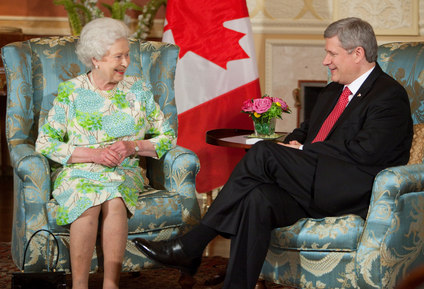
Governor General David Johnston Gives Royal Assent, as Prime MInister Harper Looks On

Royal Assent occurs automatically. The Prime Minister advises the Governor General neither to give nor withhold Royal Assent; the Prime Minister only determines the scheduling of the ceremony at which the Governor General gives Royal Assent. According to the Manual of Official Procedure of the Government of Canada, “The Government Leader in the House, in consultation with the Prime Minister and Leader of the Government in the Senate, initiates the decision to give Royal Assent to bills.”[7] Next, “when a decision has been taken [the Leader of the House] informs the Prime Minister and the responsible Assistant Secretary to the Cabinet of the date and time.”[8] The Manual treats Royal Assent as an automatic royal certification that the bill has passed both Houses of Parliament; the Prime Minister does not advise the Governor General to grant or withhold Royal Assent, but merely helps organize the ceremony. If the Prime Minister could advise the Governor General on Royal Assent, our system of responsible government would collapse.

On 29 November1882, an Order-in-Council argued the right of responsible government of 1848 empowered the Ministers of the Crown of the Dominion of Canada to advise the Governor General on all matters where the British Cabinet advises the Queen:

Now it is clear that since the concession of Responsible Government to the Colonies, the Advisors of the Governor General hold the same position with regard to him, as the Imperial Ministry does with respect to Her Majesty. They have the same powers and duties and responsibilities. They ought not to have and of right have not any great authority with respect to the Legislation of the Canadian Parliament than the Queen’s Ministers have over the Legislative action of the Imperial Legislature. […]

Should however any Bill be passed notwithstanding their opposition or adverse opinion, they cannot advise its rejection by the Sovereign.

The power of veto by the Crown is now admitted to be obsolete and practically non-existent. The expression ‘Le Roi’ or ‘La Reine s’avisera’ has not been heard in the British Parliament since 1707, in the reign of Queen Anne, and will in all probability never be heard again. The Ministers [of the Crown] in such cases if they decline to accept the responsibility of submitting the Bill for royal assent must resign and leave to others the duty of doing so.[9]

Section 55 of the Constitution Act, 1867Has Become a Dead Letter In the Wake of The Statute of Westminster, 1931 and the Letters Patent, 1947

“The Constitution Act, 1867 […] expressly confers upon the Queen or the Governor General the power to withhold the royal assent from a bill that has been enacted by the two Houses of Parliament (s. 55), but a convention stipulates that the royal assent shall never be withheld.”[10]

55. Where a Bill passed by the Houses of the Parliament is presented to the Governor General for the Queen’s Assent, he shall declare, according to his Discretion, but subject to the Provisions of this Act and to Her Majesty’s Instructions, either that he assents thereto in the Queen’s Name, or that he withholds the Queen’s Assent, or that he reserves the Bill for the Signification of the Queen’s Pleasure.[11]  

Statute of Westminster (Tidridge 2011, 47)

Section 55 has become a dead letter in the wake of the Statute of Westminster, 1931 and the Letters Patent, 1947. First, this section originally existed in order to allow the British cabinet to advise the British Sovereign to disallow legislation that the Dominion of Canada passed contrary to the interests of the British Empire. In the 19th century, the United Kingdom still controlled the foreign affairs and defence policies of the Dominion of Canada. Second, the Statute of Westminster, 1931 formally recognized the equality and independence of all the Dominions and declared the Crowns of Canada, etc. legal entities independent of and separate from the Crown of the United Kingdom. Thereafter, the Prime Minister of Canada could advise the King or Queen of Canada on Canadian constitutional matters, just as the British Prime Minister advises the King or Queen on British constitutional matters. Third, this analysis has established that by 1867, the reserve power to veto legislation had already become obsolete. And given that Canada inherited a “constitution similar in principle to that of the United Kingdom” in 1867 upon the passage of the British North America Act, 1867, I argue that the Statute of Westminster, 1931 formally freed up the convention inherent in the Constitution Act, 1867 that the Governor General may never withhold Royal Assent. Fourth, the Letters Patent, 1947 provide a further rationale in support of this argument: section 55 of the Constitution Act, 1867 says that a Governor General assents to or “reserves” a bill “subject to […] Her Majesty’s Instructions.” The Letters Patent, 1947 are such an example of “Her Majesty’s Instructions” and delegated all the constitutional powers and authorities of the King or Queen of Canada to the Governor General of Canada. Since the King of Queen of Canada no longer possessed the reserve power to veto Royal Assent, neither then does the Governor General.

If the Sovereign no longer possessed the power of veto in 1867 and 1882, then the Sovereign and the Governor General most certainly do not possess that power today in 2011. The Crown has been bound by precedent and convention for centuries to give Royal Assent to all legislation that passes both Houses of Parliament. British constitutional scholar Sir Ivor Jennings proposed that a custom or practice exists as a convention if it satisfies three questions: What are the precedents? Did the actors believe they were bound by a rule? Is there a reason for the rule?[12] First, the precedents form 300 years of constitutional history. Second, based on all available evidence from the mid-19th century to the present, all Sovereigns and Governors General have considered themselves bound to recognize that the reserve power to withhold Royal Assent no longer exists. Third, the rule exists in order to preserve the principle of responsible government and our entire constitutional system as we know it!

Hogg states that

There is undoubtedly a convention that the Queen or Governor General or Lieutenant-Governor will not withhold the royal assent from bills which have been passed by the appropriate legislative chambers, but I am not aware of that any Queen or King or Governor General or Lieutenant Governor has ever explicitly acknowledged the obligation. The convention is well understood although tacit.[13]

In all reality, the website of the British monarchy cited above shows that the Queen has publicly acknowledged that she does not possess the authority to withhold Royal Assent.

Conclusion

Queen Anne, The Last Sovereign To Refuse Royal Assent.

Only a Prime Minister leading a single-party minority government in a minority parliament would conceivably want to advise the Governor General to veto a bill that passed both Houses of Parliament. But a Prime Minister leading a single-party majority government would probably never feel compelled to offer such advice, notwithstanding its constitutional impropriety. The current situation presents an even more bizarre constitutional quandary because the Leader of the Liberal Party – the third party – has advised the Governor General to withhold Royal Assent and in effect veto Bill C-18, An Act to Reorganize the Canadian Wheat Board and to Make Consequential and Related Amendments to Certain Acts. If the Governor General were to veto this legislation, he would not only repudiate 300 years of Westminster parliamentarism, but the principle of responsible government itself: he would veto this legislation based on his discretionary authority (the reserve powers) against the wishes of the government and against the will of Parliament and on the advice of the Leader of the Liberal Party! The Governor General’s veto on the basis of a reserve power that has been used since the reign of Queen Anne in 1707 and no longer exists; the anti-constitutional use of veto today would precipitate the most serious constitutional crisis since the Glorious Revolution of 1688 and make the Byng-King Affair of 1926, the Dismissal of 1975, and the Coalition-Prorogation Controversy of 2008 look routine. If the Governor General vetoed a government bill on the basis of a reserve power of veto that no longer exists, he would essentially dismiss the Prime Minister and therefore the entire 28th Ministry and leave the country without a government. The Prime Minister of Canada advises the Queen of Canada on the appointment of the Governor General, so he also possess the authority, in exceptional circumstances, to advise the Queen of Canada directly to dismiss the Governor General of Canada; the Queen would likely be bound to follow such advice.[14] Clearly, whatever the ultimate outcome, a gubernatorial veto would leave our entire constitutional system in ruin and chaos.

Last week, Pat Martin suggested in the House of Commons that

It is possible that the Governor General, at least, will refuse to grant royal assent to a bill that the courts have struck down.”[15] However, Mr. Martin acknowledged in an unexpected reply to my tweet that “[The New Democratic Party’s] research shows [refusal to grant Royal Assent] is not an option.[16]

I can only hope that Bob Rae will also recognize that his letter repudiates 300 years of Westminster parliamentarism and offers illegitimate, non-binding and unsolicited advice to the Governor General, and that he is essentially asking the Governor General to precipitate what would become the most disastrous constitutional crisis in Canada’s history.

Related Posts:


[1] Sir John George Bourinot, Parliamentary Procedure and Practice, 4th ed. (Montreal: Dawson Brothers Publishing, 1916): 102; James W.J. Bowden and Nicholas A. MacDonald, “Writing the Unwritten: The Codification of Constitutional Conventions in Canada, the United Kingdom, Australia, and New Zealand.” Journal of Parliamentary and Political Law (forthcoming).

[2] Canada. Parliament of Canada, House of Commons. Debates. 41st Parliament, 1st Session. (Debate on the Senate Reform Act), 8 December 2011: 1230. http://www.parl.gc.ca/HousePublications/Publication.aspx?Language=E&Mode=1&Parl=41&Ses=1&DocId=5319448 [Accessed 12 December 2011].1420.

[3] Bob Rae (Leader of the Liberal Party of Canada), Open Letter to the Governor General of Canada, 12 December 2011. http://www.liberal.ca/files/2011/12/Rae-to-GG-Bill-C-18-EN.pdf [Accessed 12 December 2011].

[4] The Official Website of the British Monarchy. “The Queen-in-Parliament” [emphasis added]. http://www.royal.gov.uk/MonarchUK/QueenandGovernment/QueeninParliament.aspx [Accessed 12 December 2011].

[5] Walter Bagehot, The English Constitution. (London: Collins, 1963): 153. http://socserv.mcmaster.ca/econ/ugcm/3ll3/bagehot/constitution.pdf

[6] Walter Bagehot, The English Constitution. (London: Collins, 1963): 74-75.

http://socserv.mcmaster.ca/econ/ugcm/3ll3/bagehot/constitution.pdf

[7] Canada. Privy Council Office, Manual of Official Procedure of the Government of Canada, Henry F. Davis and André Millar.(Ottawa, Government of Canada, 1968): 417.

[8] Canada. Privy Council Office, Manual of Official Procedure of the Government of Canada, Henry F. Davis and André Millar.(Ottawa, Government of Canada, 1968): 419.

[9] Canada. Privy Council Office, Manual of Official Procedure of the Government of Canada: Appendices, Henry F. Davis and André Millar.(Ottawa, Government of Canada, 1968): 469-470 [emphasis added].

[10] Peter W. Hogg, The Constitutional Law, 2011 Student Edition (Toronto: Thomas-Reuters Canada Ltd., 2011): 1-21 to 1-22.  

[11] Constitution Act, 1867 (UK), 30 & 31 Vict, c 3, reprinted in RSC 1985, App II, No 5.

http://laws.justice.gc.ca/eng/Const/PRINT_E.pdf [Accessed 12 December 2011].

[12] Corbett Haselgrove Spurin, “Chapter 5: Constitutional Conventions” in Constitutional and Administrative Law (Corbett Haselgrove Spurin, 2004): 3. <http://www.nadr.co.uk/articles/published/ConstitutionalLaw/Chapter005Conventions.pdf>.

[13] Peter W. Hogg, The Constitutional Law, 2011 Student Edition (Toronto: Thomas-Reuters Canada Ltd., 2011): 1-27.

[14] Adam Dodek, “Crisis in Canada: Coalition Governments and Beyond,” Conference by the University of Ottawa’s Faculty of Common Law (Ottawa, Ontario, 4 December 2008); Andrew Heard, Canadian Constitutional Conventions: The Marriage of Law and Politics (Toronto: Oxford University Press Canada, 1991): 41; Peter J. Boyce, The Queen’s Other Realms: The Crown and Its Legacy in Australia, Canada, and New Zealand. (Annandale, NSW: The Federation Press, 2008): 60. Dodek and Heard discussed the fact that the prime minister of a Commonwealth realm can advise the British monarch to dismissal the governor general. Boyce argued in favour of “the monarch’s duty to dismiss a governor-general on the advice of her prime minister.” Conversely, the governor general dismissed the prime minister in the Australian Constitutional Crisis of 1975.

[15] Canada. Parliament of Canada, House of Commons. Debates. 41st Parliament, 1st Session. (Debate on the Senate Reform Act), 8 December 2011: 1230. http://www.parl.gc.ca/HousePublications/Publication.aspx?Language=E&Mode=1&Parl=41&Ses=1&DocId=5319448 [Accessed 12 December 2011].

[16] Pat Martin, MP. Discussion with Author, 12 December 2011.
Posted in Crown (Powers and Office), Governor's Discretion, Officialization of Convention, Royal Assent | Tagged , , , , , , , , , | 33 Comments

Parliamentarians and National Security


My friend and co-author Nick MacDonald wrote “Parliamentarians and National Security”, for the Canadian Parliamentary Review.

The Parliament of Canada has traditionally deferred to the government on matters relating to national security although parliamentarians have, on occasion, vied for the task of being actively involved in holding the government to account on these matters. In 1991, parliament conducted a five-year review of the Canadian Security Intelligence Service Act where the Solicitor General of Canada and his officials presented classified summaries to parliamentarians to assist them in their review of the effectiveness of the legislation. In 2004, a National Security Committee of Parliamentarians was proposed in Securing an Open Society: Canada’s National Security Policy. The Speaker’s ruling on the provision of documents of April 27, 2010 also dealt with this issue. This paper examines a number of issues and concerns that have arisen in the past on this issue, and it examines parliamentary review of national security matters in the United Kingdom, Australia and New Zealand. It concludes that there are no reasonable barriers to the involvement of parliamentarians in reviewing matters of national security in Canada.

A timely and timeless piece, his article offers an updated explanation of the role of parliament vis-a-vis the crown-in-council on matters of national security by reviewing the old Canadian scholarship, incorporating Speaker Milliken’s ruling from 2010, and comparing Canada’s model to those of the United Kingdom, Australia, and New Zealand. I encourage all of you to read it!

Related Post:

Posted in Articles and Books, Parliamentary Privilege, Reviews | Tagged | Leave a comment

The Speakership of the New Zealand House of Representatives


The Canadian Parliamentary Review has just published an article by the Speaker of the New Zealand House of Representatives, Lockwood Smith, which he based on a speech that delivered in 2010.

In “The Speakership: A New Zealand Perspective”, Smith reviews the history of the Speakership and Parliament and argues that Sir William Lenthal’s famous response to Charles I means that the Speaker as servant of the House means far more than simply acquiescing to the will of the majority. Smith sees the Speakership as a constitutional guardian and, in New Zealand, as the veritable Minister of the Parliamentary Service. Above all, the Speaker must facilitate the core function of the House of Representatives: to hold the Minister of the Crown to account for its expenditures.

 Of course the monarchy was restored in 1660 with Charles II followed by James II, but religious tensions saw Parliament at odds with the Crown until the glorious revolution in 1688 and the passage of the Bill of Rights Act. It was the start of the constitutional monarchy and, in 1690, the Commons took control over the Crown’s use of revenue as well as taxation.

Those crucial separations of power so fiercely fought for over hundreds of years, remain today and establish, to my mind, the breadth and depth of the Speaker’s role. The role is not just chairing or presiding over the House. It is, in its full context, about ensuring the House of Representatives is free and able to function effectively both as a legislature and in the vital role of holding the Crown or Executive to account. This view of the Speaker’s role guides my interpretation of Standing Orders and also my role as “Minister” responsible for the Parliamentary Service.

Lockwood Smith is a true parliamentarist.

Related Posts:


Posted in Articles and Books, Constitutional Conventions, Parliamentary Privilege, Reviews | Tagged , , , , , | 3 Comments

Constitutional Scholarship or Political Activism? The Role of the Academy Following the Coalition-Prorogation Crisis of 2008


Introduction

The line between academia and scholarship on the one hand and punditry and activism on the other has become increasingly blurred in Canada, especially in the wake of the coalition-prorogation crisis of December 2008. Recent works like Democratizing the Constitution: Reforming Responsible Government are emblematic of the attempt, as well as the failure, to reconcile the mutually exclusive concepts of political activism and constitutional scholarship.

A spin off of that book, Lori Turnbull’s column “A three-peat for prorogation? Bring on reform” in the Globe and Mailalso effectively underscores this problem: sometimes the correct academic argument becomes an obstacle to effective activism. The article makes at least two factual errors and, more broadly, purports a serious conceptual error of interpretation about the nature of crown prerogative and the role of unwritten convention in Canada’s constitution.

Problems with Turnbull’s Column and Democratizing the Constitution: Reforming Responsible Government

On Prorogation and Crown Prerogative

Turnbull argued:

Technically, the power to prorogue belongs to the Crown and can be exercised “officially” by the governor-general alone, but this would never happen without the advice of the prime minister. No Canadian governor-general has refused a prime minister’s advice to prorogue. So history would suggest that the prime minister, not the governor-general, calls the tune, regardless of where the power lies constitutionally. This is not the case in other Westminster jurisdictions.

The Dignified and the Efficient Parts of the Crown

The Supreme Court of Canada recognized in the Patriation Reference that “constitutional conventions plus constitutional law equal the total constitution of the country.” Therefore,  constitutional conventions and the written constitution form equally important parts of Canada’s constitution. The Supreme Court cannot use one part of the constitution (like the Charter) the strike down another part of the constitution (like crown prerogative or parliamentary privilege). The Constitution Act, 1982 mentions that the governor general dissolves parliament, but the Letters Patent, 1947 provide the only complete written instruction that the governor general summons, prorogues, and dissolves parliament. By convention, the governor general cannot exercise any of those powers independently and does so only on the advice of the prime minister. According to the Manual of Official Procedure of the Government of Canada, the governor general’s reserve powers may allow him to reject the prime minister’s advice to dissolve, but not to prorogue or summon, parliament. The rejection of the prime minister’s advice does not equal independent gubernatorial action. Strictly speaking, “the Crown” consists of two parts, what Bagehot called the “dignified” and “efficient” functions, respectively: the Sovereign and governor general, and the prime minister and cabinet. Thus, “crown prerogative” follows this division; the sovereign or governor general possesses “reserve powers” (what I call “royal prerogative”), and prime minister and cabinet control the Governor-in-Council’s crown prerogative.

Given the role of convention in Canada’s constitution, I disagree with Turnbull’s assertion that the governor general can “officially” summon, prorogue, or dissolve parliament independently. Turnbull states correctly that no governor general has ever rejected the prime minister’s advice to prorogue. Based on my analysis above, I find the next statement problematic: “So history would suggest that the prime minister, not the governor-general, calls the tune, regardless of where the power lies constitutionally.” (Isn’t the idiom ‘to call the shots’?) The “power lies constitutionally” in both the governor general and the prime minister, who in effect jointly exercise this crown prerogative.

This over-simplification of crown prerogative and the role of convention in Canada’s constitution probably resulted from the constraints of the newspaper column. In any case, I would have attempted to re-phrase the nature of crown prerogative more effectively, perhaps as:
The crown’s prerogative powers to summon, prorogue, and dissolve in fact rest with both the governor general and the prime minister because the former only acts on the advice of the latter. Any attempt to alter formally and substantively this relationship between the governor general and the prime minister – the crown as a whole – would require an amendment to Section 41 (a) of the Constitution Act, 1982 (“the Office of the Queen, Governor General, and Lieutenant Governor of a province”), which requires the unanimity of the Parliament of Canada and all 10 provincial legislatures.

But more fundamentally, I disagree that the crown prerogative on prorogation should be eliminated and the power vested in the legislature, and ironically, this system would detract from the House’s”basic functions, including holding the government to account.” The government introduces most legislation, for which the opposition holds the government to account. The Prime Minister normally advises prorogation upon the completion of his government’s legislative program; the House’s basic function of holding the crown to account for its expenditures does not include the determination of the end of the government’s legislative agenda.

Jarvis and Turnbull acknowledge in the conclusion of Democratizing the Constitution that their plan to eliminate the crown prerogative of prorogation and vest it in parliament via a two-thirds supermajority would require a formal constitutional amendment, but I think that they have greatly underestimated the difficulty in achieving unanimity under Section 41 (a) of the Constitution Act, 1982.

Nevertheless, in her individual column, Turnbull argues that the Standing Orders of the House of Commons could formally constrain or eliminate the crown prerogative on prorogation.

A political prorogation is a blatant abuse of a prime minister’s access to the Crown’s prerogative powers. As citizens of an elected democracy, we should not tolerate it and, with a few basic changes to the House rules, we wouldn’t have to [emphasis added].      

I guess that Turnbull forgot about the arguments and political activism contained in her own book? Maybe Turnbull should have talked to Jarvis before submitting this column, and then he could have reminded her about the book that they wrote together, and how it was more accurate about this particular subject…

“Other Westminster Jurisdictions”. Which Ones? Please Elaborate!

Turnbull argues : “So history would suggest that the prime minister, not the governor-general, calls the tune [sic (‘Calls the shots’, perhaps?)] , regardless of where the power lies constitutionally. This is not the case in other Westminster jurisdictions.” In which other Westminster jurisdictions has the crown prerogative on prorogation been eliminated? As I explained in the entry on Alex Salmond’s vision of an independent Scotland, the Scottish Parliament has eliminated the crown prerogatives on the summoning and dissolution of parliament by codifying the fixed elections to and automated summoning of parliament in the Scotland Act, 1998. However, the Scotland Act makes no mention whatsoever of the words “prorogue” and “prorogation”, which means that rather than eliminating the crown prerogative on prorogation, it eliminated prorogation itself. I explained in my entries on fixed-elections in the Commonwealth that the Westminster Parliament has devised the Fixed-Term Parliaments Act, which eliminates the crown prerogative on dissolution. The Act also says in Section 6, Paragraph 1 that “This Act does not affect Her Majesty’s power to prorogue Parliament.” The Fixed-Term Parliaments Act, 2011 does not affect prorogation at all. The New Zealand Cabinet Manual and the website of the Governor-General of New Zealand indicate that the Governor-General summons, prorogues, and dissolves parliament on the advice of the Prime Minister. The website of the Governor-General of Australia shows that the Australian viceroy carries precisely the same functions. None of the Canadian provinces have eliminated crown prerogative on prorogation either. I’m quite certain that all six Australian states also preserved the traditional standard.

So what other Westminster jurisdiction operates on the Jarvis-Turnbull principle that only a supermajority of two-thirds of the MPs in the lower house can sanction prorogation? I’ve only looked to the core Commonwealth, but I really wanted to know! Maybe Tuvalu or Jamaica do? And what does Turnbull mean by “Westminster jurisdiction”? I suspect that the phrase would only include legislatures within the 16 Commonwealth Realms that recognize Queen Elizabeth II as their Sovereign, but the vague term could also conceivably include any parliament within one of the 54 member-states (this figure includes the 16 Realms) of the Commonwealth of Nations, since they were all once part of the British Empire. Surely, the editors of the Globe and Mail could have accommodated a few extra words that elaborate on this argument.

Prime Minister Harper Has Thus Far Advised THREE Prorogations, Not Two.

Compared to the aforementioned significant conceptual errors, this statement seems minor. The Parliament of Canada provides an excellent repository of information on all of Canada’s 41 Parliaments, called ParlInfo. It compiles all statistics on the life of all 41 Parliaments, including every summoning, adjournment, prorogation, intersession, and dissolution in the history of the institution.

Turnbull argued: “If the rumours are true, this would be the third time that Mr. Harper has prorogued Parliament. The first occurred in December, 2008 […].” This is incorrect. According to ParlInfo’s statistics on the 39th Parliament, Prime Minister Harper advised that his first prorogation occur on 14 September 2007, and the 2nd session of the 39th Parliament then convened on 16 October 2007 with a Speech from the Throne. Harper subsequently advised prorogation twice in the 40th Parliament. The first prorogation of the 41st Parliament will be the Harper government’s FOURTH, not third. Perhaps Turnbull meant, “the first prorogation of the 41st Parliament will be the Harper government’s third controversial prorogation.”

More fundamentally, now that the PM Harper leads a majority government, why would he advise a prorogation before the completion of his legislative agenda? Turnbull’s column never adequately responds to this point. The Prime Minister will not advise a prorogation until his current legislation program has passed both Houses of Parliament and received Royal Assent. Turnbull herself acknowledges that “[Routine prorogations] occur when the government has fully implemented its current agenda.” Perhaps Turnbull fears that the intersession of the prorogation would become too long. But in a majority parliament, the Harper government would never employ what she terms a “political prorogation” in order “to muzzle opposition criticism, to escape parliamentary scrutiny.” Her argument breaks down at this stage, because the Prime Minister clearly would not request a prorogation in a majority parliament until his legislation program has received Royal Assent, and because the opposition cannot truly threaten the viability of the government; only the Conservative backbenchers can in this majority parliament.

Turnbull continues:

The 2012 prorogation would be substantively different. First, there is no obvious political land mine to avoid. Second, the Conservatives have demonstrated how majority status confers an immunity of sorts from even the most scathing criticism from the opposition benches. These factors make a potential upcoming prorogation less necessary from a political standpoint, but the fact remains: We live in a country where a prime minister can shut down the House, the pre-eminent institution of our parliamentary democracy, on a whim, for no particular reason.

Conclusion

Essentially, the last quoted paragraph says, “I don’t like Stephen Harper, and therefore the rules by which prorogation is carried out should be changed.” This is what I mean by political activism as opposed to constitutional scholarship. The political activists use emotive words and phrases with negative connotations like “abuse”, “acting in bad faith”, “shutting down parliament”, etc. in order to justify their arguments and, more importantly, in order to portray anyone who disagrees with them as enablers of this “abuse.” This method therefore assigns a negative moral judgement to all those who disagree with the political activist’s arguments and attempts to portray those opposed as deceptive at best and evil at worst. This political activist’s tactic subtlety attempts to limit the parameters of acceptable discourse from the outset; in contrast, a true constitutional scholar would “follow the logos”, acknowledge the fair points of opposing arguments, and draw conclusions after examining all available evidence. The political activist defines his position and dismisses competing views as not only factually incorrect or conceptually flawed, but as morally wrong. In so doing, the political activist attempts to frame the debate and market his ideas in the media and to anyone who will listen.

Ultimately, academics must choose: will they engage in true constitutional scholarship, or will they descend into punditry and political activism? In addition, once they have chosen, will they masquerade thinly veiled political activism as having produced true constitutional scholarship? As I described in the “about” section of this blog, the Coalition-Prorogation Crisis of 2008 galvanized me and motivated me to learn more about Canada’s constitution. At the time, the Conservatives made incorrect and inaccurate statements about the legality of coalition governments in the Westminster system; and the Liberal-New Democratic coalition that the Bloc supported made incorrect and inaccurate statements about prorogation, crown prerogative, and what constitutes a loss of confidence in the government. I reserve criticism for both sides. In “No Discretion”, Nick MacDonald and I offered a novel interpretation of prorogation and the nature of the reserve powers of the crown, which I hope has enriched the overall scholarship and academic literature. However, in the conclusion, we acknowledged the normative nature of some of the arguments and that they contradict how some of the events unfolded in reality– because that piece intended to offer novel constitutional scholarship that challenged the prevailing orthodoxy through an historical analysis, rather thinly-veiled political activism designed as a call to reform the system.

While researching for my individual paper that contributed to “No Discretion”, a wise historian told me that in the wake of the Coalition-Prorogation Crisis of 2008, many scholars have conflated the political with the constitutional (in other words, used their political views in order to make an interpretations of the constitution) and thus failed to maintain the distinctions between the two. I could not agree more, and I would extend the distinction to one of constitutional scholarship vs. political activism.

Related Posts:

Posted in Articles and Books, Crown (Powers and Office), Governor's Discretion, Reviews | Tagged , , , , , , , , , , , , , , , , , | 6 Comments

The Origins of Centralizing Executive Authority in the Prime Minister


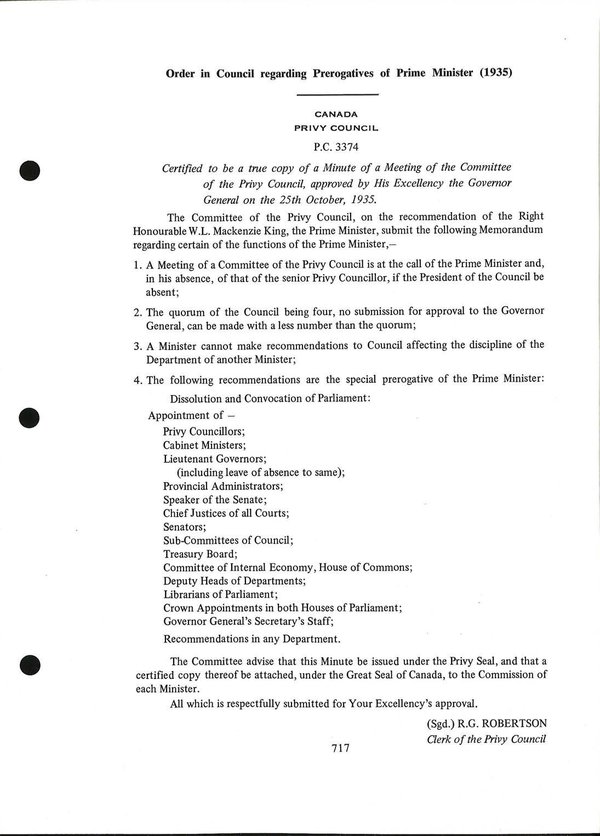
PC 1935-3374.jpg-large

Introduction

The scholarly consensus on cabinet government in Canada argues that from Prime Minister Trudeau’s first government (1968 to 1979, the 20th Ministry) onward, the powers of the prime minister have become more centralized relative to both those of cabinet and parliament. Fed largely by Donald Savoie’s magnum opus Governing from the Centre: The Concentration of Power in Canadian Politics, the mythology of cabinet government in Canada also asserts that the Pearson government (the 19th Ministry, 1963 to 1968) was the last to practise the principle of cabinet government that the prime minister acted as primus inter pares (“first among equals”), and that from Prime Ministers Trudeau to Harper, cabinet government has suffered from an inexorable decline into irrelevancy. The scholarly consensus thus sanctifies Pearson as the last non-centralizing prime minister and friend of the classical model of cabinet government, and respectful of parliament. I finally located some primary historical documents that contradict this narrative and show that, in fact, William Lyon Mackenzie King started the trend of centralizing the prerogative of the Crown-in-Council (the cabinet) in the office of the prime minister, and that Lester B. Pearson further entrenched prime ministerial centralization. This evidence also exposes the federal Liberals’ current exaggerated or fabricated claims on priding themselves as the party that respects parliament.

Mackenzie King and Order-in-Council P.C. 3374, 25 October 1935: “Memorandum Regarding Certain of the Functions of the Prime Minister”

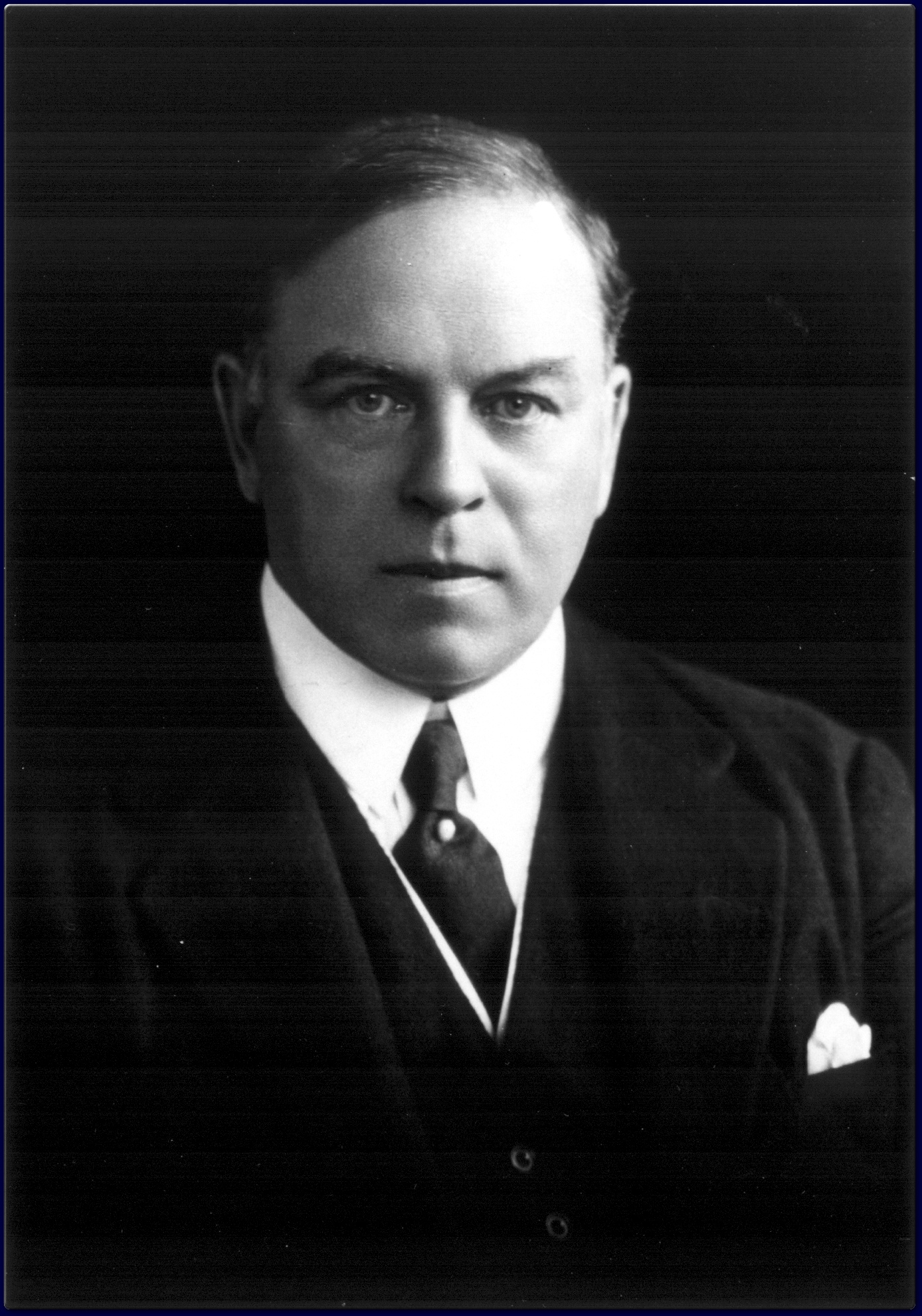
Mackenzie King

Professor Bruce Hicks of Concordia University demonstrated in “The Crown’s ‘Democratic’ Reserve Powers” that Prime Ministers Mackenzie King and Lester Pearson succeeded in centralizing key aspects of the crown prerogative of the Governor-in-Council into the office of the prime minister. He cited two primary historical documents that I have finally tracked down and uploaded to Parliamentum. Professor Hicks explained to me that through an Order-in-Council, King succeeded in effectively vesting the powers to advise the governor general to summon, prorogue, and dissolve parliament in the prime minister alone; however, his method still generated a meeting minute in Cabinet’s office record, which gave other Ministers of the Crown the opportunity to protest the decision, or worse still, leak it to the press.

A friend asked me if I had heard of a document called “Memorandum regarding certain of the functions of the Prime Minister.” I knew of the existence of an Order-in-Council to that effect, based on Professor Hicks’s article, but I had not known its specific title. I started researching and found a reference to this Order-in-Council in O’Brien and Bosc’s Parliamentary Procedure and Practice, listed footnote 108 as P.C. 3374, enacted on 25 October 1935. This reference in turn provided me with all the necessary information in order to locate this Order-in-Council on microfilm in the Library and Archives. After struggling with a finicky microfilm reader for about 30 minutes, I finally found P.C. 3374 at the very end of the reel (of course) and saved a digital copy of both pages of the Order-in-Council. (I really hate microfilm, though I recognize its utility in the pre-digital era).

You can view the “Memorandum regarding certain functions of the Prime Minister” here.

I soon discovered that the Memorandum contained more than Professor Hicks had indicated. It pertains to “certain of the functions of the Prime Minister”; the first three points relate to the conduct of cabinet meetings. Point 1 states that the Prime Minister calls cabinet meetings, and point 2 defines quorum as 4 Ministers of the Crown. Point 3 augments the Prime Minister’s position as the head of cabinet by clarifying one of the lines separating individual and collective ministerial responsibilities; the Prime Minister alone must act “affecting the discipline of the Department of another Minister”, such that the other individual Ministers of the Crown will concern themselves only with their departments. Finally, Point 4 transfers some of the Crown-in-Council’s prerogative to the Prime Minister alone. Most of these provisions still apply today, which makes this Order-in-Council historically significant.

4.The following recommendations are the special prerogative of the Prime Minister:
Dissolution and Convocation of Parliament:

Appointment of –

 Privy Councillers;
Cabinet Ministers;
Lieutenant Governors;
(including leave of absence of the same);
Provincial Administrators;
Speaker of the Senate;
Chief Justices of all Courts;
Senators;
Sub-Committees of Council;
Treasury Board;
Committee of Internal Economy, House of Commons;
Deputy Heads of Departments;
Librarians of Parliament;
Crown Appointments in both Houses of Parliament;
Governor General’s Secretary’s Staff;

Recommendations in any Department.

Whether this Order-in-Council PC 3374 officialised a drastic shift in the exercise of the Governor-in-Council’s crown or merely acknowledged the current practice of the era in writing for the first time, this primary historical document provides a fascinating insight into the third King government and the first written origins of prime ministerial centralization.

The Manual of Official Procedure of the Government of Canada and Lester Pearson’s “Instrument of Advice for Issue of Proclamation Dissolving Parliament

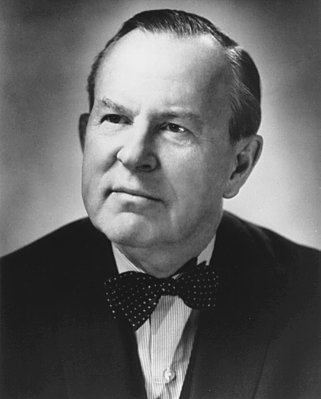
Hicks also mentioned Pearson’s reform, or “innovation”, as it were, and I located a primary source corroborating his journal article. The Manual of Official Procedure of the Government of Canada indicates on page 408 that “The advice to dissolve Parliament is a prerogative of the Prime Minister”, and the Appendices on page 634 provide an example of Prime Minister Pearson’s “Instrument of Advice for Issue of Proclamation Dissolving Parliament.”  Prime Minister Pearson, building upon King’s Order-in-Council, succeeded in cutting out the cabinet entirely from the decision-making process on advising dissolution by sending a written request directing to the Governor General in order to avoid generating a cabinet meeting minute. Pearson wrote in this “Instrument of Advice.”

Your Excellency,

The undersigned has the honour to advise that Your Excellency may be pleased, in the Queen’s name, by Instrument under the Great Seal of Canada, to dissolve the present Parliament of Canada as of the 8th day of September, 1965.

Respectfully submitted,

L.B. PEARSON
Prime Minister

Approved
GEORGES P. VANIER
7th September, 1965[1]

Despite the coded diplomatic language so emblematic of constitutional monarchies, this letter effectively commands the Governor General to carry out the Prime Minister’s advice. The Manual of Official Procedures states elsewhere that the Governor General possesses no discretion to refuse the Prime Minister’s advice to summon or prorogue parliament[2] and that the Governor General may only reject the Prime Minister’s advice to dissolve “in those rare and almost indefinable circumstances when it is necessary for the protection of the constitution.”[3] The “Instrument of Advice” and the above passage suggest that the Governor General possesses only the most limited authority to reject the Prime Minister’s advice to dissolve.

Conclusion

Lester Pearson

King’s Order-in-Council and Pearson’s “Instrument of Advice” also vest a clear advantage into the Prime Minister vis-a-vis cabinet by cutting all other Ministers of the Crown out of the constitutional loop. Therefore, I would argue that King’s and Pearson’s interpretations of crown prerogative set the stage for Trudeau’s subsequent reorganization of the cabinet committee structure, the Privy Council Office, and the Prime Minister’s Office by eroding the principle of primus inter pares well before the dates that bulk of the academic literature cites. The majority of scholars already agree that Mackenzie King presented centralizing tendencies (if only because of his long tenure in office), but scholars have largely overlooked Pearson’s. We remember Pearson as the consummate diplomat who won the Nobel Peace Prize and created modern peace-keeping in the Suez Crisis of 1956, the visionary nationalist who replaced the Canadian Red Ensign with the Maple Leaf in 1965, and the compassionate leader who fought for the Canada Health Act and established universal healthcare – the latter two while leading a minority government. I remember Pearson as the Prime Minister who commissioned the Manual of Official Procedure of the Government of Canada. Historians and political scientists should take note of Pearson’s latent centralizing tendencies and acknowledge that if Pearson’s gamble of advising early dissolution in 1965 had paid off and if he had won a majority government, he may have governed quite differently indeed. However, such an acknowledgement would require a re-evaluation of the Great Liberal Myth.

[1] Canada. Privy Council Office, Manual of Official Procedure of the Government of Canada: Appendices, Henry F. Davis and André Millar.(Ottawa, Government of Canada, 1968): 634.
[2]
Canada. Privy Council Office, Manual of Official Procedure of the Government of Canada, Henry F. Davis and André Millar.(Ottawa, Government of Canada, 1968): 150.
[3]
Ibid., 409.

Posted in Crown (Powers and Office), Governor's Discretion, Officialization of Convention, Prime Minister's Powers, Prorogation | Tagged , , , , , | 17 Comments