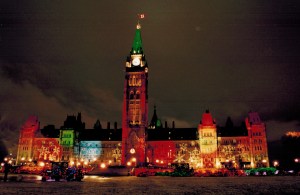
Ontario’s Next Provincial General Election: October 2018, Not June 2018


Ontario Election in October 2018, Not June

Update (18 November 2016): Please set the latest news on Ontario’s fixed-date election law:

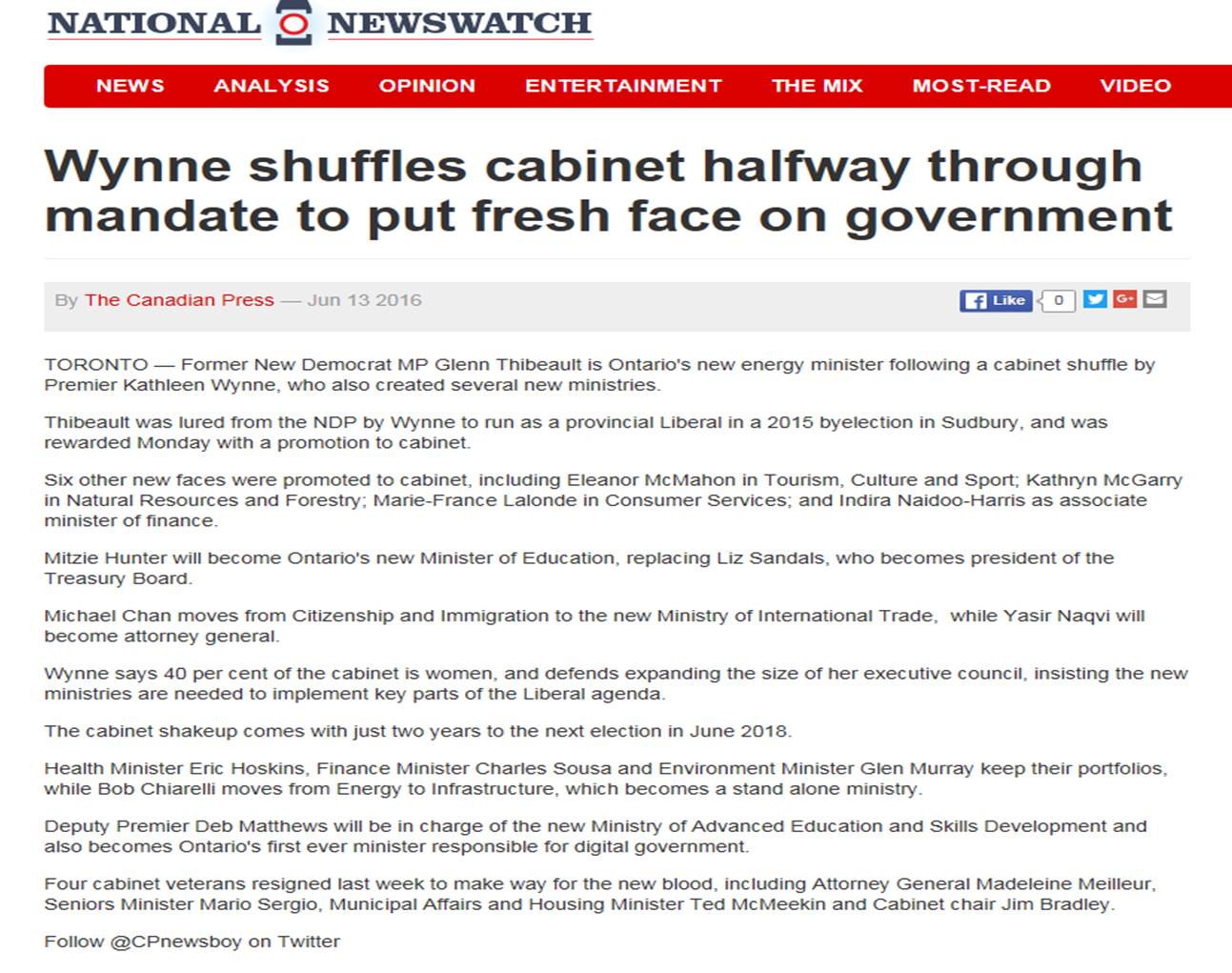
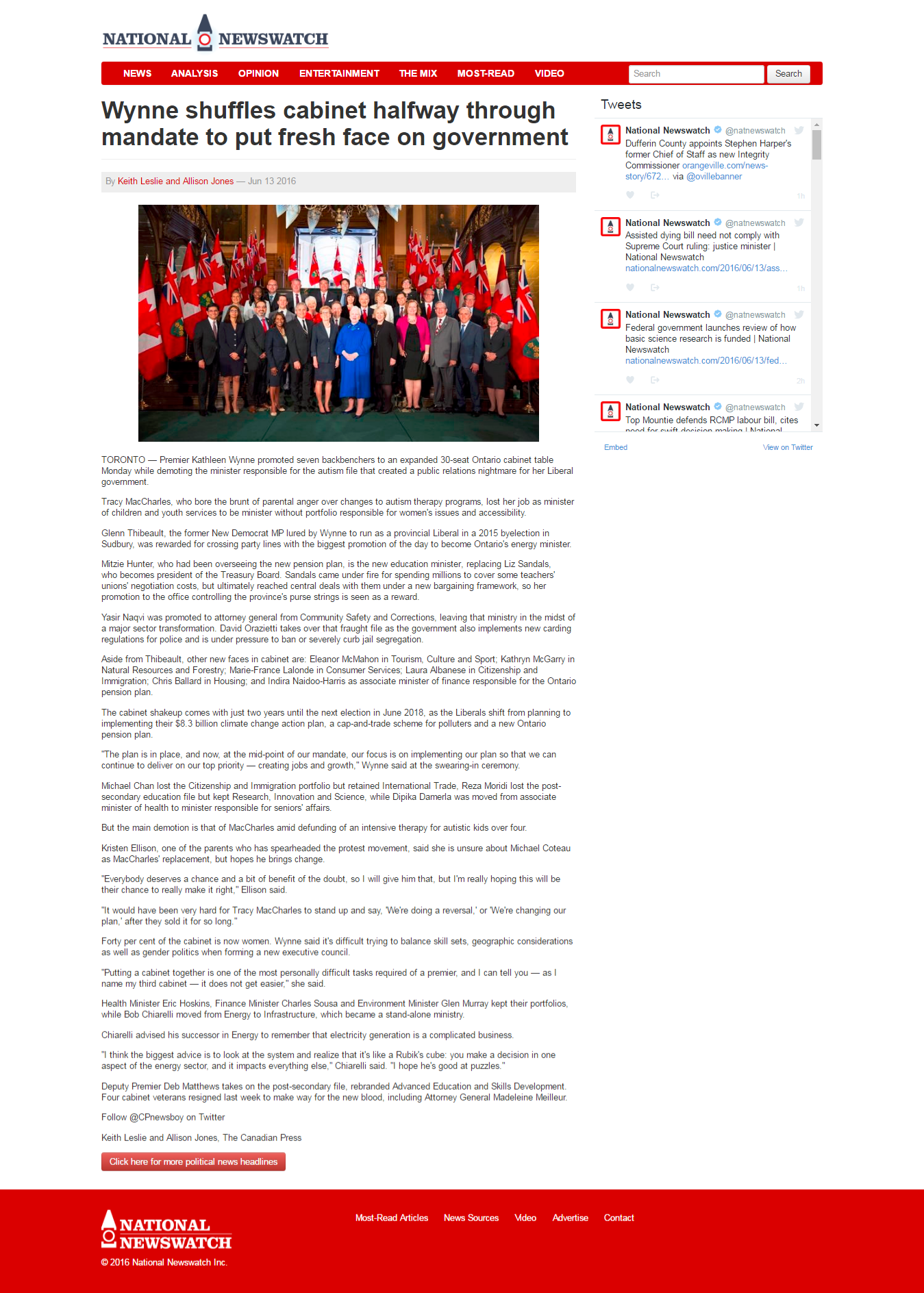
On 13 June 2016, the Canadian Press reported  on Premier Wynne’s  mid-parliament cabinet shuffle, which will take her government into the next provincial election. According to the Canadian Press, the next provincial general election is scheduled for June 2018 — but in fact, it is scheduled for October 2018. (I’ve posted these screenshots in case that the Canadian Press updates its article accordingly!)

While the last provincial general election did occur on 12 June 2014, the provincial fixed-date election law does not schedule provincial general elections precisely four years apart. Instead, it uses the first Thursday in October as the baseline, irrespective of whether the previous general election followed the schedule, or whether the Premier advised the Lieutenant Governor to dissolve the previous legislature early.

Section 9(2)(b) of the Election Act states that the next scheduled provincial election occurs in the October four years after the return of the previous writs, rather than four years to the month after the return of previous writs. The last provincial election occurred earlier than scheduled when Premier Wynne advised the Lieutenant Governor to dissolve the 40th Legislature early, in May. The Lieutenant Governor issued the writs on 7 May 2014 for a general election on 12 June 2014. This early election was originally scheduled for October 2015 and would have very inconveniently overlapped with the federal general election.

Four-Year Terms

General elections at four-year intervals

Powers of Lieutenant Governor

9(1)Nothing in this section affects the powers of the Lieutenant Governor, including the power to dissolve the Legislature, by proclamation in Her Majesty’s name, when the Lieutenant Governor sees fit.  2005, c. 35, s. 1 (3).

First Thursday in October

(2)  Subject to the powers of the Lieutenant Governor referred to in subsection (1),
            (a) a general election shall be held on Thursday, October 4, 2007, unless a general election has been held, after the day on which the Election Statute Law Amendment Act, 2005 receives Royal Assent and before October 4, 2007, because of a dissolution of the Legislature; and
            (b) thereafter, general elections shall be held on the first Thursday in October in the fourth calendar year following polling day in the most recent general election.  2005, c. 35, s. 1 (3).

This 41st Legislature is therefore scheduled to live for 4.5 years rather than 4 and to be dissolved in October 2018, not June 2018– though nothing prevents Premier Wynne from advising and receiving an early dissolution in this instance as well.

This same feature of the federal fixed-date election law explains why the 41st Parliament also lasted closer to 4.5 years rather than 4, with general elections in May 2011 but October 2015. The Canadian Press’s mistake reflects how ingrained four-year parliaments have become in the political class. But if anything, the fixed-date election laws really ought to stipulate that the next scheduled general election would occur in the same month as the previous in order to prevent some legislatures from living for 4.5 years rather than 4.

While the Wynne government indicated on 4 June 2016 that it supports the Chief Electoral Officer’s recommendation to move the date from fall to spring, the legislature has not yet amended the Election Act accordingly. (The Chief Electoral Officer of Ontario recommended a date in early June). Until such a bill receives Royal Assent, the next provincial general election remains scheduled for October 2018 rather than for June 2018. Let us not pre-empt the legislative process so eagerly here!


CP Ontario Election in 2018

Similar Posts:


Posted in Crown (Powers and Office), Dissolution, Fixed-Date Elections, Reform | 2 Comments

The Canadian Study of Parliament Group’s Conference on Electoral Reform


Photo by James Bowden in 2009

Photo by James Bowden in 2009

Introduction

My regular readers will know that I’m not a one-trick pony; at the very least, I’ve become a three-trick pony whose obsession oscillates from the constitutional conventions of Responsible Government – especially as they pertain to dissolution and prorogation – to the laws governing royal succession to the Crown of Canada, and to my latest hobbyhorse of the constitutional implications of electoral reform. (That said, I made my first foray into this subject back in 2011). What more could he possibly have to write about electoral reform? one might ask. First, I would remind you never to look a gifthorse in the mouth. Second, I’m pleased to say that I still had to type up my notes from the Canadian Study of Parliament Group’s (CSPG) Conference on Electoral Reform, which took place on Friday, 27 May 2016. I congratulate CSPG on having organized such an interesting and pertinent conference! I think that all who attended would agree that it was well worthwhile.

These notes are not exhaustive or complete; I wrote them by hand as the proceedings unfolded and typed them up two weeks later, and they reflect my bias in terms of my interest in and knowledge of the subjects on which the panellists presented. I was most interested in the fourth panel that covered the constitutional implications of electoral reform. For the most part, they recount my observations of what happened, though I couldn’t resist opining and interjecting on the fourth panel and in my conclusion. For my full arguments on the constitutional implications of electoral reform, please see my previous entry, “Jean-Pierre Kingsley Is Wrong: Electoral Reform Is A Constitutional Matter.”

Panel 1: “The History of Canadian Electoral Systems and Reform” 

The first panel consisted of presentations on the history of electoral reform and the history of provincial electoral systems in Canada. Indeed, pure single-member plurality has not always enjoyed such electoral hegemony in this country; many of the provinces (particularly in the West and in the Maritimes) once used different electoral systems. The current debates on electoral reform often ignore these historical cases.

Professor Dennis Pilon, Professor of Political Science at York University and an expert on mixed-member proportional representation (MMP) in particular, gave a very interesting presentation on the history of electoral reform at the federal level. I especially enjoyed his rendition of Mackenzie King’s mendacity on electoral reform, which I hadn’t heard before. (Though I am of course familiar with King’s Machiavellian skullduggery and his amorphous all-things-to-all-people political persona in general.) In a classic Mackenzie King move, he promised in the general election of 1935 that a Liberal government would implement electoral reform; in reality, of course, he never had any intention of following through on this pledge and only said so in order to cut into the support of the Co-operative Commonwealth Federation (CCF, the ancestor party of the NDP) and the remnant of the Progressive Party, which had broken off from the Liberals in the election of 1921. Both of these Western populist formations had advocated proportional representation. After the Liberals won a parliamentary majority in the general election of 1935, King cleverly deferred the issue by adopting his favourite tactic: manufacturing plausible deniability by way of a special parliamentary committee. (This is all starting to sound so eerily familiar…) This entity studied the issue for a year or two and ended up recommending that parliament keep single-member plurality, which gave King the political cover to reject proportional representation and rescind his promise from the previous campaign.

We could therefore conclude that King applied a variation of his infamous maxim (first stated with respect to conscription) to the subject of electoral reform as well: electoral reform if necessary, but not necessarily electoral reform. Even the generic phrase that we Canadian politicos associate with King today is just as variable and ever-shifting as King himself was in life.

Pilon concluded that if today’s Liberals are feeling confident, they will do precisely what King did in the 1930s and just keep single-member plurality but that if they feel too much pressure, they will opt for instant run-off balloting, also known as alternative vote (AV) – which is single-member majority and not a proportional system.

Harold Jansen, Professor of Political Science at the University of Lethbridge, presented on the history of electoral systems in the Western Provinces – a fascinating and little-understood topic, particularly in Central Canada. Essentially, British Columbians, Albertans, and Manitobans at various points between the 1920s and 1960s used to elect MPs under STV or AV. In Manitoba and Alberta, the Progressives and United Farmers – both part of a broader agrarian populist movement – championed electoral reform during the 1920s and succeeded in displacing the Liberals in those provinces; however, in Saskatchewan, the Liberals managed to stave off and co-opt the Progressives. The CCF then gained prominence there in the 1930s but lost interest in electoral reform after becoming successful under Tommy Douglas’s leadership. Electoral reform came later to British Columbia for more overtly tactical partisan reasons.

In Manitoba, the Progressives introduced a bifurcated electoral system that included both STV and AV. In the city of Winnipeg, MPs were elected under STV, and the whole city served as the multi-member electoral district. In the rural areas, AV prevailed because STV would have forced large rural ridings to become even larger, which would have been impractical. In later years, the city of Winnipeg was divided into more electoral districts. (It was three, I believe). The United Farmers of Alberta (UFA) copied Manitoba’s system wholesale; in Alberta, the cities of Calgary and Edmonton fell under STV, and the rest of the province was subject to AV. This bifurcated system died out in Manitoba by the 1960s, and Ernest Manning’s Social Creditists abolished it in Alberta in 1956.

In British Columbia, the provincial Liberals and Conservatives had formed a coalition government during the Second World War and continued working together in the late 1940s and early 1950s. They decided that Australian-style instant run-off balloting (AV) would serve their interests and prevent the CCF from gaining ground; the Liberals and Conservatives figured that their voters would choose the other party as their second preference on the ranked ballot. But this self-interested decision to replace SMP with AV proved the undoing of both parties, as Liberals and Conservatives alike selected the Social Creditists as their second choice! In 1952, the Social Creditists won a plurality and formed a single-party minority government; in 1953, they won a parliamentary majority and promptly abolished AV and reinstated SMP. The BC Conservatives vanished into obscurity, and the BC Liberals did not replace Social Credit as the main right-wing political party until the 1990s.

Jensen also made some other interesting observations about electoral reform in Canada. He argued that social movements, and not the electoral system itself, are what influence the number of political parties present in any given polity; he demonstrated that the Progressive Movement emerged first and that electoral reform came after in Manitoba and Alberta. Jensen also noted that switching to the bifurcated STV-AV model in Manitoba and Alberta had no effect whatsoever on voter turnout, but that both STV and AV led to an increase in the number of rejected ballots. Based on his study of AV in Manitoba and Alberta, he concluded that adopting AV at the federal level would make little difference and that we tend to over-estimate its effects, because many voters decide to mark only a “1” on the ballot and reject all the other candidates.

I would also note that the Atlantic Provinces retained unorthodox electoral systems well into the 20th century. Until 1975, the electoral districts of Newfoundland and Labrador were drawn based on religion, with Anglicans, Roman Catholics, and adherents of the United Church represented equally.[1] Even after consulting those two sources, I’m still not sure whether these were single-member districts gerrymandered in such a way that their boundaries adhered to neighbours and communities traditionally understood to be, variously, Catholic, Anglican, and United Church, or, alternatively, whether they were three-member districts in which each party nominated one candidate of each confession. But the point is that Newfoundland and Labrador did not adopt orthodox SMP until comparatively recently. (On 13 June 2016, I contacted Rand Dyck, who wrote one of those sources, and he told me that the former is correct; Newfoundland and Labrador’s electoral districts demonstrated what he and I decided to call “confessional gerrymandering” such that the boundaries were drawn to capture Catholic, Anglican, and United Church communities, but they were not multi-member districts).

A similar confessional arrangement once prevailed in Prince Edward Island. From 1893 to 1997, Prince Edward Island operated on dual-member constituencies in its provincial elections, which normally meant that each party would nominate one Roman Catholic and one Protestant per riding.[2] In addition, Nova Scotia’s provincial legislative assembly included two-member electoral districts — also to accommodate confessional representation — and, in some cases, multi-member districts that returned three, four, or five members each; by 1933, the province had eliminated its multi-member districts, but the dual-member electoral districts persisted until 1981.[3] New Brunswick (once part of Nova Scotia) seems to have inherited its predecessor Crown colony’s electoral system: until 1974, the Picture Province also operated under dual-member or multi-member constituencies.[4]

Panel 2: “Electoral Reform – The Different Models”

Louis Massicotte, Professor of Political Science at Laval University, presented on the role of party-list MPs under MMP. In particular, he compared how MMP works in Germany’s federal parliament to how it operates in Wales’s devolved regional assembly.

The former West Germany, and its successor state, the current Federal Republic of Germany, have used MMP since 1949. The German model of MMP allows “double candidacy,” whereby candidates can run for both a geographic electoral district and for the party-list compensatory seats. In practice, the two types of MPs are treated equally in the Bundestag, and the constituency MPs are not regarded as holding a monopoly on representing geographic constituencies. This is because section 38 of Germany’s Basic Law stipulates that MPs “shall be representatives of the whole people, not bound by orders or instructions, and responsible only to their conscience.” Massicotte noted that, overall, Germany’s political culture is based on consensus and co-operation rather than the adversarial politics of Westminster systems.

MMP has played out differently in Wales. The devolved Welsh assembly (created by an act of the Westminster Parliament in 1998) consists of 40 geographic seats and 20 compensatory seats for a total of 60. Since 1998, the Labour Party has won the majority of the geographic constituencies in every election. However, the adversarial British political culture did not suit MMP; Labour also won parliamentary majorities and treated list-MPs with contempt and as lesser creatures, especially because most of them sat on the opposition benches anyway. Wales has oscillated between allowing and disallowing dual candidacy. As of 2016, Welsh electoral law permits dual candidacy, which is generally regarded as a stabilizing force in MMP systems.

Massicotte concluded that the pre-existing political culture greatly affects how MMP works in practice and acknowledged that Canada’s traditions of adversarialism would run up against MMP.

Christopher Kam, Professor of Political Science at the University of British Columbia, presented on representation and accountability in electoral systems. Drawing on the work of American political scientist Bingham Powell, Kam noted that we cannot reliably identify the representativeness of any given electoral system and that accountability in an electoral system depends chiefly on two factors: the clarity of responsibility, and the capacity of voters to sanction the government. Kam noted that since proportional systems normally produce coalition governments, they thereby also reduce the clarity of responsibility, which in turn makes sanctioning the government far more difficult for voters. Generally, every electoral system produces a trade off between accountability on the one hand and representativeness on the other. Based on his interpretation of Social Choice Theory, Kam concluded that it is impossible to identify a transitive social choice and that, essentially, there is no popular will. During the question and answer session, this touched off what I described on Twitter that morning as an epic nerdfight between Kam and Pilon as they clashed over varying interpretations of Social Choice Theory. Admittedly, this is outside of my area of expertise, so my notes don’t really do Kam’s presentation justice.

Panel 3: “Electoral Reform – Lessons and Experiences from Elsewhere” 

Lawrence Leduc, Professor Emeritus of Political Science at the University of Toronto, presented on two successful electoral reform strategies, one in Japan, and the other in New Zealand.

Leduc noted that electoral reform is very difficult to achieve and that parties in opposition tend to support it most strongly. When electoral reform moves from theory to practice, it becomes a high-stakes struggle for power, he said.

New Zealand conducted its first general election under MMP in 1996, but the impetus for electoral reform there stretches back to the late 1970s. The long road to MMP was paved with a royal commission, a special parliamentary committee, self-interested about-faces by both main political parties, and two ratifying referendums. In 1978 and 1981, Labour won the popular vote but won fewer seats than the Nationals. Around this time, support for third parties – particularly Social Credit – was increasing, which reduced the winning party’s plurality of the popular vote yet further. However, Labour did go on to win parliamentary majorities in the elections of 1984 and 1987; coincidentally, Labour’s enthusiasm for electoral reform began to diminish around this time. In 1984, Labour Prime Minister David Lange then pulled a Mackenzie King and struck up a royal commission on electoral reform, which studied the issue for two years and ultimately recommended in 1986 that New Zealand switch to MMP. Labour then assiduously ignored the report. After securing re-election in 1987, Labour forwarded the issue to a parliamentary committee, which further studied electoral reform until 1989 but recommended something other than MMP. If Lange had held a séance with Mackenzie King, the wily Canadian PM would have been very proud indeed! In 1990, Jim Bolger led the Nationals (the main right-wing formation in New Zealand) to a parliamentary majority and held the first referendum on MMP in 1991 – in which fully 84% of Kiwis voted in favour of electoral reform, with 70.5% supporting MMP in particular. This caught the Nationals off guard, since they had sought to kill any reform effort through this referendum. According to Leduc, New Zealanders supported electoral reform so overwhelmingly because they had become so fed up with the antics of both Labour and the Nationals, each of which had championed electoral reform while in opposition only to defer it and study it to death in government without implementing anything. Amazingly, the Bolger government refused to enact MMP until after holding a second referendum on the issue in 1993, in which a reduced, but still very clear, majority of 53.9% voted in favour of MMP. Finally, Prime Minister John Key’s Nationals held a third retrospective referendum in 2011 that allowed New Zealanders to evaluate MMP; 57% supported it.

In its post-war constitution, Japan adopted NSTV, or non-single transferable vote, which consists of multi-member electoral districts without ensuring a proportional outcome. Japan soon after became a de facto one-party state under the Liberal-Democratic Party (LPD). Leduc identified these four factors as having contributed to support for electoral reform in Japana:

  1. One-party dominance
  2. Factionalism within the LDP (de facto parties within parties)
  3. Corruption
  4. Distorted representation

(As a sidenote, I can’t help but observe that factors 1 and 2 in particular are reminiscent of Alberta’s provincial politics pre-2015, in which the real battle occurred not between the parties in government and opposition, but instead within the governing party. Such systems offer little accountability and are prone to sudden collapse).

The LDP did not lose its overall post-war majority in the lower house until 1993. At that point, the opposition – in a coalition of 7 parties that agreed on little except the necessity of electoral reform – came to power mid-parliament and cobbled together a policy on electoral reform in an effort to prevent the LDP from re-establishing one-party rule. They settled on a parallel system, which is essentially a non-proportional version of MMP. Voters cast ballots for a candidates representing both geographic constituencies and the political parties themselves, but there is no formula (like the Droop Quota or O’Hare Quota) that ensures an overall proportional outcome. It seems that the Japanese like adopting non-proportional variants of electoral systems that were originally designed to be proportional!

However, the LPD soon won another parliamentary majority under the new system anyway. An LPD government then used its majority to alter the voting system in the later 1990s and alter the balance between constituency seats and party seats in favour of the former.

Leduc concluded that electoral reform poses such difficulties because of entrenched interests, intra-partisan division, lack of defined process, public indifference, multiple veto points, and disinformation. Most of these factors would seem to pertain to the current debate in Canada, too – especially the disagreement over process.

Panel 4: “Path to Electoral Reform, Referendum, and Constitutional Amendment”

The fourth panel consisted of Dennis Pilon; Emmett Macfarlane, Professor of Political Science at the University of Waterloo; Benoit Pelletier, Professor Law at the University of Ottawa, and; Craig Scott, former NDP MP and Professor of Law at Osgood.

Macfarlane stated that while the amending formula says little on the electoral system, sections 51 and 52 implicitly refer to it. He also concluded that switching to a proportional system like MMP or STV would require an amendment to section 51(1) of the Constitution Act, 1867 pursuant to the amending formula in section 44 of the Constitution Act, 1982. Much to my surprise and disappointment, he was the only panellist who recognized and affirmed the obvious fact that electoral reform pertains to the Constitution Acts and that a proportional system could only be implemented through some kind of constitutional amendment. He also touched on the implications of the Senate Reference from 2014 and the Supreme Court’s doctrine on “constitutional architecture,” which builds upon concepts acknowledged in the Patriation Reference and the Secession Reference, including the fact that the Constitution of Canada consists of both codified and uncodified elements. In the Senate Reference, the SCC went as far as to conclude that an attempt to alter these uncodified elements would also engage the constitutional amending formulas in Part V of the Constitution Act, 1982. Ultimately, Macfarlane rejected the Constitutional Architecture Argument in the case of electoral reform on the grounds that the electoral system does not directly engage provincial interests and because the House of Commons represents the country as a whole and not the provinces. This is significant because if the SCC’s Constitutional Architecture Doctrine were applied to reforming the electoral system of the House of Commons, then switching to any electoral system would probably be subject to the General Amending Formula under sections 38 or 42 rather than the Parliament-of-Canada-alone formula under section 44. However, Macfarlane did note that a system of MMP that allowed compensatory party seats to cross provincial boundaries would be ultra vires of section 52 of the Constitution Act, 1867 because it would “disturb” the “proportionate representation of the provinces.” Macfarlane has since written on his views in Policy Options in an article entitled, “Electoral Reform and the Law.”

(Also, just to make this absolutely clear, my short article on the constitutional implications of electoral reform that appears in the Macdonald-Laurier Institute’s Inside Policy and the arguments contained therein are an abridged version of a manuscript that I submitted to another journal on 11 May 2016, before this conference. Macfarlane and I are like Newton and Leibniz here; when smart people look at the same evidence, they tend to draw similar conclusions).

Craig Scott commented primarily on the Trudeau government’s strategy on electoral reform. He noted that civil society movements have emerged in favour of holding a referendum and on switching to MMP. He also observed that the Liberals have employed phrases like “make every vote count” – wording normally associated with proponents of MMP – even though they are known to favour AV. Scott believes that the Liberals are deliberately delaying any action on electoral reform because any delay supports either the status quo or AV and prevents MMP or STV from being implemented. In particular, he highlighted Trudeau II’s bizarre statement from 4 May 2016, in which he accused the opposition of obstructing electoral reform, even though the special committee on electoral reform had been yet been established, and even though none of the opposition parties had yet been consulted. Trudeau II said:

As you may have gathered, there is one party who is insistent that there needs to be a referendum, and they’re laying that out as a ground rule. Another party has a particular perspective on the outcome that they’re very attached to. We’re in discussions with the other parties about how to set up that committee.    

Scott hypothesized that Trudeau II had simply jumped the gun on the talking points that the Liberals had planned to roll out after the committee had started its work. Scott Reid, Conservative MP and Shadow Minister for Democratic Institutions, also believes that the Trudeau government is pulling a Mackenzie King and delaying electoral reform as long as possible so that only AV could be implemented in time for 2019, as he explained in his column in the Ottawa Citizen.

Pelletier spoke on Figueroa v Canada and argued that SMP is constitutional. In other words, Pelletier devoted a large portion of his presentation to the tautology that the constitution cannot be unconstitutional and that one part of the constitution cannot be invoked to invalidate another part of the constitution. In an amusing coincidence, “Shit Academics Say” posted a cartoon about “The Tautology Club” the very next morning on Facebook. Yes, indeed, section 3 of the Charter cannot be invoked in order to invalidate single-member plurality as an electoral system, which is contained in section 51(1) of the Constitution Act, 1867. More worrying still, Pelletier did not even know that he was making a tautology, because he did not accept that electoral reform is a constitutional matter. He insisted that switching to MMP or STV would not require any constitutional amendment at all and maintained that a constitutional amendment would only be required if electoral reform affected the principles of Responsible Government or the Office of the Queen – which means that Pelletier was suggesting that electoral reform could potentially engage the unanimity constitutional amending formula under section 41. Given Pelletier’s views on royal succession, I also had to suppress an audible chuckle toward his reference to the Office of the Queen. Frankly, invoking section 41(a) over electoral reform is a red herring, especially when you interpret “the office of the queen” and “the office of the governor general” as Pelletier and Newman do, which is that “office” includes the powers and authorities of the Queen. This is because changing the electoral system would not alter the Crown’s authority over forming governments, even if this authority would have be invoked more frequently.

In his second presentation at the conference, Pilon said that electoral reform “is all about politics”, not principles or values. I concur, since each political party not-so-coincidentally supports the electoral system from which it would derive the most benefit. However, Pilon kept insisting that we could implement MMP or STV without any constitutional amendment at all, notwithstanding section 51(1) of the Constitution Act, 1867. Interestingly, he suggested that there wouldn’t even be much point to adopting the German model of MMP in which each province would form the basis for calculating the popular votes of the political parties so that compensatory seats remain within each province. But adopting a form of MMP in which compensatory seats cross provincial boundaries would be ultra vires of section 52 of the Constitution Act, 1867, so only a constitutional amendment to that section promulgated pursuant to the General Amending Formula could allow for such a system in which the compensatory party-list seats disturbed the principle of the proportionate representation of the provinces.

Conclusion

Probably because the fourth panel concluded the conference on the topic in which I was always most interested, I drew the self-serving conclusion that Emmett Macfarlane and I were apparently the only people in the country who understand the significance of section 51(1) of the Constitution Act, 1867 and why switching to any proportional system would require some kind of constitutional amendment. This blog entry comes as an anti-climatic follow up to my article in the Macdonald-Laurier Institute’s Inside Policy magazine; it was my attending this conference that motivated me to write “Time Has Run Out on Electoral Reform“, if only to correct the factual errors on the constitutional implications of electoral reform that abounded in that last panel.

Apart from that, I did enjoy the first panel on the history of electoral systems and the changes that various provinces had undertaken in the early to mid-20th century.‎ Pilon in particular refuted some of the very bad arguments that supporters of SMP have made over the years. As he pointed out, the first recital of the preamble of the Constitution Act, 1867 (“a constitution similar in principle to that of the United Kingdom”) could in no way be construed as a constitutional entrenchment of SMP, if only because the United Kingdom did not adopt SMP broadly until the Representation of the People Act, 1884. (And even then, deviations from pure SMP, like seats for universities, persisted well into the 20th century). He also noted that SMP emerged and evolved before Responsible Government, universal adult suffrage, and the establishment of a neutral electoral commission that prevented gerrymandering of electoral districts. This is, of course, correct. But SMP has also defied teleological arguments about the inevitability of electoral reform: in Western Canada and Atlantic Canada, electoral reform has meant switching to SMP and away from multi-member districts.

Similar Posts:

[1] Rand Dyck, Provincial Politics in Canada: Towards the Turn of the Century, 3rd Edition (Scarborough, Ontario: Prentice Hall Canada), 51; Luke Flanagan and Alex Marland, “Newfoundland and Labrador,” Chapter 1 in Big Worlds: Politics and Elections in the Canadian Provinces and Territories, edited by Jared W. Wesley (Toronto: University of Toronto Press, 2016), 10.
[2] Dyck 1996, 96.
[3] Dyck 1996, 135.
[4] Dyck 1996, 180.

Posted in Electoral Reform, Reform | Leave a comment

Jean-Pierre Kingsley Is Wrong: Electoral Reform Is A Constitutional Matter


Kingsley 4

Publication in the Macdonald-Laurier Institute’s Magazine

I am most grateful to Brian Lee Crowley, David Watson, and the Macdonald-Laurier Institute for having published my short article on electoral reform online under the title, “Time Has Already Run Out on Electoral Reform“; I’m more thankful still that it will also appear in print form in the Macdonald-Laurier Institute’s Inside Policy later this month. I’d also like to thank Emmett Macfarlane, Professor of Political Science at the University of Waterloo, for having reviewed an early draft of it.

The version that I’ve posted below contains a little more content because I’ve liberated Parliamentum from the yoke of word limits. It complements my previous entry “Stephane Dion Is Right: Put Electoral Reform to a Vote.”

Introduction

In last year’s federal general election, Justin Trudeau led the Liberal Party to a parliamentary majority after campaigning on a platform that included a pledge that it would be the last time that Canadians elected MPs under a single-member plurality electoral system; as Prime Minister, Trudeau has since reiterated this policy in the ministerial mandate letters on 4 November 2015 and in the Speech from the Throne on 4 December 2015. The latter says:

To make sure that every vote counts, the Government will undertake consultations on electoral reform, and will take action to ensure that 2015 will be the last federal election conducted under the first-past-the-post voting system.

While the Speech from the Throne adopted the language typically associated with proponents of a proportional system (“make every vote count”), it is extremely unlikely that the next scheduled federal general election in 2019 will be conducted under either mixed-member proportional representation (MMP) or the single transferable vote (STV) – irrespective of whatever the upcoming special parliamentary committee on electoral reform reports by 1 December 2016. For reasons set out below, Parliament almost certainly could not adopt MMP, with its dual ballot of electing members to geographic constituencies and electing members from the political parties’ lists for the compensatory seats, nor STV, with its multi-member districts and preferential ballots, in time for 2019. However, parliament could feasibly adopt a majoritarian electoral system like Australian-style instant run-off balloting, sometimes called a ranked ballot or alternative vote (AV), for 2019.

This is because switching to AV would require only statutory amendments, such as to the Canada Elections Act, and would not require changing the boundaries of any electoral district. In contrast, switching to either MMP or STV would certainly require both a constitutional amendment of some kind and changing the boundaries of all 338 electoral districts. The only question remains whether the constitutional amendment would fall under the ambit of the amending formula under section 44 of the Constitution Act, 1982, which the Parliament of Canada alone can pass like a regular statute, or, more ominously, whether it would be subject to the dreaded General Amending Formula and all the implications that flow from “opening the Constitution” – as we tend to say in Canada, with the obvious, if unconscious, allusion to “opening Pandora’s Box” and raising the spectre of the failed Meech Lake and Charlottetown Accords. In short, electoral reform most certainly is a constitutional matter, contrary to Jean-Pierre Kingley’s bizarre assertion to the contrary.

Mixed-Member Proportional Representation and Single Transferable Vote

Mixed-member proportional representation (MMP) normally combines single-member plurality (though it could theoretically use instant run-off balloting instead) with pure party-list proportional representation; voters therefore cast two ballots, one for their constituency member of parliament and another for the political party itself. Under this system, a mathematical formula like the Droop Quota ensures an overall proportional outcome by allocating compensatory seats to the political parties that won fewer constituency seats than their share of the popular vote would merit them. In this way, the overall percentage of seats that the political parties hold in the assembly comes much closer to the percentage of the party vote that they each won in the election. Generally, this system benefits smaller parties, which would explain why the New Democratic Party and the Green Party have long advocated for it. Despite their claims to the contrary, they are motivated by self-interest just as much as the Liberals and the Conservatives are.

The single transferable vote (STV) relies on multi-member constituencies and allows voters to rank their preferred candidates in numerical order; a candidate must surpass a threshold number of votes in order to get elected. As with the compensatory seats in MMP, this threshold is determined by a formula, such as the Droop Quota, and is therefore proportional. But unlike under MMP, STV ensures that all MPs represent geographic constituencies and not the political parties themselves. Applying the Droop Quota to STV means that the votes that a candidate needs to obtain in order to win a seat is determined by dividing the total number of valid votes cast by one more than the number of candidates to be elected, and adding one to the result.

Votes needed to win = ((valid votes cast/(seats to fill +1))+1.

For candidates who surpass a given threshold, their surplus votes are redistributed according to the voters’ ranked preferences. If some seats still remain to be filled after this first redistribution because none of the other candidates meets the quota, then the least successful candidate is eliminated from contention, and his or her votes are redistributed according to the voters’ ranked preferences. This process continues until all the seats in the multi-member constituency have been filled.

In 2012, Stephane Dion proposed that Canada adopt a system of STV with multi-member ridings represented by either three or five MPs. Incidentally, Dion also argued that “precedent makes holding a referendum necessary: changing the voting system would require popular support.”

Amending Section 51(1) of the Constitution Act, 1867: The Population Formula, the Decennial Census, and the Electoral Boundary Commissions

Section 51(1) of the Constitution Act, 1867 contains the formula by which seats in the House of Commons are allocated amongst the provinces after each decennial census. Parliament last amended this formula in 2011 by way of the constitutional amending procedure under section 44 of the Constitution Act, 1982; this amendment also expanded the House of Commons from 308 to 338 seats. Section 51(1) also mandates that the seats in the House of Commons be redistributed after each decennial census; this process normally takes two years, and the next decennial census will not take place until 2021.

As this chart from Elections Canada shows, the current population formula is based on an “electoral quotient” of assigning approximately 111,000 persons to each constituency. This electoral quotient forms the baseline number of seats that each province receives, before the application of the other rules, which involve adding additional seats based on the Senate Floor Rule, the Grandfather Clause, and the Representation Rule. After this amendment to the formula in section 51(1) became law on 11 December 2011, the Harper Government also had to issue an Order-in-Council pursuant to the Electoral Boundaries Readjustment Act in order to establish the boundary commissions in each of the ten provinces, which in turn re-defined the borders of the country’s electoral districts. This was necessary because the House of Commons has also expanded from 308 to 338 seats, and those new 30 seats needed to be taken into account. The general election of 2015 was the first conducted under this new formula; if proponents of proportional representation had their way, it would also be the last. As this other helpful chart from Elections Canada shows, this entire process of re-drawing the borders of Canada’s electoral districts takes almost two years – and it could take even longer after adopting an entirely different electoral system. Furthermore, the boundary commissions can only begin their work after parliament passes the constitutional amendment to section 51(1) — and that legislative process itself can take up to one year.

These practical constraints of the legislative process itself and the electoral boundary commissions show why we could almost certainly not switch to MMP or STV in time for the next scheduled general election of 2019. In total, the process — from tabling the electoral reform bill in the House of Commons to the Governor General giving the bill royal assent and making it law; to the electoral boundary commissions undertaking their consultations and establishing the new borders of electoral districts — takes at least three years.

By definition, STV and MMP would require larger constituencies than the current electoral system: under STV, because each constituency would have multiple members representing it; under MMP, because fewer MPs would represent geographic electoral districts. Larger geographic electoral districts contain a larger number of people — and only an amendment to the population formula in section 51(1) could accommodate these changes. Both MMP and STV would therefore run afoul of the current population formula contained section 51(1) of the Constitution Act, 1867, and could therefore only be implemented by amending the rules under this section. This is because the formula under section 51(1) presumes that each electoral district contains a baseline of around 111,000 persons, plus or minus the percentage variance allowed by the Electoral Boundaries Readjustment Act, and taking into account the current formula’s exemptions and exceptions. While the current rules under section 51(1) are designed to accommodate increases in Canada’s population determined after each decennial census, these existing rules simply could not accommodate the significantly larger population per electoral district that switching to MMP or STV would necessitate.

Under MMP (particularly the model proposed by the Ontario Citizens’ Assembly in 2007), each province would retain the same number of seats in the House of Commons that it has now, but only some of those seats would remain as geographic constituencies, while some of them would become party seats divorced from geographic constituencies. For instance, Ontario could still return 121 MPs to Ottawa, but only, say, 80 MPs would represent geographic constituencies, while the other 41 would represent political parties themselves. (The ratio between geographic electoral districts and party list seats could vary, but the principle would remain the same). Logically, therefore, those 80 remaining geographic electoral districts would be larger in size (because they would still have to cover the whole province), and would therefore also necessarily contain a far larger population than the current electoral quotient of around 111,000 persons per riding.

Even if parliament opted for a novel  model of MMP where each provinces retains the same number of geographic electoral districts that it has now and merely adds on the party list seats, such a system would have to conform to the Constitution Acts and acknowledge the practical consequences. First, parliament would have to make sure that the ratio of seats between provinces remains intact so that this model of MMP conforms to the principle of proportionate representation contained in section 52 of the Constitution Act, 1867. If it tried to disturb this principle, then this alternate model of MMP could only be implemented via a constitutional amendment passed under the General Amending Formula. Second, parliament would have to switch the House of Commons from desks to benches in order to accommodate the influx of at least 100 new party-list MPs. Third and finally, even if someone tried to introduce this bizarre and unconventional model of MMP, parliament would still have to amend section 51(1) of the Constitution Act, 1867  in order to take into account the existence of seats in the House of Commons that are based on party lists and not geographic constituencies, which the current section 51(1) does not contemplate. This outlandish and farcical model of MMP could, strictly speaking, obviate the need to redraw all the riding boundaries for 2019, but it would still force an extensive renovation of the House of Commons itself and switch all or some of the desks to British-style benches just to squeeze in over 100 new party-list MPs into the chamber. As far as I can ascertain from the various pro-MMP advocacy groups in Canada, none has ever proposed a model along these lines. (Please do correct me in the comments if I’m wrong).

Since switching to STV or MMP would require adopting larger constituencies containing a larger number of persons, the government would also therefore have to issue an Order-in-Council to call up the electoral boundary commissions in all ten provinces so that they could then re-establish the borders of all 338 electoral districts. (The new MMP or STV system could still include a House of Commons consisting of 338 seats, but there would no longer be 338 geographic electoral districts). The Decennial Census Clause stipulates that the electoral boundary commissions must re-convene anyway after each Decennial Census; the next will occur in 2021. (The censuses held in 2006, 2016, etc., do not count as the constitutionally mandated Decennial Census). This means that even if the Trudeau government tried to strike up electoral boundary commissions in 2017 or 2018 after parliament passed the constitutional amendment to alter the population formula in section 51(1), the government would have to strike up another round of electoral boundary commissions again anyway after the Decennial Census of 2021. Establishing two sets of electoral boundary commissions within a period of four years would waste vast sums of money and amount to an unnecessary, impractical extravagance. Switching electoral systems on such short notice would also put an intolerable burden on Elections Canada, which has to train poll clerks and prepare the ballots months in advance of each general election. For example, Elections Canada implemented its “Election Readiness” for the general election scheduled for October 2015 as of March 2015.

The Proportionate Representation of the Provinces: Do Not Disturb

If law-makers are not careful, a system of MMP or STV could contravene section 52 of the Constitution Act, 1867 — which only an constitutional amendment promulgated under the General Amending Formula could alter. Essentially, any new electoral system would have to preserve the ratio of seats between the provinces.

Section 52 of the Constitution Act, 1867 stipulates that the seats within the House of Commons must be distributed such that the “proportionate representation of the provinces” is “not thereby disturbed.”  The Parliament of Canada alone can amend section 51(1) pursuant to the constitutional amending formula in section 44 of the Constitution Act, 1982. However, section 42(1)(a) of the Constitution Act, 1982 subjects this “principle of the proportionate representation of the provinces” to the higher threshold of the General Amending Formula. Based on the Confederation Debates, it is clear that in the 1860s, the phrase “proportionate Representation” meant “representation by population,” in other words, that each province would enjoy representation in the House of Commons proportional to its population. The Fathers of Confederation thus replaced the illiberal sectional equality of seats between Canada West (Ontario) and Canada East (Quebec) in the United Province of Canada, with representation by population. The phrase used in the Constitution Acts most certainly does not correspond to the modern usage of “proportional representation” and proportional electoral systems.

As long as the compensatory party list seats under MMP or the multi-member constituencies of STV remained within only one province, these proportional systems would not “disturb” that all-important “principle of the proportionate representation of the provinces,” which means that Parliament alone could implement either electoral system through a constitutional amendment to section 51(1) of the Constitution Act, 1867 under the amending formula in section 44 of the Constitution Act, 1982. In other words, Parliament alone could therefore probably implement models of MMP or STV that did not in any way attempt to amalgamate seats between two or more provinces or otherwise render ambiguous which seats belonged to which province. This means that under MMP, the compensatory party-list seats would have to remain within only one province and that each of the ten provinces would remain the baseline for calculating the popular vote of the political parties. If, however, we tried to create a system in which the compensatory seats are allocated based on the party vote between two or more provinces, or Canada-wide across all ten provinces, we would then need to pass a constitutional amendment under the General Amending Formula, because taking away seats from the provinces for the sake of establishing a pool of compensatory seats would “disturb” the “principle of the proportionate representation of the provinces.” This might frustrate some proponents of proportional representation who would prefer that the compensatory seats be allocated to the political parties based on their Canada-wide popular vote in order to bypass the distorting effects of the Senate Floor Rule and the over-representation of the Maritimes, but these starry-eyed idealistic progressive reformers must respect the legal-constitutional authority of this country just as much as the retrogressive anti-democratic reactionaries like me who support single-member plurality.

Conclusion

In short, Jean-Pierre Kingsley’s categorical declaration that “electoral reform is not a constitutional matter” is false, because switching to a proportional system like MMP or STV clearly would require a constitutional amendment. And the only electoral reform that could be implemented in time for the next scheduled general federal election in October 2019 is Australian-style instant run-off balloting, sometimes known as AV; quite simply, time has run out on implementing MMP or STV. In a non-coincidental coincidence, the only system that parliament could adopt in time for 2019 is the very same system that Prime Minister Trudeau himself has identified as his own personal preference.

Similar Posts:

Posted in Amending Formulas, Constitution (Written), Electoral Reform, Reform | 1 Comment

Stéphane Dion Is Right: Put Electoral Reform to a Referendum


Dion

In 2012, Stéphane Dion wrote a short policy paper on electoral reform in which he advocated that Canadians elect MPs to the House of Commons through a single transferable vote (STV) electoral system. Under Dion’s model, the multi-member constituencies would each return either 3 or 5 MPs. His essay, “Which Electoral System is Best for Canada?” appeared in a newsletter called Federal News, published by a thinktank based in Quebec called The Federal Ideal.

On page 13 of his paper, Dion also concluded that Canadians should be able to vote on electoral reform in a referendum. He wrote:

Precedent makes holding a referendum necessary in Canada: changing the voting system would require popular support. To get this support, Canadians must be presented with a voting system that provides them with better influence over the political system.

Dion — a former university professor and Minister of Intergovernmental Affairs, father of the Clarity Act, former Leader of Her Majesty’s Loyal Opposition, and current Minister of External Affairs — is one of the pre-eminent experts on Canadian political institutions in the country; I very much hope that his colleagues in cabinet would take his advice seriously if he suggested that the government should put electoral reform to a referendum today.

UPDATE (2016-06-07):

The Conservatives gave much fanfare to Minister Dion’s policy paper in Question Period on 6 June 2016. Rona Ambrose quoted Dion’s comments on referendums in her second and third questions. Alan Reyes followed up with more questions in which he also quoted Dion’s paper. The Prime Minister never acknowledged Dion’s report.

Hon. Rona Ambrose (Leader of the Opposition, CPC)
Mr. Speaker, in 2012, the current Minister of Foreign Affairs wrote a policy paper on electoral reform in which he said, “Precedent makes holding a referendum necessary in Canada: changing the voting system would require popular support.”

There is one thing that does have popular support of Canadians right now, and that is if our voting system is changed, Canadians want a say. If the Prime Minister will not listen to Canadians on this, will he at least listen to his minister and give Canadians a referendum?


Two reporters (Kelly McParland and Marie-Danielle Smith) from the National Post also referenced Dion’s paper, though they of course did not mention that they only found out about it from Parliamentum. Journalists are held to a lower standard of evidence than scholars, after all.


Similar Posts:
Posted in Electoral Reform, Reform | 4 Comments

A Response to the Broadbent Institute’s Polemic for Mixed-Member Proportional Representation


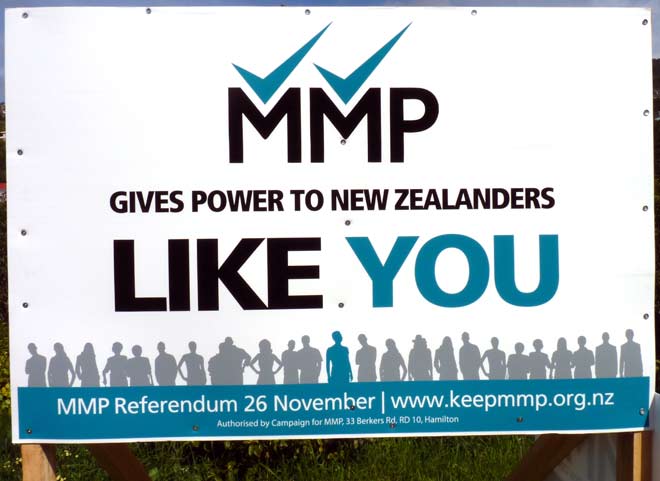
MMP in NZ

On Mixed-Member Proportional Representation

In March 2016, the Broadbent Institute released a report on electoral reform, “An Electoral System for All: Why Canada Should Adopt Proportional Representation,” and endorsed mixed-member proportional representation. It is in essence and in tone a polemic, so I shall rebut it here with a counter-polemic. 

In our current single-member plurality system, voters cast their ballots for candidates in geographic constituencies and the person who wins the largest number of votes, though not necessarily a majority and often a plurality, becomes the Member of Parliament-elect. (I regard “first past the post” as irretrievably pejorative, and so does the Broadbent Institute, judging by how it employs the term). Under pure proportional representation, voters cast their ballots for political parties themselves, and the seats in the parliament are allocated in direct proportion to the popular vote that each political party obtained; MPs are then selected based on the parties’ electoral lists, in descending order, until each party has filled the number of seats that it earned in the legislature based on its percentage of the popular vote.

Mixed-member proportional representation essentially combines single-member plurality with pure proportional representation; voters therefore cast two ballots, one for their constituency member of parliament and another for the political party itself. However, mixed-member proportional representation still strives for an overall proportional outcome by relying on a mathematical formula to allocate to the political parties that won fewer constituency seats than their popular vote merits x number of the non-geographical compensatory seats, based on a mathematical formula like the Hare Quota or the Droop Quota. In this way, the overall percentage of seats that the political parties hold in the assembly comes much closer to the percentage of the party vote that they won in the election.[1] Generally, this system benefits smaller parties, which would explain why the New Democratic Party has long advocated for it.

The geographical extent by which the compensatory seats are allocated – whether within each province or across two or more provinces –forms an important constitutional question in Canada.

Constitutional Amendments Required to Implement Two Types of Mixed-Member Proportional Representation

In short, switching to mixed-member proportional representation would necessarily require some kind of constitutional amendment, but the question of which amending formula would be necessary depends on the geographic point of reference from which compensatory seats are allocated, whether within a province or between provinces.

Section 51(1) of the Constitution Act, 1867 contains the formula by which seats in the House of Commons are allocated amongst the provinces, and section 52 of the Constitution Act, 1867 stipulates that the seats within the House of Commons must be distributed such that the “proportionate representation of the provinces” is not “disturbed.”  In this case, “proportionate representation” refers not to what we would today refer to proportional representation, but rather to the principle of representation by population under a single-member plurality electoral system. It has been established that the Parliament of Canada alone can amend section 51(1) pursuant to the constitutional amending formula in section 44 of the Constitution Act, 1982; this last occurred in 2011. However, section 42(1)(a) of the Constitution Act, 1982 subjects this principle of the “proportionate representation of the provinces” contained in section 52 of the Constitution Act, 1867 to the General Amending Formula.

Therefore, the constitutional amendment necessary for implementing mixed-member proportional representation depends on whether the compensatory party seats are allocated based on the party vote within each province or across multiple provinces. If the compensatory party seats are allocated to parties based on their vote within each province, then the Parliament of Canada alone could pass such a constitutional amendment under section 44 of the Constitution Act, 1982, because this system would not take away any seats from any province and would merely change the rules regulating the size of the remaining geographic constituencies and the ratio of geographical constituencies versus compensatory seats for the political parties. This corresponds closely to Germany’s model of mixed-member proportional representation, in which the compensatory seats are allocated based on the party vote within each of the 16 Landers (i.e., federated entities like provinces in Canada or states in Australia). If, however, we tried to create a system in which the compensatory seats are allocated based on the party vote between two or more provinces, or Canada-wide across all ten provinces, we would then need to pass a constitutional amendment under the General Amending Formula, because taking away seats from the provinces for the sake of establishing a pool of compensatory seats would “disturb” the “principle of the proportionate representation of the provinces.” Indeed, it would create a class of seats completely divorced from the provinces and wedded instead to political parties themselves.

The General Amending Formula requires that the House of Commons, Senate, and at least seven provincial assemblies representing at least one-half of the total Canadian population pass concurring resolutions. Many Canadian scholars and commentators refer to this laborious process as “opening the Constitution” – with the obvious, though perhaps unconscious, analogy to “opening Pandora’s Box” and unleashing a torrent of destruction upon the political landscape. This second model also corresponds more closely to how mixed-member proportional representation works in a unitary state like New Zealand.  

The Ambiguity of the Broadbent Institute’s Polemic

Not surprisingly, the Broadbent Institute does not venture into precisely how and what kind of system of mixed-member proportional representation it would like to implement in Canada. In particular, it does not specify whether it would to allocate the compensatory seats within each province, or, alternatively, between provinces or across Canada as a whole. At two points, the report alludes to both of these mutually exclusive options but does not decide definitively upon either. (Since this report appears online without a corresponding PDF or text version, I cannot cite specific page numbers or paragraphs).

At one point, the Broadbent Institute’s report acknowledges that mixed-member proportional representation would require larger geographic constituencies; it later concedes in a parenthetical aside – as if the precise structure of the electoral system were less important – that electoral “districts would probably be divided by province like they are now, but ridings would become larger.”[2] This wording suggests (though does not mean conclusively) that the Broadbent Institute would endorse the German Model by which the Parliament of Canada alone could implement mixed-member proportional representation pursuant to the amending formula under section 44 of the Constitution Act, 1982.

However, another paragraph later in the report implies, but does not state directly, that the Broadbent Institute would prefer a system of Canada-wide compensatory seats in order to stop rewarding political parties that currently benefit from regional pockets of support. The German Model would still allow, to some extent, for the geographic concentration of the compensatory party seats within each province and would therefore not solve what the Broadbent Institute regards as a significant flaw in Canada’s current electoral system.

[…]FPTP tends to punish small parties whose support is spread out across the country, while it rewards those whose support is geographically concentrated (and it can have the opposite effect on large parties). That’s how the Bloc Québécois became the Official Opposition in 1993 despite electing no members of Parliament outside Quebec, receiving less than 14 per cent of the popular vote, and taking in fewer votes (by more than 700,000) than the third-place Reform Party. It’s also how the Green Party of Canada, whose support is more geographically spread out, has received only one seat in two of the last five elections, and none in the other three, despite receiving between three and seven per cent of votes cast in each contest. (In a proportional system with similar popular returns, the party would likely have come away with 10–20 seats.)[3]

Other than these oblique and contradictory references, the Broadbent Institute’s polemic for mixed-member proportional representation does not venture into the constitutional and statutory mechanisms by which this electoral system could be implemented in Canada. The Broadbent Institute also does not specify what percentage of the popular vote parties would have to obtain as a minimum threshold in order to qualify for seats in the House of Commons, nor does it specify which formula – whether the Hare Quota or the Droop Quota – it would adopt for allocating the compensatory seats.

Argument from Teleology, False Consciousness, and the Myth of the “Wasted Vote”

Teleological Platitude

The Broadbent Institute relies on what I would classify as an Appeal to Teleology. This fallacy holds that history moves inexorably toward liberal-democratic (or perhaps social democratic) perfection and that therefore anything which attempts to slow or reverse this progression is manifestly bad and must be relegated to the dustbin of history. This Hegelian teleological impulse has been central to the ideology of the Progressive Movement since the early 20th century and is related to the Whiggish view of history and the Liberal Progress Narrative of the early 19th century. For example, Prime Minister Trudeau relies on this fallacy and appeals to teleology when he justifies his actions simply by stating what year it is, such as in his response to the question why he decided to appoint equal numbers of men and women to cabinet: “Because it’s 2015.” President Obama, and various other American politicians, often invoke the same fallacy through phrases like “to be on the right side of history,” meaning that one’s political opponent is not merely incorrect but is “on the wrong side of history.” On the surface, this fallacy sounds credible, but it conceals a pernicious purpose: politicians invoke it in an attempt to restrict the acceptable range of political discourse by delegitimating contrary viewpoints outright.

The Broadbent Institute relies on this Appeal to Teleology in order to dismiss single-member plurality as an inexcusable relic of the past and exalt mixed-member proportional representation as the ideal that we must realize in practice. In a series of sentence fragments, the Broadbent Institute portrays single-member plurality as an anachronism of the 19th century:

Our current electoral system has been with us since before Confederation. That is, since before 1867. Before automobiles took over our streets, before light bulbs lit our rooms, and before tin cans filled our shelves.[4]

Let’s ignore the fact that tin cans first appeared as a method of preserving food in the 1810s and gradually became more widespread throughout the 19th century. (Perhaps the Broadbent Institute could have strengthened its analogy by pointing out, for instance, that early tin cans were sealed with a lead solder which made their contents toxic). The Broadbent Institute here is suggesting that simply because we have improved materially and technologically since the mid-19th century, our electoral system must also be swept away into the dustbin of history along with lower life expectancy and steam engines, as if the single-member plurality electoral system and being materially worse off were somehow correlated to one another.

The Broadbent Institute also infuses its paper with some some Marxist tropes, particularly that of false consciousness. For instance, they steep their acknowledgement that mixed-member proportional would have to retain some geographic constituencies in such language: mixed-member proportional would have to maintain geographic constituencies of some kind because “many citizens, especially those outside of our larger cities, have a strong attachment to geographical representation […].” If only the rural proletariat would dispense with those “strong attachments” to geography and stop clinging to single-member plurality. If only they could be forced to see the truth. The Broadbent Institute picks up on its theme of false consciousness later in its report:

What we do know is that the system we now use is more familiar to Canadians, and that people tend to prefer things that are familiar to them. It’s likely true that the more Canadians learn about proportional representation, the more they will become comfortable with it, especially once they learn about the virtues of proportionality: fairness, representativeness, and engagement.[5]

Like most proponents of this electoral system, the Broadbent Institute holds that if only someone explained mixed-member proportional representation to Canadians, they would immediately begin to support it because of what the Broadbent Institute regards as its inherent and manifest superiority. More fundamentally, this viewpoint relies on a pernicious and cynical political tactic common to political parties and politicians of all ideological persuasions: the manner in which the idea is communicated is more important than the merits of the idea itself.

The So-Called “Wasted Vote”

The Broadbent Institute also relies heavily on the specious concept of the so-called “wasted vote.” The Broadbent Institute goes farther than most of its allies and defines a “wasted vote” as any vote “cast for a candidate who didn’t win.” But why does a vote cast for a candidate who ends up losing in a given riding count as having been “wasted”? This notion pre-supposes that all votes cast should somehow always translate into electing MPs, as if only the candidate for whom a citizen voted can “represent” him or her in parliament. This assertion also presupposes that citizens now possess a right to vote for a winning candidate. But we cannot pervert the constitutionally entrenched right to vote into an imaginary right to elect a winning candidate. We make choices to the exclusion of other options, and we work to allocate scarce resources. Furthermore, this begs the question as to what the Broadbent Institute would consider a non-wasted vote, because they seem to imply that even if a candidate wins 50%+1 of the votes in a riding, those who did not vote for the winning candidate still “wasted” their votes!

The Broadbent Institute laments that under the current system, “millions of Canadians are struck with a member of parliament they didn’t vote for.” But even under mixed-member proportional representation, there is no guarantee that the constituency MP for which a citizen votes would go on to win in that geographic district, which means, under the logic of the Broadbent Institute, that some Canadians would still be “stuck with a member of parliament they didn’t vote for.” With respect to the ballot dedicated to the party vote, the Broadbent Institute also doesn’t explain whether it would prefer a closed list or an open list, which means that citizens might not be able to choose their preferred party candidate either but would instead be limited to choosing the political party, whose list would then determine the order in which its compensatory seats are filled in the legislature.

Later on in the report, the authors define a “wasted vote” as one either “cast for candidates who don’t win” or “for parties that receive fewer seats than their public support indicates they deserve.” The second corresponds more closely to what other proponents of mixed-member proportional have put forward.  But the first illustrates the Broadbent Institute’s warped view on the nature of voting itself.

The Broadbent Institute Sets Some Myths of Its Own

Ironically, in the section on “Busting PR Myths,” the Broadbent Institute introduces some mendacious mythology of its own. For example, it defines political “stability” in a misleading manner; instead of linking stability to the number of ministries, or governments, in office over a given time, it ties “stability” to the number of general elections held and parliaments elected over a given time. In this manner, the Broadbent Institute propagandizes Italy as a paragon of political stability because it has held only 18 elections since 1945, while Canada has held 22 over the same period.  In a parliamentary system in which governments must maintain the confidence of the assembly, the true test of stability is the longevity of the ministry in office, not the number of general elections held. Stability depends upon the executive, not the legislature, because the government can survive across multiple parliaments, but once one parliament is dissolve, it is gone forever. Since 1945, there have been only 15 ministries in office in Canada – while over the same period there have been 41 in Italy. As Italy shows, when a country adopts a proportional system, elections matter less, because mid-parliamentary transitions of power between ministries become the norm.

The Broadbent Institute also conflates electing representatives with forming governments.

Some critics claim that PR makes accountability more difficult, since it’s hard to “punish” a single candidate or party that you’re dissatisfied with at election time. As with other systems, if as a voter in a PR system, you’re dissatisfied with a given representative or party, you’re free to choose any other alternative. But unlike in FPTP, your choice, no matter what it may be, is likely to count towards electing a representative.[6]

It notes, correctly, that critics of mixed-member proportional representation argue against this system on the grounds that it encourages coalition governments, which in turn makes punishing governments and the political parties that form them more difficult during elections. This is true. But then the report pivots away from this criticism and simply states that the voters remain free to reject their local representative or a given party – which is true, but this is not the same thing as rejecting a government and its policies, and it does not respond to the fact that rejecting coalition governments is more difficult than rejecting single-party majority governments.

The Broadbent Institute also tacitly acknowledges that adopting mixed-member proportional representation would form part of a larger institutional reform in how Canadians govern themselves and how parliamentary government operates. In other words, with mixed-member proportional comes, at the very least, coalition governments; it could also come with fixed-term parliaments, confirmation voting, and constructive non-confidence, because, as European parliamentary systems show, these institutional features normally go hand in hand in an attempt to maintain some modicum of stability.

It’s true that under a PR system, single party majority governments would probably be few and far between. Instead, parties would have to co-operate with one another to work in the best interest of Canadians. This would occur through minority and coalition governments—that is, parties that engage in public, formal power-sharing agreements in order to form a government. Globally, these arrangements are very common.[7]

Finally, the Broadbent Institute concludes its report on the same erroneous Appeal to Teleology on which it began. From the Broadbent Institute’s point of view, we must reject single-member plurality just as we have rejected a restricted franchise and have gradually expanded the right to vote from propertied white men to all adult citizens, irrespective of sex or ethnicity. This teleological claim also implies that single-member plurality discriminates on the basis of sex or race or some other criteria that would make it inconsistent with the Charter and that we must therefore reject single-member plurality outright and replace it with a new system. First, liberals and social democrats cannot claim credit for this progressive expansion of the franchise toward universal adult suffrage, because it was the Conservative government of Sir Robert Borden in 1918 that introduced the Act to confer the Electoral Franchise upon Women in 1918 and the Conservative government of John Diefenbaker that tabled the bill extending the franchise to all indigenous peoples. Second, universal adult suffrage and the right to vote itself, under section 3 of the Constitution Act, 1982, do not equate to the electoral system by which Canadian voters elect members of parliament. These are two separate issues – the first is a constitutional question; the second, a political question – but the Broadbent Institute relies on the false premise and disingenuous implication of combining the two together in order to delegitimate single-member plurality. You do not “waste” your vote simply because you happen to cast your ballot for a party that does not form government. To suggest otherwise would be to make the absurd assertion that our democratic rights include the right to elect members who then in turn must become cabinet ministers in government – a prosperous and unenforceable notion. 

Conclusion 

Since the Canadian proponents of mixed-member proportional representation remain silent on practical matters, it is unclear whether they would object to the limited, politically feasible method that would set up, in effect, 10 proportional systems in each province. Instead, they tend to rely on vague outlines couched in normative claims because they concern themselves more with convincing Canadians that mixed-member proportional representation is best and inherently more fair than single-member plurality than explaining precisely the constitutional and statutory by which their preferred option would be implemented. In this respect, the Broadbent Institute finds itself in the company of the Law Commission of Canada’s report on electoral reform from 2004, “Voting Counts: Electoral Reform for Canada,” as well as other advocacy groups like Fair Vote Canada and the Every Voter Counts Alliance.

The proponents of mixed-member proportional representation owe Canadians thoroughness and transparency.

Similar Posts: 

 Endnotes

[1] Citizens’ Assembly on Electoral Reform, “Description of The Ontario Citizens’ Assembly’s Mixed-Member Proportional System,” Part IV in Democracy at Work: The Ontario Citizens’ Assembly on Electoral Reform (Toronto: Citizens’ Assembly on Electoral Reform, 2007), 144-162.
[2] Broadbent Institute, An Electoral System for All: Why Canada Should Adopt Proportional Representation, March 2016. [Accessed 17 March 2016 < http://www.broadbentinstitute.ca/an_electoral_system_for_all>] Since this report appears online without a corresponding PDF or text version, I cannot cite specific page numbers or paragraphs.
[3] Ibid.
[4] Ibid.
[5] Ibid.
[6] Ibid.
[7] Ibid.

Posted in Electoral Reform, Reform | 7 Comments