Savoie ne sait pas: The Governor General of Canada Does Not Unadjourn the House of Commons


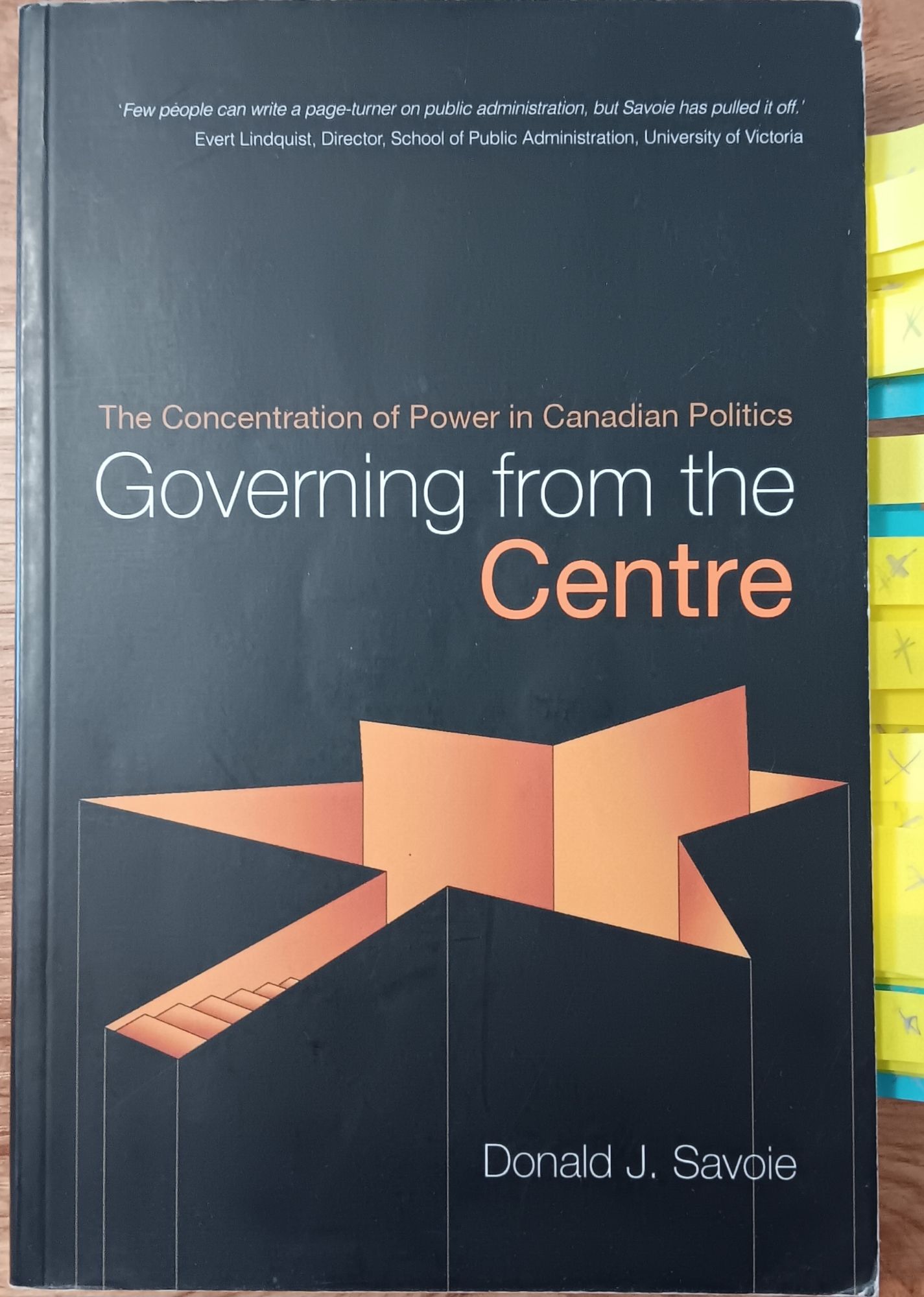
My copy of Governing from the Centre, which I read probably around 2010 or 2011.

The Governor General does not decide when the House of Commons or the Senate come out of an adjournment and resume sitting. The House of Commons and Senate vote to adjourn themselves and to resume sitting, but the Crown summons, prorogues, and dissolves Parliament on the Prime Minister’s advice. This really is not complicated.

Yet Donald Savoie just wrote this bizarre column for The Hill Times where he asks some rhetorical questions about when the Governor General should act on the advice of the Leader of the Opposition. The answer to that, in Canada, is never. Some of our other sister Realms, like Saint Kitts and Nevis, have codified in their constitutions that the Governor General appoints some Senators on the advice of the Prime Minister and others on the advice of the Leader of the Opposition, but no such provision exists here.[1]

Continue reading

Posted in Crown (Powers and Office), Parliament, Prorogation, Speaker of the House of Commons | 3 Comments

All I Want for Christmas Is a Constitutional Crisis


The Most Chaotic Week in Ottawa Since February 1963

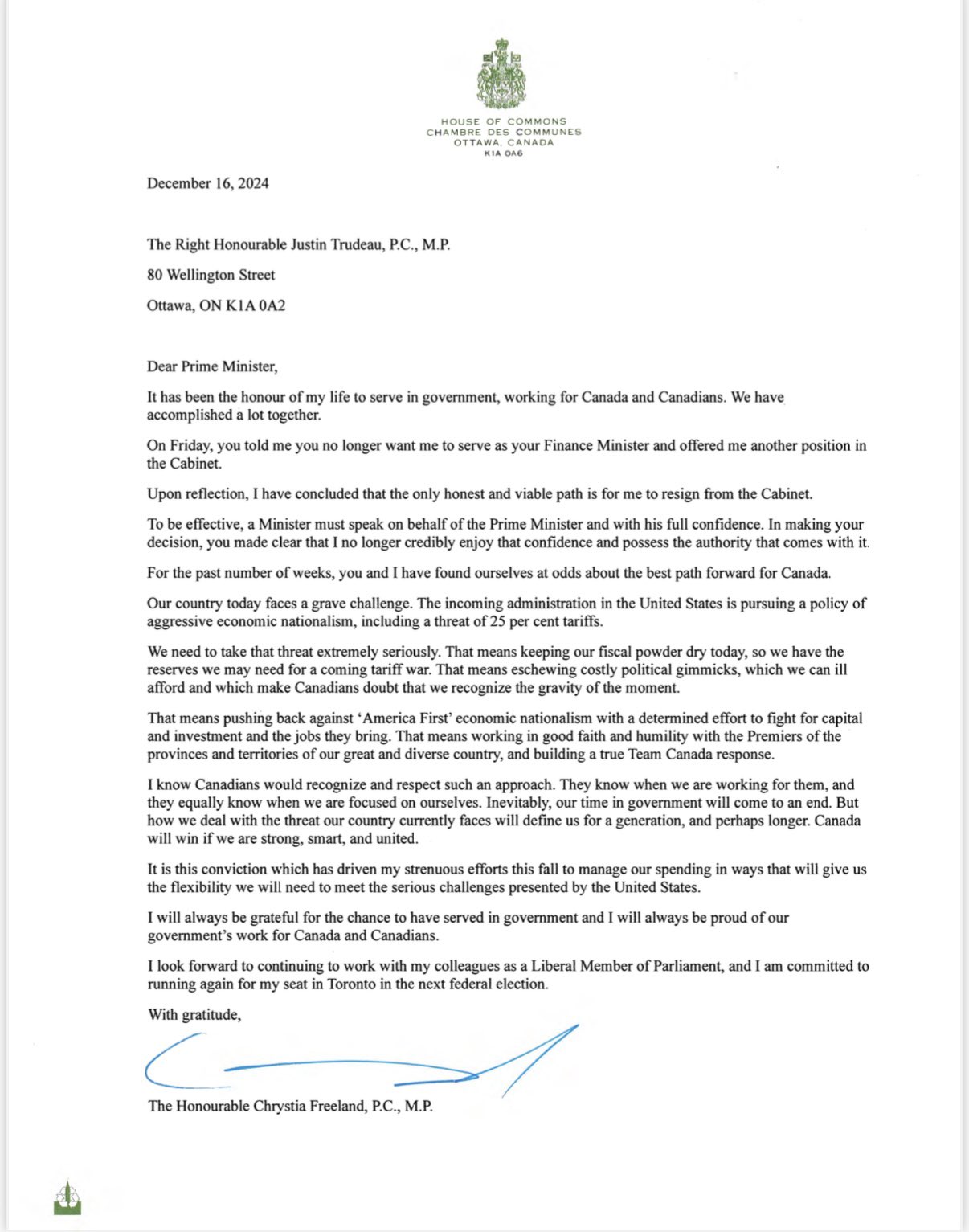
Chrystia Freeland resigned as Minister of Finance and Deputy Prime Minister in spectacular fashion on Monday, 16 December 2024 mere hours before she would have delivered the Fall Economic Update in the House of Commons. She revealed that Trudeau had informed her the previous Friday that he intended to shuffle her out of the most powerful and important portfolio in cabinet and accused him of having pursued “costly political gimmicks” in the face of the serious threats posed by President-elect Donald Trump, who might impose tariffs of 25% on Canadian products coming in to the United States.[1] Trudeau appointed Dominic LeBlanc as the new Minister of Finance later that evening and then shuffled cabinet more broadly on Friday the 20th.[2]

Not since Douglas Harkness resigned as Minister of National Defence on 3 February 1963 over a profound irreconcilable disagreement with Prime Minister Diefenbaker on the handling of the Cuban Missile Crisis and the question of allowing American nuclear warheads in Canada has a ministerial resignation on a question of policy shaken an incumbent government so badly and taken Parliament, the press, and the public by such surprise.[3] The House of Commons withdrew its confidence from the collapsing Diefenbaker ministry two days later on 5 February 1963 and forced an early election less that one year after the previous.[4] Unlike in 1963 when the ministerial chaos happened squarely in the middle of a regular late-winter sitting, the House of Commons had already scheduled itself to adjourn until late January 2025 as of Tuesday, 17 December 2024, which prevented the crisis from playing out in the same way.

Continue reading

Posted in Crown (Powers and Office), Dissolution, Prorogation | 1 Comment

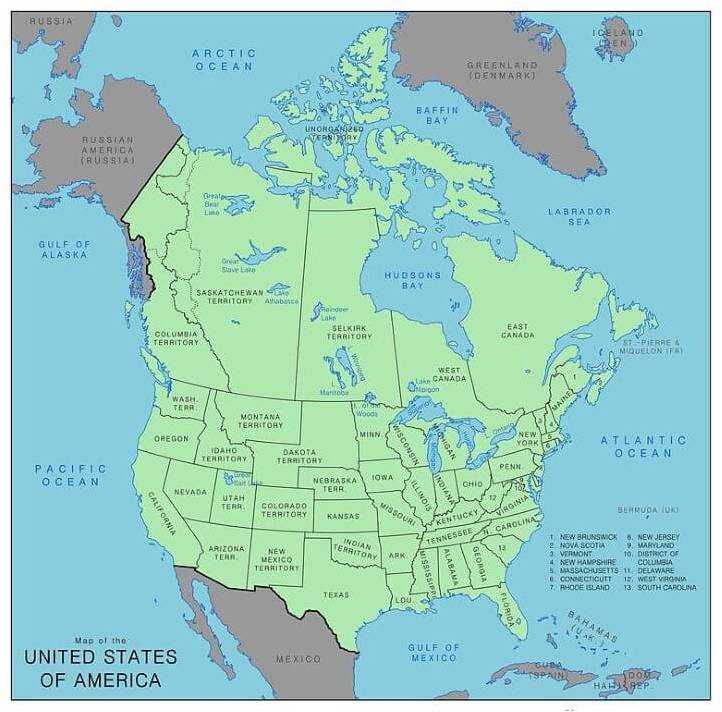
A Time When America Would Have Given Us Seven States


The trope that Canada should avoid becoming “the 51st state” has never made much sense to me. While the Americans would surely not allow Prince Edward Island to carry on as a separate polity (and certainly not under such an overtly royal name) and would perhaps even merge all three Maritime Provinces into a single state, they would also not disregard our federal structure entirely and merge eleven constitutionally entrenched polities into one. We forget that the United States of America is also a federation and that the US Constitution contains a division of powers between two orders of government just as our Constitution Act, 1867 does.

I base my view on historical precedent.

Continue reading

Posted in History of British North America | Leave a comment

The Presidential Bicameral Adjournment Clause Is Almost An American Equivalent to Prorogation


An American Connection

Over the last thirteen years, I have been pleasantly surprised to find that Parliamentum attracts a surprising number of readers from the United States, about one-quarter to one-third of the total depending on the year. I occasionally write on American topics, but mainly on British North American history and how Canada or the United Kingdom relate to the United States, and by drawing anecdotally from the five years that I spent there. I also go only as far as my limited knowledge of American political institutions permits and remain aware of all the known unknowns which face me here. From the point of view of a Commonwealth Realm like Canada, Australia, the United Kingdom, the United States does many things backwards and in defiance of what strikes us as common sense. For instance, the House of Representatives dissolves by efflux of time in January after the general election the previous November. In another strange twist, the House of Representatives also has no Standing Orders – which is to say, a set of rules which carries over by default from one Congress to the next, though subject to amendment at any time – but instead must adopt its own rules wholesale every two years.

The framers who founded the United States of America in the 1780s and wrote the Articles of Confederation in 1777 and the United States Constitution in 1787 well understood British history, parliamentary precedents, and the Common Law. John Adams in his Political Essays on the Principal Points of Controversy Between Great Britain and Her Colonies, Thomas Jefferson in his Summary View of the Rights of British America, and Alexander Hamilton, James Madison, and John Jay in the Federalist Papers all demonstrated a strong grasp of the general intellectual currents of the Enlightenment, the First British Empire, and Hanovarian Britain, in addition to  an implicit fluency with the venerable tomes of the era like Sir William Blackstone’s Commentaries on the Laws of England. They designed the United States Constitution as a republican transcription of the Hanovarian Constitution of the 18th century when a stronger separation of powers between the executive and legislature pertained and before Responsible Government and collective ministerial responsibility had fully emerged by the 1830s and significantly narrowed that separation (but did not “fuse” the two).

I first noticed in 2012 that Alexander Hamilton devoted Federalist 69 to comparing the authorities of the President of the United States under Article II of the US Constitution to the royal prerogatives and authorities of the King of the United Kingdom, and that Hamilton expressly compared one clause in Article II, Section 3 to prorogation. This reference suddenly became relevant again after Donald Trump pulled a Grover Cleveland and won a non-consecutive second term earlier this month and his staff started floating the idea of invoking in early 2025 what I call the Presidential Bicameral Adjournment Clause of the US Constitution for the first time since 1787. I would like to compare prorogation in the Commonwealth Realms to the rough American equivalents of prorogation: first, the adjournment sine die and the 20th Amendment; and second, the Presidential Bicameral Adjournment Clause – so far never used. But I must admit, I have encountered some difficulty in discerning the precise effects of adjournment sine die on legislative business. Some learned American readers might need to correct any errors if I have failed to do their system justice.

Continue reading

Posted in Comparative, History of British North America, Parliamentarism v Presidentialism | Leave a comment

Tim Houston’s Snap Election in Nova Scotia


Houston Breached the Last Redoubt

Nova Scotia long resisted the trend of fixed-date elections in Canada and stood for years as the last redoubt of the ten provinces to rely solely on section 4(1) of the Constitution Act, 1982, which sets the maximum life of a legislative assembly at five years from the date fixed for the return of writs of the previous general election. And no province agonised over fixed-date elections quite like Nova Scotia either. The House of Assembly considered several private members’ bills to implement fixed-date elections from 2007 to 2013; they all failed because they never gained the support of the government. All fixed-date election laws in Canada started out life as government bills. Stephen McNeil, Liberal Premier from October 2013 to February 2021, even went so far as to rule out imposing a fixed-date election law in Nova Scotia altogether on 8 April 2015 only two days after Wade MacLaughlan, at the time the new Liberal Premier of Prince Edward Island, ignored his province’s electoral schedule. McNeil also alluded to all the ad hockery that Saskatchewan, Manitoba, and Prince Edward Island had gone through to avoid the possibility that their provincial general elections would overlap with the federal general election in October 2015 as evidence that “fixed dates haven’t been working.”[1] All that changed on the Fifth of November 2021.

Continue reading

Posted in Fixed-Date Elections | Leave a comment