
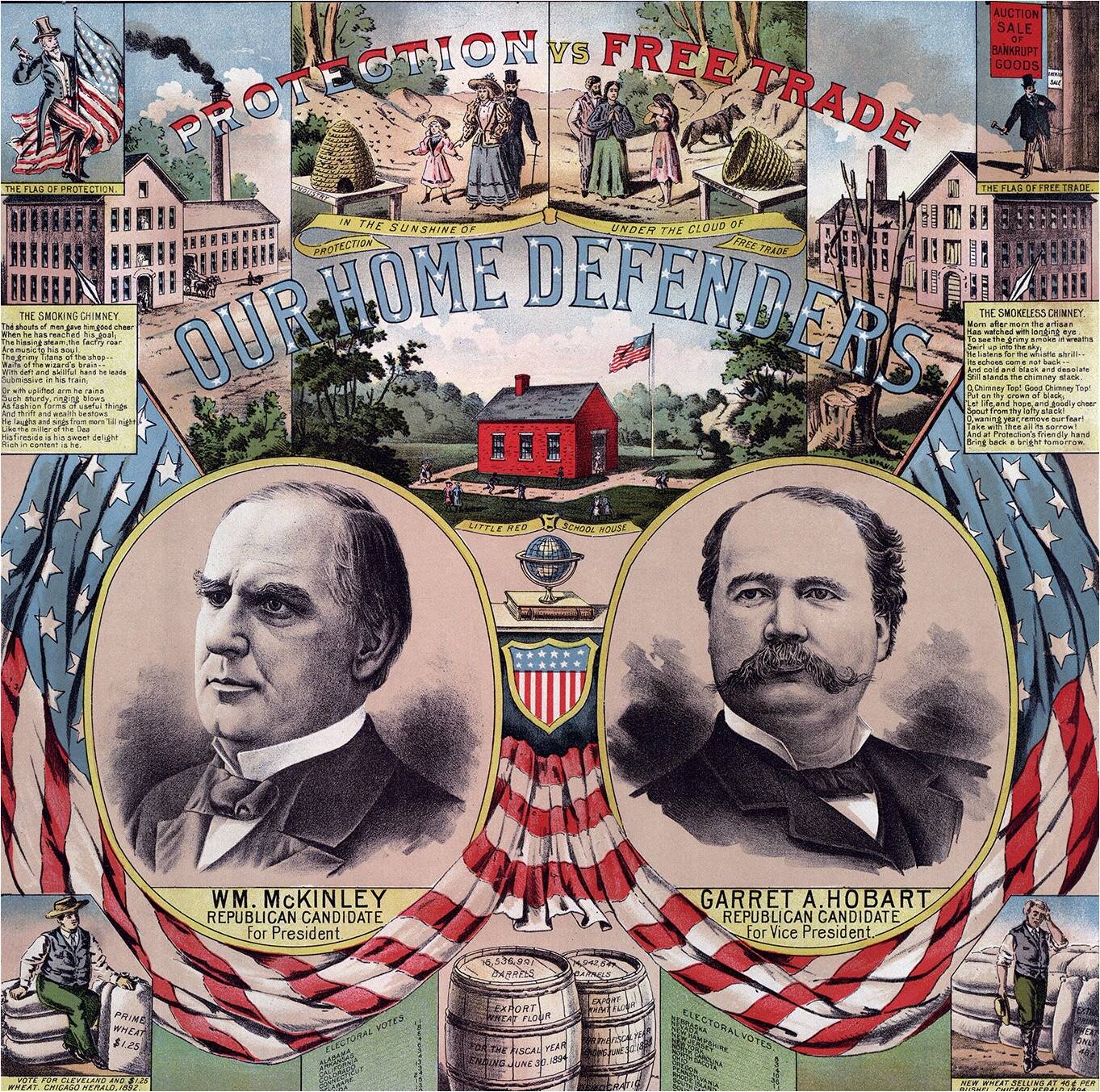
Trump admires William McKinley and his high tariffs
Protectionism Is Cool Again
Donald Trump promised to cry havoc in November 2024 as President-elect, and he hath now as President let loose the dogs of tradewar. Trump had denounced the tradedeficit between Canada and the United States, which have occurred under the trade agreement between Canada, the United States, and Mexico that he negotiated during his first non-consecutive term.[1] But the Doctrine of Trumpian Infallibility dictates that he somehow bears no responsibility for the trade agreement that he initiated and secured eight years ago and which he now finds bad.
NAFTA was always NAFTA in English, ALÉNA en français, and TLCAN en español, but this newer trade agreement that Trump forced in his first term reflects the post-truth era of caprice and stupidity in which we live, because we cannot agree on something as basic as the name of this trilateral agreement. Canada in English calls it “The Canada-United States-Mexico Agreement (CUSMA)”, while in Washington the agreement identifies itself as “The United States-Mexico-Canada Agreement.” The trilateral international Secretariat charged with administering the treaty between the three countries also gives it different names in English, French, and Spanish. In English, “The Agreement” identifies as both the “Canada-United States-Mexico Agreement (CUSMA) / United States-Mexica-Canada Agreement (USMCA).” The Mexicans call it El Tratado entre México, Estados Unidos y Canadá (T-MEC), simply “The Treaty between Mexico, the United States, and Canada.” And Canada also calls it in French by Accord Canada – États-Unis – Mexique – a direct translation of the Canadian English name shorn of the preposition which elegantly marks the Spanish, which surprises me given the prevailing pedantry that French-speakers usually show toward their language.
On 1 February 2025, Trump issued an executive order under Article II of the US Constitution and delegated legislation pursuant to the International Emergency Economic Powers Act, the National Emergencies Act, the Trade Act, and the United States Code to impose a tariff of 25% on all Canadian goods and products except energy, which he shall merely tariff at a rate of 10%, as of 4 February.
Sec. 2. (a) All articles that are products of Canada as defined by the Federal Register notice described in subsection (e) of this section (Federal Register notice), and except for those products described in subsection (b) of this section, shall be, consistent with law, subject to an additional 25 percent ad valorem rate of duty. Such rate of duty shall apply with respect to goods entered for consumption, or withdrawn from warehouse for consumption, on or after 12:01 a.m. eastern time on February 4, 2025 […]
(b) With respect to energy or energy resources, as defined in section 8 of Executive Order 14156 of January 20, 2025 (Declaring a National Energy Emergency), and as otherwise included in the Federal Register notice, such articles that are products of Canada as defined by the Federal Register notice shall be, consistent with law, subject to an additional 10 percent ad valorem rate of duty. Such rate of duty shall apply with respect to goods entered for consumption, or withdrawn from warehouse for consumption, on or after 12:01 a.m. eastern time on February 4, 2025 […].[2]
Most ominously still, Trump issued an open declaration of tradewar and warned Canada not to retaliate, or else he might escalate the tariffs yet further:
(d) Should Canada retaliate against the United States in response to this action through import duties on United States exports to Canada or similar measures, the President may increase or expand in scope the duties imposed under this order to ensure the efficacy of this action.[3]
This executive order only applies to Canada, which presumably means that Trump will soon issue additional executive orders imposing tariffs on Mexico separately. CUSMA – I’ll use the Canadian variant of the name here, I suppose, purely because it makes a pronounceable acronym – came into effect in December 2019, shortly before the pandemic.[4] Trump has, in effect, abrogated that Treaty unilaterally, killed free trade in North America, and undone decades of good will.
And yet this is not the first time that the United States has abruptly cancelled free trade and re-imposed protectionist tariffs on Canada either. In some ways, Trump has brought the United States back to its protectionist norm.
 James Bowden's Blog