1896: Tupper & Laurier Debate the Role of Governor General and Popular vs Parliamentary Sovereignty


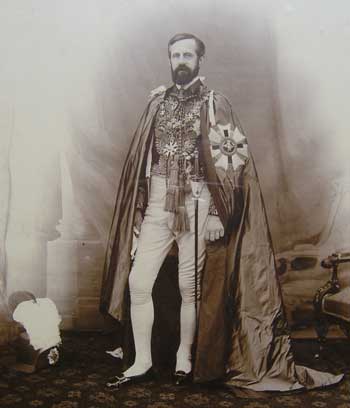
Governor General Lord Aberdeen

Introduction  

On 8 July 1896, Governor General Lord Aberdeen forced Prime Minister Sir Charles Tupper from office by refusing to promulgate his constitutional advice and sign off on Orders-in-Council to summon senators and make other appointments. Tupper sought to fill up vacancies knowing full well that the Liberals had just won a parliamentary majority for the first time since 1874 in the general election held on 23 June 1896. When Aberdeen refused to sign the Orders-in-Council, Tupper wrote back that he had no choice but to resign the premiership, because the prime minister cannot remain in office after a governor general has rejected his constitutional advice and withdrawn his confidence from him. Lord Aberdeen then appointed Sir Wilfrid Laurier as Prime Minister, and Laurier would stand astride Canadian politics like a colossus for the next fifteen years. At Tupper’s insistence and at Aberdeen’s acquiescence, their written correspondence from July 1896 became part of the public record in the Sessional Papers of the House of Commons in the 1st session of the 8th Parliament that September. Tupper and Laurier then debated the propriety of Governor General Lord Aberdeen’s actions in a fascinating exchange which revealed competing narratives of parliamentary sovereignty versus popular sovereignty, what we would now call the Caretaker Convention versus the Spoils System, and the circumstances under which the Governor General can or should reject ministerial advice.


Continue reading

Posted in Appointment of PM, Caretaker Convention & Government Formation, Confidence Convention, Constitutional Conventions, Crown (Powers and Office), Dorchester Review, Formation of Governments, History of British North America | 3 Comments

When Hollywood Screenwriters Don’t Understand How Parliamentary Government Works


The plots of some films hinge upon fundamental misunderstandings of how parliamentary government works, and I thought that outlining an example would prove both entertaining and instructive. Sherlock Holmes from 2009, directed by Guy Ritchie and starring Jude Law and Robert Downey Jr. and his ridiculously contrived attempt at Received Pronunciation, presents one such example.

The preposterous villain, played by Mark Strong, faked his own death after murdering several young women, in what the film no doubt considers an allusion to Jack the Ripper. He then relied on occult trickery to carry out his climatic Bond Villain plan of releasing a poisonous gas into the House of Lords and assassinating all his rivals in one fell swoop. Hans Matheson’s character — hilariously called “Lord Coward” — plays an implausibly young Home Secretary and Blackwood’s most loyal and fanatical follower. He set Blackwood’s plan in motion by nodding ostentatiously to other peers and by addressing his fellow peers to order by yelling out “My Lords! Milords!” (As Tywin Lannister told Arya Stark, the high-born would never say “Milord”). In this universe, the Lord Speaker does not preside over debate in the House of Lords either. Blackwood then made his dramatic entrance on queue and gave one of those grandiosely evil speeches.

He attempted to execute his plan, and several peers, after dramatically re-appearing in the chamber of the House of Lords itself, in which he himself apparently had the right to sit as a member of the nobility. This attack would have killed only the peers who did not support him because he had already given an antidote to the peers on his side. That would seem to preclude the possibility of convincing any of the other peers from changing their minds, but no matter!

This mass assassination would, in turn, somehow have enabled him to impose a personal rule and dictatorship over the entire British Empire. He had mentioned earlier in the film another plot to re-annex the United States of America into the British Empire as well, which he could apparently achieve simply because he assassinated the United States ambassador to the United Kingdom. Presumably, he would also have sought to abolish the self-government of the Dominion of Canada, the Dominion of New Zealand, and the Australasian colonies, too, though he and his supporters don’t say.

Needless to say, none of this makes any sense.

Continue reading

Posted in Film & Television, Humour, Reviews | 9 Comments

Newfoundland & Labrador Must By Law Hold An Early Election By 2021


Dwight Ball Announces His Intention to Resign as Premier

On 17 February 2020, Dwight Ball announced that he would step down as Premier of Newfoundland and Labrador as soon as the Liberal Party of the province chooses its new leader.  Around 1 minute 30 seconds into the recorded message, broadcast at 6:00 pm Newfoundland Time, Ball says:

“Now given the minority nature of our government and therefore the uncertainty of when the next [general election] campaign will come, now is the time for me to make way for new leadership. […] But before I do, I will continue to work everyday as your Premier until a new leader [of the Liberal Party] is chosen.”[1]

But this is not exactly true. Newfoundland and Labrador, unique amongst the nine provinces and two territories which have adopted fixed-date election laws, requires that new premier appointed to office before the close of the third year in the life of a House of Assembly advise the Lieutenant Governor to call an early general election within 12 months. So contrary to Ball’s statement, there is, in fact, an absolute certainty and statutory necessity that Newfoundlanders and Labradoreans will go to the polls again by 2021, after having last done so only on 17 May 2019.

Continue reading

Posted in Caretaker Convention & Government Formation, Crown (Powers and Office), Dissolution, Formation of Governments | 1 Comment

Rejecting Constitutional Advice Equals Dismissal from Office: How Governor General Lord Aberdeen Forced Sir Charles Tupper’s Resignation in 1896


When I first embarked on this constitutional odyssey in 2011, I encountered scholars who propagated a novel constitutional interpretation with no basis in history, nor in the principles of Responsible Government itself, which I call “Reserve Powers Without Consequence”: the notion that the Governor General can reject a prime minister’s constitutional advice and that this extraordinary and rare vice-regal intervention, in turn, entails no consequences and allows the prime minister to carry on in office as if nothing happened until the House of Commons might say otherwise. This is false. And numerous historical precedents — along with the recent case from British Columbia in 2017 — demonstrate the falsity of this notion. I have written on one such case study in my latest piece in The Dorchester Review.

Continue reading

Posted in Caretaker Convention & Government Formation, Dorchester Review, Formation of Governments, My Published Works | 2 Comments

Extra-Constitutional Reform of the Senate of Canada


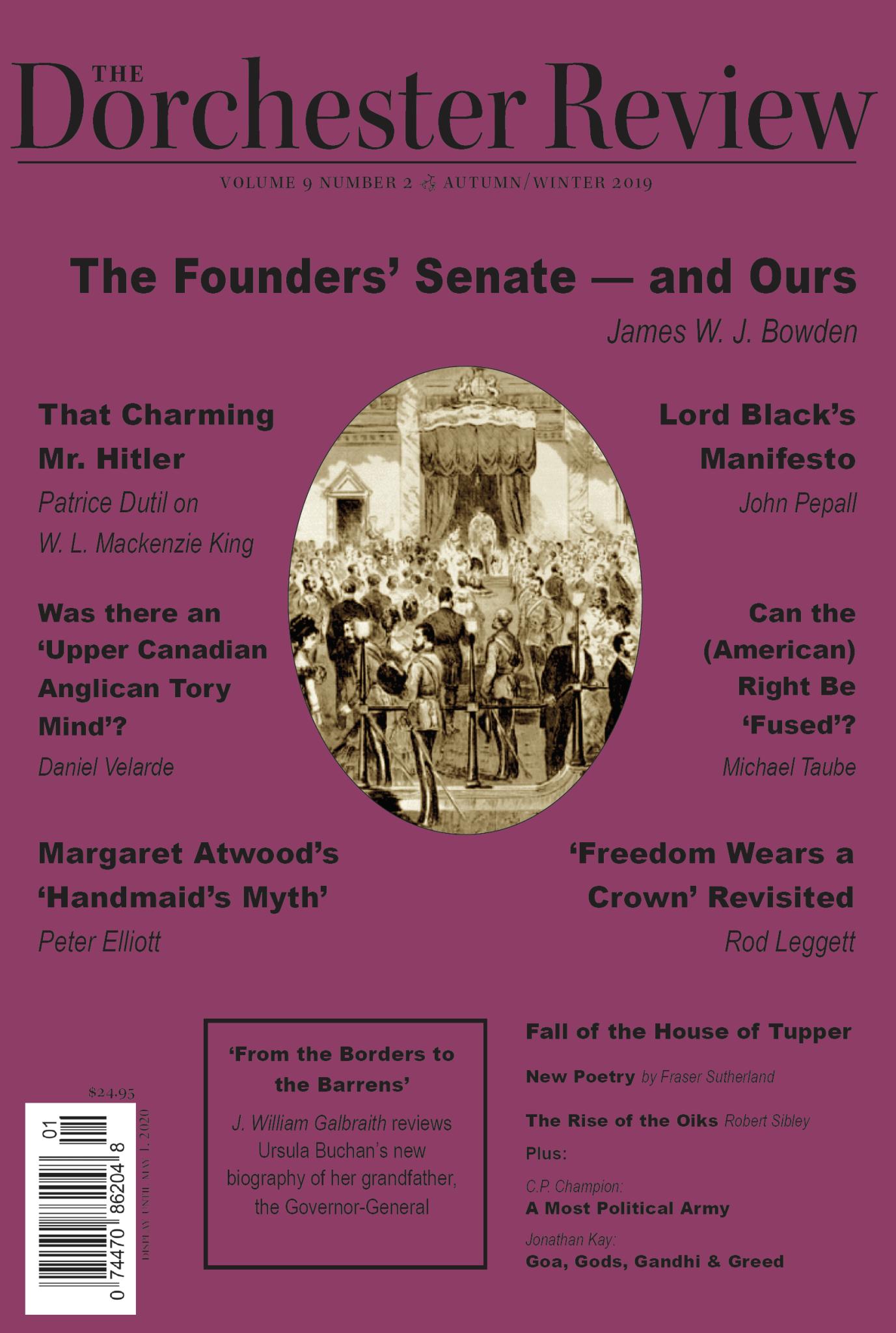
The latest issue of The Dorchester Review includes my piece on “The Founders’ Senate.” In this article, I outline how the Senate of Canada, and the Legislative Council of the Province of Canada, functioned as partisan legislative bodies from the 1840s to 2015. I also argue that Stephen Harper from 2013 to 2015 and Justin Trudeau from 2015 to present both took steps to undermine and transform the role and composition of the Senate through extra-constitutional means in response to the Supreme Court’s Senate Reference, which has all but destroyed any efforts to reform the Senate through constitutional amendment. I encourage you to subscribe to the DR if you’re interested in reading my piece.

Similar Posts: 

Posted in Dorchester Review, History of British North America, My Published Works, Senate Reform | Leave a comment