PROC Examines the Retroactive Prorogation Rationale After All


PROC decided to study the Retroactive Prorogation Rationale (Sessional Paper 8560-432-1261-01_e) in 2020 after all. Committees tend not to update the official transcripts (Evidence) until two weeks later, so I misinterpreted and missed some of these developments last month by going off the Minutes alone.

On Thursday, 10 December, PROC invited four university professors – Kathy Brock, Philippe Lagassé, Barbara Messamore, and Daniel Turp – to appear remotely as witnesses and speak to the first Retroactive Prorogation Rationale released under the new Standing Order 32(7). PROC has not made the official Evidence public yet, so I’m taking this dialogue from Parl Vu and translating remarks from French into English where necessary.

Continue reading

Posted in Crown (Powers and Office), Prorogation | 2 Comments

Thomas D’Arcy McGee on Literature as National Identity


The Dorchester Review will soon publish my piece on Thomas D’Arcy McGee and the Kingdom of Canada. In anticipation of that article, I would like to share with you the section that I had to cut early on in the drafting. But like the deleted scene of a film that went through post-production, it is complete with respect to the rest of the upcoming article; it should even mostly stand on its own, too.

Continue reading

Posted in History of British North America, My Published Works | 1 Comment

PROC Sentences the Retroactive Prorogation Rationale to a Quiet Bureaucratic Death


Sometimes I forgot to follow up on these developments right away, and the obscura and minutia on which I normally focus here on Parliamentum usually goes unreported in the press, too. The House of Commons Standing Committee on Procedure and House Affairs (PROC) has taken steps to bury the Trudeau government’s Retroactive Prorogation Rationale, tabled and referred to PROC under the new Standing Order 32(7), and delay any study on it at all until at least January 2021 – and probably never. The whole idea of forcing the government to table a rationale for the previous prorogation retroactively in the next session never lent itself to anything productive or substantive, but I would have been curious to see what, if anything, PROC did in response.

Continue reading

Posted in Crown (Powers and Office), Prorogation | Leave a comment

The Trudeau Government’s Retroactive Prorogation Rationale Under Standing Order 32(7)


Introduction

In my previous post, I recounted how the House of Commons had added in Standing Order 32(7) in June 2017, on the initiative of the Trudeau government and its parliamentary majority at the time, which now obliges the government of the day to table a report outlining the rationale for the previous prorogation. I remarked that, depending on how you count “sitting day,” the deadline for tabling this document would have occurred on either 27 or 28 October. The new Standing Order says:

Not later than 20 sitting days after the beginning of the second or subsequent session of a Parliament, a minister of the Crown shall lay upon the table a document outlining the reasons for the latest prorogation. This document shall be deemed referred to the Standing Committee on Procedure and House Affairs immediately after it is presented in the House.[1]

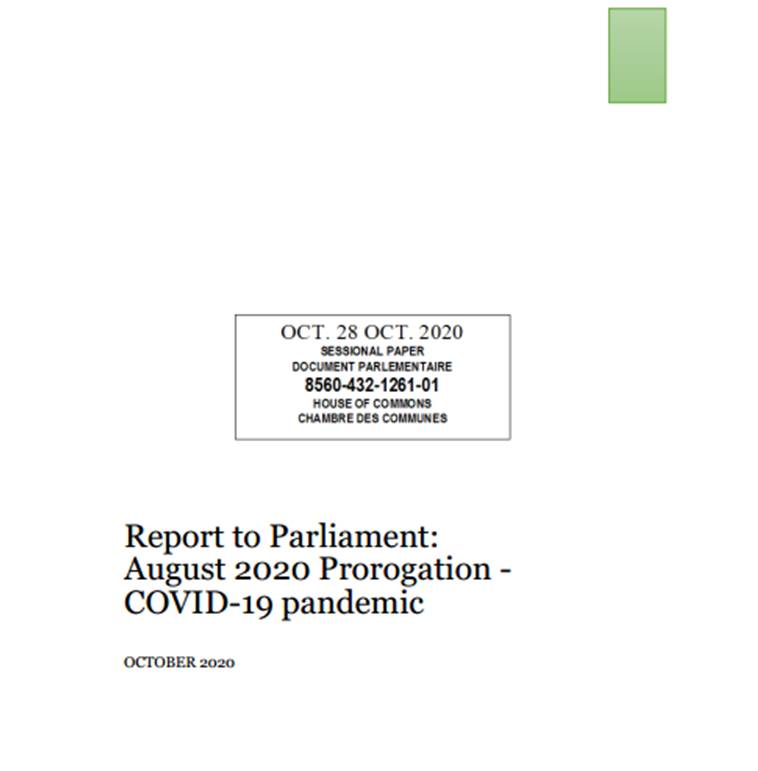
The Leader of the Government in the House of Commons dutifully tabled the document on 28 October as Sessional Paper 8560-432-1261-01,[2] revealing entitled Report to Parliament: August 2020 Prorogation – COVID-19 pandemic. I have uploaded it here to Parliamentum for your reference.

Continue reading

Posted in Crown (Powers and Office), Prorogation | 2 Comments

Justin Trudeau Has Made Prorogation Great Again


Update: The Government House Leader tabled the Retroactive Prorogation Rationale in the House of Commons on 28 October.

Introduction

On 19 August 2020, the exigencies of a minority parliament and global pandemic brought about the first prorogation of the Parliament of Canada in seven years.[1] The day before, Prime Minister J. Trudeau had dismissed Bill Morneau, the Minister of Finance –universally recognised in all Commonwealth Realms as the most important cabinet portfolio.[2] Most of the press, with the notable exception of Paul Wells[3], portrayed Morneau’s dismissal as a voluntary resignation.[4] But rumours of Morneau’s dismissal had swirled the previous week, at which time the Prime Minister sealed Morneau’s fate by publicly affirming his confidence in his Minister of Finance.[5] This first prorogation since 2013 also stopped parliamentary committees from continuing their investigation into the WE Scandal, which had proven politically embarrassing to the Trudeau government and to Trudeau and Morneau in particular.[6] Under the circumstances, it is therefore difficult to deny the tactical nature of Trudeau’s first prorogation, which shows striking parallels to Harper’s second tactical prorogation of December 2009, which also halted a parliamentary committee’s study into a politically embarrassing issue. The proclamation set the start of the 2nd session of the 43rd Parliament for 23 September.[7]

But this prorogation should never have happened. Justin Trudeau became Prime Minister in 2015 pledging to put an end to the tactical prorogations of Stephen Harper. The Liberal platform in 2015 had declared: “Harper has used prorogation to avoid difficult political circumstances. We will not.”[8] In 2017, the Trudeau government published a discussion paper reiterating that pledge: “There have been instances where Governments have prorogued early in the session to avoid politically difficult situations. The Government committed to Canadians to not abuse prorogation in such a manner.”[9] Indeed, when the Liberals commanded a parliamentary majority, Trudeau initially hewed to his promise so literally that he took the unprecedented step of never proroguing the 42nd Parliament at all, the first time in Canadian history that a majority parliament lasted for four years under one session. The 1st session of the 42nd Parliament therefore, rather absurdly, lasted from December 2015 to October 2019. But the political exigencies of a minority parliament and the Pandemic conspired to make tactical prorogation too tempting once more.

Justin Trudeau has now made prorogation great again.

Continue reading

Posted in Crown (Powers and Office), Prorogation | 2 Comments