
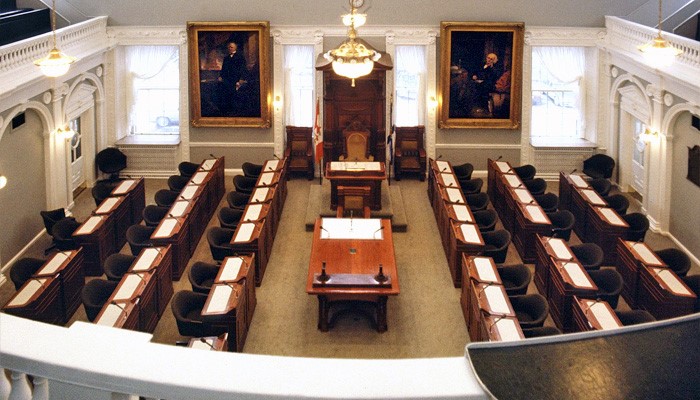
Nova Scotia’s Failed Fixed-Date Election Bills, 2007-2014
No province has agonized over fixed-date elections like Nova Scotia. Its House of Assembly has debated several private members’ bills to establish fixed-date elections and almost joined in the first wave of legislation back in 2007 and then almost joined the second wave of fixed-date legislation in 2013. But three successive ministries of the three main Canadian parties between 2007 and 2015 – those of Conservative Rodney MacDonald (February 2006 to June 2009), New Democrat Darrell Dexter (June 2009 to October 2013), and Liberal Stephen McNeil (October 2013 to February 2021) – all declined to table such legislation. More extraordinarily still, a Liberal backbencher named Stephen McNeil introduced the first bill in 2007 yet ultimately decided as Premier in 2013 and 2014 not to support two Conservative private members’ bills ostensibly because he had not decided upon establishing the schedule in spring versus fall.[1] But on 8 April 2015, Premier McNeil announced that his government would not table legislation to enact fixed-date elections in Nova Scotia because they were not fit for purpose.[2] He said:
“What we are seeing is the fixed dates haven’t been working, so when we amended the legislation we didn’t put one in. Legislation across the country hasn’t resulted in fixed election dates, that’s the issue. We’re not in the business of creating legislation that people don’t adhere to or wouldn’t be adhered to in this province.”
McNeil abruptly shifted course on 8 April because of what two of his opposite numbers had just done. Alberta enacted its fixed-date election law in 2012, and Prince Edward Island’s dates back to 2008, yet these laws did not prevent Wade MacLaughlan, Liberal Premier of Prince Edward Island, from obtaining a snap election on 6 April and Jim Prentice, Conservative Premier of Alberta, from doing the same on 7 April.[3] This double act also marked the first two occasions where Premiers obtained snap elections in majority legislatures – the very scenario which the modern incarnation of fixed-date election laws would supposedly always prevent after Chretien’s successive snap elections in 1997 and 2000. The previous early dissolutions and snap elections under fixed-date election laws in Canada in 2008 and Ontario and Quebec in 2014 occurred in minority parliaments.
But Nova Scotia, which had long stood as the last redoubt of the old ways, became the last jurisdiction in Canada to enact a fixed-date election law on the Fifth of November 2021. After twenty years, fixed-date election laws have now completed their long march through the legislatures. It began with British Columbia in 2001 and ended with Nova Scotia in 2021.

 James Bowden's Blog