
Election of 2025
On 28 April 2025, we returned yet another minority parliament in the 45th federal general election. Elections Canada’s preliminary results show that this general election brought out the highest voterturnout since 1993, at 68.7% compared to 69.6% thirty-two years ago. The fervent proponents of proportional representation should take heart that the Bloc Quebecois won 6.3% of the vote and 6.4% of the seats and that the Conservatives won 41.3% of the votes and 42.0% of the seats, though they will lament that the New Democrats suffered from an inefficient vote, winning 6.3% of the popular vote but only 2.0% of the seats, and will curse that the Liberals won 49.3% of the seats from 43.7% of the popular vote.
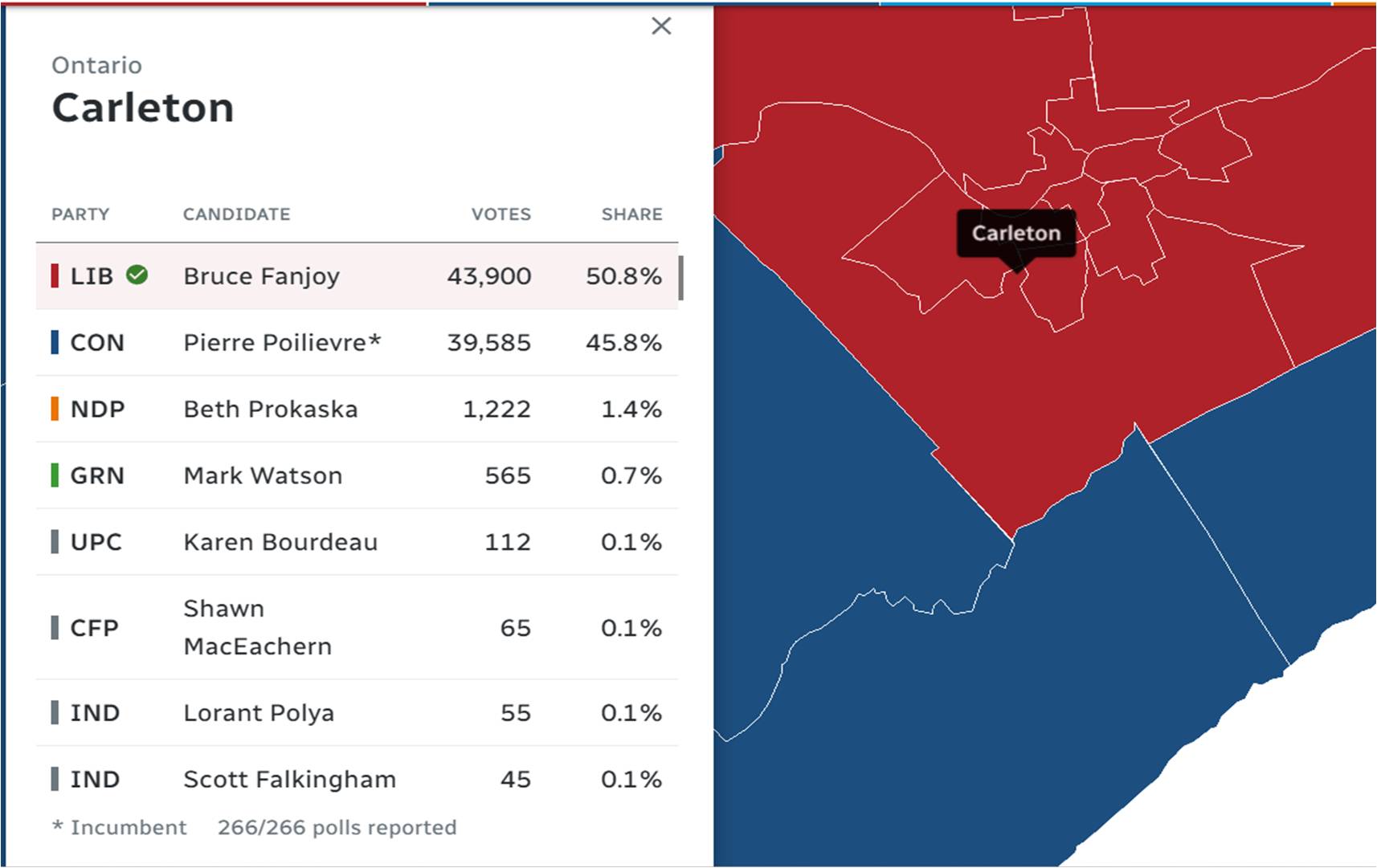
But the Age of Minority Parliaments continues despite the enormous turnout and engagement. While the Conservatives increased their share of the popular vote from 33.74% in 2021 to 41.3% in 2025, the Liberals increased theirs from 33.62% to 43.7% and came within only 3 seats of winning a bare majority (or 4 counting a Liberal Speaker), returning 169 MPs opposite 144 Conservatives, 22 Blocists, 7 New Democrats, and 1 Green.[1] Both Jagmeet Singh, the outgoing leader of the New Democratic Party, and Pierre Poilievre, leader of the Conservative Party, lost their own seats. Not only did Mark Carney immediately reverse two years of precipitous decline almost lead the Liberals to an outright majority, but the Liberals will soon face an official opposition without its leader, a demoralised rump of seven New Democrats who have lost their status as an official party in the House of Commons (which, incidentally, means that they need not hold any votes on whether to apply the Reform Act to themselves), a diminished Bloc Quebecois, and the perennial but septuagenarian Elizabeth May withering on the vine of the Green Party. If Poilievre had retained his own seat in Carleton, the Conservatives would almost certainly keep him as leader. But his humiliating defeat and pending absence from the new House of Commons might make some Conservative MPs look elsewhere. The Reform Act might give them the instrument to oust yet another leader.
What the Reform Act Says
In April 2014, Conservative MP Michael Chong first tabled the legislation which eventually became the Reform Act in June 2015.[2] The bill at First Reading would have added five procedures to the Parliament of Canada Act which outlined how recognised parties in the House of Commons could conduct leadership reviews, oust their leaders and appoint an interim leader, remove members from the parliamentary party, and re-admit said members to the parliamentary under some conditions. These provisions would have applied automatically to all parliamentary parties as a matter of course, like any normal statutory provision.
But Chong had to accept significant amendments to his bill, which nearly gutted it, in order to secure its passage. The Reform Act as enacted in 2015 made all these automatic procedures contingent instead: every parliamentary party has to decide when it first meets after each general election whether to subject itself to each of the procedures, separately, and the decision applies only for the life of that particular parliament. In its first meeting after each general election, each parliamentary party must (but under no pain of true enforcement) vote on whether to apply each of these five procedures to itself for the duration of each parliament:
- Section 49.2: That a member of the House of Commons can only be expelled from the parliamentary party if at least 20% of the members of the parliamentary party ask that the caucus chair hold a vote to review the other member’s status, and if a simple majority of the parliamentary party votes by secret ballot to expel that member;
- Section 49.3: That a member of the House of Commons so expelled under that procedure can only become a member of that parliamentary party again by being re-elected as a candidate of that party, or if at least 20% of the members of the parliamentary party ask the caucus chair hold a vote to review the other member’s status, and if a majority of the parliamentary party then votes by secret ballot to re-admit that member;
- Section 49.4: The parliamentary party by secret ballot elects from amongst its members a caucus chair, who can only be removed if at least 20% of the parliamentary party deliver written notice to that effect, and if a majority by secret ballot then vote to oust said caucus chair;
- Section 49.5: The parliamentary party can initiate a “leadership review” by secret ballot “to endorse or replace the leader of a party” if at least 20% of its members sign a written notice to that effect. If a majority of the parliamentary party then votes to oust their leader, the caucus chair then presides over a second vote to elect an “interim leader” until the party holds its formal leadership election amongst its broader membership at one of those daft conventions.
- Section 49.6: The parliamentary party shall elect an “interim leader” as soon as possible under the procedure outlined in section 49.5 if the leader dies in office, becomes incapacitated, or resigns.[3]
The procedures in 49.2 and 49.3 are counted in the same vote, which is why a parliamentary party votes on whether to adopt four procedures under the Reform Act. These procedures could have applied to the three parliaments elected in 2015, 2019, and 2021, and they will soon apply to the 45th Parliament elected in 2025 once it meets for the first time later this year. As of the 44th Parliament, only the Conservative parliamentary party has ever voted to apply any of the procedures to itself, perhaps because the other political parties seem to regard this legislation as an attempt to change the Conservative Party’s procedures through a higher authority – not an entirely unfair criticism given that Chong’s legislation did ultimately flow from the conservative in-fighting of the 2000s.
Speaker’s Ruling in 2019
On 2 April 2019, Justin Trudeau called what The Globe and Mail characterized as “emergency meeting of the national caucus” to announce that he had unilaterally expelled two former ministers, Jane Philpott and Jody Wilson-Raybould, from the Liberal parliamentary party.[4] Both Philpott and Wilson-Raybould had resigned from cabinet in protest over Trudeau’s handling of SNC-Lavalin Scandal and his insistence that Wilson-Raybould, as Attorney General, seek a deferred prosecution agreement in the case. Given that caucuses usually meet on Wednesday morning rather than on Tuesday night, that seems like a fair characterization. On 9 April 2019, Jane Philpott raised a point of privilege and argued that Trudeau violated the Reform Act when he expelled her and Wilson-Raybould from the Liberal parliamentary party unilaterally.
When the Prime Minister and his office prevented Liberal members of Parliament from exercising their rights under section 49.8, they violated the rights of Liberal members in three ways.
First, the Prime Minister deprived members of their right under right under section 49.8 to vote four times in a recorded manner.
Second, in depriving members of their right to vote, the Prime Minister denied members the opportunity to adopt the rules in sections 49.2 and 49.3 concerning caucus expulsions and caucus readmittance respectively. In doing so, the Prime Minister deprived members of their right to determine the expulsion of a caucus colleague on a secret ballot vote and their right to determine the readmittance of a Liberal member to the caucus on a secret ballot vote.
Third, in denying members their right to vote and adopt the expulsion rule in section 49.2 and the readmission rule in section 49.3, the Prime Minister denied members being considered for expulsion or readmission the right to a due process, one that is not ad hoc, not arbitrary nor unlawful. […]
In other words, on April 2, 2019, when I and the member for Vancouver Granville were expelled by the Prime Minister, the Liberal caucus had 179 members, which means that at least 90 Liberal MPs would have been required to vote in favour of expulsion in a secret ballot. If only 120 MPs showed up to vote, 90 votes in favour of expulsion would still have been required.
The Prime Minister stated at the April 2 open meeting of the Liberal caucus and on national television that he had taken the decision to expel the honourable members from caucus. The Prime Minister added that he had met with me and the member for Vancouver Granville to inform us of his decision. This confirms that we were expelled prior to the commencement of the Liberal caucus meeting.
The Prime Minister‘s words that night to the Liberal caucus are important to underscore because expulsion should not be his decision to take unilaterally. However, the decision had been already made. [5]
Speaker Regan replied right away that he cannot enforce statutes but pledged to deliver a fulsome ruling before the House of Commons later. Two days later on 11 April 2019, Regan set the operative precedent in 2019 that the Speaker of the House of Commons would not even try enforcing the law. He ruled that the parliamentary parties must enforce it themselves. Consequently, if they decide not to abide by the law, then no one can do anything to force them to abide by it.
The issue at hand is quite simple: The Chair is being asked, as was the case with the recent ruling on a similar matter, to determine whether provisions included in the Parliament of Canada Act, as they relate to matters of caucus, have been violated. […]
It is the caucus of each recognized party, not the Speaker, which bears the responsibility for ensuring that these votes are held. In fact, the only role of the Speaker is to be advised of the caucus decision. Section 49.8(5) of the act states: 49.8(5) As soon as feasible after the conduct of the votes, the chair of the caucus shall inform the Speaker of the House of Commons of the outcome of each vote. The Speaker’s role stops there. It does not, in any way, extend to interpreting the results of the votes, how the votes were taken or interpreting any other relevant provisions. This is very much in keeping with the general restraint on Speakers when they are asked to interpret the law.
[…]parliamentary privilege and, thus, the authority of the Speaker is limited to the internal affairs of the House, its own proceedings. It does not extend to caucus matters. […]This leaves caucuses alone with the authority to govern their internal operations. […]
With the full authority given to caucuses themselves in such unequivocal terms, it is clear that the Chair has no role in the interpretation or enforcement of this statute, even when members feel rudderless without what they feel would be clearly stated and understood rules.[6]
The Reform Act In Practice
So far, the Conservative parliamentary party made use of the Reform Act twice. During the 43rd Parliament, Conservative MPs kicked Derek Sloan out caucus on 20 January 2021 because he had accepted a political donation from a white nationalist.[7] During the 44th Parliament, the Conservative caucus voted on 2 February 2022 to oust Erin O’Toole as partyleader by a margin 73 to 45 over the party’s disappointing performance in the election of 2021 and the fallout of the Convoy’s blockade of downtown Ottawa; [8] they named Candice Bergen as interim leader until holding a full leadership election where 68.15% of partymembers elected Pierre Poilievre on the first ballot on 9 September 2022.[9] But the fates have now turned against Poilievre. He lost his own seat of Carleton, which he had held continuously since 2004, by 5%, even though the Conservative Party increased its share of the popular vote and returned twenty-four more MPs in the general election.[10]
The Liberal parliamentary party declined in the 42nd, 43rd, and 44th Parliaments to apply the provisions of the Reform Act to itself, which gave Trudeau the latitude to exact internal punishments unilaterally, to pressure Liberal MPs to resign from caucus, and, ultimately, to delay his own resignation by several months. For example, Trudeau unilaterally ousted both Jody Wilson-Raybould and Jane Philpott from the parliamentary party in 2019, even though they had resigned from cabinet before criticising him publicly.[11] The Liberal parliamentary party failed to abide by the terms of the Reform Act after the election of 2015 when Liberal MPs did not hold a recorded vote at all in their first caucus meeting on whether to apply the terms of the act to themselves for the duration of the 42nd Parliament.[12] Since the Liberals did not even vote on whether to apply the Reform Act to themselves for the 42nd Parliament, elected in 2015, Trudeau remained free to oust MPs unilaterally. The same went for the New Democrats.
In 2019, the Liberal parliamentary party seems to have held the proper vote but declined to apply the Reform Act to itself for the 43rd Parliament.[13] In the 44th Parliament elected in September 2021, only the Conservative parliamentary party decided to subject itself to all four elements of the Reform Act.[14] The New Democrats and Blocists decided not to adopt any of the terms of the legislation, and the Liberals likewise unanimously rejected all provisos.[15] Many Liberal MPs came to regret their decision to ignore the Reform Act by the summer and fall of 2024 when they failed to force a recalcitrant Justin Trudeau to resign in October 2024 and again in December 2024. However, Trudeau still had no choice but to announce on 6 January 2025 that he would resign as leader of the Liberal Party and Prime Minister once the Liberals chose his successor.
The Perilous Precedents for Poilievre
Already the lone Conservative re-elected in Nova Scotia, Chris d’Entremont, has expressed some skepticism toward Poilievre’s leadership: “It’s going to be difficult to question or keep government to account from outside of the House of Commons. Is it going in, finding another riding somewhere in Canada and calling a by-election? I don’t think that’s fair, I believe, for the person that just ran for a year, trying to get elected in their area, but that’s a discussion we need to have as a caucus.”[16]
The Conservatives have set precedents over the last six years which now put them in a bind: they ousted Andrew Scheer after the election of 2019 and Erin O’Toole after the election of 2021 when they both succeeded only in holding the Liberals to a plurality in the House of Commons and minority government. Even if the Conservatives resolve to keep Poilievre as their leader, the Carney government could also delay his return to the Commons in a by-election by up to six months.[17] The historical precedents also work against Poilievre. In 1983, Elmer McKay resigned his seat in Central Nova so that Brian Mulroney, whom the Progressive Conservatives had just elected and a leadership convention, could run in a by-election and enter the House of Commons. But McKay did so with the understanding that the next election would probably happen within one year or so. In our case in 2025, the loyal Conservative who gives up his seat for Poilievre could have to wait four years to run again, given that Carney’s Liberals only fell three seats short of a majority in this new 45th Parliament, which does not have to be dissolved until September 2029.
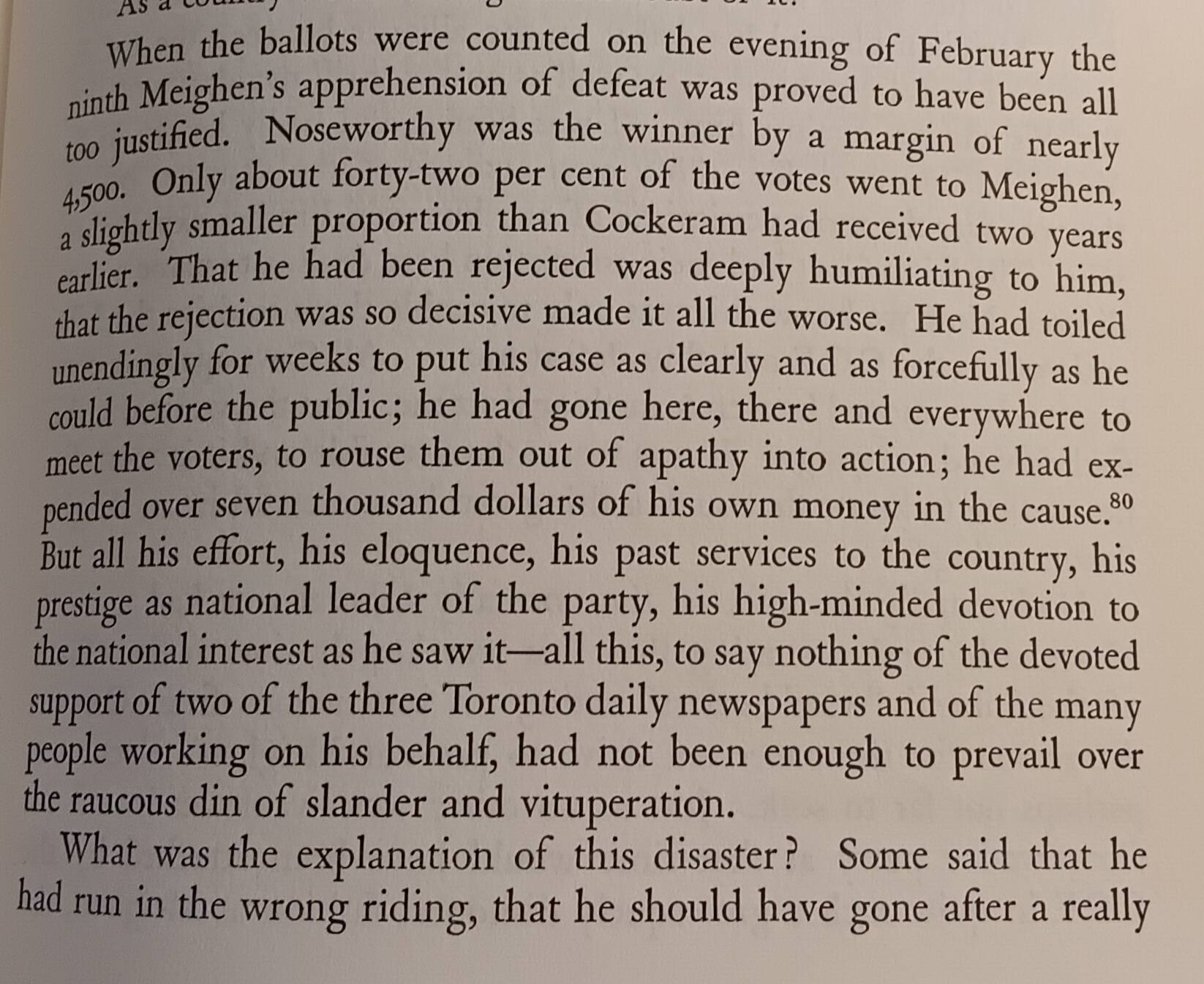
Other precedents also do not bode well. One hundred years, Mackenzie King lost his own riding in the election of October 1925 where Arthur Meighen’s Conservatives also won the plurality. But King insisted on remaining as Prime Minister and testing the confidence of the new House of Commons, which his ministry obtained during his absence on 14 January 1926.[18] Charles MacDonald resigned as the Liberal MP for Prince Albert, which allowed Mackenzie King to run in the riding.[19] Arthur Meighen decided that the Conservatives would not contest the by-election; King won the riding by acclamation and re-entered the Commons in February.[20] But King here controlled the timing of the by-election in a way that Poilievre today cannot. Perhaps the closest precedent happened in the early 1940s and also does not work in Poilievre’s favour. Arthur Meighen returned to lead the Conservative Party once more on 12 November 1941, but he retained his seat in the Senate until 1942 when he tried to re-enter the House of Commons in a by-election.[21] Meighen won 42% of the vote in South York but still lost to J.W. Noseworthy of the Co-operative Commonwealth Federation on 9 February 1942.[22] Meighen later resigned in defeat as leader of a rudderless Conservative Party on 9 December 1942.[23]
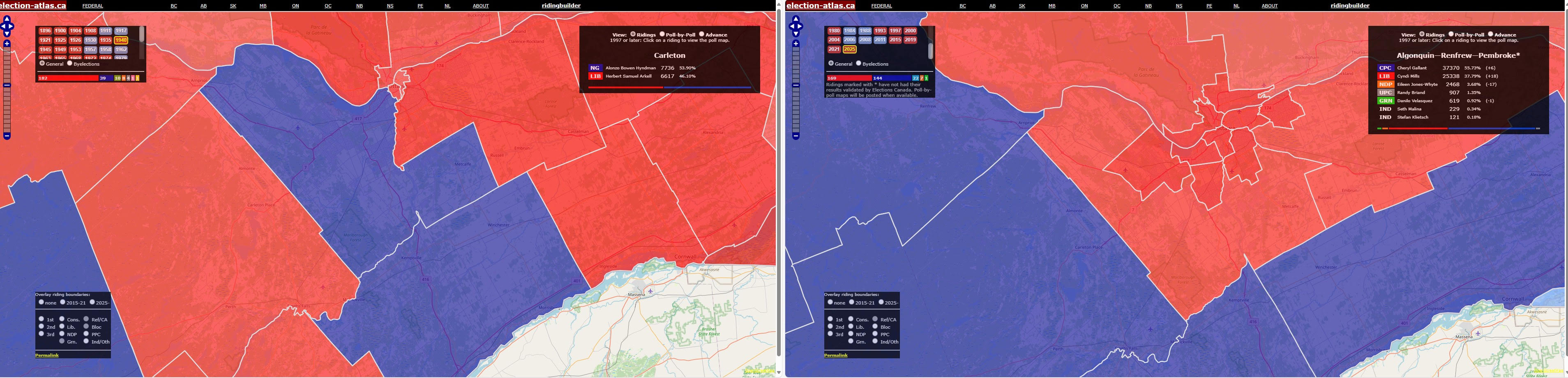
On the left is Carleton as a safe Conservative seat under the Representation Act, 1933 as it appeared when Arthur Meighen tried to re-enter the House of Commons in 1942. On the right is Carleton as it appears today under the Representation Order, 2023. By coincidence, the two configurations of Carleton 90 years apart share the same western and southern borders. But they did not for most of the decades in between.
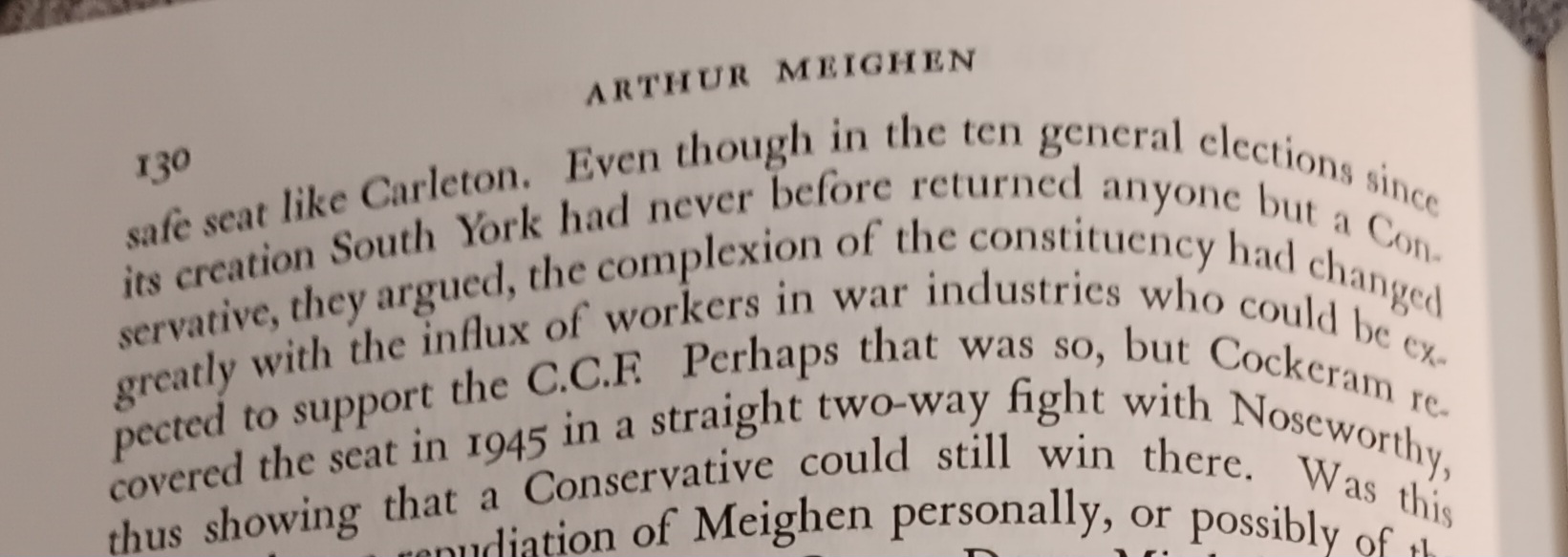
And in an amusing irony of history, Meighen’s biographer Roger Graham recounted that Conservatives tried to persuade Meighen to run not in York South but instead “should have gone after a really safe seat like Carleton”– until recently, Pierre Poilievre’s riding of 21 years – which in 1942 covered almost exactly the same territory as it does in 2025. [24]
The Reform Act in 2025
In 2022, I argued that the unenforceable Reform Act will only prove its mettle if the caucus of the governing party votes to apply its procedures to itself. Even though the Liberals just went through the travails of trying to oust Trudeau for several months in 2024, I suspect that they will once again either not bother holding a vote at all on whether to apply the Reform Act to themselves or will vote against adopting it because if a parliamentary party votes to apply the Reform Act to itself, this in and of itself could be construed as a lack of confidence in the partyleader. In contrast, if Parliament had enacted Chong’s original bill as it appeared at First Reading, which would have applied all these rules automatically to every parliamentary party in every parliament, the question could fade into the background. I expect that the Conservatives will vote to apply the Reform Act to themselves when the 45th Parliament convenes later this spring, as they have in the previous parliaments, if only to give themselves options. They might to hold a vote and keep Poilievre as leader and then decide amongst themselves who should resign to make way for Poilievre to run in a by-election and re-enter the House of Commons later this year.
In any case, the 45th Parliament should already prove eventful.
Similar Posts:
- The Transfer of Power Between Justin Trudeau and Mark Carney (March 2025)
- Justin Trudeau Had an Epiphany and Endorsed My Doctrine of Prorogation (January 2025)
- All I Want for Christmas Is a Constitutional Crisis (23 December 2024)
- Ousting Party Leaders: From the King Doctrine to the Unenforceable Reform Act (October 2024)
- Dissenting Liberal MPs Fail to Thatcher Trudeau (October 2024)
- The Most Pointless Election Since 1965 (September 2021)
Notes
[1] Elections Canada, “April 28, 2025 General Election: Election Results,” accessed 30 April 2025.
[2] An Act to amend the Canada Elections Act and the Parliament of Canada Act (candidacy and caucus reforms), SC 2015, c. 37.
[3] An Act to amend the Canada Elections Act and the Parliament of Canada Act (candidacy and caucus reforms), SC 2015, c. 37, at section 4.
[4] Robert Fife, Steven Chase, and Janice Dickson, “Trudeau Expels Wilson-Raybould and Philpott from Liberal Cuacus over SNC-Lavalin Affair,” The Globe and Mail, 2 April 2019.
[5] Jane Philpott, “Privilege: Alleged Process Used to Determine Liberal Caucus Membership,” House of Commons Debates, 42nd Parliament, 1st Session, Volume 148, Number 403, Thursday, 11 April 2019, at pages 26847-26848.
[6] Geoff Regan (Speaker of the House of Commons), “Privilege: Alleged Process Used to Determine Liberal Caucus Membership – Speaker’s Ruling,” House of Commons Debates, 42nd Parliament, 1st Session, Volume 148, Number 403, Thursday, 11 April 2019, at pages 26975-26976.
[7] Catharine Tunney, “Conservatives Have Voted to Expel Derek Sloan from Caucus,” CBC News, 20 January 2021.
[8] Catherine Levesque, “Updated: Erin O’Toole Ousted as Leader of the Conservative Party, Will Stay On As MP,” The National Post, 2 February 2022.
[9] Rachel Aiello, “Pierre Poilievre Wins Conservative Leadership on First Ballot,” CTV News, 10 September 2022.
[10] John Paul Tasker, “Poilievre Faces Uncertain Future After Losing His Own Seat and Failing to Depose the Liberals,” CBC News, 29 April 2025.
[11] Marie-Danielle Smith, “Did Trudeau Break the Law by Expelling MPs?”National Post, 10 April 2019, A4.
[12] Andrew Coyne, “Clean, Quick Caucus Coup Less Bloody,” National Post, 5 November 2019, A4.
[13] Joan Bryden, “Liberal MPs Take Pass on Caucus Power,” National Post, 12 December 2019.
[14] Ian Campbell, “NDP and Bloc Caucuses Vote Not to Adopt Reform Act Measures,” The Hill Times, 22 October 2021.
[15] Ian Campbell, “Liberal Caucus Votes Unanimously Against Reform Act Measures,” The Hill Times, 11 November 2021.
[16] Stephanie Levitz, “Prominent Conservatives Back Poilievre as Leader After Riding Loss,” The Globe and Mail, 30 April 2025.
[17] Canada Elections Act, S.C. 2000, c. 9, at section 57(1.1)
[18] House of Commons of Canada, Journals, 15th Parliament, 1st Session, Volume LXIII (63), No. 6, Thursday, 14 January 1926, at pages 28-29.
[19] F.C. Mears, “Saskatchewan Seat Opened for Premier; Voting Day, Feb. 15, The Globe, 16 January 1926, at page 1.
[20] F.C Mears, “No Opposition for Premier King,” The Globe, 27 January 1926, at page 1.
[21] Frank Flaherty, “Meighen Becomes Chief of Conservative Party; Favors Non-Party Govt.,” The Evening Citizen, 13 November 1941, at page 15.
[22] The Evening Citizen, “Conservative Leader Defeated, 2 Cabinet Ministers Elected, Third Liberal Also Wins Seat,” 10 February 1942, t page 13; Roger Graham, Arthur Meighen, Volume III – No Surrender (Toronto: Clarke, Irwin & Company Limited, 1965), 129-131.
[23] The Evening Citizen, “Meighen Reveals His Intention to Pass from Stage,” 9 December 1942, at page 1.
[24] Graham, Arthur Meighen, Volume III, 129-130.

 James Bowden's Blog
An elected Calgary MP has already offered to resign his seat to allow PP to get into the House. Carney and the Liberals should have the decency to then immediately call the by-election allowing for the shortest writ period allowed under Canada Elections Act for that. That is the most we can expect.
MP Englemont is showing typical “tory syndrome” by prematurely and quite ignorantly for him given his experience to suggest that PP’s absence from the House even for a short time will seriously
hamper the Conservatives in opposition- that is nonsense and he knows it.
Mike Donison, West Kelowna, B.C.
LikeLike