
The 15th Snap Election Notwithstanding a Fixed-Date Elections Law
Ontarians last went to the polls during the pandemic on 2 June 2022 in accordance with section 9 of the Election Act:
General elections at four-year intervals
Powers of Lieutenant Governor
9 (1) Nothing in this section affects the powers of the Lieutenant Governor, including the power to dissolve the Legislature, by proclamation in Her Majesty’s name, when the Lieutenant Governor sees fit. 2005, c. 35, s. 1 (3).
First Thursday in June
(2) Subject to the powers of the Lieutenant Governor referred to in subsection (1), general elections shall be held on the first Thursday in June in the fourth calendar year following polling day in the most recent general election. 2016, c. 33, s. 7.[1]
They would have gone again on 4 June 2026, but Doug Ford, Premier of Ontario, decided otherwise. He made this speculation official on 24 January 2025 at a press conference in Brampton, and he formally requested that Lieutenant Governor Edith Dumont dissolve the 43rd Legislature on 28 January. However, Her Honour could not issue the writs of election until 29 January because “a writ for an election shall be dated on a Wednesday” under section 9.1(3) of the Election Act[2] for an election on 27 February 2025, the “fifth Thursday after the date of the writ.”[3] The writ period in Ontario therefore lasts 29 days.
Months of Speculation
Speculation began as early as 15 April 2024, when Steve Paikin advised his readers to look out for the signs of an early election – even before Ford had said anything himself.[4]
Premier Ford himself fed the speculation on 24 May 2024 when he refused to answer the simple question of whether he would follow the electoral schedule – four times in a row.[5]
17:42 Rob Ferguson, Toronto Star: Hi, Premier. Rob Ferguson, Toronto Star
Doug Ford: Hi, Rob, good morning
Rob Ferguson: As you’ve mentioned, this is a big promise from 2018 that’s finally been fulfilled. Does this by moving it ahead of schedule, does this give you room, and are you planning to use this, to get this out of the way, get it implemented and call an early election?
Doug Ford: No, what we’re doing is keeping a promise, Rob, but thanks for the question. You know, we have a long agenda that we’re fulfilling the promises – Promises Made, Promises Kept – we’re getting it done for the people of Ontario […]
19:13 Rob Ferguson: So are you committing then to sticking with the June 2026 election schedule, you’re going to stick to that date?
Doug Ford: We’re going to make sure that we fulfill our agenda and our promises that we made, making sure we save taxpayers money, reducing the cost of doing business by $8 billion each and every year. […].
25:40 Siobhan Morris, CTV News: I want to try this one more time about uh the election date. Are you committed to June 2026, or should Ontarians be preparing for something maybe sooner?
Doug Ford: Well, we’re committed to getting our agenda through and making sure that we continue to create new opportunities and new jobs. When we took office in 2018, there was 300,000 people [whose] jobs were chased out of this province. […].
35:22 Jeff Gray, Globe and Mail: Premier, a follow up: that actually leads into my next question, because it does sound like there’s an election already underway, the way you’re talking this morning. You’ve twice declined to rule out calling an early election. Can you talk a bit about why you’re keeping your options open? Do you see an opportunity? The Liberals leader is not established yet; you’ve had some attack ads that have been a success against her. Is this a timing thing? You want to keep your options open when they’re weak?
Doug Ford: Well, again, I just want to get our agenda through. I want to continue building Ontario, creating more jobs that we never saw for 15 years in this province. All we saw is more and more debt, and, you know, hallway healthcare and jobs being run out of this province, and it just it was a nightmare. […].
Only after Ford refused to answer this simple question at the end of May 2024 did other journalists follow Steve Paikin’s lead and start to believe that we faced an early general election before that scheduled for June 2026.[6]
Ford Confirms Early Election
Prime Minister Trudeau decided only on 6 January 2025 that he should finally announce his intention to resign and turn himself into a lame duck just before Donald Trump took office again – all while getting parliament prorogued for two and a half months for the sake of the Liberals’ time-consuming leadership election. Ford took advantage of this chaos and uncertainty to obtain his snap election at a time when the federal Prime Minister had hamstrung himself from mounting a vigorous defence of our country.
On 24 January 2025, Ford announced that he would plunge the Province of Ontario – or “Ontairo”, with only three syllables, as he often calls this province – into an unnecessarily early election in the middle of winter.[7]
16:10 Premier, Lane Harrison, CBC News. We – myself and many of my colleagues – have it on good
authority as of yesterday that you will be calling an election next Wednesday. I was hoping you could send us into the weekend with a little bit of certainty and tell us once and for all: will you be calling an election next Wednesday?
Premier Ford: We will be calling the election next Wednesday. I’ll be see seeing the Lieutenant Governor on Tuesday. We need a mandate from the people to fight against Donald Trump’s tariffs. The attack is coming against our families, our businesses, our communities. And with a strong mandate, we will be able to fight with Donald Trump to make sure we stop the tariffs and make sure that we give certainty to the people of Ontario [Ontairo]. It may take investing tens of billions of dollars. We do tens of billions of dollars. It’s no different than during the pandemic. We’ll make sure that we secure people’s livelihoods, and I will do whatever it takes to protect the people of Ontario, in turn, because we’re the engine of Canada protecting all Canadians. We will not back down.
Lane Harrison: Okay, so speaking of that mandate, I mean, if you feel that you need a new mandate, do you feel like you’ve lost the confidence of the people of Ontario?
Premier Ford: To the contrary, to the total contrary, or Canada as well. Right now, there’s a lack of leadership at the federal level. And at the federal level, we don’t know who’s going to be the next prime minister. Right now, we need strong leadership in this country, we need strong leadership in this province, and we’re going to deliver that strong leadership for the people of Ontario.
Ford filled the vacuum that Trudeau created and waded far into federal jurisdictions, making outlandish claims that he would somehow negotiate directly with President Trump as if he were the Prime Minister of Canada instead of the Premier of Ontario. But a plurality of the 45.4% of eligible voters in Ontario who cast their ballots believed him and want Doug Ford to keep wearing his blue “Canada Is Not For Sale” baseballcaps. Meanwhile, Ford seems determined to continue ignoring the most pressing problems which fall primarily under provincial jurisdiction; he seems especially uninterested in trying to solve the ongoing Housing Crisis by getting more housing built in Ontario.
Ford Refused to Make the Electoral Map More Equal
On 1 August 2024, Doug Ford laughed off the suggestion that Ontario should follow the precedents since the 1990s and bring at least its southern electoral boundaries in line with the new federal electoral boundaries for Ontario on the grounds that “the feds jerry-rig the ridings” and that he did not want to add more politicians to Queen’s Park.[8] Incidentally, he also hinted in those remarks that he would not wait until 2026 before facing the voters again:
“I’m going to leave the boundaries alone, and people will decide if they want to move forward with our government on prosperity, on healthcare, on the economy, or they want to go backwards and vote for the other guys. They’ll have that choice.”[9]
I took personal offence at the time to Ford’s ignorant outburst and resent it after having devoted two years of my life to the most recent federal electoral readjustment and supported the work of the Federal Electoral Boundaries Commissions. I even drafted the perfunctory forewords of the final reports of several of the commissions, including Ontario’s. Ford deserves the utmost contempt and disdain for having falsely accused the Federal Electoral Boundaries Commission for the Province of Ontario of gerrymandering when it did nothing of the sort but instead gave Ontario one of the best and most proportional electoral maps in the history of this province.
Ford’s steadfast ignorance forced Ontarians to vote under an unequal and disproportionate electoral map on 27 February 2025. The populations of 6 of the 121 electoral districts established in 2013 had by 2021 exceeded the electoral quota (average number of people per MP) by greater than 25% – the maximum allowance under the federal Electoral Boundaries Readjustment Act – and 24 exceed the electoral quota by greater than 10%. Brampton West stands out as the most disproportional by far; its population exceeds the electoral quota by fully 39.25%. In contrast, the adjacent riding of Brampton Centre comes in at -10.32% of the electoral quota. Other ridings within Toronto proper like Don Valley East come in at -18.48% of the electoral quota – which is why the Commission eliminated that riding altogether and redistributed it to the fast-growing areas of the western GTA. This electoral map from the 2010s, which the ages have now skewed, registers at 5.18% on the Loosemore-Hanby Index compared to only 2.87% when the Federal Electoral Boundaries Commission for the Province of Ontario created it in 2013. (The closer to 0, the more proportional, and therefore better, the electoral map is).
- 3. Loosemore-Hanby Index on the Representation Order, 2013
- 0. Loosemore-Hanby Index on Census of 2021 under the Rep Order, 2013
- 3. Loosemore-Hanby Index in the Representation Orders, 2023
But under the new electoral map for the 2020s, the populations of all ridings in the Western GTA fall below +10% of the electoral quota. This new map therefore provides a much fairer allotment and registers at 3.21% on the Loosemore-Hanby Index. One could make a strong case that the current electoral boundaries in the province of Ontario, flowing as they do from the federal electoral boundaries of the 2010s, have become disproportional enough that they violate the Doctrine of Effective Representation that the Supreme Court established in Carter in 1991. And given that Statistics Canada releases the quinquennial census in 2026, Ontario might want to rely on that data instead if the legislature chooses to update the province’s electoral boundaries independent of what happens at the federal level. But now that Ford has won another majority and re-set the next scheduled election to 7 June 2029, Ontarians face the prospect of going to the polls in another general election based on a census nearly two decades out of date. The disproportionality of these old boundaries based on the census of 2011 and proclaimed in 2013 will only worsen and climb higher than 5.18% in the interim.
Ford refused to table ad hoc legislation to bring Ontario’s southern provincial electoral boundaries in line with the new federal electoral boundaries for the Province of Ontario during the legislative assembly’s autumnal sitting between October and December 2024. Most Ontarians will now vote on February 27th based on electoral boundaries devised in 2012 and established in 2013 based on the census of 2011. The new federal electoral boundaries rely on the latest decennial census of 2021 and significantly reduced the disproportionality of the number of people per MP across Ontario.
Worse still, neither the Liberals nor the New Democrats could bother to table legislation to bring Ontario’s provincial electoral boundaries in line with its newer federal electoral boundaries. In fact, Hansard only records one entry on “electoral boundaries” in the entire 1st session of the recently departed 43rd Parliament of Ontario when Adil Shamji, the Liberal MPP for Don Valley East, complained self-servingly that the Federal Electoral Boundaries Commission for the Province of Ontario had abolished his riding at the federal level.[10]
Ironically, the new electoral map in southern Ontario would, if anything, have benefitted the Conservatives in the snap election on 27 February 2025 because Liberal candidate Adil Shamji won re-election in Don Valley East – a riding that no longer exists under Ontario’s new federal electoral map. Ford’s Conservatives did very well in the western GTA and would therefore probably have won two additional seats, given that the Commission redistributed Don Valley East there along with Ontario’s one entirely new riding.
The Provincial Premier Who Claims Victory Like a Federal Prime Minister
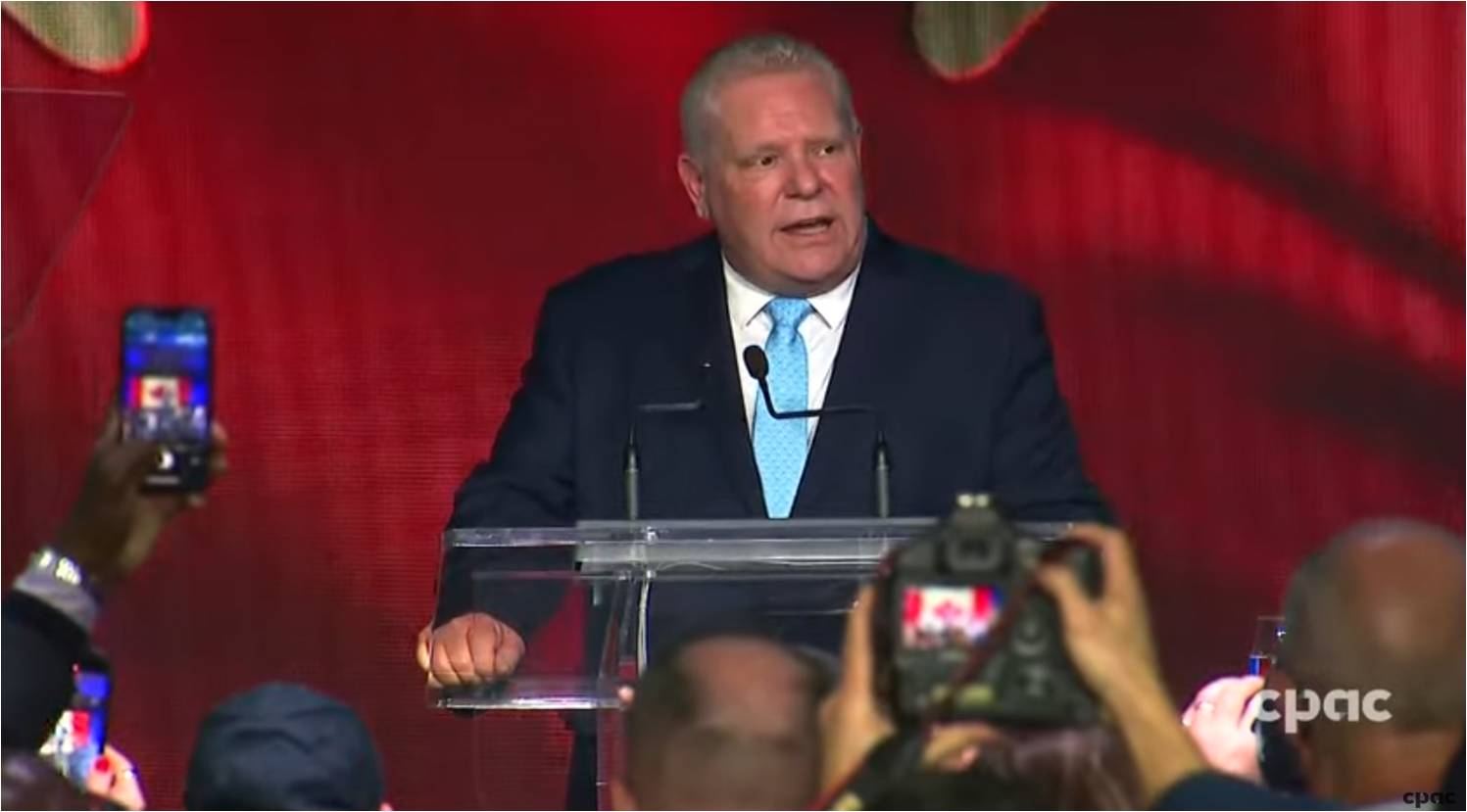
Ford also delivered a victoryspeech as if he were the Prime Minister of Canada instead of the Premier of Ontario. At 9:34 in CPAC’s video, the electronic screens displaying a blue background for the Progressive Conservative Party of Ontario suddenly morphed into a fluttering Canadian flag:
This election was about who we are, about the future we choose for ourselves. Donald Trump thinks he can break us. He thinks he can divide and conquer, pit region against region. Donald Trump doesn’t know what we know: he is underestimating us. He is underestimating the resilience of the Canadian people, the Canadian Spirit. Make no mistake: Canada won’t start a fight with the U.S., but you better believe we’re ready to win one! […] So folks, let me be clear: Canada will never ever be the 51st state, and Canada is not for sale!
Over the last weeks and months, I’ve seen the best of our province, the best of our country: hardworking people standing up for what’s decent for what’s right. It’s you the people who will get us through this, who will fight for our future. Together, we’re going to emerge from this stronger and more united than ever before, from coast to coast to coast. We’re going to stand together. We’re going to fight. We’re going to fight for our province. We’re going to fight for our country. Together, we’re going to protect Ontario. I want to thank you, and may God bless the people of Canada. May God bless the people of Ontario .[11]
Ford said the last word there once again as “Ontairo,” with an erroneous three syllables.
However, the events of the last five weeks, where President Trump decided to impose, and then rescind, his own executive order under the auspices of “Progress on the Situation at Our Northern Border” after having held another perfect phone call with Prime Minister Trudeau, show that Doug Ford as Premier of Ontario can do nothing about American tariffs. They will happen, or not happen, irrespective of Doug Ford, who can only stand by and watch the chaos unfold like the rest of us. Trump has most recently threatened to impose tariffs once more for 4 March 2025, only to rescind and then re-impose that threat. This whirlwind of chaos undermines one of Ford’s main claims that only he can protect Ontario and shield this province’s manufacturing sector with his enormous girth from Trumpian Tariffs; yet even though he clearly cannot do so, Ontarians believed him anyway.
Conclusion
Doug Ford secured the 15th snap election without first having lost the confidence of the House of Commons or legislative assembly and in defiance of fixed-date election laws scheduling polling day many months later. And as of 27 February 2025, 12 of those 15 snap elections – including Ford’s – have returned the incumbent government and therefore rewarded the incumbent first minister. Consequently, the legislative assembly that Ontarians just elected can now live up to Wednesday, 9 May 2029 for an election held on Thursday, 7 June 2029 under the current legislation. But Ontario and the other provinces should follow Nova Scotia’s lead and repeal the fixed-date election laws altogether because this experiment with the goal of stabilising the lifecycle of majority parliaments at four years has failed, and premiers continue to make a mockery of the fixed schedules.
Similar Posts:
- Fixed-Date Elections
- Nova Scotia Poised to Repeal Its Fixed-Date Elections Law (February 2025)
- Tim Houston’s Snap Election in Nova Scotia (November 2024)
- Fixed-Date Election Laws and Voter Turnout (November 2023)
- Prince Edward Island Holds Third Consecutive Early Election in Defiance of Its Fixed-Date Elections Law (March 2023)
- Nova Scotia Enacts Canada’s Last Fixed-Date Election Law (January 2022)
- Why Justin Trudeau’s Snap Election in 2021 Does Not Break the Fixed-Date Elections Law (August 2021)
- Wade MacLauchlan Has Become the First Premier to Ignore a Fixed-Date Election Law Twice (April 2019)
- Newfoundland and Labrador Will Also Go for An Early Election in May 2019 (April 2019)
- Politicos No Longer Give Fixed-Date Election Laws a Second Thought (September 2018)
- When Snap Elections Are Good and Just (August 2018)
- Will Wade MacLauchlan Become the First Premier to Ignore a Fixed-Date Election Law Twice? (May 2018)
Notes
[1] Election Act, R.S.O. 1990, chapter E.6, at section 9.
[2] Election Act, R.S.O. 1990, chapter E.6, at section 9.1(3).
[3] Election Act, R.S.O. 1990, chapter E.6, at section 9.1(5).
[4] Steve Paikin, “Keep Your Eyes Open for Signs of an Early Election Call in Ontario,” TVO Today, 15 April 2024.
[5] CPAC, “Premier Doug Ford Announces Beer and Wine Coming to Corner Stores in Ontario – May 24, 2024,” steamed live on 24 May 2024. The exchanges occur between 17:42 and 19:13, at 25:40, ant at 35:22.
[6] CTV News, “Premier Doug Ford Fuels Early Ontario Election Speculation by Declining to Commit to June 2026,” 24 May 2024; John Michael McGrath, “What Ontario’s Contract with the Beer Store May Tell Us about Election Timing,” TVO Today, 31 May 2024; Robyn Urback, “Ontario Blowing $225-Million to Cancel Its Beer Store Contract Is a Scandal, Not Something to Celebrate,” The Globe and Mail, 28 May 2024; CTV News, “Ontario Parties Spend Summer Preparing for Possibility of an Early Election,” 21 August 2024; Chris Fox, “Doug Ford and PCs in ‘Majority Government Territory’ as Election Speculation Builds: Poll,” CTV News, 29 August 2024; CTV News, “Ford Rules Out Ontario Election in 2024, But Could Call an Early Election in 2025,” 4 September 2024; Shawn Jeffords, “Ontario Political Parties Scramble to Prepare Ahead of Possible Early Election,” CBC News, 16 January 2025; Lucas Powers, “Ford Signals an Early Ontario Election Is Coming as Trump Muses Again About Stiff Tariffs,” CBC News, 20 January 2025; Ethan Lang, “Internal PC Memo Signals Ontario Premier Will Likely Call Early Election,” CBC News, 21 January 2025; John Rieti and Sarah Petz, “Ford Could Call Ontario Election as Early as Next Week: Sources,” CBC News, 22 January 2025; Lane Harrison, “Doug Ford Planning to Call Ontario Election Next Wednesday: Source,” CBC News, 23 January 2025.
[7] CPAC, “Premier Ford Announces LRT Expansaion, Confirms Upcoming Ontario Election Call – January 24, 2025,” streamed live on 24 January 2025.
[8] CPAC, “Ontario Premier Doug Ford on Health Services, Electoral Districts, Child Welfare – August 1, 2024,” 1 August 2024.
[9] Ibid.
[10] Adil Shamji, “Member’s Statements: Riding of Don Valley East,” in Legislative Assembly of Ontario, Hansard, 43rd Parliament, 1st Session, No. 68A, Thursday, 20 April 2023, at page 3737.
[11] CPAC, “Ontario Election: Progressive Conservative Leader Doug Ford Delivers Victory Speech,” streamed live 27 February 2025.

 James Bowden's Blog