
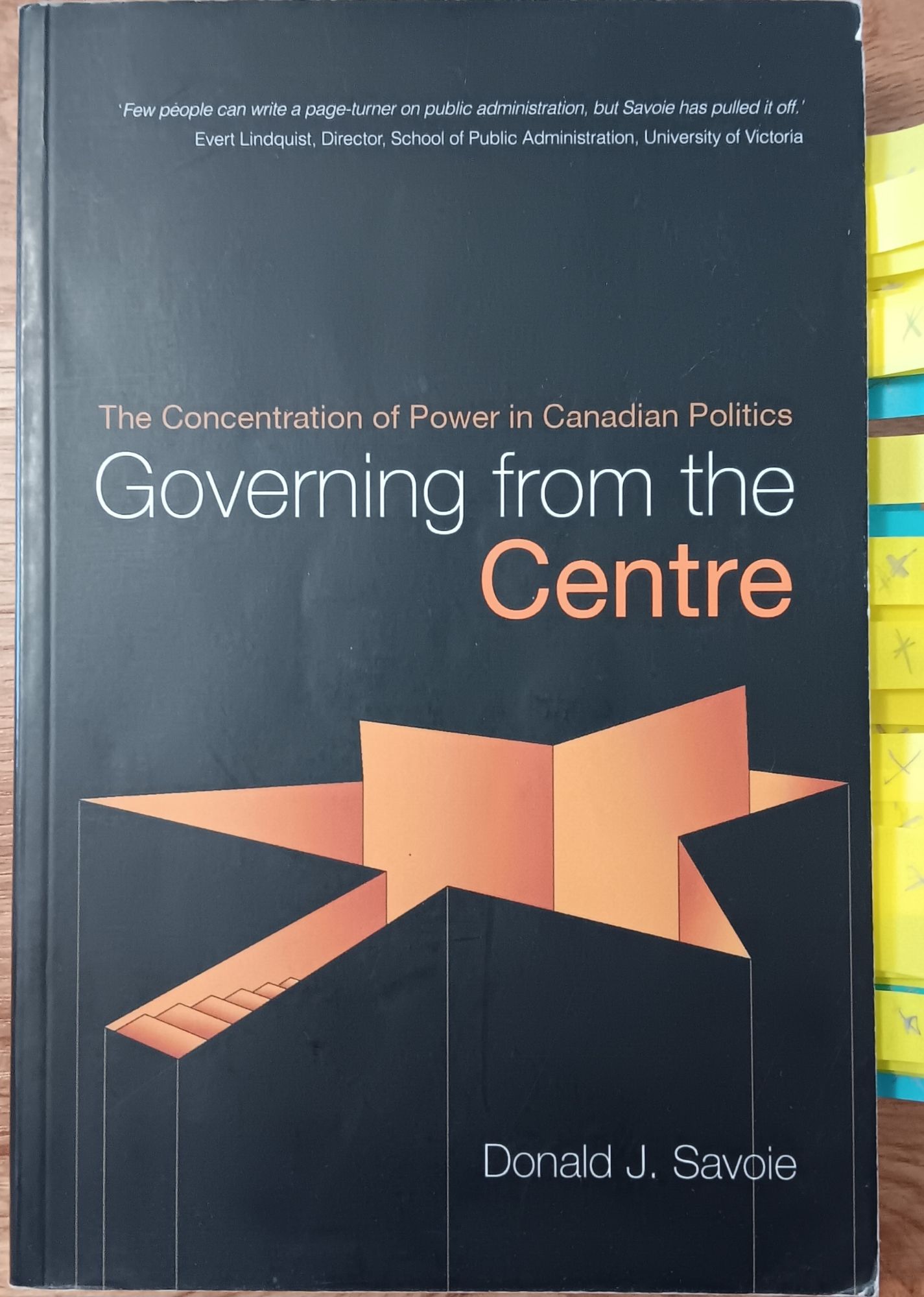
My copy of Governing from the Centre, which I read probably around 2010 or 2011.
The Governor General does not decide when the House of Commons or the Senate come out of an adjournment and resume sitting. The House of Commons and Senate vote to adjourn themselves and to resume sitting, but the Crown summons, prorogues, and dissolves Parliament on the Prime Minister’s advice. This really is not complicated.
Yet Donald Savoie just wrote this bizarre column for The Hill Times where he asks some rhetorical questions about when the Governor General should act on the advice of the Leader of the Opposition. The answer to that, in Canada, is never. Some of our other sister Realms, like Saint Kitts and Nevis, have codified in their constitutions that the Governor General appoints some Senators on the advice of the Prime Minister and others on the advice of the Leader of the Opposition, but no such provision exists here.[1]
He opined:
However, what if the leader of the opposition would ask all Members of the House of Commons to co-sign a letter asking the Governor General to reconvene Parliament or for her to refuse a request from the prime minister to prorogue Parliament? And what if over 50 per cent of the Members of the Commons agreed to sign the letter? Members of Parliament making a formal request in a letter carries more weight than individual MPs issuing a press release or giving an interview to journalists. The Governor General would then have to decide if such a letter signed by a majority of MPs qualifies under the “almost without exception.” The advice to the Governor General would be coming from a majority of MPs in the Commons, not from the leader of opposition.[2]
Savoie here presents at least two misunderstandings of how our system of government works. This is the point where one professor of political science hyper-active on Twitter from southwestern Ontario has said in the past and might say again now that I have no business correcting luminaries of Canadian political science because I don’t have a PhD and am not myself a professor, etc., etc., etc. But the facts exist outside of our post-nominals. All I can do is point you to the primary sources so that you can look at them for ourselves.
First and foremost, the Governor General does not decide to reconvene the House of Commons early when it has decided merely to adjourn itself to a specific date. The Speaker of the House of Commons decides to cut short an adjournment and resume sitting early under Standing Order 28(3), though only “after consultation with the government.” The House of Commons could decide to modify this procedure requiring consulting only the government and perhaps should do so. But in any event, the Governor General plays no role in this process and does not meddle with the collective parliamentary privilege of the House of Commons, or of the Senate, to establish their own rules and procedures. The two houses are masters of their respective domains, in Seinfeld parlance. The House of Commons has decided through its Standing Orders to establish a regular sitting calendar that applies automatically until otherwise amended. The Journals of Tuesday, 17 December 2024 close with the adjournment: “Accordingly, at 3:47 p.m., the Speaker adjourned the House until Monday, January 27, 2025, at 11:00 a.m., pursuant to Standing Orders 28(2) and 24(1).”[3]
The House of Commons stands adjourned until Monday, 27 January 2025, which means that only the Speaker could resume the sitting earlier under Standing Order 28(3) “after consulting with the government.”
Recall of House.
28 (3) Whenever the House stands adjourned, if the Speaker is satisfied, after consultation with the government, that the public interest requires that the House should meet at an earlier time, the Speaker may give notice that being so satisfied the House shall meet, and thereupon the House shall meet to transact its business as if it had been duly adjourned to that time. In the event of the Speaker being unable to act owing to illness or other cause, the Deputy Speaker, the Assistant Deputy Speaker and Deputy Chair of Committees of the Whole or the Assistant Deputy Speaker and Assistant Deputy Chair of Committees of the Whole shall act in the Speaker’s stead for all the purposes of this section.[4]
Second, the Governor General only summons, prorogues, or dissolves Parliament on the advice of the Prime Minister and the Prime Minister alone via an instrument of advice. That is it. There is no other way. And if the Governor General ever refused a Prime Minister’s advice to prorogue or dissolve Parliament, the Prime Minister who gave that advice would have to resign, as Mackenzie King did in 1926, or, more recently, as Christie Clark did in British Columbia in 2017, and the Governor would then have to commission the Leader of the Opposition as the Prime Minister-designate and then Prime Minister. But this new Prime Minister takes responsibility for the dismissal or his or her predecessor and for the decision to prorogue or dissolve parliament or not. The Governor is not acting on the advice of the Leader of the Opposition or the Commons under these circumstances. In other words, exercising vice-regal discretion to dismiss a prime minister or premier is not the equivalent of acting on the advice of the leader of the opposition or the House of Commons as a whole.
Savoie then quotes the title of his own book from 1997, Governing from the Centre: The Concentration of Power in Canadian Politics: “Much has been said lately about the growing power of the prime minister and the ability of prime ministers to govern from the centre.” Yes, very good.
Savoie concludes with a paragraph that muddles the distinction between, one the one hand, how the House of Commons and Senate adjourn themselves under collective parliamentary privilege, and, on the other, how the Crown prorogues Parliament on the Prime Minister’s advice.
At the moment, the decision to prorogue Parliament or to recall Parliament lies in the hands of the government, or more to the point, in the hands of prime ministers. One way to rebalance power between prime ministers and Parliament is to give Parliament the power to decide when it should sit. Members of the House of Commons who do not sit on the government side of the House can only request a recall of Parliament through the government and if the government should refuse, MPs have no other course of action. It only stands to reason that if a majority of MPs want the Commons to sit, then they should have the power to make that decision.[5]
The Prime Minister decides when to summon and prorogue Parliament. But the House of Commons decides when and how to adjourn itself under its Standing Orders. The House of Commons could certainly amend its Standing Orders to oblige the Speaker to cut short an adjournment based on consultations with MPs in some way, as opposed to the current procedure under Standing Order 28(3) where the Speaker has to consult “with the government” alone instead of the House of Commons as a whole. However, the House of Commons alone mostly cannot interference with the Crown’s authority to prorogue Parliament.
Yet despite all the minority parliaments of the 21st century, the House of Commons has never bothered to amend its own Standing Orders on these matters when the opposition outnumbered the government and could have pushed the changes through PROC. And on this matter, we cannot blame this failure on the Prime Minister and authority too centralised within him and his office; only MPs themselves bear this blame.
Similar Posts:
- All I Want for Christmas Is a Constitutional Crisis (December 2024)
- Ousting Party Leaders: From the King Doctrine to the Unenforceable Reform Act (October 2024)
- Dissenting Liberal MPs Fail to Thatcher Trudeau (October 2024)
- Replacing the Prime Minister During an Election: A Forgotten Canadian Precedent (June 2024)
- A Mature Country Does not Demand Absolutist Party Discipline (February 2023)
- J.W.J. “Party Discipline and Its Fate: Canada’s Ironclad Controls Are Beginning to Rust.” The Dorchester Review12, no. 2 (2022): 47-58.
- Stop Appealing to the Governor General to Overthrow Responsible Government (November 2016)
- David Johnston on the Constitutional Relationship Between the Governor General and the Prime Minister (December 2012)
- Neither the Queen Nor the Governor General Can Dissolve Parliament Unilaterally! (April 2012)
Notes
[1] The Constitution of Saint Christopher and Nevis, at section 30(1)(a).
[2] Donald Savoie, “GG Simon On Solid Ground to Dismiss Poilievre’s Request to Recall Parliament, But if a Majority of MPs Asked, It Could Be a Different Story,” The Hill Times, 24 December 2024.
[3] House of Commons, 44th Parliament, 1st Session, Journals, No. 391 (Unrevised), Tuesday, 17 December 2024, at page 4911.
[4] Standing Orders of the House of Commons, Including Appendices (Ottawa: House of Commons of Canada, 18 September 2023), S.O. 28(3), at page 18.
[5] Donald Savoie, “GG Simon On Solid Ground to Dismiss Poilievre’s Request to Recall Parliament, But if a Majority of MPs Asked, It Could Be a Different Story,” The Hill Times, 24 December 2024.

 James Bowden's Blog
Pingback: Poilievre is trying hard to fire him, but Trudeau holds all the cards - myspace.com.mm
Pingback: FIRST READING: Conservatives are trying hard to fire him, but Trudeau holds all the cards - Severuss
Savoie has feet of clay!
LikeLike