
Even after suffering the worst defeat in electoral history in 2011, the Liberals had managed to cling onto their redoubt of Toronto—St. Paul’s and their core support of urban Torontonians who would surely never abandon them. A Conservative had not won that area since 1988. So when the Liberals lost this seemingly safest of safe seats to Conservative candidate Don Stewart in a by-election on 24 June 2024, some Liberal MPs began anonymously questioning Justin Trudeau’s leadership to the press.[1] The Liberal caucus chair Brenda Shanahan then rebuffed any effort to convene in caucus during the summer of 2024 and said that the parliamentary party would not meet again until the House of Commons resumed sitting in September.[2] The Liberals continued to tail the Conservatives by about 20 points in the polls throughout the summer of 2024, but they believed that they could still shepherd their legislation through the House of Commons for another year in light of the confidence-and-supply agreement that they had struck with the New Democrats in March 2022.
Jagmeet Singh, eager to exploit the Liberals’ decline, abruptly announced on 4 September that his New Democrats had not merely withdrawn from the confidence-and-supply agreement but had “ripped it up.” Singh denounced the Liberals as “too weak, too selfish, and too beholden to corporate interests to fight for people” and believed that “they cannot stop the Conservatives.”[3] The House of Commons awoke from its summer slumber on 16 September 2024, and as if the prospect of losing control of the Order Paper did not present enough problems, the Liberals then lost yet another safe seat in urban Montreal to the Bloc that same evening.[4] Without the support of their New Democratic allies, the Liberals truly did start to lose control of the agenda of the House of Commons on 2 October 2024 over Conservative motions calling upon the government to table documents that the government would prefer not to table.[5] By 11 October, rumours began to swirl that some Liberal MPs had begun organizing to oust Trudeau from the Liberal leadership.[6] Sean Casey identified himself as one of the disaffected Liberal MPs on CBC’s Power and Politics on 15 October.[7] Ken McDonald of Newfoundland and Labrador and Wayne Long of New Brunswick followed suit.
The smouldering rebellion finally erupted out in the open on Wednesday, 23 October 24 Liberal MPs signed a letter calling that they had lost confidence in their leader and told Trudeau at caucus that he must announce by 28 October whether he intends to stay on or resign. This seems like a strange demand given that Trudeau has said many times over the last few weeks that he will lead the Liberal Party in the next general election. Trudeau then apparently told his Liberal colleagues that he would think about it.[8] The National Post added that a “Code Red Petition” calling on the parliamentary party to hold a vote on Trudeau’s leadership as soon as possible has circulated amongst members supporters of the Liberal Party.[9]
Casey lamented on 23 October 2024: “I wish there was a mechanism for it, yes” – the “it” being a vote by secret ballot of Liberal MPs on Trudeau’s leadership.[10] There is a mechanism for it, of course, which Casey should well understand if The Hill Times reported accurately that the Liberal caucus voted unanimously – so including Casey – at the start of the 44th Parliament in 2021 not to apply the Reform Act to itself.[11] McDonald has also mused that he and perhaps some other Liberal dissenters would vote against the Trudeau government on a question of confidence in the House of Commons.[12] To my knowledge, nothing like that has happened since October-November 1873 when the House of Commons returned after Sir John A. Macdonald’s tactical prorogation and still resolved to punish his drunken telegram and lies surrounding the Pacific Scandal; enough Liberal-Conservatives (as they were then known) voted against Macdonald so that the Commons withdrew its confidence from his ministry, and Governor General Lord Dufferin appointed Alexander Mackenzie as the new Prime Minister mid-parliamentary in November 1873.
If the Liberals had voted to apply the Reform Act to their parliamentary party during the 44th Parliament in 2021, then they would as of 23 October 2024 have needed the signatures of 31 MPs (20% of 153 rounded to the larger whole integer) to trigger the “leadership review” under section 49.5. But only 24 Liberal MPs signed the letter calling upon Trudeau to resign. Even if the Liberal rebels had met that threshold and convinced 5 more of their colleagues to join them, the majority of the Liberal caucus would probably still have voted to keep Justin Trudeau as leader. At that stage, the disaffected Liberal MPs would either have had to break away like the Democratic Reform Caucus of 2001, or accept defeat and let the issue drop – for now. After all, what happened to the British Conservative and Unionist Party in 2022 provides a cautionary tale for the Liberal Party of Canada in 2024: even though a majority of 59% of the parliamentary party initially expressed its confidence in Boris Johnson’s leadership on 6 June 2022, the mere act of having held such a vote itself ultimately eroded Johnson’s authority over his ministry and party and ultimately forced him to resign the leadership and premiership only one month later on 7 July 2022.[13]
But in the British case, it was the resignation en masse of several cabinet ministers and parliamentary secretaries on 5 and 6 July which proved decisive and forced Johnson to resign on 7 July; everyone around him had gone. Sajid Javid, Minister of Health and Social Care, and Rishi Sunak, the Chancellor and thus most important minister after the Prime Minister, resigned on 5 July and triggered an avalanche of what the British call junior ministers (probably closest to what we once called ministers of state) and parliamentary secretaries over the next 48 hours.[14] Sunak obliquely criticised Johnson’s personal misconduct, saying: “the public rightly expect the government to be conducted properly, competently and seriously. I recognise that this may be my last ministerial job, but I believe that these standards are worth fighting for and that is why I am resigning.”[15] In contrast, Trudeau does not face any allegations of personal misconduct comparable to those against Boris Johnson, who brazenly flouted his own lockdown orders with boozy parties at Number 10 and then lied about them afterwards repeatedly to the House of Commons. Trudeau merely faces declining political fortunes and a consistent unpopularity in the public opinion polls since mid-2023.
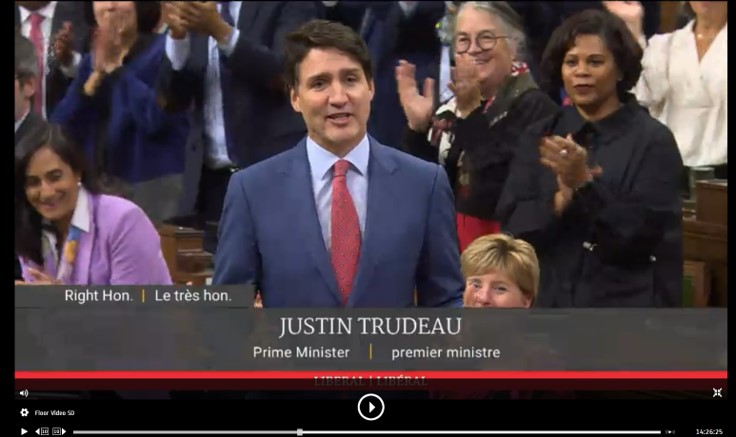
Trudeau survived this revolt, and his colleagues stood up and applauded him during Question Period in the House of Commons later that day. Fewer than 20% of the parliamentary party signed that letter, and only three of the 24 dared reveal themselves publicly. Most of the Liberal MPs who emerged from caucus spoke to the journalists lurking around the parliamentary precinct as if they had just undergone grouptherapy and relished in expounding upon their feelings and putting their emotions on display. They doubtless all experienced things differently, too.
Ultimately, I suspect that the House of Commons as a whole would withdraw its confidence from the Trudeau government and trigger a general election before the Liberal caucus tries to oust Trudeau as leader and therefore as Prime Minister – unless some crucial cabinet ministers (like Chrystia Freeland, Dominic LeBlanc, Melanie Joly, or Marc Miller) also lose confidence in him and resign. In 2024, Justin Trudeau has probably become the most hated Prime Minister amongst the broader public since Brian Mulroney in 1992-1993, who despite polling between 12 and 21% in 1992 and 1993 never lost the confidence of the Progressive Conservative caucus.[16] But the Liberals might consider that if Brian Mulroney had stayed and led the party in the election of 1993, he would still have lost but would probably have won more than two seats. But perhaps most fundamentally of all, Trudeau won the last Liberal leadership election in 2013 so decisively at the party’s lowest point in its history that no successor can emerge from the current parliamentary party. MPs can only oust one leader when they have at least some idea of who would become the next leader.
And even if one could, time might have run out to replace Trudeau. Recent precedents show that premiers who first came to power mid-parliament after winning their party’s leadership could best win elections in their own rights if they had fully one to two years to govern beforehand. For instance, Kathleen Wynne won the Liberal leadership and became Premier of Ontario in February 2013 and led the Liberals to a majority in June 2014. Christy Clark won the Liberal leadership and became Premier of British Columbia in March 2011 and led the Liberals to another majority in May 2013. (Neither won a second election, but their parties had been in power for about a decade already). Scott Moe became leader of the Saskatchewan Party and Premier of Saskatchewan in February 2018 and won a parliamentary majority in the next general election in October 2020. (We shall soon see if Moe can win a second majority or not). That said, becoming premier mid-legislature and serving for about one year does not guarantee another electoral victory either, as Ernie Eves and his Conservatives learned to their chagrin in Ontario’s general election in October 2003. In contrast, the placeholder prime ministers who served for mere months, like John Turner and Kim Campbell, led their parties to disaster and extinction, respectively. Liberal MPs will no doubt have to take all these precedents into consideration from now until whatever happens by October 28th.
Similar Posts:
- Replacing the Prime Minister During an Election: A Forgotten Canadian Precedent (June 2024)
- A Mature Country Does not Demand Absolutist Party Discipline (February 2023)
- The Disgrace of Boris Johnson (February 2022)
- J.W.J. “Party Discipline and Its Fate: Canada’s Ironclad Controls Are Beginning to Rust.” The Dorchester Review12, no. 2 (2022): 47-58.
Notes
[1] Catharine Tunney, “Trudeau Says He Hears Canadians’ ‘Concerns and Frustrations’ after Dramatic Byelection Loss,” CBC News, 25 June 2024.
[2] Marieke Walsh and Laura Stone, “Liberals Reject Demands for Caucus Meeting, Sources Say Most MPs Don’t Want One,” The Globe and Mail, 6 July 2024.
[3] Prime Minister of Canada, “Delivering for Canadians Now,” 22 March 2022. ; New Democratic Party, “Delivering for Canadians Now,” 22 March 2022. ; New Democratic Party, “Singh Ends Supply and Confidence Agreement with Governing Liberals,” 4 September 2024.
[4] John Paul Tasker, “Bloc Quebecois Win Longtime Liberal Seat and Deliver Stunning Blow to Trudeau in Montreal Byelection,” CBC News, 16 September 2024.
[5] Laura Osman and Alessia Passafiume, “House of Commons Grinds to a Halt Over Allegations of Liberal ‘Corruption,’” Global News, 3 October 2024.
[6] David Cochrane, John Paul Tasker, Catherine Cullen, “Some Liberal MPs Are Mounting a New Effort to Oust Justin Trudeau,” CBC News, 11 October 2024.
[7] Darren Major and Kate McKenna, “Liberal Backbencher Calls on Justin Trudeau to Resign as Liberal Leader,” CBC News, 15 October 2024.
[8] John Paul Tasker, “‘The Liberal Party Is Strong and United,’ Trudeau Says After 24 MPs Sign a Letter Calling on Him to Quit,” CBC News, 23 October 2024.
[9] Catherine Levesque, Ryan Tumilty, and Stephanie Taylor, “Trudeau Given a One-Week Deadline to Response to Calls for Him to Resign,” The National Post, 23 October 2024.
[10] John Paul Tasker, “‘The Liberal Party Is Strong and United,’ Trudeau Says After 24 MPs Sign a Letter Calling on Him to Quit,” CBC News, 23 October 2024.
[11] Ian Campbell, “Liberal Caucus Votes Unanimously Against Reform Act Measures,” The Hill Times, 11 November 2021.
[12] Alex Kennedy, “Voting to Topple the Government Not Out of the Question, Says Liberal MP Ken McDonald,” CBC News, 23 October 2024.
[13] Joshua Nevett, “Boris Johnson Wins Vote But Suffers Large Tory Rebellion,” BBC News, 6 June 2022; Owen Amos, “Boris Johnson Resigns: Five Things That Led to the PM’s Downfall,” BBC News, 7 July 2022.
[14] Robert Walker, “Boris Johnson: The Moral Case for Government Resignations in July 2022,” British Politics, 18 (2023): 60-80.
[15] United Kingdom. Prime Minister’s Office, 10 Downing Street, Rishi Sunak’s Resignation Letter and the Prime Minister’s Response, 5 July 2022.
[16] University of Waterloo, “Political Scientists Assess Mulroney,” 25 February 1993.

 James Bowden's Blog
Well. In Australia, this would be over and settled by now. At least we despatch leaders with efficiency.
MB
LikeLiked by 1 person
I know. But the Liberal parliamentary party decided to entreat us to this embarrassing spectacle instead, where they all emerged from grouptherapy primed to spout off psychobabble and other delusions and held that talking matters more than taking action. Or talking *is* taking action from their post-modern point of view. You can see that Trudeau has thoroughly imprinted himself on this party based on how they all conduct themselves.
Nothing will happen though, I suspect. Trudeau has ensured that no clear rival to him exists within the Liberal caucus or cabinet today. He won the last leadership election in 2013 so decisively at the Liberals’ lowest point, so no one can rival him. This isn’t like Howard vs Costello, Blair vs Brown, or Chretien vs Martin. No candidate has emerged or will emerge.
LikeLiked by 1 person