
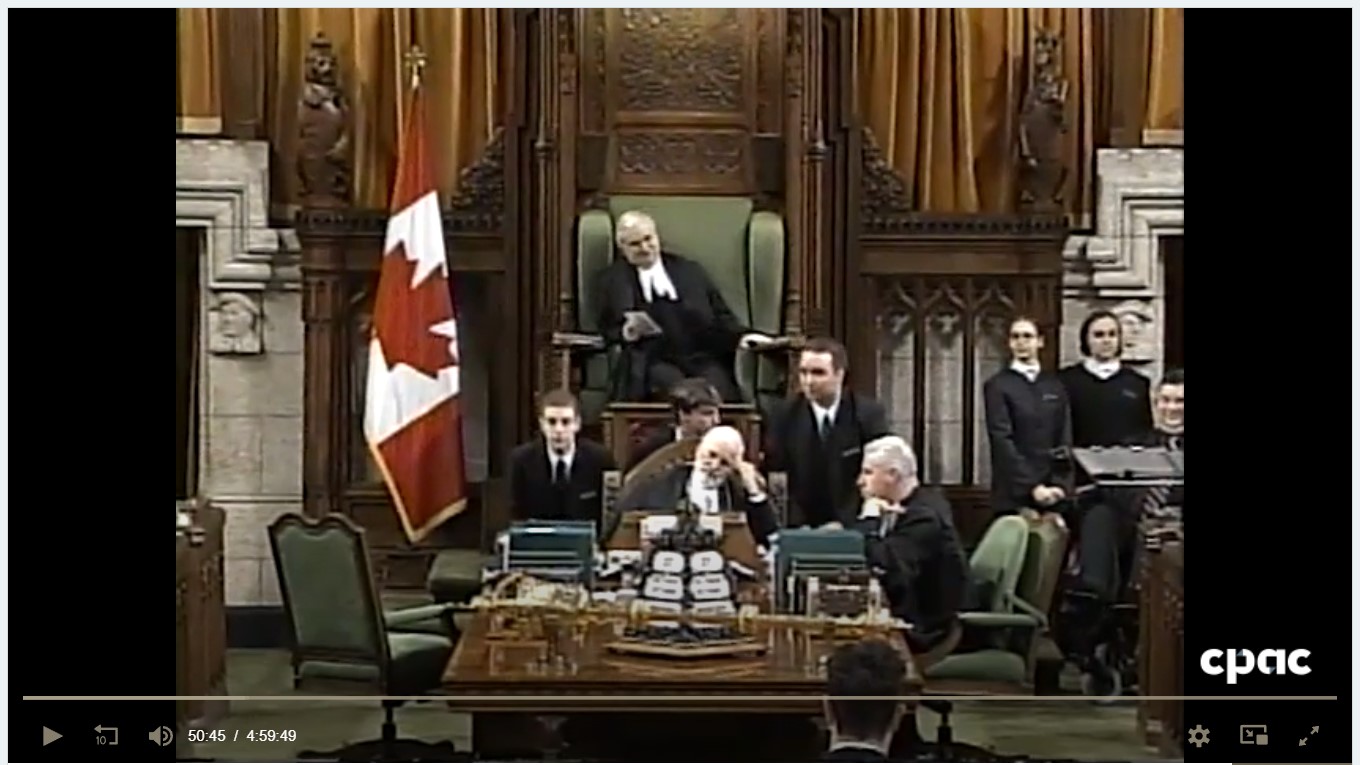
The Conservative opposition benches erupted into the chorus of Steam’s “Na Na Hey Hey Kiss Him Goodbye” when John Efford, the Minister of Natural Resources, rose in response to a provocative question in which Conservative MP Norman Doyle accused his fellow Newfoundlander of treason by likening him to Benedict Arnold. The Two Newfoundlanders squared off over the what The Globe and Mail described that week as “the collapse of an offshore oil royalty deal” between Ottawa and St. John’s:[1]
Mr. Norman Doyle (St. John’s East, CPC): Mr. Speaker, now that the Prime Minister has had 24 hours to reflect on his broken promises to the people of Newfoundland and Labrador, and now that he has had a chance to talk to Premier Williams, would the Prime Minister tell the House if he is willing to stand by the commitment he made to the premier and the people of our province during the federal election campaign? Or maybe he will bounce this question off the Newfoundland minister who, unfortunately, today has been called the Benedict Arnold of Newfoundland and Labrador.
Some hon. members: Oh, oh!
Hon. R. John Efford (Minister of Natural Resources, Lib.): Mr. Speaker—
Some hon. members: Oh, oh!
The Speaker: Order. I am sure the minister appreciates the choral welcome but the Minister of Natural Resources has to be heard and he has the floor.
Hon. R. John Efford: Mr. Speaker, let me say to all hon. members opposite and my colleagues from Newfoundland and Labrador that after 20 years of working for the province of Newfoundland and Labrador, I will take second place to nobody on that side. Let me say that, on this side from the Prime Minister to all members of the government, the Minister of Finance and myself, we, unlike the other side, want to see Newfoundland grow and prosper and—
Some hon. members: Oh, oh!
The Speaker: Order. The hon. member for Carleton—Mississippi Mills.[2]
Hansard does not transcribe what MPs say word for word but instead records what journalists might call a read out “edited for clarity”, a heightened reality that makes MPs sound more articulate than they truly are. The House of Commons does not record heckling from members not recognised by the chair, but instead uses the “Some honourable members: Oh, oh!” as a shorthand in Hansard. Only since the House of Commons decided to televise itself in 1977 can we spot the differences between statements made and noises uttered in the chamber on the one hand versus the official record edited for clarity on the other. And in this case, you would not know merely from reading Hansard that Conservative MPs broke out in the chorus of that famous hit single from 1969 twice, which makes Milliken’s humorous intervention about “the choral welcome” seem out of place.
- Hansard (2004-10-27) The Choral Welcome
- Globe and Mail (2004-10-28) The Collapse of the Offshore Oil Deal
Thankfully, we can watch the proceedings of the House of Commons from 27 October 2004 on CPAC in the glorious pixilated and analogue standard definition of the era. Everything before the standard broadcast went digital in 2009 somehow looks like the 1970s, and these videos make the House of Commons seem somehow beige and unsaturated in colour, too. Also, John Efford sounds like an improbable mixture of Larry David and John Crosbie, or perhaps merely Larry David doing a Newfoundland accent.
The 38th Parliament, elected in June 2004 and dissolved in November 2005, ushered in the Age of the Minority Parliaments of the 21st century under which we have toiled on and off for twelve of the last twenty years. Then as now a Liberal minority government teetered on the brink, though Paul Martin’s Liberals and Jack Layton’s New Democrats never struck a confidence-and-supply agreement. Ultimately, the success of a minority parliament depends upon whether the government can command the confidence of the House of Commons. But the moments in between depend largely on the Speaker of the House of Commons. Twenty years ago, MPs across the House of Commons of that 38th Parliament also respected Peter Milliken. Even as a backbencher, he took an interest in the history and procedure of the House of Commons, spearheaded a successful private member’s bill to amend the Financial Administration Act and restrict the use of the Governor General’s Special Warrants to when parliament is dissolved (instead of also to when it is prorogued and in an intersession), and he served as the chair of PROC in the 35th Parliament when it studied matters like the Electoral Boundaries Readjustment Act.
Milliken allowed lively debates and even some heckling in the Commons, though he called MPs to order when necessary with humour and mirth rather than, for instance, dwelling on specific phrasing for several minutes in a bizarre fit of petulant pedantry, continuously imposing himself into the debates by interrupting the cut and thrust of the exchanges between the front benches on either side of the Commons, halting debate entirely by looming over the chair in painful, awkward silence for bouts of thirty seconds or more, and then by naming and rejecting the recalcitrant from the chamber.
Similar Posts:
- Parliament – Decorum
- Parliament – Speaker of the House of Commons
- Anthony Rota Resigns in Disgrace as Speaker of the House of Commons (September 2023)
- Question Period and the “Administrative Responsibility” of Federal Ministers (November 2022)
- Suspending the Speaker of the Legislative Assembly of New Brunswick (April 2018)
Notes
[1] Brian Laghi and Jane Taber, “PM Tries to Pacify Williams – Blasted by Newfoundland Liberals, Martin Reaches Out to Angry Premier,” The Globe and Mail, 28 October 2002, A1.
[2] Norman Doyle (Conservative MP for St John’s East) and Hon. R. John Efford (Minister of Natural Resources, Lib), “Oral Questions – Natural Resources”, House of Commons Debates, 38th Parliament, 1st Session, Volume 140, Number 016, Wednesday, 27 October 2004, at page 835.

 James Bowden's Blog
I recall many years ago on a live TV program with the Federal Minister of Education answering questions from young people he was asked why parliament is so often so unruly. I thought the Minister’s response on the spot was pretty good. He explained that the real work happened in the cabinet and in the committees, where members of parliament came together to talk with each other and find or discern answers to problems. The House on the other hand was really a theatre where some members were apt to sometimes become a bit theatrical and dramatic.
LikeLike