
Outline of the Book
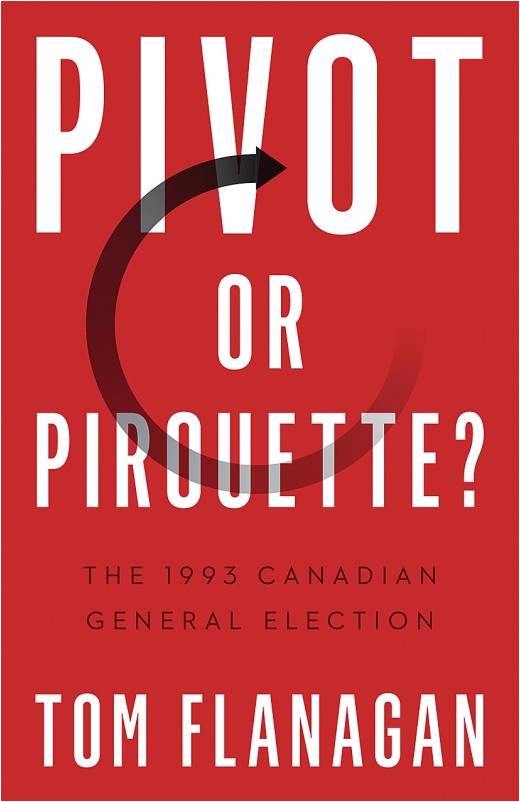
Tom Flanagan’s Pivot or Pirouette? The 1993 Canadian General Election is the first in a new series on “Turning Point Elections” edited by Gerald Baier and R. Kenneth Carty and published by the University of British Columbia Press. John C. Courtney wrote the second book on the elections of 1957 and 1958, Revival and Change, and the third book King and Chaos: The 1935 Canadian General Election by David MacKenzie just came out two weeks ago.
Flanagan, now professor emeritus of political science at the University of Calgary, is singularly suited to discuss this seismic federal election in which the Reform Party in the West and the Bloc québécois captured the two key pillars of Brian Mulroney’s electoral coalition and reduced the old Progressive-Conservative Party to two MPs. He has carved out an unusual niche for himself as a professor of political science who has put his studies into practice, first as the Director of Policy of Preston Manning’s Reform Party in the early 1990s and later as Stephen Harper’s campaign manager and chief of staff from 2002 to 2006. In other words, he contributed both to reducing the old Progressive Conservative Party in 1993 and in supplanting it while re-uniting the political right into the new Conservative Party in 2003.
Flanagan wrote an earlier treatise on the election of 1993 in Waiting for the Wave: The Reform Party and Preston Manning and its aftermath in 1995, but Pivot or Pirouette gives him the chance to revisit the consequences of this momentous election with the benefit of nearly 30 years of hindsight and a clearer view of what that election hath wrought on Canadian politics.
Flanagan organises the book into five chapters and a conclusion. The first, “Grand Coalition,” recounts how Brian Mulroney successfully persuaded disaffected Quebec nationalists to join forces with the PC party’s Western base in 1984 and 1988 by offering a mixture of constitutional and free-market economic reforms. Both the Western and Quebec pillars supported free trade with the United States in 1988. “The Collapse of the Coalition” then reviews how this shotgun marriage started to break down after Manitoba and Newfoundland & Labrador rejected the Meech Lake Accord in 1990, Canada entered another recession, and voters rejected the Charlottetown Accord in October 1992. In “The Contestants,” Flanagan provides short biographies on the men and women who led the Progressive Conservative, Liberal, New Democratic, and Reform Parties and the Bloc québécois in the election of 1993, while “The Contest” outlines key events of the election campaign itself between Sept. 9 and Oct. 25, 1993. Flanagan briefly summarises how the echoes of the election of 1993 reverberated throughout the rest of the 1990s, the 2000s, and the 2010s in “Aftermath.”
Finally, he argues based on Rational Choice Theory and Median Voter Theory in “The Punctuated Equilibrium of Canadian Politics” that Canadian political parties compete for the median voter but that usually only new political parties like Reform and the Bloc québécois substantively shift the centre of political gravity and can change where the median voter lies, which forces older parties to adapt.
These substantive chapters come in at 156 pages. Flanagan also includes appendices on the “list of key players” and a “timeline of key events” from 1980 to 2022, further reinforcing 1993 as the hinge on which the last four decades turns.
Some Digital Content
You’ll have to subscribe to the Dorchester Review for the rest. But I would like to share some of the accompanying videos and historical news footage from 1993 that would have appeared in the full article if it appeared in a purely digital format – all whilst having a little fun, too.
On rare occasions, we record the precise instant where something consequential happens and diverts the flow of history. The general federal election of 1993 provides one such example.
You can see for yourself the exact moment where Jean Chretien led the Liberals to a parliamentary majority and utterly destroyed the Progressive-Conservative Party’s entire campaign and consigned Kim Campbell to the dustbin of history.
“Last night the Conservative party reached a new low. They tried to make fun of the way I look. God gave me a physical defect. And I’ve accepted that since I [was] a kid. It is true, I speak on one side of my mouth. I am not a Tory; I don’t speak on both sides of my mouth.”[1]
Chretien responded to John Tory’s infamous “Face Ad” — which really does appear to mock the Bell’s Palsy that partially paralysed Chretien’s face — so skilfully that if our current memeculture and streaming video had existed in 1993, someone would have uploaded an edited version of that footage where sunglasses slowly descend from the top of the frame to Chretien’s eyes to the tune of “The Next Episode” by Dr. DRE and Snoop Dogg. “Nah-nah-nah-nah-nah, it’s the one and only Petit gars de Shawinigan!”
Notes
[1] CBC News, “Campaign Ad Backfires on Kim Campbell,” 15 October 1993.

 James Bowden's Blog