The Gerrymander of 1882


If Canadians think of electoral redistribution at all, they might hold this vague notion that Canada eliminated partisan gerrymandering by delegating the task from politicians to independent boundaries commissions. They might also recall having read or heard something in the news about state supreme courts in various American states ruling specific gerrymanders unconstitutional. But Canada possesses its own sordid history of gerrymandering, where the party in power manipulates the boundaries of electoral districts to maximize the votes of its own supporters and dilute the votes of its opponents, thus consolidating its gains in subsequent general elections and perpetuating its tenure in office.

Continue reading

Posted in Electoral Boundaries Readjustments | Leave a comment

British Columbia & Ontario Would Each Already Gain 1 New MP under the Latest Population Estimates of Q4 2023


The House of Commons will expand yet further in 2031 once the Population Estimates for 1 July 2031 become available.  

On 19 December 2023, Statistics Canada’s most recent population estimates for 1 October 2023,which showed the largest growth in a single quarter since 1957.[1] Canada’s estimated population for that date stands at 40,528,396.[2] The population estimates for each province and territory break down as follows:

Continue reading

Posted in Electoral Boundaries Readjustments | 1 Comment

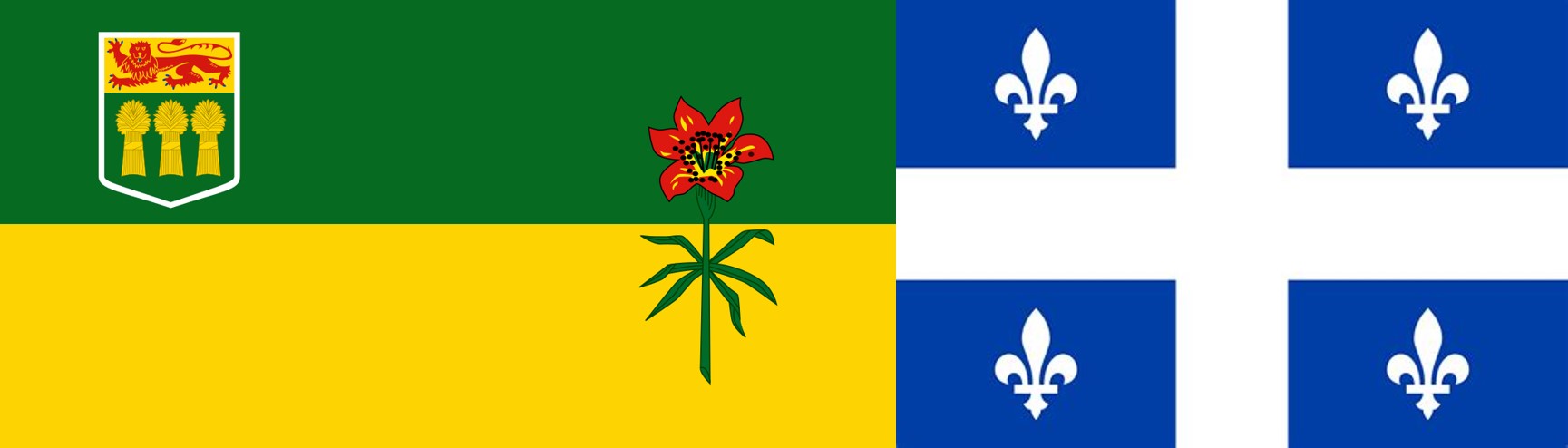
Quebec Acknowledges Saskatchewan’s Unilateral Constitutional Amendment in Its Updated Administrative Consolidation of the Constitution Act, 1867


“A crocus and fleur-de-lis entwined.
Autonomism forever!:

On 14 November 2023, the Government of Quebec updated its administrative consolidation of the Constitution Acts to what should be its 4th edition and recognised a constitutional amendment that the legislature of Saskatchewan added to the text of section 90 of the Constitution Act, 1867 as of 15 September 2023.

Continue reading

Posted in Amending Formulas, Consolidations, Constitution (Written) | 1 Comment

Fixed-Date Election Laws and Voter Turnout


British Columbia became the first province to adopt fixed-date election laws in 2001, and the law first took effect for the province’s general election of 2005. Newfoundland and Labrador followed suit and enacted Canada’s second fixed-date election law in 2004, which first applied to the general election in 2007. Some Canadian scholars hailed this initial wave of provincial fixed-date election laws in the mid- to late-2000s as a panacea that would rebalance the “democratic deficit” – a fashionable phrase fifteen to twenty years ago – vanquish political cynicism, and increase voter turnout. Henry Milner speculated fervently in 2005 that fixed-date elections would complement efforts to increase voter turnout, though without necessarily doing so directly themselves.

Beyond this, fixed election dates could enhance the effectiveness of a variety of measures designed to actively boost voter turnout.[1] […] This does not mean that moving toward fixed voting dates will in itself reverse Canada’s low and declining voter turnout; but it is a necessary component of a systematic effort to address this pressing issue.[2]

Now that we have run this experiment for ten to almost twenty years in most jurisdictions, we can examine the statistical trends: the statistics do not bear out this hypothesis. Voter turnout has either continued to decline or has levelled out since the advent of fixed-date election laws in Canada and in all provinces, except for in Alberta, where its transition toward a two-party system with increased competition and choice in elections since 2012 probably explains higher turnout.

In the following charts, I noted the general elections which have taken place since the fixed-date elections law first applied, though these lists include both scheduled and snap general elections. I have drawn the data from the official reports of Chief Electoral Officers or from the website of the relevant elections agency.

Continue reading

Posted in Fixed-Date Elections | 1 Comment

Jean Chrétien Shawinigan-Handshakes Canadian History


On 23 October, Jean Chrétien sat for an interview with Daniel Thibault of Radio-Canada to mark the 30th anniversary of the general election of 1993, in which he led the Liberals to victory and the first of three consecutive parliamentary majorities. Thibault asked Chrétien, who will turn 90 on 11 January 2024, various perfunctory and respectful questions about his ten years as prime minister, and their exchange included Chrétien’s recollections of Quebec’s referendum of 1995. But here the wily old Jean Chrétien – derided as “Yesterday’s Man” even back in the election of 1993 – still wishes not merely to share his own recollections of significant political events but to spin tall tales in that famous folksiness of the Little Guy from Shawinigan.

This interview will receive little to no attention in English Canada and will disappear into the ether that separates our Two Solitudes.

Chrétien recounted the following to Thibault at around 5 minutes and 40 seconds into the video:

Continue reading

Posted in Film & Television, Reviews | Leave a comment