Two Swords and One Inch Apart?


If you’ve ever taken an official tour of the Parliament of Canada, the guide will normally present the House of Commons in the antechamber and explain the overall seating arrangements – that the government sits to the Speaker’s right, and the loyal opposition to his left – and take note of the desks of the prime minister and leader of the opposition. The guide will note the adversarial (I consider this a positive attribute) arrangement of the House of Commons, which maintains opposing rows of seats rather than a horseshoe configuration. He or she may then characterize the distance separating the government and opposition benches as inviolable because, conforming to an ancient custom of the British Parliament, they must remain “two swords and one inch apart.” The House of Commons Procedure and Practice of O’Brien and Bosc mostly corroborates this claim (in the first paragraph of “Seating”, by footnote 38): “The distance across the floor of the House between the government and opposition benches is 3.96 metres, said to be equivalent to two swords’ length.” The footnote attributes the origin of this custom to a time when members of the British House of Commons carried swords, and that “red lines marked on the carpet two swords’ length apart still serve as a reminder to seek resolutions by peaceful means.”

Let’s examine the validity of these customs on “sword lengths” and seating configurations by looking at some photographs at our sister parliaments in the United Kingdom, Australia, and New Zealand.
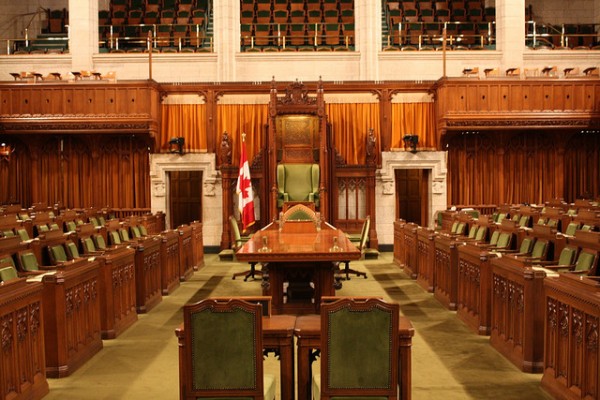
Canadian House of Commons and its wide center aisle

The British House of Commons consists of two distinct sets of opposing benches separated by a center aisle. As of 2010, it seats 650 members. “Some Traditions and Customs of the House”, produced by the House of Commons Information Office, corroborates the reference to red lines from O’Brien and Bosc and the notion that the government and opposition benches remain two swords apart (though not an inch more):  “They may not speak from the floor of the House between the red lines (traditionally supposed to be two sword-lengths apart).”  However, the House of Commons Information Office does not list any precise measurement like the 396 centimeters that O’Brien and Bosc claim. Certainly, the length of swords would have varied depending on the type of sword and the period in history – but the distance between the government and opposition benches in the Canadian House of Commons is clearly much greater than that in the British House of Commons – one need only look at the photos. For instance, during the weekly Prime Minister’s Questions (PMQs), the prime minister and leader of the opposition stand directly behind the Clerks’ desk and the mace and speak into the microphones by their respective despatch boxes. But in the Canadian House of Commons, the prime minister and leader of the opposition stand nowhere near the Clerks’ desk during their exchanges in Question Period. There are a few possible explanations to take these different interpretations of “two swords” into account: either the Canadian sources are wrong, or the British House of Commons was expanded through the addition of a new front bench, thus narrowing the gap between the government and opposition. Or Canadian parliamentarians wielded massive Claymores, while their British counterparts settled for more modest sabres!
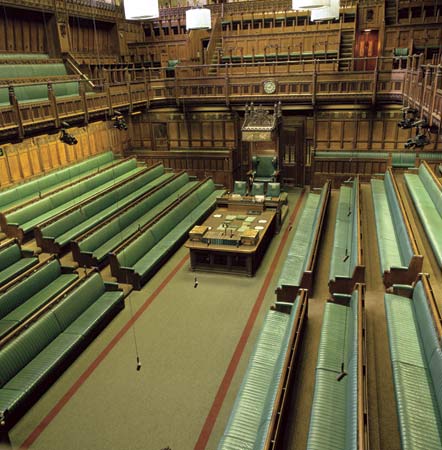
The benches and narrow aisle of the British House of Commons

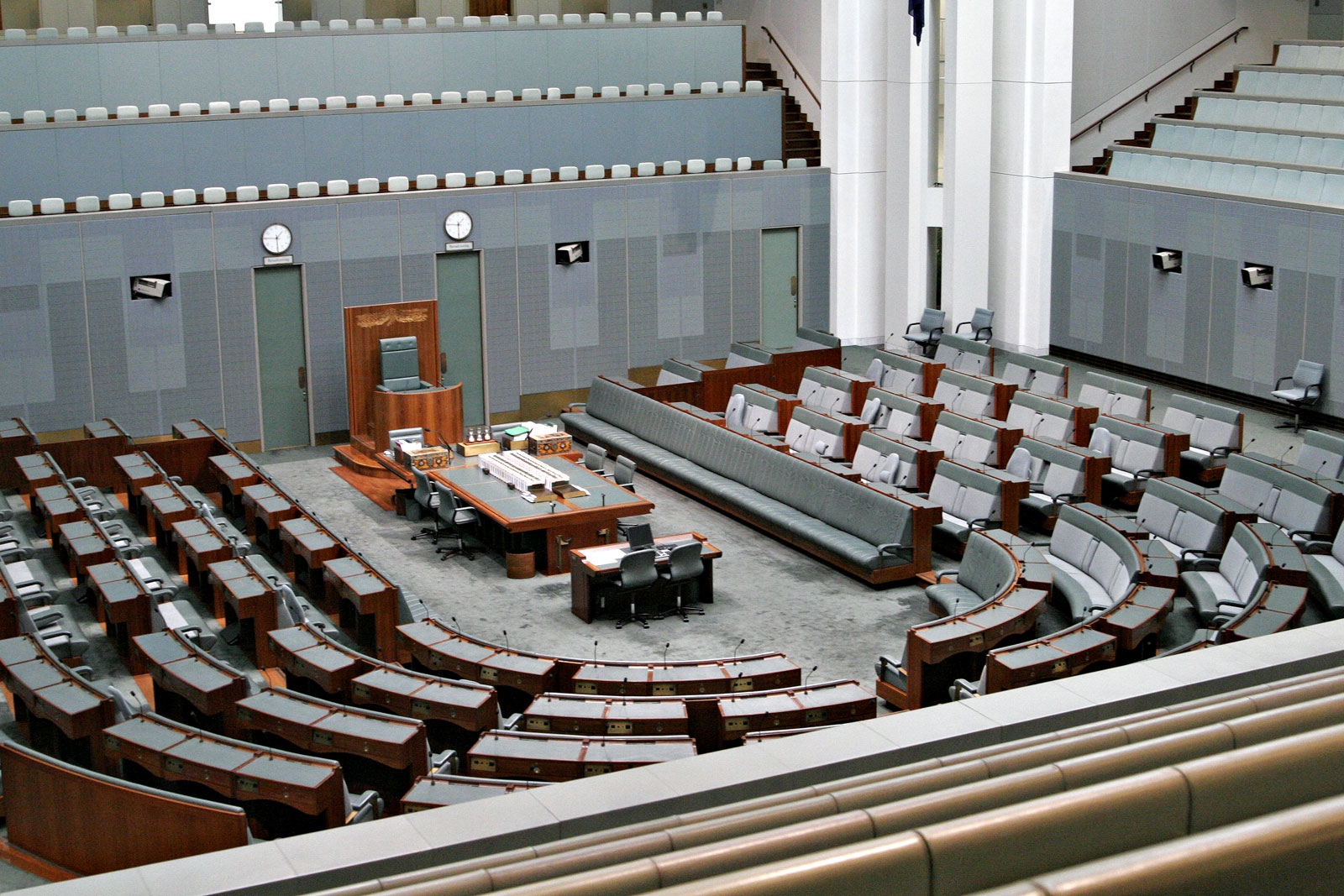
Our southern hemispheric Commonwealth cousins have both made significant adaptations to the basic Westminster model (more on that later), as well as noticeable changes to their lower houses. They use refer to their lower houses by a different name : as “House of Representatives” instead of the traditional moniker “House of Commons”, perhaps in order to avoid the pejorative historical and colonial associations with “commoner”. The Australian House of Representatives consists of 150 members, who sit in a horseshoe configuration, which breaks with the British tradition. The government and opposition front benches form a single, unbroken line; and like in the British House of Commons, the Australian prime minister and leader of the opposition address each other during Question Time from their respective despatch boxes and microphones. However, the overall distance between the Clerks’ table and the front benches are roughly the same distance apart as ours. The backbenchers sit in pairs in what appears to be a bench-desk hybrid. (The Australians always have to be different). The New Zealand House of Representatives, which seats 122 members, combines the desks of the Canadian House of Commons with the horseshoe configuration of the Australian House of Representatives; their front desks are also roughly the same distance apart as ours, and like us, they don’t use despatch boxes. The partial center aisles of their Houses of Representatives look about 396 centimeters wide.
 Turning back to the Canadian House of Commons, the parliamentary tour guide would also mention that the desks accommodate the 308 members of the House of Commons, and that Parliament re-evaluations the number of Commons seats every ten years, which has so far always resulted in adding more desks. But as anyone can plainly see, the House of Commons has reached its capacity and can accommodate no additional desks under the traditional arrangement that supposedly requires that the government and opposition sit 396 centimeters apart. The Harper government introduced Bill C-12 in the 3rd session of the 40th Parliament, which would have expanded the House of Commons by 30 seats in order to represent more fairly the growing populations in British Columbia, Alberta, and Ontario. But where would all those additional desks go? The sheer physical limitations of the House of Commons preclude the inclusion of more desks.  Perhaps another row of desks could be added in the back, but then it would block off the corridor behind the curtains; and the addition of a new row in the front would narrow the 396-centimeter gap.

The New Zealand House of Representatives uses desks like ours

Now that the Harper government commands a majority of the House, this bill will probably be re-introduced in the 41st Parliament. In order to accommodate those additional 30-odd seats, which would probably become official around 2014, the House of Commons should switch to benches like Westminster. In addition to their more efficient use of space in the chamber, benches would also deprive members of the ability to bang loudly on the desks during Question Period. The addition of these new seats also happily corresponds to Public Works’ scheduled renovation of Centre Block in 2015, so the renovation could easily accommodate the conversion from desks to benches! And for good measure, the prime minister and leader of the opposition should also address each other across despatch boxes. I shall explain in a later post why the Canadian House of Commons ought to scrap the current format of Question Period and adopt the British model of Question Time and Prime Minister’s Questions in its entirety.

Posted in Electoral Boundaries Readjustments, Parliament, Traditions and History | 11 Comments

Crowned Maces in the Legislatures of South Carolina and Virginia


I chose a British parliamentary mace as the header for Parliamentum, because the mace represents the Crown-in-Parliament (sometimes called the Queen-in-Parliament) and the authority of the Speaker and of the House of Commons to pass laws; it always points toward the government, to the Speaker’s right, and daily parliamentary business cannot begin until after the ceremonial procession, where the Sergeant-at-Arms places the mace on the table.

The parliamentary maces in most legislatures and parliaments in the Commonwealth resemble medieval sceptres, like that which the British monarch carries at the coronation, adorned with the Crown of Saint Edward. This shape makes perfect sense for a symbol of the Crown-in-Parliament and the House’s authority to pass law based on the Crown-in-Parliament as the guarantor of our liberties in a constitutional monarchy. However, such an overtly kingly symbol seems a damn sight odd for a state legislature in the United States of America, but some of the legislatures of the original 13 Colonies have retained the standard maces made of gilded silver and adorned with the Crown of Saint Edward in homage to their colonial heritage. Indeed, these legislatures are special, because they predate the Continental Congress and the United States Congress by several decades.

My parents visited the Virginian legislature in 2011 and took this photo of the official portraits of the Queen and Prince Phillip, who visited in 2007 to mark the 400th anniversary of the founding of Jamestown.

So how do the modern Americans legislatures circumvent or re-interpret the meaning of the mace as the symbol of the Crown-in-Parliament? The website of South Carolina State House explains that the mace of the House of Representatives is “the emblem of authority for the House of Representatives.” The House of Representatives of South Carolina has even retained the ancient ceremonial procession of the mace: “for the Sergeant-at-Arms to bear the mace ahead of the Speaker and lay it upon its specially prepared rack on the Rostrum in front of the Speaker.” Interestingly, the Senate of South Carolina has retained what appears to be an defunct tradition of the House of Lords by using the State Sword to represent the authority of the Senate. To me, it also inadvertently symbolizes South Carolina’s famous bellicosity and proud independent streak! After all, it was the first southern state to secede from the Union and produced the likes of John C. Calhoun and other vehement slavers and secessionists.

Mace of the South Carolinian House of Representatives

 The House of Delegates of the Commonwealth of Virginia also honours the old traditions of the “Old Dominion”, as King Charles II dubbed the colony (hattip, Andrew Cusack). As the bastion of Anglicanism, landed gentry, and the Virginian Dynasty of Presidents, Virginia always struck me as a natural contender to retain the English ways, considering that its very name pays homage to Queen Elizabeth I, “the Virgin Queen”. The website of the House of Delegates (the lower house of Virginia)  describes their mace as “symboliz[ing] the importance of our government.”

Mace of the House of Delegates of Virginia

A mace only logically makes sense if it represents the authority of the legislature, where sovereignty lies. But both of the Virginian and South Carolinian explanations omit that the Constitution of the United States of America vests sovereignty not in the president, nor in the Congress, but in the people, thanks largely to James Madison. (And I’m fairly certain that all the states abide by this legal doctrine as well). By vesting sovereignty in the people of the United States, the Framers by-passed the issue of whether the federal government or state governments would supersede one another; they made both orders of government accountable to the same sovereign. The electorate, not the legislature, is therefore the sovereign. And if in these state legislatures, the maces represent the authority of the “government”, then to which side of the lower house do they point? Presumably they would point toward the majority party. These maces could represent the authority of the legislative branch of government or the legislature, but again, legislatures are not the sovereign in the United States. While the British sovereign or a Governor General cannot withhold Royal Assent from a bill that has passed through parliament, the Governor of a state can veto any legislation passed by both houses, and the upper house can reject legislation passed by the lower house. So what is the point of representing the “authority” of the lower house or that of the “government”, a misnomer in any case, since the Governor also forms a part of the government, when that authority is subject to the checks and balances and division of powers of the American system?

Here is the Virginian mace in its display case. (My parents also took this photo in 2011).

During the American Revolution, the southern colonies produced proportionately more Tory Loyalists than did the North – particularly in contrast to those rebellious, Puritanical New Englanders! In that sense, I’m not surprised that some of them continue to use these British symbols but have attempted to adapt their meaning and remind their citizens that their legislatures pre-date the US Congress. Perhaps Virginia and South Carolina invoke this old British symbolism of the legislature’s power in order to represent the 10th Amendment’s primacy of the states over the federal government in all residual powers. Either way, I find their use of British maces quite interesting and rather ironic.

Related Posts

Posted in History of British North America, Parliament, Traditions and History | 7 Comments

Republican Ignorance of Parliamentarism and Constitutional Monarchy


While I emphasize parliamentarism, like most of my Whiggish predecessors, I support our current constitutional monarchy and Crown-in-Parliament as a system of government and oppose the argument that Canada ought to become a federal republic. Steve LaFleur wrote an excellent piece on constitutional monarch in Canada and addressed reasonably some of the common republican arguments for the abolition of Canada’s current system of government. Then an expatriate New Zealander named Fergus Hodgson wrote a largely incoherent rebuttal of Steve’s piece that barely even addressed the issue of constitutional monarchy, but described the constitutional monarchy of the 16 Commonwealth realms inaccurately by implying that they remained under the yoke of absolute monarchy, constant political interference from the Crown, and sheer despotism. Frankly, I would have expected a New Zealander to understand Westminster parliamentarism and constitutional monarchy well enough to critique it based on facts rather than misinformation and an interpretation of the Crown that hasn’t applied since at least the mid-18th century.

 I emailed an unhappy Fergus and accused him of misconstruing the Commonwealth realms as absolute monarchies because of the following factually incorrect, hyperbolic statements in his incoherent, flawed column:

  • “During the same week Canadians celebrated Victoria Day, their historic ruler’s birthday […] [emphasis added].”
  • “The monarchy’s opponents must all want a chance to become king or president, and Canadians mustn’t be mature enough to rule themselves, as their betters in the motherland evidently are [emphasis added].”
  • “LaFleur’s limp defence, typical of royal apologists, does not answer why ancestry alone should determine one’s position to rule [emphasis added].”

 Like many republicans who don’t understand constitutional monarchy and how Westminster parliamentarism works in fact, Fergus has erected the strawman of absolute monarchy in place of our real constitutional monarchy, then claims to have demolished the justification for the latter. I italicized all instances of a monarch “ruling” because, as page 3 of the New Zealand Cabinet Manual says: “The Queen reigns but the government rules so long as it has the support of the House of Representatives [emphasis added].” English constitutional scholar Vernon Bogdanor describes constitutional monarchy as one in which “The Queen reigns but Parliament rules.” In any case, the concepts of “reigning” and “ruling” are distinct – and that distinction is all-important in understanding parliamentarism and the Crown-in-Parliament. The monarch merely “reigns” because constitutional conventions have constrained her political power to the reserve powers, which she may invoke only in the most exceptional circumstances. In all other circumstances, she only exercises those royal powers on the advice of the prime minister or cabinet.

I also explained to Fergus in our correspondence that Canadians have “been mature enough to rule themselves” since 1848 when our crown colonies achieved responsible government – which means that the government can only exercise authority in the name of the Crown when it commands the confidence of the House of Commons (or Representatives) – and that Canada has reaped its rewards uninterrupted since. For his benefit, I also informed him that Australia and New Zealand have ruled themselves under the regime of responsible government since around 1854. (Canada did achieve it first, as part of Lord Durham’s experiment). Fergus didn’t seem to understand the definition of “responsible government” or have any idea of its significance, and replied with a statement just as incoherent as was his column in response to Steve’s article: “You may believe that ever-expanding and entangling socialism is ‘responsible government since 1848.’ I suggest that is not the case.”

 Well, Fergus, I suggest that you not confuse an institution and system of government with an immoral left-wing ideology, that you read the New Zealand Cabinet Manual, do your research on constitutional monarchy, and educate yourself on Westminster parliamentarism instead of continuing to ensnare yourself in the republicans’ symbolic, hyperbolic fallacy against our Westminster system of government.

Related Posts

Posted in Monarchism v Republicanism | 4 Comments

“Confederation Day”: I Agree With Eugene Forsey On Something!


 I view the Canadian scholarship on issues like the appropriate extent of the governor general’s reserve power as a clash between two opposing camps whose basic positions have changed little, if at all, over the past eighty years. Only the scholars occupying those competing camps have changed. Eugene Forsey bore the standard of those scholars in favour of a broad interpretation of the viceregal reserve powers and consequently give the governor general great latitude in rejecting a prime minister’s advice to prorogue or dissolve. In contrast, one of Forsey’s contemporaries, the lesser known and under-appreciated R. MacGregor Dawson believed that a governor general could reject a prime minister’s advice only under “the most exceptional circumstances.” Anyone who has also read the article that Nick MacDonald and I wrote earlier this year will know that I favour Dawson’s interpretation because it better acknowledges the trajectory of history of the Crown’s power toward a gradual elimination of most real political power. Forsey, however, deliberately broke with the scholarship that had heretofore supported the limitation of Crown’s power, from Walter Bagehot to Sir William Anson to A.V. Dicey. I will elaborate on this issue in more detail in subsequent posts.

In light of my substantial disagreements with Forsey’s affectation for 17th-century royal power, and that I’ve never really agreed with any of his scholarship on the Crown and its relationship to Parliament, I was shocked this morning to find that my Facebook rant from July 1st invoked almost precisely the same reasoning as that of Professor Forsey before parliamentary committee in 1970. Parliament changed the name of our national day in the early 1980s from the historically significant “Dominion Day” to the historically bereft and pedestrian “Canada Day” – as if Canadians didn’t already know that they lived in Canada and needed the government to remind them of the country’s name. Sarah Hagen brought to my attention transcripts from the House of Commons committees from March 12, 1970 and Professor Forsey’s witty testimony on the issue of changing the name of Dominion Day at the behest of republicans who seek to rid Canada of its constitutional monarchy by stealth over time.

 “Dr. Forsey: Well, I think it [Canada Day] is devoid of the historical associations which you do get either in Dominion Day or in Mr. Hogarth’s suggestion Confederation Day. It takes the historical zip out of the thing somehow and it seems to me that you want to have something in the name of the day if possible. You want to have something to commemorate some historical event and this was a meaningful historical event. Just as I would say, if the United States called its national holiday “United States Day”, that would be a rather colourless and banal description of that day. They call it, to the best of my belief, “Independence Day”, and I think that immediately recalls to every American the fact that on July 4, 1776, the 13 colonies became the United States of America. I think it has an evocative touch to it that you would not get if you simply said “United States Day.” […] Similarly, if you called the French national holiday “Bastille Day”, as I think it usually is called, again it seems to me that you would be taking some of the historical significance out of the thing.”

If the Parliament of Canada had to rechristen our national day, “Confederation Day” would have been a suitable replacement, because it dignifies the creation of the Dominion of Canada on July 1st, 1867 with the historical gravitas and significance that the day deserves.

Posted in Dominion Day, History of British North America, Parliament | 10 Comments

The Accidental Development of Cabinet Government


Our system of Westminster parliamentarism depends upon unwritten constitutional conventions. I will discuss my take on convention in further detail in subsequent posts, but generally, a constitutional convention evolves from a custom or practice that served a valuable purpose and ultimately became integral to parliamentary government. Sometimes these customs develop by design, usually after a significant written declaration; for instance, after The Great Charter of King John of 1215, customs evolved in order to accommodate that supreme written law that parliament must approve any and all levying of taxes. But during the Middle Ages, Kings still exercised the prerogative power to dissolve parliament and would sometimes extract Parliament’s approval to levy a specific tax in order to finance his war and then simply dissolve it. The idea of “grievance before supply”, which forced the King to take the grievances of his people’s representatives into account before asking them to approve taxes, arose in response to this development (I suspect, in this case, more by design than by chance).

George I

But sometimes a custom that leads to the founding of a significant constitutional convention does develop by pure happenstance from seemingly the most minor of causes. As my friend Nick MacDonald recounted, the entire development of cabinet government started by accident. After Queen Anne Stuart died in 1714 with no legitimate issue, Parliament formally changed the line of succession by invoking the Act of Settlement of 1701 and declared that the Crown would then pass onto the closest Protestant relatives of the Stuarts, Sophia of Hanover and her descendents. The Crown thus passed to the German-speaking George of Hanover, who became George I. Precisely because he spoke very little English and was a foreigner whom Parliament had invited to become King, he needed to rely on Parliament for advice more than his predecessors. Parliament itself was also maturing into an institution that supported a polarized two-party system of Whigs (I would have been with them!) and Tories. George I gradually withdrew from the meetings of the King’s Privy Council, which allowed the privy councillors, drawn from Parliament, to govern collectively. This custom eventually evolved into the Cabinet. And one of the Privy Councillors, Sir Robert Walpole, became the King’s chief advisor, or Prime Minister, if you will.

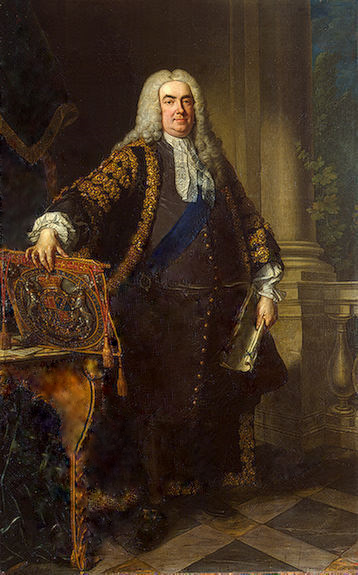
Sir Robert Walpole, the UK’s first de facto Prime Minister

The official website of the British monarchy provided an succinct explanation of these humble origins of cabinet government: “After 1717, George rarely attended Cabinet meetings. This allowed the Cabinet to act collectively and formulate policies, which, provided they were backed by a majority in the Commons, the king was usually powerless to resist. After the South Sea Bubble crisis of 1720 (when the South Sea Company, with heavy government and royal investments, crashed), Robert Walpole took over. The most able of George’s ministers, and known as the first ‘Prime Minister’, Walpole’s was the longest running administration in British history (1721-42).”

So there you go. We have cabinet government and responsible government today because George I didn’t speak English very well.

Posted in Cabinet's Powers, Origins | 8 Comments