The Liberal Party of Canada has elaborated on its plans to hold something akin to an open primary in the selection of its next leader in the Roadmap to Renewal. I mentioned the proposal in an earlier entry before the Liberals had formally released this document. The Liberals made the leadership primary the centerpiece of their Roadmap, but they’ve also devised the basis of a plan for the democratization of the nomination process at the local level. The local level will ultimately provide the most fertile ground for new party activists, so the Liberals should really concentrate their efforts on their constituency associations and only then proceed to the level of national leadership – if they seek a genuine bottom-up, democratic renewal. In other words, the Liberals need to cultivate their grass roots and a powerbase before making any pretence of forming government again.
These three paragraphs describe the Liberals’ conception of primaries. This kind of primary sounds more like what our American friends call “closed primaries”, in which only the party membership vote; in contrast, all registered electors can vote in an open primary. But the introduction of two tiers of involvement (members and “supporters”) could complicate matters.
7. That the Constitution be amended to extend the right to participate in the selection of the next permanent Leader of LPC to all Members and Supporters as defined in section 5, permitting electronic, online and mail-in voting, utilizing either a preferential or run-off ballot system, in the context of an appropriately secured, national voting process that: (i) is staged and phased regionally over a period of no less than 10 and no more than 16 weeks between March 1, 2013 and June 30, 2013; (ii) is weighted equally by electoral district; (iii) is confirmed by a vote of the Council of Presidents (“CoP”) at an in-person meeting of the CoP in the manner of an electoral college vote;
8. That the Constitution be amended to extend the right to participate in the nomination of LPC candidates for the House of Commons in any election or by-election to all Members and Supporters living in the electoral district, permitting electronic, online and mail-in voting, using a preferential system and a single-vote selection process that is appropriately secured;
9. That the Convention affirm the principle of requiring all LPC candidates for the House of Commons in any election or by-election to face an open nomination contest in their electoral districts in order to stand for election as an LPC Candidate in any election or by-election, subject to the Board’s right to approve specified exceptions to the rule at the request of and on the recommendation of the Leader.
The Liberals would introduce a preferential ballot to both the national and local levels and aim to attract new members and “supporters” in the hope of creating a new electoral base of support. But if the Liberals weigh each electoral district equally, then they’ll entrench the same mistake as the Conservatives and punish the more populous and active riding associations. So what is their incentive to recruit new members and supporters? As I speculated in the earlier post, the Liberals aim to hold their primary contest in phases “regionally” (which presumably means Atlantic, Quebec, Ontario, West, though alternatively, it could also involve dividing the larger provinces into regions like GTA, Northern Ontario, etc. We’ll have to wait and see). Then the third point adds another bizarre layer of bureaucracy and codifies precisely the internal party’s power struggles that caused the Liberals to become so detached from their base and lose electoral support: the presidents of all the Liberal riding associations would gather and “confirm” the votes of the Liberal members and supporters “in the manner of an electoral college vote.” What exactly does this process entail? I can only presume that the document is alluding to the American electoral college used in presidential elections – but under that system, a state’s population ultimately determines its number of votes in the electoral college. But if the Liberals intend to weigh all riding associations equally, then the “Council of Presidents” would not really function like the electoral college; rather, it would function as some kind of aristocratic counter-weight to the popular election of the leader. In turn, this process of confirmation implies that the candidates win electoral districts as a whole in a winner-takes-all format, rather than a proportional division of votes within each electoral district added for a country-wide score. In short, a leader elected under such a system would be beholden both to Liberal activists and the internal machination of the Liberal Party – but not to the parliamentary party, the Liberal caucus. This “Leader” could easily become an omnipotent figure that caucus cannot remove and against whom the parliamentary party would be virtually powerless.
The third paragraphs sets out a procedure whereby any Liberal MP would face an open nomination in the manner of the closed primary described above – but “subject to the Board’s right to approve specified exceptions to the rule at the request of and on the recommendation of the Leader.” This caveat means that the “Leader” (notice the unnecessary capitalization?) could ultimately determine which MPs face challenges and those who don’t. This system practically begs for some corruption and nepotism.
The contradictions between the good democratic proposals and the entrenchment of the powerful anti-democratic power of the party executive may undermine this new process in the long term. I do, however, welcome the prospect of any political party implementing closed primaries.
The Commonwealth Heads of Government Meeting (CHOGM, pronounced “Chog-m”) convened in Perth, Western Australia at the end of October. The Commonwealth Heads of Government discussed, among other issues, the Cameron government’s legislation to amend the Act of Settlement, 1700. Among other things, the Act establishes the rules that determine the succession to the Crown of the United Kingdom of Great Britain and Northern Ireland; Prime Minister Cameron wants to repeal male primogeniture through an amendment that would take into account the first-born child rather than the first-born son and repeal the penalty on marrying Catholics (or “Papists” as the current wording says!), which currently causes a royal to lose his or her place in the line of succession. However, these reforms would still maintain the established Church of England and the overall Protestant succession: the Sovereign, being the Head of the Church of England, and royals in the line of succession who still harbour any desire toward the possibility of becoming King or Queen, still must adhere to the Anglican faith.
Perhaps I’m succumbing to typical grad-student phraseology again, but the sheer historical and legal complexity of this issue of the Protestant succession combined with the overlay of the Doctrine of Reception in the former colonies and current Commonwealth realms does not lend itself to a succinct, concise blog entry. I may devote a few more entries to this subject. In this case, I will describe the historical significance of both parliament’s control of the line of succession, in the forms of the Bill of Rights, 1688and the Act of Settlement, 1700, and the Cameron government’s amendments to the Act of Settlement. I will also discuss the implications of the British government’s amendments and how they relate to the Statute of Westminster and the other 15 Commonwealth realms that vest their crowns in the same person, Queen Elizabeth II. The parliaments of the other 15 realms will likely pass legislation of identical effect because all the Prime Ministers of the Commonwealth realms have agreed in principle at the latest CHoGM on the elimination of male primogeniture and the penalty for marrying Catholics. Australian constitutional scholar and Professor of Law at the University of Sydney, Anne Twomey, has suggested that Australia and Canada, as the only two federations among these 16 Commonwealth realms, may face some legal-constitutional obstacles in reforming their version of the Act of Settlement.
I support the two proposed changes. I only wish that Prime Minister Cameron in particular were willing to acknowledge that the Act of Settlement contains far more than simply the codification of male primogeniture and the penalty applied to royal marriages to Catholics. In fact, the Act of Settlement and the Bill of Rights represent the triumph of parliamentary sovereignty by vesting power in the crown-in-parliament rather than simply in the Sovereign’s person.
The Bill of Rights and the Act of Settlement
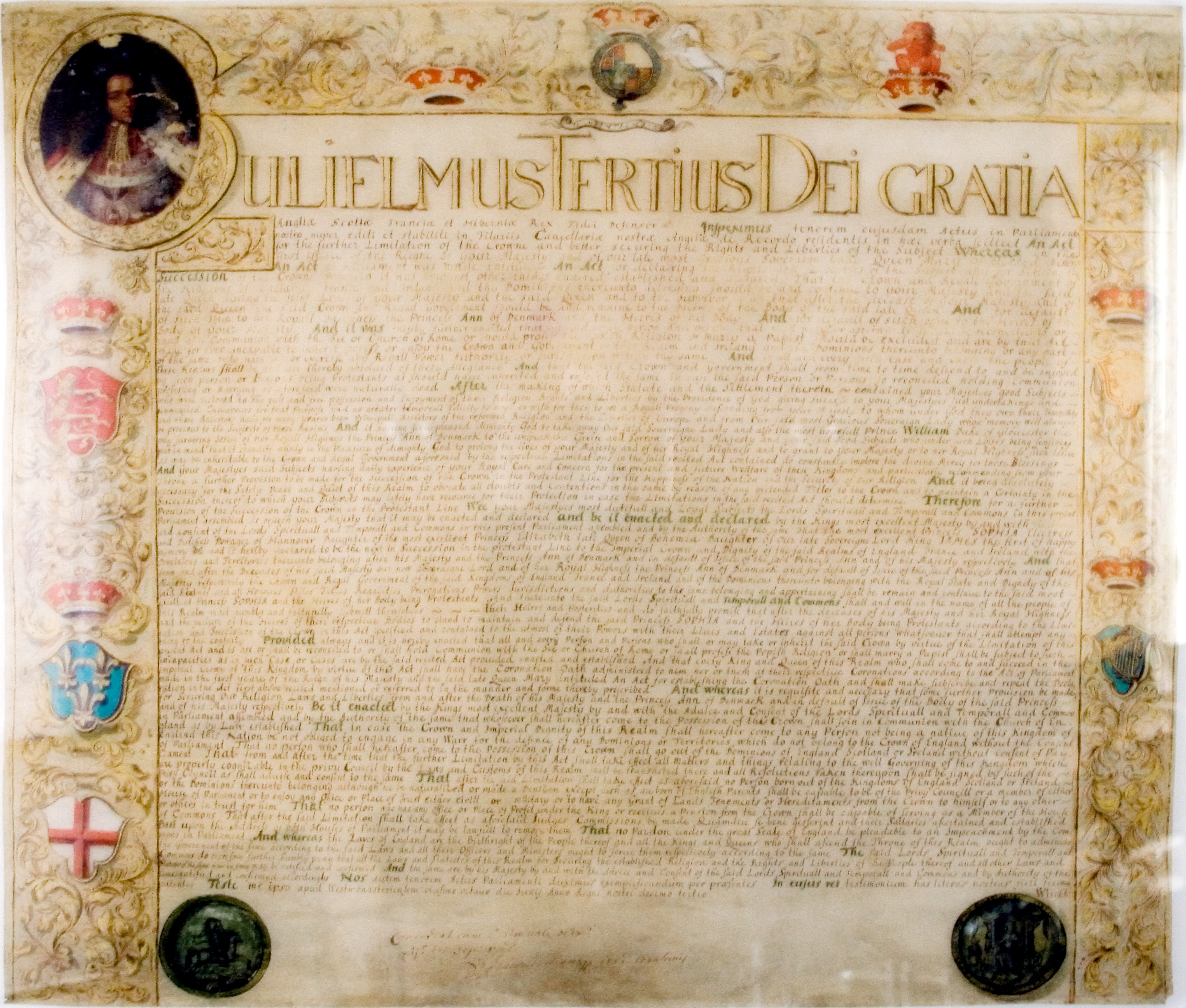
The Act of Settlement, “William III By the Grace of God”
The Constitutional Settlement of 1688 established that under a constitutional monarchy, Parliament controls the royal line of succession. The Bill of Rights, 1688 and the Act of Settlement, 1700 served to secure and solidify the progress of parliament and the supremacy of the Crown-in-Parliament. Thus far, Parliament has twice exercised this power in order to install a new royal house of the Protestant faith: in the 17th and 18th centuries, Parliament saw Catholic kingship, associated with Continental absolutism abroad and intense civil strife at home, as a fundamental threat to English liberty and England’s independence. Coincidentally, The Bill of Rights reads like the Declaration of Independence and lists a whole series of offences that James II committed as King. It clearly equates Protestantism to liberty and proclaims (in an era before standardized English spelling): “Whereas the late King James the Second by the Assistance of diverse evill Councellors Judges and Ministers imployed by him did endeavour to subvert and extirpate the Protestant Religion and the Lawes and Liberties of this Kingdome.”
As David Starkey explains in Monarchy, the accession of the overtly Catholic James II (brother and first legitimate heir of Charles II) in 1685 caused significant consternation and strife and raised serious constitutional difficulties from the outset because all monarchs after Henry VIII had been the Supreme Governor of the Church of England and Anglican. “James drew up a Declaration of Indulgence, which offered universal religions toleration to all Anglicans, Catholics, and Protestant dissenters.” James II invoked his crown prerogative on enforcing religious toleration in an attempt to impose an absolute monarchy on Great Britain.
By 1688, the birth of James II’s son, who would eventually have secured a re-Catholization of Britain, alienated key segments of Parliament and the Church of England – Tory and Whig alike. Parliament then took the “revolutionary and treasonable step” on 30 June 1688 of inviting William of Orange, who had married Mary Stuart (daughter of James II), to invade Britain and become King. William III landed on 5 November 1688 (“another auspicious day for Protestants”). James II underwent a “psychosomatic crisis” after losing faith and convincing himself that God was in fact on William’s Protestant side. His daughters Mary and Anne supported William, and James fled to France in exile later that year. Parliament deemed James II to have abdicated both his own kingship as well as those of his Catholic heirs and successors in the House of Stuart. The Bill of Rights, William of Orange and Queen Mary as co-monarchs. Queen Anne succeeded his sister Mary after William & Mary died without issue. “England had in effect elected a King and Queen. England and the monarchy would never be the same.” Thus the “Glorious Revolution” and the Bill of Rights secured the Protestant succession and Parliament’s authority to determine that line of succession through “an armed yet bloodless invasion”.
The Bill of Rights equates Protestantism with England’s liberty and independence and codified the first ban on marrying Catholics:
“And whereas it hath beene found by Experience that it is inconsistent with the Safety and Welfaire of this Protestant Kingdome to be governed by a Popish Prince or by any King or Queene marrying a Papist the said Lords Spirituall and Temporall and Commons doe further pray that it may be enacted That all and every person and persons that is are or shall be reconciled to or shall hold Communion with the See or Church of Rome or shall professe the Popish Religion or shall marry a Papist shall be excluded and be for ever uncapeable to inherit possesse or enjoy the Crowne and Government of this Realme […].”
But the Bill of Rights also contains other significant provisions that provided the basis for our modern liberties. It codified parliamentary privilege: “That the Freedome of Speech and Debates or Proceedings in Parlyament ought not to be impeached or questioned in any Court or Place out of Parlyament.” The Bill of Rights also codified the supremacy of the Crown-in-Parliament: “That the pretended Power of Suspending of Laws or the Execution of Laws by Regall Authority without Consent of Parlyament is illegall.”
In 1707, Parliament passed the Act of Settlement, which provided that after the demise of Queen Anne, who had no royal issue, the crown would pass on to her closest Protestant successor, Princess Sophia of Hanover and her descendents. The Act entered into force in 1714, and the House of Hanover established itself with George I:
“His Majesty had recommended from the Throne a further Provision for the Succession of the Crown in the Protestant Line. The Princess Sophia, Electress and Duchess Dowager of Hanover, Daughter of the late Queen of Bohemia, Daughter of King James the First, to inherit after the King and the Princess Anne, in Default of Issue of the said Princess and His Majesty, respectively and the Heirs of her Body, being Protestants.”
David Cameron dismissed the penalty for marrying Catholics as “an historical anomaly” and betrayed the legacy of liberty that the Bill of Rights and Act of Settlement secured. If anything, this provision is an anachronism, not an anomaly: the penalty for marrying Catholics used to serve a valid and necessary function, but in the 21st century, it no longer performs any legitimate function, and Parliament should therefore repeal it.
The Amendment of the Canadian Act of Settlement
The legal Doctrine of Reception means that Canada, and the other Commonwealth realms, have at various times “received” English statutory and common law to the extent that those laws proved relevant in the colonies. (See Peter Hogg’s Constitutional Law of Canada for detailed information on reception). This reception undoubtedly included the Bill of Rights, 1688 and the Act of Settlement, 1707. The Parliament of Canada can therefore amend the Canadian version of this act, subject to the written constitution.
Anne Twomey, Professor of Law at the University of Sydney, delivered a presentation to the Constitution Unit “Changing the Rules of Succession and the Problem of the Realms.” She concluded that the Statute of Westminster does not empower the Commonwealth realms with a veto over the sovereignty to the British Parliament to amend the Act of Settlement, 1700; however, it is certainly in the best interest of all 16 realms to coordinate their respective legislation in order to avoid bifurcating the 16 crowns.
Twomey suggested that s. 41(a) of the Constitution Act, 1982 might require the use of the unanimity amending formula in order to change the rules of succession to the Crown of Canada, depending upon the interpretation of “Office of the Queen, Governor General or Lieutenant-Governor of a Province.” Twomey suggested that that “Office” refers to the powers and functions and not to the rules by which the succession to the Crown of Canada is determined. I concur with this interpretation and hope that the Government of Canada will argue that Section 41 (a) “Office of the Queen, Governor General, and Lieutenant-Governor of a Province” refers to the crown prerogative, or the powers, functions, and existence of the office – not the rules by which the line the succession is determined. If this interpretation stands, then the Parliament of Canada could probably amend the legislation unilaterally, though the Government of Canada may choose to consult the provincial governments.
O’Donohue v Canada
So far, only Tony O’Donohue v Her Majesty the Queen in Right of Canada, Her Majesty the Queen in Right of Ontariooffers any kind of interpretation of the Act of Settlement in Canada. However, I found some parts of the ruling contradictory, and because it came from a lower court, the Ontario Superior Court of Justice, a higher court could well overturn it. Tony O’Donohue alleges that the “certain provisions of the Act of Settlement are of no force or effect as they discriminate against Roman Catholics in violation of the equality provisions of the Canadian Charter of Rights and Freedoms.” The ruling correctly states that by the doctrine of reception and because of the importance of the law, the Act of Settlement has become part of Canada’s unwritten constitution. As such, the Charter cannot be invoked in order to strike down any part of the Act of Settlement, because logically every part of the constitution, written or unwritten, is inherently constitutional (even if certain points come into conflict). The courts therefore cannot use one part of the constitution to strike down another. In addition, the Court acknowledges that even if the Canadian Act of Settlement were successfully challenged, the Canadian ruling would have no force and effect in the United Kingdom. This conclusion conforms to the Doctrine of Reception and recognizes the separation of the British and Canadian versions of the statute.
The Status of the Crown of Canada
Tidridge shows that the Statute of Westminster, 1931 formally created the independent crowns of the Commonwealth Realms.
Then the ruling starts to become inconsistent. At paragraph 17, it says that “the impugned portions of the Act of Settlement are a key element of the rules governing succession to the British Crown.” But if they already established that the Canadian version of the Act has no bearing on British succession, then logically it cannot effect the “British Crown”, but only the Crown of Canada. This phrase is also problematic because it implies that the Crown of Canada and the Crown of the United Kingdom are one and the same entity, even though they are constitutionally separate because of the Dominion Conferences of 1926 and the Statute of Westminster, 1931. But at paragraph 34, they say that only an act of the Parliament of Canada made Edward VIII’s abdication of the “Crown of Canada” effective. Then at paragraph 36, the ruling argues that “Canada is united under the Crown of Great Britain, ” and paragraph 27 asserts that “we […] share the Crown with the United Kingdom.” In reality, we don’t share the Crown with the United Kingdom: our two crowns are just held by the same individual, Queen Elizabeth II. Second, paragraphs 34 and 36 seem to contradict one another on the constitutional distinction and uniqueness of the Crown of Canada relative to the Crown of the United Kingdom.
The “Office of the Queen”, the Statute of Westminster as Treaty, and Succession in Canada
The ruling argues that the Statute of Westminster acts as a treaty and that “the rules by which succession is determined” act as “the core of how the monarchy functions” (para, 38); therefore, amendment to the Canadian Act of Settlement would “bring about a fundamental change in the office of the Queen” and require the use of s. 41 (a) of the Constitution Act, 1982 (para 33).
The judges based that assertion on the interpretation of the Statute of Westminster as “a treaty among the Commonwealth countries to share the monarchy under the existing rules and not to change the rules without the agreement of all signatories” (para 33). This argument does not make sense for several reasons. First, the term “Commonwealth countries” cannot be used interchangeably with “Commonwealth realms” because of the 54 member-states of the Commonwealth of Nations, only 16 are constitutional monarchies that recognize Elizabeth II as their head of state. Second and most fundamentally, Professor Twomey presents a thorough and convincing case why the Statute of Westminster should not be considered a binding treaty. It is an act of the British Parliament, the last piece of legislation that the Imperial Parliament passed that truly affects the Dominions by formally ensuring that “the United Kingdom would no longer impose British statutes on the various dominions without their accord.” Perhaps more importantly, its “signatories” only included the six self-governing Dominions of 1931 (Australia, Canada, the Irish Free State, New Zealand, Newfoundland, and South Africa); Ireland and South Africa have since become republics, and Newfoundland has since became part of Canada. A treaty would necessarily need to be updated in order to take into account all these significant changes and that there are 16 Commonwealth Realms today.
O’Donohue incorrectly applies the rules by which succession is determined to section 41 (a) based on the faulty interpretation of the Statute of Westminster as treaty. Since this premise is incorrect and some of the other premises contradict one another, I can only conclude that the overall conclusion that succession falls under “office of the Queen” is therefore also wrong and deeply flawed.
Conclusion
The Constitutional Settlement of 1688-89 constituted what American historian Steven Pincus has dubbed “The First Modern Revolution”: in this case, Parliament asserted its power to determine the royal line of succession and destroyed the notion of the Divine Right of Kings and monarchical absolutism. Parliament selects the monarch, not God. England sowed the seeds of this Glorious Revolution in the 1640s and 1650s during the brutal civil wars between the Royalists and the Parliamentarians (the Roundheads and the Cavaliers) and the Cromwellian Protectorate; without significant bloodshed, Parliament had revolutionized England and laid the foundation for parliamentary limitations of the royal prerogative, constitutional monarchy, and representative government. Parliament deemed the Protestant succession a necessary condition for the preservation of parliamentary sovereignty and English liberty and so enforced that principle in the Bill of Rights, 1688 and the Act of Settlement, 1700.
The penalty for marrying Catholics has long since become an anachronism, and the Westminster Parliament certainly possesses the power to repeal this measure. Theoretically, a member of the Royal Family could marry any “dissenting [non-Anglican] Protestant”, a Jew, a Muslim, a Hindi, or whatever and still retain his or her place in the line of succession; only marriage to a “Papist” would forever bar them from the throne. The Statute of Westminster does not empower the 15 other Commonwealth realms that also recognize Queen Elizabeth II as their head of state with a veto over the sovereignty of the Westminster Parliament: a) because the Doctrine of Reception means they have all received the Bill of Rights and Act of Settlement into their bodies of law, and that they would therefore separately and independently amend their received Acts of Settlement and b) because the Statute of Westminster recognized the legal and constitutional independence of the self-governing colonies. If the British Parliament can no longer legislate for the Commonwealth realms, then logically the parliaments of the Commonwealth realms cannot legislate for the United Kingdom – because each country’s parliament exercises its sovereignty only within the confines of its territory. However, it is in the best interest of the Commonwealth Realms to coordinate this effort if they all want to vest their separate crowns into the same person, as has been the historic practice. Again, I would argue that such “bifurcation” is possible. Each country has received the Act of Settlement and incorporated it, implicitly or explicitly, into its body of law and can amend its legislation accordingly as long as the crown remains with a descendent of Princess Sophia of Hanover. The corollary of this principle might mean that the parliament of a Commonwealth realm could abolish the crown altogether – except those like Australia and Canada, whose parliaments are subject to written constitutions and amending formulas. Any such amendments would not affect the first two royals in the line of succession (Charles Prince of Wales and the William Duke of Cambridge) because they are both first-born children married to Protestants; the new rules would first directly apply to the children of Will and Kate. If the repeal of male primogeniture is enacted, then the first-born child, rather than first-born son, of Will and Kate will follow William in the line of succession.
I expect that the Harper government will introduce the necessary legislation in the 2nd session of the 41st Parliament and devote a significant portion of the next Speech from the Throne to these historic amendments. The Prime Minister’s Office issued this press release on during the CHoGM but so far hasn’t made any new announcements. I’ll keep an eye on key developments and write about them as the information becomes available.
The Independent has reported that the Cameron government will put forward legislation that will either preempt or set the ground rules for Alex Salmond’s referendum on Scottish independence. The Cameron government would even call it “The Clarity Act”, like our law here in Canada, which stipulates that in order for a province to secede, its provincial government must submit a clear question that a clear majority of the people of that province support; the House of Commons (and not the Senate) would determine after the referendum whether it had constituted a clear majority on a clear question. Such legislation in the UK would allow the Westminster Parliament to exercise its legitimate authority over Scotland’s constitutional status, as per the terms of the Scotland Act, 1998.
The Westminster Parliament would force the Scottish Parliament to submit one clear question on whether Scotland should separate and effectively dissolve the United Kingdom rather than Alex Salmond’s current plan to offer two options: full independence (even though Scotland would keep the Pound Sterling and effectively contain a monetary union with England), and maximum devolution (“devo max”), which would transfer all powers but defence and foreign affairs to Scotland. In any case, a referendum would only empower the Scottish government to negotiate a settlement with the British government and would not (or at least shouldn’t) entail obligatory constitutional reforms on the part of the Westminster Parliament.
I’ll keep a close eye on these constitutional developments relating to the Scottish referendum.
This issue of Scotland’s independence provides a veritable treasure trove of new constitutional material to explore with respect to the devolution of certain powers to the restored Scottish Parliament and the newly established Welsh and Northern Irish Assemblies. The United Kingdom of Great Britain and Northern Ireland, officially a unitary state, has embarked on a process of federalisation in which England still relies on the Westminster Parliament while the other three nations (Scotland, Wales, and Northern Ireland) benefit from their own devolved legislatures. As the renowned English constitutional scholar Vernon Bogdanor remarked, “the unwritten constitution is changing before our eyes.”
The politico-constitutional consternation in the United Kingdom carries implications that may pertain to Canada and the question of Quebec’s secession from our federal union. I will briefly summarize the history of The Crown of Scotland and the creation of the United Kingdom as well as the nature of the new Scottish Parliament.
From the Personal Union of the Crowns (1603-1707) to The Act of Union, 1707 and the Scotland Act, 1998
Elizabeth I died without royal issue in 1603, and thus the glorious House of Tudor died with her. The threat of invasion from the French or Spanish and a protracted war of English succession compelled Elizabeth I’s courtiers to arrange that King James VI of Scotland also assume the Crown of England upon Elizabeth’s demise. James shared a distant blood relation to the House of Tudor (his great-grandfather James IV married Henry VIII’s sister Margaret), and he was a Protestant. James VI of Scotland also became James I of England and became the first monarch to hold the personal unions of the crowns of Scotland and England, which lasted from James’s accession to the throne of England in 1603 to the Act of Union, 1707. This personal union of the two crowns meant that England and Scotland maintained their status as separate kingdoms with separate parliaments and separate state churches, but shared one monarch. The 16 Commonwealth realms today constitute a personal union. James I sought unsuccessfully to convert this personal union into a full political union.
English historian David Starkey explains the negotiations that led to the creation of the United Kingdom in the Act of Union, 1707. In 1701, the Westminster Parliament passed the Act of Settlement in order to ensure the Protestant Hanoverian succession to the crown of English after Anne’s demise – but the English never consulted the Scots. In response, the Scottish Parliament passed the Act of Security in 1703, which stipulated that the crown of Scotland would also passed onto a Protestant, but not the same Protestant who would wear the crown of England. The Westminster Parliament passed the Aliens Act and banned the major Scottish export trade to England in order to constrain Scotland’s finances and force the Scots to negotiate. Queen Anne succeeded where James failed. The Act of Union, 1707 secured the personal union of the crowns of England and Scotland and prevented their bifurcation and created the political union of the United Kingdom of Great Britain. In order to achieve full political union, both the Westminster Parliament and the Scottish Parliament had to agree on the Act of Union. But the Scottish Parliament also had to vote not merely for its dissolution, but for its total demise; under the United Kingdom, the Westminster Parliament would govern for all of Great Britain. The Scots received full access to all the prosperous English colonies – which thereafter became part of the British Empire. While the Scots relinquished their parliament and sovereignty, they never surrendered their distinct national identity.
The Scottish Parliament
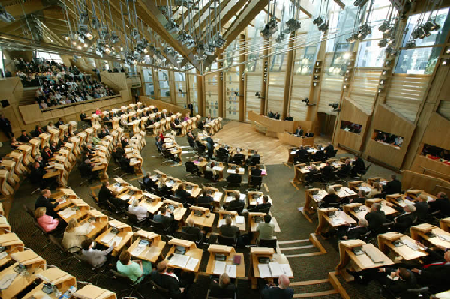
The Scottish Parliament adopted the semi-circular seating arrangment of the New Zealand and Australian Houses.
This stubborn Scottish nationalism culminated in the reestablishment of the Scottish Parliament in the form of a devolved assembly, as the Blair government set out in the Scotland Act, 1998. The new Scottish Parliament deviates dramatically from the traditional Westminster model, as this pamphlet and the Scotland Act show. It consists of 129 “Ministers of the Scottish Parliament”, or MSPs, and it operates on a mixed-member proportional system. 73 of the MSPs represent the single-member constituencies; the remaining 56 “Regional MSPs” are elected on the basis of party affiliation in 8 Scottish Parliament Regions, each of which contains 7 seats. “In each region, parties are allocated seats depending on the number of votes they receive in this regional ballot, and taking into account the number of constituency seats they win in the region”, which ensures the overall proportional result. The New Zealand House of Representatives operates on this system as well.
Initially, the Scottish Parliament had also deviated from the Westminster model by pioneering true fixed elections every four years; ironically, the Westminster Parliament has itself now adopted this radical method with the passage of the Fixed-Term Parliaments Act earlier this year. The Scottish Parliament pioneered the elimination of crown prerogative on dissolution: the Scottish Parliament dissolves and summons itself automatically every four years so that the elections occur on the first Thursday in May, and the new parliament convenes 7 days later (section 2 of the Scotland Act). The most recent occurred in May 2011. The words “prorogue” and “prorogation” appear nowhere in the Scotland Act, so I can only presume that the Scottish Parliament not only eliminated the crown prorogation on the summoning and dissolving of Parliament but took the even more radical step of eliminating the entire concept of prorogation altogether!
Sections 44 through 47 set up the new Scottish Executive, which consists of the “First Minister” (I guess that the traditional “Prime Minister” would have created too much confusion and power struggle with London), Ministers, and the Lord Advocate and Solicitor General for Scotland. Section 45 says that “(1) The First Minister shall be appointed by Her Majesty from among the members of the Parliament and shall hold office at Her Majesty’s pleasure.” That procedure conforms to the Westminster standard, though the act of codifying this function is in and of itself radical. But Section 46 states that the Parliament itself will nominate a candidate for First Minister within 28 days of its convening. Then the Queen would be obliged to appoint that candidate as First Minister. Section 47 establishes how ministers are appointed:
(1) The First Minister may, with the approval of Her Majesty, appoint Ministers from among the members of the Parliament.
(2) The First Minister shall not seek Her Majesty’s approval for any appointment under this section without the agreement of the Parliament.
The Parliament confirms the First Minister’s choice of ministers for portfolio like the US Senate must confirm the President’s choice of cabinet. Under the normal Westminster model, the Prime Minister nominates and Her Majesty-in-Council or the Governor-in-Council formally appoints a minister – but the Queen or Governor General does not possess a reserve power to refuse such appointment. This Scottish system revolutionizes and fundamentally alters this process: the First Minister formally “appoints”, the Parliament “agrees” (or confirms the appointment), and the Queen “approves”!
Overall, the Scottish Parliament is a bizarre hybrid of the congressional and Westminster parliamentary models: the Scotland Act codifies (and therefore limits) crown prerogative, and not only codifies a basic outline of the confidence convention but also vests the power to approve appointments in the parliament.
The Scotland Act indicates that the Scottish Parliament exercises its authority over the following policy fields:
agriculture, forestry and fisheries
education and training
environment
health and social services
housing
law and order
local government
sport and the arts
tourism and economic development
transport.
The Westminster Parliament retains the following “reserved” policy fields:
benefits and social security
immigration
defence
foreign policy
employment
broadcasting
trade and industry
nuclear energy, oil, coal, gas and electricity
consumer rights
data protection
the Constitution.
The SNP’s Proposal: Restoration of the Personal Union
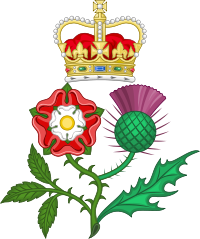
James I: The English rose and Scottish thristle represent the separate kingdoms of England and Scotland that fall under the same crown in a personal union.
Finally, after having explained the history of the Crown of Scotland and the powers and functions of the Scottish Parliament, I come to the Scottish National Party’s proposal for Scottish independence. So if “the Constitution” falls under one of the policy fields reserved to the Westminster Parliament, then how can the Scottish government undertake a referendum on Scottish independence? Like the Parizeau government of Quebec in 1995, the Salmond government has portrayed the referendum on an independent Scotland as a mandate to negotiate.
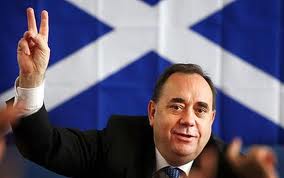
The Salmond government published its conception of an independent Scotland in Scotland’s Future: A Draft Referendum Bill Consultation Paper. From what I’ve read so far, Alex Salmond seems like a genuine monarchist, and for practical political reasons, the Scottish National Party will put forward a conception of an independent Scotland that it believes can win the support of a majority of the Scottish people. In addition, the Royal Family summer in Balmoral in Scotland – and Queen Elizabeth II herself, not the Crown Estate, owns Balmoral.
This point summarizes what an independent Scotland would look like:
1.19. Her Majesty The Queen would remain as Head of State. The current parliamentary and political Union of Great Britain and Northern Ireland would become a monarchical and social Union – united kingdoms rather than a United Kingdom – maintaining a relationship forged in 1603 by the Union of the Crowns.
In all reality, the dissolution of the United Kingdom would not “maintain” a relationship forged in 1603: it would restore this personal union of the crowns. I’ll watch Scottish politics with great interest in the years to come and observe how this referendum campaign unfolds.
The Globe and Mail reported today that the Liberal Party will elect its next leader by “US-style primary,” which conceals the different types of primaries that the various American states use: open, closed, jungle, etc. Judging by Ibbitson’s description, the Liberals’ idea sounds most like an open primary. I described the British Conservative Party’s experimentation with open primaries and Douglas Carswell’s Private Members’ Bill that would have buttressed the organization and holding of open primaries in law. But the British Conservatives have used primaries at the constituency level in order to elect local candidates who would become more responsive to their constituents and less beholden to party whips; no where did Douglas Carswell’s bill suggest that the leader of the party should be elected by primary.
In fact, I would argue that the election of the leader by primary will only succeed in creating an omnipotent party leader and potential prime minister emboldened by veritable popular election — a principle incompatible with true parliamentary government. If anything, I would prefer that we revert to the traditional system that the Australian Labor and Liberal Parties still follow today whereby the parliamentary caucus elects the party leader because this system actually enforces cabinet government. Coupled with open, or even closed, primaries at the constituency level, this system would best reinforce responsible government, true cabinet government, and create the expectation that parties adhere to their electoral platforms more closely when in government.
In any case, the Liberals suffered an historic loss in the election of 2011 and will try anything in order to increase their support. Or as New Democratic Liberal Interim Leader Bob Rae says, “When you’re in third place, you need to be able to take more risks, and you need to be edgier.” However, at the time of writing, the Liberal Party’s website does not list any news release regarding their open primary or how precisely their open primary will work. For instance, we don’t yet know whether the Liberals will organize their leadership primary province by province, sequentially, or whatever. The idea of electing a leader by open primary is probably unprecedented in a Westminster system, so the Liberal Party of Canada has entered uncharted territory; it would probably do well to create hundreds of groups of enthusiastic Liberal activists at the local level, and only then build up their overall organization. Frankly, this idea sounds like a new manifestation of the trite Liberal lament, “If only we had a better leader, Canadians would continue to vote for us.” I’ll devote more analyses to the Liberals’ proposals as they become available. Hopefully the Liberals will also see the virtue of organizing primaries at the local level.

 The Liberal Party of Canada has elaborated on its plans to hold something akin to an open primary in the selection of its next leader in the Roadmap to Renewal. I mentioned the proposal in an earlier entry before the Liberals had formally released this document. The Liberals made the leadership primary the centerpiece of their Roadmap, but they’ve also devised the basis of a plan for the democratization of the nomination process at the local level. The local level will ultimately provide the most fertile ground for new party activists, so the Liberals should really concentrate their efforts on their constituency associations and only then proceed to the level of national leadership – if they seek a genuine bottom-up, democratic renewal. In other words, the Liberals need to cultivate their grass roots and a powerbase before making any pretence of forming government again.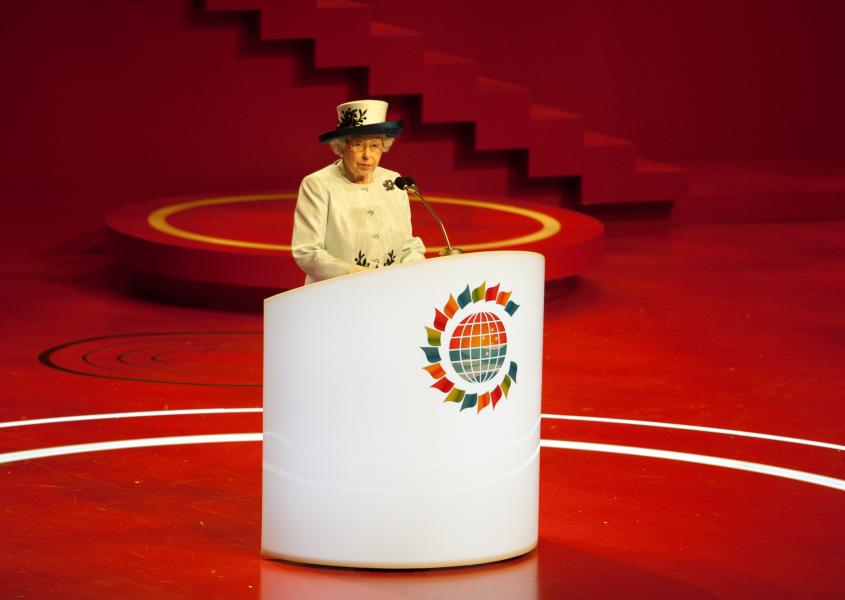

 James Bowden's Blog