
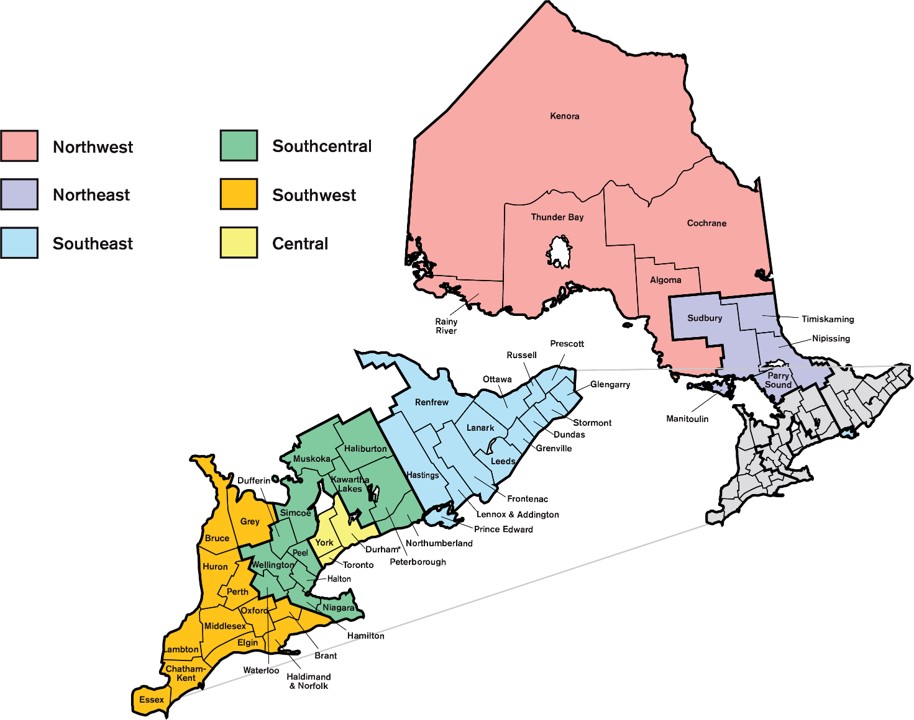
Ontario recently repealed its fixed-date election law and abolished pre-writ spending limits. Instead of putting those amendments to the Election Act in an omnibus budget implementation bill, they should have formed part of an electoral bill that would also allow Ontario to readjust the boundaries of provincial electoral districts regularly, as every other province has already done. Ideally, Ontario would simply readjust its provincial electoral boundaries by way of an independent commission every eight to ten years like every other province. But no other province boasts so many federal electoral districts as Ontario’s 122, and no provincial elected assembly has more than 125 members. Every other province is represented by significantly fewer MPs in Ottawa than MLAs (or MNAs or MHAs) in their provincial capitals: 7 vs 40 in Newfoundland & Labrador, 4 vs 27 in Prince Edward Island, 11 vs 55 in Nova Scotia, 10 vs 49 in New Brunswick, 78 vs 125 in Quebec, 14 vs 57 in Manitoba, 14 vs 61 in Saskatchewan, 37 vs 87 in Alberta, and 43 vs 93 in British Columbia. It therefore stands to reason that Ontario should take advantage of this unique convergence to save money and double up most of its federal electoral districts as its provincial electoral districts. But Northern Ontario for practical purposes does need more than nine northern ridings within its provincial assembly; thankfully, the provincial parliament alone determines the ideal number of ridings and people per elected representative irrespective of any inter-provincial or federal considerations under the province’s constitution.
Ontario has struggled since the 1990s on how to approach readjusting the boundaries of its provincial electoral districts and provides a cautionary tale of what happens when ad hockery gets out of hand. In 1996, The Fewer Politicians Act of Conservative Premier Mike Harris reduced the Legislative Assembly from 130 MPPs to 99 in one fell swoop by doubling Ontario’s new federal electoral boundaries as Ontario’s provincial electoral boundaries as well.[1] This statute automatically applied the Representation Order, 1996 and the Representation Order, 2003 to Ontario’s legislative assembly. However, Liberal Premier Dalton McGuinty wanted to stop Northern Ontario from losing ridings upon each federal electoral redistribution while still doubling Ontario’s federal electoral boundaries as the provincial electoral boundaries everywhere. The Representation Act, 2005 guaranteed Northern Ontario a minimum of 11 ridings at Queen’s Park but kept the federal “southern electoral districts” to the rest of the province. But since this amendment abolished the automatic application of the latest federal representation order to Ontario, the Parliament of Ontario now has to adopt new legislation ad hoc every decade. In 2017, Liberal Premier Kathleen Wynne tabled legislation to apply the Representation Order, 2013 to southern Ontario while also increasing Northern Ontario’s minimal allocation to 13 ridings.[2]
But the pattern broke down in the 2020s. Conservative Premier Doug Ford refused to table legislation to update Ontario’s southern electoral districts in accordance with the Representation Order, 2023, which he denounced in August 2024 as having “jury-rigged” federal electoral boundaries in Ontario.[3] Ford did not even have the courtesy to use the correct word for the partisan manipulation of electoral boundaries (“gerrymandering” or “gerrymandered”) yet ironically forced Ontarians to vote in his snap election in February 2025 on a highly distorted electoral map at over 5.19% on the Loosemore-Hanby Index. This ad hockery can only last so long as the Federal Electoral Boundaries Commissions for Ontario maintain the same general boundaries between Northern and Southern Ontario.
Ontario’s Representation Act, 2015 expanded the legislative assembly to 124 single-member districts overall, declared the “111 southern electoral districts” as identical to those 111 federal electoral districts under the Representation Order, 2013, but gave Northern Ontario 13 provincial electoral districts as opposed to the 10 federal electoral districts covering this same region under the Representation Order, 2013. This provincial legislation therefore set the border between Northern Ontario and Southern Ontario along the southern and eastern boundaries of the provincial electoral districts of Parry Sound—Muskoka and Nipissing where they meet the identical federal and provincial ridings of Simcoe North, Haliburton—Kawartha Lakes—Brock, and Renfrew—Nipissing—Pembroke.
The new electoral boundaries under the federal Representation Order, 2023 kept this same border between northern and southern Ontario. The Parliament of Ontario could therefore amend the Representation Act to make those 113 federal electoral districts south of that line the new provincial electoral districts as well, while preserving the 13 ridings in Northern Ontario. But that only solves the problem in the 2020s. Ontario needs a durable and lasting solution in the 2030s onward.

Representation Order, 2003
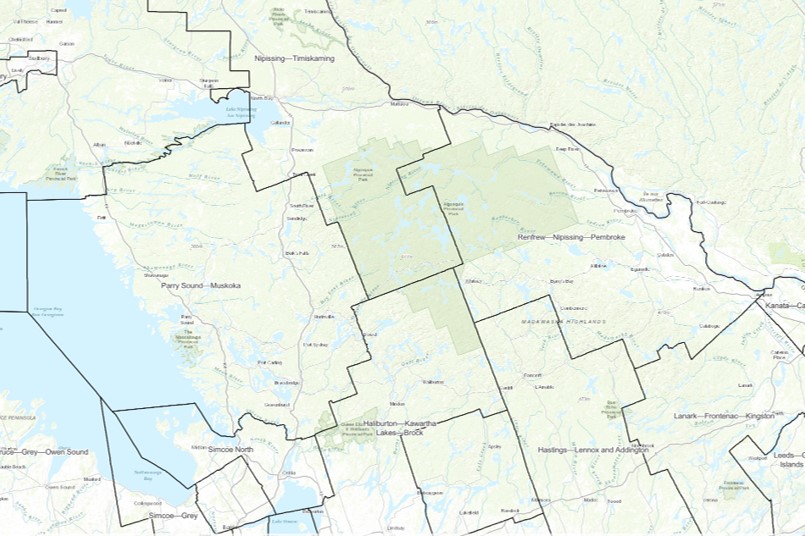
Representation Order, 2013
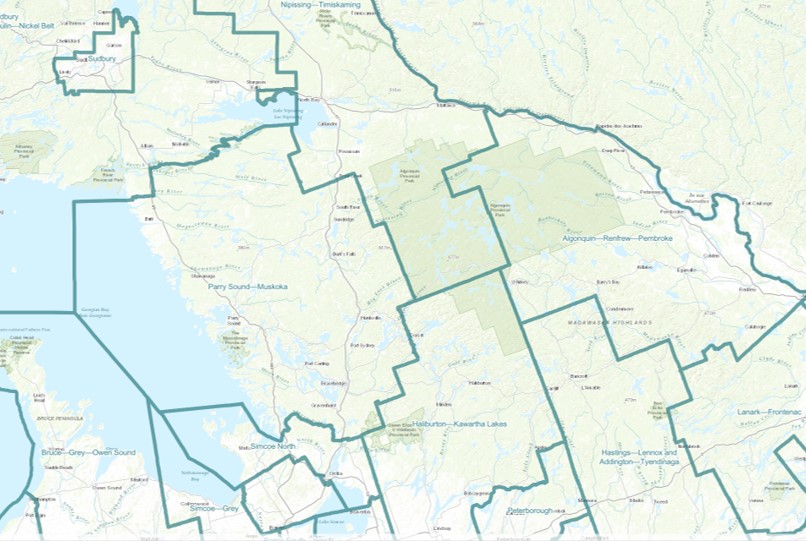
Representation Orders, 2023
The provincial parliament should therefore amend the Representation Act to say something to the effect that from the 2030s onward, after the proclamation of each new federal Representation Order under the federal Electoral Boundaries Readjustment Act, the Province of Ontario will establish a new Far-North Electoral Boundaries Commission to re-establish the 13 or however many ridings dedicated to Northern Ontario and, if necessary, re-establish the border between northern and southern Ontario if the latest federal Representation Order has altered it. After either confirming that the border between northern and southern Ontario has remained intact or changing that border, as necessary, the southern federal electoral districts will double up as the provincial electoral districts. This policy would serve two purposes: first, it would make electoral redistribution fair and non-partisan by preventing the government from deciding not to table legislation ad hoc to update the electoral boundaries in southern Ontario, like the Ford government did in 2024-2025; second, it would make sure that Northern Ontario also goes through a provincial electoral readjustment every ten years or so to take into account changes in population there. The independent commission might end up making no changes to the northern ridings after holding public hearings and consulting with indigenous peoples, but at least those interested would have had the chance to give their views.
Canada’s biggest province should not maintain the ignominious distinction of being the only one of the ten which refuses to readjust its provincial electoral boundaries regularly.
Similar Posts:
- Readjusting Electoral Boundaries
- Doug Ford Wins Snap Election on an Extremely Disproportional Electoral Map (March 2025)
- Doug Ford’s Gibberish on Gerrymandering: Why Ontario Needs Its Own Separate Provincial Electoral Boundaries Commission (August 2024)
Notes
[1] The Fewer Politicians Act, Bill 81, 36th Parliament, 1st Session, 1996.
[2] Representation Act, 2015, S.O. 2015, chapter 31; Representation Statute Law Amendment Act, 2017, S.O. 2017, chapter 18. The Far North Electoral Boundaries Commission took into account factors like “communities of interest”, “representation of indigenous people”, “sparsity, density, and the rate of population growth,” “geographic features,” and “the availability and accessibility of means of communication and transportation” in northern Ontario when it drew up the region’s 13 electoral districts in 2017Far North Electoral Boundaries Commission, Final Report (Toronto: Queen’s Printer for Ontario, 8 August 2017), at page 12.
[3] Doug Ford (Premier of Ontario), press conference in Durham, 1 August 2024. In response to the question, “Will you be realigning the provincial riding boundaries to match?”, Ford replied: “No. Because why change something that works? It works, so it’s all good. Just because the feds want to do it, [to] jerry-rig [sic] the ridings – and it’s no secret: people do that, governments do that. I’m not doing it. I’m going to leave the boundaries alone, and people will decide if they want to move forward with our government on prosperity, on healthcare, on the economy, or they want to go backwards and vote for the other guys. They’ll have that choice.”

 James Bowden's Blog