
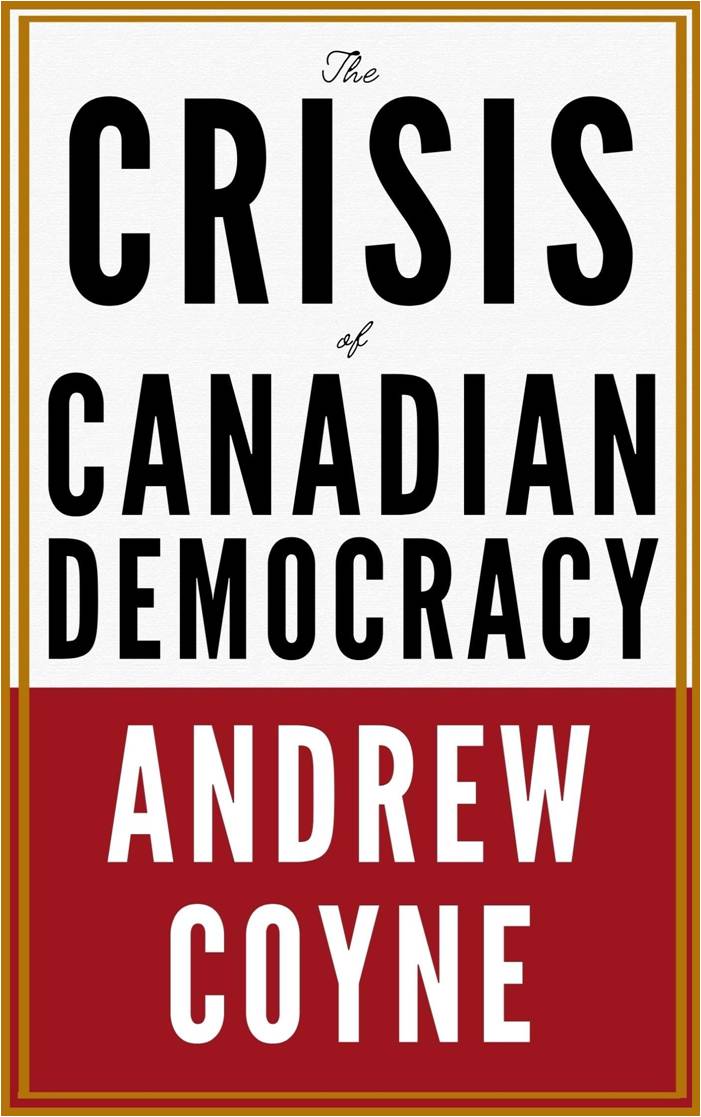
In The Crisis of Canadian Democracy, Andrew Coyne repeats the same refrain that has made the rounds for decades but presents his polemic as if it were original. His superficial assertions seem like profound arguments at first glance, and an inescapable implication weaves throughout his narrative: if only everyone thought as Andrew Coyne does, then so many of our problems would solve themselves. I risk giving Coyne too much attention and legitimacy by reviewing this book at all, but the bulk of this book merits a thorough refutation because he seems to have garnered such a following, especially from the credulous at The Hub, The Agenda with Steve Paikin, and the Monk Centre.
The errors and inaccuracies begin on the very first page, even before the title. Sutherland House included a table on “The Government of Canada” which ostensibly outlines the “three main branches” of “a constitutional monarchy and parliamentary democracy.” The “legislative branch (Parliament”) does indeed consist of the King, Senate, and House of Commons under section 17 of the Constitution Act, 1867. But Sutherland House strips the Crown of Canada of its executive authority by insisting that the “executive branch” consists only of the prime minister, cabinet, Privy Council Office, and the Prime Minister’s Office. The Governor General appoints and dismisses prime ministers and summons, prorogues, and dissolves parliament on the prime minister’s advice, but the publisher did not deem this pedantic details of sufficient importance to mention. Coyne also insists that he should rely on the “conventional shorthand” of calling the House of Commons “Parliament.”[1]
Coyne states on page 1 that he wants to drag the deluded and the ignorant out of Plato’s Cave and into the light so that they finally understand that “we do not live in the system we think we do.”[2] He boldly proclaimed at the end of the introduction that “the beginning of change is to shed our illusions. Before we can start to fix our democracy, we need to realize how broken it is. That is the work of the remainder of this book.”[3] If only Coyne had turned this brilliant insight inward and shed his own illusions and misunderstandings and contradictions.
Coyne revels in the superficial. He equated the unclear want of confidence in the Martin government in May 2005 with Harper’s first tactical prorogation of December 2008 and Trudeau’s second tactical prorogation of January 2025 and elided all nuance in a single sentence. He ended the section with an absurd rhetorical question:
“Now suppose the defeated prime minister were to recommend to the governor general that the House [the one time that he should have written “Parliament”] be dissolved and an election called. Convention dictates the governor general would be within her rights to call upon another party or parties to form a government, assuming they had the support of a majority of the House. But successive Conservative leaders have made clear that they would not accept this. What if, the governor general having refused his advice, the prime minister refused to resign?”[4]
Then the Governor General would outright dismiss the Prime Minister from office and appoint another. Coyne wrote this statement as if a precedent involving this very scenario had not occurred within the last decade. In 2017, Lieutenant Governor Judith Guichon dismissed Christie Clark as Premier and rejected her constitutional advise to dissolve the legislature which British Columbians had returned only a few weeks before. If a federal Conservative prime minister who only headed a minority government advised the Governor General to dissolve parliament when the House of Commons could nevertheless support an alternative government, then the Governor General would reject this advice and dismiss the Conservative prime minister from office, irrespective of his refusal to resign. If this Conservative prime minister attempted to refuse to resign or be dismissed, then the Governor General would refuse to sign off on any Orders-in-Council or Instruments of Advice, and the Government of Canada would grind to a halt. Since the Governor General would also refuse to prorogue or dissolve parliament, the House of Commons would meet soon and then formally withdraw its confidence from that recalcitrant Conservative prime minister.
Coyne also in some ways tries to portray the Prime Minister of Canada as singularly powerful compared to the prime ministers of other Commonwealth Realms in areas where these various prime ministers in fact share the same basic authorities: “The prime minister alone decides when Parliament should be prorogued, and when it should be recalled, and when it should be dissolved for fresh elections.”[5] He does not seem to understand, for instance, that the Prime Minister of the United Kingdom also decides alone when to advise the King to dissolve parliament and has held this power over cabinet since at least the tenure of David Lloyd George in the 1910s and 1920s.[6] Nor does Coyne know that the British prime minister wields the sole authority over cabinet on using nuclear weapons.[7] Canada lacks this direct equivalent, but this example demonstrates in principle that the British prime minister wields a great deal of authority over the British cabinet.
Coyne starts off the second chapter by showing that he does not understand the transfer of power between ministries in Canada. He declares: “No government may take office, or wield power, without the confidence of the House of Commons.”[8] (But he at least had the decency to use “the House of Commons” here instead of “Parliament.”) But this is clearly false. In fact, all governments in Coyne’s lifetime have taken office first and started exercising their authority before meeting the House of Commons. At the time of writing in mid-May 2025, the Carney government still has not yet had the chance to meet and test the confidence of the House of Commons. Coyne uses these imprecise formulations throughout while simultaneously claiming to shatter the illusions that his readers hold about how Canada’s system of government works. The only ministries in Canada which first obtain the confidence of an elected assembly before taking office do so under the Consensus Government of Northwest Territories and Nunavut; everywhere else, a new prime minister or premier takes office first and then meets the House of Commons or legislative assembly afterwards.
But Coyne does make a handful of insightful observations. He traces the origin of prime ministerial dominance over cabinet and caucus to two factors, both of which involved Mackenzie King: first, that the Liberal and Conservative parties took away the power to elect leaders from the parliamentary party and gave it to delegates or members of the party instead;[9] and, second, the Liberal dominance of federal politics in the 20th century, but especially after 1935. These both created perverse incentives where the Liberals ran roughshod over the House of Commons, most infamously by invoking closure in the Pipeline Debate in 1956 toward the end of St. Laurent’s premiership and again in 1964 to resolve the Great Flag Debate. The Conservatives, in turn, accept the centralised authority out of desperation because they attain power so seldom and need to make the most of what little time in office they have.[10]
Yet this chapter also marks the start of a series of bewildering Coynean Contradictions: Coyne sets up numerous contradictions in this book, where he makes a declaration in one paragraph only to draw the opposite conclusion a few paragraphs later or make a concession in a footnote which undermines his original premise. For example, Coyne asserts that the Canadian prime minister, unique in the Commonwealth Realms, prevents the House of Commons from sitting for enough days in any given year and therefore uses timeallocation (the modern closure) to force through government bills. He notes that the British and Canadian Houses of Commons both used to sit on average 150 days per year but that since the 1990s, the two chambers have diverged and that our Commons now meets only for an average of 112 days a year. Yet in the footnote on the very same page, he concedes that the lower houses of Australia, Germany, and Japan only sit for about 60 days per year and therefore do not support his argument that fewer sitting days indicate centralised prime ministerial power.[11] Coyne also admits two pages later that the average number of sitting days has declined since the 1990s because the 21st century has seen an age of minority parliaments punctuated by more frequent elections, not because of a prime ministerial plot.[12]
“The frequency with which parliaments have been either dissolved or prorogued of late has given rise to a growing sense that these practices are being abused,” Coyne laments. In fact, prorogation occurs less often today than in the 20th century, though routine annual prorogation has given way to rare but tactical prorogations. We cannot shed our illusions if we do not understand something so basic. Since this Age of Minority Parliaments began in 2004, parliament has only been prorogued six times: routinely in 2007 and 2013, but tactically in 2008, 2009, 2020, and 2025. In other words, Stephen Harper prorogued routinely twice and tactically twice, while Justin Trudeau only ever prorogued tactically and also twice.
Coyne attempted to keep his false narrative that the Canadian prime minister uniquely controls summoning, proroguing, and dissolving parliament compared to his counterparts in the United Kingdom, Australia, and New Zealand with another error. He said: “It is not a requirement of parliamentary democracies that prime ministers wield this power: New Zealand and Australia hold elections on fixed three-year timetables […].”[13] Here Coyne has conflated two separate things: the maximum life of a parliament at which it would dissolve by efflux of time versus the Crown’s authority to dissolve parliament earlier than its maximum life.
The Commonwealth of Australia and Dominion of New Zealand have set the maximum life of their respective parliaments at three years, but their elections do not occur on fixed timetables because their Governors General still dissolves parliament on the prime minister’s advice. Section 5 of the Commonwealth of Australia Constitution Act of 1900 makes clear that “The Governor-General […] may also from time to time, by Proclamation or otherwise, prorogue the Parliament, and may in like manner dissolve the House of Representatives.” Section 28 says, “Every House of Representatives shall continue for three years from the first meeting of the House, and no longer, by may be sooner dissolved by the Governor-General.” These serve as a direct equivalent of sections 38 and 50 of Canada’s Constitution Act, 1867. Sections 17 and 18 of New Zealand’s Constitution Act, 1986 likewise recognises that “The term of Parliament shall, unless Parliament is sooner dissolved, be 3 years from the day fixed for the return of the writs for the last proceding general election of members of the House of Representatives, and no longer” and that “The Governor-General may by Proclamation prorogue or dissolve Parliament.”
Coyne then showed that he misunderstands the nature of fixed-date election laws in Canada. He derived the same superficial and incorrect conclusion as Duff Conacher and Andrew Heard and for the same reason: he only read some of the legislative debates of the Harper government’s bill from 2006-2007 but did not pay close attention to what the government’s lawyers said before committee. Coyne quoted what Rob Nicholson said at committee as if his testimony somehow contradicted the wording of what became the fixed-date elections law; worse still, he ignored the testimony of senior civil servants before the same committee who explained that nothing would prevent the prime minister from advising the Governor General to dissolve parliament early and that the House of Commons would not need to withdraw its confidence first.[14] He also missed that Nova Scotia became both the last province to enact a fixed-date election law and the first the repeal one, too, though he might have submitted this manuscript before March 2025.
Coyne made smaller mistakes, too. He said that “Harper prorogued Parliament […] in 2010 to shut down a Parliament committee’s hearings into allegations that the Afghan armed forces […] had tortured prisoners […] captured by Canadian troops.”[15] But the Governor General prorogued Parliament on Harper’s advice on in December 2009, not 2010; Coyne presumably meant to say that the intersession happened mainly in 2010.
Coyne also cannot decide what should constitute a want of confidence. On the one hand, he laments that Stephen Harper declared most government bills matters of confidence during minority parliaments from 2006 to 2011, and on the next page, he also believes that Lester Pearson should have resigned in February 1968 when his government unexpectedly lost a vote on a tax bill at third reading and on a Friday while many MPs were away instead of obtaining an affirmative expression of confidence from the House of Commons one week later. Coyne naturally omitted that all this happened after Pearson had already announced his intention to resign as prime minister once the Liberal Party had chosen its next leader, which means that if Pearson had advised the Governor General to dissolve Parliament in February 1968, then the general election would have happened at almost the same time that the Liberals held their leadership convention in April 1968 (elections lasted 50 to 60 days back then) would therefore have made no sense at all.
As Coyne wrote on the previous page, this scenario – which he does not even understand that he is implicitly advocating – would surely also have “stretched credulity.”[16] Once again, his superficial understandings of Canadian political history lead him astray. Coyne also lambasted Robert Stanfield as “the courtly Conservative leader” who allowed the House of Commons “to give [the Liberals] a do-over via a formal confidence vote” in February 1968, while he elsewhere in this book denounces all politicians as venial and inherently corrupt.[17] Coyne also got some details wrong in the footnote on the same page, insisting that Sir John A. Macdonald resigned in 1874 and that Mackenzie King resigned in 1925.[18] He got both dates wrong. Macdonald resigned on 5 November 1873, and King famously chose not to resign after the election of October 1925 where the Conservatives won the plurality of seats but instead resigned in June 1926 after Governor General Lord Byng rejected his constitutional advice to dissolve parliament. Coyne at least got that latter detail about October 1925 right on the next page.[19]
Coyne also touched upon without bothering to examine in any detail the similar precedent from 10 May 2005 where the Commons adopted a motion by 153 to 150 that the Standing Committee on Public Accounts amend a report “so as to recommend that the government resign because of its failure to address the deficiencies in governance of the public service addressed in the report.”[20] In this case as well, the government demonstrated within a week that it held the confidence of the House of Commons after Paul Martin managed to lure Conservative MP Belinda Stronach into crossing the floor in time for the budget. If that counted as a want of confidence as Coyne believes, then the motion also made no sense because calling upon the government to resign would then prevent the prime minister from obtaining an early dissolution of parliament and general election. Indeed, the Conservative motion of May 2005 makes so little sense that one could believe that Coyne had advised Stephen Harper on it back then.
In another Coynean Contradiction, he declares on page 59 that “Television has arguably done great harm to the Canadian House, the first in the world to broadcast its proceedings live” but then proposes on page 60 that we solve this problem by changing the camera angles so that our proceedings allow “cutaways, reaction shots, and movement” – in other words, by making the televised proceedings more cinematic and dramatic.[21] He claims that the British House of Commons allows does this, but I see no difference in how the British and Canadian Houses of Commons toggle between their cameras during Prime Minister’s Questions and Question Period.
I encourage you to watch the proceedings of British Prime Minister’s Questions of 21 May 2025 and Canadian Question Period of 11 December 2024 for yourself to see if you spot the difference that Coyne alleges. They both start with wide-angle shots of the House of Commons, centered on the Speaker, and then cut to whichever MP whom the Speaker recognises and allows to speak. Then the video cuts to another wide-angle shot of half the chamber before cutting again to the Prime Minister. I see no cuts in the middle to the reaction shots that Coyne has imagined in the British House of Commons. The only difference that I see is that the British House of Commons uses a static over-the-shoulder mid-angle shot sometimes centered on either the government’s or opposition’s despatch boxes (which we lack in any event), while the Canadian House of Commons uses a tracking camera at mid-range instead. I really have no idea what Coyne is going on about here.
But Coyne at least correctly identified that Canadian prime ministerial over-reach began when the Liberal and Conservative parliamentary parties gave up their right to elect the party leader in 1919 and 1927, respectively.[22] Here he did not go wrong because he cited me and my earlier work for the DR on “Party Discipline and The King Doctrine.” The other crucial development happened under Pierre Trudeau in the 1970s when Parliament amended the Canada Elections Act to give partyleaders a veto over candidates.[23] But in another hilarious Coynean Contradiction, Coyne presented the provision in the Reform Act which reaffirms that the caucus can oust the partyleader as a “nuclear option so awful as to be unusable” – in this case, only a sentence after mentioning that the Conservatives parliamentary party invoked it to oust O’Toole in 2022; usually, Coyne takes an entire page to contradict himself so overtly, not merely one sentence.
Coyne treats the power of Canadian prime ministers as a recent phenomenon dating back to perhaps Pierre Trudeau and quotes Donald Savoie’s famous Governing from the Centre. But Canadian prime ministers began asserting their authority over cabinet as a whole in writing in 1896 when Sir Charles Tupper tried to consolidate his tenuous grasp over his Conservative colleagues with an Order-in-Council outlining the Special Prerogatives of the Prime Minister.[24] I agree that Justin Trudeau, by making the mandateletters public, probably increased his leverage over cabinet as prime minister.[25] However, he probably is correct that coalition governments between at least two political parties would reduce the centralised or outsized power of a prime minister over cabinet.
The chapter “Unelected vs. Elected” contains the most absurd arguments in the whole book on the Senate, the Supreme Court, and the Notwithstanding Clause.
Coyne points out that prime ministers have never bothered to maintain any semblance of partisan balance between Liberals and Conservatives in the upper chamber. This is true, as I chronicled in my article on the subject in 2019. He argues that the Senate should never reject bills and that the House of Ill Repute therefore failed to abide by the framers’ intent between Confederation and the Second World War when it vetoed 125 bills, pocket-vetoed a further 60 or so, and made amendments to 33 in ways that the House of Commons found unacceptable. In Coyne’s esteemed estimation, the Senate only carried out its true and legitimate purpose between around 1945 and 1984, during which time it defeated only a handful of bills including in 1961 one which declared “the office of the Governor of the Bank of Canada vacant.”[26] Nowhere – not even in a footnote – did Coyne think fit to acknowledge that this bill targeted his own father, James Coyne, who ended up resigning as Governor of the Bank of Canada anyway despite the bill’s defeat.
This bothers me. Andrew Coyne cannot possibly write about the Coyne Affair (as the controversy was known in the 1960s) in the same way that anyone else could because the scandal involved his own father. His decision to omit that pertinent fact seems sneaky and underhanded and tantamount to failing to disclose financial ties, especially given that most journalists or columnists in Canada even now mention when they know the person about whom they are writing. Coyne comes from a long lineage of long-lived members of the Canadian Establishment. His father, James Elliot Coyne, served as the second Governor of the Bank of Canada. His grandfather, James Bowes Coyne, served as a federal judge, and his great-grandfather James Henry Coyne fought against Irish invaders in the Fenian Raids before becoming a lawyer, historian, and member of the Royal Society of Canada. Yet our Coyne approaches this subject as if this meant nothing and as if he can legitimately discuss it neutrally as someone with no familial connect could. Here he reminds me of when historians Margaret MacMillian and Dan Snow talk about the First World War and British Prime Minister David Lloyd George without acknowledging that he was one of their direct ancestors (great-grandfather and great-great-grandfather, respectively); they similarly cannot talk and write about him in the same way that other historians who do not share that familial link could.
Coyne’s arrogance shines through in this section most strongly. He insists that the Senate must never defeat a bill. “It may be legal, but it is not legitimate. […] The Commons has a democratic mandate. The Senate does not. It is as simple as that.”[27] This unequivocal declaration raises an amusing implication: Andrew Coyne must therefore believe that the Senate in 1961 should have adopted the Diefenbaker government’s bill to fire his father James Coyne as Governor of the Bank of Canada. Coyne then goes on to say that the Senate must also adopt bills emanating from the House of Commons which seem unconstitutional and that the courts should simply strike them down later.[28]
After lecturing his readers on why we must uphold constitutional conventions instead of continuing to let them erode, Coyne then insists that the Salisbury Convention in the United Kingdom – that the House of Lords will never reject bills emanating from the government’s manifesto in the last general election – makes no sense because “the prerogative of the Commons to pass a particular piece of legislation does not depend on having promised it in the last election, but solely from its members’ status as the elected representatives of the people.”[29] This is obtuse to say to the least. The close analogy between the House of Lords and the Senate of Canada makes this system worthy of consideration in Canada. In fact, the House of Lords has become increasingly similar to the Senate of Canada as successive Labour governments have undermined the hereditary peers and replaced them with life peers.
The Constitution Act, 1867 grants the Senate of Canada the same authorities as the House of Commons, apart from introducing money bills, as Coyne himself acknowledges. An unelected upper chamber with virtually the same formal authorities as the elected lower chamber can therefore in all reasonable adopt something like the Salisbury Convention to avoid turning itself into a de facto confidence chamber or thwarting the government. Having run on a specific issue in a general election does matter, and Coyne himself even laments in later chapters that political parties do not take their platforms seriously enough.[30] But Coyne has decreed that the Senate of Canada must by convention – a convention that he imposes, mind you – “defer at all times, without exception” to the House of Commons because “The Senate has the power to defy the Commons, but it does not have the legitimacy.”[31] Since he fears that others will not accept his convention, Coyne also believes that we should enact a constitutional amendment to limit the Senate formally to a suspensive veto of six months over all bills emanating from the House of Commons in line in principle with the Parliament Acts, 1911 & 1949 of the United Kingdom. However, he did not mention that the Government of Canada considered but ultimately abandoned tabling such a resolution to amend the constitution under the General Procedure in 1985.[32] To further bolster the Coyne Convention, he also believes that the Senate could somehow unilaterally surrender its authority under the Constitution Act, 1867 by amending its standing orders, The Rules of the Senate, and that these would then supersede the supreme law of Canada.[33]
Coyne unleashed his hatred on the Notwithstanding Clause, which in his opinion ought not to exist at all. But since it does, he believes that a constitutional convention should emerge to make the Notwithstanding Clause a dead letter. He drew a ridiculous analogy to segregationalists in the American South; after all, “the notwithstanding clause allows governments” (in fact, the provincial legislatures and the federal Parliament) “to override the most basic human rights […]”, as if “Governor George Wallace” could have kept “Alabama’s segregation laws in defiance of his country’s constitution.”[34] Does Coyne not understand the legislative process in the United States in his own analogy? The legislative assembly and senate of a Southern state would have to adopt identical versions of a bill, and the Governor would then have to sign it into law; the Governor does not make statutes by himself. And even then, a state legislature would have to re-enact the offensive legislation every five years and keep the public debate over their illiberal ideology and their shame alive virtually in perpetuity.
Worse still, Coyne asserts that provincial governments have since 2017 “increasingly” tabled bills invoking the Notwithstanding Clause “not in response to judicial rulings, but in advance of them: inserted into a bill pre-emptively, such that the courts are prevented from ever examining it.”[35] This is not exactly true. Between 2017 and 2023, provincial legislatures invoked section 33 of the Constitution Act, 1982 eight times (at First Reading), three in response to judicial decisions and five pre-emptively. But the Moe government in Saskatchewan never proclaimed the School Choice Protection Act, 2018 into force, the Higgs government in New Brunswick allowed the legislative assembly to strike out the invocation of the Notwithstanding Clause as well in 2020, and the Ford government accepted amendments to strike out references to the Notwithstanding Clause at Second Reading for what became the Efficient Local Government Act, 2018.[36] And even if Ontario’s legislature had invoked the Notwithstanding Clause as part of the Better Local Government Act, 2018, this provision automatically expired on 14 August 2024.[37] Furthermore, the legislature of Ontario invoked the clause on 3 November 2022 and then enacted another statute repealing the Keeping Students in Class Act, 2022 and therefore its own invocation of section 33.[38]
From 1982 to 2023, the provincial legislatures invoked the Notwithstanding Clause substantively (excluding Quebec’s pro forma protests on all statutes from 1982 to 1985) a total of 26 times at First Reading, and 20 times pre-emptively.[39] The provinces have in the 2010s and 2020s therefore done nothing new. But Coyne will have none of it. “The rights guaranteed by the Charter, it says, are not guaranteed at all. They are not permanent and universal, but temporary and contingent – not so much rights and permissions.”[40] Yet that description could equally describe the Reasonable Limits Clause in section 1 of the Charter just as it could the Notwithstanding Clause in section 33 of the Charter, irrespective of how judges apply the Oakes Test.
The Senate must never reject a bill from the House of Commons because the appointive upper chamber lacks any democratic legitimacy, and the provincial legislatures and Parliament of Canada must never invoke the Notwithstanding Clause because it should not exist in the first place and in principle undermines the rest of the Charter. But Coyne gives us clever alternative: if a provincial legislature ever invokes the Notwithstanding Clause again, the Government of Canada should dust off the duo of sections 90 and 56 of the Constitution Act, 1867 and simply disallow such statutes altogether. Even though the Senate under the Constitution Act, 1867 holds all the same authority as the House of Commons apart from introducing money bills, the Senate cannot exercise the full constitutional scope of its authority because it lacks democratic legitimacy. But the Government of Canada can and should disallow provincial statutes which invoke the Notwithstanding Clause by relying on provisions of the Constitution Act, 1867 which have almost certainly gone extinct and even though the Government of Canada has no democratic legitimacy with respect to the governments and legislative assemblies of the provinces. Understand? You must find a way to make those contradictory propositions make sense if you ever wish to escape the Plato’s Cave of Canada’s fake democracy.
Coyne insists that “Disallowance has not, as some have claimed, become void from disuse” because “constitutional texts do not simply expire with the passage of time.”[41] Yet this is clearly false, like many of Coyne’s other bold pronouncements. For instance, section 132 of the Constitution Act, 1867 describes the Dominion of Canada and the provinces as “part of the British Empire” – a polity or idea that no longer exists now that the Imperial Parliament can no longer legislate for Canada under any circumstances. While the substance of section 132 remains operative, that clause about the British Empire does not. But better yet, the very same section 56 instructs the Governor General to send the Colonial Secretary copies of all bills to which he has given royal assent so that the King-in-Council for the United Kingdom can decide whether to disallow such bills within two years. This text within section 56 of the Constitution Act, 1867 necessarily became a deadletter by 1982 at the latest; in practice, no Governor General has reserved a Canadian bill for King of the United Kingdom’s consideration it at all since the Letters Patent Constituting the Office of the Governor General, 1878,[42] and the British have not disallowed a Canadian statute since the Act to repeal section 23 of the Merchants’ Shipping Act, 1876 in 1878.[43] The Governors General also stopped sending copies of Canadian statutes to London altogether in 1942.[44] No less an authority than Peter Hogg also argued that federal disallowance of provincial legislation has become spent and no longer applies.[45]
And even if Coyne were right and Hogg were wrong, the textual meaning of this provision should also mean that the federal disallowance of provincial legislation has died along with the Imperial disallowance of federal legislation. Section 90 applied section 56 and Imperial disallowance of Canadian legislation to Dominion disallowance of provincial legislation through textual substitution. The strict grammatical structure of this mirrored section 56 makes disallowing provincial legislation contingent upon federal receipt of provincial legislation and means that if the Lieutenant Governor does not send the Governor General copies of provincial statutes, then the Governor General-in-Council cannot disallow provincial statutes at all.
Where the Governor General assents to a Bill in the Queen’s Name, he shall by the first convenient Opportunity send an authentic Copy of the Act to One of Her Majesty’s Principal Secretaries of State, and if the Queen in Council within Two Years after Receipt thereof by the Secretary of State thinks fit to disallow the Act, such Disallowance (with a Certificate of the Secretary of State of the Day on which the Act was received by him) being signified by the Governor General, by Speech or Message to each of the Houses of the Parliament or by Proclamation, shall annul the Act from and after the Day of such Signification.
Section 90 then gives the following instruction:
“[…] the Provisions relating to […] the Disallowance of Acts […] shall extend and apply to the Legislatures of the several Provinces […] with the Substitution of the Lieutenant Governor of the Province for the Governor General, of the Governor General for the Queen and for a Secretary of State, of One Year for Two Years, and of the Province for Canada.”
Consequently, this mirrored section 56 would say:
Where the Lieutenant Governor assents to a Bill in the Governor General’s Name, he shall by the first convenient Opportunity send an authentic Copy of the Act to the Governor General, and if the Governor General in Council within One Year after Receipt thereof by the Governor General thinks fit to disallow the Act, such Disallowance (with a Certificate of the Governor General of the Day on which the Act was received by him) being signified by the Lieutenant Governor, by Speech or Message to each of the Houses of the Parliament or by Proclamation, shall annul the Act from and after the Day of such Signification.
Interestingly, the provincial Lieutenant Governors in most provinces assent to bills in the King’s name, and never in that of the Governor General, which means that this mirrored section 56 contains a factual error. In addition, the grammatical structure of that sentence means that if the Governor General does not receive a certified copy of a provincial statute from the Lieutenant Governor, then the Governor General-in-Council cannot disallow that statute. Coyne would no doubt cite his own superior moral reasoning to dismiss my plain reading of the mirrored section 56 as trickery and pedantry and proclaim himself correct as usual. However, Garry Toffoli has argued that the mirroring provision in section 90 applies an empty set to section 56 (because “the provision of this act referring to disallowance” has died) and that since the Imperial disallowance of federal statutes has gone extinct, the federal disallowance of provincial statutes has likewise gone extinct. This would then subsume and render moot my grammatical observation.
Coyne does at least concede that “reviving its [disallowance’s] use would be controversial, without a doubt” but insists that we must keep it in reserve as a “nuclear option” to deter provincial legislatures from applying the Notwithstanding Clause, which “has clearly become too dangerous to be left unguarded.”[46] The same could be said of Coyne’s manifesto. If the Governor General-in-Council started disallowing provincial statutes which invoke the Notwithstanding Clause from Quebec, then Ottawa might just push Quebeckers over the edge to give Paul St. Pierre Plamondon’s Parti quebecois a majority in 2026 and further induce Quebeckers to vote “Quitter” in a third referendum in 2027.
Other factual errors abound. Coyne asserted that the Trudeau government “had plainly lost the confidence of the House” by January 2025 when Trudeau advised the Governor General to prorogue the 1st (and last) session of the 44th Parliament.[47] But this is false. The House of Commons had not withdrawn its confidence from the government beforehand; if it had, then parliament could not have been prorogued. Once the government has lost the confidence of the Commons, only two options remain: either the prime minister resigns on behalf of the government, or the prime minister obtains a dissolution of parliament and an election right away. In fact, the New Democrats supported the Liberals on a question of confidence as late as 3 December 2024.[48] In addition, Trudeau’s prorogation in January 2025 did not postpone or prevent a withdrawal of confidence already scheduled, unlike Harper’s prorogation in December 2008.
And if the 44th Parliament had continued meeting in January 2025 or had met again in March 2025, it is far from clear that Trudeau would have lost the confidence of the House of Commons given that Jagmeet Singh changed his mind publicly on that question several times and other New Democrats expressed different views. On 20 December 2024, Singh declared: “The Liberals don’t deserve another chance. That’s why the NDP will vote to bring this government down. […] No matter who is leading the Liberal Party, this government’s time is up. We will put forward a clear motion of non-confidence in the next sitting of the House of Commons.”[49] Singh maintained that commitment on 7 January 2025, one day after Trudeau’s resignation: “It does not matter who is selected as the next Liberal leader. […] As soon as there is a confidence vote, New Democrats will be voting against the government.”[50] As late as 28 January, Singh pledged: “I will be voting against the government at the earliest opportunity.”[51] But by 30 January, Singh had changed his mind and decided to delay toppling the Liberals until the end of March rather than at the earliest opportunity.[52]
Coyne concludes that the crisis in Canadian democracy – the cabinets too large, the rigid party discipline, the power of the prime minister over cabinet, and the manner of electing party leaders – flows from “the historic dominance of one party, the Liberals” as well as “a series of historical accidents” which saw the Conservatives in power during the Great War and the Great Depression and associated them with conscription and economic ruin.[53] The voters proved Coyne right on 28 April 2025 when they awarded the Liberals a fourth consecutive electoral victory and a near-majority in the new House of Commons after the party jettisoned its most unpopular policies: “The famous Liberal ‘flexibility’ in matters of ideology – some would call it unscrupulousness – allowed the party to shift with the prevailing political winds.”[54] However, Coyne also lists several factors which have nothing to do with the Liberal Party’s dominance in the 20th century, such as low voter turnout, the electoral system, and the representation formula which assigns x number of MPs to each province.
Coyne tried in this book to pass off a diluted mishmash of Democratizing the Constitution, Governing from the Centre, and the Samara Institute’s many reports as original. One can only conclude from this muddle of half-truth, careless error, and nonsense that constitutional conventions say what Andrew Coyne believes that they say, for whatever arbitrary reasons that he wishes. Coyne contradicts himself often, but he does not contain the multitudes of Walt Whitman. The elegant new Coyne Doctrine has replaced that cumbersome and pesky Jennings Test and made determining whether a constitutional convention exists far easier; instead of discussing three questions – What the precedents? Do politicians considers themselves bound by a rule? Is there a reason for the rule? – we now need only answer one: does Andrew Coyne think that there is a reason for the rule? If so, then it does. If not, then it doesn’t.
Notes
[1] Andrew Coyne, The Crisis of Canadian Democracy (Toronto: Sutherland House, 2025), 2 footnote.
[2] Andrew Coyne, The Crisis of Canadian Democracy (Toronto: Sutherland House, 2025), 1.
[3] Coyne, The Crisis of Canadian Democracy, 16.
[4] Coyne, The Crisis of Canadian Democracy, 11.
[5] Coyne, The Crisis of Canadian Democracy, 12.
[6] Peter Hennessy, The Prime Minister: The Office and Its Holders Since 1945 (London: Penguin Books, 2000), 49.
[7] Hennessy, The Prime Minister, 50.
[8] Coyne, The Crisis of Canadian Democracy, 17-18.
[9] Coyne, The Crisis of Canadian Democracy, 64. Coyne even cited me here.
[10] Coyne, The Crisis of Canadian Democracy, 24-25.
[11] Coyne, The Crisis of Canadian Democracy, 25.
[12] Coyne, The Crisis of Canadian Democracy, 27.
[13] Coyne, The Crisis of Canadian Democracy, 28.
[14] Warran Newman (General Counsel, Constitutional and Administrative Law, Department of Justice), “Study on Bill C-16, An Act to amend the Canada Elections Act,” in Evidence: Standing Committee on Procedure and House Affairs, 39th Parliament, 1st Session, Number 018, Tuesday, 26 September 2006, at page 6; Patrick Monahan (Dean, Osgoode Hall Law School), in “Bill C-16, An Act to amend the Canada Elections Act,” Senate of Canada, Proceedings of the Standing Senate Committee on Legal and Constitutional Affairs, 39th Parliament, 1st Session, Issue No. 21, 15 February 2007, at age 21:48.
[15] Coyne, The Crisis of Canadian Democracy, 29.
[16] Coyne, The Crisis of Canadian Democracy, 29-30.
[17] Coyne, The Crisis of Canadian Democracy, 30.
[18] Coyne, The Crisis of Canadian Democracy, 30 at the footnote.
[19] Coyne, The Crisis of Canadian Democracy, 31.
[20] House of Commons of Canada, Journals, “Concurrence in Committee Reports,” 38th Parliament, 1st Session, No. 95, Tuesday, 10 May 2005, at pages 731-734; House of Commons of Canada, Journals, “Government Orders,” 38th Parliament, 1st Session, No. 102, Thursday, 19 May 2005, at pages 783-784.
[21] Coyne, The Crisis of Canadian Democracy, 59-60.
[22] Coyne, The Crisis of Canadian Democracy, 64.
[23] Coyne, The Crisis of Canadian Democracy, 69.
[24] J.W.J. Bowden, “The Origins of the Caretaker Convention: Governor General Lord Aberdeen’s Dismissal of Prime Minister Tupper in 1896,” Journal of Parliamentary and Political Law 16, no. 2 (2022): 395.
[25] Coyne, The Crisis of Canadian Democracy, 102.
[26] Coyne, The Crisis of Canadian Democracy, 113.
[27] Coyne, The Crisis of Canadian Democracy, 116-117.
[28] Coyne, The Crisis of Canadian Democracy, 117.
[29] Coyne, The Crisis of Canadian Democracy, 117.
[30] Coyne, The Crisis of Canadian Democracy, 152-153.
[31] Coyne, The Crisis of Canadian Democracy, 117.
[32] James Ross Hurley, Amending Canada’s Constitution: History, Process, Problems and Prospects (Ottawa: Minister of Supply and Services Canada, 1968), 105.
[33] Coyne, The Crisis of Canadian Democracy, 121.
[34] Coyne, The Crisis of Canadian Democracy, 132.
[35] Coyne, The Crisis of Canadian Democracy, 136.
[36] Caitlin Salvino, “A Tool of ‘Last Resort’: A Comprehensive Account of the Notwithstanding Clause, Political Use form 1982-2021,” Journal of Parliamentary and Political Law 16, no. 1 (March 2022): 79.
[37] Better Local Government Act, 2018, S.O. 2018, c. 11.
[38] Keeping Students in Class Act, 2022, S.O. 2022, c. 19; An Act to Repeal the Keeping Students in Class Act, 2022, S.O. 2022, c. 20.
[39] Caitlin Salvino, “A Tool of ‘Last Resort’: A Comprehensive Account of the Notwithstanding Clause, Political Use form 1982-2021,” Journal of Parliamentary and Political Law 16, no. 1 (March 2022): 81-82.
[40] Coyne, The Crisis of Canadian Democracy, 136.
[41] Coyne, The Crisis of Canadian Democracy, 140.
[42] Peter W. Hogg, Constitutional Law of Canada, 2011 Student Edition (Toronto: Carswell, 2011), at 3.1, footnote 5.
[43] John George Bourinot, Parliamentary Procedure and Practice in the Dominion of Canada (Montreal: Dawson Brothers, Publishers, 1892), 650.
[44] Henri Brun and Guy Tremblay, Droit Constitutionnel (Cowansville: Editions Yvon Blais, 1982), 84.
[45] Peter W. Hogg, Constitutional Law of Canada, 2011 Student Edition (Toronto: Carswell, 2011), at 5.3(c).
[46] Coyne, The Crisis of Canadian Democracy, 140.
[47] Coyne, The Crisis of Canadian Democracy, 240.
[48] Darren Major, “NDP Won’t Back Conservative Non-Confidence Motion That Borrows Singh’s Own Words,” CBC News, 3 December 2024.
[49] New Democratic Party, “Jagmeet Singh’s Letter to Canadians,” 20 December 2024.
[50] David Thurton, “NDP Source Says Voters Can Expect an ‘Unfiltered’ Singh in Election Campaign,” CBC News, 7 January 2025.
[51] Radio Canada International, “Singh Suggests NDP Could Help Liberals Pass Trump Tariff Relief,” 28 January 2025.
[52] The Canadian Press, “NDP Leader Doubles Down on Pledge to Force a Spring Election,” 30 January 2025.
[53] Coyne, The Crisis of Canadian Democracy, 244.
[54] Coyne, The Crisis of Canadian Democracy, 245.

 James Bowden's Blog
THE ASSASSINATION OF ONE ANDREW COYNE! THANK YOU!
LikeLike