
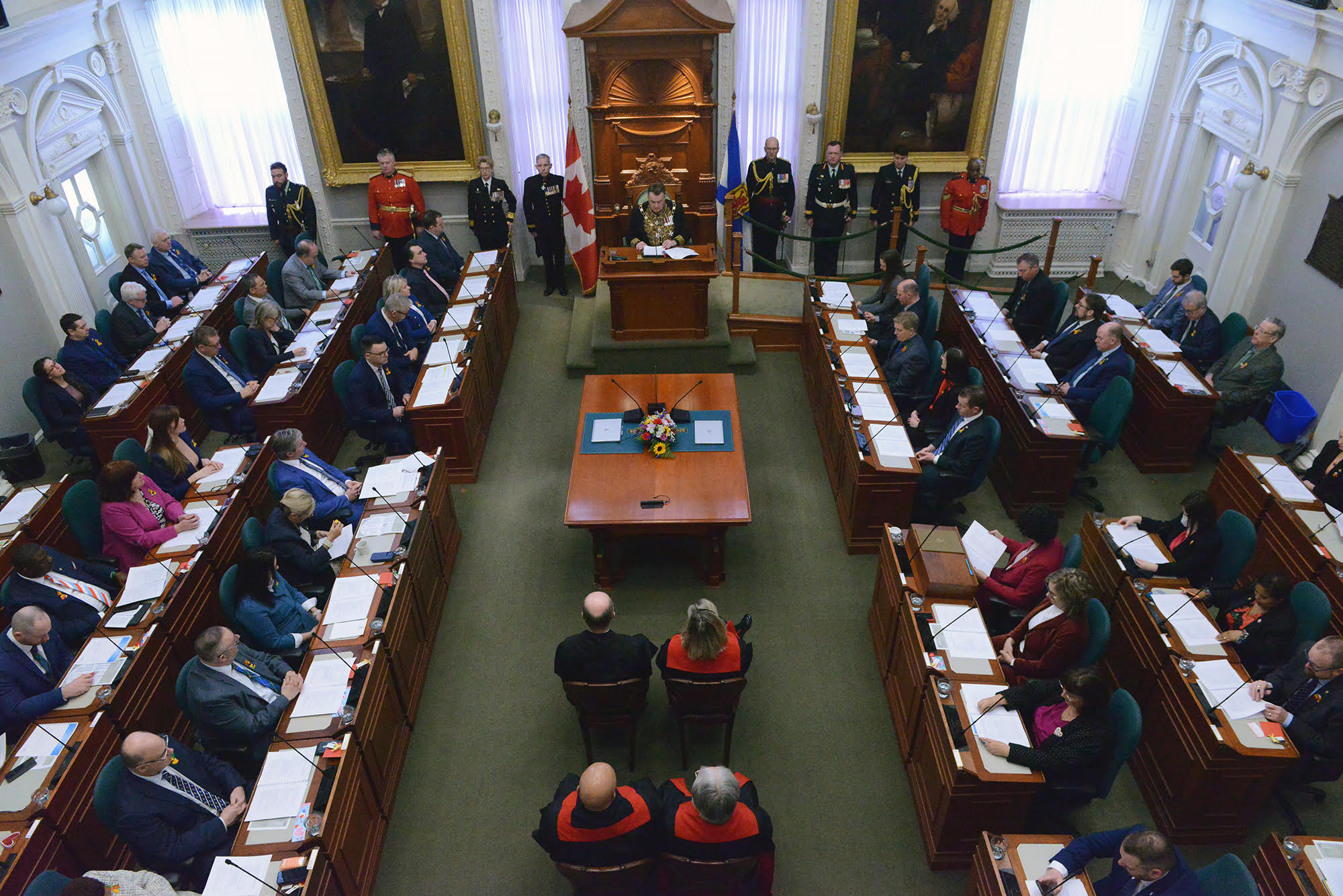
Tim Houston, Premier of Nova Scotia and leader of the Progressive Conservative Party, decided on 27 October 2024 to advise the Lieutenant Governor to dissolve the legislature for a snap election 7 months early instead of allowing the general election to take place on 15 July 2025 based on the legislation that he himself had introduced in 2021. His gambit paid off. Houston’s Progressive Conservatives won 43 out of 55 seats in the election held on 26 November 2024 on 52.49% of the popular vote, compared to 31 seats on 38.55% of the vote on 17 August 2021.
In my previous post on this subject, I predicted that Houston would introduce legislation to change the schedule of fixed-date elections from the ridiculous Third Tuesday in July every four years as of 2025 to a date every fourth early June, like in Ontario. But Houston has exceeded my expectations and instead tabled a bill on 18 February 2025 to repeal Nova Scotia’s fixed-date elections law outright! Nova Scotia became the last province or territory to enact one of these futile and redundant laws on 5 November 2021, and it now seems poised to become the first province to repeal its fixed-date elections as well.
Bill 1, An Act Respecting Government Organization and Administration quietly buried the provision in one line in section 11 and says simply: “Section 29A of Chapter 5 of the Acts of 2011, the Elections Act, is repealed.”[1] Houston’s ministry commands the support of an overwhelming majority of the House of Assembly, which will therefore surely pass this bill in the current sitting.
This bill would therefore repeal the following:
Fixed election date
29A (1) Nothing in this Section affects the powers of the Lieutenant Governor, including the power to dissolve the House of Assembly at the discretion of the Lieutenant Governor.
(2) Subject to subsections (3) and (4), and the powers of the Lieutenant Governor referred to in subsection (1), notwithstanding any other enactment, each general election must be held on the third Tuesday in July, in the fourth calendar year following election day for the most recent general election.
(3) Where the Chief Electoral Officer is of the opinion that a Tuesday that would otherwise be election day is not suitable for that purpose, including by reason of it being in conflict with a day of cultural or religious significance or a federal or municipal election, the Chief Electoral Officer shall choose another day in accordance with subsection (4) and recommend to the Governor in Council that election day be that other day, and the Governor in Council may make an order to that effect.
(4) For the purpose of subsection (3), the Chief Electoral Officer may, notwithstanding clause 29(b), choose as an alternative ordinary election day one of the seven days following the Tuesday that would otherwise be election day.
(5) In the case of a general election under subsection (2), an order may not be made under subsection (3) within seventy days preceding the Tuesday that would otherwise be election day.[2]
Nova Scotia’s fixed-date elections law from November 2021 scheduled elections for the third Tuesday every fourth July starting in 2025 – which Houston’s snap election in November 2024 pre-empted. Consequently, if Nova Scotia kept its law, then the province would hold its next general election no later than 18 July 2029, which would have forced the 65th General Assembly to last longer than four years. But repealing a fixed-date elections law simply allows section 4(1) of the Constitution Act, 1982 to reassert itself as the baseline of federal and provincial law; Nova Scotia would have to hold its next provincial general election by 26 November 2029.[3]
Section 4(1) of the Constitution Act, 1982 sets the maximum life of a House of Commons and legislative assembly at five years, which means that Parliament and the legislatures can decrease their maximum lives through normal statute – as the fixed-date elections laws have done – but also means that that only a constitutional amendment (under the General Amending Procedure, in this case) could increase their maximum lives beyond five years.
All the other provinces, Yukon, and Ottawa should follow Nova Scotia’s lead because Canada’s fixed-date election laws are not and never were fit for purpose. I deliberately said that Ottawa and all the provinces should repeal their fixed-date election laws, because the three territories can, in fact, abolish or severely restrict the executive authority to dissolve the legislature because the territorial Commissions do not fall under section 41(a). The Commissioners of Yukon, Northwest Territories, and Nunavut perform the same functions as the provincial Lieutenant Governors, but they remain creatures of the federal statutes which established the three territories and not to the Constitution of Canada. However, since Yukon replicates precisely the same system of Responsible Government as the provinces in which the Premier can advise the Commissioner to dissolve the legislature at will, this territory might as well repeal its fixed-date elections as well. In contrast, Northwest Territories and Nunavut especially could keep their fixed-date election laws because they operate on Consensus Government, and de facto individual ministerial constructive non-confidence, and confirmation voting. The Premiers therefore always remain in office after an election and do not resign until after the new legislative assembly meets and votes that the Commissioner appoint someone else as Premier instead. Fixed-date election laws actually work very well under this system.
The federal and provincial laws were supposed to stabilise the lifecycle of parliaments and legislatures at four years and reacted against specific instances of long and short majority parliaments in the 1990s, namely Mulroney’s and Campbell’s long parliament that lasted a few days short of five years in 1993, and Chretien’s short parliaments which he allowed to live only about three and a half years in 1997 and 2000. But these laws deliberately do not and cannot fetter the constitutionally entrenched authority of the Governor General and Lieutenant Governors to dissolve parliament and the legislatures, respectively, on ministerial advice because section 41(a) of the Constitution Act, 1982 protects the “offices” of the Governor General and the Lieutenant Governors and therefore the authorities that they exercise, including the summoning, prorogation, and dissolution of parliament and the legislatures.
Consequently, these laws merely reduced the maximum life of a parliament or legislatures from five years to somewhere between four and five years in an annoyingly roundabout way without imposing a maximum life of four years on a parliament or legislature. Parliament and the legislatures should simply have enacted laws which directly lowered their maximum lives to four years in wording mimicking section 4(1) of the Constitution Act, 1982, that parliament or a legislature can live “four years after the date fixed for the return of the writs of a general election and no longer.” Incidentally, none of the fixed-date election laws ever guaranteed, if allowed to operate without further intervention, general elections every four years because they schedule elections on x day in every fourth y month. For instance, the 41st Parliament went from 23 May 2011 to 2 August 2015 instead of mid-May 2015.
Under these futile fixed-date election laws, the Prime Minister or Premier can still advise and obtain early dissolutions at will, in either a minority or a majority parliament, without first having lost the confidence of the House of Commons or assembly. And precisely this scenario has happened between September 2008 and January 2025 fifteen times, eight under minority legislatures and seven under majority legislatures. Prince Edward Island has made the strongest mockery of its law which schedules elections the first Monday every fourth October starting in 2011 by hosting early elections with alarming periodicity three times, in May 2015, April 2019, and April 2023. So far, two federal Prime Ministers and Premiers of every province except Saskatchewan and New Brunswick have called snap elections notwithstanding these laws. Furthermore, the legislatures of Manitoba, Saskatchewan, Prince Edward Island, Newfoundland and Labrador, and British Columbia have at various points voted to extend their own lives by amending their fixed-date election laws, though only Manitoba’s and Saskatchewan’s ended up lasting four and half years instead of four (from 2011 to 2016) because the Premiers of Prince Edward Island and British Columbia called snap elections in May 2015 and October 2020, respectively. In other words, elections occur on fixed schedules until either the legislature or the Premier says otherwise.
We should repeal these daft laws and simply revert back to the old standard of section 4(1) of the Constitution Act, 1982. Nova Scotia will soon set the operative precedent that other jurisdictions should follow.
Similar Posts:
- Tim Houston’s Snap Election in Nova Scotia (November 2024)
- Fixed-Date Election Laws and Voter Turnout (November 2023)
- Prince Edward Island Holds Third Consecutive Early Election in Defiance of Its Fixed-Date Elections Law (March 2023)
- Nova Scotia Enacts Canada’s Last Fixed-Date Election Law (January 2022)
- Yukon’s Fixed-Date Elections Law (January 2022)
- Why Justin Trudeau’s Snap Election in 2021 Does Not Break the Fixed-Date Elections Law (August 2021)
- Wade MacLauchlan Has Become the First Premier to Ignore a Fixed-Date Election Law Twice (April 2019)
- Politicos No Longer Give Fixed-Date Election Laws a Second Thought (September 2018)
- When Snap Elections Are Good and Just (August 2018)
- Pauline Marois Copies Stephen Harper: The Futility of Fixed-Date Election Laws (March 2014)
- Will Wynne Pull a Harper? Fixed-Date Elections and Dissolution in Ontario (September 2013)
- Premier Wynne Adopts Prime Minister Harper’s Tactics on Early Dissolution. Will The Media Vilify Her Accordingly? (September 2013)
- Fixed Elections in the Provinces, Part I (August 2011)
- Fixed Elections in the Provinces, Part II (August 2011)
- Fixed Elections in the Provinces, Part III: Analysis and Conclusions (August 2011)
- Stephen Harper Did Not “Break His Own Law” in 2008 (August 2011)
Notes
[1] Nova Scotia, Bill No. 1, 65th General Assembly, 1st Session, 3 Charles III, 2025, at section 11.
[2] Elections Act (Nova Scotia), chapter 5 of the acts of 2011, s.29.
[3] Nova Scotia, Royal Gazette, Part II, Volume 48, no. 23, 15 November 2024, Nova Scotia Regulation 237/2024, “Proclamation, Dissolution of General Assembly and fixing of dates of Writs of Election and ordinary polling day,” at pages 679-680. Nova Scotia’s Election Act doesn’t include a provision specifying the “date of the return of writs”, so I can only presume that polling day serves this function given that section 229(1) speaks of “the day fixed for return of writ of election for a by-election or the writs of election for a general election.”

 James Bowden's Blog